
USCIS AOS Memo: Navigating Employment-Based Green Cards in 2026
Understand the USCIS AOS Memo and its impact on employment-based green cards under the current administration. Learn how to navigate the process with Imigrar, your Orlando immigration experts.
Navigating the complexities of U.S. immigration law can be challenging, especially with ongoing policy updates and shifts in administrative focus. For foreign nationals seeking permanent residency through employment, and for the employers who sponsor them, staying informed is paramount. Recently, a renewed emphasis on certain aspects of the Adjustment of Status (AOS) process, particularly concerning job portability, has become a significant talking point. This guide from Imigrar, your trusted immigration law firm in Orlando, aims to demystify these developments and provide clear, actionable advice.
Need Help? Our Orlando immigration team is ready to assist. Call +1 786-791-3106 for a free consultation, or message us online. Se Habla Español.
The reporting that sparked this guide
USCIS AOS Memo: What Employers and Employees Should Know (Boundless Immigration)
What This News Means for Immigrants in Orlando and Across Florida
The discussions surrounding the USCIS Adjustment of Status (AOS) memo, and its implications for employment-based green card applicants, are not just theoretical legal points; they have very real, tangible consequences for individuals and businesses across Florida, particularly in dynamic economic hubs like Orlando.
Why this news is showing up now
While the core principles of Adjustment of Status and job portability under the American Competitiveness in the Twenty-First Century Act (AC21) have been law for years, the current administration, led by President Donald Trump, has consistently demonstrated a commitment to strengthening immigration enforcement and ensuring the integrity of the immigration system. This has translated into a renewed focus on existing policies, often leading to stricter interpretations and increased scrutiny during the application process. The "news" today isn't necessarily about a brand new memo but rather a heightened emphasis by the current U.S. Citizenship and Immigration Services (USCIS) on adhering to the guidelines outlined in previous memos, such as the William R. Yates memo from 2005 and subsequent clarifications, especially regarding the "same or similar occupational classification" for job portability. This renewed focus aims to prevent fraud and ensure that immigrants are genuinely pursuing the employment for which they were sponsored. For those with long-pending Form I-485 applications, this means a more rigorous review of their current employment situation and future job prospects.
How it can affect Florida residents
Florida is a state built on diversity and a thriving economy, with sectors like tourism, tech, healthcare, and agriculture heavily reliant on skilled foreign national employees. For Central Florida residents, particularly those in Orlando and Orange County, this renewed scrutiny directly impacts their journey to permanent residency. Employers in the I-4 corridor who sponsor foreign workers for green cards must now be more diligent than ever in documenting job offers and understanding their obligations throughout the AOS process. Similarly, foreign national employees who have filed their Form I-485 and whose applications have been pending for 180 days or more, must exercise extreme caution if considering a job change. The Orlando USCIS Field Office, like others nationwide, is applying these principles with increased rigor, leading to more Requests for Evidence (RFEs) and potentially longer processing times. Understanding these nuances is critical to avoiding delays or, worse, denial of a green card application. Imigrar is deeply familiar with the local landscape and the challenges faced by our community.
What the USCIS AOS Memo Is (and Why It Matters)
The USCIS Adjustment of Status (AOS) memo, often referred to in discussions about employment-based immigration, refers to a series of policy guidance documents issued by USCIS, most notably the William R. Yates memo from 2005. This memo, and subsequent clarifications, provides crucial guidance on how USCIS adjudicators should handle certain aspects of employment-based Adjustment of Status applications, particularly concerning job changes and the "portability" provisions of the American Competitiveness in the Twenty-First Century Act (AC21).
A plain-English definition
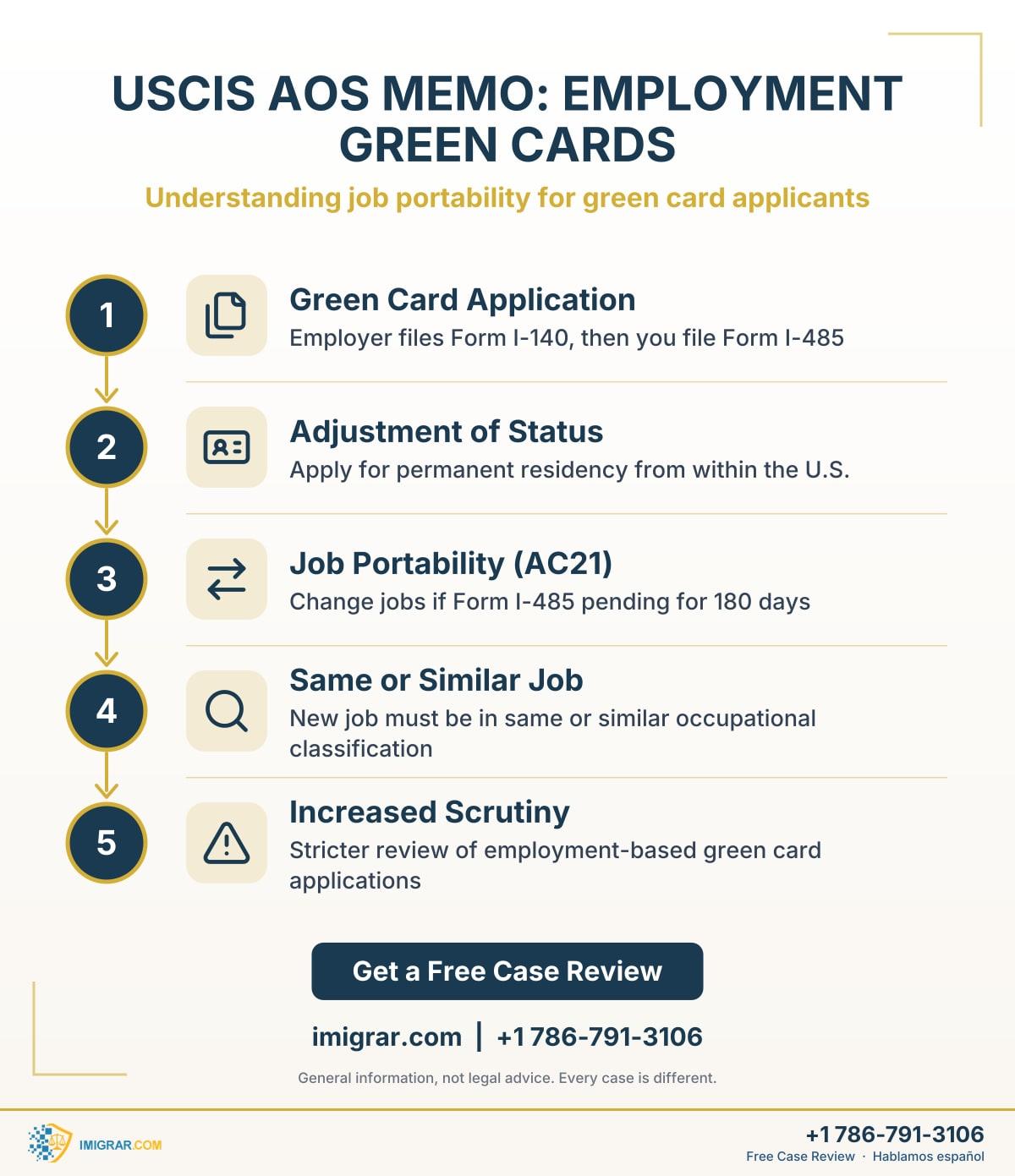
In simple terms, when you apply for a green card through your employer, you typically go through a two-step process: first, your employer files a petition for you (usually Form I-140, Immigrant Petition for Alien Worker), and second, you file your own application to adjust your status to a permanent resident (Form I-485, Application to Register Permanent Residence or Adjust Status). The memo primarily addresses what happens if you want or need to change jobs *after* your employer has filed Form I-140 on your behalf, and your Form I-485 has been pending for at least 180 days. It clarifies the conditions under which you can "port" (transfer) your green card application to a new employer or a new position with the same employer, without having to start the entire green card process over again. The reason this matters so much is that employment-based green card processing can take many years, and during that time, people's careers and life circumstances often change. The memo provides a framework for how USCIS evaluates whether a new job is "same or similar" to the original job offer, which is the key to successful portability. The current administration's stance has led to a more stringent interpretation of these guidelines, making it essential for both employees and employers to understand every detail.
Key terms you need to know
To fully grasp the implications of the USCIS AOS memo, it's essential to understand the following key terms:
- Adjustment of Status (AOS): This is the process that allows eligible foreign nationals already in the United States to apply for lawful permanent resident status (a green card) without having to return to their home country to complete visa processing. It is primarily done by filing Form I-485.
- Concurrent Filing: In certain situations where a green card visa number is immediately available, an applicant can file Form I-140 and Form I-485 at the same time. The memo reinforces the requirement for a bona fide job offer at the time of concurrent filing and throughout the process.
- Form I-140, Immigrant Petition for Alien Worker: This is the initial petition filed by an employer on behalf of a foreign national worker, establishing their eligibility for an employment-based immigrant visa category (e.g., EB-1, EB-2, EB-3).
- Form I-485, Application to Register Permanent Residence or Adjust Status: This is the application filed by the foreign national to adjust their status to a lawful permanent resident, typically after an Form I-140 has been approved or concurrently filed.
- Priority Date: This is the date USCIS receives your immigrant petition (usually Form I-140 or PERM Labor Certification filing date). It establishes your place in the green card queue and determines when a visa number becomes available to you according to the U.S. Department of State's Visa Bulletin.
- Portability (AC21): This refers to Section 204(j) of the American Competitiveness in the Twenty-First Century Act (AC21). It allows a foreign national whose Form I-485 application has been pending for 180 days or more to change employers or jobs without invalidating their underlying Form I-140, provided the new job is in the "same or similar occupational classification." This is a critical provision for many applicants, and the memo focuses heavily on its interpretation.
- Same or Similar Occupational Classification: This is the central concept of AC21 portability. The memo clarifies how USCIS determines if a new job is sufficiently similar to the original job offer. This involves comparing job duties, skills, experience, education, wages, and the Standard Occupational Classification (SOC) codes. The current administration emphasizes a strict, holistic review to ensure the integrity of the original petition.
- Bona Fide Job Offer: USCIS requires that the employer has a genuine intent to employ the foreign national permanently upon green card approval, and the foreign national has a genuine intent to accept and perform the job. The memo highlights that this intent must be present at the time of filing and remain throughout the adjudication process, especially if job changes occur.
- Employer-Employee Relationship: This is a key factor in employment-based petitions. USCIS scrutinizes whether a legitimate employer-employee relationship exists, especially in cases involving staffing agencies or self-employment scenarios, to ensure the sponsoring entity can genuinely offer and sustain the position.
- EAD (Employment Authorization Document): Also known as a work permit, this document allows foreign nationals with a pending Form I-485 to work legally in the U.S. while their green card application is processed. It is typically applied for using Form I-765.
- AP (Advance Parole): This document allows foreign nationals with a pending Form I-485 to travel internationally and re-enter the U.S. without abandoning their AOS application. It is applied for using Form I-131.
Understanding these terms is the first step in successfully navigating the employment-based green card process under the current policy climate. The nuances of the AOS memo, particularly concerning job portability, are designed to ensure that the employment-based immigration system is used as intended, for genuine job offers and long-term employment.
Current Immigration Law: The Foundation
The USCIS AOS memo operates within the existing framework of the Immigration and Nationality Act (INA), which is the bedrock of U.S. immigration law. While the memo provides interpretive guidance, it does not create new law; rather, it clarifies how existing statutes should be applied by adjudicators, especially under the current administration's heightened scrutiny.
Federal requirements
The primary legal basis for Adjustment of Status is Section 245(a) of the INA (8 U.S.C. § 1255(a)). This section broadly allows certain foreign nationals to adjust their status to lawful permanent resident if they were inspected and admitted or paroled into the United States, are eligible for an immigrant visa, and a visa is immediately available to them at the time of filing the Form I-485. For employment-based categories (EB-1, EB-2, EB-3), eligibility hinges on an approved (or concurrently filed) Form I-140, Immigrant Petition for Alien Worker. The employer must demonstrate the ability to pay the proffered wage, and the foreign national must meet the qualifications for the position. The federal requirements also include:
- Lawful Entry: Generally, applicants must have been inspected and admitted or paroled into the U.S.
- Maintenance of Status: Applicants must have maintained lawful nonimmigrant status, or be exempt from this requirement (e.g., immediate relatives, certain employment-based applicants who have not been out of status for more than 180 days).
- Admissibility: Applicants must not be inadmissible to the U.S. on any grounds (e.g., health, criminal history, security, public charge). The current administration has significantly expanded the application of the public charge rule, although recent court decisions have limited its reach, it remains a point of scrutiny for some.
- Visa Availability: A visa number must be immediately available for the applicant's preference category and country of chargeability, as indicated by the Department of State's Visa Bulletin.
The AC21 provisions, specifically INA Section 204(j) (8 U.S.C. § 1154(j)), provide the legal foundation for job portability. This section allows the validity of an approved Form I-140 petition to be retained even if the foreign national changes jobs, provided their Form I-485 has been pending for 180 days or more, and the new job is in the "same or similar occupational classification." The USCIS AOS memo clarifies how adjudicators should interpret "same or similar" and the overall intent of the employer and employee under this provision. The current administration emphasizes the need for a sustained, bona fide job offer throughout the process, even with portability. It's crucial that all documentation supporting the job offer and its continuity is robust and clearly demonstrates compliance with these federal requirements.
For more detailed information on forms and policies, always refer to the USCIS official website.
Florida-specific considerations
While immigration law is federal, its application often involves local USCIS field offices and regional considerations. In Florida, particularly for Central Florida residents, the Orlando USCIS Field Office plays a crucial role in the interview and adjudication process for many Adjustment of Status applications. While the federal requirements remain uniform, the local office's specific caseload, processing priorities, and the individual adjudicating officer can influence the experience. Florida's diverse economy, from the booming tech sector in Orlando to the agricultural industry across the state, means that many employers rely on the employment-based green card system. This makes understanding the nuances of the AOS memo particularly vital for businesses and employees in the state. For example, if your case is in Orlando, understanding local processing times and potential interview backlogs is important. An experienced immigration attorney familiar with the Orlando Field Office can provide invaluable insights.
Important: Always ensure that any documents submitted to USCIS are consistent with state records, especially regarding names, dates, and addresses. Discrepancies can lead to Requests for Evidence (RFEs) and delays.
How to Navigate the AOS Process Under the New Memo: A Complete Step-by-Step Guide
Navigating the employment-based Adjustment of Status (AOS) process requires meticulous attention to detail and a thorough understanding of current USCIS policies, especially in light of the renewed scrutiny emphasized by the AOS memo. This step-by-step guide will help you understand the journey, with a particular focus on the memo's impact.
1) Understanding the Employer's Role and Initial Petition (Form I-140)
The journey to an employment-based green card typically begins with your sponsoring employer. This initial phase sets the foundation for your entire application. Under the current administration, the legitimacy and permanence of the job offer are scrutinized from the very beginning.
- PERM Labor Certification (if required): For most EB-2 (excluding NIW) and EB-3 categories, the employer must first obtain a certified PERM Labor Certification from the Department of Labor. This process demonstrates that there are no qualified U.S. workers available and willing to fill the position. This step establishes your Priority Date.
- Filing Form I-140, Immigrant Petition for Alien Worker: Once PERM is certified (or if PERM is not required, as with EB-1 or NIW), the employer files Form I-140 with USCIS on your behalf. This petition establishes your eligibility for a specific employment-based immigrant visa category.
- Demonstrating Ability to Pay: The employer must prove they have the financial ability to pay the proffered wage from the Priority Date until you obtain permanent residency. This is a crucial point that USCIS often scrutinizes.
Required Documents for Form I-140 (Employer-provided):
- Certified PERM Labor Certification (ETA Form 9089), if applicable.
- Job offer letter detailing the position, duties, and salary.
- Company financial statements, tax returns, or annual reports to prove ability to pay.
- Evidence of the foreign national's qualifications (e.g., academic degrees, transcripts, professional licenses, experience letters).
- Company organizational charts, business licenses, and other corporate documents.
2) Concurrent Filing and Priority Date Management
After the Form I-140 is filed, the next step depends on the availability of a visa number for your category and country of chargeability. This is where your Priority Date becomes critical.
- Checking the Visa Bulletin: You must regularly check the U.S. Department of State's Visa Bulletin to see if your Priority Date is "current" (meaning a visa number is immediately available).
- Concurrent Filing: If your Priority Date is current when the Form I-140 is filed, you may be able to file your Form I-485 concurrently with the Form I-140. This can significantly expedite the process, as you can also apply for an EAD and Advance Parole. The memo implies that the bona fide job offer must be truly active and intended at the moment of concurrent filing.
- Waiting for Priority Date to Become Current: If concurrent filing is not possible, you must wait for your Form I-140 to be approved and for your Priority Date to become current before you can file your Form I-485.
Required Documents/Actions for Priority Date Management:
- Regular review of the monthly Visa Bulletin.
- Receipt or approval notice for Form I-140.
- Communication with your employer and attorney regarding visa availability.
3) Filing Your Adjustment of Status Application (Form I-485)
This is the personal application for your green card. It is a comprehensive package that requires extensive documentation. Under the current administration, the completeness and accuracy of this package are more critical than ever.
- Form I-485, Application to Register Permanent Residence or Adjust Status: This is the core application form.
- Form I-765, Application for Employment Authorization: Filed concurrently with Form I-485 to obtain an EAD, allowing you to work legally while your green card is pending.
- Form I-131, Application for Travel Document: Filed concurrently to obtain Advance Parole, allowing you to travel internationally and re-enter the U.S. without abandoning your Form I-485.
- Form I-693, Report of Medical Examination and Vaccination Record: Must be completed by a USCIS-approved civil surgeon. This form has a limited validity period, so coordinate with your attorney on when to obtain it.
- Form I-864, Affidavit of Support (if applicable): While primarily for family-based cases, it can sometimes be required in employment-based cases if there's a family sponsor involved or other specific circumstances. Generally, for employment-based, the employer's ability to pay is key.
Required Documents for Form I-485 Package (Applicant-provided):
- Two passport-style photos.
- Copy of government-issued photo identification (e.g., passport biographic page).
- Copy of birth certificate (with certified English translation if not in English).
- Copy of all previous visas, I-94 arrival/departure records, and entry stamps.
- Copies of all previous USCIS notices (e.g., I-797 approval notices for previous nonimmigrant visas).
- Copy of marriage certificate (if applicable, for derivative applicants).
- Copies of children's birth certificates (if applicable, for derivative applicants).
- Certified copies of police and court records (if any arrests or convictions).
- Form I-693 in a sealed envelope from the civil surgeon.
- Proof of your current lawful status (e.g., latest I-797 approval notice for H-1B, L-1, etc.).
- Copy of Form I-140 approval notice or receipt notice (if not concurrently filed).
Reminder: For Central Florida residents, ensure all documents are properly organized and submitted to the correct USCIS lockbox facility as per the USCIS Direct Filing Addresses.
4) Biometrics, Interviews, and USCIS Review
After filing, USCIS will process your application, which includes several key steps:
- Biometrics Appointment: You will receive an appointment notice for biometrics (fingerprints, photos, signature) at a local Application Support Center (ASC). This is used for background checks.
- Interview Scheduling: For most employment-based AOS applications, an interview at a USCIS field office (e.g., the Orlando USCIS Field Office) is now required. The memo's principles will be heavily scrutinized during this interview, especially regarding the bona fide nature of the job offer and, if applicable, any job changes.
- Responding to RFEs: USCIS may issue a Request for Evidence (RFE) if they need more information or clarification. Prompt and thorough responses are crucial.
Required Documents for Interview (Bring originals and copies):
- Interview appointment notice.
- Your passport and all travel documents.
- Your EAD and Advance Parole documents (if approved).
- Originals of all documents submitted with your Form I-485 package (birth certificates, marriage certificates, previous visa notices, etc.).
- Original Form I-693 (if not already submitted or if it expired).
- Latest pay stubs and employment verification letters from your current employer.
- Evidence of your bona fide job offer (for original employer or new employer if portability was used).
5) Navigating Job Changes (Portability under AC21)
This is arguably the most critical area addressed by the USCIS AOS memo. If your Form I-485 has been pending for 180 days or more, you may be able to change jobs under AC21 portability without invalidating your green card application.
- 180-Day Rule: Your Form I-485 must have been pending for at least 180 days since its receipt date.
- "Same or Similar Occupational Classification": The new job's duties, responsibilities, skills, education, experience, and salary must be substantially similar to the original job described in your Form I-140. The memo emphasizes a holistic, case-by-case review. USCIS will use resources like the Department of Labor's SOC codes but is not limited to them. A significant change in job duties or a substantial decrease in salary could be problematic.
- Employer Notification: While not strictly required to file a new Form I-140, you (or your new employer) should notify USCIS of the job change, usually through a new job offer letter and a letter explaining the similarity, often submitted in response to an RFE or during an interview.
- Bona Fide Job Offer with New Employer: The new employer must also genuinely intend to employ you permanently.
Required Documents for AC21 Portability (if applicable):
- New job offer letter detailing position, duties, salary, and start date.
- Letter from the new employer confirming the job offer and explaining how the position is "same or similar" to the original Form I-140 job.
- Old job description and new job description for comparison.
- Letters of experience from previous employers (if relevant to demonstrating skills for the new role).
- Pay stubs and W-2s from your current employment.
Warning: Navigating AC21 portability is complex, and the current administration's interpretation is strict. Always consult with an experienced immigration attorney before making any job changes while your Form I-485 is pending.
6) Final Decision and Green Card Issuance
The culmination of your journey is the final decision from USCIS.
- Approval: If your application is approved, you will receive a welcome notice and your physical green card will be mailed to you.
- Denial: A denial can occur for various reasons, including failure to meet eligibility, misinterpretation of the memo's requirements, or issues during the interview. If denied, immediate legal action is crucial to explore options such as appeals or motions to reopen/reconsider.
Timeline Expectations: USCIS processing times can vary significantly based on the service center, field office (e.g., Orlando USCIS Field Office), and your specific visa category and country of chargeability. You can check estimated processing times on the USCIS Processing Times website. Be prepared for the process to take months to several years.
Practical Steps You Can Take Today
Given the current immigration landscape and the renewed focus on the USCIS AOS memo, proactive preparation is your best defense. Here are practical steps you can take right now to strengthen your employment-based green card application:
Actionable Checklist:
- Consult an Experienced Immigration Attorney: This is the most crucial step. An attorney from Imigrar can assess your specific situation, explain how the AOS memo applies to you, and guide you through every step. This is especially vital for those considering job changes under AC21.
- Gather All Personal Documents: Start collecting original birth certificates, marriage certificates, passports, previous visa stamps, I-94 records, and any other relevant personal identification documents. Ensure all foreign documents are accompanied by certified English translations.
- Understand Your Priority Date: Know your Priority Date and regularly check the Visa Bulletin to monitor visa availability for your category and country.
- Maintain Lawful Status: Always ensure you are maintaining your underlying nonimmigrant status (e.g., H-1B, L-1) until your Form I-485 is approved or your EAD is valid. Do not let your status lapse.
- Communicate with Your Employer: Maintain open communication with your sponsoring employer. Ensure they understand their obligations and are prepared to provide necessary documentation throughout the process, including letters confirming employment and job duties.
- Keep Meticulous Records: Create a comprehensive file with copies of every document submitted to or received from USCIS, including all forms, receipt notices, approval notices, RFEs, and correspondence. Keep pay stubs, W-2s, and employment verification letters up-to-date.
- Be Truthful and Consistent: All information provided to USCIS must be accurate and consistent across all applications and interviews. Discrepancies can lead to significant problems.
- Prepare for Interview Scrutiny: Understand that interviews are now more common for employment-based AOS. Be prepared to discuss your job duties, the employer-employee relationship, and your intent to work for the sponsoring employer.
Document Preparation Guidance:
- Organization is Key: Arrange all documents logically, perhaps by category (e.g., personal identification, employment history, USCIS filings). Use dividers or tabs.
- Translations: Any document not in English must be accompanied by a complete and accurate English translation, along with a certification by the translator that they are competent to translate and that the translation is accurate.
- Copies vs. Originals: Always send copies unless USCIS specifically requests originals. Bring originals to any interview.
- Proofread Everything: Before submission, meticulously proofread all forms and supporting documents for any errors or inconsistencies.
Timeline Expectations:
The Adjustment of Status process, especially for employment-based categories, can be lengthy. While USCIS aims for efficiency, various factors can affect processing times:
- Visa Bulletin Backlogs: For certain countries (e.g., India, China) and categories, visa backlogs can mean waiting years for a Priority Date to become current.
- USCIS Processing Times: These fluctuate based on caseloads at different service centers and field offices. Check the USCIS Processing Times page for the most current estimates.
- Requests for Evidence (RFEs): Responding to an RFE adds time to the process.
- Interview Scheduling: Scheduling interviews at the Orlando USCIS Field Office or other locations can take several months.
It is not uncommon for the entire process, from PERM to green card in hand, to take anywhere from 2 to 10+ years, depending on your country of origin and visa category. Patience and persistent legal guidance are essential.
Considering a Job Change? Don't risk your green card. The rules are complex. Call Imigrar at +1 786-791-3106 for expert advice on AC21 portability. Se Habla Español.
How Imigrar Helps Immigrants in Orlando
At Imigrar, we understand that the journey to a green card is one of the most significant undertakings in an immigrant's life. The recent discussions surrounding the USCIS AOS memo, coupled with the current administration's approach to immigration, add layers of complexity that can be daunting for both foreign national employees and their sponsoring employers. Our firm, conveniently located in Orlando, Florida, is dedicated to providing professional, accurate, and compassionate legal representation to clients nationwide.
Our experienced team specializes in employment-based immigration, including the intricate details of Adjustment of Status and AC21 portability. We have a deep understanding of the current administration's policies and how they are interpreted by USCIS adjudicators, including those at the Orlando USCIS Field Office. We pride ourselves on staying ahead of policy changes, ensuring that our advice is always current and strategically sound. Our expertise allows us to:
- Provide Strategic Guidance: We help you understand the specific requirements for your employment-based category and develop a robust strategy for your Form I-140 and Form I-485 applications.
- Navigate Complex Memos: We break down complex policy memos, like the AOS memo, into understandable terms, explaining how they impact your case, especially concerning job changes and "same or similar" occupational classifications.
- Prepare Flawless Applications: We meticulously prepare all necessary forms and supporting documentation, ensuring accuracy and completeness to minimize RFEs and delays.
- Represent You at Interviews: Our attorneys can prepare you for your green card interview and, in many cases, attend with you at the Orlando USCIS Field Office or other locations, providing crucial support and advocacy.
- Address Challenges: Should you face an RFE, Notice of Intent to Deny (NOID), or even a denial, we are equipped to respond effectively, protecting your interests and exploring all available legal avenues.
- Advocate for Families: Our tagline, "Keep Families Together," reflects our core mission. We understand that employment-based immigration often involves spouses and children, and we ensure their applications are handled with the same care and expertise.
We offer a free consultation to discuss your specific immigration needs. Don't navigate these complex waters alone. Our team is ready to provide the guidance and support you need to achieve your immigration goals. Se Habla Español.
Frequently Asked Questions
Q: Who is primarily affected by this USCIS AOS memo?
A: This memo primarily affects foreign national employees who are sponsored by U.S. employers for an employment-based green card, and whose Form I-485, Application to Register Permanent Residence or Adjust Status, has been pending for 180 days or more. It also significantly impacts their sponsoring employers. The memo clarifies how USCIS adjudicators should evaluate job changes for these individuals under the AC21 portability provisions. Under the current administration, the scrutiny applied to these cases is heightened, making it critical for both parties to understand the memo's implications.
Q: What does "same or similar occupational classification" mean under the memo for portability?
A: The "same or similar occupational classification" is the cornerstone of AC21 portability. Under the guidance of the AOS memo and the current administration's strict interpretation, USCIS will conduct a holistic review to determine if your new job's duties, responsibilities, required skills, education, experience, and even salary are substantially comparable to those of the original job offer that formed the basis of your Form I-140. This means not just a similar job title, but a deep similarity in the actual work performed. USCIS may look at Standard Occupational Classification (SOC) codes, but they are not the sole factor. Any significant deviation could lead to an RFE or denial, so careful analysis with an attorney is essential before making a job change.
Q: How does this memo impact concurrent filing of Form I-140 and Form I-485?
A: The AOS memo does not prohibit concurrent filing of Form I-140 and Form I-485 when visa numbers are available. However, it strongly reinforces the requirement that a legitimate, bona fide job offer must exist and be intended at the time of filing the Form I-140 and throughout the entire adjudication process. Under the current administration, USCIS is more rigorously assessing whether the employer genuinely intends to employ the foreign national permanently upon green card approval. This means that even with concurrent filing, the employer-employee relationship and the validity of the job offer will be scrutinized, potentially leading to more RFEs regarding the ongoing nature of the employment.
Q: What should employers do in light of this memo and the current administration's policies?
A: Employers sponsoring foreign national employees for green cards should take several proactive steps. First, ensure that all job offers are genuinely bona fide and that there is a clear intent to employ the foreign national upon green card approval. Second, maintain meticulous records of the employee's work history, job duties, and wages. Third, be prepared to respond to potential Requests for Evidence (RFEs) from USCIS, especially if an employee's Form I-485 has been pending for an extended period or if they have exercised AC21 portability. Finally, consult with an experienced immigration law firm like Imigrar to understand their ongoing obligations and ensure compliance with the evolving interpretations of current immigration policies. This proactive approach can help mitigate risks and streamline the process.
Q: Can I travel internationally while my Form I-485 is pending, especially with the new memo?
A: Yes, generally, if you have an approved Advance Parole (AP) document (Form I-131), you can travel internationally while your Form I-485 is pending. The AOS memo primarily focuses on job portability and the bona fide job offer, not international travel. However, it is always imperative to consult with an experienced immigration attorney before any international travel. Certain situations, such as having accrued unlawful presence in the past, or specific criminal history, could still make re-entry problematic even with Advance Parole. Your attorney can assess your individual circumstances and advise you on the safest course of action, particularly for Central Florida residents who may have ties abroad.
Q: What happens if my employment-based Adjustment of Status application is denied?
A: A denial of an employment-based Adjustment of Status application can have severe consequences, potentially leading to the loss of your lawful immigration status and even initiating removal (deportation) proceedings. The specific options available after a denial depend entirely on the reason for the denial. You might have the option to file a motion to reopen or a motion to reconsider with USCIS, or in some cases, an appeal to the Administrative Appeals Office (AAO). In other situations, re-filing the application might be possible, but only if you still maintain an underlying lawful status and eligibility. It is absolutely crucial to seek immediate legal counsel from an experienced immigration law firm like Imigrar. Our team can quickly assess the denial notice, understand the underlying issues, and strategize the best path forward to protect your rights and your future in the U.S.
Q: What are the typical costs associated with filing an employment-based Green Card application, considering the memo's implications?
A: The costs for an employment-based Green Card application can be substantial and typically include various USCIS filing fees, as well as attorney fees. USCIS fees currently include separate charges for Form I-140, Form I-485, Form I-765 (EAD), Form I-131 (Advance Parole), and Form I-693 (medical examination). These fees can easily total several thousand dollars per applicant, and often more if derivative family members are also applying. Additionally, there are costs associated with the PERM Labor Certification process (if applicable), which are typically borne by the employer. Attorney fees for legal representation vary based on the complexity of the case, the specific services required, and the law firm's expertise. While the memo itself doesn't directly add fees, the increased scrutiny and potential for RFEs under the current administration mean that expert legal guidance is more valuable than ever, making legal fees a critical investment. Always confirm current USCIS fees on the USCIS Forms website.
Worried about your Green Card application? Don't guess. Get expert legal help from Imigrar. Call +1 786-791-3106 today for a free consultation. Se Habla Español.
Common Mistakes (and How to Avoid Them)
The complexities of immigration law, exacerbated by memos and shifting administrative priorities, often lead to common pitfalls for applicants and employers. Avoiding these mistakes is crucial for a successful employment-based Adjustment of Status process.
Mistake #1: Misinterpreting "Same or Similar" for Portability
Description: Many foreign nationals, whose Form I-485 has been pending for 180 days or more, assume that any job with a similar title or in the same industry will qualify for AC21 portability. The USCIS AOS memo, particularly under the current administration's strict interpretation, clarifies that "same or similar" is a much narrower definition. It requires a detailed comparison of job duties, responsibilities, skills, education, experience, and even salary. A new job that seems similar on the surface might be deemed substantially different by USCIS, invalidating the underlying Form I-140.
How to Avoid: Never assume. Before making any job change, consult with an experienced immigration attorney. Provide them with detailed job descriptions for both your original sponsored position and the prospective new position. Your attorney can conduct a thorough analysis, often comparing SOC codes and other industry standards, to determine if the new role genuinely qualifies as "same or similar." If there's any doubt, it's safer to remain with the sponsoring employer or explore alternative immigration pathways.
Mistake #2: Assuming Automatic Approval of Job Changes Without Proper Notification
Description: Even if a new job legitimately falls under the "same or similar" classification, some applicants fail to properly notify USCIS of the change. While there isn't a specific form to "port" the application, failing to provide USCIS with evidence of the new employment can lead to RFEs, delays, or even denial. USCIS needs to verify that the new employment meets the AC21 requirements and that a bona fide job offer still exists.
How to Avoid: If you change jobs after your Form I-485 has been pending for 180 days, proactively work with your attorney to prepare a detailed notification to USCIS. This typically includes a letter from the new employer confirming the job offer, a description of the new duties, and a letter from your attorney explaining how the new position meets the "same or similar" criteria. This package should be submitted to USCIS or be ready to present if an RFE is issued or during your interview at the Orlando USCIS Field Office.
Mistake #3: Neglecting to Maintain Lawful Status While Form I-485 is Pending
Description: Once Form I-485 is filed, some applicants mistakenly believe they no longer need to maintain their underlying nonimmigrant status (e.g., H-1B, L-1). While the filing of Form I-485 provides a "period of authorized stay," it does not automatically extend your nonimmigrant visa status. If your nonimmigrant status expires and your EAD has not yet been approved or issued, you could fall out of status, jeopardizing your AOS application.
How to Avoid: Always keep track of the expiration date of your nonimmigrant visa status (e.g., on your I-94 record). If your EAD is not approved before your nonimmigrant status expires, you must file to extend your nonimmigrant status (e.g., H-1B extension) if you wish to continue working or remain lawfully present. Consult your attorney to ensure continuous lawful status and employment authorization throughout the green card process.
Mistake #4: Incomplete or Inaccurate Documentation Leading to RFEs and Delays
Description: The Adjustment of Status process requires a vast amount of documentation, and even minor errors, omissions, or inconsistencies can trigger a Request for Evidence (RFE). Under the current administration, RFEs are more common and often more detailed, demanding extensive proof. Failing to provide comprehensive and accurate documentation upfront inevitably leads to significant delays and added stress.
How to Avoid: Be meticulous. Work closely with your immigration attorney to ensure every required form is correctly filled out, every question is answered truthfully, and every piece of supporting documentation is included. Double-check all dates, names, and addresses for consistency across all documents. For Central Florida residents, ensure local addresses and contacts are accurate. Ensure all foreign documents are properly translated and certified. A complete and well-organized application package is far more likely to be processed smoothly.
Mistake #5: Failing to Consult Legal Counsel Early and Throughout the Process
Description: Attempting to navigate the employment-based green card process, especially with the nuances introduced by policy memos and current administrative scrutiny, without expert legal guidance is a significant risk. Many individuals rely on outdated information, online forums, or advice from well-meaning but unqualified sources, leading to critical errors that can result in denials or even deportation proceedings.
How to Avoid: Engage an experienced immigration attorney from the very beginning of your green card journey. An attorney from Imigrar can provide personalized advice, anticipate potential issues, interpret complex regulations like the AOS memo, and ensure that your application is robust and compliant. From the initial Form I-140 filing to the final green card interview at the Orlando USCIS Field Office, continuous legal guidance is an invaluable investment in your future.
Don't make a costly mistake! Protect your immigration future with expert legal guidance from Imigrar. Call +1 786-791-3106 for a free consultation. Se Habla Español.
The USCIS Adjustment of Status (AOS) memo, particularly its implications for job portability and the rigorous application by the current administration, underscores the need for careful planning and expert legal guidance in employment-based green card cases. For immigrants in Orlando, across Florida, and nationwide, understanding these policies is not just about compliance; it's about securing your future and keeping your family together.
At Imigrar, we are committed to providing comprehensive, up-to-date legal assistance. Our team understands the local nuances, from the Orlando USCIS Field Office procedures to the specific needs of Florida's diverse workforce. We are here to help you navigate every step of this intricate process with confidence and clarity.
Don't let policy changes or complex regulations derail your dreams. Take control of your immigration journey today.
Ready to secure your future in the U.S.? Contact Imigrar, your trusted Orlando immigration law firm. Call us now at +1 786-791-3106 for a free, confidential consultation. Se Habla Español. Let us help you keep your family together.
Related Topics
Need Legal Assistance?
Our experienced immigration attorneys are here to help with your case. Contact Imigrar today for a free consultation and let us guide you through the legal process with confidence.
📍 Orlando, Florida • Serving clients nationwide
📧 info@imigrar.com