
International Students Thrive: Navigating Trump's U.S. Visa Policies
Despite current U.S. immigration policies, international student enrollment in California remains strong. Discover what this means for Florida-bound students and how Imigrar can help you achieve your academic dreams.
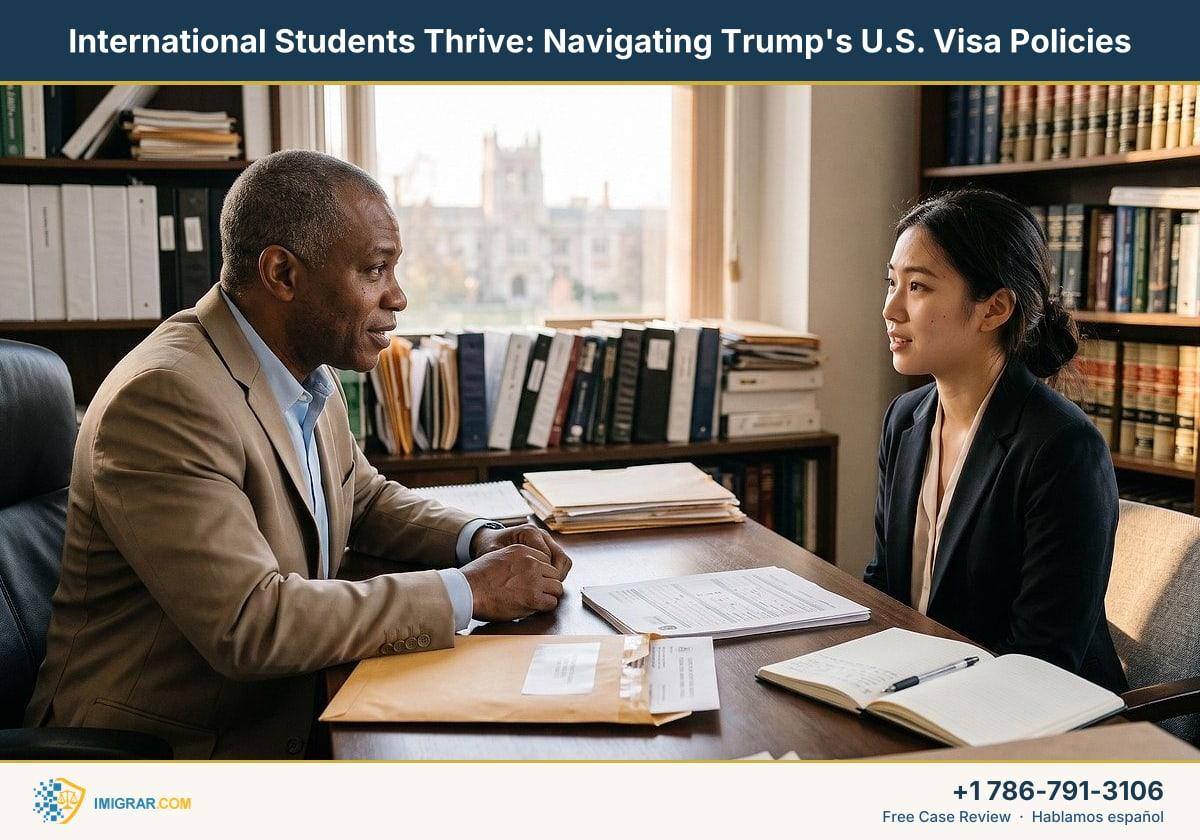
For aspiring international students, the dream of pursuing higher education in the United States remains a powerful draw. Despite evolving immigration landscapes and heightened scrutiny, the U.S. continues to be a top destination for global talent. Recent reports indicate that even with current federal policies, international student enrollment at leading institutions is holding strong, particularly in states like California. This resilience sends a clear message: with the right preparation and legal guidance, your academic aspirations in the U.S. are well within reach.
Considering studying in the U.S.? Imigrar is here to help you navigate the F-1 visa process. Our experienced legal team in Orlando serves clients nationwide, ensuring you understand every requirement. Call +1 786-791-3106 for a free consultation, or message us online. Se Habla Español.
The reporting that sparked this guide
The insights driving this comprehensive guide stem from a recent report by EdSource, highlighting the continued robust presence of international students in California universities:
What This News Means for Immigrants in Orlando and Across Florida
The EdSource report offers a significant perspective for prospective international students and their families, especially those considering academic opportunities in Florida. While federal immigration policies apply nationwide, the experiences of specific states can provide valuable insights into broader trends and potential local impacts.
Why this news is showing up now
This news is particularly relevant now in late 2026, nearly two years into President Trump's second term. His administration's focus on "America First" and stricter immigration enforcement has been a consistent theme, leading to ongoing discussions and adjustments in various visa categories, including those for international students. The EdSource report emerges as universities complete their admissions cycles and enrollment figures become clear, providing a real-time assessment of how these federal policies are influencing student decisions and institutional strategies. It speaks to the resilience of the U.S. higher education system and the enduring appeal of American universities, even under a more restrictive policy environment. It also reflects a period where institutions have adapted to new regulations and students have become more informed about navigating the application and visa processes under current conditions.
How it can affect Florida residents
While the report focuses on California, its implications for Florida are substantial. Florida is a major destination for international students, boasting a strong public university system including the University of Central Florida (UCF) in Orlando, the University of Florida, Florida State University, and numerous private institutions like Rollins College, also in Central Florida. These universities attract thousands of students from around the globe annually, contributing significantly to the state's economy, cultural diversity, and intellectual capital.
- Continued Appeal of Florida Education: The California trend suggests that despite the Trump administration's current visa policies, the overall value and quality of a U.S. education remain undiminished for many international students. This bodes well for Florida institutions, indicating that they can continue to attract top talent.
- Economic Impact: International students contribute billions of dollars to the U.S. economy through tuition, living expenses, and related spending. For Central Florida residents, this translates into local job creation, support for businesses along the I-4 corridor, and a vibrant local economy in cities like Orlando and Gainesville.
- Cultural Enrichment: A diverse student body enriches the educational experience for all students, fostering global understanding and cross-cultural exchange. For residents of Orange County and surrounding areas, this means a more cosmopolitan community with diverse perspectives.
- Heightened Scrutiny, Not Deterrence: The report implies that while there might be increased scrutiny or procedural complexities (which we will detail), these are not insurmountable barriers. Instead, they emphasize the need for meticulous preparation, clear demonstration of non-immigrant intent, and strong legal guidance—factors that Imigrar specializes in providing.
- Local Adaptations: Florida universities, like their California counterparts, have likely adapted their international student support services to help students navigate current federal policies more effectively. This includes advising on visa applications, maintaining status, and understanding post-graduation options like Optional Practical Training (OPT) and STEM OPT.
For those in Orlando and across Florida considering an F-1 student visa, this news is largely positive. It suggests that the path to studying in the U.S. is still viable and rewarding, provided you approach it with diligence and expert assistance. Imigrar is deeply familiar with the nuances of federal immigration law and how it applies to students pursuing their education in the Sunshine State.
What International Student Visa Policies Are (and Why They Matter)
Understanding the framework governing international students is crucial for anyone aspiring to study in the United States. The F-1 visa is the most common non-immigrant visa for individuals wishing to pursue academic studies in the U.S. It allows foreign nationals to enter the country temporarily to attend a college, university, seminary, conservatory, academic high school, elementary school, or other academic institution, including a language training program.
A plain-English definition
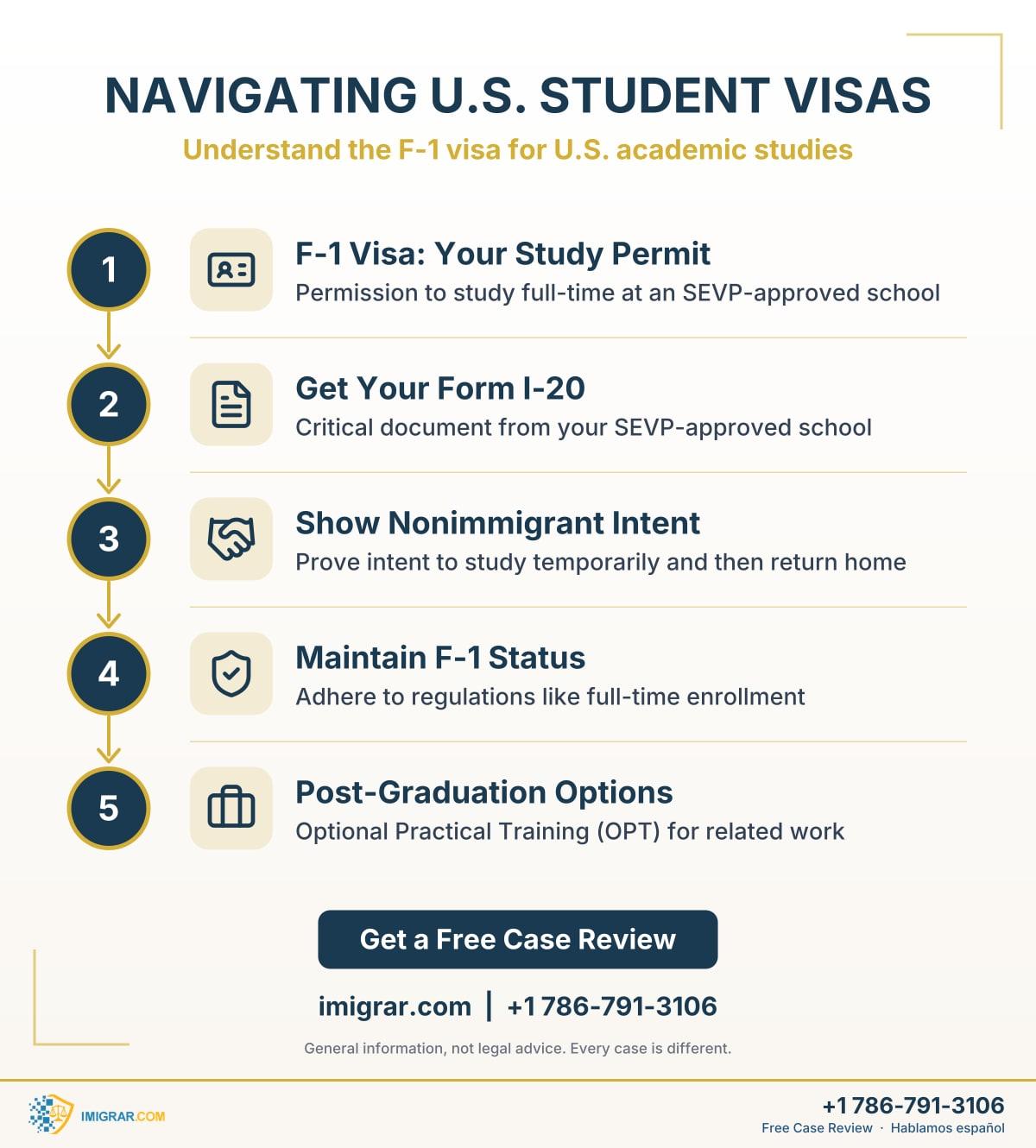
In simple terms, an F-1 visa is your permission slip from the U.S. government to come to America and study. It's for people who want to enroll in a full-time academic program at a school approved by the Student and Exchange Visitor Program (SEVP). This visa is temporary, meaning the government expects you to return to your home country after you complete your studies. The key is demonstrating your genuine intention to study and then leave, rather than trying to immigrate permanently.
Key terms you need to know
Navigating the F-1 visa process involves a specific vocabulary. Here are some essential terms:
- SEVIS (Student and Exchange Visitor Information System): This is a U.S. government database that tracks F-1 students (and J-1 exchange visitors) from the moment they receive their initial documents until they graduate or depart the U.S. All SEVP-approved schools must use SEVIS.
- SEVP (Student and Exchange Visitor Program): A component of U.S. Immigration and Customs Enforcement (ICE) within the Department of Homeland Security (DHS). SEVP manages schools and nonimmigrant students, ensuring compliance with federal regulations. Only schools approved by SEVP can enroll international students.
- Form I-20 (Certificate of Eligibility for Nonimmigrant Student Status): This is the most critical document issued by a SEVP-approved school to a prospective F-1 student. It proves that you have been accepted by the school and that you meet the financial requirements to study and live in the U.S. You need this form to pay the SEVIS fee and apply for your visa.
- DSO (Designated School Official): An authorized school employee responsible for managing international student affairs, including issuing Form I-20, updating SEVIS records, and advising students on immigration regulations. Your DSO is your primary point of contact at your university for all immigration-related matters.
- Nonimmigrant Intent: This is the fundamental principle of the F-1 visa. You must prove to consular officers and immigration officials that your intention is to study temporarily in the U.S. and then return to your home country. This is a common point of scrutiny under the current administration.
- F-1 Status: This refers to your legal immigration status while in the U.S. as an international student. Maintaining your F-1 status means adhering to all visa regulations, such as full-time enrollment, academic progress, and not working without authorization.
- Change of Status (COS): If you are already in the U.S. on a different nonimmigrant visa (e.g., B-1/B-2 visitor), you might be able to apply to change your status to F-1 without leaving the country. This involves filing Form I-539 with USCIS.
- Consular Processing: The standard method for obtaining an F-1 visa, which involves applying at a U.S. embassy or consulate in your home country or country of residence.
- Optional Practical Training (OPT): A period during which F-1 students can work in a field directly related to their major area of study. This can be pre-completion (during studies) or post-completion (after graduation). Post-completion OPT is generally for 12 months.
- STEM OPT Extension: A 24-month extension of post-completion OPT available to F-1 students who have earned a degree in a qualifying Science, Technology, Engineering, or Mathematics (STEM) field from a SEVP-certified U.S. institution.
- Form I-901 (SEVIS Fee Payment): The fee required for all F and M nonimmigrant visa applicants to support the SEVIS system.
- Form DS-160 (Online Nonimmigrant Visa Application): The electronic application form you must complete before your visa interview at a U.S. embassy or consulate.
Understanding these terms is your first step towards a successful international student journey. The Trump administration currently maintains a strong emphasis on vetting and ensuring that all nonimmigrant visa applicants meet strict eligibility criteria, particularly regarding nonimmigrant intent. This necessitates clear and consistent documentation throughout your application process.
Current Immigration Law: The Foundation for International Students
The legal framework for international students primarily falls under the Immigration and Nationality Act (INA), specifically Section 101(a)(15)(F) for academic students. While the core statutes remain stable, the Trump administration has implemented policy changes and increased enforcement measures that impact how these laws are interpreted and applied, particularly concerning F-1 visas and related post-study work options.
Federal requirements
To qualify for an F-1 visa, federal law requires you to meet several key criteria:
- Enrollment in an SEVP-Approved School: You must be accepted by a school that is certified by the Student and Exchange Visitor Program (SEVP).
- Full-Time Enrollment: You must be enrolled in a full course of study at your chosen institution. For undergraduate students, this typically means at least 12 credit hours per semester.
- English Proficiency: You must be proficient in English or be enrolled in courses leading to English proficiency.
- Sufficient Funds: You must demonstrate that you have sufficient funds to cover your tuition, living expenses, and other costs for the entire duration of your stay in the U.S., or that you have access to such funds. This is a critical area of scrutiny for the current administration.
- Nonimmigrant Intent: You must demonstrate to the consular officer that you intend to depart the U.S. upon completion of your studies and do not have immigrant intent. This means proving ties to your home country (family, property, job prospects) and a clear plan after graduation. This is perhaps the most heavily scrutinized aspect under President Trump's policies.
- Maintenance of Status: Once in the U.S., you must maintain your F-1 status by complying with all regulations, including academic progress, not working illegally, and reporting any changes to your DSO.
The Trump administration continues to prioritize national security and the integrity of the visa system. This translates into more rigorous background checks, extended processing times in some cases, and a sharper focus on the "bona fides" of an applicant—meaning the genuine nature of their intent to study and return. While the foundational laws haven't changed, the *application* and *enforcement* have become stricter. For example, there's increased vigilance regarding potential fraud in applications and stricter interpretations of what constitutes "maintaining status."
Florida-specific considerations
While immigration law is federal, its impact is felt locally. Florida does not have its own state-specific F-1 visa laws, as immigration is solely a federal domain. However, Florida's universities and colleges operate within these federal guidelines and often have robust international student services departments to assist with compliance.
- Major Institutions: Institutions like the University of Central Florida (UCF), the University of Florida, Florida International University, and smaller colleges like Rollins College in Winter Park (near Orlando) are all SEVP-approved and attract large international student populations.
- Orlando USCIS Field Office: If you are already in the U.S. and need to file certain applications (such as Form I-539 for Change of Status or Extension of Stay) while residing in Central Florida, your case would be processed by USCIS, and potentially interviewed at the Orlando Field Office located on Tradeport Drive.
- Local Economy: International students are vital to the Central Florida economy, contributing to local businesses, housing, and job markets, especially along the I-4 corridor.
Official Government References:
- For comprehensive information on F-1 visas and student regulations, always refer to the USCIS official website.
- Details on visa processing and interview requirements are available from the U.S. Department of State.
- Specific forms can be found at USCIS Forms.
Important: Staying informed about current policies is crucial. While the core F-1 visa requirements are stable, the Trump administration has shown a willingness to adjust enforcement priorities and interpretations. Consulting with an experienced immigration attorney like Imigrar ensures you have the most up-to-date information.
How to Obtain and Maintain Your F-1 Student Visa: A Complete Step-by-Step Guide
The process of securing an F-1 student visa and successfully maintaining your status in the U.S. requires careful planning and adherence to strict regulations. This guide breaks down the essential steps.
1) Get Accepted by a SEVP-Approved School
Your journey begins with academic acceptance. You must apply to and be accepted by an educational institution that is approved by the Student and Exchange Visitor Program (SEVP).
- Research and Apply: Identify universities or colleges in Florida or nationwide that offer your desired program and are SEVP-approved. Complete their application process, including submitting transcripts, test scores (e.g., TOEFL, IELTS, SAT, GRE), essays, and letters of recommendation.
- Receive Acceptance and Form I-20: Once accepted, the school's Designated School Official (DSO) will issue you a Form I-20, Certificate of Eligibility for Nonimmigrant Student Status. This form is proof of your acceptance, program of study, and estimated costs.
- Required Documents for this step:
- Official acceptance letter from a SEVP-approved school.
- Original Form I-20 issued by your school.
- Proof of financial resources (bank statements, scholarship letters, sponsor affidavits) demonstrating you can cover your first year's expenses as listed on the Form I-20.
- Valid passport.
Need Assistance with Your Student Visa Application? Don't navigate complex forms and requirements alone. Our Orlando immigration team is ready to assist. Call +1 786-791-3106 for a free consultation, or message us online. Se Habla Español.
2) Pay the SEVIS I-901 Fee
After receiving your Form I-20, you must pay the SEVIS I-901 fee. This fee supports the operation of the SEVIS system.
- Online Payment: Pay the fee online via the FMJFee.com website. Ensure your name on the payment matches your name on the Form I-20 exactly.
- Print Your Receipt: Keep the payment confirmation receipt. You will need it for your visa interview.
- Required Documents for this step:
- Your Form I-20 (to get your SEVIS ID number).
- A valid credit card for payment.
- Printed confirmation of your Form I-901 payment.
3) Complete the DS-160 Nonimmigrant Visa Application
The next step is to complete the online Nonimmigrant Visa Application (Form DS-160) through the U.S. Department of State website.
- Fill Out Accurately: Provide accurate and complete information. Any discrepancies can lead to delays or denial.
- Upload Photo: You will need to upload a recent passport-style photograph that meets U.S. government specifications.
- Print Confirmation Page: After submission, print the confirmation page with the barcode. You will need this for your interview.
- Required Documents for this step:
- Valid passport.
- Digital photograph meeting U.S. visa requirements.
- Travel itinerary (if you have one).
- Dates of your last five visits to the U.S. (if applicable).
- Resume/CV (if applicable).
- Letter of invitation from your school (if applicable).
- Form I-20 (for reference during completion).
- Printed DS-160 confirmation page.
4) Schedule and Attend Your Visa Interview
Once you've paid the SEVIS fee and completed the DS-160, you can schedule your F-1 visa interview at a U.S. embassy or consulate in your home country or country of residence.
- Schedule Early: Visa interview wait times can vary significantly, especially under current administration policies, which sometimes lead to increased vetting. Schedule your appointment as early as possible.
- Gather Documents: Collect all required documents (originals and copies) for the interview.
- Prepare for Interview: The interview is crucial. The consular officer will assess your eligibility and, most importantly, your nonimmigrant intent. Be prepared to discuss your academic plans, financial resources, and ties to your home country. Be honest and concise.
- Required Documents for this step (bring originals and copies):
- Valid passport (must be valid for at least six months beyond your intended period of stay).
- Form I-20 (signed by you and your DSO).
- Form DS-160 confirmation page.
- Form I-901 SEVIS fee payment receipt.
- Visa interview appointment confirmation.
- One or more passport-style photographs (if not uploaded successfully with DS-160).
- Proof of financial support (original bank statements, scholarship letters, sponsor affidavits).
- Academic transcripts, diplomas, degrees, or certificates.
- Test scores (TOEFL, IELTS, SAT, GRE, GMAT, etc.).
- Proof of ties to your home country (property deeds, family ties, job offer letters, etc.).
5) Prepare for Your Arrival in the U.S.
If your visa is approved, you will receive your passport back with the F-1 visa stamp. There are specific rules regarding when you can enter the U.S.
- 30-Day Rule: You can enter the U.S. no more than 30 days before the start date listed on your Form I-20.
- Port of Entry: Be prepared to present your passport, F-1 visa, and Form I-20 to the Customs and Border Protection (CBP) officer at your port of entry. They will review your documents and determine your admission.
- Required Documents for this step:
- Valid passport with F-1 visa.
- Original Form I-20.
- Form I-901 SEVIS fee receipt.
- Proof of financial resources (copies).
- School acceptance letter (copy).
- Contact information for your DSO.
6) Maintain Your F-1 Status Throughout Your Studies
Maintaining your F-1 status is paramount. Failure to do so can lead to serious immigration consequences, including deportation and future bars to re-entry.
- Full Course of Study: Enroll and maintain a full course of study each academic term. Exceptions (like reduced course load) must be authorized by your DSO in advance.
- Academic Progress: Make normal academic progress towards completing your degree.
- Valid Passport: Keep your passport valid at all times.
- Report Changes: Inform your DSO immediately of any changes to your address, name, major, funding, or any other significant life event.
- No Unauthorized Employment: Do not work off-campus without explicit authorization (e.g., Curricular Practical Training (CPT) or Optional Practical Training (OPT)). Unauthorized employment is a severe violation.
- Travel Endorsement: If you travel outside the U.S. and plan to re-enter, ensure your Form I-20 is endorsed for travel by your DSO.
- Required Documents for this step (for your records and DSO):
- Current Form I-20.
- Valid passport.
- Academic transcripts and records.
- Any employment authorization documents (EAD) for CPT/OPT.
7) Understand Post-Graduation Options (OPT/STEM OPT)
After completing your studies, you may be eligible for practical training opportunities.
- Optional Practical Training (OPT): F-1 students can apply for 12 months of post-completion OPT to work in a field directly related to their major. You must apply for an Employment Authorization Document (EAD) by filing Form I-765 with USCIS.
- STEM OPT Extension: Students with a qualifying STEM degree can apply for a 24-month extension of OPT, totaling 36 months. This requires an E-Verify employer and a training plan (Form I-983).
- Timelines are Critical: There are strict application windows for OPT and STEM OPT. Missing these deadlines can result in loss of eligibility. For OPT, you typically apply up to 90 days before your program end date and no later than 60 days after.
- Required Documents for this step:
- Updated Form I-20 endorsed for OPT/STEM OPT by your DSO.
- Form I-765, Application for Employment Authorization.
- Passport photos.
- Copy of your passport and F-1 visa.
- Copies of previous EADs (if applicable).
- Official transcripts.
- For STEM OPT: Form I-983 (Training Plan), employer E-Verify information.
Reminder: The Trump administration has maintained a strong focus on ensuring that OPT and STEM OPT programs are used as intended for training and do not displace American workers. Adherence to all rules, including employment in a field directly related to your major, is closely monitored.
Practical Steps You Can Take Today
Preparing for your international student journey requires proactive steps. Here's an actionable checklist to help you get started:
- Research Thoroughly: Identify SEVP-approved schools and programs that align with your academic and career goals. Consider universities in Central Florida like UCF or Rollins College.
- Gather Financial Documentation: Start collecting bank statements, scholarship letters, and affidavits of support from sponsors. Ensure these documents clearly demonstrate your ability to cover tuition and living expenses for at least your first year, as listed on the Form I-20. This is a critical area of scrutiny.
- Prepare for the Visa Interview: Practice answering questions about your academic plans, why you chose the U.S. and your specific school, your financial resources, and most importantly, your clear intention to return to your home country after graduation. Emphasize strong ties to your home country.
- Understand Trump Administration Policies: While the core F-1 visa requirements remain, be aware that the current administration emphasizes strict vetting, non-immigrant intent, and national security. This means applications may face increased scrutiny, and it's vital to present a clear, consistent, and honest case.
- Consult an Immigration Attorney: Before submitting any application, schedule a consultation with an experienced immigration lawyer. Imigrar can provide personalized advice, review your documents, and help you anticipate potential challenges.
- Plan Your Post-Graduation Path: Even before you arrive, have a general idea of your post-graduation intentions. While you can't have immigrant intent, understanding options like OPT/STEM OPT can help you articulate your career goals during your interview and ensure you meet eligibility if you pursue them later.
Document Preparation Guidance
- Originals and Copies: Always bring original documents to your interview and keep copies for your records.
- Translations: If any documents are not in English, ensure they are accompanied by certified English translations.
- Organization: Organize your documents neatly in a binder or folder, making it easy to present them during your interview.
- Consistency: Ensure all information across your passport, Form I-20, DS-160, and financial documents is consistent and accurate.
Timeline Expectations
- School Applications: Varies by institution, often 6-12 months before the program start date.
- Form I-20 Issuance: After acceptance and financial verification, typically a few weeks.
- SEVIS I-901 Fee Payment: Can be done anytime after receiving Form I-20.
- DS-160 Completion: Online, can take several hours to complete accurately.
- Visa Interview Scheduling: Wait times vary significantly by country and consulate. Check the U.S. Department of State website for current estimates. Plan to schedule several months in advance of your program start date.
- Visa Processing: Usually a few days to a few weeks after the interview, but can be longer if administrative processing is required.
- OPT/STEM OPT Application: Strict windows, typically 90 days before program end up to 60 days after for OPT, and specific windows for STEM OPT extension. USCIS processing times for Form I-765 can be found on the USCIS Processing Times page.
Warning: The Trump administration's policy of "extreme vetting" means that some applications may face extended administrative processing, particularly for students from certain countries or those studying sensitive fields. Factor this potential delay into your timeline.
How Imigrar Helps International Students in Orlando and Beyond
At Imigrar, we understand that pursuing an education in the U.S. is a life-changing decision. Our mission, "Keep Families Together," extends to helping students build their futures and potentially create new family ties in the U.S. We provide dedicated legal support to international students navigating the complex U.S. immigration system, especially under the current administration's policies.
Our experience and expertise
Our team of experienced immigration attorneys specializes in F-1 visas, status maintenance, and post-graduation opportunities. We stay rigorously updated on all federal immigration policies, including those introduced or emphasized by the Trump administration. We can assist you with:
- F-1 Visa Application Guidance: From reviewing your Form I-20 and DS-160 to preparing you for your visa interview, we ensure your application is accurate, complete, and effectively demonstrates your nonimmigrant intent.
- Change of Status (COS): If you are already in the U.S. on a different visa and wish to change to F-1 status, we can guide you through the Form I-539 application process.
- Maintaining F-1 Status: We advise on how to comply with all F-1 regulations, including full-time enrollment requirements, travel, and permissible employment, helping you avoid accidental violations.
- Optional Practical Training (OPT) & STEM OPT: We assist with the complex application process for Form I-765 for OPT and STEM OPT extensions, ensuring you meet all eligibility criteria and deadlines.
- Responding to RFEs: If USCIS issues a Request for Evidence (RFE) or Notice of Intent to Deny (NOID), we can help you prepare a comprehensive and timely response.
- Addressing Policy Changes: We provide up-to-date advice on how current administration policies, such as increased scrutiny or potential changes to visa validity, might affect your specific case.
Whether you're applying from abroad or managing your status while studying at the University of Central Florida, Rollins College, or any other institution, our Orlando-based firm serves clients nationwide. We are committed to providing personalized, compassionate, and effective legal representation.
Free consultation offer
Don't let the complexities of immigration law deter your academic dreams. We offer a free initial consultation to discuss your specific situation, answer your questions, and outline a clear path forward. This is your opportunity to gain clarity and confidence.
Se Habla Español. Our bilingual team is here to serve both English and Spanish-speaking clients, ensuring clear communication and understanding throughout your legal journey.
Ready to start your U.S. academic journey with confidence? Contact Imigrar today. Call +1 786-791-3106 for your free consultation, or message us online. Our Orlando immigration lawyers are here to help. Se Habla Español.
Frequently Asked Questions About International Student Visas
Q: Am I eligible for an F-1 visa if I have family members who are U.S. citizens or permanent residents?
A: Yes, having family members in the U.S. does not automatically disqualify you. However, it can lead to increased scrutiny regarding your nonimmigrant intent. The consular officer will want to be convinced that despite your family ties, your primary purpose is temporary study and you genuinely intend to return to your home country upon completion. You must present strong evidence of ties to your home country (property, job offers, other family, etc.) to counteract any perception of immigrant intent. An attorney can help you prepare for this line of questioning.
Q: How does getting an F-1 visa affect my future immigration status, like applying for a Green Card?
A: An F-1 visa is a nonimmigrant visa, meaning it is for temporary stay. While you are on an F-1 visa, you are generally expected to maintain nonimmigrant intent. However, U.S. immigration law allows for "dual intent" in certain circumstances (like H-1B visas), and it is possible to transition from F-1 status to another visa category (e.g., H-1B after OPT) that could eventually lead to a Green Card. This is a complex process and requires careful planning and often a change in your nonimmigrant intent. It's crucial to consult with an immigration attorney to understand the implications for your long-term goals.
Q: What is the typical timeline for getting an F-1 visa and how has it changed under the Trump administration?
A: The timeline can vary greatly. After school acceptance and receiving your Form I-20, paying the SEVIS fee and completing the DS-160 are relatively quick. The longest variable is often the visa interview appointment wait time at the U.S. embassy or consulate, which can range from a few days to several months depending on the location and time of year. Under the Trump administration, there has been an emphasis on "extreme vetting," which can sometimes lead to longer processing times for security checks (administrative processing) after the interview, especially for students from certain countries or in specific fields of study. It is advisable to apply as early as possible, ideally 3-6 months before your program start date.
Q: What financial documents are absolutely required, and what if I don't have enough funds myself?
A: You must provide official bank statements showing liquid assets sufficient to cover at least your first year's tuition and living expenses as stated on your Form I-20. If you don't have sufficient personal funds, you can use a sponsor (e.g., parents, relatives, government, organization). In this case, you will need a signed affidavit of support from your sponsor, along with their official bank statements or other proof of funds. Scholarship letters from your university also count. The key is clear, verifiable proof of funds for your entire period of study. Consular officers under the current administration are particularly vigilant about the authenticity and sufficiency of financial documents.
Q: What are the total costs involved in applying for an F-1 visa, including legal fees?
A: The primary government fees include the SEVIS I-901 fee (currently $350) and the DS-160 application fee (currently $185). These fees are subject to change. Beyond government fees, you must also consider application fees for universities, standardized test fees (TOEFL, SAT, etc.), travel expenses for your interview, and the cost of tuition and living expenses once you arrive. If you choose to hire an immigration attorney like Imigrar, our legal fees will be discussed transparently during your free consultation. While an attorney's fees are an additional cost, they can significantly reduce the risk of denial and save you money and time in the long run by ensuring a correctly prepared application.
Q: What happens if my F-1 visa application is denied, and can I reapply?
A: If your F-1 visa is denied, the consular officer should provide you with a reason for the denial. Common reasons include failure to demonstrate sufficient nonimmigrant intent, insufficient financial resources, or incomplete documentation. In most cases, you can reapply for the visa. However, it is crucial to understand *why* you were denied and address those issues before reapplying. Simply reapplying without rectifying the underlying problems will likely lead to another denial. If you receive a denial, contact Imigrar immediately. We can review your denial letter, assess the reasons, and help you prepare a stronger reapplication, ensuring you address all concerns raised by the consular officer.
Common Mistakes (and How to Avoid Them)
Navigating the F-1 visa process, especially under the current administration's stricter policies, can be challenging. Many applicants make avoidable mistakes that can lead to delays or even denials. Here are some of the most common pitfalls:
Mistake #1: Underestimating the Visa Interview and Nonimmigrant Intent
Many applicants fail to adequately prepare for their visa interview, particularly regarding demonstrating nonimmigrant intent. Consular officers are trained to identify individuals who may have underlying intentions to immigrate permanently rather than return home after their studies. Under President Trump's current policies, this scrutiny is even more intense.
- How to Avoid: Practice answering questions about your academic plans, why you chose the U.S. and your specific school, your financial resources, and your clear plans to return to your home country. Be prepared to discuss strong ties to your home country, such as family responsibilities, property ownership, or job prospects. Avoid giving vague answers or expressing a desire to stay in the U.S. permanently. Honesty and clarity are paramount.
Mistake #2: Failing to Maintain Full-Time Enrollment or Academic Progress
Once in the U.S., some students inadvertently violate their F-1 status by dropping below a full course load without authorization or by failing to make satisfactory academic progress. This can lead to termination of your SEVIS record and loss of your legal status.
- How to Avoid: Always maintain a full course of study as defined by your university. If you face academic difficulties, need to take a reduced course load, or wish to withdraw, communicate immediately with your DSO. They are your primary resource for understanding and maintaining your F-1 status and can authorize exceptions in specific circumstances (e.g., medical reasons, final semester). Never make these decisions without consulting your DSO first.
Mistake #3: Working Without Authorization
Unauthorized employment is one of the most severe violations of F-1 status and can lead to immediate termination of your visa, deportation, and future bars to entry into the U.S. This includes working off-campus without CPT or OPT authorization, or exceeding the allowed hours for on-campus employment.
- How to Avoid: Understand the strict rules around F-1 employment. On-campus employment is generally limited to 20 hours per week during the academic year and full-time during breaks. Off-campus employment requires specific authorization through Curricular Practical Training (CPT) or Optional Practical Training (OPT), both of which must be approved by your DSO and, for OPT, by USCIS (requiring an Employment Authorization Document (EAD)). Never begin working off-campus before receiving your EAD for OPT or proper CPT authorization.
Mistake #4: Not Understanding Trump Administration Policy Nuances
While the fundamental F-1 visa laws are stable, the current administration's emphasis on "Buy American, Hire American," increased vetting, and "America First" policies can lead to stricter interpretations and longer processing times. Many applicants fail to account for these nuances, leading to frustration or unexpected delays.
- How to Avoid: Stay informed about current immigration policies. Regularly check official government websites like USCIS and the Department of State. More importantly, consult with an experienced immigration attorney like Imigrar. We constantly monitor policy changes and can provide tailored advice on how these changes might impact your application, your interview, or your ability to transition to post-study work options like OPT and STEM OPT. Proactive legal guidance is your best defense against unexpected policy hurdles.
Avoiding these common mistakes is crucial for a smooth and successful F-1 visa journey. At Imigrar, we guide our clients through every step, ensuring they are well-prepared and compliant with all regulations.
The journey to study in the United States is an incredible opportunity that requires careful navigation of immigration policies and procedures. While current federal policies demand thorough preparation and a clear understanding of requirements, the EdSource report from California reinforces that the dream of a U.S. education remains vibrant and attainable for international students.
At Imigrar, we are dedicated to helping you achieve your academic goals and build a bright future. Our Orlando-based team provides expert legal guidance to international students across Florida and nationwide, ensuring your application is strong, your status is maintained, and your path is clear.
Don't let immigration complexities stand between you and your U.S. education.
Contact Imigrar today for a free, confidential consultation. Our experienced immigration attorneys are ready to answer your questions and provide the personalized support you need.
Call us at +1 786-791-3106 or message us online.
Se Habla Español. Let us help you keep your dreams together.
Related Topics
Need Legal Assistance?
Our experienced immigration attorneys are here to help with your case. Contact Imigrar today for a free consultation and let us guide you through the legal process with confidence.
📍 Orlando, Florida • Serving clients nationwide
📧 info@imigrar.com