
Supreme Court & Trump's Immigration: What It Means for Your Family
The Supreme Court is reviewing President Trump's immigration agenda. Understand the impact on your family, status, and future with our comprehensive guide.
The landscape of U.S. immigration law is constantly shifting, and few developments have as profound an impact as a review by the Supreme Court. As of today, November 25, 2026, the nation's highest court is poised to delve deeply into the current administration's immigration policies, a move that could redefine the futures of countless individuals and families across the country, including right here in Orlando and throughout Florida. At Imigrar, our mission is to Keep Families Together, and staying informed is the first step toward protecting your loved ones.
This comprehensive guide is designed to cut through the legal jargon and provide you with clear, actionable information about what the Supreme Court's scrutiny of President Trump's immigration agenda means for you. We'll explore the policies in question, how they might affect your immigration journey, and the crucial steps you can take today to safeguard your family's future.
The reporting that sparked this guide:
The Supreme Court is about to take a closer look at Trump’s immigration agenda (CNN)
What This News Means for Immigrants in Orlando and Across Florida
The Supreme Court's decision to take on a closer review of President Trump's immigration agenda is not just a headline; it's a pivotal moment with real-world implications for individuals and families navigating the U.S. immigration system. For our clients in Orlando, Central Florida, and indeed nationwide, understanding this development is crucial.
Why this news is showing up now
President Donald Trump's administration, now in its second term, has pursued a robust and often controversial immigration agenda, characterized by a focus on border security, stricter enforcement, and a re-evaluation of long-standing immigration policies. Many of these policies, from changes to asylum procedures to interpretations of the Public Charge Rule, have faced immediate and sustained legal challenges from civil rights organizations, immigrant advocacy groups, and even state governments. These challenges have worked their way through federal district courts and appellate courts, creating a complex web of injunctions, conflicting rulings, and legal precedents.
The Supreme Court, as the highest judicial body in the United States, is the ultimate arbiter of these legal disputes. It typically hears cases that present significant constitutional questions or involve conflicting interpretations of federal law among lower courts. The sheer volume and constitutional gravity of the legal battles surrounding the Trump administration's immigration policies have made it inevitable that many of these cases would ultimately reach the Supreme Court. Now, with a full docket and a clear mandate to resolve these critical legal questions, the Court is poised to issue definitive rulings that will shape the future of immigration law for years to come.
The timing also reflects the natural progression of the legal system. Cases take time to litigate through various levels of appeal. As President Trump's second term progresses, many of his administration's key immigration initiatives have matured, leading to more settled legal challenges that are now ripe for Supreme Court review. This isn't just about a single policy; it's about the broader framework of executive authority in immigration matters and the balance between enforcement and humanitarian concerns.
How it can affect Florida residents
Florida is home to one of the nation's most diverse and dynamic immigrant populations, with significant communities from Latin America, the Caribbean, and beyond. The decisions handed down by the Supreme Court regarding President Trump's immigration agenda will have a direct and profound impact on many residents here, particularly those in Orlando and the surrounding Central Florida region. Here’s how:
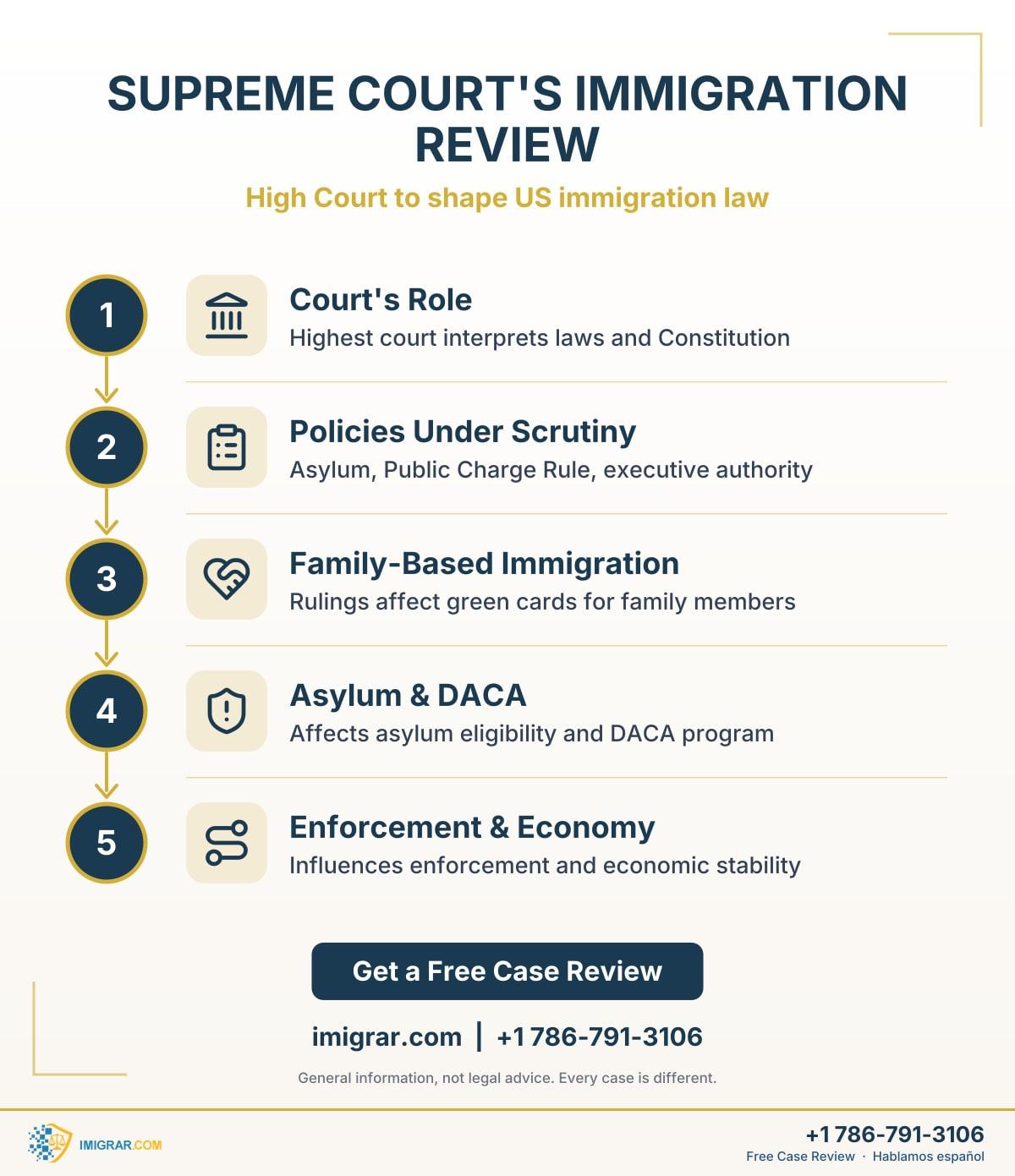
- Family-Based Immigration: Policies like stricter interpretations of the Public Charge Rule, which evaluates an immigrant's likelihood of becoming dependent on government benefits, can directly affect Floridians sponsoring relatives. A Supreme Court ruling could either ease or further restrict the path to green cards for family members. For many, the ability to reunite with loved ones is paramount, embodying Imigrar's core mission to Keep Families Together.
- Asylum Seekers and Refugees: Florida, with its extensive coastline and proximity to the Caribbean, often sees a significant number of asylum seekers. Policies related to eligibility, expedited removal, and safe third-country agreements are central to the Supreme Court's review. Changes could dramatically alter the process for individuals seeking protection from persecution, potentially making it harder or easier to gain asylum in the U.S.
- DACA Recipients: The future of the Deferred Action for Childhood Arrivals (DACA) program has been a persistent legal battleground. Many young Floridians, often referred to as "Dreamers," rely on DACA for work authorization and protection from deportation. A Supreme Court ruling could provide much-needed stability or, conversely, create immense uncertainty for thousands in our state.
- Enforcement and Deportation: Rulings on border enforcement, interior enforcement priorities, and the authority of agencies like ICE (Immigration and Customs Enforcement) could influence how immigration laws are enforced within Florida. This could impact everything from local law enforcement cooperation to the frequency of raids and detentions, affecting immigrant communities in Orange County and along the I-4 corridor.
- Economic Impact: Immigrants are a vital part of Florida's economy, contributing to industries from agriculture and tourism to healthcare and construction. Any broad policy changes resulting from Supreme Court decisions could have ripple effects on the state's workforce and economic stability.
For residents of Orlando, whether you are sponsoring a family member, seeking asylum, or are a DACA recipient, these Supreme Court decisions are not abstract legal concepts. They are critical junctures that will determine your ability to live, work, and thrive in the United States. This is why staying informed and seeking expert legal counsel is more important than ever.
Need Help? Our Orlando immigration team is ready to assist. Call +1 786-791-3106 for a free consultation, or message us online. Se Habla Español.
What the Supreme Court's Review of Trump's Immigration Agenda Is (and Why It Matters)
The concept of the Supreme Court scrutinizing a President's agenda can seem daunting, but at its core, it's a fundamental aspect of American democracy. This section breaks down what this judicial review entails and why its outcomes are so significant for immigrants and their families.
A plain-English definition
In simple terms, the Supreme Court's review of President Trump's immigration agenda means that the highest court in the United States is examining whether the immigration policies and actions taken by the current administration are legal. This involves determining if these policies comply with the existing laws passed by Congress (primarily the Immigration and Nationality Act), align with the U.S. Constitution, and fall within the legal boundaries of presidential authority. It's essentially a check and balance, where the judiciary assesses if the executive branch has overstepped its powers or violated fundamental rights in its approach to immigration.
The Court isn't creating new laws; rather, it is interpreting existing laws and the Constitution in the context of the administration's actions. The cases often involve complex questions about the scope of executive power, the rights of non-citizens, and the procedural fairness of government actions. When the Supreme Court issues a ruling, that decision becomes the law of the land, setting a binding precedent for all lower courts and government agencies, including USCIS, ICE, and CBP (Customs and Border Protection).
Key terms you need to know
Understanding these terms will help you grasp the nuances of the Supreme Court's role and the ongoing legal debates:
- Judicial Review: This is the power of the courts, particularly the Supreme Court, to determine whether laws, executive orders, or government actions violate the U.S. Constitution or are beyond the authority granted by Congress. It's the mechanism through which the Court is examining Trump's policies.
- Executive Order: A directive issued by the President of the United States that manages operations of the federal government. Many of President Trump's immigration policies, such as certain travel restrictions or changes to asylum processing, have been initiated through executive orders or presidential proclamations, which are subject to judicial review.
- Immigration and Nationality Act (INA): This is the foundational body of federal law that governs immigration to the United States. It dictates who can enter, how they can obtain legal status, and the grounds for deportation. All executive actions on immigration must, in theory, comply with the INA.
- Certiorari (Writ of Certiorari): This is a formal request from a lower court or party for the Supreme Court to review a case. The Supreme Court grants "cert" for only a small percentage of cases, typically those involving significant legal questions or conflicts among lower courts. When the CNN article mentions the Supreme Court "taking a closer look," it implies the Court has granted certiorari for several key immigration cases.
- Stare Decisis: A Latin phrase meaning "to stand by things decided." It's the legal principle of adhering to precedents set by previous court decisions. While not absolute, the Supreme Court generally respects its past rulings, which provides stability to the law.
- Asylum: A form of protection granted to foreign nationals who are unable or unwilling to return to their home country due to a well-founded fear of persecution on account of race, religion, nationality, membership in a particular social group, or political opinion. Many of the Trump administration's policies have sought to limit access to asylum or alter its procedures, leading to numerous legal challenges.
- Public Charge Rule: A policy that allows immigration officials to deny green cards or visas to immigrants deemed likely to become "public charges"—primarily dependent on government benefits like food stamps, Medicaid, or housing assistance. The Trump administration significantly expanded the scope of this rule, making it a major point of contention and legal challenge.
- DACA (Deferred Action for Childhood Arrivals): An administrative program providing temporary protection from deportation and work authorization to eligible undocumented immigrants who came to the U.S. as children. The Trump administration has repeatedly sought to terminate DACA, leading to extensive litigation now reaching the Supreme Court.
- Border Enforcement: Refers to the policies and actions taken by the government to control and secure the U.S. borders, including the construction of physical barriers, increased deployment of agents, and expedited removal processes. Many challenges concern the legality and implementation of these enforcement measures.
Understanding these terms is critical as you follow the news and consider how these developments might impact your personal immigration situation. The Supreme Court's deliberations are not merely academic; they are about the fundamental principles of justice, fairness, and the rule of law as applied to human lives.
Need Help? Our Orlando immigration team is ready to assist. Call +1 786-791-3106 for a free consultation, or message us online. Se Habla Español.
Current Immigration Law: The Foundation
Despite the constant flux of executive policies and the ongoing legal battles, the fundamental framework of U.S. immigration law remains the Immigration and Nationality Act (INA). This foundational legislation, established by Congress, outlines the rules for who can enter, stay, and become a citizen of the United States. President Trump's administration's policies, while impactful, generally operate by interpreting, enforcing, or seeking to modify *within the bounds* of this existing federal law, which is precisely why they are subject to judicial review.
Federal requirements
The INA covers all major categories of immigration, including family-based, employment-based, and humanitarian (asylum/refugee) immigration. Here are some core aspects:
- Family-Based Immigration: This category prioritizes the reunification of U.S. citizens and lawful permanent residents (green card holders) with their close family members. Key forms include Form I-130, Petition for Alien Relative, filed by the U.S. citizen or LPR sponsor. Once approved, the beneficiary may apply for a green card through consular processing abroad or Adjustment of Status (using Form I-485) if already in the U.S. The number of visas available each year is limited by country and preference category, creating waiting periods often referred to by a Priority Date. The Trump administration's expanded Public Charge Rule has significantly impacted this category, requiring applicants to demonstrate they will not become a burden on the state, often through the submission of Form I-864, Affidavit of Support, with higher financial thresholds.
- Employment-Based Immigration: This pathway allows foreign nationals with specific skills, education, or investment capital to immigrate to the U.S. It includes various visa categories (e.g., EB-1 for extraordinary ability, EB-2 for professionals with advanced degrees, EB-3 for skilled workers). Many of these require a U.S. employer to sponsor the applicant, often involving a labor certification process.
- Asylum and Refugee Status: The INA provides protection for individuals fleeing persecution. Asylum seekers apply from within the U.S. or at a port of entry (using Form I-589, Application for Asylum and for Withholding of Removal), while refugees apply from outside the U.S. The Trump administration has implemented numerous policies aimed at restricting asylum eligibility, including the "Remain in Mexico" policy (Migrant Protection Protocols), expedited removal procedures, and bans on asylum for individuals who transit through third countries without seeking protection there. These policy changes are central to the Supreme Court's current review.
- Grounds of Inadmissibility and Deportability: The INA also specifies reasons why an individual may be denied entry to the U.S. (inadmissibility, INA § 212(a)) or removed from the U.S. (deportability, INA § 237(a)). These grounds include criminal offenses, health-related issues, immigration violations, and public charge concerns. The Trump administration has pursued more aggressive enforcement of these grounds.
For official information on forms, policies, and procedures, always refer to the USCIS official website.
Florida-specific considerations
While immigration law is federal, its implementation and impact are felt locally. In Florida, the federal requirements interact with unique state dynamics:
- Local Enforcement Cooperation: Florida state and local law enforcement agencies may cooperate with federal immigration authorities like ICE. Policies dictating this cooperation, such as "sanctuary city" bans (though Florida has none designated as such), can influence how federal enforcement actions play out in communities like Orlando, Kissimmee, and other parts of Central Florida.
- Diverse Immigrant Communities: Florida's large Cuban, Venezuelan, Haitian, and Central American populations are particularly sensitive to changes in asylum and refugee policies. For example, specific parole programs or temporary protected status (TPS) designations, though federal, have a disproportionate impact on Floridians due to demographic concentration.
- Orlando USCIS Field Office: For many Central Florida residents, the Orlando USCIS Field Office is where interviews for green cards (Form I-485), naturalization (Form N-400), and other applications take place. Federal policy changes directly affect the procedures, wait times, and adjudication standards at this local office.
- State-Level Support and Services: While access to federal benefits is restricted for many immigrants (especially under the Public Charge Rule), state-level services and educational opportunities can still be crucial. State legislation can impact eligibility for things like in-state tuition or professional licenses for certain immigrant groups, irrespective of federal policy shifts.
Understanding both the federal foundation and Florida's unique context is key to navigating the immigration system, especially during periods of significant legal review by the Supreme Court.
How to Navigate Trump's Immigration Policies Amid Supreme Court Review: A Complete Step-by-Step Guide
The Supreme Court's review injects a layer of uncertainty into an already complex immigration system. For immigrants and their families, proactive preparation and informed decision-making are paramount. This guide outlines the essential steps you should take to protect your immigration future in Orlando and beyond.
1) Understand the Specific Policies Under Review
The first step is to inform yourself about which particular policies are being challenged and how they might relate to your own situation. The Supreme Court's docket often includes cases addressing a range of issues. While Imigrar will keep you updated, some common areas of contention under the Trump administration include:
- Asylum Restrictions: Policies limiting who can apply for asylum, where they can apply, or how their claims are processed.
- Public Charge Rule: The expanded definition of who might become a "public charge" and thus be denied a green card or visa.
- DACA Termination Efforts: Legal challenges to the administration's attempts to end the Deferred Action for Childhood Arrivals program.
- Border Wall Funding and Construction: Disputes over the executive branch's authority to reallocate funds for border barrier construction.
- Travel Bans/Restrictions: Challenges to country-specific restrictions on entry, though many initial bans have evolved or been fully litigated.
Action: Monitor reliable news sources (like the CNN article linked above) and official government announcements. Understand that a Supreme Court ruling on one policy doesn't automatically affect all others. Keep records of any specific communications or denials you've received related to these policies.
2) Assess Your Current Immigration Status and Eligibility
Before you can react to potential changes, you need a clear understanding of your current legal standing. This involves knowing your exact immigration status and the requirements for any applications you have pending or plan to file.
- Know Your Status: Are you a U.S. citizen, a lawful permanent resident (green card holder), on a specific visa (e.g., H-1B, F-1), an asylum applicant, a DACA recipient, or undocumented? Each status comes with different rights and vulnerabilities.
- Review Your Documents: Check expiration dates on your passport, visa, green card, Employment Authorization Document (**EAD**), and **I-94 Arrival/Departure Record**. Ensure all information is accurate.
- Understand Eligibility for Your Application: If you have a pending application (e.g., **Form I-130**, **Form I-485**, **Form N-400**), review its specific eligibility criteria. Consider how a change in policy, such as the Public Charge Rule, might retroactively affect your case or future applications.
Documents to Review: Current passport, visa, green card, **EAD**, **I-94 record**, any **Notice of Action (Form I-797)** from USCIS, previous application receipts.
3) Gather and Organize All Essential Immigration Documents
Being prepared means having all your paperwork in order, regardless of what the Supreme Court decides. This will save you critical time if you need to act quickly on new guidance or if your attorney advises immediate action.
- Personal Identification:
- Birth Certificates (for yourself, spouse, children, and U.S. citizen/LPR petitioner)
- Marriage Certificate(s)
- Divorce Decrees (if applicable)
- Passports (current and expired)
- National Identity Cards
- Immigration Records:
- All previous **USCIS** forms filed (e.g., **Form I-130**, **Form I-485**, **Form I-765**, **Form I-589**, **Form N-400**)
- Approval Notices (**Form I-797**)
- Green Card (front and back)
- **EAD** (front and back)
- Visa stamps in passport
- **I-94 Arrival/Departure Record** (retrieve from CBP website)
- Any court documents from immigration proceedings (Executive Office for Immigration Review)
- Financial Documents:
- Tax Returns (past 3-5 years)
- Employment Letters and Pay Stubs
- Bank Statements
- Proof of Assets (property deeds, investment statements)
- **Form I-864, Affidavit of Support**, and supporting documents from your sponsor
- Other Supporting Documents:
- Medical Exam results (**Form I-693**)
- Police Clearance Certificates from all countries resided in for 6+ months since age 16
- Proof of bona fide relationship (for family petitions: photos, joint bank accounts, shared leases, utility bills, insurance policies)
- Educational degrees, transcripts, professional licenses
Reminder: Make multiple copies of everything. Keep originals in a secure, fireproof location, and have digital backups.
4) Consult with an Experienced Immigration Attorney Immediately
This is arguably the most critical step. The complexities of immigration law, combined with the uncertainty of Supreme Court review, make professional legal guidance indispensable. An attorney can:
- Provide a personalized assessment of how potential rulings might affect your specific case.
- Advise on proactive measures, such as filing certain applications now, gathering specific evidence, or preparing for potential delays or changes.
- Help you understand the nuances of federal and Florida-specific immigration policies.
- Represent you in any interactions with **USCIS**, **ICE**, or the immigration courts.
Action: Schedule a consultation with a reputable immigration law firm like Imigrar. Bring all your organized documents (from step 3) to this meeting. Our Orlando-based team is ready to help.
5) Stay Informed Through Reliable Sources
In the age of misinformation, it's vital to get your immigration news from official and trusted sources. Avoid rumors, social media speculation, or unofficial channels that may provide inaccurate or misleading information.
- Official Government Websites:
- USCIS official website (for forms, policy updates, and processing times)
- U.S. Department of State (for visa bulletins and consular processing information)
- Executive Office for Immigration Review (for immigration court information)
- U.S. Supreme Court website (for official case dockets and opinions)
- Reputable Legal News Outlets: Follow established legal news services that cover Supreme Court decisions accurately.
- Your Attorney: Your immigration lawyer will be your primary source for how Supreme Court rulings directly impact your case.
6) Prepare for Potential Changes and Contingencies
The Supreme Court could rule in favor of the administration, against it, or issue a mixed decision. Each outcome has different implications. Your attorney can help you strategize for various scenarios.
- If a Policy is Upheld: Understand what that means for your eligibility or application process. You may need to meet stricter requirements or face new hurdles.
- If a Policy is Struck Down: This could mean a return to previous policies, potentially reopening opportunities or easing restrictions. Be ready to act quickly if this occurs.
- Financial Preparedness: Immigration processes often involve fees (**USCIS filing fees** can range from hundreds to thousands of dollars), legal costs, and potentially travel expenses. Having financial reserves is always wise.
- Backup Plans: Discuss with your attorney potential alternatives or backup strategies depending on the rulings.
Important: Changes can be implemented with little notice, especially if a previous injunction is lifted. Proactive planning is your best defense.
7) Know Your Rights and Understand Enforcement Actions
In times of heightened enforcement or policy changes, it's crucial to understand your constitutional rights, regardless of your immigration status.
- Right to Remain Silent: You have the right to remain silent when questioned by law enforcement, including immigration officers.
- Right to an Attorney: You have the right to speak with an attorney. Do not sign anything without legal counsel.
- Do Not Open Your Door to ICE Without a Warrant: **ICE** agents typically need a judicial warrant to enter your home.
- Carry "Know Your Rights" Information: Keep a card with your rights and your attorney's contact information readily available.
For Central Florida residents, understanding how local law enforcement might interact with federal immigration agencies is also important. Your attorney can provide specific guidance for your area, including Orlando and Orange County.
Need Help? Our Orlando immigration team is ready to assist. Call +1 786-791-3106 for a free consultation, or message us online. Se Habla Español.
Practical Steps You Can Take Today
While the Supreme Court deliberates, there are immediate, proactive steps you can take to strengthen your immigration position and prepare for any eventuality. These actions can provide peace of mind and ensure you're ready to act when decisions are made.
Actionable Checklist (5+ items)
- Review and Update All Personal Information: Ensure your address, phone number, and email are current with **USCIS** for any pending applications. A change of address (Form AR-11) must be filed within 10 days of moving.
- Create a Comprehensive Document File: Gather all immigration, personal, and financial documents (as detailed in Step 3 of the guide above). Organize them in a secure physical binder and create digital backups.
- Consult an Immigration Attorney: Schedule a consultation with an experienced immigration lawyer to discuss your specific situation and potential impacts of the Supreme Court cases. This is crucial for personalized advice.
- Check USCIS Processing Times: Regularly monitor the USCIS Processing Times website for your specific form and field office (e.g., the Orlando USCIS Field Office). This helps manage expectations, although Supreme Court rulings can cause fluctuations.
- Save for Legal and Application Fees: Immigration processes involve various costs. Having funds set aside for legal fees, application fees (which can be substantial for forms like **Form I-485**), and potential travel expenses is always a smart move.
- Attend "Know Your Rights" Workshops: Seek out reputable community organizations or legal aid groups in Orlando and Central Florida that offer workshops on immigrant rights. Understanding your rights can empower you during interactions with law enforcement.
- Keep a Record of All Communications: Document every interaction you have with **USCIS**, **ICE**, or other immigration authorities, including dates, names, and what was discussed. Keep copies of all correspondence.
Document Preparation Guidance
Effective document management is key to a smooth immigration process. Here’s how to ensure your documents are ready:
- Categorize and Label: Organize documents by type (e.g., "Personal ID," "Immigration Forms," "Financial Records," "Proof of Relationship"). Use clear labels for folders or binder tabs.
- Photocopy Everything: Never submit original documents unless specifically requested by **USCIS** or an immigration judge. Always keep certified copies of originals.
- Digital Backups: Scan all important documents and save them to a secure cloud storage service (e.g., Google Drive, Dropbox) and an external hard drive. Password-protect sensitive files.
- Translation Requirements: If any documents are not in English, you will need a certified English translation. The translator must provide a signed statement affirming their fluency in both languages and the accuracy of the translation.
- Multiple Copies: Have at least two complete sets of your organized documents: one for your records and one to provide to your attorney.
Timeline Expectations
Navigating the immigration system, especially during Supreme Court review, requires patience. Here’s what to expect regarding timelines:
- Supreme Court Decision Timeline: Cases argued before the Supreme Court are typically decided by the end of the Court’s term, usually in late June of the following year. However, complex cases can sometimes be re-argued or take longer. Expect decisions to be released over several months, not all at once.
- Implementation of Rulings: Once a Supreme Court decision is issued, it can take time for government agencies like **USCIS** to issue new guidance, update forms, or change procedures. This could be weeks or even months.
- Application Processing Times: Even without Supreme Court intervention, **USCIS processing times** can be extensive and vary greatly by form, field office (like the Orlando USCIS Field Office), and service center. Policy changes can sometimes cause further delays or, conversely, expedite certain processes if backlogs are cleared. Always check the official USCIS Processing Times page for the most current estimates.
- Legal Case Durations: If your case is directly affected by a Supreme Court ruling and requires further legal action (e.g., reopening a denied case), that process itself will have its own timeline, which your attorney can estimate.
Warning: Do not make critical life decisions based on rumors or speculative timelines. Always consult with your immigration attorney for the most accurate and personalized advice.
How Imigrar Helps Immigrants in Orlando
At Imigrar, we understand that the current immigration climate, compounded by Supreme Court review, can be a source of immense stress and confusion for immigrants and their families in Orlando and across Florida. Our firm is dedicated to providing clarity, compassionate support, and expert legal representation to help you navigate these challenging times, always with our core mission to Keep Families Together at heart.
Our experience and expertise
Our team of experienced immigration attorneys brings a wealth of knowledge and a deep understanding of federal immigration law, including its intricate relationship with executive policies and judicial oversight. We specialize in:
- Family-Based Immigration: From filing **Form I-130, Petition for Alien Relative**, to guiding you through Adjustment of Status (**Form I-485**) or consular processing, we help U.S. citizens and green card holders reunite with their loved ones. We are adept at addressing challenges posed by policies like the Public Charge Rule.
- Asylum and Humanitarian Relief: We represent individuals seeking protection in the U.S., meticulously preparing **Form I-589, Application for Asylum and for Withholding of Removal**, and navigating complex asylum interviews and court proceedings.
- DACA Renewals and Contingency Planning: For our DACA recipients in Central Florida, we assist with renewals and provide crucial advice on potential pathways and contingency plans, understanding the program's precarious legal status.
- Deportation Defense: We vigorously defend individuals facing removal proceedings before the Executive Office for Immigration Review, fighting to protect their right to remain in the U.S.
- Naturalization and Citizenship: We guide eligible permanent residents through the process of becoming U.S. citizens, from **Form N-400, Application for Naturalization**, to the final oath ceremony.
Our attorneys stay abreast of all legal developments, including Supreme Court decisions and their implications for the Orlando USCIS Field Office and immigration courts. We have a proven track record of successful outcomes and are committed to providing personalized attention to each client, recognizing that every immigration journey is unique.
Free consultation offer
We know that taking the first step can be the hardest. That's why Imigrar offers a free, no-obligation consultation to discuss your immigration situation. During this consultation, we will:
- Review the details of your case.
- Explain how the Supreme Court's review of President Trump's immigration agenda might impact you.
- Outline your legal options and potential pathways forward.
- Answer your pressing questions in clear, understandable language.
Whether you're in Orlando, Miami, Jacksonville, or anywhere else in Florida, our dedicated team is here to provide the expert advice you need. We are committed to helping you make informed decisions about your future and the future of your family.
Se Habla Español. Our bilingual team is ready to serve the diverse Spanish-speaking communities of Florida, ensuring clear communication and culturally sensitive legal support.
Don't face these uncertainties alone. Let Imigrar be your trusted guide. Call us today to schedule your free consultation.
Frequently Asked Questions About the Supreme Court's Review of Trump's Immigration Agenda
The Supreme Court's involvement in immigration policy raises many questions for immigrants and their families. Here are some of the most common inquiries, along with detailed answers.
Q: How will the Supreme Court's decisions impact my DACA status?
A: The future of DACA has been a continuous legal battle, and it is highly likely that the Supreme Court will issue definitive rulings that could solidify its future or, conversely, allow for its termination. If the Court upholds the administration's efforts to end DACA, it could mean the program ceases to accept new applications and renewals become uncertain. If the Court rules against the administration, DACA could gain more stability, potentially even allowing for new applications. Regardless of the outcome, Important: DACA recipients should continue to consult with an immigration attorney about renewal applications, potential advance parole, and any available contingency plans. Do not delay your renewal if you are eligible within the **180-day** or **90-day window** before expiration.
Q: Will current family-based immigration petitions be affected by these rulings?
A: While the core structure of family-based immigration (e.g., who can sponsor whom) is set by the Immigration and Nationality Act (INA) and less likely to be directly overturned by a Supreme Court ruling on executive actions, related policies could be significantly impacted. For instance, the expanded Public Charge Rule, which affects many family-based green card applicants, is a key area of legal challenge. If the Supreme Court strikes down or modifies this rule, it could ease financial burdens and eligibility requirements for thousands of family-based petitioners and beneficiaries in Orlando and nationwide. Conversely, if it is upheld, the stricter requirements for Form I-864, Affidavit of Support, would remain in place, making it harder for some families to qualify. Your attorney can assess the specific impact on your Form I-130 or Form I-485 application.
Q: What if I have an asylum application pending?
A: Asylum policies are a central focus of the Trump administration's agenda and, consequently, a major area of Supreme Court review. Rulings could affect virtually every aspect of the asylum process, including eligibility criteria, the validity of "safe third country" agreements, the standards for credible fear interviews, and access to the asylum system at the border. If the Court upholds stricter policies, it could make it significantly more difficult to be granted asylum. If policies are struck down, it could mean a return to previous, potentially more lenient, standards. Warning: If you have a pending asylum application (Form I-589) or are considering applying, you must seek legal advice immediately to understand how potential rulings could impact your case and to ensure you are prepared for any changes.
Q: How long will it take for the Supreme Court to issue its decisions?
A: The Supreme Court typically hears arguments from October through April and issues its decisions by the end of June of the following year. However, complex or highly contested cases can sometimes be re-argued or take longer. For example, a case argued in November 2026 would likely see a decision issued by June 2027. It's important to remember that decisions are released periodically throughout this period, not all at once. Even after a decision, government agencies like USCIS may take weeks or months to implement new guidance or procedures.
Q: What documents should I prepare now, even if my case isn't directly before the Supreme Court?
A: You should proactively gather and organize all essential documents, as detailed in Step 3 of our guide. This includes personal identification (birth certificates, passports), marriage/divorce certificates, all previous immigration forms (**Form I-130**, **Form I-485**, **Form I-765**, etc.) and approval notices, financial records (tax returns, employment letters), and any evidence supporting your relationship or eligibility. Having a complete, organized file will allow your attorney to quickly assess your options and respond to any new policy changes, whether it’s a requirement for a new form or a need to submit additional evidence for your case at the Orlando USCIS Field Office.
Q: What happens if the Supreme Court rules against an existing Trump administration policy?
A: If the Supreme Court rules against an administration policy, that policy is essentially invalidated. The government would then typically revert to the previous policy or issue new guidance that complies with the Court's ruling. This could have several effects:
- Reopening Cases: If a policy led to denials, those cases might be eligible for reopening or reconsideration under the previous rules.
- Changes in Eligibility: Criteria for certain benefits (e.g., asylum, green cards under the Public Charge Rule) could become less restrictive.
- Procedural Shifts: Application processes, interview procedures, or enforcement protocols could change to align with the Court's decision.
It's crucial to understand that such changes are not always instantaneous and may require further action on your part, often with the guidance of an attorney, to take advantage of new opportunities or rectify previous denials. The specific impact will depend entirely on the details of the Court's ruling.
Q: What are the cost considerations associated with these Supreme Court decisions or their aftermath?
A: The cost considerations can be significant. Even if your case isn't directly before the Supreme Court, any changes resulting from its rulings could necessitate new or amended applications, which come with **USCIS filing fees**. For example, a new **Adjustment of Status** application (**Form I-485**) can cost over a thousand dollars. Additionally, navigating policy changes often requires extensive legal assistance, incurring attorney fees. If a case needs to be reopened or appealed, these costs can accumulate quickly. Reminder: It's always advisable to have financial reserves to cover potential legal and application expenses, ensuring you can act quickly if new opportunities arise or if you need to defend your status.
Common Mistakes (and How to Avoid Them)
During periods of significant legal uncertainty, such as the Supreme Court's review of immigration policies, it's easy to make mistakes that can jeopardize your immigration case. Being aware of these common pitfalls can help you avoid them.
Mistake #1: Relying on unofficial or misleading information.
In the digital age, misinformation spreads rapidly, especially concerning hot-button issues like immigration. Rumors, social media posts, and unverified news articles can cause unnecessary panic, lead to incorrect actions, or provide false hope. This is particularly dangerous for sensitive matters like the outcome of Supreme Court cases or changes to policies like the Public Charge Rule or DACA.
How to Avoid: Always verify information from official government sources like USCIS official website, U.S. Department of State, and the Supreme Court's own website. Even better, consult directly with an experienced immigration attorney. A reputable lawyer can provide accurate, up-to-date information tailored to your specific situation and cut through the noise. Do not make decisions based on what you hear from friends, family, or online forums.
Mistake #2: Delaying necessary applications or renewals.
The uncertainty surrounding Supreme Court decisions can sometimes lead immigrants to adopt a "wait and see" approach, delaying critical actions like visa renewals, green card applications, or **DACA** renewals. This can be a grave mistake. Deadlines are often strict, and missing them can result in loss of status, accrual of unlawful presence, or even deportation. For example, if your **EAD** or **DACA** expires while you are waiting for a Supreme Court decision, you could lose your work authorization and face severe consequences.
How to Avoid: Continue to meet all deadlines for existing applications and renewals. If you are eligible to file an application (e.g., **Form I-130**, **Form I-485**, **Form N-400**) or renewal, do so promptly. Consult with your attorney about the best timing for new applications, as sometimes filing before a potential policy change can be advantageous, while other times it might be better to wait for clarity. The key is to make an informed decision with legal guidance, not to delay out of fear or uncertainty. Remember, the **Orlando USCIS Field Office** and other service centers continue to process applications.
Mistake #3: Not gathering all documents in advance.
Immigration cases are document-intensive. When policies change or new opportunities arise, the ability to act quickly can be crucial. If you don't have all your personal, financial, and immigration documents readily available and organized, you could face significant delays, miss deadlines, or even have your application denied due to incomplete submissions. This is particularly true for complex forms like the **Form I-485, Application to Register Permanent Residence or Adjust Status**, which requires extensive supporting evidence.
How to Avoid: Start gathering and organizing all necessary documents today, as outlined in Step 3 of our detailed guide. Create a master file, make copies, and ensure everything is translated if necessary. This proactive step will reduce stress, save time, and allow your attorney to move swiftly on your behalf when required. It also ensures that if an opportunity arises due to a Supreme Court ruling, you are ready to seize it without scrambling for paperwork.
Avoiding these common mistakes, coupled with expert legal guidance from Imigrar, will significantly strengthen your position and help protect your immigration future amidst the Supreme Court's review of President Trump's immigration agenda. We are here to help you navigate these turbulent waters and to Keep Families Together.
Need Help? Our Orlando immigration team is ready to assist. Call +1 786-791-3106 for a free consultation, or message us online. Se Habla Español.
Related Topics
Need Legal Assistance?
Our experienced immigration attorneys are here to help with your case. Contact Imigrar today for a free consultation and let us guide you through the legal process with confidence.
📍 Orlando, Florida • Serving clients nationwide
📧 info@imigrar.com