
Medicare Loss for Immigrants: Your Guide to Maintaining Coverage
Understand the recent news about 300,000 legal immigrants losing Medicare. Learn eligibility, alternative options, and how Imigrar helps protect your health and family.
The reporting that sparked this guide: 300,000 legal immigrants told they’re losing Medicare coverage (The Washington Post)
What This News Means for Immigrants in Orlando and Across Florida
The recent report from The Washington Post has sent ripples of concern through immigrant communities nationwide, and especially here in Florida. The news that hundreds of thousands of legal immigrants are being informed they will lose their Medicare coverage is a deeply unsettling development. For many, Medicare is a lifeline, providing essential health services as they age. This sudden shift leaves many seniors facing an uncertain future regarding their healthcare access and financial stability.
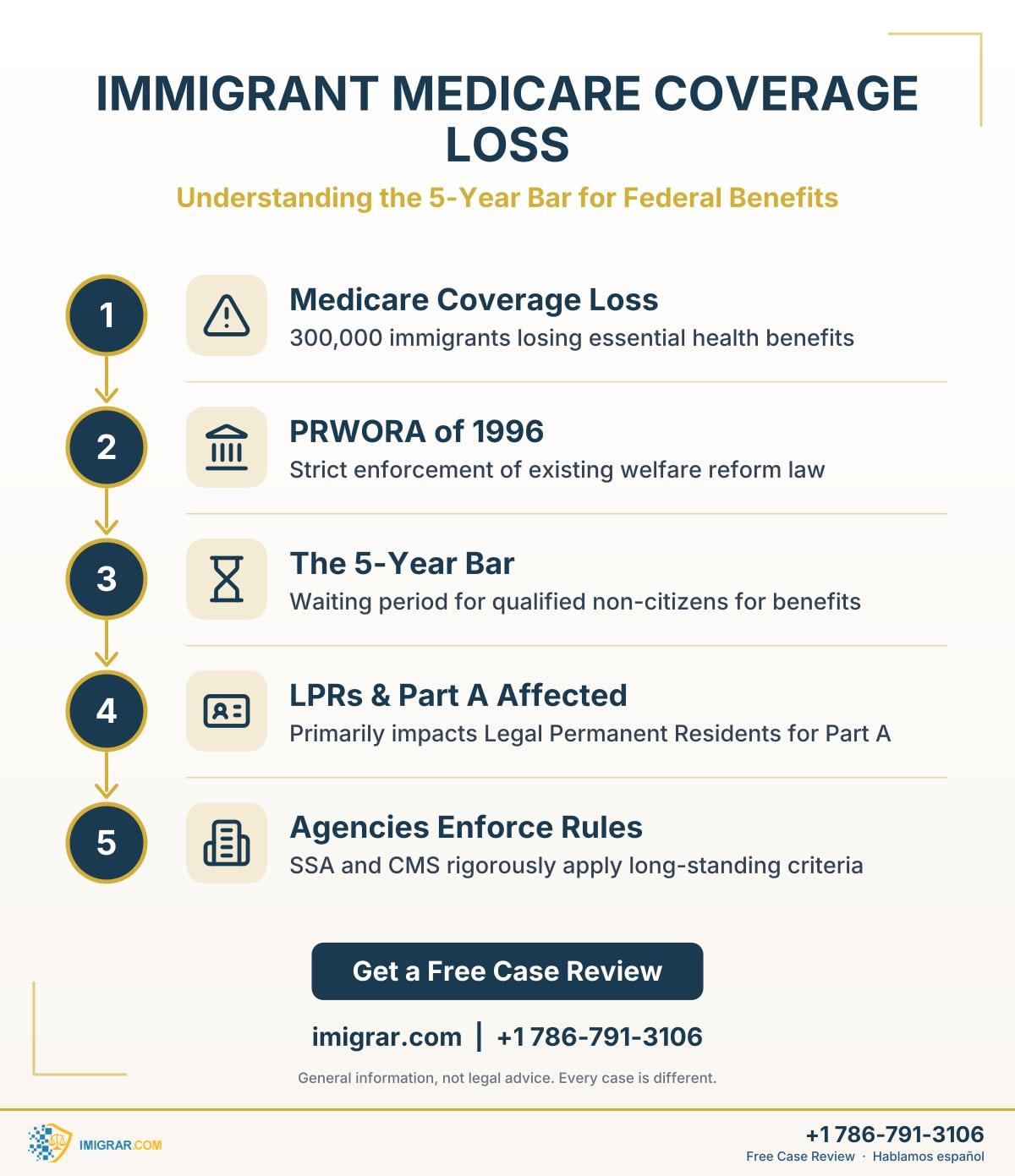
Why this news is showing up now
This critical situation isn't a result of a brand-new law, but rather the strict interpretation and enforcement of existing legislation, primarily the **Personal Responsibility and Work Opportunity Act (PRWORA) of 1996**. While this law has been in effect for decades, its specific application to Medicare eligibility for certain groups of legal immigrants is now coming to a head. Many immigrants, particularly those who have worked for years and paid into the Social Security and Medicare systems, believed they were contributing towards and therefore earning their future benefits. However, PRWORA established a **5-year bar** (or 5-year waiting period) for most "qualified non-citizens" before they can access certain federal means-tested public benefits, including some aspects of Medicare. What we are seeing now is the Social Security Administration (SSA) and the Centers for Medicare & Medicaid Services (CMS) rigorously applying these rules, leading to benefit terminations for individuals who previously may have been covered or who misunderstood the precise eligibility criteria. The notifications are being sent out as the system identifies individuals who, under this strict interpretation, do not meet the full requirements despite their contributions.
The timing also coincides with increased data cross-referencing between federal agencies, allowing for more precise identification of individuals whose immigration status or length of residency doesn't align with the specific Medicare eligibility rules. This proactive enforcement aims to align benefit distribution strictly with the letter of the law, regardless of the humanitarian impact.
How it can affect Florida residents
Florida is home to one of the largest and most diverse immigrant populations in the United States. From the vibrant communities of Miami and Orlando to the agricultural heartlands, immigrants are an integral part of our state's fabric. Many senior immigrants in Florida rely heavily on Medicare for their healthcare needs, especially given the high cost of medical care and prescription drugs. The loss of Medicare coverage can have devastating consequences for these individuals and their families:
- Financial Hardship: Without Medicare, many will face exorbitant medical bills, leading to significant debt or forcing them to forgo necessary treatments. This can be particularly challenging for seniors living on fixed incomes.
- Healthcare Gaps: Finding affordable alternative health insurance can be incredibly difficult, especially for older individuals with pre-existing conditions. This could lead to a lack of access to doctors, specialists, and vital medications.
- Increased Stress and Anxiety: The uncertainty surrounding healthcare can take a severe toll on mental and emotional well-being, affecting not just the immigrant seniors but also their families who often provide care and support.
- Impact on Families: Younger family members may feel compelled to shoulder the financial burden of their parents' or grandparents' healthcare, diverting resources from their own families and future plans.
- Community Strain: A surge in uninsured seniors could place additional strain on community clinics and charitable organizations, which may not have the resources to absorb such a large number of new patients.
For Central Florida residents, particularly those in Orange County and along the I-4 corridor, the impact is keenly felt. Orlando’s diverse population includes many immigrants who have built lives here, contributed to our economy, and are now facing this unforeseen challenge. Understanding these implications is the first step toward finding solutions and ensuring our community members receive the support they need.
Need Help? Our Orlando immigration team is ready to assist. If you or a loved one are affected by these Medicare changes, don't face it alone. Call +1 786-791-3106 for a free consultation, or message us online. Se Habla Español.
Understanding the Medicare Coverage Crisis for Immigrants
The news about 300,000 legal immigrants losing Medicare coverage highlights a complex intersection of immigration law and federal healthcare policy. It's crucial for those affected, and their families, to understand precisely what is happening and why.
A plain-English definition
**Medicare** is the federal health insurance program for people who are 65 or older, certain younger people with disabilities, and people with End-Stage Renal Disease (ESRD). It's broadly divided into several parts:
- Medicare Part A (Hospital Insurance): Helps cover inpatient hospital stays, care in a skilled nursing facility, hospice care, and some home health care. Most people don't pay a monthly premium for Part A if they or their spouse paid Medicare taxes through employment for a sufficient period (usually 10 years or 40 quarters).
- Medicare Part B (Medical Insurance): Helps cover certain doctors' services, outpatient care, medical supplies, and preventive services. Most people pay a monthly premium for Part B.
- Medicare Part C (Medicare Advantage): A private insurance plan that contracts with Medicare to provide Part A and Part B benefits.
- Medicare Part D (Prescription Drug Coverage): Helps cover the cost of prescription drugs.
The current crisis primarily concerns **Medicare Part A** for certain **Legal Permanent Residents (LPRs)**, also known as **Green Card holders**. The core issue stems from federal law that imposes a **5-year waiting period** on many "qualified non-citizens" before they can become eligible for certain federal public benefits, even if they have paid Medicare taxes. While many immigrants contribute to the system through payroll taxes, the law dictates that simply paying taxes does not automatically confer eligibility for Part A without a premium, unless they meet specific "qualified non-citizen" criteria AND have completed the 5-year waiting period after obtaining their **Legal Permanent Resident (LPR)** status. The recent Washington Post article highlights that the Social Security Administration (SSA) is now rigorously enforcing these long-standing rules, leading to the termination of benefits for individuals who previously might have received them or who did not fully understand the nuanced eligibility requirements. This means that even if you've worked for 10+ years and paid taxes, you might still be barred from premium-free Part A until you've been an LPR for five years.
Key terms you need to know
Navigating this issue requires understanding specific legal and healthcare terms:
- Medicare: As defined above, the federal health insurance program for seniors and certain disabled individuals.
- Legal Permanent Resident (LPR) / Green Card Holder: An individual who has been granted the privilege of residing permanently in the United States. This is a foundational status for many federal benefits.
- Qualified Non-Citizen: A term defined by federal law (specifically **PRWORA**) that determines eligibility for many public benefits. It includes LPRs, asylees, refugees, Cuban/Haitian entrants, certain parolees, victims of trafficking, and others. Not all "qualified non-citizens" are treated equally for all benefits.
- 5-Year Bar (or 5-Year Waiting Period): The critical period established by **PRWORA** (8 U.S.C. § 1613) where most "qualified non-citizens" are ineligible for certain federal means-tested public benefits, including premium-free Medicare Part A, for the first five years after their entry into the U.S. in a qualified status.
- Personal Responsibility and Work Opportunity Act (PRWORA) of 1996: The landmark welfare reform law that significantly restricted access to federal public benefits for many non-citizens. This is the primary statute driving the current Medicare eligibility issues.
- Social Security Administration (SSA): The federal agency responsible for administering Social Security benefits and determining eligibility for Medicare.
- Centers for Medicare & Medicaid Services (CMS): The federal agency that administers Medicare and Medicaid.
- Medicare Taxes: Payroll taxes (FICA) paid by employees and employers to fund Medicare. While essential for the system, they don't automatically override the **PRWORA** waiting period for immigrants.
- Date of Entry / Date of Adjustment of Status: This is a critical date for the 5-year bar. It refers to the date you officially became a **Legal Permanent Resident** in the U.S.
Current Immigration Law: The Foundation of Medicare Eligibility
Understanding the current legal framework is paramount to comprehending why this situation is unfolding. The intersection of immigration law and public benefit eligibility is complex, rooted in specific federal statutes.
Federal requirements
The primary federal laws governing Medicare eligibility for immigrants are the **Social Security Act** (specifically 42 U.S.C. § 1395i-2 for Part A) and the **Personal Responsibility and Work Opportunity Act (PRWORA) of 1996** (8 U.S.C. § 1611, 8 U.S.C. § 1612, 8 U.S.C. § 1613).
Under the **Social Security Act**, individuals generally qualify for premium-free Medicare Part A if they are 65 or older and have worked and paid Medicare taxes for at least 10 years (40 quarters). However, **PRWORA** introduced significant restrictions for non-citizens, creating a two-tiered system for federal public benefits.
**PRWORA** defines specific categories of "qualified non-citizens" who *may* be eligible for federal public benefits, but often only after a **5-year waiting period**. These "qualified non-citizens" generally include:
- Lawful Permanent Residents (**LPRs** or **Green Card holders**).
- Asylees and Refugees.
- Cuban/Haitian Entrants.
- Parolees for at least one year.
- Individuals granted withholding of deportation/removal.
- Battered spouses, children, or parents under the Violence Against Women Act (VAWA).
- Victims of severe forms of trafficking.
Crucially, for most LPRs, the 5-year waiting period (or "5-year bar") applies to premium-free Medicare Part A. This means that even if an LPR has paid Medicare taxes for 40 quarters, they are generally not eligible for premium-free Part A until five years *after* they obtained their **Legal Permanent Resident** status. Exceptions to the 5-year bar typically include refugees, asylees, those granted withholding of removal, and certain veterans/active duty military personnel and their families. The current issue arises because individuals who either fell through the cracks, or whose eligibility was previously interpreted differently, are now having their benefits terminated due to strict enforcement of this 5-year rule for LPRs. The SSA is cross-referencing immigration data with Medicare enrollment records to ensure compliance.
For more detailed information on immigration statutes and regulations, visit the USCIS official website.
Florida-specific considerations
While Medicare is a federal program, its loss can have ripple effects on state resources and individual healthcare planning in Florida. Florida does not have its own comprehensive state-funded health insurance program that can easily substitute for Medicare for seniors. Unlike some states, Florida has not expanded its Medicaid program to cover all low-income adults, making access to Medicaid particularly challenging for many non-disabled, non-pregnant adults, including seniors, whose income might be slightly above the very low threshold for traditional Medicaid.
For those losing Medicare Part A, alternative options in Florida would primarily involve:
- The Affordable Care Act (ACA) Marketplace (Healthcare.gov): Immigrants who are **LPRs** and other "qualified non-citizens" are generally eligible to purchase health plans through the marketplace and may qualify for subsidies to lower their monthly premiums and out-of-pocket costs, depending on their income. This is often the most viable alternative.
- Private Health Insurance: Purchasing directly from an insurance company, which can be very expensive, especially for seniors.
- Community Health Centers: These centers, including many in Orlando and throughout Central Florida, offer services on a sliding scale based on income, providing a critical safety net for those without insurance.
Immigrants in Florida must also understand that while they may lose federal Medicare, their immigration status (e.g., **LPR**) itself is not directly threatened by this change, unless there are other underlying issues. However, the financial strain from losing healthcare could indirectly impact their ability to maintain their residence or, for those still in the process of applying for a **Green Card**, raise questions about public charge considerations (though this is less likely for those already LPRs and simply losing a benefit). Always consult with an immigration attorney to understand your specific situation.
Relevant USCIS Forms that establish LPR status, which then starts the 5-year clock for Medicare eligibility, include:
- Form I-130, Petition for Alien Relative: Filed by a U.S. citizen or LPR relative to establish a qualifying relationship.
- Form I-485, Application to Register Permanent Residence or Adjust Status: Filed by an individual seeking to become an LPR while in the U.S.
- Form I-864, Affidavit of Support: A legally enforceable contract where a sponsor agrees to financially support the immigrant, relevant for public charge considerations.
For forms and processing times, refer to USCIS Forms and USCIS Processing Times.
Warning: The complexity of immigration law and federal benefits means you shouldn't navigate these changes alone. Our Orlando immigration attorneys specialize in protecting immigrant families. Call +1 786-791-3106 today for a free consultation. Se Habla Español.
Navigating Your Healthcare Options: A Step-by-Step Guide for Affected Immigrants
If you or a loved one is among the 300,000 legal immigrants facing the loss of Medicare coverage, it's vital to take immediate, informed action. This step-by-step guide will help you understand your options and the necessary actions.
1) Understand Your Current Status and Notice
The first and most crucial step is to fully comprehend why your Medicare coverage is being terminated. You should have received a notice from the Social Security Administration (SSA) or the Centers for Medicare & Medicaid Services (CMS). This letter will detail the reason for termination, which is likely related to the **5-year bar** for "qualified non-citizens" under **PRWORA**.
- Review the letter carefully: Note the effective date of termination and any deadlines for appeal.
- Verify your LPR date: Confirm the exact date you officially became a **Legal Permanent Resident**. This date is critical for calculating the 5-year waiting period. You can find this on your **Green Card** (resident alien card) or your **I-485 Approval Notice**.
- Identify your immigration status: Confirm if you are an LPR, asylee, refugee, or another category of "qualified non-citizen." This determines which rules apply to you.
2) Assess Your Eligibility for Exceptions or Alternative Pathways to Medicare
While the **5-year bar** applies to most **LPRs**, certain "qualified non-citizens" are exempt. Check if you fall into any of these categories:
- Refugee or Asylee Status: Individuals granted refugee or asylum status are generally exempt from the 5-year bar for federal public benefits.
- Withholding of Removal: Those granted withholding of deportation or removal are also typically exempt.
- Veterans or Active Duty Military: Certain non-citizens who served in the U.S. military (or their spouses/children) may be exempt from the bar.
- Medicare Part B or D: If you are losing premium-free Medicare Part A, you may still be able to enroll in Medicare Part B (Medical Insurance) and/or Part D (Prescription Drug Coverage) if you pay the monthly premiums. This is distinct from Part A eligibility based on work history. You would need to proactively enroll during specific enrollment periods.
If you believe you meet an exception, gather all documentation supporting that claim.
3) Explore Alternative Health Coverage Options
If you are losing Medicare Part A and do not qualify for an exemption, securing alternative health insurance is your top priority. Do not wait until your coverage ends.
- ACA Marketplace Plans (Healthcare.gov): As a **Legal Permanent Resident**, you are eligible to purchase health insurance through the Affordable Care Act (ACA) marketplace. You may qualify for premium tax credits and cost-sharing reductions based on your income, making plans more affordable. Losing Medicare coverage often triggers a Special Enrollment Period (SEP), allowing you to enroll outside of the annual Open Enrollment.
- Required Documents for ACA: Proof of identity, proof of immigration status (**Green Card**, I-485 approval notice), proof of income (tax returns, pay stubs, Social Security statements), Social Security Number (SSN).
- Visit Healthcare.gov to explore plans.
- Medicaid (Florida): While Florida has strict Medicaid eligibility rules for adults, it's worth checking if your income and resources meet the requirements. Eligibility for Medicaid in Florida is generally limited to very low-income pregnant women, children, parents with dependent children, and individuals who are aged, blind, or disabled.
- Required Documents for Medicaid: Proof of identity, proof of immigration status, proof of income and assets, household composition details.
- Employer-Sponsored Health Plans: If you or your spouse are still actively working, check if an employer-sponsored health plan is an option.
- Private Health Insurance: You can purchase a plan directly from an insurance company, but these are often more expensive and may not offer the same level of benefits.
- Community Health Centers: For immediate and affordable care, community health centers (like those found throughout Orlando and Central Florida) offer services on a sliding scale based on income, regardless of insurance status.
4) Consult with Legal and Healthcare Professionals
This situation demands expert advice from both an immigration attorney and a healthcare or Medicare specialist. The issues are complex, intertwining immigration status with federal benefit eligibility.
- Immigration Attorney (Imigrar): An experienced immigration lawyer can review your specific immigration history, confirm your LPR date, assess if any exceptions apply to your case, and advise on any potential immigration implications. They can also help interpret official notices and guide you on the best course of action.
- Medicare Counselor/Specialist: A State Health Insurance Assistance Program (SHIP) counselor or other Medicare specialist can help you understand your Medicare options (e.g., enrolling in Part B/D with premiums) and navigate the ACA marketplace.
5) Gather All Necessary Documents
Regardless of the path you choose, thorough documentation is essential. Organize all relevant papers in a secure and accessible location.
- Immigration Documents: Your **Green Card**, **Form I-485 Approval Notice**, passport, visa stamps, any
Related Topics
Need Legal Assistance?
Our experienced immigration attorneys are here to help with your case. Contact Imigrar today for a free consultation and let us guide you through the legal process with confidence.
📍 Orlando, Florida • Serving clients nationwide
📧 info@imigrar.com