
Refugee Green Cards: Understanding Past Challenges & Securing Your Future in 2026
A federal judge's past questioning of policies targeting refugee green cards highlights ongoing protections. Learn how to navigate the process for permanent residency in 2026.

The reporting that sparked this guide: US judge questions Trump administration's policies targeting refugees (Reuters)
What This News Means for Immigrants in Orlando and Across Florida
As of November 24, 2026, the landscape of U.S. immigration law continues to evolve, but the core principles of due process and judicial oversight remain steadfast. A significant Reuters report from several years ago highlighted a federal judge's critical questioning of the Trump administration's policies aimed at freezing thousands of refugees' Green Card applications. While the administration in power has since changed, the legal battles and precedents set during that era continue to shape how refugee cases are handled today. For refugees and their families, understanding the historical context of these challenges is crucial, as it underscores the importance of robust legal representation and the persistent need to protect the rights of those seeking safety and a new life in the United States.
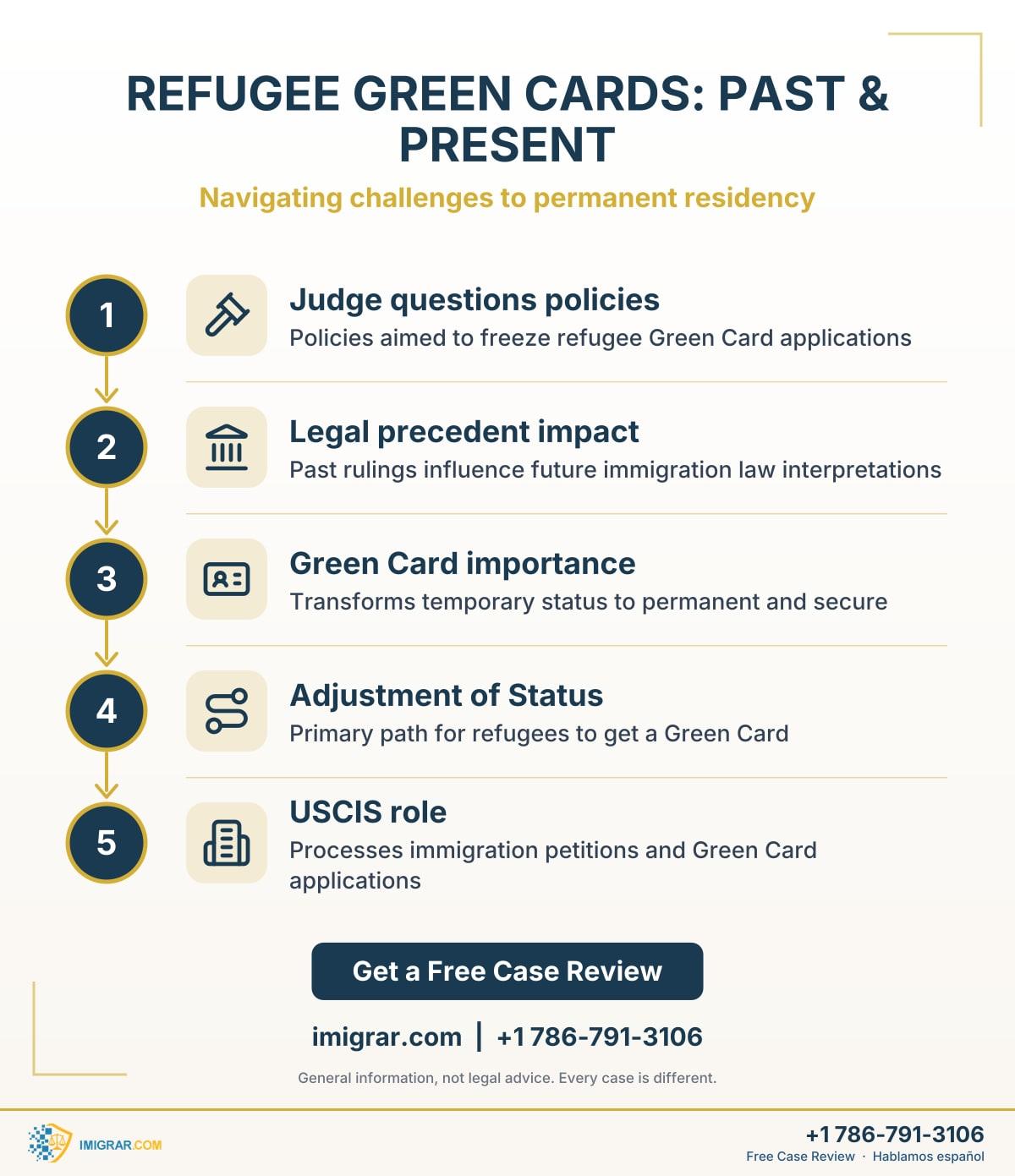
Why this news is showing up now
Even in 2026, the legacy of past immigration policies, particularly those targeting vulnerable populations like refugees, continues to resonate within the legal community and among immigrant advocacy groups. The specific Reuters report, while from a previous era, serves as a powerful reminder of how executive actions can dramatically impact individuals' lives and how the judiciary often plays a critical role in upholding established law and protecting fundamental rights. Discussions around these past challenges are resurfacing today for several reasons:
- Legal Precedent: Court decisions, even those from prior administrations, establish legal precedents that can influence future interpretations of immigration law. Understanding these past rulings helps attorneys and advocates anticipate potential challenges and build stronger cases.
- Ongoing Advocacy: Immigration advocacy groups consistently reference historical policies and their judicial challenges to highlight the need for stable, humane, and legally sound immigration systems. This news provides a touchstone for discussions about refugee protection and the path to permanent residency.
- Policy Evolution: Current administrations often review and revise policies based on lessons learned from previous ones. The questioning of past policies by judges informs ongoing debates about how best to manage immigration and refugee resettlement.
- Client Concerns: Many refugees and asylees who arrived during or prior to that period may still be navigating their path to a Green Card, and they may have experienced direct impacts from those policies. Understanding the legal challenges to these policies provides context and reassurance that their rights have been, and continue to be, defended.
At Imigrar, we understand that for many, the journey to a secure future is long and complex. We believe in keeping families together and providing clarity amidst legal complexities, drawing on both current law and historical context to best serve our clients.
How it can affect Florida residents
Florida, particularly Central Florida with cities like Orlando, has a significant and diverse immigrant population, including many refugees and asylees who have resettled here. The implications of past legal challenges to refugee policies are deeply relevant to residents across the state:
- Refugee Community Impact: Florida is home to vibrant refugee communities from various parts of the world. Any policy that threatens or delays their path to permanent residency directly affects their ability to build stable lives, integrate into society, and contribute to the local economy.
- Family Unity: Policies that freeze Green Card processing directly impact family reunification efforts. Many refugees have family members abroad or in other parts of the U.S. whose ability to join them depends on their own secure immigration status. When a judge questions such policies, it reaffirms the principle of keeping families together, which is central to Imigrar’s mission.
- Local Economy and Services: Delays in Green Card acquisition can affect access to employment, education, and social services. Stable immigration status allows individuals to secure better jobs, pursue higher education, and access healthcare, all of which benefit Florida's communities.
- Legal Landscape in Orlando: For those in Orlando and surrounding areas like Orange County, understanding the nuances of these legal challenges is vital. The Orlando USCIS Field Office and local immigration courts are where many of these cases are processed. Knowing that the judiciary acts as a check on executive power can instill confidence in the legal system, even when facing significant bureaucratic hurdles.
Even if the specific policy referenced is no longer in effect, the underlying vulnerability of refugees seeking permanent residency remains a concern. The judge's questioning of those policies serves as a powerful testament to the ongoing importance of legal advocacy in protecting these vulnerable populations. For Central Florida residents, this means that vigilance, informed action, and expert legal counsel are always essential for navigating the complex path to a secure future.
Need Help? Our Orlando immigration team is ready to assist. Call +1 786-791-3106 for a free consultation, or message us online. Se Habla Español.
What Targeting Refugees' Green Cards Is (and Why It Matters)
The Reuters report highlighted a legal challenge to policies that sought to "freeze thousands of refugees' Green Card applications." To understand why this matters, it's essential to define what this entails and the broader context of refugee protection in the U.S.
A plain-English definition
When we talk about "targeting refugees' Green Card applications," it refers to government actions or policies designed to make it harder, slower, or even impossible for people who have been granted refugee status in the U.S. to obtain lawful permanent resident (LPR) status, commonly known as a Green Card. Essentially, it's about putting up new roadblocks or freezing existing applications for individuals who have already been recognized as needing protection from persecution in their home countries.
For a refugee, obtaining a Green Card is the critical next step after being granted asylum or refugee status. It transforms their temporary protected status into a more permanent and secure one, offering stability, the ability to travel more freely, and eventually, the option to apply for U.S. citizenship. Policies that target these applications are seen as undermining the very purpose of refugee protection and creating prolonged uncertainty for individuals and families who have already endured immense hardship.
Key terms you need to know
Navigating the immigration system requires understanding specific terminology. Here are some key terms related to refugees and the Green Card process:
- Refugee: A person who has fled their country of origin and is unable or unwilling to return due to a well-founded fear of persecution based on race, religion, nationality, membership in a particular social group, or political opinion. Refugees are typically processed and admitted from outside the U.S.
- Asylee (Asylum Seeker): Similar to a refugee, but an asylee is someone who is already in the U.S. or at a port of entry and then applies for protection based on the same fear of persecution. Once granted, their status is functionally similar to a refugee for the purpose of seeking a Green Card.
- Green Card (Form I-551, Permanent Resident Card): This card proves that you are a lawful permanent resident (LPR) of the United States. It allows you to live and work permanently in the U.S., travel internationally, and eventually apply for U.S. citizenship.
- Adjustment of Status: The process by which a non-citizen already in the United States applies to become a lawful permanent resident (get a Green Card) without having to return to their home country to complete visa processing. For refugees and asylees, this is the primary path to a Green Card.
- USCIS (U.S. Citizenship and Immigration Services): The federal agency that oversees lawful immigration to the United States. USCIS processes immigration petitions and applications, including those for Green Cards. You can find more information on the USCIS official website.
- EOIR (Executive Office for Immigration Review): An agency within the U.S. Department of Justice that administers the nation's immigration courts. This office handles asylum claims and other immigration court proceedings. Visit Executive Office for Immigration Review for details.
- INA (Immigration and Nationality Act): The body of law that governs immigration to the United States. Specific sections of the INA dictate the eligibility and process for refugees and asylees to obtain permanent residency.
- Priority Date: While more common in family-based and employment-based immigration, understanding the concept is useful. For refugees/asylees, the "date of admission" or "date asylum granted" often functions similarly, marking the start of their eligibility clock for Adjustment of Status.
- Derivative Beneficiaries: Family members (spouse and unmarried children under 21) who are included in a refugee's or asylee's application and receive the same status. They can also apply for Adjustment of Status.
Understanding these terms is the first step toward effectively navigating the immigration process. The policies questioned by the judge sought to undermine these established pathways, emphasizing the importance of judicial oversight and legal advocacy in protecting these definitions and processes for those seeking refuge.
Current Immigration Law: The Foundation
The ability of refugees and asylees to apply for a Green Card (lawful permanent residency) is firmly established in U.S. immigration law, primarily through the Immigration and Nationality Act (INA). While specific regulations and policies can be challenged or modified, the fundamental right to apply for permanent residency after a period of protected status remains a cornerstone of the U.S. refugee program.
Federal requirements
Under federal law, specifically Section 209(a) and 209(b) of the Immigration and Nationality Act (INA), refugees and asylees are eligible to apply for Adjustment of Status to lawful permanent resident (LPR) status after one year of physical presence in the United States in their refugee or asylee status. This is a critical provision that provides a pathway to stability and eventual citizenship for those granted protection.
The key federal requirements for refugees and asylees seeking to adjust their status include:
- One Year Physical Presence: The applicant must have been physically present in the U.S. for at least one year since being admitted as a refugee or granted asylum.
- Continued Refugee/Asylee Status: The applicant must continue to meet the definition of a refugee or asylee, and their status must not have been terminated.
- Admissibility: The applicant must be admissible to the United States for permanent residence. This involves passing background checks and not being subject to certain grounds of inadmissibility (e.g., criminal history, certain health issues, national security concerns). Waivers may be available for some grounds of inadmissibility.
- Application: The applicant must properly file Form I-485, Application to Register Permanent Residence or Adjust Status, along with all required supporting documentation and fees.
- Medical Examination: A medical examination by a USCIS-approved civil surgeon is generally required, submitted on Form I-693, Report of Medical Examination and Vaccination Record.
For refugees, their initial admission to the U.S. is typically processed by the Department of State, and they arrive with a specific immigration classification. Asylees, on the other hand, apply for asylum from within the U.S. (using Form I-589, Application for Asylum and for Withholding of Removal) or at a port of entry, and once granted, they follow a similar path to Adjustment of Status.
Important: There is no visa bulletin backlog for refugees and asylees adjusting status, unlike many other Green Card categories. This means that once eligible, they can apply without waiting for a visa number to become available, making the one-year mark a significant milestone.
For more detailed information, always refer to the USCIS official website, specifically the sections on refugees and asylees.
Florida-specific considerations
While immigration law is federal, practical considerations in Florida can influence the process for refugees and asylees:
- Orlando USCIS Field Office: If your case is in Orlando or the surrounding Central Florida area (including Orange County, Seminole County, Osceola County), your Adjustment of Status interview (if required) will likely take place at the Orlando USCIS Field Office. Familiarity with local office procedures and common interview questions can be advantageous.
- Refugee Resettlement Agencies: Florida hosts numerous refugee resettlement agencies that provide initial support, housing, and social services to newly arrived refugees. These agencies can be valuable resources for understanding local support systems, although they do not provide legal advice for Green Card applications.
- Cultural Competency: Florida's diverse population means that USCIS officers and legal service providers often have experience working with individuals from various cultural backgrounds. However, ensuring your legal team, like Imigrar, is culturally competent and offers services in multiple languages (Se Habla Español) can significantly ease the process.
- Access to Civil Surgeons: Finding a USCIS-approved civil surgeon for your required medical examination (Form I-693) in Central Florida is generally straightforward, but it's important to schedule this well in advance and ensure the physician understands the specific requirements for immigration medical exams.
The legal framework for refugees seeking Green Cards is designed to provide a pathway to permanent stability. Understanding these federal requirements and local considerations is vital for a successful application. Imigrar specializes in guiding individuals through these precise steps, ensuring compliance with all laws and regulations.
Considering applying for your Green Card? Don't navigate the complexities alone. Contact Imigrar's Orlando team today for expert guidance. Call +1 786-791-3106 for a free consultation. Se Habla Español.
How to Adjust Status as a Refugee or Asylee: A Complete Step-by-Step Guide
For refugees and asylees, the path to a Green Card is through Adjustment of Status. This process allows you to become a lawful permanent resident without leaving the United States. Here’s a detailed, step-by-step guide to help you understand the journey.
1) Confirm Eligibility and Gather Initial Information
The first crucial step is to ensure you meet the basic eligibility criteria for Adjustment of Status as a refugee or asylee. This primarily means:
- You have been physically present in the U.S. for at least one year since your admission as a refugee or the date your asylum was granted.
- You continue to meet the definition of a refugee or asylee.
- You are admissible to the United States (or qualify for a waiver of inadmissibility).
Once you confirm eligibility, begin gathering essential personal and immigration documents. This includes:
- Proof of Refugee/Asylee Status: Your I-94 Arrival/Departure Record, asylum grant letter, or other official USCIS documents confirming your status.
- Identification Documents: Passport, national identity card (if applicable), birth certificate.
- Marriage Certificate: If you are married and your spouse is also adjusting status.
- Children's Birth Certificates: If you have unmarried children under 21 who are derivative beneficiaries.
- Previous Immigration Documents: Any notices, approvals, or correspondence from USCIS or the Executive Office for Immigration Review (EOIR).
Reminder: Keep original documents safe and provide only copies unless specifically requested by USCIS. Ensure all foreign language documents are accompanied by a certified English translation.
2) Complete Your Medical Examination (Form I-693)
Before filing your Adjustment of Status application, you generally need to undergo a medical examination by a USCIS-approved civil surgeon. The results are recorded on Form I-693, Report of Medical Examination and Vaccination Record. The civil surgeon will check for certain communicable diseases, physical or mental disorders, and drug abuse, and verify that you have received all required vaccinations.
- Find a Civil Surgeon: Use the USCIS website's Find a Civil Surgeon tool. For Central Florida residents, many approved surgeons are available in Orlando and surrounding areas.
- Required Documents for Exam: Bring your government-issued photo ID (e.g., passport), vaccination records, and a list of any medications you are taking.
- Sealed Envelope: The civil surgeon will provide you with the completed Form I-693 in a sealed envelope. Do NOT open this envelope. You must submit it to USCIS unopened.
Warning: The medical exam results are valid for two years from the date of the civil surgeon's signature. It's best to complete this step close to when you plan to file your Form I-485.
3) Prepare and File Form I-485, Application to Register Permanent Residence or Adjust Status
This is the core of your Green Card application. Meticulous preparation is essential.
- Complete Form I-485: Fill out every section accurately and completely. Any blank fields or inconsistencies can cause delays.
- Required Supporting Documents for Form I-485:
- Two passport-style photos (current specifications).
- Copy of your birth certificate.
- Copy of your passport biographical page (if available).
- Copy of your I-94 Arrival/Departure Record (front and back), showing your refugee status, or asylum grant letter.
- Copy of the Form I-797, Approval Notice, for your asylum application (if applicable).
- Copy of your marriage certificate (if applicable).
- Copy of divorce decrees or death certificates for any prior marriages (if applicable).
- Copy of Form I-693 (medical examination, in the sealed envelope).
- Certified English translations for any foreign language documents.
- Appropriate filing fees.
- Additional Forms (if applicable):
- Form I-765, Application for Employment Authorization (EAD) – Allows you to work while your Green Card is pending.
- Form I-131, Application for Travel Document (Advance Parole) – Allows you to travel outside the U.S. and return while your Green Card is pending.
- Form I-601, Application for Waiver of Grounds of Inadmissibility (if needed).
- Form I-730, Refugee/Asylee Relative Petition (if petitioning for family members abroad).
- Mail Your Application: Send your complete package to the correct USCIS lockbox facility. The address depends on the type of application and where you live. Check the USCIS Direct Filing Addresses for Form I-485.
Important: Keep a complete copy of everything you send to USCIS for your records.
4) Attend Biometrics Appointment and Respond to RFEs
After USCIS receives your application, they will send you a receipt notice (Form I-797C). Soon after, you will receive an appointment notice for a biometrics services appointment at an Application Support Center (ASC).
- Biometrics: At the ASC, USCIS will collect your fingerprints, photograph, and signature. This data is used for background and security checks.
- RFEs (Requests for Evidence): USCIS may send you an RFE if they need more information or documents to process your application. It's crucial to respond to RFEs promptly and completely by the deadline provided. Failure to do so can lead to denial.
- Interview Waiver: While interviews are generally required for Adjustment of Status, USCIS may waive the interview for certain refugee or asylee applicants if all necessary information is available and there are no apparent issues. However, be prepared for an interview.
5) Prepare for and Attend the Interview (If Required)
If an interview is required, USCIS will send you an interview notice with the date, time, and location. For Orlando residents, this will likely be at the Orlando USCIS Field Office.
- Preparation: Review your entire application package. Be prepared to answer questions about your refugee/asylum claim, your personal history, your family, and your admissibility to the U.S.
- Required Documents for Interview: Bring originals of all documents you submitted with your application, plus any other documents requested in the interview notice. This might include your passport, I-94, marriage certificate, birth certificates, and the sealed Form I-693 if you haven't submitted it yet.
- Legal Counsel: It is highly recommended to have an experienced immigration attorney from Imigrar accompany you to the interview. Your attorney can provide support, clarify questions, and protect your rights.
6) Receive a Decision
After the interview (or after all information is received if the interview is waived), USCIS will make a decision on your application. This can take several weeks or months.
- Approval: If your application is approved, you will receive an approval notice, and your Green Card will be mailed to you. Congratulations! You are now a lawful permanent resident.
- Denial: If your application is denied, USCIS will send you a written explanation of the reasons for the denial. You may have options to appeal the decision or refile, depending on the grounds for denial. This is where legal expertise is crucial.
The Adjustment of Status process for refugees and asylees can be lengthy and complex. Having a knowledgeable legal team like Imigrar by your side can significantly increase your chances of a successful outcome and help you navigate potential challenges. We are dedicated to helping you achieve permanent residency and keep your family together.
Practical Steps You Can Take Today
Navigating the Green Card process as a refugee or asylee can feel overwhelming, but there are concrete steps you can take right now to prepare and strengthen your application. Proactive preparation is key to a smooth process, especially in the evolving immigration landscape of 2026.
Actionable Checklist (5+ items)
- Verify Your Eligibility: Double-check your admission date as a refugee or the date your asylum was granted. Ensure you have completed at least one year of physical presence in the U.S. This is a non-negotiable requirement.
- Organize Your Documents: Start compiling all personal and immigration documents. Create a master checklist and a physical or digital folder for each type of document. Ensure all foreign language documents are translated and certified.
- Locate a Civil Surgeon: Research and identify USCIS-approved civil surgeons in your area. For Central Florida residents, search for "USCIS civil surgeon Orlando" to find options. Schedule your medical exam (Form I-693) to align with your filing timeline.
- Understand the Forms: Download and review Form I-485, Form I-693, and any other relevant forms (like Form I-765 for work authorization or Form I-131 for travel). Read the instructions carefully.
- Check Filing Fees: Review the current USCIS filing fees for Form I-485 and any other forms you plan to submit. Fees can change, so always check the USCIS Forms page for the latest information.
- Consult an Immigration Attorney: This is arguably the most important step. Schedule a free consultation with an experienced immigration law firm like Imigrar. An attorney can assess your specific situation, identify potential issues, and guide you through the entire process.
Document Preparation Guidance
Thorough document preparation is critical. Here’s how to approach it:
- Originals vs. Copies: Always keep your
Related Topics
Need Legal Assistance?
Our experienced immigration attorneys are here to help with your case. Contact Imigrar today for a free consultation and let us guide you through the legal process with confidence.
📍 Orlando, Florida • Serving clients nationwide
📧 info@imigrar.com