
Trump-Era Green Card Policy: What Florida Immigrants Need to Know Now
The Trump administration's green card policies sparked significant concern. Learn what those changes meant, how current law applies to your family in Florida, and how Imigrar can help you navigate the process.
The landscape of U.S. immigration law is constantly evolving, and policies from previous administrations can continue to spark discussion and concern among immigrant communities. At Imigrar, we believe in keeping families together by providing clear, accurate, and up-to-date information, especially when past policies cast long shadows or inform future debates.
The reporting that sparked this guide
This comprehensive guide is inspired by critical reporting on immigration policy during a previous presidential administration, specifically concerning green card eligibility:
The CalMatters article highlighted the complexities and anxieties surrounding the Trump administration's approach to green card applications, particularly its emphasis on self-sufficiency and the potential requirement for immigrants to return to their home countries if deemed a "public charge." While the specific policy discussed in that article has since been rescinded, its historical impact and the principles it raised continue to be relevant for understanding the broader immigration framework and preparing for potential future policy shifts. This guide will clarify the past, explain the present, and equip you with the knowledge to move forward confidently.
What This News Means for Immigrants in Orlando and Across Florida
For immigrants and their families in Orlando, Central Florida, and throughout the nation, understanding past immigration policies is almost as important as knowing the current law. Policies implemented by one administration, even if later rescinded, often leave a lasting impact on how individuals approach their applications and how government agencies interpret regulations.
Why this news is showing up now
The news regarding the Trump administration's green card policy, particularly the "public charge" rule, continues to surface for several reasons, even years after its initial implementation and subsequent rescission. First, the policy represented a significant departure from long-standing immigration norms, creating widespread fear and confusion. Its effects were felt deeply by many families, and the memory of those challenges persists. Second, discussions around immigration policy are cyclical. What was once implemented can be proposed again by future administrations or serve as a blueprint for new restrictions. Therefore, staying informed about past policies helps immigrant communities and their legal advocates anticipate and prepare for potential future changes.
Specifically, the Trump-era rule broadened the definition of a "public charge" and expanded the types of public benefits that could render an applicant inadmissible. It also introduced a more stringent "totality of the circumstances" test, evaluating factors like age, health, family status, assets, resources, financial status, education, and skills. This created immense uncertainty for individuals applying for green cards through Adjustment of Status or Consular Processing, especially those who had previously accessed or might need to access certain forms of public assistance.
For many, the policy's primary impact was a chilling effect, deterring eligible immigrants from seeking essential healthcare, food, or housing assistance out of fear it would jeopardize their immigration prospects. This historical context is vital for understanding the anxieties many immigrants still carry, even under current, more favorable rules.
How it can affect Florida residents
Florida is home to a vibrant and diverse immigrant population, with Orlando being a significant hub for new arrivals and established families alike. Policies like the Trump-era public charge rule disproportionately affect communities that rely on essential services, leading to difficult choices between basic needs and immigration goals. While the 2019 public charge rule is no longer in effect, its legacy means that many Florida residents still harbor concerns about how using public benefits might impact their immigration applications. This concern can lead to underutilization of vital services, impacting public health and welfare for entire communities.
For Central Florida residents, understanding the distinction between past and current law is crucial. Misinformation or outdated advice can lead to unnecessary fear or incorrect application strategies. For example, some may still believe that receiving Medicaid for their children or using food stamps will automatically disqualify them, which, under current policy, is generally not the case for most family-based green card applicants.
Moreover, Florida's specific demographic makeup, with large populations of individuals from Latin American and Caribbean countries, means that any federal immigration policy changes have a significant local impact. Our clients in Orlando, Kissimmee, and along the I-4 corridor are particularly sensitive to these shifts, as many are navigating complex family-based immigration processes. Imigrar is here to provide clarity and guidance, ensuring that you understand your rights and the current requirements, regardless of past policy debates.
What Public Charge Is (and Why It Matters)
The concept of "public charge" is central to many discussions about green card eligibility, and understanding it is crucial for anyone navigating the U.S. immigration system. While the Trump administration's policy significantly altered its application for a period, the underlying principle remains a part of U.S. law.
A plain-English definition
At its core, the public charge rule is a ground of inadmissibility. This means that if an individual applying for a green card (or certain other visas) is determined to be a "public charge," they can be denied admission to the United States or denied adjustment of status. Simply put, a "public charge" is someone who is deemed likely to become primarily dependent on the government for subsistence, either through direct cash assistance for income maintenance or through long-term institutionalization at government expense.
The key here is "primarily dependent." It's not about occasionally using a public service; it's about whether the government believes you will rely on public benefits as your main means of support. The intent of the rule is to ensure that immigrants are self-sufficient or have sufficient support from family members who are U.S. citizens or green card holders.
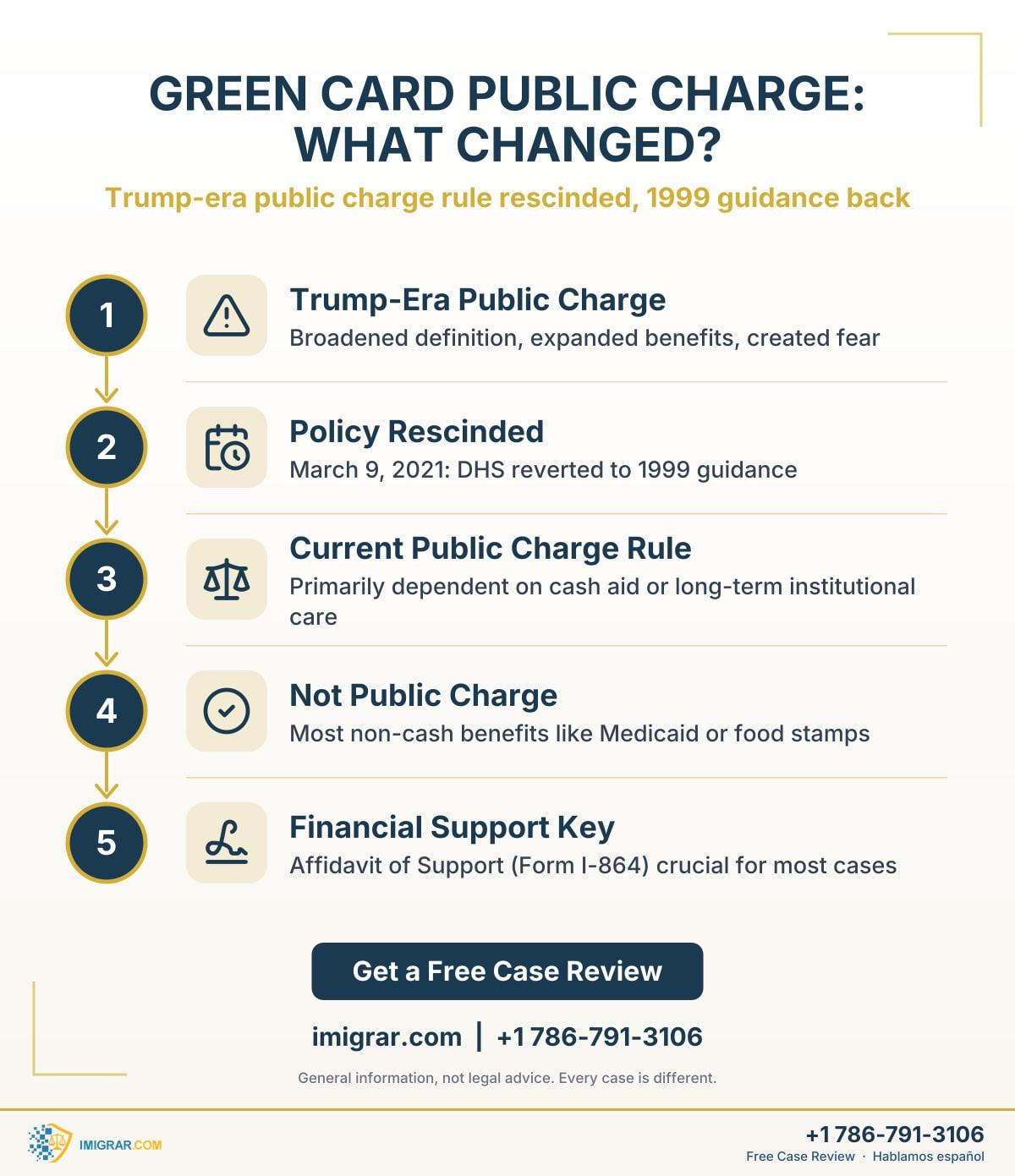
Important: The 2019 public charge rule expanded this definition significantly. However, as of March 9, 2021, the Department of Homeland Security (DHS) reverted to the 1999 public charge guidance. This means the stricter Trump-era rule is no longer in effect. We will delve into the specifics of current law in the next section, but it's vital to recognize that the definition of "public charge" has changed back to a less restrictive standard.
Key terms you need to know
Navigating immigration law requires familiarity with specific terminology. Here are some key terms related to the public charge rule and green card applications:
- Public Charge Rule: The legal principle that allows immigration officials to deny a visa or green card to individuals deemed likely to become primarily dependent on government assistance.
- Inadmissibility: A legal term meaning that an individual is ineligible to enter the United States or obtain a green card due to certain grounds, such as being a public charge, having a criminal record, or health issues.
- Adjustment of Status (AOS): The process by which an eligible individual already in the United States applies for lawful permanent resident status (a green card) without having to return to their home country. This typically involves filing Form I-485.
- Consular Processing: The process by which an eligible individual outside the United States applies for an immigrant visa (green card) through a U.S. embassy or consulate in their home country.
- Affidavit of Support (Form I-864): A legally binding document signed by a petitioner (sponsor) who agrees to financially support the immigrant applicant. This form is crucial for overcoming public charge concerns in most family-based green card cases.
- Sponsor/Petitioner: The U.S. citizen or lawful permanent resident who files an immigrant petition (e.g., Form I-130) on behalf of a family member and typically also acts as the financial sponsor by filing Form I-864.
- Means-Tested Public Benefits: Government assistance programs where eligibility is determined by an applicant's income and assets. Under current (1999) public charge guidance, only certain cash assistance programs and long-term institutional care at government expense are considered. The Trump-era rule greatly expanded this list to include non-cash benefits like Medicaid, food stamps, and housing assistance.
- Totality of the Circumstances: The comprehensive evaluation process used by immigration officers to determine if someone is likely to become a public charge. Factors considered include age, health, family status, assets, resources, financial status, education, and skills.
- Priority Date: The date your immigrant petition (e.g., Form I-130) was filed. This date determines your place in the line for an immigrant visa, especially for categories with annual limits.
Need Help? Our Orlando immigration team is ready to assist. Call +1 786-791-3106 for a free consultation, or message us online. Se Habla Español.
Current Immigration Law: The Foundation
Understanding the current legal framework for green card applications, especially concerning the public charge rule, is paramount. While the Trump administration's 2019 Public Charge Final Rule generated significant apprehension, it is crucial to know that this rule was vacated and removed from the Code of Federal Regulations as of March 9, 2021. The U.S. government, under the Biden administration, reverted to applying the 1999 Interim Field Guidance on public charge inadmissibility.
Federal requirements
The legal basis for the public charge ground of inadmissibility is found in the Immigration and Nationality Act (INA) at Section 212(a)(4). This section states that an applicant is inadmissible if they are "likely at any time to become a public charge."
Under the **current 1999 public charge guidance**, USCIS and Department of State (DOS) officials consider a limited set of benefits when determining public charge inadmissibility. These are primarily:
- Cash assistance for income maintenance: This includes programs like Supplemental Security Income (SSI), Temporary Assistance for Needy Families (TANF), and state or local cash assistance programs.
- Long-term institutionalization at government expense: For example, being in a nursing home or mental health institution that is primarily funded by the government.
Important Distinction: Unlike the rescinded 2019 rule, the current guidance generally *does not* consider non-cash benefits such as Medicaid (except for long-term institutional care), Supplemental Nutrition Assistance Program (SNAP/food stamps), housing assistance, or disaster relief when making a public charge determination. Similarly, benefits received by family members (e.g., children) who are U.S. citizens or lawful permanent residents are generally *not* considered for the applicant's public charge determination.
The "totality of the circumstances" test is still applied, but with a focus on these specific types of benefits. Factors considered include:
- Age
- Health
- Family status
- Assets, resources, and financial status
- Education and skills
- The existence of a sufficient Affidavit of Support (Form I-864), which is a legally enforceable contract where a sponsor agrees to financially support the immigrant.
For most family-based green card applications, a properly filed and sufficient Form I-864 from a qualified sponsor is the most critical factor in overcoming public charge concerns. The sponsor must demonstrate income at or above 125% of the Federal Poverty Guidelines for their household size. If the primary sponsor's income is insufficient, a joint sponsor may be required.
You can find official information and forms on the USCIS official website and learn more about immigrant visa processing through the U.S. Department of State.
Florida-specific considerations
While immigration law is federal, its impact is deeply felt at the state and local levels. For Florida residents, especially those in and around Orlando, several points are worth noting:
- Access to Benefits: Florida has various state and local programs. Immigrants should always consult with an attorney before applying for any benefits to understand potential implications, even if they are generally not considered for public charge under current federal guidance.
- Local Resources: Communities in Orange County and surrounding areas offer many support services. Knowing which services are safe to access without public charge implications is vital for immigrant families. Imigrar can help distinguish between benefits that are or are not considered for public charge purposes.
- USCIS Field Offices: If your case is in Orlando, your interview for Adjustment of Status will likely take place at the Orlando USCIS Field Office. Understanding local procedures and having all documentation in order is key.
- Legal Support: The complexity of immigration law, even with the rescission of the stricter public charge rule, means that expert legal guidance is invaluable. For Central Florida residents, Imigrar provides localized support tailored to your unique circumstances.
Remember, the goal is to present a strong case demonstrating that you are not likely to become primarily dependent on the government. This involves thorough documentation of your financial stability, employment history, education, and the robust support of your U.S. citizen or green card holder sponsor.
How to Navigate Green Card Applications with Public Charge Concerns in Mind: A Complete Step-by-Step Guide
Even with the more favorable 1999 public charge guidance back in effect, preparing a green card application requires careful attention to demonstrate self-sufficiency and financial stability. This guide outlines the essential steps for applicants and their sponsors.
1) Understand the Current Public Charge Rule and Its History
Before beginning your application, ensure you have a clear understanding of what constitutes a "public charge" under the *current* 1999 guidance, as opposed to the rescinded 2019 Trump-era rule. This knowledge will alleviate unnecessary fears and help you focus on relevant documentation.
- Key Action: Familiarize yourself with the 1999 public charge guidance. Know which benefits *do* count (cash assistance for income maintenance, long-term institutionalization at government expense) and, importantly, which *do not* (Medicaid, SNAP, housing assistance, WIC, etc.).
- Required Documents for Understanding:
- USCIS Public Charge Fact Sheet (current version)
- Information on INA Section 212(a)(4)
- Guidance from the USCIS official website
- Tip: If you or your family members have received benefits, document precisely which benefits, the dates, and the amounts. This information is for your records and for discussion with your attorney.
2) Gather Comprehensive Financial Documentation
The bedrock of a successful green card application, particularly concerning public charge, is robust financial evidence. This demonstrates that you either have your own means of support or, more commonly, that your sponsor has the financial capacity to support you.
- Key Action: Collect all financial records for yourself (if applicable) and, most importantly, for your sponsor. This includes proof of income, assets, and liabilities.
- Required Documents for Sponsor (and Applicant, if applicable):
- Tax Transcripts: Federal income tax returns or IRS tax transcripts for the most recent three years.
- Employment Verification: Letters from employers, recent pay stubs (e.g., for the past 6 months), and W-2s or 1099s.
- Proof of Assets: Bank statements (checking, savings, investment accounts), property deeds, statements from retirement accounts, and other liquid assets.
- Debts/Liabilities: Documentation of significant debts, such as mortgage statements, car loans, or student loans.
- Household Size Documentation: Birth certificates, marriage certificates, and other documents to prove the number of dependents in the sponsor's household.
- Reminder: The sponsor's income must meet or exceed 125% of the Federal Poverty Guidelines. For active duty military personnel petitioning for their spouse or children, the requirement is 100%.
3) Complete and File the Affidavit of Support (Form I-864)
The Affidavit of Support (Form I-864) is a legally binding contract that the petitioner (and any joint sponsor) signs, agreeing to financially support the immigrant. It is arguably the most critical document for overcoming public charge inadmissibility in family-based cases.
- Key Action: The petitioner must accurately complete Form I-864, attach all required financial evidence, and sign it. If the petitioner's income is insufficient, a qualified joint sponsor may be needed, who will also complete and sign a separate Form I-864 with their own financial documentation.
- Required Documents for Form I-864:
- Completed and signed Form I-864 (and Form I-864A if household members' income is used, or a separate Form I-864 for a joint sponsor).
- Sponsor's most recent federal income tax return (or IRS tax transcript) and W-2s/1099s.
- Proof of current employment and income (pay stubs, employment letter).
- Proof of assets (if relying on assets to meet income requirements).
- Proof of U.S. citizenship or lawful permanent residency for the sponsor(s) (e.g., U.S. passport, birth certificate, green card).
- Warning: Incomplete or incorrectly filed Form I-864 is a common reason for delays or Requests for Evidence (RFEs). Ensure every section is filled out and all supporting documents are attached.
4) Prepare for the Interview (Adjustment of Status or Consular Processing)
Whether you are adjusting status in the U.S. or processing your visa at a consulate abroad, an interview with an immigration officer is a critical step. Be prepared to discuss your financial situation and your sponsor's ability to support you.
- Key Action: Review your entire application package, especially the financial documents. Be ready to answer questions about your employment history, educational background, skills, and any past use of public benefits.
- Required Documents for Interview:
- All original documents submitted with your application (birth certificates, marriage certificates, passports, etc.).
- Up-to-date financial documents for the sponsor (e.g., most recent pay stubs since filing, updated bank statements).
- Any additional documents requested by USCIS or the consulate.
- Medical examination results (Form I-693 for Adjustment of Status).
- For Orlando residents, your interview will be at the Orlando USCIS Field Office. Ensure you have your appointment notice and arrive on time.
- Tip: Dress professionally, be truthful, and answer questions directly. If you don't understand a question, ask for clarification.
5) Maintain Good Records and Seek Ongoing Legal Counsel
The immigration process can be lengthy, and policies can change. Maintaining meticulous records throughout your application process and even after receiving your green card is essential. Furthermore, continuous legal guidance ensures you are always compliant with the latest regulations.
- Key Action: Keep copies of everything you submit, all correspondence from USCIS or DOS, and any new financial or personal documents. Consult with an immigration attorney for any significant life changes or policy updates.
- Required Documents for Record Keeping:
- Complete copy of your entire submitted application package.
- Receipt notices, approval notices, and any RFEs or denials.
- Updated financial records, employment letters, and tax documents.
- Travel records (if any international travel occurs during processing).
- Reminder: The sponsor's financial obligation under Form I-864 typically lasts until the sponsored immigrant becomes a U.S. citizen, works for 40 qualifying quarters (usually 10 years), leaves the U.S. permanently, or dies. Understanding this long-term commitment is vital.
Need Help? Our Orlando immigration team is ready to assist. Call +1 786-791-3106 for a free consultation, or message us online. Se Habla Español.
Practical Steps You Can Take Today
Preparing for a green card application, especially with considerations like the public charge rule, can feel overwhelming. However, by taking proactive steps, you can significantly strengthen your case and reduce stress. Here’s an actionable checklist:
- Educate Yourself on Current Law: Reconfirm that the 1999 public charge guidance is still in effect.
Related Topics
Need Legal Assistance?
Our experienced immigration attorneys are here to help with your case. Contact Imigrar today for a free consultation and let us guide you through the legal process with confidence.
📍 Orlando, Florida • Serving clients nationwide
📧 info@imigrar.com