
Green Cards Abroad: Navigating the Trump-Era Rule for U.S. Immigrants
Understand the Trump administration's policy shift requiring some green card applicants to apply from abroad. This comprehensive guide covers requirements, steps, and how Imigrar helps families in Orlando and nationwide.
The reporting that sparked this guide: Foreigners in U.S. must apply for green cards abroad, new Trump administration rule says (PBS)
What This News Means for Immigrants in Orlando and Across Florida
The path to obtaining a U.S. Green Card, officially known as Lawful Permanent Resident (LPR) status, is complex and ever-evolving. For years, many individuals already present in the United States could apply for their Green Card through a process called Adjustment of Status (AOS), allowing them to remain in the U.S. while their application was processed. However, a significant shift in immigration policy, particularly during the Trump administration, introduced stricter interpretations and enforcement that often necessitated a different route: Consular Processing, requiring applicants to return to their home country for their final interview.
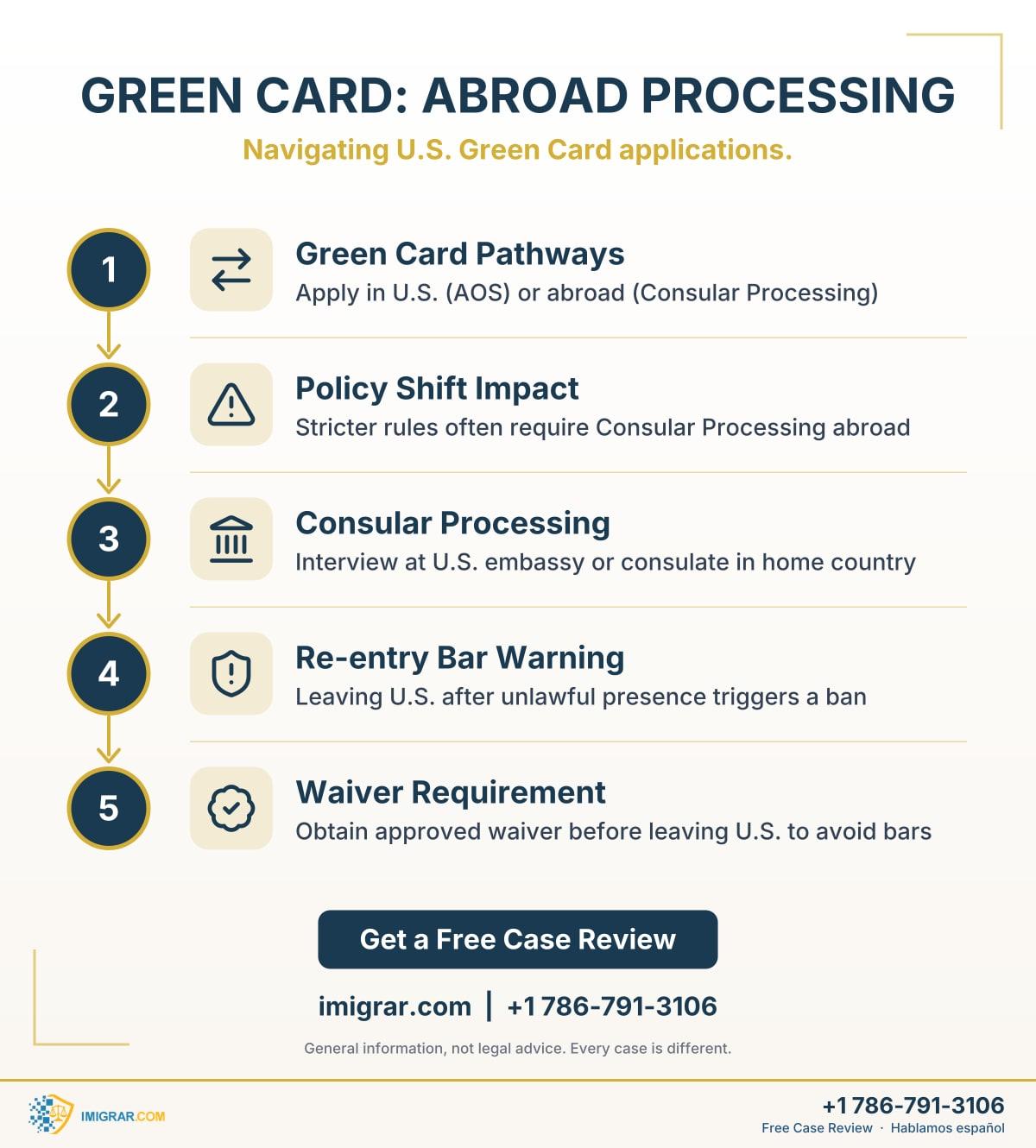
Why this news is showing up now
While the initial reporting on this policy shift dates back to the Trump administration, its implications are not a fleeting news cycle; they represent a fundamental change in how certain Green Card applications are handled and continue to impact immigrants today, in 2026. The "new rule" referenced in the PBS report wasn't necessarily a brand-new law but rather a more stringent enforcement and interpretation of existing immigration statutes, specifically regarding eligibility for Adjustment of Status versus the requirement for Consular Processing. The focus intensified on individuals who had accrued periods of unlawful presence in the U.S. or entered without inspection. For these individuals, the option to adjust status domestically became significantly curtailed, pushing them towards applying for their immigrant visa abroad. This created a heightened awareness and concern among immigrant communities and legal practitioners about the risks and requirements of leaving the U.S. to complete their Green Card process.
Even years later, the precedent set and the stricter enforcement mechanisms put in place continue to shape immigration procedures. Understanding these past policy decisions is crucial for anyone currently navigating the Green Card process, as the underlying legal principles and potential pitfalls remain highly relevant.
How it can affect Florida residents
For immigrants residing in Florida, particularly those in the vibrant and diverse Orlando area, this policy has profound implications. Florida is home to a large immigrant population, many of whom have family members either in the process of immigrating or considering it. The Orlando USCIS Field Office typically handles a high volume of Adjustment of Status applications. When individuals are deemed ineligible for AOS due to factors like unlawful entry or lengthy periods of unlawful presence, they are often directed to pursue Consular Processing. This means:
- Disruption to Families: Families in Central Florida may face the difficult decision of a loved one having to leave the U.S. for an indefinite period to attend an interview at a U.S. consulate or embassy in their home country. This can lead to prolonged separation, financial strain, and emotional distress.
- Increased Risk: Leaving the U.S. after accruing unlawful presence triggers potential re-entry bars (3-year or 10-year bans), which can only be overcome with an approved waiver. This adds a layer of significant risk and complexity to the process.
- Legal Complexities: Navigating consular processing and potential waivers requires meticulous preparation and expert legal guidance. Florida residents, from Orange County to the I-4 corridor, need to understand these nuances to avoid critical mistakes that could jeopardize their Green Card application.
- Economic Impact: The inability to adjust status domestically can impact an individual's ability to work legally and contribute to the Florida economy while their application is pending, often pushing them into precarious situations.
At Imigrar, we understand these challenges deeply. Our mission is to "Keep Families Together," and we are dedicated to guiding Orlando and Florida residents through these complex immigration pathways, minimizing risks, and maximizing success.
Need Help? Our Orlando immigration team is ready to assist. Call +1 786-791-3106 for a free consultation, or message us online. Se Habla Español.
What This Rule Is (and Why It Matters)
The "Trump administration rule" regarding Green Card applications from abroad is not a single, isolated piece of legislation, but rather a more aggressive enforcement posture and interpretation of existing U.S. immigration law, primarily the Immigration and Nationality Act (INA). It amplified the preference for Consular Processing for certain applicants and made Adjustment of Status less accessible for those with specific immigration histories, particularly those who entered the U.S. without inspection or overstayed their visas significantly.
A plain-English definition
In simple terms, for many years, if you were in the U.S. and eligible for a Green Card (e.g., through a family petition), you had two main options: Adjustment of Status (AOS) or Consular Processing. AOS allowed you to apply for your Green Card from within the U.S. without leaving. Consular Processing required you to return to your home country (or a third country if no consulate in your home country) for an interview at a U.S. consulate or embassy.
The policy shift meant that if you had certain issues in your immigration history – most notably, entering the U.S. illegally (without inspection) or accumulating significant periods of unlawful presence – you were generally deemed ineligible for Adjustment of Status. Instead, you would be required to leave the U.S. and complete your Green Card application through Consular Processing. The critical challenge with this is that leaving the U.S. after accruing unlawful presence can trigger a re-entry bar (a ban on returning to the U.S. for 3 or 10 years), making the process far more perilous unless a specific waiver is granted *before* you depart.
Key terms you need to know
Understanding the following terms is essential to grasp the nuances of this immigration policy:
- Green Card (Lawful Permanent Resident Status): This document grants you official authorization to live and work permanently in the United States.
- Adjustment of Status (AOS): The process of applying for a Green Card while physically present in the United States. It allows eligible individuals to transition from a nonimmigrant status (like a tourist or student visa) to lawful permanent resident status without leaving the country. This typically involves filing Form I-485, Application to Register Permanent Residence or Adjust Status.
- Consular Processing: The process of applying for an immigrant visa at a U.S. embassy or consulate outside the United States. Once approved, the immigrant visa allows entry into the U.S. as a permanent resident, and the Green Card is mailed afterward. This typically involves filing Form DS-260, Immigrant Visa Application.
- Immigrant Visa: A visa issued by a U.S. embassy or consulate abroad to an individual who intends to live permanently in the United States. It is essentially a temporary Green Card, valid for entry into the U.S. as a permanent resident.
- Unlawful Presence: This refers to time spent in the U.S. after the expiration of an authorized period of stay, or any time spent in the U.S. without being admitted or paroled. Accruing more than 180 days but less than one year of unlawful presence can trigger a 3-year bar to re-entry, while accruing one year or more can trigger a 10-year bar.
- Re-entry Bar: A legal penalty preventing an individual from re-entering the U.S. for a specific period (3 or 10 years) after leaving, often triggered by unlawful presence.
- Waiver of Inadmissibility: An application filed with USCIS (e.g., Form I-601, Application for Waiver of Grounds of Inadmissibility) or a U.S. consulate (e.g., Form I-212, Application for Permission to Reapply for Admission into the United States After Deportation or Removal) to overcome certain grounds that would otherwise make an individual ineligible (inadmissible) for a Green Card or entry into the U.S.
- Petition (e.g., Form I-130): The initial step in many family-based immigration cases, filed by a U.S. citizen or LPR relative to establish a qualifying relationship with the immigrant beneficiary.
The rule essentially underscored that if you are subject to an inadmissibility ground, particularly due to unlawful presence, and you are not eligible for a specific exception, you must pursue Consular Processing and likely obtain a waiver *before* leaving the U.S. to avoid the severe consequences of the re-entry bars.
Current Immigration Law: The Foundation
U.S. immigration law is primarily governed by the Immigration and Nationality Act (INA). This comprehensive statute outlines who is eligible for immigration benefits, the processes involved, and the grounds of inadmissibility that can prevent someone from obtaining a Green Card or entering the U.S. The "rule" discussed here largely stems from a stricter interpretation and enforcement of existing INA sections, particularly those related to adjustment of status (INA § 245), grounds of inadmissibility (INA § 212), and unlawful presence (INA § 212(a)(9)(B)).
Federal requirements
To qualify for a Green Card, whether through Adjustment of Status or Consular Processing, applicants must meet specific federal requirements. These generally include:
- Eligibility through a Petition: Most Green Card paths begin with an approved petition, typically a family-based petition (Form I-130, Petition for Alien Relative) filed by a U.S. citizen or Lawful Permanent Resident (LPR) spouse, parent, or child; or an employment-based petition (e.g., Form I-140, Immigrant Petition for Alien Worker).
- Admissibility: Applicants must be "admissible" to the United States. This means they must not fall under any of the grounds of inadmissibility outlined in INA § 212(a). Common grounds include:
- Health-related grounds: Certain communicable diseases, lack of vaccinations.
- Criminal grounds: Convictions for certain crimes, drug offenses.
- Security-related grounds: Terrorism, espionage.
- Public Charge grounds: Likelihood of becoming primarily dependent on government assistance.
- Immigration violations: Prior deportations, misrepresentations, and critically, unlawful presence.
- Visa Availability: For many family-based and employment-based categories, there is an annual limit on the number of visas issued. An applicant’s Priority Date (the date the initial petition was filed) must be current according to the U.S. Department of State's Visa Bulletin.
The key distinction highlighted by the Trump-era policy is that individuals who entered the U.S. without inspection (EWI) are generally barred from Adjustment of Status under INA § 245(a). Furthermore, those who accrued more than 180 days of unlawful presence and then depart the U.S. trigger a re-entry bar (3 years for 180 days to less than a year, 10 years for one year or more). To overcome these bars and other grounds of inadmissibility when applying through Consular Processing, specific waivers (like Form I-601 or Form I-212) must be approved. The Provisional Unlawful Presence Waiver (Form I-601A) allows some individuals to seek a waiver while still in the U.S. before departing for their consular interview, significantly reducing the period of separation from their families.
For detailed information on forms and requirements, always refer to the USCIS official website.
Florida-specific considerations
While immigration law is federal, its implementation has local impacts. For residents of Florida, particularly in the Orlando metropolitan area, there are several practical considerations:
- Orlando USCIS Field Office: This office processes interviews for Adjustment of Status and naturalization applications for Central Florida residents. If an individual is deemed ineligible for AOS during their interview here, they will be instructed to pursue Consular Processing, which means leaving Florida and the U.S.
- Access to Legal Expertise: Given Florida's large immigrant population, there's a strong network of immigration legal services. However, finding experienced attorneys well-versed in complex waiver applications and consular processing, especially involving travel abroad and re-entry bars, is crucial. Imigrar, located in Orlando, specializes in these intricate cases.
- Community Support: The immigrant communities across Orange County and the I-4 corridor often provide vital support networks. However, the emotional and logistical challenges of Consular Processing and potential family separation can be immense, making professional legal and emotional support indispensable.
- Economic Impact on Families: The need for a family member to leave the U.S. for an extended period can significantly impact household income and stability for families living in Florida. Planning for this financial strain is a key part of the process.
Navigating Complex Immigration Laws? Imigrar's expert team in Orlando can help you understand your options, whether it's Adjustment of Status or Consular Processing with a waiver. Call +1 786-791-3106 for a free consultation. Se Habla Español.
How to Navigate Consular Processing for a Green Card: A Complete Step-by-Step Guide
If you are required to pursue Consular Processing for your Green Card, the journey involves several critical steps that must be followed precisely. This guide outlines the typical process, emphasizing the importance of thorough preparation and legal counsel.
1) Determine Eligibility and Petition Filing
The first step in almost all family-based Green Card cases is to establish a qualifying relationship with a U.S. citizen or Lawful Permanent Resident (LPR) relative. This relative, known as the "petitioner," files a petition on your behalf, the "beneficiary."
- Action: The U.S. citizen or LPR petitioner files Form I-130, Petition for Alien Relative, with U.S. Citizenship and Immigration Services (USCIS).
- Required Documents (for Form I-130):
- Proof of U.S. citizenship or LPR status for the petitioner (e.g., birth certificate, passport, Green Card).
- Proof of qualifying relationship (e.g., marriage certificate, birth certificate, adoption decree).
- Passport-style photos of both petitioner and beneficiary.
- Copy of beneficiary's passport.
- Any necessary translations of foreign documents.
- Important: USCIS will review the petition to verify the relationship. Once approved, the petition is sent to the National Visa Center (NVC).
2) National Visa Center (NVC) Processing
After USCIS approves the Form I-130, it forwards the case to the National Visa Center (NVC), a component of the U.S. Department of State. The NVC is responsible for pre-processing immigrant visa applications before the interview at the U.S. embassy or consulate abroad.
- Action: The NVC will send instructions and invoices for fees. You will pay the Immigrant Visa Application Processing Fee and the Affidavit of Support Fee. Then, the beneficiary (or their attorney) will complete and submit Form DS-260, Immigrant Visa Application, and the petitioner will submit Form I-864, Affidavit of Support.
- Required Documents (for NVC stage):
- Confirmation page of submitted Form DS-260.
- Form I-864, Affidavit of Support, with supporting financial documents (e.g., federal income tax returns, W-2s, employment letters, pay stubs, bank statements) from the petitioner and any joint sponsors.
- Beneficiary's birth certificate.
- Marriage certificate (if applicable).
- Police certificates from all countries where the beneficiary has lived for certain periods since age 16.
- Military records (if applicable).
- Court and prison records (if applicable).
- Any previous immigration-related documents (e.g., prior visa applications, I-94 records).
- Passport biographic data page.
- All documents must be translated into English by a certified translator.
- Reminder: Ensure all documents are scanned and uploaded to the NVC's Consular Electronic Application Center (CEAC) accurately and completely. Incomplete submissions will delay your case.
3) Gather Required Documents for Interview
While the NVC reviews your submitted documents, you should begin preparing the original copies of all documents you will need to bring to your consular interview. This includes all documents uploaded to the NVC, plus additional items.
- Action: Collect all original civil documents, financial documents, and any other required paperwork. Ensure all foreign documents are accompanied by certified English translations.
- Required Documents (for interview, in addition to NVC documents):
- Valid passport, valid for at least six months beyond the intended date of entry into the U.S.
- Two identical passport-style photographs meeting U.S. visa requirements.
- Appointment confirmation letter from the NVC.
- Medical examination results (see step 4).
- Any original waivers approved by USCIS (e.g., Form I-601A, Provisional Unlawful Presence Waiver).
- Proof of termination of prior marriages (divorce decrees, death certificates), if applicable.
- Original police certificates.
- Evidence of relationship (e.g., photos, correspondence, joint accounts for spouses).
- Warning: Do not travel to the interview without all required original documents. A missing document can lead to significant delays or even denial.
4) Medical Examination
Before your interview, you must undergo a medical examination by a physician authorized by the U.S. embassy or consulate in the country where your interview will take place. This is a mandatory step to ensure you meet the health-related admissibility requirements.
- Action: Schedule and attend a medical examination with an approved panel physician. The NVC website or the embassy/consulate's website will provide a list of approved doctors.
- Required for Medical Exam:
- Valid passport.
- Appointment letter.
- Vaccination records (immunizations are required for immigrant visas).
- List of current medications.
- Any relevant medical history (e.g., prior surgeries, chronic conditions).
- Fees for the examination.
- Important: The physician will provide the results in a sealed envelope. DO NOT open this envelope. You must bring it unopened to your visa interview.
5) Attend the Visa Interview Abroad
This is the most critical step, where a consular officer will review your application, verify your documents, and determine your eligibility for an immigrant visa.
- Action: Travel to the designated U.S. embassy or consulate in your home country (or a third country if permitted) for your scheduled interview. Be prepared to answer questions about your relationship to the petitioner, your background, and your intentions in the U.S.
- Required for Interview:
- All original documents gathered in Step 3.
- Sealed medical exam results.
- Any additional documents requested by the consular officer.
- Tip: Dress professionally, arrive early, and answer all questions honestly and directly. If you have an attorney, they generally cannot attend the interview with you inside the consulate, but they can prepare you thoroughly beforehand.
6) Visa Issuance and U.S. Entry
If your interview is successful and no additional documents or waivers are needed, the consular officer will approve your immigrant visa.
- Action: The embassy or consulate will typically stamp your passport with an immigrant visa and return it to you, often with a sealed "visa packet" (do not open this). You then have a limited timeframe (usually six months) to enter the U.S.
- Required for U.S. Entry:
- Passport with immigrant visa.
- Sealed visa packet (if provided).
- Proof of payment of the USCIS Immigrant Fee (paid online *after* visa approval, but *before* entry).
- Important: Upon entry at a U.S. Port of Entry, a Customs and Border Protection (CBP) officer will inspect your documents and admit you as a lawful permanent resident.
7) Green Card Production
After you have been admitted to the U.S. as a permanent resident, USCIS will process and mail your physical Green Card.
- Action: Your Green Card will typically be mailed to the address provided on your Form DS-260 within a few weeks of your entry. Ensure your mailing address is accurate and update it with USCIS if it changes.
- Reminder: If you don't receive your Green Card within 90 days of entry, contact USCIS.
This process can be lengthy and fraught with potential complications, especially if waivers for inadmissibility are required. Seeking experienced legal counsel from the outset is highly recommended to ensure all steps are followed correctly and to anticipate and mitigate potential issues.
Practical Steps You Can Take Today
Navigating the complexities of Consular Processing, especially when dealing with potential re-entry bars or inadmissibility, requires proactive planning. Here are practical steps you can take right now to prepare and protect your future.
Overwhelmed by Consular Processing? Let Imigrar simplify the journey. Our Orlando-based team offers expert guidance and support. Call +1 786-791-3106 for a free consultation. Se Habla Español.
Actionable Checklist
- Consult with an Experienced Immigration Attorney: This is the most crucial first step. An attorney can assess your unique situation, determine if you are subject to the "apply abroad" rule, identify potential inadmissibility issues (like unlawful presence), and advise on necessary waivers (e.g., Form I-601A).
- Gather All Personal and Financial Documents: Start collecting birth certificates, marriage certificates, divorce decrees, passports, school records, employment history, tax returns, bank statements, and any previous immigration paperwork.
- Understand Your Immigration History: Be honest and thorough about your entire history in the U.S., including entry dates, visa types, departures, and any periods of overstay or unauthorized work. This information is vital for your attorney to assess your eligibility and potential challenges.
- Plan Financially: Consular Processing involves various fees (USCIS, NVC, medical exam, travel costs) and potential income loss during separation. Begin saving and preparing a financial plan.
- Secure a U.S. Citizen or LPR Sponsor: If you are applying through a family petition, ensure your petitioner is willing and able to meet the financial requirements of the Affidavit of Support (Form I-864).
- Research Consular Procedures: Familiarize yourself with the specific U.S. embassy or consulate where your interview will likely take place. Their websites (e.g.,
Related Articles
You may also be interested in:
-
Naturalization Test Changes 2026: What Orlando Immigrants Need to Know Now
Major changes are coming to the U.S. Naturalization Test in 2026. Learn how these updates could impact your path to citizenship, especially for those ...
-
USCIS Issues New Naturalization Guidance on Good Moral Character — Nov 19, 2026, 6:00 AM
USCIS released guidance explaining how financial support obligations, public benefits, and affidavits of support may affect naturalization application...
-
Federal Court Dismisses EB-5 Delay Lawsuit Against DHS — Nov 19, 2026, 3:00 AM
A federal court rejected a 32-month EB-5 processing-delay challenge, reinforcing the difficulty of proving unreasonable agency delay. Investors should...
-
First Circuit Rejects DHS Third-Country Deportation Policy — Nov 18, 2026, 9:00 PM
A federal appeals court found DHS’s third-country removal process unlawful, strengthening notice and fear-screening protections for people facing depo...
-
Naturalization Test Changes 2026: What Orlando Immigrants Need to Know Now
Related Topics
Need Legal Assistance?
Our experienced immigration attorneys are here to help with your case. Contact Imigrar today for a free consultation and let us guide you through the legal process with confidence.
📍 Orlando, Florida • Serving clients nationwide
📧 info@imigrar.com