
Naturalization Test Changes 2026: What Orlando Immigrants Need to Know Now
Major changes are coming to the U.S. Naturalization Test in 2026. Learn how these updates could impact your path to citizenship, especially for those in Orlando and Central Florida. Imigrar helps you prepare.
The journey to U.S. citizenship is a significant milestone for many immigrants, offering stability, rights, and the opportunity to truly call America home. At Imigrar, we understand that this path, while rewarding, can also be complex and filled with questions. As an immigration law firm based in Orlando, Florida, dedicated to keeping families together, we are committed to providing you with timely, accurate, and actionable information.
Today, we're addressing a crucial development that could impact thousands of aspiring citizens across Florida and the nation: the upcoming changes to the Naturalization Test in 2026. Understanding these changes now is key to a smooth and successful naturalization process.
Need Help? Our Orlando immigration team is ready to assist. Navigating naturalization, especially with upcoming changes, can be challenging. Call +1 786-791-3106 for a free consultation, or message us online. Se Habla Español.
The reporting that sparked this guide
Recent reports have highlighted significant updates on the horizon for the U.S. Naturalization Test. These changes are designed to modernize the test and ensure it accurately assesses an applicant's understanding of U.S. history, government, and civics. While the exact details are still being finalized, the general direction points towards a more interactive and analytical assessment.
For more details on the developing news, you can refer to reports such as: Naturalization Test Changes Coming in 2026 (Citizenship)
What This News Means for Immigrants in Orlando and Across Florida
The news of impending changes to the Naturalization Test is significant for anyone planning to apply for U.S. citizenship. For immigrants residing in Orlando, Central Florida, and throughout the Sunshine State, these updates necessitate proactive preparation.
Why this news is showing up now
The U.S. Citizenship and Immigration Services (USCIS) periodically reviews and updates its naturalization process to ensure its effectiveness and relevance. The last major overhaul of the civics test was implemented in 2008, with a temporary revision in 2020 that was later rescinded. These cycles of review mean that discussions and pilot programs for new test formats often begin years in advance of their official implementation.
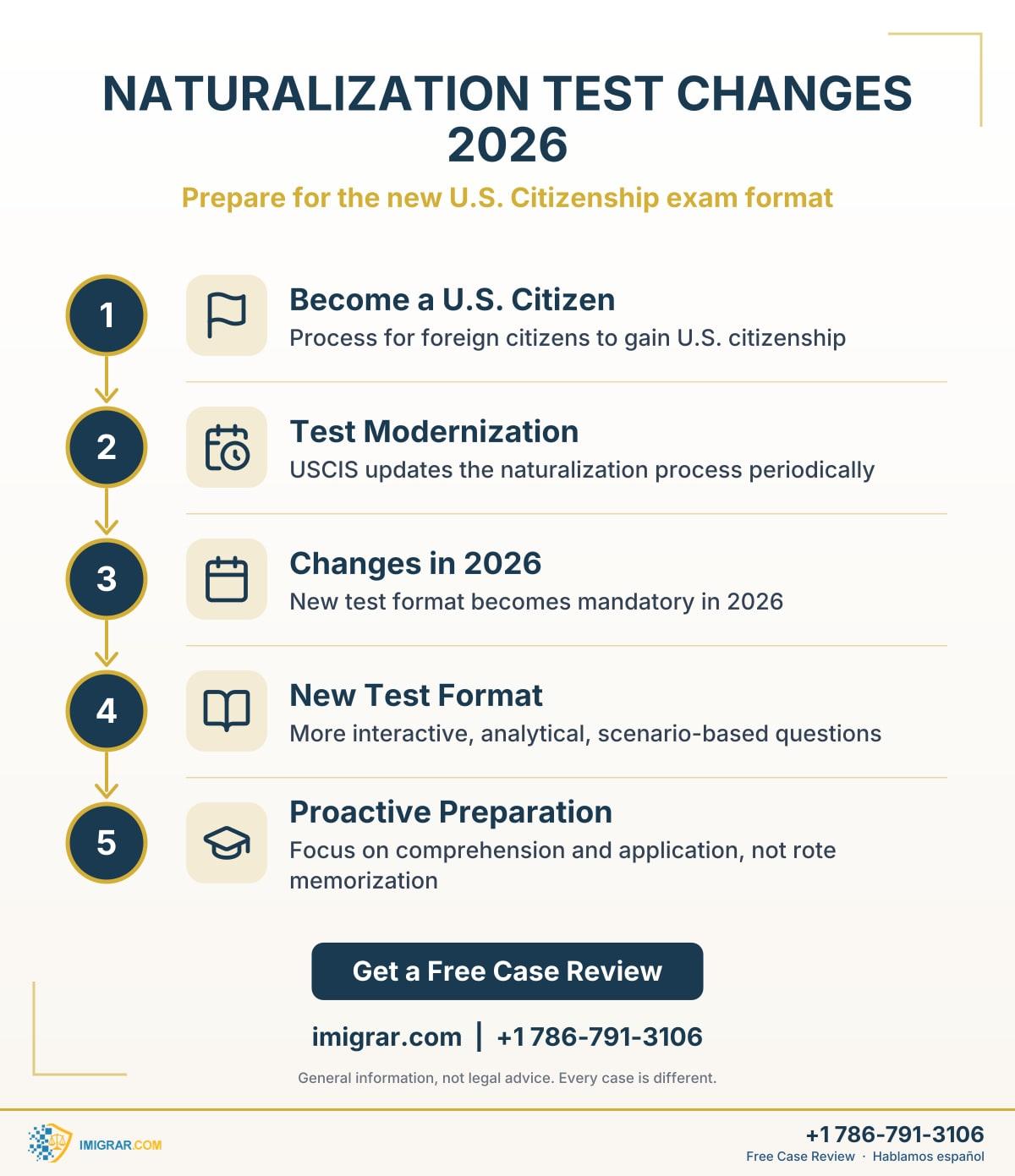
The current news cycle is a result of USCIS efforts to pilot and evaluate potential new test formats. This foresight allows future applicants to be aware and begin preparing for the revised requirements well before they become mandatory in 2026. It’s a call to action for prospective citizens to stay informed and adapt their study strategies.
How it can affect Florida residents
Whether you're living in Orange County, along the I-4 corridor, or anywhere else in Florida, the naturalization process culminates in an interview at a USCIS Field Office, such as the one in Orlando. The upcoming changes will directly impact how you prepare for and experience that crucial interview.
- Preparation Strategy: Current study materials primarily focus on memorization of 100 civics questions. The new test is expected to include more scenario-based questions, requiring a deeper understanding and analytical thinking, rather than just recall.
- Interview Experience: The interview format itself might change, potentially incorporating elements that assess civic knowledge and English proficiency in a more integrated, conversational manner.
- Timelines: While the changes are slated for 2026, if you plan to apply for citizenship in the next year or two, you might fall under the current test rules. However, if your application process extends into 2026 or later, you will likely encounter the new format. Understanding your potential timeline is critical.
- Local Resources: Communities in Orlando and across Florida offer various resources for naturalization preparation. These resources will need to update their curricula to reflect the new test structure, so staying connected with reputable organizations and legal counsel like Imigrar is essential.
For Central Florida residents, understanding these changes means you can begin to adjust your study habits now, focusing on comprehension and application rather than rote memorization. This proactive approach will significantly increase your chances of success.
Considering naturalization in Florida? Don't wait for 2026 to start preparing. Our experienced immigration attorneys at Imigrar can help you understand your eligibility and navigate the process. Call +1 786-791-3106 today for a free consultation. Se Habla Español.
What Naturalization Is (and Why It Matters) and the Upcoming Test Changes
Naturalization is the process by which a foreign citizen or national can become a U.S. citizen. It's a pathway to full participation in American society, offering rights and responsibilities that extend beyond those of a lawful permanent resident (Green Card holder). The Naturalization Test is a critical component of this process, designed to ensure applicants possess a basic understanding of the English language and U.S. civics.
A plain-English definition
In simple terms, Naturalization is how you officially become a citizen of the United States after having been a lawful permanent resident (Green Card holder) for a certain period. The process involves submitting an application, attending an interview, and passing a two-part test: an English test and a civics test. If successful, you take an Oath of Allegiance and officially become a U.S. citizen.
The "Naturalization Test Changes Coming in 2026" refer to proposed updates to the civics portion of this test. Instead of just asking for specific facts (e.g., "What is the capital of Florida?"), the new test is expected to include more scenario-based questions that require applicants to apply their knowledge of U.S. government and history to hypothetical situations, or to explain concepts in their own words. For instance, an applicant might be asked to describe the purpose of the three branches of government rather than just naming them.
Key terms you need to know
- USCIS (U.S. Citizenship and Immigration Services): The government agency responsible for overseeing lawful immigration to the United States, including the naturalization process. You will interact with USCIS throughout your application.
- Form N-400: The official application form for naturalization. This is the primary document you submit to initiate the process.
- Lawful Permanent Resident (LPR) / Green Card Holder: An individual who has been granted the privilege of permanently residing in the United States. This is a prerequisite for most naturalization applicants.
- Naturalization Interview: A meeting with a USCIS officer where your application is reviewed, and you take the English and civics tests. For those in Central Florida, this typically occurs at the Orlando USCIS Field Office.
- English Test: Assesses your ability to read, write, and speak basic English. You'll be asked to read a simple sentence, write a simple sentence, and answer questions verbally during the interview.
- Civics Test: Assesses your knowledge of U.S. history, government, and civics. This is the portion of the test that is slated for significant changes in 2026.
- Oath of Allegiance: The final step in the naturalization process, where you formally pledge your loyalty to the United States and become a U.S. citizen.
- Continuous Residence: The requirement that an applicant maintain residence in the U.S. for a specified period (usually 5 years, or 3 years if married to a U.S. citizen) before applying for naturalization.
- Good Moral Character: A legal requirement that means an applicant must not have committed certain crimes or acts that would disqualify them from citizenship during the statutory period prior to applying.
Understanding these terms is fundamental to navigating the naturalization process, especially as the test components evolve. The shift towards more analytical questions for the civics test means that simply memorizing the 100 questions will likely no longer be sufficient for those applying in 2026 and beyond. A deeper understanding of concepts and the ability to articulate them will be crucial.
Current Immigration Law: The Foundation of U.S. Citizenship
The naturalization process is governed by federal law, primarily the Immigration and Nationality Act (INA). While the test content may change, the underlying legal requirements for eligibility remain steadfast.
Federal requirements
The core requirements for naturalization are outlined in Section 312 of the INA (8 U.S.C. § 1423) for the English and civics requirements, and Section 316 (8 U.S.C. § 1427) and Section 319 (8 U.S.C. § 1430) for general eligibility. To become a U.S. citizen through naturalization, most applicants must meet the following criteria:
- Age: Be at least 18 years old at the time of filing Form N-400.
- Lawful Permanent Residence: Be a lawful permanent resident (Green Card holder) for at least 5 years. This period is reduced to 3 years if you are married to a U.S. citizen and meet specific conditions (e.g., have been living in marital union with the citizen spouse for those 3 years).
- Continuous Residence: Have maintained continuous residence in the U.S. for the required 5 or 3 years immediately preceding the filing of Form N-400. Absences from the U.S. can break continuous residence if they are for 6 months or more.
- Physical Presence: Have been physically present in the U.S. for at least half of the required continuous residence period (e.g., 30 months out of 5 years, or 18 months out of 3 years).
- Residence in USCIS District/State: Reside for at least 3 months in the state or USCIS district where you file your Form N-400. For Orlando residents, this means having lived in Florida for at least 3 months.
- Good Moral Character: Demonstrate good moral character for the statutory period (5 or 3 years) leading up to your application and until you take the Oath of Allegiance. Certain criminal convictions or actions can disqualify an applicant.
- Attachment to the U.S. Constitution: Be able to demonstrate an attachment to the principles of the U.S. Constitution and a willingness to take the Oath of Allegiance.
- English and Civics Knowledge: Be able to read, write, and speak basic English, and have a basic understanding of U.S. history and government (civics). This is where the 2026 test changes will apply.
Important: There are exceptions to some of these requirements for certain groups, such as military personnel, spouses of U.S. citizens working abroad, and individuals with specific medical conditions that prevent them from learning English or civics. USCIS official website provides detailed guidance on these exceptions.
Florida-specific considerations
While naturalization laws are federal, the practical application often involves local factors. For those living in Orlando and Central Florida:
- Orlando USCIS Field Office: Your naturalization interview will typically be conducted at the Orlando USCIS Field Office. Familiarizing yourself with its location and procedures can reduce stress.
- Community Resources: Various non-profit organizations and educational institutions in Orange County and surrounding areas offer citizenship classes and English language support, which will be vital for preparing for the current and future civics tests.
- Legal Expertise: An immigration law firm like Imigrar, based in Orlando, is intimately familiar with the local USCIS office’s practices and can provide tailored advice for Florida residents.
Remember, while the specifics of the civics test are evolving, the fundamental requirements for naturalization remain consistent under federal law. Understanding these foundations is the first step toward a successful application.
Worried about meeting naturalization requirements? Imigrar offers expert legal guidance for immigrants in Orlando and nationwide. Let us help you assess your eligibility and prepare your application. Call +1 786-791-3106 for a free consultation. Se Habla Español.
How to Apply for U.S. Citizenship: A Complete Step-by-Step Guide
The naturalization process involves several stages, each with its own requirements and timelines. Here’s a comprehensive guide to help you navigate the journey to U.S. citizenship.
1) Determine Your Eligibility
Before you even begin filling out forms, confirm you meet the fundamental requirements. This is the most crucial first step.
- Check your Green Card status: Have you been a Lawful Permanent Resident for at least 5 years (or 3 years if married to a U.S. citizen and living together)?
- Review your travel history: Have you maintained continuous residence and met the physical presence requirements? Extended trips outside the U.S. can impact this.
- Assess your moral character: Have you avoided committing certain crimes that could disqualify you? Be honest and seek legal advice if you have any arrests or convictions, no matter how minor.
- Confirm your age and residency: Are you at least 18 years old, and have you lived in Florida for at least 3 months?
Required Documents for Eligibility Assessment:
- Your Green Card (Form I-551)
- Passports and travel records (entry/exit stamps)
- Marriage certificate (if applying under the 3-year rule)
- Divorce decrees or death certificates for previous marriages (if applicable)
- Criminal records (if any, including arrest reports, court dispositions, probation records)
2) Prepare and File Form N-400, Application for Naturalization
Once you’ve confirmed eligibility, the next step is to meticulously complete and submit Form N-400. This form is extensive and requires accurate information about your personal history, residence, employment, travel, and moral character.
- Gather all necessary documents: This includes copies of your Green Card, marriage certificate (if applicable), tax transcripts for the past 5 years (or 3 years), selective service registration (if male and between ages 18-26), and any other supporting evidence.
- Complete Form N-400: Fill out the form accurately and completely. Do not leave any sections blank; write "N/A" if a question does not apply to you.
- Pay the filing fees: As of 2026, fees are subject to change, but currently, the filing fee for Form N-400 is typically $640, plus an $85 biometrics fee (total $725). Fee waivers are available for certain low-income applicants. Always check the USCIS Fees page for the most current information.
- Mail your application: Send your completed Form N-400 and supporting documents to the correct USCIS lockbox facility. The address depends on where you live.
Required Documents for Form N-400 Filing:
- Completed and signed Form N-400
- Copy of your Green Card (front and back)
- Two passport-style photos (if required; check instructions for current requirements)
- Check or money order for the filing fees, or approved fee waiver request (Form I-912)
- Copies of marriage certificates, divorce decrees, birth certificates of children (if applicable)
- Certified court dispositions for any arrests or convictions (even if expunged)
- Tax transcripts for the past 5 (or 3) years (Important: USCIS often requests these)
- Proof of Selective Service registration (for males born after Dec 31, 1959)
3) Attend Your Biometrics Appointment
After filing Form N-400, USCIS will send you an appointment notice (Form I-797C, Notice of Action) for a biometrics appointment at an Application Support Center (ASC).
- Fingerprints, photos, and signature: At this appointment, USCIS will collect your fingerprints, photograph, and signature. This information is used for background checks.
- Timeliness: It is crucial to attend this appointment. If you cannot, you must follow the instructions on the notice to reschedule.
Required Documents for Biometrics Appointment:
- Biometrics appointment notice (Form I-797C)
- Valid government-issued photo identification (e.g., Green Card, passport, driver's license)
4) Prepare for the Naturalization Interview and Test
This is where the upcoming 2026 changes to the civics test become particularly relevant. Regardless of the test format, thorough preparation is essential.
- English Test Preparation: Practice reading and writing simple English sentences. Be ready to answer questions about your Form N-400 verbally in English.
- Civics Test Preparation (Current): Study the 100 civics questions and answers provided by USCIS. You will be asked up to 10 questions and must answer 6 correctly.
- Civics Test Preparation (For 2026 Changes): Begin to focus on understanding the *concepts* behind the civics questions. Practice explaining governmental functions, historical events, and civic duties in your own words. Stay updated on the specific format changes announced by USCIS. Resources from USCIS will be updated closer to 2026.
- Review your Form N-400: The interviewing officer will ask questions based on your application. Be familiar with every answer you provided.
Resources for Preparation:
- USCIS Civics Test Study Materials
- English language learning resources
- Local citizenship classes in Orlando or Central Florida
- Immigration lawyer for personalized test prep strategies
5) Attend the Naturalization Interview
Your interview will be scheduled at the Orlando USCIS Field Office. This is your opportunity to demonstrate your eligibility and knowledge.
- Arrive on time: Be punctual and bring all required documents.
- Be honest and thorough: Answer all questions truthfully and to the best of your ability.
- Pass the English and Civics Tests: The officer will administer both tests during the interview.
- Review and sign: The officer will review your Form N-400 with you and may ask you to sign an updated application if there have been changes since filing.
Required Documents for Interview:
- Interview Appointment Notice (Form I-797C)
- Your Green Card (Form I-551)
- All passports (current and expired)
- State-issued identification (e.g., Florida driver's license)
- Originals of all documents submitted with Form N-400 (e.g., marriage certificate, birth certificates of children, court dispositions)
- Proof of current marital status (if applicable)
- Proof of any recent travel outside the U.S.
- Proof of financial support (e.g., latest tax returns, pay stubs)
- Any other documents requested in your appointment letter or that have changed since filing
6) Receive a Decision and Attend the Oath of Allegiance Ceremony
After your interview, the USCIS officer will make a decision on your application.
- Decision: You may receive a decision immediately, or USCIS may mail you a decision notice (Form N-652, Naturalization Interview Results) later.
- Oath Ceremony: If approved, you will receive a notice (Form N-445, Notice of Naturalization Oath Ceremony) to attend an Oath of Allegiance ceremony. This is typically held within a few weeks or months.
- Become a U.S. Citizen: At the ceremony, you will return your Green Card, take the Oath of Allegiance, and receive your Certificate of Naturalization. Congratulations, you are now a U.S. citizen!
Required Documents for Oath Ceremony:
- Form N-445, Notice of Naturalization Oath Ceremony
- Your Green Card (Form I-551)
- Any other documents listed on Form N-445
Practical Steps You Can Take Today
Don't wait until 2026 to start preparing for your naturalization journey. Proactive planning can make all the difference, especially with the upcoming test changes.
Navigating the naturalization process can be overwhelming. Imigrar's Orlando team provides personalized support, from application preparation to interview coaching. Call us at +1 786-791-3106 for a free consultation. Se Habla Español.
Actionable checklist with 5+ items
- Start Studying Now (and Smart): Begin reviewing the current 100 civics questions. More importantly, start understanding the *concepts* behind them. Don't just memorize answers; comprehend why they are important. For example, understand *why* we have three branches of government, not just their names.
- Improve Your English Skills: The English test is foundational. Practice speaking, reading, and writing English daily. Watch English news, read books, and converse with native speakers. This will also help with the conversational aspect of the interview.
- Gather and Organize Your Documents: Start collecting all necessary documents: Green Card, passports, tax returns, marriage certificates, birth certificates, and any court records. Organize them neatly and make copies. This will save significant time later.
- Consult with an Immigration Attorney: Even if you think your case is straightforward, a consultation with a lawyer from Imigrar can identify potential issues you might overlook, confirm eligibility, and guide you on the best preparation strategy, especially concerning the 2026 test changes.
- Monitor USCIS Updates: Regularly check the USCIS official website for the latest information on the 2026 Naturalization Test changes. They will release official study materials and guidelines as the implementation date approaches.
- Maintain Good Moral Character: Avoid any actions that could jeopardize your "good moral character" requirement. This includes avoiding arrests, paying taxes, and fulfilling any child support obligations.
Document preparation guidance
- Originals vs. Copies: For your Form N-400 submission, generally send copies of documents unless USCIS specifically requests originals. *However, always bring the originals to your interview.*
- Translations: Any document not in English must be accompanied by a complete and certified English translation. The translator must certify that they are competent to translate and that the translation is accurate.
- Organization: Use tabs, labels, and binders to keep your documents organized. This makes it easier for you and the USCIS officer to review your application. Create a checklist to ensure you have everything.
- Tax Records: It is highly recommended to obtain official tax transcripts from the IRS for the required period, rather than just submitting copies of your filed returns. These are considered more authoritative.
Timeline expectations
The naturalization process can take time. Current processing times for Form N-400 vary significantly by field office. For the Orlando USCIS Field Office, you can check specific USCIS Processing Times online.
- Filing to Biometrics: Typically 1-2 months after filing.
- Biometrics to Interview: Can range from 6 months to over a year, depending on the field office workload.
- Interview to Oath Ceremony: Often within a few weeks to a couple of months, but can be longer in some cases.
Reminder: These are estimates. The entire process, from filing Form N-400 to the Oath Ceremony, can take anywhere from 8 months to 2 years or more. Starting your preparation early, especially with the 2026 test changes looming, is the smartest approach.
How Imigrar Helps Immigrants in Orlando Navigate Naturalization
At Imigrar,
Related Topics
Need Legal Assistance?
Our experienced immigration attorneys are here to help with your case. Contact Imigrar today for a free consultation and let us guide you through the legal process with confidence.
📍 Orlando, Florida • Serving clients nationwide
📧 info@imigrar.com