
SCOTUS Rulings: What They Mean for TPS & Asylum Seekers in Florida
The Supreme Court’s recent decisions on TPS and asylum have profound implications. Understand the rulings, their impact on Florida immigrants, and how to protect your rights.
The landscape of U.S. immigration law is constantly shifting, and recent Supreme Court decisions have introduced significant changes that directly affect thousands of families in Florida and across the nation. At Imigrar, we understand the anxiety and uncertainty these developments can cause. Our mission is to keep families together, and that means providing clear, accurate, and actionable information to help you navigate these complex times. Today, we delve into two seismic rulings that demand your immediate attention.
Need Help? Our Orlando immigration team is ready to assist. Call +1 786-791-3106 for a free consultation, or message us online. Se Habla Español.
The reporting that sparked this guide
What This News Means for Immigrants in Orlando and Across Florida
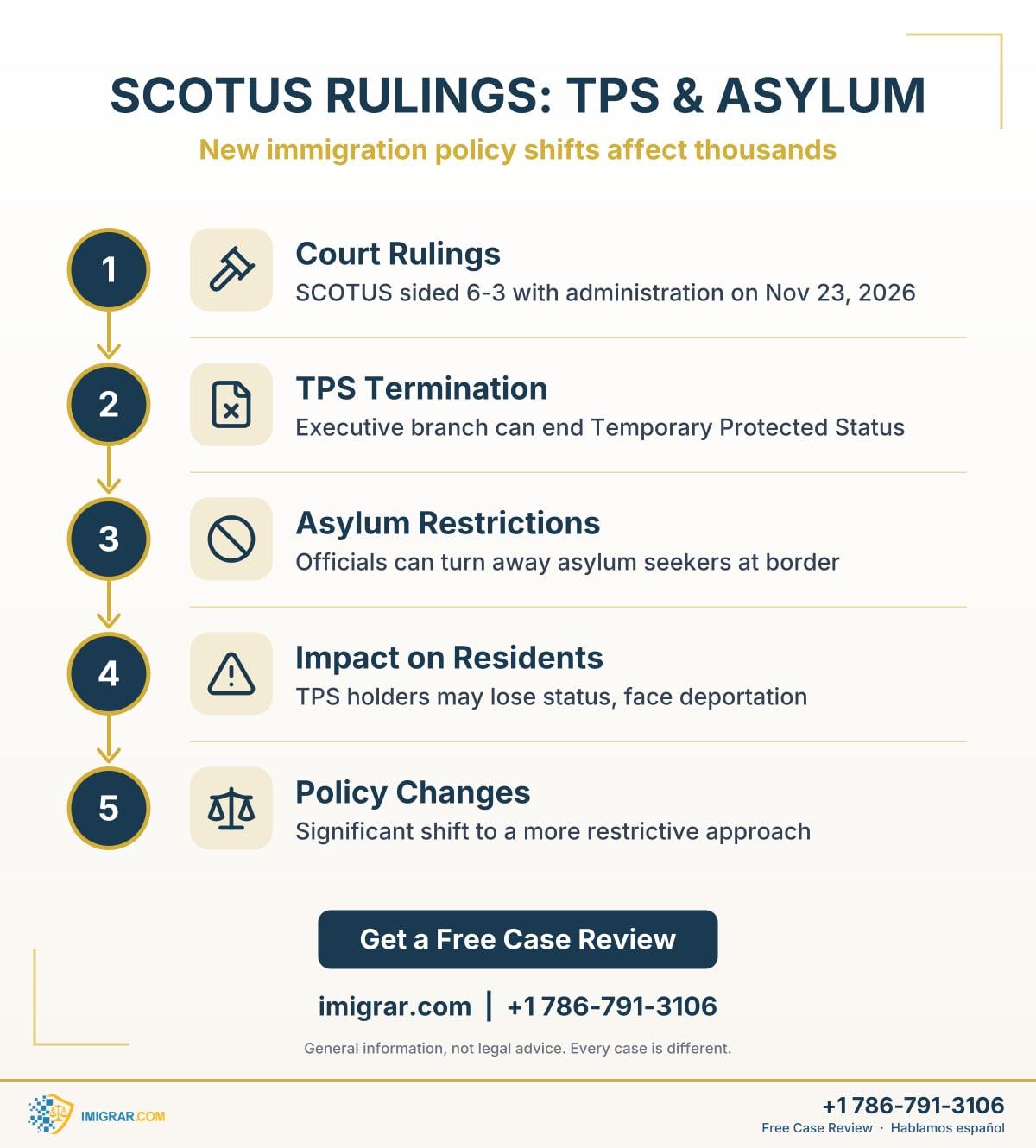
The recent Supreme Court decisions, issued on November 23, 2026, represent a significant shift in U.S. immigration policy, particularly concerning Temporary Protected Status (TPS) and asylum claims at the border. These rulings, both decided 6-3 in favor of the Trump administration, underscore a more restrictive approach to immigration that could have far-reaching consequences for individuals and families who have built lives in the United States, including many here in Orlando and throughout Florida.
Why this news is showing up now
These rulings are the culmination of years of legal challenges to policies implemented by the Trump administration. The administration sought to significantly curtail protections for certain immigrant groups and limit access to asylum. Advocates and immigrant rights organizations fought these policies through the lower courts, but the cases have now reached the nation's highest judicial body. The Supreme Court's conservative majority has ultimately sided with the executive branch's broad authority in immigration matters, leading to these definitive, and for many, devastating, outcomes.
The cases specifically addressed the administration's attempts to terminate TPS designations for several countries and its policies regarding asylum processing at the U.S. southern border, often referred to as "turn away" policies or restrictions on asylum eligibility based on how one enters the country. The legal battles were complex, revolving around interpretations of the Administrative Procedure Act (APA), the Immigration and Nationality Act (INA), and international human rights obligations. The Court's decisions signal a willingness to grant substantial deference to the executive branch in setting immigration policy, even when those policies significantly reduce protections for vulnerable populations.
How it can affect Florida residents
Florida is home to a vibrant and diverse immigrant population, including many individuals from countries designated for TPS. These rulings directly threaten the stability of thousands of TPS holders who have lived and worked legally in the U.S. for years, contributing to our economy and communities. For Central Florida residents, particularly those in Orlando, Kissimmee, and along the I-4 corridor, the impact could be profound. Many families have mixed-status members, meaning some have TPS while others are U.S. citizens or lawful permanent residents. The termination of TPS could separate families, disrupt established lives, and create immense economic hardship.
For asylum seekers, especially those who may have been considering arriving at the U.S. southern border, these rulings mean a drastically reduced chance of even having their case heard. Florida has historically been a destination for individuals seeking refuge, and these decisions could close doors that once offered hope. It is crucial for anyone considering seeking asylum or those currently in the process to understand that the legal landscape has become significantly more challenging. This also impacts legal aid organizations and attorneys in Orlando who assist asylum seekers, as they must now navigate an even more restrictive legal framework.
The Orlando USCIS Field Office and local immigration courts will inevitably feel the ripple effects of these decisions. There may be increased processing of TPS terminations, a surge in deportation proceedings for those who lose their status, and a more stringent approach to asylum claims. For any immigrant in Florida, understanding these changes and seeking legal counsel is more critical now than ever before.
Need Help? Our Orlando immigration team is ready to assist. Call +1 786-791-3106 for a free consultation, or message us online. Se Habla Español.
What These Rulings Are (and Why It Matters)
The Supreme Court's recent decisions represent a significant setback for immigrant rights and protections. While the specifics of each ruling are complex, their combined effect is to empower the executive branch to limit humanitarian protections and restrict access to asylum more aggressively.
A plain-English definition
In simple terms, the Supreme Court has ruled that the Trump administration had the legal authority to proceed with its plans to end Temporary Protected Status (TPS) for certain countries. This means that people from these countries who have lived legally in the U.S. under TPS for many years may now lose their protected status and face deportation. Simultaneously, the Court also affirmed the administration's ability to implement policies that effectively allow border officials to "turn away" asylum seekers at the U.S. border, making it much harder, if not impossible, for many individuals fleeing persecution to even apply for asylum if they don't meet specific, stringent entry requirements or arrive at a designated port of entry.
These rulings are not just legal technicalities; they are decisions with profound human consequences. They impact individuals who have built lives, raised families, and contributed to American society, as well as those desperately seeking safety from persecution. For those whose countries were designated for TPS, this could mean being forced to return to dangerous conditions they fled years ago. For asylum seekers, it could mean being denied the fundamental right to seek protection, potentially sending them back to life-threatening situations.
Key terms you need to know
- Temporary Protected Status (TPS): A humanitarian immigration program established by the Immigration and Nationality Act (INA) that allows eligible nationals of certain countries to remain in the U.S. and obtain work authorization if their home country is experiencing conditions (such as armed conflict, environmental disaster, or other extraordinary circumstances) that make it unsafe for them to return. TPS is temporary and can be extended or terminated by the Secretary of Homeland Security.
- Asylum: A form of protection granted to individuals who are unable or unwilling to return to their country of origin because of a well-founded fear of persecution on account of race, religion, nationality, membership in a particular social group, or political opinion. Asylum seekers must generally apply within one year of their arrival in the U.S.
- Supreme Court: The highest judicial body in the United States, responsible for interpreting the Constitution and federal laws. Its decisions are binding on all other federal and state courts.
- Trump Administration Policies: The set of immigration policies pursued during the Trump presidency, characterized by increased enforcement, restrictions on legal immigration, and efforts to limit asylum access.
- "Strip TPS": Refers to the government's action of terminating the TPS designation for a particular country, thereby ending the protected status for its nationals in the U.S.
- "Turn Away Asylum Seekers": Policies that deny individuals the opportunity to apply for asylum at the border, often by implementing restrictions on how and where asylum claims can be made, or by returning individuals to third countries without a full hearing. This can include policies like "Remain in Mexico" (Migrant Protection Protocols) or limitations based on "transit bans."
- Immigration and Nationality Act (INA): The body of law governing immigration to the United States. It sets forth the conditions for entry, residence, and naturalization.
- Administrative Procedure Act (APA): A federal law that governs the way in which administrative agencies of the federal government may propose and establish regulations. Challenges to TPS terminations often argued that the administration violated the APA.
Current Immigration Law: The Foundation
Understanding the current state of immigration law is crucial, especially in light of these new rulings. While the Supreme Court's decisions have significant implications, they operate within the existing framework of the Immigration and Nationality Act (INA). It’s important to remember that these rulings interpret the law, but they don't rewrite the fundamental statutes themselves, though they do dictate how those statutes are applied.
Federal requirements
The federal government, primarily through the Department of Homeland Security (DHS) and its agencies like USCIS (U.S. Citizenship and Immigration Services) and CBP (Customs and Border Protection), administers immigration law. The INA outlines the requirements for various immigration benefits, including TPS and asylum. For example:
- Temporary Protected Status (TPS): Established under INA § 244, TPS allows the Secretary of Homeland Security to designate a country for TPS if conditions prevent its nationals from returning safely, or if the country cannot handle their return adequately. The law provides criteria for designation and extension. Individuals granted TPS must meet certain eligibility requirements, including continuous physical presence in the U.S. since the effective date of the most recent designation, and continuous residence in the U.S. since the date specified by the Secretary. They must also register during specific windows. Key forms include Form I-821, Application for Temporary Protected Status, and Form I-765, Application for Employment Authorization.
- Asylum: Governed by INA § 208, asylum is available to individuals who meet the definition of a refugee – someone who has a well-founded fear of persecution on specific grounds. Asylum seekers must generally apply within one year of their last arrival in the U.S. using Form I-589, Application for Asylum and for Withholding of Removal. The recent Supreme Court rulings severely impact the ability of individuals to even *access* the asylum process, particularly if they do not present at a port of entry or traveled through other countries without seeking protection there.
These rulings reinforce the executive branch's discretion in deciding which countries receive or lose TPS designations, and how border policies are implemented to control asylum claims. This means that while the legal framework for TPS and asylum still exists, the operational doors to these protections have been significantly narrowed by judicial interpretation.
For official information, always refer to the USCIS official website.
Florida-specific considerations
While immigration law is federal, its impact is deeply felt at the local level. For residents of Orlando and the broader Central Florida region, these rulings translate into practical challenges:
- Orlando USCIS Field Office: This office handles many TPS renewals and asylum applications for individuals residing in Orange County and surrounding areas. With TPS terminations becoming more certain, this office may see an increase in case reviews or even notices to appear in immigration court.
- Immigration Courts in Florida: Individuals whose TPS is terminated or those who are turned away at the border and later apprehended could find themselves in removal proceedings before an immigration judge in Florida. The Executive Office for Immigration Review (EOIR) oversees these courts.
- Community Impact: Florida's economy, particularly in sectors like tourism, agriculture, and construction, relies on immigrant labor. The loss of legal status for TPS holders could create labor shortages and devastate families who are integral to our communities.
- Access to Legal Aid: Given the complexity and severity of these rulings, the demand for qualified immigration legal assistance in Florida will undoubtedly rise. It is crucial for affected individuals to seek counsel from experienced attorneys familiar with both federal immigration law and its local implications.
Important: Even with these adverse rulings, specific legal avenues and defenses may still exist depending on your individual circumstances. Do not assume your case is hopeless without consulting a qualified immigration attorney.
How to Navigate Your Immigration Status and Rights After These Rulings: A Complete Step-by-Step Guide
Given the Supreme Court's decisions, simply applying for TPS or asylum as before is no longer a straightforward path for many. Instead, this guide outlines crucial steps to protect your current status and explore all available legal avenues if you are a TPS holder or an asylum seeker impacted by these rulings.
1) Understand Your Current Status and the Specific Impact of the Rulings
The first step is to precisely understand your current immigration status and how these Supreme Court decisions specifically affect you. Not all TPS designations were immediately terminated, and asylum policies can vary.
- For TPS Holders:
- Identify Your Country of Origin: Determine if your country's TPS designation was among those targeted by the Trump administration and affirmed for termination by the Supreme Court. Examples historically include El Salvador, Haiti, Honduras, Nepal, Nicaragua, and Sudan.
- Note the Effective Termination Date: If your country's TPS designation is set to terminate, there will be an official effective date. Mark this date carefully.
- Review Your TPS Documents: Gather your Form I-797C, Notice of Action for TPS approval, and any Employment Authorization Documents (EADs) (Form I-766) you possess.
- For Asylum Seekers (or potential seekers):
- Assess Your Entry Method: Did you enter at a port of entry? Did you transit through other countries? These factors are now critical due to the "turn away" policies upheld by the Court.
- Identify Your Current Location: Are you already in the U.S. and have filed Form I-589? Are you at the border? Are you considering coming to the border?
- Review Your Asylum Documents: If you have already filed, gather your receipt notices and any correspondence from USCIS or the immigration court.
Required Documents (for review):
- Current Passport or national ID
- Birth Certificate
- Marriage Certificate (if applicable)
- TPS Approval Notices (Form I-797C)
- Employment Authorization Documents (EADs, Form I-766)
- Asylum Application (Form I-589) and receipt notices
- Any immigration court documents (Notices to Appear, hearing notices)
2) Seek Immediate Legal Counsel from an Experienced Immigration Attorney
This is arguably the most critical step. The complexity of these rulings and the potential consequences demand expert legal advice. An attorney can analyze your specific situation, explain the nuances of the law, and advise on the best course of action.
- Schedule a Consultation: Contact an immigration law firm like Imigrar as soon as possible. Do not delay, as deadlines can be strict.
- Be Prepared: Bring all documents gathered in Step 1 to your consultation. Be honest and thorough about your immigration history.
- Discuss All Options: Explore every potential avenue for relief, such as:
- Adjustment of Status (AOS): If you have a qualifying U.S. citizen or Legal Permanent Resident (LPR) family member, you might be eligible to adjust your status to an LPR. This often requires a legal entry, but there can be exceptions for certain TPS holders. (Form I-485, Application to Register Permanent Residence or Adjust Status).
- Special Immigrant Juvenile Status (SIJS): For children who have been abused, neglected, or abandoned.
- U Visas or T Visas: For victims of certain crimes or human trafficking.
- VAWA (Violence Against Women Act) Petitions: For victims of abuse by a U.S. citizen or LPR spouse, parent, or child.
- Other Forms of Asylum/Withholding of Removal: Even if border asylum is restricted, there might be avenues for those already in the U.S.
- Cancellation of Removal: For individuals in removal proceedings who meet strict criteria.
Required Documents (for attorney):
- All documents from Step 1
- Any prior immigration applications or petitions
- Police records (if applicable)
- Evidence of ties to the U.S. (utility bills, lease agreements, tax returns, school records)
3) Gather All Necessary Supporting Documents and Evidence
Regardless of the specific path you pursue, having a comprehensive collection of documents is vital. This includes personal identification, proof of residence, financial records, and evidence of good moral character and community ties.
- Personal Identification: Passports, birth certificates, marriage certificates, previous EADs.
- Proof of Residence: Lease agreements, utility bills, bank statements, school records for children, tax returns showing your address in the U.S. for the required period.
- Financial Documents: Tax returns (Form 1040), W-2s, pay stubs, bank statements, evidence of property ownership. These demonstrate your contributions and stability.
- Evidence of Good Moral Character: Police clearance certificates from all places you’ve lived, court dispositions for any arrests (even minor ones), character reference letters from employers, community leaders, or religious figures.
- Medical Records: If applying for certain benefits, a medical examination report (Form I-693) might be required.
Reminder: Keep original documents safe and only provide copies unless specifically requested. Start organizing these documents in a clear, accessible manner.
4) Explore Alternative Immigration Pathways and Prepare Applications
Working with your attorney, identify and prepare applications for any alternative immigration relief you may qualify for. This could involve filing new petitions or preparing defensive arguments if you are placed in removal proceedings.
- Family-Based Petitions: If you have a U.S. citizen or LPR spouse, parent, or adult child, they may be able to file an immigrant petition on your behalf (Form I-130, Petition for Alien Relative). This is a critical option for many TPS holders.
- Employment-Based Visas: If you have specialized skills or a job offer, explore employment-based visa options.
- Humanitarian Relief: Re-evaluate eligibility for U Visas, T Visas, or VAWA petitions if applicable.
- Continuance of Status: For TPS holders whose status is being terminated, your attorney may advise on strategies to maintain legal presence or prepare for potential removal proceedings. This could involve applying for other forms of relief simultaneously.
Warning: Filing applications without proper legal guidance, especially now, could lead to severe negative consequences, including deportation. Always consult your attorney.
5) Monitor Official Updates and Prepare for Potential Legal Challenges
The legal landscape is dynamic. Stay informed about any new government guidance, legislative efforts, or further court challenges that could impact your situation.
- Follow Official Channels: Regularly check USCIS official website and U.S. Department of State for updates. Your attorney will also keep you informed.
- Know Your Rights: Understand your rights if approached by immigration enforcement (ICE). You have the right to remain silent and the right to an attorney.
- Develop a Contingency Plan: In consultation with your attorney and family, discuss what steps would be taken if you lose your status or face removal proceedings. This includes financial planning, designating guardians for children, and preparing for potential appeals.
Important: Do not engage with unofficial sources or rumors. Rely on your attorney and official government releases for accurate information.
Need Help? Our Orlando immigration team is ready to assist. Call +1 786-791-3106 for a free consultation, or message us online. Se Habla Español.
Practical Steps You Can Take Today
In the face of these challenging Supreme Court rulings, taking proactive steps is essential. These actions can help you prepare, protect your rights, and strengthen your case for any future immigration applications or defenses.
Actionable Checklist (5+ items)
- Consult an Immigration Attorney Immediately: This cannot be stressed enough. The sooner you speak with an expert, the more options you may have. Call Imigrar at +1 786-791-3106.
- Gather and Organize All Immigration Documents: Start compiling every piece of paper related to your immigration history, including past applications, approvals, denial letters, and any court documents. Create a secure, organized system for these.
- Collect Personal and Financial Records: Assemble birth certificates, marriage licenses, tax returns for the past five years (Form 1040), utility bills, lease agreements, employment letters, and pay stubs. These prove your residency, employment, and ties to the community.
- Obtain Police Clearance Certificates: Get records from every jurisdiction you have lived in the U.S. If you have any arrests, obtain certified court dispositions. This is crucial for demonstrating good moral character.
- Build a "Community Ties" Portfolio: Gather letters of support from employers, teachers, religious leaders, and community members. Include evidence of volunteer work, school enrollment for children, and any other indicators of your positive contributions to U.S. society.
- Understand Your Rights: Educate yourself and your family on what to do if approached by immigration enforcement. Know your right to remain silent and to speak with an attorney.
- Stay Informed Through Reliable Sources: Bookmark USCIS official website and other reputable legal news sources. Avoid misinformation from social media or unreliable channels.
Document Preparation Guidance
When preparing documents, consider these tips:
- Make Multiple Copies: Keep at least one set of originals in a safe, secure location (e.g., a fireproof box or safe deposit box). Create several copies for your attorney and for your own records.
- Translate Foreign Documents: Any document not in English must be accompanied by a certified English translation. The translator must certify that they are competent to translate and that the translation is accurate.
- Organize Chronologically: Arrange documents in chronological order within categories (e.g., all tax returns together, oldest to newest). This makes review much easier.
- Create a Master List: Keep a detailed list of all documents you have, where the originals are stored, and when copies were made.
- Digital Backups: Scan important documents and store them securely in a cloud service or encrypted hard drive, separate from physical copies.
Timeline Expectations
The timeline for navigating these new realities can vary significantly based on your individual circumstances.
- Immediate Action (0-2 weeks):
- Schedule and attend your initial consultation with an immigration attorney.
- Begin gathering all personal and immigration documents.
- Short-Term (2 weeks - 3 months):
- Work with your attorney to identify and prepare alternative applications (e.g., Form I-130, Form I-485, U Visa, etc.).
- File necessary applications and petitions as advised by your lawyer.
- If your TPS is terminated, your attorney will advise on the specific grace period (often 180 days) and any actions needed during this time.
- Long-Term (3 months - multiple years):
- Processing times for new applications can be lengthy. Check USCIS Processing Times regularly.
- If placed in removal proceedings, the immigration court process can take years, involving multiple hearings and potential appeals to the Board of Immigration Appeals (BIA).
- Remain in close contact with your attorney for updates and to address any Requests for Evidence (RFEs) or interview notices promptly.
Important: Do not miss any deadlines or appointments. Failure to respond to USCIS or court notices can lead to adverse decisions, including deportation orders.
How Imigrar Helps Immigrants in Orlando
At Imigrar, we understand the profound impact these Supreme Court rulings have on the lives of immigrants and their families in Orlando and across Florida. Our firm is dedicated to providing compassionate, expert legal guidance, especially during challenging times like these. Our tagline, "Keep Families Together," is not just a slogan; it's the core of our mission.
Our experienced immigration attorneys possess a deep understanding of complex U.S. immigration law, including the intricacies of TPS, asylum, and family-based petitions. We stay abreast of all legal developments, including the latest court decisions and policy changes, ensuring that our advice is always current and strategically sound. If your case is in Orlando, we are intimately familiar with the local USCIS Field Office procedures and the dynamics of the immigration courts in Florida.
We offer comprehensive services designed to help you navigate this uncertain landscape:
- Thorough Case Evaluation: We will meticulously review your immigration history, current status, and the specific details of your situation to determine how these rulings affect you directly.
- Personalized Legal Strategy: Based on our evaluation, we will develop a tailored legal strategy, exploring all possible avenues for relief, such as adjustment of status, other visa categories, or defensive asylum claims.
- Document Preparation and Submission: Our team will assist you in gathering, organizing, and preparing all necessary forms and supporting documents, ensuring accuracy and completeness to avoid delays or denials.
- Representation in Immigration Proceedings: If you are placed in removal proceedings, we will vigorously represent you before immigration courts and the Board of Immigration Appeals, fighting to protect your rights and keep your family together.
- Clear Communication: We believe in transparent and empathetic communication. We will explain complex legal concepts in plain English, keeping you informed at every step of your case.
We invite
Check your immigration court case
Enter your A-Number to see your next hearing, judge and court. Free and private.
Questions about your result?
Our team can explain what it means for your case.
Related Topics
Need Legal Assistance?
Our experienced immigration attorneys are here to help with your case. Contact Imigrar today for a free consultation and let us guide you through the legal process with confidence.
📍 Orlando, Florida • Serving clients nationwide
📧 info@imigrar.com