
Massachusetts Sues ICE: What it Means for Immigrants in Florida
Massachusetts' lawsuit against ICE over courthouse arrests without judicial warrants signals a critical legal battle. Understand your rights and risks in Florida.
The reporting that sparked this guide: Massachusetts sues ICE, saying courthouse arrests violate state law (The Washington Post)
What This News Means for Immigrants in Orlando and Across Florida
The recent lawsuit filed by the state of Massachusetts against U.S. Immigration and Customs Enforcement (ICE) has sent ripples through the immigrant community nationwide. On November 24, 2026, this legal challenge highlights a critical and ongoing debate about the scope of federal immigration enforcement, particularly in "sensitive locations" like courthouses. While this specific lawsuit originates in Massachusetts, its implications resonate deeply with immigrants and their families in Florida, including those in Orlando and the broader Central Florida region. Understanding the nuances of this legal battle is crucial for anyone navigating the U.S. immigration system.
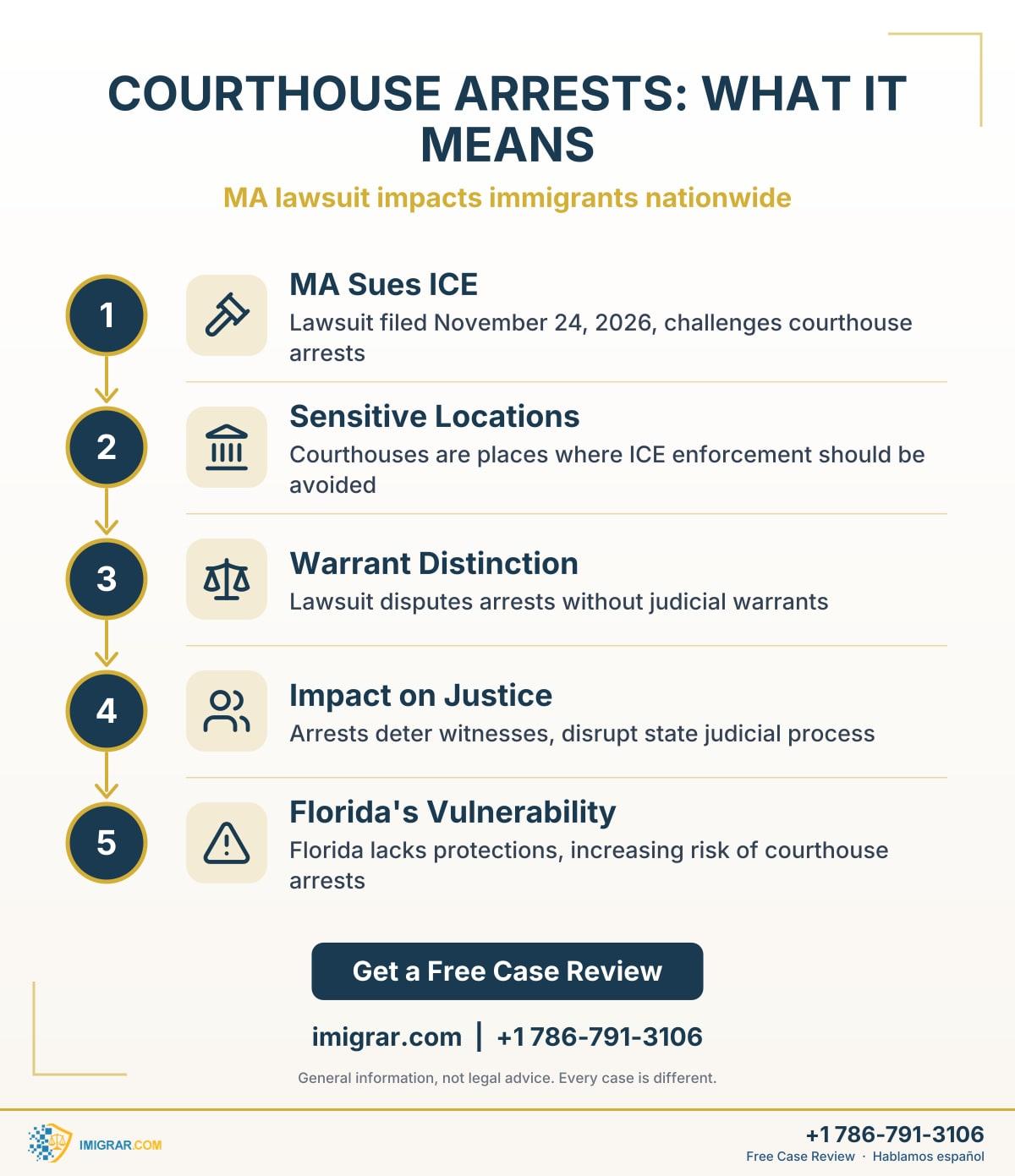
Why this news is showing up now
This lawsuit isn't a sudden development but rather the latest escalation in a long-standing tension between federal immigration authorities and state governments, as well as immigrant advocacy groups. The state of Massachusetts alleges that ICE agents have been detaining individuals at courthouses without judicial warrants, directly violating new state-level protections that were put in place to safeguard immigrants attending court proceedings. These protections aim to ensure that individuals, regardless of their immigration status, can access the justice system without fear of civil immigration arrest. The lawsuit claims that despite these new state laws, ICE has continued its practice, leading to dozens of alleged detentions. This legal action forces a direct confrontation over jurisdiction and the interpretation of federal immigration authority versus state sovereignty and civil liberties.
The timing underscores a persistent pattern: as states enact measures to protect their immigrant populations and ensure access to justice, federal agencies like ICE sometimes interpret their enforcement powers differently, leading to clashes. The core of the Massachusetts argument is that these arrests disrupt the state’s judicial process, deter victims and witnesses from coming forward, and ultimately undermine public safety by creating a climate of fear. This legal challenge seeks to clarify the boundaries of ICE’s authority within state courthouses, particularly concerning the requirement for judicial warrants, which offer a higher standard of probable cause review than administrative warrants issued by ICE itself.
How it can affect Florida residents
For immigrants in Orlando, across the I-4 corridor, and throughout Florida, this lawsuit serves as a vital reminder of the complex and often divergent legal landscapes they must navigate. While Massachusetts has specific state laws aimed at limiting ICE’s courthouse activities, Florida does not currently have similar statewide protections or "sanctuary" policies regarding courthouses. This distinction is paramount:
- Increased Vulnerability: Without state-level protections, individuals attending court in Florida may face a higher risk of encounter and arrest by ICE agents at or near courthouses. This applies whether you are a plaintiff, defendant, witness, or even just accompanying a family member.
- Chilling Effect: The fear of arrest can deter individuals, including victims of crimes or witnesses, from seeking justice or participating in court proceedings, regardless of their legal status. This undermines the integrity of Florida’s justice system and can create significant public safety concerns for all residents.
- Need for Proactive Legal Counsel: In the absence of state protections, the importance of proactive legal advice from an experienced immigration attorney cannot be overstated. Understanding your rights, preparing for court appearances, and having a plan in place are absolutely critical for Florida residents.
- Policy Debate: The Massachusetts lawsuit may ignite further debate and advocacy efforts in other states, including Florida, regarding similar protections. While Florida's current political climate may not favor such legislation, awareness of these national legal battles can empower communities to advocate for change.
Warning: The situation in Florida regarding ICE enforcement at courthouses remains fluid and is distinct from states with specific protective laws. Always consult with an immigration attorney before any court appearance if you have immigration concerns.
Need Help? Our Orlando immigration team is ready to assist. If you have concerns about courthouse appearances or ICE enforcement, don't wait. Call +1 786-791-3106 for a free consultation, or message us online. Se Habla Español.
What Courthouse Immigration Arrests Are (and Why They Matter)
The controversy highlighted by the Massachusetts lawsuit centers on a specific type of immigration enforcement: arrests made by ICE agents at or near state courthouses. These actions are particularly contentious because they intersect with the functioning of state judicial systems and impact individuals who are often there for non-immigration-related matters.
A plain-English definition
A "courthouse immigration arrest" refers to the detention of an individual by U.S. Immigration and Customs Enforcement (ICE) agents when that individual is either inside a courthouse, immediately outside a courthouse, or en route to or from a court proceeding. The critical distinction in the Massachusetts lawsuit, and a point of contention nationwide, is whether these arrests are carried out with a judicial warrant (issued by a judge or magistrate based on probable cause) or merely an administrative warrant (issued by an ICE officer, often based solely on an immigration detainer or an order of removal). The lawsuit argues that without a judicial warrant, these arrests violate state law and potentially constitutional protections.
Why does this matter? Courthouses are considered "sensitive locations" by ICE itself, meaning enforcement actions there should generally be avoided unless certain conditions are met. The idea behind this policy is to ensure that everyone, regardless of immigration status, feels safe enough to access the justice system – whether to report a crime, testify as a witness, seek protection from abuse, or address a legal matter. When ICE makes arrests without judicial warrants in these locations, it can create a chilling effect, discouraging individuals from participating in legal processes vital to public safety and civil order.
Key terms you need to know
Navigating discussions around immigration enforcement requires understanding specific terminology:
- ICE (U.S. Immigration and Customs Enforcement): The principal investigative arm of the U.S. Department of Homeland Security (DHS), responsible for enforcing federal immigration laws.
- Judicial Warrant: An order issued by a judge or magistrate, authorizing law enforcement to take a specific action (like an arrest or search), based on a finding of probable cause. This requires a higher standard of review and evidence.
- Administrative Warrant: A document issued by an immigration officer (an ICE agent), authorizing the arrest of an individual for an immigration violation. Unlike a judicial warrant, an administrative warrant does not require judicial review for probable cause and is often based on an immigration detainer or a final order of removal. This is the type of "warrant" that is often at the heart of disputes over courthouse arrests.
- Sensitive Locations Policy: An ICE policy that generally directs agents to avoid enforcement actions at certain places, including schools, hospitals, places of worship, and courthouses, unless there are exigent circumstances, national security concerns, or a judicial warrant. The interpretation and application of this policy are frequently debated.
- Civil Immigration Enforcement: The enforcement of immigration laws that do not involve criminal charges, such as overstaying a visa or entering without inspection. Arrests based on civil immigration violations are distinct from criminal arrests.
- Criminal Warrant: A warrant issued by a judge for an individual believed to have committed a crime. This is different from an administrative immigration warrant.
- Due Process: A fundamental constitutional right guaranteeing that individuals receive fair treatment and a fair hearing in legal proceedings, including immigration proceedings.
- Detainer (Immigration Detainer): A request from ICE to a law enforcement agency to hold an individual in custody for up to 48 hours (excluding weekends and holidays) after their release date, so ICE can take them into custody. These are civil, not criminal, requests.
- Removal Proceedings: The legal process through which the U.S. government seeks to deport or remove a non-citizen from the country. These proceedings typically take place in immigration court.
- Sanctuary Policies: Broad term referring to state or local government policies that limit their cooperation with federal immigration enforcement agencies. Massachusetts' new protections for courthouses can be seen as a form of "sanctuary policy" for judicial spaces. Florida currently does not have such policies at the state level.
Understanding these terms is critical to grasping the legal arguments being made in the Massachusetts lawsuit and to comprehending your rights and risks in the current immigration enforcement environment.
Current Immigration Law: The Foundation and Contention
The legal framework governing immigration enforcement, particularly at sensitive locations like courthouses, is a complex interplay of federal statutes, agency policies, and constitutional protections. The Massachusetts lawsuit challenges ICE’s interpretation and application of these rules, particularly concerning the type of warrant required for arrests in such locations.
Federal requirements
At the federal level, the primary authority for immigration enforcement stems from the Immigration and Nationality Act (INA). Specifically, 8 U.S.C. § 1357 grants ICE officers broad powers to arrest individuals for immigration violations. However, this authority is not absolute and is subject to constitutional limitations, primarily the Fourth Amendment, which protects against unreasonable searches and seizures.
ICE itself has a "Sensitive Locations Policy" that was most recently updated in April 2021. This policy states that enforcement actions should generally be avoided at specific locations, including courthouses, schools, hospitals, and places of worship. The stated purpose is to ensure that people can access essential services and civic institutions without fear. However, the policy includes exceptions, allowing enforcement actions in sensitive locations when:
- There are exigent circumstances (e.g., immediate pursuit of a dangerous felon).
- The enforcement action involves national security.
- The target is a national security or public safety threat (e.g., a convicted felon).
- The enforcement action involves an individual who has been ordered removed from the U.S.
- The enforcement action is approved by a supervisor and involves a judicial warrant or, in some cases, an administrative warrant for an individual subject to a final order of removal.
The crux of the Massachusetts lawsuit lies in the interpretation of the "judicial warrant" requirement. While ICE often relies on administrative warrants for arrests, many states and advocacy groups argue that for arrests in sensitive locations, a judicial warrant (issued by an Article III judge) is necessary to meet constitutional standards and uphold the integrity of state judicial systems. An administrative warrant, issued by an ICE officer, does not carry the same judicial oversight. The debate centers on whether ICE's internal policy provides sufficient protection or if a higher legal standard, mandated by state law or constitutional interpretation, should prevail.
While the topic of courthouse arrests doesn't directly involve filling out a specific USCIS form for the arrest itself, individuals who are detained may later be required to submit forms related to their immigration status or defense, such as:
- Form I-589, Application for Asylum and for Withholding of Removal
- Form I-765, Application for Employment Authorization (often filed concurrently with asylum or other applications)
- Form I-246, Application for Stay of Deportation or Removal (in specific circumstances)
- Form I-290B, Notice of Appeal or Motion (if appealing an adverse decision)
Florida-specific considerations
Unlike Massachusetts, Florida does not have state laws or policies that specifically restrict ICE’s ability to make arrests at or near courthouses without a judicial warrant. This means that immigrants in Florida, including those in Orlando, Kissimmee, and throughout Orange County, face a different reality:
- No State Protections: There are no statewide "sensitive location" policies in Florida that mirror those enacted in Massachusetts. This means ICE agents in Florida generally operate under federal guidelines without additional state-level limitations on courthouse enforcement.
- Greater Risk: Individuals with outstanding immigration issues, including those with final orders of removal, prior deportations, or even those simply out of status, may be at a higher risk of civil immigration arrest if they attend court in Florida.
- Florida's Cooperation with ICE: Florida has generally pursued policies that encourage cooperation between local law enforcement and federal immigration authorities. This includes laws that prohibit "sanctuary" policies and mandate cooperation with ICE detainers, further distinguishing Florida from states like Massachusetts.
- Impact on Justice System: While not legally restricted by the state, the practice of courthouse arrests still has a chilling effect on Florida's justice system. Immigrants may be hesitant to report crimes, seek protective orders, or appear as witnesses, fearing an encounter with ICE. This can compromise public safety and the ability of local courts to function effectively.
For residents of Central Florida, understanding these distinctions is paramount. The legal landscape here requires a heightened sense of awareness and proactive legal planning. Always consult with an experienced immigration attorney before any court appearance if you have immigration concerns. Visit the USCIS official website for general information on immigration law, but remember that specific enforcement actions like those at courthouses fall under ICE's purview, a different agency within DHS.
Worried about a court appearance in Orlando? Don't face it alone. Imigrar offers expert legal guidance for immigrants throughout Florida. Call us at +1 786-791-3106 for a free consultation. Se Habla Español.
Navigating Court Appearances as an Immigrant: A Proactive Guide
Given the ongoing debate and the specific situation in Florida, it is essential for immigrants to be proactive and informed when facing any court appearance. This guide outlines crucial steps to help you protect yourself and your family.
1) Understand Your Rights and the Legal Landscape
Before stepping into any courthouse, it’s vital to be aware of your fundamental rights and the specific legal environment in Florida. The U.S. Constitution, particularly the Fourth Amendment, protects all individuals within U.S. territory from unreasonable searches and seizures, regardless of immigration status. You also have the right to remain silent and the right to an attorney. However, these rights must be asserted.
- Know Your "Miranda" Rights: If detained, you have the right to remain silent. Anything you say can be used against you. You also have the right to an attorney. Assert these rights clearly.
- Distinguish Warrants: Understand the difference between a judicial warrant (issued by a judge based on probable cause) and an administrative warrant (issued by an ICE officer). While ICE can make arrests with an administrative warrant, a judicial warrant provides a stronger legal basis and often more safeguards.
- Florida-Specific Context: Remember that Florida does not have statewide "sensitive location" protections for courthouses like Massachusetts. This means ICE operations might be more prevalent and less restricted by state law here.
2) Consult with an Immigration Attorney BEFORE Any Court Appearance
This is arguably the most critical step. If you have any immigration concerns (e.g., you are out of status, have a prior deportation order, or have an ongoing immigration case), you should never attend a court appearance without first consulting an experienced immigration attorney. An attorney can:
- Assess Your Risk: Evaluate your immigration history and current status to determine your potential risk of encountering ICE.
- Advise on Necessity: Determine if your presence in court is absolutely necessary or if alternative arrangements can be made.
- Develop a Strategy: Create a plan for your court appearance, including who should accompany you, what documents to bring, and how to respond if approached by ICE.
- Represent You: If you have an existing immigration case, your attorney can represent you in immigration court. For state or civil court matters, they can coordinate with your criminal or civil attorney.
Required Documents for Consultation: Bring all immigration documents, court notices, and any relevant personal identification.
3) Prepare for Court and Have an Emergency Plan
Preparation extends beyond understanding your legal rights. It involves practical steps to minimize risk and ensure your family's safety if an incident occurs.
- Minimal Information: If you must attend court, carry only essential documents. Avoid carrying foreign passports or documents that explicitly reveal your immigration status unless legally required for your court case.
- Emergency Contacts: Memorize or carry on your person the phone number of your immigration attorney and at least two trusted family members or friends.
- Care Plan for Dependents: If you have children or other dependents, establish a detailed care plan. Designate a trusted individual who can pick up your children from school, access medical records, and make decisions if you are detained.
- "Know Your Rights" Card: Carry a "Know Your Rights" card from a reputable organization. This card can be shown to agents to assert your rights without speaking.
- Travel with Caution: If possible, have a trusted citizen or legal permanent resident accompany you to court. They can act as a witness and contact your attorney if needed.
4) Know What to Do if Approached by ICE
If you are approached by ICE agents at or near a courthouse, your response can significantly impact the outcome.
- Do Not Lie: Never lie to immigration officers.
- Remain Silent: You have the right to remain silent. State clearly, "I wish to remain silent and I want to speak with my attorney."
- Do Not Sign Anything: Do not sign any documents without first speaking to your attorney.
- Ask for a Warrant: Ask if they have a warrant. If they say yes, ask to see it. Crucially, ask if it is a judicial warrant signed by a judge or an administrative warrant. If it's an administrative warrant, you are generally not required to open your door if you are at home, but in a public space like a courthouse, they may proceed with an arrest based on it.
- Do Not Resist: Do not physically resist arrest.
5) Inform Your Attorney Immediately if Detained
If you or a loved one is detained by ICE, immediate action is necessary.
- Contact Attorney: As soon as possible, or have your family contact your immigration attorney. Provide them with all details: where and when you were arrested, what was said, and which agency made the arrest.
- Do Not Provide Information: Beyond confirming your identity (name), do not answer questions about your immigration status, country of origin, or how you entered the U.S. until you have spoken with your attorney.
- Family Notification: Ensure your family knows to notify your attorney immediately and to avoid making statements to ICE themselves.
6) Document Everything and Gather Information
Detailed records are invaluable in immigration proceedings.
- Agent Information: Try to remember or note down the agents' names, badge numbers, and agency.
- Time and Location: Record the exact time and location of the encounter and arrest.
- Witnesses: If there are witnesses, get their contact information if possible.
- Conditions of Detention: Note any conditions of your detention, including where you are taken.
7) Understand Post-Arrest Procedures
Once detained, you will likely be processed and may be placed into removal proceedings.
- Processing: You will be fingerprinted, photographed, and interviewed.
- Credible Fear Interview: If you express fear of returning to your home country, you may be referred for a credible fear interview. This is a critical step, and you have the right to consult with an attorney before and during this interview.
- Bond Hearing: In some cases, you may be eligible for an immigration bond, allowing you to be released from detention while your case proceeds. Your attorney can argue for a bond hearing in immigration court, such as the Orlando Immigration Court.
- Removal Proceedings: You will likely receive a Notice to Appear (NTA) in immigration court, initiating formal removal proceedings.
Reminder: The immigration process after detention can be complex and intimidating. Professional legal representation is crucial at every stage.
Practical Steps You Can Take Today
Empower yourself by taking proactive measures, especially if you reside in Central Florida and might need to interact with the justice system.
Actionable Checklist:
- Consult with an Immigration Attorney: Schedule a consultation with an experienced immigration lawyer, even if you don't have an immediate court date. Understand your individual risk factors and legal options.
- Create an Emergency Plan: Develop a detailed plan with your family. This should include emergency contacts (attorney, trusted friends/family), care arrangements for children, and access to important documents.
- Prepare a "Know Your Rights" Packet: Assemble a small packet containing your attorney's contact information, an emergency contact list, and a "Know Your Rights" card.
- Review Immigration Documents: Gather and organize all your immigration documents. Ensure you know what they are and where they are kept securely (not on your person if you are at risk).
- Attend Community Workshops: Look for local workshops or seminars in Orlando that educate immigrants on their rights and what to do during an ICE encounter.
- Stay Informed: Follow reputable immigration news sources and discuss any new developments with your attorney
Related Topics
Need Legal Assistance?
Our experienced immigration attorneys are here to help with your case. Contact Imigrar today for a free consultation and let us guide you through the legal process with confidence.
📍 Orlando, Florida • Serving clients nationwide
📧 info@imigrar.com