
Refugee Green Cards: Judge's Review of Past Policies & Your Path to Permanent Residency
A federal judge's scrutiny of past policies targeting refugees highlights the ongoing fight for permanent residency. Understand your rights and the path to a green card with Imigrar.
The reporting that sparked this guide: US judge questions Trump administration's policies targeting refugees (Reuters)
What This News Means for Immigrants in Orlando and Across Florida
The journey to a new life in the United States, particularly for refugees, is often fraught with uncertainty and complex legal challenges. Recent reports, like the one from Reuters detailing a federal judge's scrutiny of past administration policies targeting refugees, serve as a potent reminder of the dynamic nature of U.S. immigration law and the constant battle to protect the rights of vulnerable populations. While this specific news concerns policies from a previous administration, its implications resonate deeply today, especially for those seeking to stabilize their status and build a permanent home here.
Why this news is showing up now
Even years after an administration's term ends, the legal challenges to its policies can persist. Courts often take considerable time to deliberate on complex cases, especially those involving constitutional questions or broad executive actions. The Reuters report highlights a federal judge's consideration of blocking policies that aimed to freeze thousands of refugees' green card applications. This demonstrates the enduring power of the judiciary to review and potentially overturn executive branch decisions, ensuring that policies align with existing laws and humanitarian principles.
For individuals granted refugee status, the path to obtaining a Green Card (lawful permanent residency) is a critical step towards stability and integration. Policies that attempt to impede this process can have devastating long-term effects on families and communities. The ongoing judicial review, even of past policies, underscores the importance of legal oversight and serves as a beacon of hope for those who might have been impacted or fear similar restrictions in the future. It reminds us that no policy, however sweeping, is entirely immune to legal challenge and that the courts play a vital role in upholding the rule of law and protecting individual rights.
The legal landscape is constantly evolving. What was challenged yesterday might set a precedent for tomorrow. For immigrants and their families in Orlando and nationwide, understanding these legal battles is crucial. It informs them about potential future policy shifts, the importance of legal advocacy, and the avenues available to protect their rights.
How it can affect Florida residents
Florida, particularly Central Florida around Orlando, is a vibrant hub for diverse immigrant communities, including a significant number of refugees and asylees who have resettled here. When a federal judge questions policies that could freeze green card applications for refugees, it directly impacts thousands of individuals and families who call Florida home.
For Florida residents who entered the U.S. as refugees, or who are family members of refugees, such policies can create immense anxiety and uncertainty about their future. A freeze on green card applications means a delay in obtaining permanent residency, which in turn affects access to critical services, employment opportunities, and the ability to travel freely. It can separate families, delay reunification efforts, and hinder the full integration of individuals into society.
The Orlando USCIS Field Office processes numerous applications for adjustment of status for refugees. Any policy affecting these applications would directly translate into longer processing times, increased backlogs, and a more stressful experience for applicants in Orange County and surrounding areas. This news serves as a reminder that vigilance and expert legal guidance are essential for Florida's refugee communities. Imigrar, based right here in Orlando, is committed to monitoring these developments and providing proactive advice to ensure our clients' paths to permanent residency are as smooth as possible, regardless of past or future policy shifts.
Need Help? Our Orlando immigration team is ready to assist. Call +1 786-791-3106 for a free consultation, or message us online. Se Habla Español.
What Refugee Green Card Freezes and Judicial Review Is (and Why It Matters)
The news about a federal judge questioning past policies targeting refugees and their green card applications might seem complex, but it boils down to fundamental principles of immigration law and the checks and balances within the U.S. government. At its core, it’s about ensuring that executive actions adhere to established laws and do not unduly harm individuals seeking protection and a stable future.
A plain-English definition
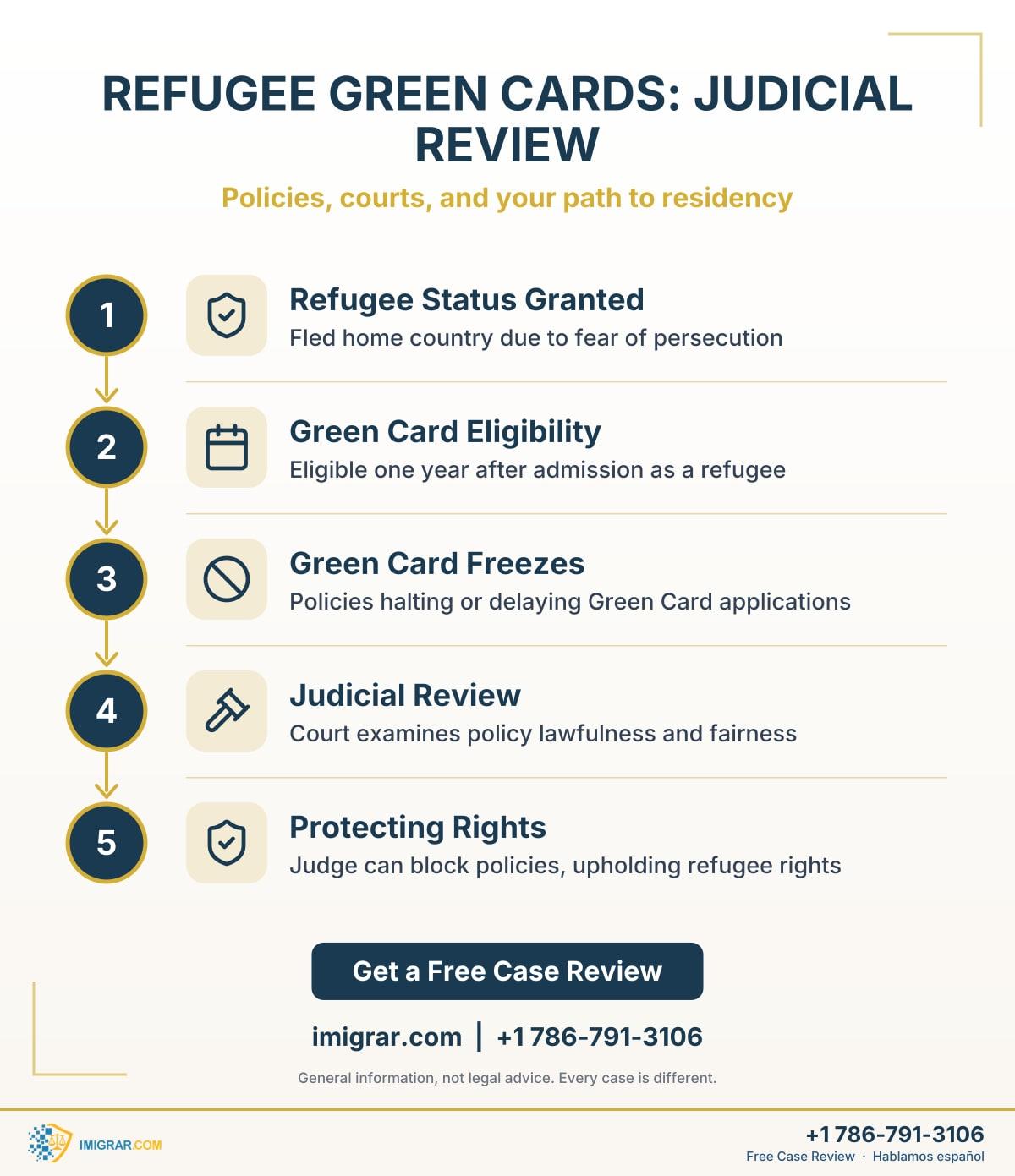
When we talk about "refugee green card freezes," we're referring to government policies that attempt to halt or severely delay the process by which individuals who have been granted refugee status can apply for and receive their Green Card, also known as lawful permanent residency. Refugees are individuals who have fled their home countries due to a well-founded fear of persecution. Once granted refugee status in the U.S., they are generally eligible to apply for a Green Card one year after their admission.
The "judicial review" aspect means that a federal court, led by a judge, is examining whether these government policies were lawful, fair, and consistent with existing immigration statutes and the U.S. Constitution. In this context, the judge appeared open to "blocking" these policies, which would mean preventing the government from enforcing them. This is a crucial function of the judiciary: to act as a safeguard against executive overreach and ensure that the rights of individuals, including refugees, are protected.
Essentially, the judge is asking: "Did the previous administration have the legal authority to stop or slow down green card applications for refugees, and if not, should these actions be overturned or prevented from having further effect?" This process is vital because it can uphold the rights of thousands of refugees who are seeking to establish permanent lives in the U.S. and keep families together.
Key terms you need to know
Understanding the following terms will help you navigate the complexities of refugee immigration and the news surrounding it:
- Refugee Status: Granted to individuals who meet the definition of a refugee under U.S. immigration law, meaning they have fled their country due to persecution or a well-founded fear of persecution on account of race, religion, nationality, membership in a particular social group, or political opinion. This status is typically granted while the individual is outside the U.S.
- Asylee Status: Similar to refugee status, but granted to individuals who are already present in the U.S. or at a port of entry when they apply for protection. Both refugees and asylees have similar paths to a Green Card.
- Green Card (Lawful Permanent Residency): This is the official document (Form I-551) that grants an individual the right to live and work permanently in the United States. For refugees and asylees, obtaining a Green Card is the next major step after their initial grant of protection.
- Adjustment of Status: The process by which an eligible individual already in the United States applies to change their immigration status from a temporary one (like refugee status) to lawful permanent resident (Green Card holder) without having to leave the country. This involves filing Form I-485.
- Preliminary Injunction: A court order issued early in a lawsuit that temporarily prohibits a party from taking a specific action or requires them to maintain a certain status quo until the case can be fully heard and decided. In this news, the judge "appeared open to blocking" policies, which often refers to issuing a preliminary injunction.
- Executive Order/Policy: A directive issued by the President of the United States that manages operations of the federal government. The policies questioned by the judge would have been executive actions taken by the previous administration.
- Immigration and Nationality Act (INA): The primary body of law governing immigration in the United States. It outlines who is eligible for various statuses, including refugee status and adjustment of status. Judicial challenges often examine whether executive policies comply with the INA.
- Priority Date: While more common in family-based and employment-based immigration, understanding processing times is critical for refugees. For refugee adjustment of status, eligibility generally begins one year after admission as a refugee.
- USCIS (U.S. Citizenship and Immigration Services): The government agency responsible for administering the country's lawful immigration system. They process applications for refugee status, adjustment of status, and other immigration benefits.
Current Immigration Law: The Foundation
U.S. immigration law is primarily governed by the Immigration and Nationality Act (INA). For refugees, specific sections of the INA outline their eligibility for status and their subsequent path to lawful permanent residency. Understanding these statutory foundations is crucial, especially when policies from past administrations come under judicial scrutiny.
Federal requirements
The INA provides a clear pathway for refugees to become lawful permanent residents. Section 207 of the INA defines a refugee and establishes the process for their admission into the United States. Section 209(a) and (b) of the INA specifically address the Adjustment of Status for refugees and asylees, respectively. These sections generally state that a refugee or asylee is eligible to apply for a Green Card one year after their admission to the U.S. or grant of asylum.
The core federal requirements for a refugee to adjust status include:
- One Year of Physical Presence: The refugee must have been physically present in the United States for at least one year since their admission as a refugee.
- Continued Refugee Status: The individual must continue to meet the definition of a refugee or be a qualifying family member (spouse or child) of a refugee.
- Admissibility: The applicant must be admissible to the United States for permanent residence. While many grounds of inadmissibility are waived for refugees due to the circumstances of their flight, some grounds, particularly those related to criminal history or security concerns, can still apply. A medical examination is generally required.
- Application Filing: The individual must properly file Form I-485, Application to Register Permanent Residence or Adjust Status, along with all required supporting documentation and fees.
Important: The law mandates that USCIS must adjust the status of a refugee who meets these criteria, provided they are not otherwise inadmissible. Policies that attempt to "freeze" or arbitrarily delay this process often face legal challenges precisely because they may contradict these statutory requirements.
For official information, always refer to the USCIS official website.
Florida-specific considerations
While immigration law is federal, its implementation and the resources available to immigrants have local relevance. For Central Florida residents, the process of adjusting status as a refugee will primarily involve interaction with the Orlando USCIS Field Office.
- Local Filing and Interviews: While most applications are mailed to USCIS service centers, interviews for adjustment of status often take place at the local field office. If your case is in Orlando, your interview would likely be conducted at the Orlando USCIS Field Office, located at 6650 TPC Drive, Orlando, FL 32822.
- Community Resources: Florida is home to numerous refugee resettlement agencies and community organizations that provide support services, English language classes, and employment assistance to refugees. These organizations can be invaluable during the adjustment process.
- Legal Support in Florida: Having an experienced immigration attorney based in Florida, particularly one familiar with the Orlando immigration landscape, can be highly beneficial. They understand local processing nuances, potential backlogs at the Orlando Field Office, and can provide personalized guidance for your specific situation.
Understanding both the federal legal framework and the local operational context is key to successfully navigating the adjustment of status process for refugees in Florida.
USCIS Forms relevant to refugees and asylees:
- Form I-590, Registration for Classification as Refugee (initial refugee application, often filed overseas).
- Form I-730, Refugee/Asylee Relative Petition (for family members).
- Form I-485, Application to Register Permanent Residence or Adjust Status (the primary form for adjusting status to a Green Card holder).
- Form I-765, Application for Employment Authorization (often filed concurrently with I-485 or as a standalone application for refugees).
- Form I-131, Application for Travel Document (for a Refugee Travel Document, which allows refugees to travel internationally).
- Form I-693, Report of Medical Examination and Vaccination Record (required for adjustment of status).
For up-to-date forms and instructions, always visit USCIS Forms.
Need Help? Our Orlando immigration team is ready to assist. Call +1 786-791-3106 for a free consultation, or message us online. Se Habla Español.
How to Adjust Status as a Refugee: A Complete Step-by-Step Guide
For refugees, the ultimate goal after finding safety in the U.S. is often to obtain a Green Card, or lawful permanent residency. This process, known as Adjustment of Status, is critical for long-term stability and integration. While the news highlights challenges, the legal pathway remains open and navigable with the right guidance. Here's a detailed guide:
1) Understand Eligibility & Wait Times
The first and most crucial step is to confirm your eligibility. As a refugee, you are generally eligible to apply for Adjustment of Status one year after your admission to the United States. This "one-year rule" is a strict requirement. You must maintain your refugee status throughout this period.
- Eligibility Checklist:
- You were admitted to the U.S. as a refugee.
- You have been physically present in the U.S. for at least one year since your admission.
- You continue to meet the definition of a refugee, or you are a qualifying spouse or child of a refugee.
- You are not inadmissible to the U.S. under any grounds that cannot be waived.
- Timing Considerations: You can apply any time after the one-year anniversary of your admission. There is no deadline for applying once you are eligible, but it is highly recommended to apply as soon as possible to avoid potential future policy changes or processing delays.
2) Prepare Required Forms
The core of your application will be Form I-485, Application to Register Permanent Residence or Adjust Status. This form is extensive and requires accurate and complete information. You'll also need to include several supplementary forms:
- Mandatory Forms:
- Form I-485, Application to Register Permanent Residence or Adjust Status.
- Form G-325A, Biographic Information (if required by I-485 instructions; check current instructions as this form is often integrated into I-485).
- Form I-693, Report of Medical Examination and Vaccination Record (completed by a USCIS-approved civil surgeon).
- Optional but Recommended Forms (may be filed concurrently):
- Form I-765, Application for Employment Authorization (if you need a work permit while your I-485 is pending).
- Form I-131, Application for Travel Document (if you need to travel internationally while your I-485 is pending, specifically for a Refugee Travel Document).
Reminder: Always use the most current versions of USCIS forms, available on USCIS Forms. Instructions change frequently.
3) Gather Supporting Documents
This is often the most time-consuming step. You'll need to collect a comprehensive set of documents to prove your identity, refugee status, and eligibility. Organize everything meticulously.
- Essential Documents Checklist:
- Two passport-style photos (meeting USCIS specifications).
- Copy of your Form I-94, Arrival/Departure Record (or electronic record showing refugee admission).
- Copy of your Refugee travel document, if you have one.
- Copy of your birth certificate.
- Copy of your marriage certificate (if applicable).
- Copy of previous divorce decrees or death certificates of prior spouses (if applicable).
- Copy of your passport biographical page (if available).
- Certified English translations of any foreign language documents.
- Affidavit(s) of support (Form I-864) or other evidence of self-sufficiency (while not strictly required for refugees in the same way as family-based applicants, it's good practice to demonstrate you won't become a public charge).
- Evidence of continuous physical presence for one year (e.g., utility bills, employment records, school records).
- Police clearances from any country you have lived in for more than six months since turning 16, if requested by USCIS.
Warning: Missing or incomplete documents are common reasons for delays or denials. Double-check every requirement.
4) Attend Biometrics Appointment
After you file your Form I-485, USCIS will send you an appointment notice (Form I-797C) for a biometrics services appointment at an Application Support Center (ASC). For Central Florida residents, this would likely be at the Orlando ASC or a nearby location.
- What to Expect:
- You will have your fingerprints, photograph, and signature taken. These are used for background checks.
- Bring your appointment notice and a valid photo ID (e.g., passport, state ID).
- The biometrics appointment is typically quick and straightforward.
5) Prepare for Interview
While not all refugee adjustment of status cases require an interview, USCIS reserves the right to call applicants for an interview at a local field office (like the Orlando USCIS Field Office). If an interview is scheduled, it's crucial to be well-prepared.
- Interview Preparation Checklist:
- Review your entire application package (Form I-485 and all supporting documents).
- Gather original copies of all documents submitted with your application, plus any documents that have changed or expired since filing.
- Be prepared to answer questions about your refugee claim, your admission to the U.S., your family history, and your activities since arriving.
- If you are not fluent in English, bring a certified interpreter. If you are working with Imigrar, we can assist with this.
- Consider having an attorney accompany you to the interview. This is highly recommended to protect your rights and ensure fair treatment.
6) Receive Decision
After your biometrics and potentially an interview, USCIS will process your application. This processing time can vary significantly (check USCIS Processing Times for current estimates).
- Possible Outcomes:
- Approval: If your application is approved, you will receive a welcome notice and your Green Card will be mailed to you. The Green Card is valid for 10 years and can be renewed.
- Request for Evidence (RFE): USCIS may send an RFE if they need additional documents or clarification. Respond promptly and thoroughly.
- Notice of Intent to Deny (NOID): A NOID indicates USCIS intends to deny your application and gives you a chance to respond and provide further evidence. This is a serious notice and requires immediate legal attention.
- Denial: If your application is denied, you will receive a denial letter explaining the reasons. You may have options to appeal or refile, depending on the reason for denial.
Practical Steps You Can Take Today
Even with ongoing legal scrutiny of past policies, refugees in Orlando and across the nation can take proactive steps to secure their immigration future. Staying informed and organized is paramount.
Actionable Checklist:
- Consult with an Experienced Immigration Attorney: This is the most crucial step. A qualified attorney can assess your specific situation, confirm your eligibility, and guide you through the complex application process. Given the dynamic nature of immigration law and the historical context of policy challenges, expert legal advice is invaluable.
- Gather All Necessary Documents: Start compiling all required documents immediately. This includes personal identification, birth certificates, marriage certificates, refugee admission documents (Form I-94), and any other records proving your identity and status. Ensure all foreign documents are translated and certified.
- Monitor USCIS Processing Times: Regularly check the USCIS Processing Times page for the Orlando USCIS Field Office (if applicable for interviews) and the relevant service center. This will give you an idea of what to expect after filing.
- Maintain Your Current Status: Ensure you do not violate any immigration laws or conditions of your refugee status while your application is pending. Any legal issues could jeopardize your adjustment of status.
- Keep Copies of Everything: Make a copy of every form, document, and communication you send to or receive from USCIS. Organize them in a secure, accessible file.
- Prepare for the Medical Examination: Research USCIS-approved civil surgeons in the Orlando area (or wherever you reside) so you are ready to schedule your medical exam (Form I-693) when you are preparing your application.
Document Preparation Guidance:
- Accuracy is Key: Ensure all information on your forms is accurate and consistent with your supporting documents. Discrepancies can lead to RFEs or denials.
- Certified Translations: Any document not in English must be accompanied by a complete and accurate English translation, certified by the translator.
- Organize, Organize, Organize: Use tabs, dividers, and cover letters to clearly label and organize your application package. This helps USCIS officers process your application more efficiently.
Timeline Expectations:
While it's impossible to give an exact timeline, here's a general expectation for refugee adjustment of status:
- Preparation Phase: This can take several weeks to a few months, depending on how quickly you can gather all documents and complete forms.
- Filing to Biometrics: Typically, you'll receive a receipt notice within 2-4 weeks of filing, followed by a biometrics appointment notice within 4-8 weeks. The appointment itself usually occurs 1-2 months after the notice.
- Processing Time: After biometrics and any potential interview, the processing time for Form I-485 can range from 6 months to over 2 years, depending on the USCIS service center and current backlogs. You can check average processing times on the USCIS website.
- Employment Authorization/Travel Document: If filed concurrently, an Employment Authorization Document (EAD) and Refugee Travel Document (RTD) can sometimes be approved faster than the I-485, often within 3-10 months.
Important: Processing times are estimates and can fluctuate. External factors, such as judicial reviews of past policies or new executive actions, can also impact these timelines.
How Imigrar Helps Immigrants in Orlando
At Imigrar, we understand that the immigration journey can be overwhelming, especially when news of policy challenges and legal battles adds to the uncertainty. Our mission is to "Keep Families Together" by providing expert, compassionate, and results-driven legal representation to immigrants in Orlando, across Florida, and nationwide.
Our team of dedicated immigration attorneys possesses extensive experience in all facets of U.S. immigration law, including complex cases involving refugees and asylees seeking Adjustment of Status. We stay abreast of the latest legal developments, court rulings, and policy changes, ensuring our clients receive the most current and accurate advice.
When you choose Imigrar, you benefit from:
- Personalized Legal Strategy: We don't believe in one-size-fits-all solutions. We meticulously review your unique situation, assess your eligibility, and craft a tailored strategy designed to maximize your chances of success.
- Comprehensive Application Preparation: From accurately completing Form I-485 and all supporting forms to organizing your extensive documentation, we handle the intricate details, minimizing errors and delays.
- Representation at Interviews: Our attorneys can prepare you for your USCIS interview at the Orlando USCIS Field Office and, importantly, accompany you to ensure your rights are protected and the process is fair.
- Navigating Complexities: Whether it's responding to a Request for Evidence (RFE), addressing inadmissibility issues, or understanding the impact of judicial decisions on your case, we provide clear guidance and strong advocacy.
- Bilingual Services: We proudly offer services in both English and Spanish (Se Habla Español), ensuring clear communication and cultural understanding for our diverse client base.
We believe everyone deserves a fair chance at building a stable life in
Related Topics
Need Legal Assistance?
Our experienced immigration attorneys are here to help with your case. Contact Imigrar today for a free consultation and let us guide you through the legal process with confidence.
📍 Orlando, Florida • Serving clients nationwide
📧 info@imigrar.com