
New F-1 Visa Rules: What Foreign Students in the US Need to Know
Navigating the Trump administration's tightened F-1 student visa rules can be complex. This guide explains federal permission for extended stays, university power changes, and how Imigrar helps.
The landscape of U.S. immigration law for foreign students is undergoing significant changes, impacting thousands of individuals pursuing their education and future in the United States. Recent policy shifts, particularly those initiated during the Trump administration, have introduced new complexities, especially concerning the duration of stay and the process for extending student visas. Understanding these changes is not just important; it's critical for maintaining legal status and achieving your academic and professional goals.
At Imigrar, an immigration law firm based in Orlando, Florida, we are committed to keeping our clients informed and empowered. Our mission, "Keep Families Together," extends to supporting students who are building their futures in the U.S. This comprehensive guide breaks down the latest developments, offering clear, actionable advice for students nationwide, including those in Orlando and across Florida.
The reporting that sparked this guide
Trump administration tightens visa rules for foreign students (BBC)
What This News Means for Immigrants in Orlando and Across Florida
The news report highlights a pivotal shift in how the U.S. government manages the stay of F-1 student visa holders. Historically, F-1 students were admitted for "Duration of Status" (D/S), meaning they could remain in the U.S. as long as they maintained their full-time student status, completed their program, and adhered to all immigration regulations, including authorized post-completion Optional Practical Training (OPT). Universities, through their Designated School Officials (DSOs), played a significant role in extending I-20 forms for program extensions.
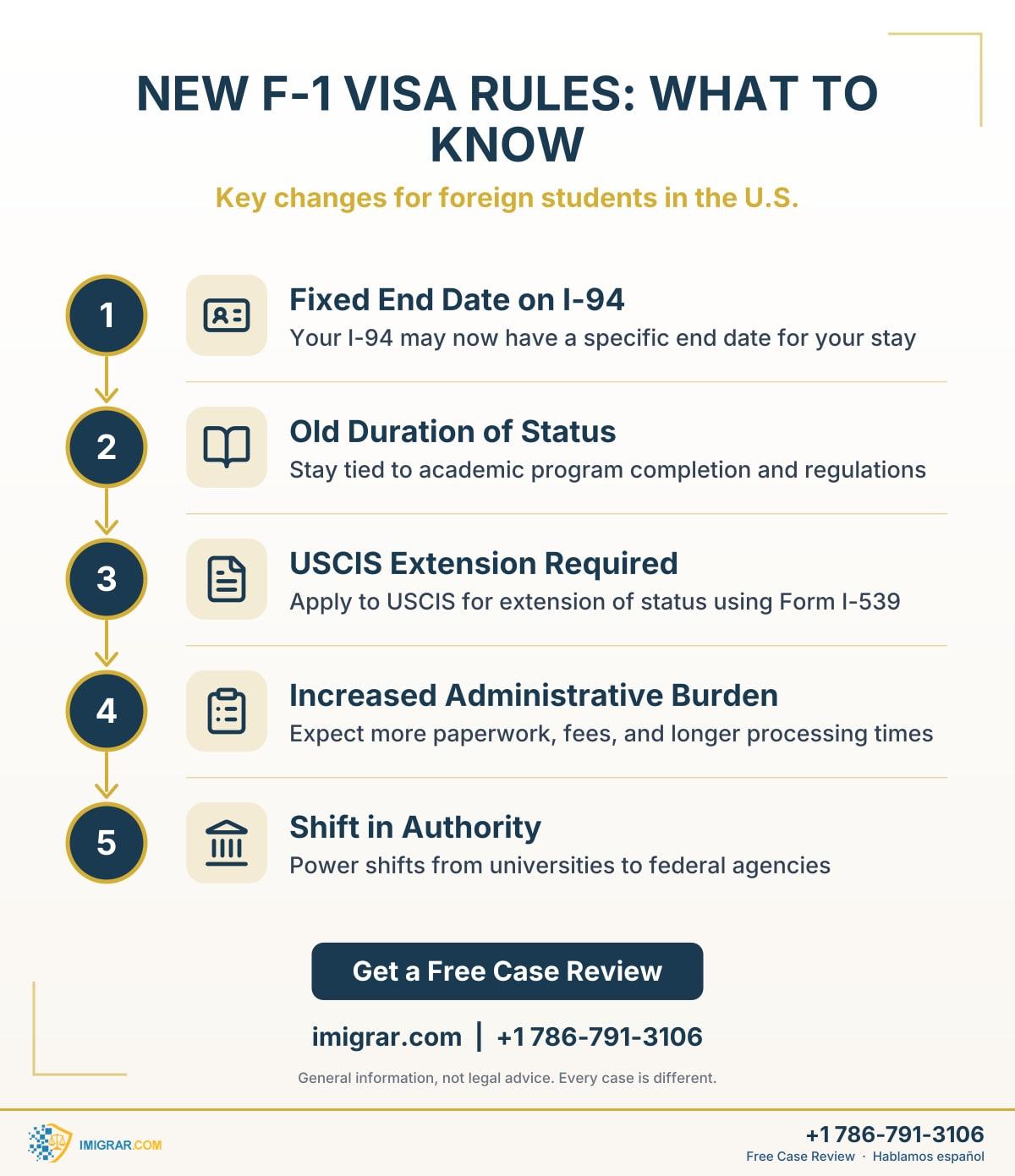
The tightened rules, however, introduce a more stringent approach, potentially limiting the initial period of admission and shifting the power to grant extensions from universities to federal agencies like U.S. Citizenship and Immigration Services (USCIS). For international students, this means increased vigilance, proactive planning, and a deeper understanding of federal application processes.
Why this news is showing up now
While the policies referenced in the BBC report originated during the Trump administration, the implications and potential for their re-implementation or continued enforcement remain highly relevant in 2026. Immigration policies, once enacted or proposed, often have long-lasting effects or can be revisited and reinforced depending on the prevailing political climate and administrative priorities. The current administration may choose to uphold, modify, or even expand upon these stricter measures, especially in the context of broader immigration enforcement discussions.
Furthermore, the operational changes required by such policies – including adjustments to how USCIS and university SEVP officials process applications – create an ongoing impact. For students, this isn't just historical news; it represents a fundamental change in the regulatory environment they operate within. It underscores the need for continuous awareness and adherence to the most current federal guidelines, which can often be subject to reinterpretation or stricter application.
How it can affect Florida residents
Florida is home to numerous prestigious universities and colleges, attracting a substantial number of international students annually. Institutions like the University of Central Florida (UCF) in Orlando, the University of Florida, Florida State University, and many others along the I-4 corridor and throughout the state rely on a robust international student population. These new rules directly impact students enrolled in these programs, as well as prospective students considering Florida for their education.
For Central Florida residents and those across the state, the effects can be multifaceted:
- Increased Administrative Burden: Students pursuing degrees that traditionally take longer than four years (e.g., Ph.D. programs, certain medical or engineering degrees) will face the additional step of applying for an extension of status with USCIS. This means more paperwork, fees, and processing times, potentially disrupting academic progress.
- Uncertainty and Stress: The shift from D/S to a fixed end date on the I-94 can create anxiety for students who previously enjoyed a more flexible period of stay. The need for federal permission introduces an element of uncertainty that wasn't as prevalent before.
- Impact on University Operations: Florida universities will need to adapt their advising services to help students navigate these new federal requirements. Their DSOs will have a changed role, focusing more on supporting USCIS applications rather than simply extending I-20s.
- Economic Implications: International students contribute significantly to Florida's economy through tuition, living expenses, and innovation. Policies that create barriers to their enrollment or retention could have broader economic consequences for the state.
- Proximity to Orlando USCIS Field Office: While the Orlando Field Office primarily handles adjustment of status interviews, any increased federal processing for extensions means students in Florida will be part of a larger national pool, potentially experiencing longer processing times. Understanding local resources and legal support becomes even more critical.
Need Help? Our Orlando immigration team is ready to assist. Navigating these new F-1 visa rules requires expert guidance. Call +1 786-791-3106 for a free consultation, or message us online. Se Habla Español.
What Tightened F-1 Visa Rules Are (and Why It Matters)
A plain-English definition
In simple terms, the "tightened F-1 visa rules" refer to a policy change that aims to give international students a specific, fixed end date for their authorized stay in the U.S., rather than allowing them to stay for the "duration of their studies" (Duration of Status, or D/S). Before these rules, F-1 students were typically admitted for D/S, meaning their legal stay was tied to their academic program's completion, plus any authorized practical training and a grace period. Universities, through their Designated School Officials (DSOs), could extend the Form I-20 (Certificate of Eligibility) if a student needed more time to complete their program.
The new rules, stemming from proposals and actions during the Trump administration and potentially being upheld or reinstated, mandate that an F-1 student's Form I-94 (Arrival/Departure Record) might indicate a specific end date, often tied to the initial program end date on the Form I-20, or a maximum period like four years. If a student needs to stay beyond that date—for instance, to complete a longer degree program, change academic levels, or extend OPT—they would no longer simply get a new Form I-20 from their university. Instead, they would need to apply to U.S. Citizenship and Immigration Services (USCIS) for an "extension of status" using Form I-539, requiring federal government permission.
This matters because it adds a significant layer of administrative burden, cost, and uncertainty for students. It shifts power from the universities (who previously had more flexibility to manage student timelines) to the federal government, requiring more approvals, longer processing times, and potentially higher risks of denial.
Key terms you need to know
- F-1 Visa: The most common nonimmigrant visa for individuals who wish to pursue academic studies in the United States.
- Duration of Status (D/S): The previous policy where F-1 students were admitted for the length of their academic program plus any authorized practical training (like OPT) and a grace period. Their Form I-94 would typically say "D/S."
- Fixed End Date (FED) / Specific Period of Admission: The new policy where the Form I-94 for F-1 students might have a specific date by which they must leave the U.S. or obtain an extension. This date may be shorter than the anticipated program duration.
- Form I-20, Certificate of Eligibility for Nonimmigrant Student Status: A document issued by a SEVP-approved school that certifies a student's eligibility for F-1 status. It details the program of study, costs, and expected completion date.
- Form I-94, Arrival/Departure Record: An electronic record issued by Customs and Border Protection (CBP) upon entry to the U.S. or by USCIS after a change/extension of status. It indicates the date by which an individual must depart the U.S. or change/extend their status. Under the new rules, this is the critical document for determining authorized stay. You can access your I-94 record online at CBP I-94 Website.
- Designated School Official (DSO): A staff member at a SEVP-approved school authorized to issue Form I-20s and manage student records in the Student and Exchange Visitor Information System (SEVIS).
- SEVIS (Student and Exchange Visitor Information System): A U.S. government database that maintains information on F-1 and J-1 nonimmigrants.
- USCIS (U.S. Citizenship and Immigration Services): The federal agency responsible for processing immigration benefits, including extensions of nonimmigrant status.
- SEVP (Student and Exchange Visitor Program): Administered by U.S. Immigration and Customs Enforcement (ICE), SEVP oversees schools and students to ensure compliance with immigration laws.
- Extension of Status (EOS): The process of applying to USCIS (typically using Form I-539) to legally extend one's stay in the U.S. beyond the date initially granted on the Form I-94.
- Change of Status (COS): The process of applying to USCIS (typically using Form I-539) to change from one nonimmigrant visa category to another (e.g., from B-2 visitor to F-1 student).
Current Immigration Law: The Foundation
To understand the impact of the new rules, it's essential to grasp the legal framework governing F-1 students. The primary legal authority comes from the Immigration and Nationality Act (INA), specifically Section 101(a)(15)(F) which defines nonimmigrant students, and 8 CFR 214.2(f) which details the regulations for F-1 students.
Traditionally, F-1 students were granted admission for "duration of status" (D/S). This meant their authorized stay was valid as long as they maintained their F-1 status by:
- Enrolling in a full course of study at a SEVP-certified institution.
- Making normal progress toward completing their program.
- Not engaging in unauthorized employment.
- Complying with all other F-1 regulations.
Under D/S, the Form I-94 would typically indicate "D/S" in the "Admit Until Date" field. If a student needed more time to complete their program, their DSO could issue a new Form I-20 reflecting the extended program end date, and the student's status would generally continue uninterrupted without needing a separate USCIS application for extension, provided they maintained status.
The tightened rules, however, aim to replace D/S with a "specific period of admission" or "fixed end date" for certain nonimmigrants, including F-1 students. While the proposed rule "Establishing a Fixed Time Period of Admission for Certain F, J, and I Nonimmigrants" (RIN 1653-AA74) faced significant public comment and legal challenges, its underlying principles have influenced current enforcement and interpretation. This means that a student's Form I-94 might now have a specific end date, regardless of the program end date on their Form I-20. If the I-94 date expires before the program completion, the student must file for an extension of status with USCIS.
Federal requirements
Under these new interpretations or actualized policies, the federal government, primarily through USCIS and CBP, takes a more direct role in managing an F-1 student's length of stay. Key federal requirements now include:
- Initial Admission Period: Students may be admitted for a period tied to their initial Form I-20 program end date or a maximum fixed period (e.g., four years), whichever is shorter, as indicated on their Form I-94.
- Timely Extension Filing: If the program extends beyond the Form I-94 end date, students must file Form I-539, Application to Extend/Change Nonimmigrant Status, with USCIS well in advance of their current authorized stay expiration.
- Maintaining Status: Regardless of the I-94 date, students must continuously maintain their F-1 status as defined by 8 CFR 214.2(f). Failure to do so can result in unlawful presence, even if the I-94 has not expired.
- SEVIS Compliance: All changes to a student's academic program, personal information, or employment must be updated in SEVIS by the DSO.
- Financial Solvency: Students must demonstrate sufficient funds to cover their educational and living expenses for the entire duration of their requested extension.
For more details on F-1 student regulations, visit the USCIS official website and the Study in the States website managed by SEVP.
Florida-specific considerations
While immigration law is federal, its application has local implications. For F-1 students in Florida:
- University Support: Florida universities (like UCF, Rollins College, Florida International University, University of South Florida) have international student offices with DSOs. These offices will be crucial resources for obtaining updated Form I-20s reflecting program extensions and advising on the USCIS extension process.
- Orlando USCIS Field Office: While the Orlando Field Office does not process Form I-539 applications directly, it handles interviews for other immigration benefits. Students in the Orlando area should be aware of its location and services, though their Form I-539 will be processed by a USCIS service center.
- State-level Advocacy: Florida's diverse population and significant international student community mean there may be state-level advocacy efforts or resources available to support students impacted by these federal changes.
Reminder: Always consult with your university's DSO and an experienced immigration attorney for personalized advice, especially when dealing with complex federal applications like extensions of status.
How to Apply for an F-1 Student Visa Extension of Status: A Complete Step-by-Step Guide
If your Form I-94 has a fixed end date that will expire before you complete your F-1 program, you must apply for an Extension of Status (EOS) with USCIS. This guide outlines the typical steps involved. It is crucial to start this process well in advance of your I-94 expiration date, ideally 120 to 180 days before.
1) Consult Your Designated School Official (DSO) and Obtain a New I-20
Action: Your first and most critical step is to meet with your DSO at your university's international student office. Explain your situation and the need for an extension. Details: Your DSO will verify that you have maintained your F-1 status, are making normal academic progress, and require more time due to legitimate academic reasons (e.g., change of major, unexpected course requirements, research extension). They will then issue you a new Form I-20 with an updated program end date. This new I-20 is essential for your USCIS application.
Required Documents (from DSO):
- Updated Form I-20 with the new program end date.
- Letter from DSO confirming your good standing, academic progress, and the necessity for the extension.
2) Gather All Required Documents for Form I-539
Action: Collect all necessary personal and immigration documents. Accuracy and completeness are paramount to avoid Request for Evidence (RFE) or denial.
Required Documents (for your USCIS application):
- Form I-539, Application to Extend/Change Nonimmigrant Status: Ensure you use the latest version from the USCIS Forms page.
- Form I-539A, Supplemental Information for Application to Extend/Change Nonimmigrant Status: If you have co-applicants (e.g., F-2 dependents).
- Copy of your most recent Form I-94, Arrival/Departure Record. You can retrieve it online from CBP I-94 Website.
- Copies of all previous Form I-20s, especially the most recent one issued by your DSO for the extension.
- Copy of your current passport biographic page(s) and visa stamp (if applicable).
- Copies of any previous U.S. visa stamps.
- Copies of all previous EAD cards (for OPT/CPT, if applicable).
- Proof of financial support (e.g., bank statements, scholarship letters, affidavit of support from sponsors). These must demonstrate sufficient funds to cover tuition and living expenses for the entire requested extension period.
- Academic transcripts and/or letters from academic advisors confirming your continued enrollment and academic progress.
- Explanation letter from you detailing why the extension is needed and how you have maintained F-1 status.
- Proof of payment for the USCIS filing fee (check or money order payable to "U.S. Department of Homeland Security"). Check current fees on the USCIS website.
Important: Ensure all copies are clear and legible. Do NOT send original documents unless specifically requested by USCIS.
3) Complete and Review Form I-539
Action: Fill out Form I-539 meticulously. This form can be complex, and even minor errors can lead to delays or denials.
Details:
- Part 1: Information About You: Provide accurate personal details.
- Part 2: Application Type: Select "1.a. I am applying for an extension of stay in my current status."
- Part 3: Processing Information: Crucially, state your current nonimmigrant status (F-1) and the date your authorized stay expires (from your Form I-94). For "The new date through which I am requesting to extend my stay is (mm/dd/yyyy)," enter the new program end date from your updated Form I-20.
- Part 4: Additional Information: Answer all questions truthfully. Provide explanations where necessary, especially regarding any past immigration issues.
- Part 5: Applicant's Statement, Contact Information, Declaration, and Signature: Sign and date the form. If an attorney prepares it, they will sign Part 6.
Warning: Never misrepresent facts or omit information. Doing so can lead to severe immigration consequences.
4) Prepare Your Application Package and File with USCIS
Action: Organize your documents and mail your complete application package to the correct USCIS Service Center.
Details:
- Organize: Place your check on top, followed by Form I-539, then Form I-539A (if applicable), and then all supporting documents in a logical order (e.g., I-20s, I-94, passport, financial proof, academic proof, explanation letter).
- Mailing Address: The filing address depends on your current status and the specific type of application. Always check the "Where to File" section on the USCIS Form I-539 page before mailing. For F-1 extensions, it is typically a USCIS Lockbox facility.
- Proof of Mailing: Send your application via certified mail with return receipt requested, or through a courier service that provides tracking. This is your proof that you filed on time.
Timeline Expectation: USCIS processing times for Form I-539 can vary significantly. Check the USCIS Processing Times website for current estimates for the service center handling your application. It can range from a few months to over a year.
5) Respond to Biometrics Appointment or Request for Evidence (RFE)
Action: After filing, you will likely receive a receipt notice (Form I-797C, Notice of Action) from USCIS. Subsequently, you may receive a biometrics appointment notice or an RFE.
Details:
- Biometrics: Most Form I-539 applicants are required to attend a biometrics appointment at an Application Support Center (ASC). This involves fingerprinting and photographing. Attend this appointment as scheduled; failure to do so can lead to denial.
- RFE: If USCIS needs more information or clarification, they will send an RFE. It is crucial to respond completely and on time. An attorney can help you understand and respond effectively to an RFE.
Important: Continue to maintain your F-1 status throughout the processing period. If your I-94 expires while your extension application is pending, you are generally authorized to remain in the U.S. for up to 240 days or until USCIS makes a decision, whichever comes first, as long as you filed on time and maintained status. However, you cannot travel outside the U.S. while the application is pending without potentially abandoning it.
6) Receive a Decision from USCIS
Action: USCIS will mail you a decision notice (Form I-797, Notice of Action).
Details:
- Approval: If approved, your Form I-797 will include a new Form I-94 with the extended end date. Keep this document safe as it is proof of your legal status.
- Denial: If denied, the notice will state the reasons. A denial means you must depart the U.S. by the date specified in the denial notice or take other immediate legal action to avoid accruing unlawful presence. Consult an immigration attorney immediately if your application is denied.
Confused by the process? Don't risk your student status. Imigrar's experienced immigration lawyers in Orlando can guide you through every step of your F-1 visa extension. Call us today for a free consultation at +1 786-791-3106. Se Habla Español.
Practical Steps You Can Take Today
Being proactive is your best defense against the complexities of these new F-1 visa rules. Here's an actionable checklist:
- Review Your I-94 Immediately: Access your electronic Form I-94 at CBP's website. Check the "Admit Until Date." If it has a specific date instead of "D/S," note it down. This is your critical deadline.
- Understand Your I-20 Program End Date: Compare your I-94 end date with the program end date on your current Form I-20. If your I-94 expires before your I-20, you will likely need to apply for an extension of status.
- Consult Your DSO Early: Schedule an appointment with your university's Designated School Official (DSO) as soon as possible. Discuss your academic plan, the need for an extension, and the process for obtaining an updated Form I-20. Aim to do this at least 6 months before your I-94 expiration.
Related Topics
Need Legal Assistance?
Our experienced immigration attorneys are here to help with your case. Contact Imigrar today for a free consultation and let us guide you through the legal process with confidence.
📍 Orlando, Florida • Serving clients nationwide
📧 info@imigrar.com