
Danish 'Ghetto Law' Ruling: What it Means for Immigrants in Orlando & the U.S.
A recent Danish court ruling on 'ghetto laws' highlights global immigration policy shifts. While not directly applicable, this news serves as a critical reminder for immigrants in Florida and nationwide to understand and secure their rights under U.S. law.
What This News Means for Immigrants in Orlando and Across Florida
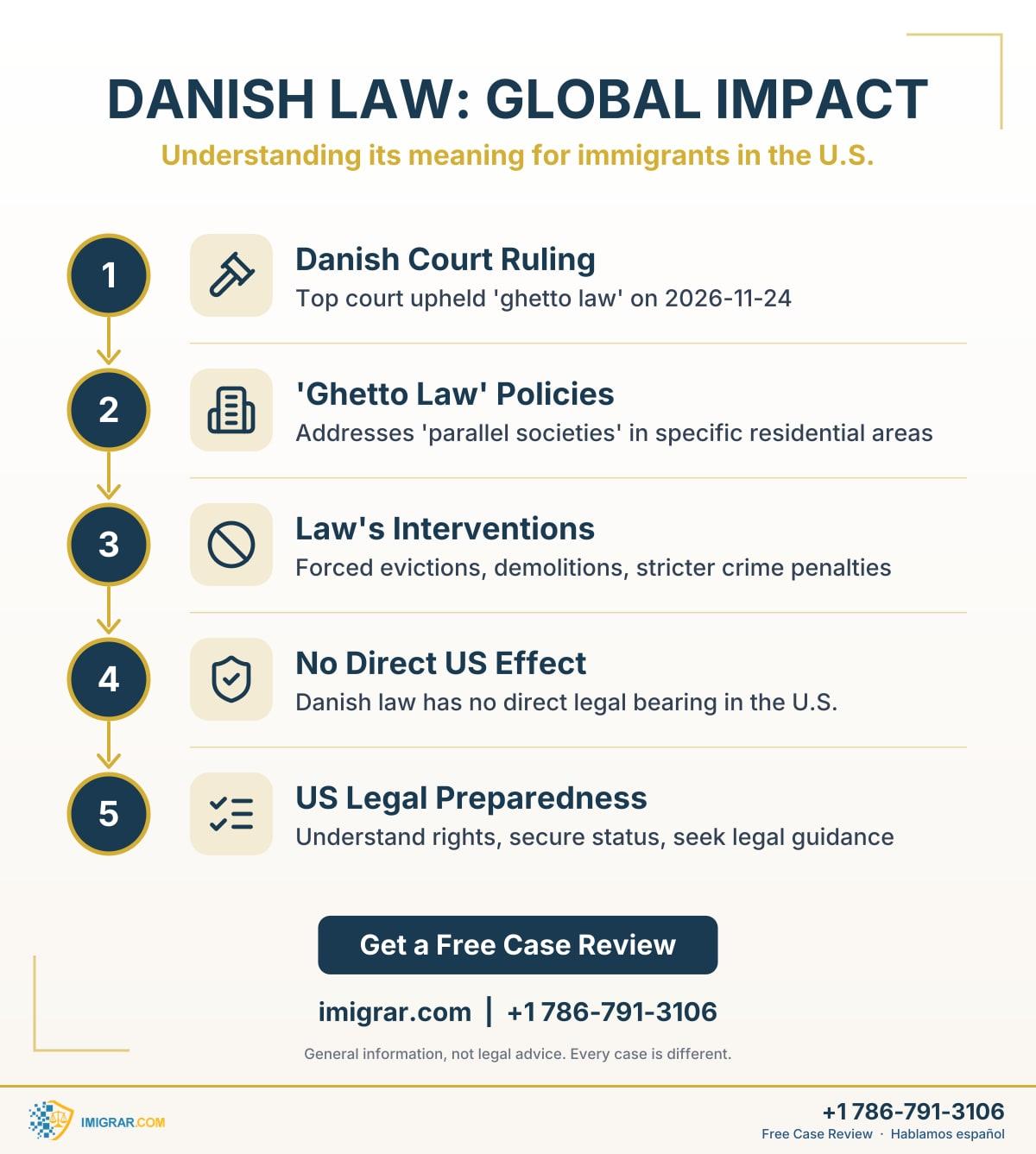
The global landscape of immigration policy is constantly shifting, and recent international events often resonate deeply within immigrant communities worldwide, including here in Orlando and across Florida. On 2026-11-24, news broke from Denmark regarding a top court’s ruling that upheld the country’s controversial "ghetto law," stating that the eviction of "non-Western" families did not constitute discrimination. While this ruling originates thousands of miles away, it sends a powerful message about the evolving nature of immigration laws and the critical importance of understanding and protecting your rights wherever you are.Why this news is showing up now
The Danish Supreme Court’s decision is the culmination of years of legal and political debate surrounding the nation’s "ghetto laws," enacted to address perceived "parallel societies" in certain residential areas. These laws classify neighborhoods based on socioeconomic factors, crime rates, and the percentage of "non-Western" residents, leading to measures like forced evictions, demolition of homes, and even stricter penalties for crimes committed within these designated areas. The recent ruling, affirming that these actions do not amount to discrimination under Danish law, has generated significant international discussion. It highlights a growing trend in some European nations towards more restrictive immigration and integration policies, often framed around national identity and social cohesion. This news, therefore, isn't just a legal update from a distant country; it’s a stark example of how national governments can implement policies that profoundly impact immigrant families, raising questions about human rights, equality, and the very definition of discrimination in an increasingly diverse world.How it can affect Florida residents
**Important:** It is crucial to understand that the Danish "ghetto law" and its recent court ruling have **no direct legal bearing** on immigrants or residents in Florida or anywhere else in the United States. The U.S. legal system operates independently, with its own robust framework of constitutional rights and statutory protections against discrimination. However, the indirect effects of such international news can be significant for immigrant communities in Florida. Firstly, it can understandably cause anxiety and concern. Hearing about policies that target specific communities based on their origin can make individuals feel vulnerable, even if they are living under a different legal system. For families in Orlando and throughout the I-4 corridor who have built lives here, such news can stir fears about the stability of their homes and communities. Secondly, this ruling serves as a potent reminder of the importance of **proactive legal engagement** in the United States. While the U.S. legal framework provides strong protections, navigating the complexities of immigration law can be challenging. The Danish situation underscores the need for: * **Understanding Your Rights:** Knowing the constitutional and statutory protections available to you as an immigrant in the U.S. * **Securing Your Status:** Taking proactive steps to legalize or solidify your immigration status in the U.S. to prevent future uncertainties. * **Vigilance:** Staying informed about U.S. immigration policy changes and how they might affect you. * **Legal Representation:** Recognizing that expert legal guidance is invaluable in protecting your interests and keeping your family together. For Central Florida residents, particularly those in Orange County, this news should reinforce the necessity of consulting with experienced immigration attorneys to ensure their status is secure and their rights are protected. It emphasizes that while the U.S. is not Denmark, the global conversation around immigration means that being well-informed and legally prepared is more important than ever.Feeling Unsure About Your Rights? The complexities of immigration law can be daunting, especially with global news creating uncertainty. Our Orlando immigration team at Imigrar understands your concerns and is ready to assist. Call +1 786-791-3106 for a free consultation, or message us online. Se Habla Español.
What the ‘Ghetto Law’ Controversy Is (and Why It Matters for Immigrants)
The term "ghetto law" might sound extreme, but it accurately reflects the controversial nature of the policies enacted in Denmark. Understanding what these laws entail, even as a non-Danish citizen, helps to contextualize the broader global challenges and debates surrounding immigration and integration.A plain-English definition
Denmark's "ghetto law" is a set of policies designed to address what the Danish government perceives as "parallel societies" – areas where immigrant populations are seen as not integrating sufficiently into Danish society. These laws target specific residential areas (often public housing projects) that meet a combination of criteria over a certain period. Once an area is designated a "ghetto" or "vulnerable area," it triggers a range of interventions. The core idea is to break up concentrated ethnic communities and disperse residents to promote integration. Measures include: * **Forced Evictions and Demolitions:** Residents, particularly those from "non-Western" backgrounds, can be evicted from their homes, and entire housing blocks can be demolished to make way for new housing with a different demographic mix. * **Stricter Penalties for Crimes:** Individuals committing crimes within designated "ghetto" areas face double the normal penalties. * **Mandatory Daycare:** Children over one year old in "ghetto" areas are required to attend daycare for at least 25 hours a week, with a focus on Danish values and language. * **Restrictions on Residency:** New residents from "non-Western" countries can be prevented from moving into certain areas. The recent ruling by Denmark’s top court upheld the legality of these forced evictions, concluding that they did not constitute discrimination because the criteria for "ghetto" designation were based on objective socioeconomic factors (like income and employment) alongside the percentage of "non-Western" residents, rather than solely on ethnicity. However, critics argue that the practical application disproportionately affects and targets specific ethnic groups, thereby constituting indirect discrimination.Key terms you need to know
When discussing policies like Denmark's "ghetto law," several key terms emerge that are important for any immigrant to understand, even in a U.S. context: * **"Ghetto Law"**: This informal term refers to Denmark's "Parallel Society Law" and related legislative packages aimed at addressing perceived lack of integration in specific residential areas. Its official name is the "National Strategy for Parallel Societies." * **"Non-Western"**: This is a specific demographic classification used in Denmark, typically referring to individuals from countries outside of Europe, North America, Australia, and New Zealand. This categorization itself is a point of contention, as critics argue it creates a two-tiered system of citizenship. * **Discrimination**: In a broad sense, discrimination is the unjust or prejudicial treatment of different categories of people, especially on the grounds of race, age, sex, or disability. In the U.S., anti-discrimination laws are robust, prohibiting unfair treatment based on protected characteristics like national origin, race, and religion. The Danish court's ruling hinged on whether the "ghetto law" constituted *direct* discrimination, finding it did not based on their interpretation of the criteria. * **Integration Policies**: These are government strategies designed to help immigrants assimilate into the host country's society. They can range from language courses and job training to, in the case of Denmark, more coercive measures like residential dispersion. * **Human Rights**: These are fundamental rights and freedoms that all individuals are entitled to, regardless of nationality, sex, national or ethnic origin, color, religion, language, or any other status. Organizations like the United Nations and the Council of Europe monitor human rights compliance, and policies like the "ghetto law" often spark debates about their adherence to international human rights standards concerning housing, non-discrimination, and family life. Understanding these terms helps shed light on the complex global challenges faced by immigrant communities and underscores why strong legal protections, like those offered in the U.S., are so vital.Current Immigration Law in the U.S.: Protecting Your Rights
While the Danish "ghetto law" ruling highlights a specific approach to immigration and integration in Europe, it is essential for immigrants in the U.S. to understand that the legal framework here is fundamentally different, built upon principles of **due process**, **equal protection**, and established pathways to legal residency and citizenship. The U.S. legal system provides significant protections against discrimination based on national origin, race, or religion, ensuring that individuals are not arbitrarily targeted or removed from their homes simply due to their background or community.Federal requirements
The foundation of immigrant rights and protections in the United States lies in the **U.S. Constitution** and federal statutes. * **The 14th Amendment's Equal Protection Clause**: This ensures that no state shall "deny to any person within its jurisdiction the equal protection of the laws." This applies to all persons, whether citizens or non-citizens, preventing states from enacting discriminatory laws. * **The Civil Rights Act of 1964**: This landmark legislation prohibits discrimination based on race, color, religion, sex, or national origin in public accommodations, employment, and federally funded programs. * **The Fair Housing Act**: This federal law prohibits discrimination in the sale, rental, and financing of housing based on race, color, religion, sex, national origin, familial status, and disability. This is a critical protection against the kind of housing-based discrimination seen in Denmark. * **The Immigration and Nationality Act (INA)**: Codified at 8 U.S.C. § 1101 et seq., the INA is the bedrock of U.S. immigration law. It establishes the conditions for entry, stay, and removal of foreign nationals, as well as the pathways to permanent residency and citizenship. Crucially, the INA outlines specific, legal categories under which individuals can obtain immigrant visas or adjust their status, providing stability and security. Key agencies involved in federal immigration law include: * **U.S. Citizenship and Immigration Services (USCIS)**: Responsible for administering lawful immigration to the United States. USCIS processes various petitions and applications for immigration benefits. You can find all official forms and guidance on the USCIS official website. * **U.S. Department of State (DOS)**: Manages U.S. foreign policy and is responsible for issuing visas at U.S. embassies and consulates abroad. You can learn more about visa processes at U.S. Department of State. * **Executive Office for Immigration Review (EOIR)**: This component of the Department of Justice administers the immigration courts and the Board of Immigration Appeals, handling deportation and removal proceedings. For more information, visit Executive Office for Immigration Review. Common USCIS forms relevant to securing legal status include: * Form I-130, Petition for Alien Relative: Filed by a U.S. citizen or lawful permanent resident (LPR) to establish a relationship with an eligible foreign relative who wishes to immigrate to the United States. * Form I-485, Application to Register Permanent Residence or Adjust Status: Filed by an eligible individual already in the U.S. to apply for lawful permanent resident status (a Green Card). * Form N-400, Application for Naturalization: Filed by eligible LPRs to apply for U.S. citizenship. These forms and the processes they represent are the structured, legal pathways for immigrants to establish a secure and protected life in the U.S., contrasting sharply with policies that might arbitrarily disrupt communities based on origin.Florida-specific considerations
While federal law governs immigration, states like Florida can enact laws that affect immigrants, though they cannot contradict federal immigration law or constitutional protections. In Florida, recent legislative actions have focused on issues related to undocumented immigration, such as: * **Increased Enforcement Measures:** Some state laws have enhanced penalties for transporting undocumented individuals or required certain employers to use E-Verify. * **Healthcare Restrictions:** There have been measures impacting healthcare access for undocumented immigrants. **Warning:** It is vital to distinguish between laws targeting undocumented immigration and those affecting individuals with lawful status or those actively pursuing it. Florida laws, while sometimes stringent, cannot override federal protections against discrimination for those legally present in the U.S. or interfere with federal immigration processes. For residents in Orlando and Central Florida, understanding the interplay between federal and state laws is crucial. The Orlando USCIS Field Office serves the region, handling interviews for adjustment of status, naturalization, and other immigration benefits. While state policies might create a challenging environment for some, they underscore the importance of securing and maintaining legal immigration status to ensure families can remain together and live free from fear of arbitrary removal or discrimination. Imigrar serves clients across Florida, including Orange County and the surrounding areas, providing guidance through these complexities.How to Secure Your Immigration Status in the U.S.: A Proactive Guide
In light of global immigration trends, securing your legal immigration status in the U.S. is the most effective way to protect yourself and your family. One of the most common pathways for individuals already in the U.S. to obtain a Green Card is through **Adjustment of Status (AOS)**. This process allows eligible individuals to become lawful permanent residents without having to leave the country. Here’s a complete step-by-step guide to adjusting your status:1) Determine Your Eligibility for Adjustment of Status
Before anything else, you must determine if you qualify for AOS. Eligibility typically depends on: * **Lawful Entry:** You generally must have been inspected and admitted or paroled into the United States. * **Immigrant Visa Availability:** An immigrant visa must be immediately available to you at the time you file your Form I-485. This is usually determined by your **Priority Date** and the **Visa Bulletin** published by the Department of State. Immediate relatives of U.S. citizens (spouses, unmarried children under 21, and parents) do not have to wait for a visa to become available, as visas are always considered immediately available. * **Eligibility Category:** You must fall into an eligible category, such as: * Immediate relative of a U.S. citizen. * Family-sponsored immigrant (e.g., adult children, siblings of U.S. citizens; spouses and children of LPRs). * Employment-based immigrant. * Asylee or refugee. * Special immigrant (e.g., religious workers, certain juveniles). * **Admissibility:** You must be admissible to the U.S. Inadmissibility grounds (e.g., certain criminal offenses, health issues, prior immigration violations) can prevent adjustment, though waivers may be available for some. **Required Documents for Eligibility:** * Proof of U.S. citizen or LPR sponsor's status (e.g., birth certificate, naturalization certificate, Green Card). * Your birth certificate. * Proof of lawful entry (e.g., passport with visa stamp, I-94 arrival/departure record). * Marriage certificate (if applicable). * Any previous immigration applications or notices.2) File the Immigrant Petition (If Applicable)
For most family-based and some employment-based categories, a preliminary petition must be filed and approved before you can apply for AOS. * **Family-Based Immigration:** Your sponsoring U.S. citizen or LPR relative must file Form I-130, Petition for Alien Relative, with USCIS. This petition establishes the qualifying relationship between you and your sponsor. * **Employment-Based Immigration:** Your sponsoring employer typically files Form I-140, Immigrant Petition for Alien Worker, on your behalf. **Important:** For immediate relatives of U.S. citizens, the Form I-130 and Form I-485 can often be filed concurrently (at the same time), which can expedite the process. **Required Documents for Form I-130:** * Form I-130, signed and completed. * Proof of relationship (e.g., marriage certificate, birth certificates). * Proof of U.S. citizen/LPR status of petitioner. * Passport-style photos for both petitioner and beneficiary. * Any other supporting documentation requested by USCIS to prove the bona fides of the relationship.3) Prepare and File Your Adjustment of Status Application
Once an immigrant visa is available (or concurrently for immediate relatives), you can prepare and file your AOS application package. This is a comprehensive submission to USCIS and typically includes: * Form I-485, Application to Register Permanent Residence or Adjust Status. * Form I-765, Application for Employment Authorization (optional, allows you to work while AOS is pending). * Form I-131, Application for Travel Document (optional, allows you to travel internationally while AOS is pending – known as Advance Parole). * Form I-864, Affidavit of Support (required for most family-based immigrants, submitted by the petitioner/sponsor to show they can financially support you). * Form I-693, Report of Medical Examination and Vaccination Record (must be completed by a USCIS-approved civil surgeon). * **Passport-style photographs** (typically two for each form requiring them). * **Copy of your birth certificate** (with certified translation if not in English). * **Copy of your passport biographical page and visa page.** * **Copy of your Form I-94** Arrival/Departure Record. * **Copies of all prior immigration applications and approvals** (e.g., I-797 approval notices). * **Certified copies of court records** (if you have any criminal history). **Reminder:** All documents not in English must be accompanied by a certified English translation.4) Attend Biometrics Appointment and Interview
After USCIS receives your application, you will typically receive: * **Receipt Notices:** Confirming USCIS has received your forms. * **Biometrics Appointment Notice:** You will be scheduled to attend an appointment at a local Application Support Center (ASC) to have your fingerprints, photograph, and signature taken. This is used for background checks. For Central Florida residents, this might be at the Orlando USCIS Field Office or another nearby ASC. * **Interview Notice:** Most AOS applicants will be scheduled for an interview at a USCIS field office (e.g., the Orlando USCIS Field Office). Both the applicant and the petitioner (if applicable) must attend. The officer will review your application, verify information, and ask questions to confirm eligibility and the bona fides of your relationship (for family-based cases).5) Respond to Requests for Evidence (RFEs) or Notices of Intent to Deny (NOID)
USCIS may send you an **RFE** if they need additional documents or information to make a decision on your case. It is **critical** to respond to RFEs completely and by the specified deadline. Failure to do so can lead to denial. A **NOID** indicates USCIS intends to deny your application and gives you a final chance to submit evidence to overcome the grounds for denial.6) Receive a Decision
If your application is approved, you will receive a welcome notice and your Green Card will be mailed to you. You are officially a **Lawful Permanent Resident**. If denied, USCIS will provide a reason for the denial, and you may have options to appeal or refile, depending on the reason. **Warning:** The AOS process can be complex and requires meticulous attention to detail. Any misstep can cause significant delays or even denial. Consulting with an experienced immigration attorney from Imigrar is highly recommended to ensure your application is accurate and complete.Don't Navigate USCIS Alone! The Adjustment of Status process is intricate. Let Imigrar's expert team guide you through every step. We serve clients nationwide, including those in Orlando and throughout Florida. Call us today at +1 786-791-3106 for a free consultation. Se Habla Español.
Practical Steps You Can Take Today to Protect Your Family
The news from Denmark serves as a powerful reminder that proactive measures are the best defense against uncertainty. Here are practical steps you can take today to secure your immigration future in the U.S. and protect your family in Orlando and beyond: * **Consult an Immigration Attorney:** This is the single most important step. An experienced attorney can assess your unique situation, identify eligible pathways to legal status, andRelated Topics
Need Legal Assistance?
Our experienced immigration attorneys are here to help with your case. Contact Imigrar today for a free consultation and let us guide you through the legal process with confidence.
📍 Orlando, Florida • Serving clients nationwide
📧 info@imigrar.com