
Trump Green Card Memo: Navigating New Hurdles to Family Immigration
Understand the Trump Administration's Green Card memo and its impact on your path to permanent residency. Imigrar helps families in Orlando and nationwide navigate these complex changes.
The reporting that sparked this guide:
What This News Means for Immigrants in Orlando and Across Florida
The landscape of U.S. immigration policy is constantly evolving, and under President Donald Trump’s current administration, these changes often create significant anxiety and uncertainty for immigrant families. A recent Green Card memo issued by the administration, highlighted by the Center for American Progress, is a prime example of a policy directive that could profoundly reshape how individuals and families pursue legal permanent residency. At Imigrar, we understand that for many in Orlando, Central Florida, and throughout the nation, these developments aren't just headlines; they are deeply personal matters that affect your future and the unity of your family.
Why this news is showing up now
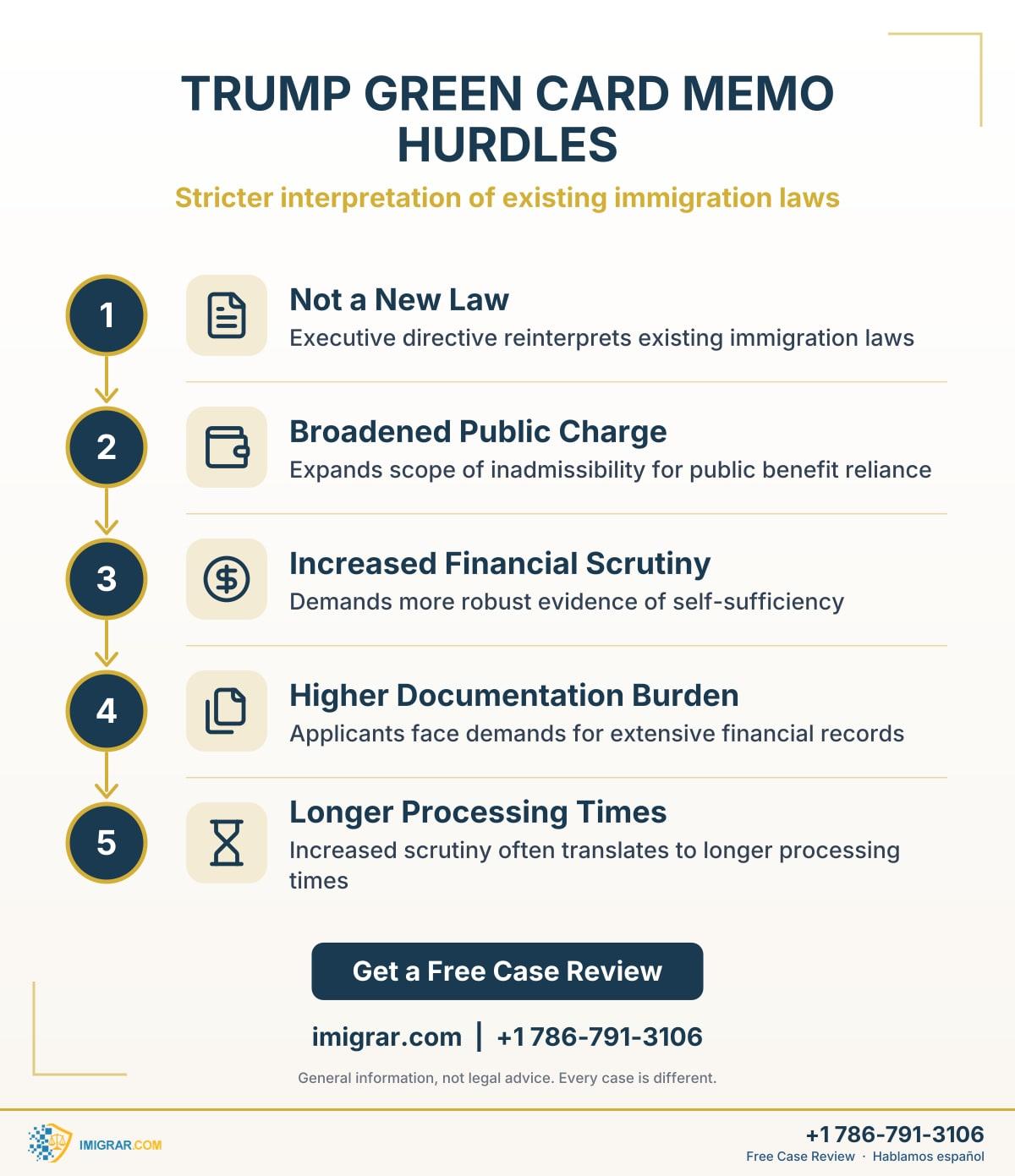
President Trump's administration, now in its second term, continues to prioritize policies aimed at restricting legal immigration pathways and increasing scrutiny on applicants. This particular Green Card memo, while building on previous administrative directives, represents a renewed and intensified focus on certain aspects of eligibility and enforceability. It’s not about new legislation, but rather a reinterpretation and stricter application of existing immigration laws, designed to create additional hurdles for those seeking permanent residency. These memos often emerge as internal guidance to agencies like U.S. Citizenship and Immigration Services (USCIS) or the Department of State, directing how officers should adjudicate cases. This means that while the core laws remain the same, the *way* your application is reviewed and the level of evidence required are significantly impacted. For applicants, this translates to a more challenging and often prolonged process, where even minor discrepancies or perceived deficiencies can lead to delays or denials. The administration’s stated goal is to ensure immigrants are self-sufficient and do not become a "public charge," a concept that is being broadly applied to limit who qualifies for a Green Card.How it can affect Florida residents
Florida is a melting pot of cultures and home to a vibrant, diverse immigrant population. From the bustling metropolitan areas like Orlando and Miami to the agricultural heartlands, immigrants are integral to our economy and community fabric. This Green Card memo, with its potential for increased scrutiny and stricter requirements, poses particular challenges for Florida residents:- Family Unity: Many Floridian families rely on family-based immigration pathways to reunite with loved ones. The memo’s focus on stricter interpretations of eligibility and financial self-sufficiency could make it harder for U.S. citizens and lawful permanent residents in Orange County and beyond to sponsor their family members, potentially leading to prolonged separations. Our tagline, "Keep Families Together," underscores our commitment to combating policies that threaten family unity.
- Economic Impact: Florida’s economy, especially sectors along the I-4 corridor like tourism, hospitality, and construction, heavily depends on immigrant labor and entrepreneurship. Policies that reduce legal immigration can lead to labor shortages, stifle innovation, and harm local businesses. Immigrants contribute significantly to Florida's tax base and consumer spending.
- Increased Documentation Burden: Applicants in Florida may face demands for more extensive financial records, health information, and evidence of self-sufficiency. This can be particularly burdensome for those with lower incomes or less access to comprehensive financial planning, even if they have been productive members of society.
- Processing Delays: Increased scrutiny often translates to longer processing times at the Orlando USCIS Field Office and other national service centers. This uncertainty can cause immense stress and disrupt lives, careers, and educational plans for individuals and families across the state.
- Fear and Confusion: The constant stream of policy changes and memos creates a climate of fear and confusion. Many in Central Florida are unsure about their rights, their eligibility, or how to proceed, leading to inaction or mistakes that could jeopardize their immigration journey.
Understanding these potential impacts is the first step. The next is to take proactive, informed action.
Need Help Navigating These Changes? Our Orlando immigration team is ready to assist. Call +1 786-791-3106 for a free consultation, or message us online. Se Habla Español.
What the Trump Administration Green Card Memo Is (and Why It Matters)
The Trump Administration's Green Card memo is not a new law passed by Congress, nor does it fundamentally alter the Immigration and Nationality Act (INA). Instead, it is an executive directive or internal guidance issued by the administration to agencies like U.S. Citizenship and Immigration Services (USCIS) and consular officers at U.S. Embassies and Consulates abroad. Its primary purpose is to provide instructions on how existing immigration laws should be interpreted and applied, often with a bias towards stricter enforcement and increased barriers to entry.
A plain-English definition
Imagine the existing immigration laws as a large rulebook. A Green Card memo is like a new set of highly detailed, often more restrictive, instructions on *how to read and apply* specific rules within that rulebook. It doesn't rewrite the rulebook, but it dictates a much tougher interpretation, especially concerning who qualifies for a Green Card and what evidence they must provide.Specifically, this memo likely reinforces and expands upon previous administration efforts to restrict legal immigration, particularly by:
- Broadening the "Public Charge" Definition: Emphasizing and potentially expanding the scope of the Public Charge inadmissibility ground, making it harder for applicants who might rely on certain public benefits (or are deemed likely to) to obtain a Green Card. This is a critical point of increased scrutiny.
- Increasing Scrutiny on Financial Self-Sufficiency: Requiring more robust and extensive evidence that applicants will not become a burden on the U.S. government. This can impact sponsors (petitioners) as well, demanding higher income thresholds or more comprehensive financial documentation.
- Heightening Interview Scrutiny: Directing adjudicators to delve deeper into an applicant's background, intentions, and financial stability during interviews for Adjustment of Status or Consular Processing.
- Limiting Discretionary Approvals: Reducing the flexibility of immigration officers to approve cases where there might be minor issues but overall eligibility is strong, instead pushing for more rigid adherence to every single requirement.
Why it matters: While not a new law, an administrative memo carries significant weight because it directly dictates how thousands of immigration officers nationwide and worldwide will process applications. It shifts the burden of proof even more heavily onto applicants, increases the risk of Request for Evidence (RFE) notices, delays, and denials, and fundamentally changes the experience of applying for a Green Card. For families in Orlando and across the country, this memo represents another layer of complexity and uncertainty in their journey towards permanent residency.
Key terms you need to know
Understanding the following terms is crucial when navigating Green Card applications, especially under the current administration's heightened scrutiny:- Green Card (Lawful Permanent Resident Status): This is your official identification card that proves you are authorized to live and work permanently in the United States. It is also known as Form I-551.
- Adjustment of Status (AOS): The process of applying for a Green Card from within the United States, typically after entering on a nonimmigrant visa (e.g., tourist, student, worker) and meeting certain eligibility criteria. This process involves filing Form I-485.
- Consular Processing: The process of applying for a Green Card from outside the United States at a U.S. embassy or consulate in your home country. This involves filing Form DS-260.
- Public Charge Rule: A long-standing U.S. immigration law that allows immigration officials to deny a Green Card to individuals who are deemed likely to become primarily dependent on the government for subsistence. The Trump administration has significantly expanded the types of public benefits considered and the criteria for determining who might become a public charge, making this a major hurdle for many applicants.
- Immigration and Nationality Act (INA): The body of federal law governing immigration to the United States. While the memo doesn't change the INA, it directs how agencies interpret and enforce its provisions.
- Family-Based Immigration: Pathways to a Green Card based on a qualifying relationship with a U.S. citizen or lawful permanent resident, such as a spouse, child, parent, or sibling. These are often categorized as Immediate Relatives (IR) or Family Preference categories (F1, F2A, F2B, F3, F4).
- Employment-Based Immigration: Pathways to a Green Card based on a qualifying job offer or investment in the U.S. (EB-1, EB-2, EB-3, EB-4, EB-5).
- Priority Date: The date your initial immigration petition (e.g., Form I-130 or Form I-140) was properly filed and received by USCIS. This date determines your place in the waiting line for a visa in certain preference categories.
- Visa Bulletin: A monthly publication by the U.S. Department of State that summarizes the availability of immigrant visas for the upcoming month. It indicates which Priority Dates are current for various preference categories and countries.
- Affidavit of Support (Form I-864): A legally binding document filed by a U.S. citizen or lawful permanent resident sponsor who promises to financially support the intending immigrant. This form is critically important in proving the applicant will not become a Public Charge.
Concerned about the "Public Charge" rule? Our Orlando immigration attorneys specialize in navigating complex financial requirements. Call +1 786-791-3106 for expert guidance. Se Habla Español.
Current Immigration Law: The Foundation
While the Trump Administration's Green Card memo imposes stricter interpretations and increased scrutiny, it is essential to remember that the fundamental laws governing immigration to the United States remain codified in the Immigration and Nationality Act (INA). The memo guides how these laws are applied, not the laws themselves. Understanding the statutory framework is crucial for any Green Card applicant.
Federal requirements
The INA establishes the various categories under which individuals can qualify for a Green Card. The most common pathways affected by the memo’s increased scrutiny are family-based and, to some extent, employment-based immigration, particularly concerning the Public Charge ground of inadmissibility.Key Pathways and Their Foundations:
- Family-Based Immigration: These categories are designed to unite families.
- Immediate Relatives (IR): Spouses of U.S. citizens, unmarried children under 21 of U.S. citizens, and parents of U.S. citizens (if the citizen is 21 or older). There are no annual quotas, meaning visa numbers are always available.
- Family Preference Categories:
- F1: Unmarried sons and daughters (21 or older) of U.S. citizens.
- F2A: Spouses and children (unmarried, under 21) of Lawful Permanent Residents (LPRs).
- F2B: Unmarried sons and daughters (21 or older) of LPRs.
- F3: Married sons and daughters of U.S. citizens.
- F4: Brothers and sisters of U.S. citizens (if the citizen is 21 or older). These categories are subject to annual quotas and lengthy waits, determined by the Visa Bulletin and your Priority Date.
- Employment-Based Immigration:
- EB-1, EB-2, EB-3: For workers with extraordinary ability, advanced degrees, or skilled/unskilled labor, respectively.
- EB-4: Special immigrants (e.g., religious workers).
- EB-5: Immigrant investors. These categories also have annual quotas.
- Diversity Visa Lottery: Provides up to 50,000 visas annually to individuals from countries with historically low rates of immigration to the U.S.
Inadmissibility Grounds: Beyond meeting specific category requirements, applicants must also be admissible to the U.S. The memo particularly emphasizes the following grounds:
- Public Charge (INA §212(a)(4)): This is the most significant area impacted by the current administration's guidance. An applicant is inadmissible if they are determined "likely at any time to become a public charge." The memo significantly broadens what constitutes a "public charge" and increases the evidence required to overcome this ground, focusing heavily on financial stability, assets, education, skills, health, and age.
- Health-Related Grounds (INA §212(a)(1)): Certain communicable diseases, lack of vaccinations, or physical/mental disorders with associated harmful behavior.
- Criminal Grounds (INA §212(a)(2)): Certain criminal convictions or admissions of criminal acts.
- Security and Related Grounds (INA §212(a)(3)): Terrorism, espionage, etc.
- Illegal Entry and Immigration Violations (INA §212(a)(6) & (9)): Prior illegal entries, unlawful presence, misrepresentation.
Required Forms: Navigating these pathways requires specific forms, which are now scrutinized more intensely:
- Form I-130, Petition for Alien Relative: Filed by a U.S. citizen or LPR to establish a qualifying family relationship.
- Form I-485, Application to Register Permanent Residence or Adjust Status: Filed by an eligible individual within the U.S. to adjust their status to LPR.
- Form DS-260, Immigrant Visa Electronic Application: Used for Consular Processing, filed by an eligible individual outside the U.S.
- Form I-864, Affidavit of Support Under Section 213A of the Act: A legally binding document from the sponsor, crucial for overcoming Public Charge concerns.
- Form I-693, Report of Medical Examination and Vaccination Record: Required for Adjustment of Status applicants.
Official Reference: For the most accurate and up-to-date information on forms and requirements, always refer to the USCIS official website.
Florida-specific considerations
While immigration law is federal, its application has local nuances. For residents of Florida, especially in the greater Orlando area:- Orlando USCIS Field Office: If you are undergoing Adjustment of Status and live in Central Florida, your interview will likely be scheduled at the Orlando USCIS Field Office. Familiarity with local office procedures and common interview questions (which may be influenced by the memo’s directives) is beneficial.
- Diverse Demographics: Florida’s large immigrant populations from Latin America, the Caribbean, and other regions mean that many families rely on family-based petitions. The memo's impact on these pathways will be acutely felt within these communities.
- Economic Contributions: Florida's economy benefits immensely from immigrant labor in agriculture, hospitality, and construction. Policies that deter legal immigration can have tangible economic repercussions across the state, including in Orange County.
- State-Level Advocacy: While federal law governs immigration, state and local advocacy groups in Florida play a vital role in supporting immigrant communities and challenging harmful policies. Staying informed about local resources and support networks can be valuable.
Navigating the current legal framework, especially with the added layer of administrative scrutiny, demands careful attention to detail and a thorough understanding of all requirements.
How to Apply for a Green Card Under Current Policies: A Complete Step-by-Step Guide
Applying for a Green Card is a complex process, and the Trump Administration's memo has added layers of scrutiny, particularly regarding financial self-sufficiency and the Public Charge rule. This guide outlines the general steps, emphasizing areas where the memo's impact is most pronounced.
1) Determine Your Eligibility and Category
Before anything else, you must establish a qualifying basis for a Green Card. This is the bedrock of your application. * **Identify Your Sponsor:** Is it a U.S. citizen or a Lawful Permanent Resident (LPR) family member? Is it an employer? Are you eligible through asylum, refugee status, or other special categories? * **Review Relationship:** For family-based petitions, the relationship must be legitimate and legally recognized (e.g., marriage certificate, birth certificate). * **Check Visa Availability:** If applying in a Family Preference or Employment-Based category, you must determine if a visa number is available based on your country of birth and your Priority Date, as published in the U.S. Department of State Visa Bulletin. Immediate Relatives of U.S. citizens do not have this wait.Required Documents for Step 1:
- Proof of U.S. Citizenship/LPR Status for Petitioner: Birth certificate, U.S. passport, Certificate of Naturalization, or Green Card (Form I-551).
- Proof of Relationship: Marriage certificates, birth certificates, adoption decrees, or other official documents establishing the qualifying relationship.
- Identification for Beneficiary: Passport, birth certificate.
2) File the Initial Petition with USCIS
This is the first formal step to establish your eligibility. * **For Family-Based:** The U.S. citizen or LPR petitioner files Form I-130, Petition for Alien Relative, with USCIS. This form proves the existence of a qualifying relationship. * **For Employment-Based:** The employer typically files Form I-140, Immigrant Petition for Alien Worker, or you might self-petition for certain categories. * **Accurate Information:** Ensure all information is consistent with other official documents. Discrepancies can trigger RFEs or denials under current scrutiny.Required Documents for Step 2 (Form I-130 example):
- Completed and signed Form I-130.
- Copy of petitioner's proof of U.S. citizenship or LPR status.
- Copy of beneficiary's birth certificate.
- Copy of marriage certificate (if applicable).
- Copies of divorce decrees or death certificates for any prior marriages of both petitioner and beneficiary (if applicable).
- Passport-style photos of both petitioner and beneficiary.
- Proof of bona fide marriage (if applicable): joint bank accounts, leases, utility bills, photos, affidavits from friends/family.
- Applicable filing fees.
3) Wait for Visa Availability (If Applicable)
If you are in a Family Preference or Employment-Based category, your Priority Date becomes crucial. * **Monitor the Visa Bulletin:** Regularly check the U.S. Department of State Visa Bulletin to see when your Priority Date becomes "current." This indicates that an immigrant visa number is available for you. * **What "Current" Means:** Once your Priority Date is current, you can proceed with either Adjustment of Status (if in the U.S.) or Consular Processing (if outside the U.S.). This wait can range from months to many years, depending on the category and country of chargeability.4) Apply for Permanent Residency (Adjustment of Status or Consular Processing)
This is the core of your Green Card application, and where the memo's impact on Public Charge and increased scrutiny is most keenly felt.Option A: Adjustment of Status (If you are in the U.S.) This involves filing a packet of forms with USCIS.
- File Concurrently (if eligible): If your Priority Date is current (or you are an Immediate Relative) and you maintained lawful status, you can often file Form I-485 concurrently with or after Form I-130 is approved.
- Key Forms to File:
- Form I-485, Application to Register Permanent Residence or Adjust Status: The main application.
- Form I-864, Affidavit of Support: This is absolutely critical under the current administration. Your sponsor must meet strict income guidelines (125% of the Poverty Guidelines for their household size) and demonstrate ability to support you. Provide extensive financial documentation.
- Form I-693, Report of Medical Examination and Vaccination Record: Completed by a USCIS-approved civil surgeon.
- Form I-765, Application for Employment Authorization (Optional): Allows you to work legally while Form I-485 is pending.
- Form I-131, Application for Travel Document (Optional): Allows you to travel internationally while Form I-485 is pending (Advance Parole). Traveling without it can terminate your AOS application.
Required Documents for Adjustment of Status (beyond initial petition):
- Completed and signed Form I-485, Form I-864, Form I-693, and optional forms.
- Two passport-style photos.
- Copy of birth certificate.
- Copy of passport bio page and visa page.
- Copy of Form I-94 (Arrival/Departure Record).
- Copies of all previous immigration documents (e.g., I-20s, EAD cards, H1B approvals).
- Certified copies of court and police records for any arrests or convictions (even if charges were dropped or expunged).
- For Form I-864: Sponsor's federal income tax returns (3 most recent years), W-2s, 1099s, pay stubs, employment verification letter, bank statements, proof of assets (if needed).
- For Public Charge: Additional evidence of your own financial self-sufficiency (education, skills, job offers, assets, health insurance).
- Applicable filing fees.
Option B: Consular Processing (If you are outside the U.S. or ineligible for AOS) This involves working with the National Visa Center (NVC) and a U.S. embassy/consulate abroad.
- NVC Processing: Once your Form I-130 (or other petition) is approved and your Priority Date is current, USCIS sends the approved petition to the NVC. The NVC will then instruct you to pay fees and submit required documents online.
- Submit Forms and Documents: You will complete Form DS-260, Immigrant Visa Electronic Application, and upload all supporting civil and financial documents. This includes the Form I-864.
- Medical Examination: You will undergo a medical exam with an embassy-approved physician in your home country.
Required Documents for Consular Processing (beyond initial petition):
- Completed and signed Form DS-260.
- Passport valid for at least six months beyond your intended entry date.
- Two passport-style photos.
- Birth certificate.
- Marriage certificate (if applicable).
- Divorce decrees or death certificates for any prior marriages.
- Police certificates from all countries where you have lived for specified periods.
- Military records (if applicable).
- Court and prison records (if applicable).
- Form I-864, Affidavit of Support, with all supporting financial documentation from your sponsor.
- Medical examination results.
- Applicable filing fees.
5) Attend Biometrics Appointment and Interview
This is a critical stage for both AOS and Consular Processing. * **Biometrics:** USCIS will send you an appointment notice for a biometrics services appointment. You will provide fingerprints, photos, and a signature. This is used for background checks. * **Interview:** * **For AOS in Orlando:** You will attend an interview at the Orlando USCIS Field Office. Both the petitioner and beneficiary typically attend. The officer will review your application, verify information, and ask questions about your relationship (for family-based) and your eligibility, including your financial self-sufficiency under the Public Charge rule. * **For Consular Processing:** You will attend an interview at the U.S. embassy or consulate in your home country. Be prepared to answer questions thoroughly and truthfully.Important: Prepare extensively for your interview. The memo emphasizes increased scrutiny, so be ready to provide clear, consistent answers and any additional requested documentation.
6) Decision and Green Card Issuance
* **Approval:** If your application is approved, you will receive your Green Card (Form I-551) by mail. For consular processing, you will receive a visa stamp in your passport, allowing you to enter the U.S. as a permanent resident. * **Conditional Green Card:** If you are married to a U.S. citizen for less than two years at the time of approval, you will receive a 2-year conditional Green Card.7) Post-Approval Considerations
* **Removing Conditions:** If you received a conditional Green Card, you must file Form I-751, Petition to Remove Conditions on Residence, within the 90-day window before your conditional Green Card expires. Failure to do so can lead to loss of status. * **Naturalization:** After meeting residency and other requirements (typically 5 years, or 3 years if married to a U.S. citizen), you may be eligible to apply for U.S. citizenship.USCIS Forms are available for download directly from the official website. Always use the latest version.
Practical Steps You Can Take Today to Protect Your Green Card Application
Navigating the complexities of current immigration policies, especially with the Trump Administration's Green Card memo increasing scrutiny, requires proactive and strategic planning. Here are practical steps you can take today to strengthen your application and protect your family's future.
Actionable Checklist:
* **Consult an Experienced Immigration Attorney:** This is the single most important step. Policies are constantly shifting. An attorney specializing in U.S. immigration law, like Imigrar, can provide up-to-date advice, identify potential issues, and help you prepare a robust application. Don't try to go it alone. * **Gather and Organize All Documents:** Start collecting every single document related to your identity, relationships, finances, education, employment, and immigration history. Organize them clearly, making copies and keeping originals safe. * **Understand the Public Charge Rule Thoroughly:** Review the specific criteria for the Public Charge rule. Be prepared to provide extensive evidence of your financial self-sufficiency and your sponsor's ability to support you. This includes tax returns, pay stubs, bank statements, and potentially proof of health insurance, assets, and educational attainment. * **Maintain Impeccable Records:** Keep a meticulous record of all communications with USCIS, NVC, and any other government agencies. Document every filing, payment, and interaction. * **Avoid Any Immigration Violations:** Do not overstay your visa, work without authorization, or make any misrepresentations on government forms. Even minor violations can be severely penalized under the current administration's strict enforcement. * **Stay Informed (But Don't Panic):** Follow reputable news sources and immigration legal updates. While it's important to be aware of changes, avoid misinformation. Focus on actionable advice from trusted legal professionals. * **Build a Strong Financial Portfolio:** If possible, improve your credit score, secure stable employment, and accumulate savings. These actions can strengthen your case against Public Charge concerns.Document Preparation Guidance:
* **Completeness and Accuracy:** Ensure every form is filled out completely and accurately. Incomplete applications are a primary cause of delays and RFEs. * **Translations:** Any document not in English must be accompanied by a certified English translation. The translator must provide a certification that they are competent to translate and that the translation is accurate. * **Notarization:** Some documents may require notarization. Check USCIS guidelines carefully. * **Organize and Label:** Present your documents in a clear, organized manner, ideally with cover sheets and tabs, making it easy for the adjudicating officer to review. * **Multiple Copies:** Always keep a complete copy of everything you submit to USCIS or the NVC.Timeline Expectations:
* **Variability:** Processing times are highly variable and can change frequently. The Trump Administration's increased scrutiny and potential for RFEs often lead to longer waits. * **Check Online:** Monitor the USCIS Processing Times tool for the most current estimates for your specific form and field office (e.g., Orlando USCIS Field Office). * **Patience is Key:** Be prepared for a lengthy process. It's not uncommon for Green Card applications to take 1-3 years or even longer, especially for preference categories. * **RFEs and NOIDs:** Be prepared for potential Requests for Evidence (RFEs) or Notices of Intent to Deny (NOIDs). Responding promptly and thoroughly to these is critical.Warning: Do not make any major life decisions (e.g., selling property, leaving a job, international travel) without first consulting with your immigration attorney, especially while your Green Card application is pending.
How Imigrar Helps Immigrants in Orlando and Across the Nation
At Imigrar, we understand the profound impact that evolving immigration policies, like the Trump Administration's Green Card memo, have on individuals and families. Our mission, "Keep Families Together," guides every aspect of our practice. Based in Orlando, Florida, we proudly serve clients not only across Central Florida but also nationwide, providing expert legal guidance and unwavering support through these challenging times.
Our Experience and Expertise: Our team of dedicated immigration attorneys possesses extensive experience navigating the complexities of U.S. immigration law. We specialize in family-based immigration, employment-based visas, adjustment of status, consular processing, and naturalization. We are intimately familiar with the increased scrutiny and specific challenges posed by the current administration's directives, including the nuanced interpretation of the Public Charge rule and heightened evidentiary requirements. We stay abreast of every policy change, memo, and judicial development to ensure our clients receive the most accurate and effective representation possible.
Personalized and Strategic Approach: We know that no two immigration cases are identical. That's why we take a personalized approach, carefully assessing your unique situation, goals, and potential vulnerabilities. We develop tailored strategies designed to maximize your chances of success, meticulously preparing your application, gathering robust evidence, and anticipating potential obstacles. Our goal is to make your immigration journey as smooth and stress-free as possible, providing clarity amidst uncertainty.
Comprehensive Support: From the initial consultation to the final decision, Imigrar is with you every step of the way. We assist with:
- Eligibility Assessment: Determining the most appropriate Green Card pathway for you.
- Document Preparation: Guiding you through the collection, organization, and translation of all required documentation.
- Application Filing: Meticulously completing and filing all USCIS and NVC forms (e.g., Form I-130, Form I-485, Form DS-260, Form I-864).
- RFE and NOID Responses: Crafting strong, comprehensive responses to Requests for Evidence or Notices of Intent to Deny.
- Interview Preparation: Thoroughly preparing you for your biometrics appointment and Green Card interview at the Orlando USCIS Field Office or a U.S. consulate abroad.
- Appeals: Representing you in appeals if an unfavorable decision is rendered.
Free Consultation Offer: We believe everyone deserves access to expert legal advice. That’s why we offer a free initial consultation to discuss your immigration needs and how the current policies might affect you. This is an opportunity to understand your options without financial commitment.
Se Habla Español: Our team is proud to offer services in both English and Spanish, ensuring that language is never a barrier to receiving top-tier legal representation. ¡Se Habla Español!
Do not let the complexity of immigration law or the current administration's policies deter you from pursuing your dreams. Let Imigrar be your trusted guide and advocate.
Ready to secure your future? Contact Imigrar for a free consultation. Call us today at +1 786-791-3106 or reach out online. Let us help you keep your family together.
Frequently Asked Questions
Q: How does the Trump Administration's new Green Card memo affect *my* eligibility?
A: The memo doesn't change the underlying immigration laws that define basic eligibility for a Green Card (e.g., specific family relationships or employment categories). However, it significantly impacts the *interpretation* and *application* of these laws by immigration officers. This means that while you might technically be eligible, the memo directs officials to apply increased scrutiny, especially regarding the Public Charge rule and your financial self-sufficiency. It may require you to provide much more extensive documentation to prove you won't become a burden on the U.S. government. For example, even if you have a sponsor, the memo can lead to a deeper examination of your own financial history, education, skills, and health. It's crucial to consult with an attorney to assess your specific situation under these heightened standards.
Q: Will my current immigration status be impacted while my Green Card application is pending?
A: Generally, if you filed for Adjustment of Status (Form I-485) while maintaining a lawful nonimmigrant status (or if you are an Immediate Relative of a U.S. citizen), your lawful presence in the U.S. is typically extended while your application is pending. You can also apply for employment authorization (Form I-765) and advance parole (Form I-131) to work and travel during this period. However, it's vital to avoid any actions that could jeopardize your status, such as unauthorized employment or criminal activity. For those undergoing Consular Processing abroad, your status in your home country is generally unaffected, but a denial could impact future visa applications to the U.S. The memo itself doesn't directly alter your pending status but can increase the risk of a denial, which would then impact your ability to remain in or enter the U.S.
Q: What are the typical timelines for Green Card processing, especially with these new policies?
A: Green Card processing times were already lengthy and have become even more unpredictable under the current administration. The increased scrutiny, potential for more Requests for Evidence (RFEs), and thorough background checks contribute to longer waits. For Adjustment of Status in Orlando, processing times can range from 1 to 3 years or more, depending on the specific category, service center, and the complexity of your case. Family preference categories, subject to the Visa Bulletin, can involve many years of waiting for a Priority Date to become current. You can monitor estimated processing times on the USCIS Processing Times website. It's important to prepare for a long journey and maintain consistent communication with your legal team.
Q: What specific documents are now more critical due to the increased scrutiny from the memo?
A: The memo places a heavy emphasis on financial self-sufficiency and the Public Charge rule. Therefore, documents proving financial stability are now more critical than ever. These include: * **Comprehensive Financial Records:** Several years of federal income tax returns (IRS transcripts preferred), W-2s, 1099s, pay stubs, bank statements, and proof of assets (e.g., property deeds, investment accounts). * **Sponsor's Affidavit of Support (Form I-864):** This form and its supporting documents must be meticulously prepared, demonstrating the sponsor's ability to meet the income threshold. * **Beneficiary's Financial Standing:** Evidence of your own education, skills, employment history, job offers, health insurance coverage, and lack of reliance on public benefits. * **Medical Records:** A thorough medical examination (Form I-693) from a USCIS-approved civil surgeon is crucial, as health issues can be considered in Public Charge determinations. * **Proof of Relationship (Family-Based):** Even more robust evidence of a bona fide relationship (joint accounts, leases, photos, affidavits) may be required to overcome skepticism.
Q: What are the cost considerations for applying for a Green Card under the current administration?
A: Applying for a Green Card involves several fees, which can add up significantly: * **USCIS Filing Fees:** These include fees for the initial petition (e.g., Form I-130), the Green Card application (Form I-485 or DS-260), biometrics, and optional applications like work permits (Form I-765) and travel permits (Form I-131). Fees are subject to change, so always check the USCIS Forms page for current amounts. * **Medical Exam Fees:** Paid directly to the civil surgeon. * **Translation and Notarization Fees:** For any documents not in English. * **Attorney Fees:** Legal representation is highly recommended, especially with increased scrutiny. While an investment, it significantly increases your chances of success and avoids costly mistakes. * **Other Costs:** Travel for interviews (e.g., to the Orlando USCIS Field Office or an overseas consulate), postage, and obtaining certified copies of documents. The total cost can range from a few thousand dollars to several thousand, not including attorney fees. It's an investment in your future, and budgeting carefully is important.
Q: What happens if my Green Card application is denied based on the new memo's interpretation?
A: A denial can have serious consequences. If your Adjustment of Status application is denied, and you no longer have an underlying lawful nonimmigrant status, you may begin accruing unlawful presence, which can lead to bars from future entry into the U.S. In some cases, USCIS may issue a Notice to Appear (NTA), initiating removal (deportation) proceedings before an immigration judge at the Executive Office for Immigration Review. If your Consular Processing application is denied, you will not be granted the immigrant visa. Depending on the reason for denial (e.g., a finding of inadmissibility), you might be able to appeal the decision, file a motion to reconsider, or reapply if the issue can be resolved. However, some denials, especially those related to fraud or serious criminal grounds, can lead to permanent bars. It is absolutely critical to consult with an immigration attorney immediately upon receiving a denial notice to understand your options and avoid further adverse consequences.
Common Mistakes (and How to Avoid Them)
The increased scrutiny under the Trump Administration's Green Card memo makes even minor errors potentially catastrophic. Avoiding these common mistakes is crucial for a successful application.
Mistake #1: Underestimating the Impact of the Memo and Public Charge Rule
Many applicants assume that if they qualified before, they will qualify now. This is a dangerous assumption. The memo signals a much stricter interpretation of eligibility, particularly the Public Charge rule. USCIS officers are explicitly directed to look for reasons to deny applications based on perceived financial instability or potential reliance on public benefits. **How to Avoid:** Take the memo seriously. Assume your application will be subjected to the highest level of scrutiny. Proactively gather extensive financial documentation for both yourself and your sponsor (Form I-864), even if you think you meet the minimum income requirements. Be prepared to demonstrate a robust history of self-sufficiency, education, skills, and health insurance coverage. Consult an attorney to understand the specific nuances and evidentiary demands.Mistake #2: Insufficient or Inconsistent Financial Documentation
This is directly related to the Public Charge rule. Applicants often provide only the bare minimum financial documents, or their records are inconsistent. For example, tax returns might not align with bank statements or employment letters. The current administration's directives mean that any perceived weakness in financial evidence can lead to a Request for Evidence (RFE) or even a denial. **How to Avoid:** Provide a comprehensive financial package. Include several years of federal tax returns (IRS transcripts are best), W-2s, 1099s, recent pay stubs, bank statements, and employment verification letters. If relying on assets, provide clear documentation of ownership and value. Ensure all financial documents are consistent with each other and with the information provided on Form I-864. If there are gaps or inconsistencies, be prepared to explain them with supporting evidence.Mistake #3: Filing Incomplete or Inaccurate Applications Without Legal Review
The sheer volume and complexity of Green Card forms (e.g., Form I-130, Form I-485) mean that errors, omissions, or misrepresentations are common for those attempting to self-file. Even small mistakes can trigger RFEs, significant delays, or outright denials, consuming valuable time and money. **How to Avoid:** Engage an experienced immigration attorney. An attorney will meticulously review every form and document for completeness and accuracy, ensuring all required fields are filled, questions are answered truthfully, and supporting evidence is correctly organized and submitted. They can also help identify potential red flags and advise on how to address them proactively. For example, for Central Florida residents applying at the Orlando USCIS Field Office, an attorney can ensure your application meets local processing standards.Mistake #4: Failing to Disclose All Relevant Information
Applicants sometimes omit information they deem insignificant or potentially damaging, such as minor arrests, previous visa denials, or short periods of unlawful presence. Under the current administration, USCIS conducts thorough background checks, and any undisclosed information can be seen as a misrepresentation, leading to severe consequences, including permanent bars from the U.S. **How to Avoid:** Be completely honest and transparent with your immigration attorney about *all* aspects of your history, even if you think it's irrelevant or embarrassing. Your attorney is bound by attorney-client privilege and needs the full picture to properly advise you. They can help you properly disclose information, explain any issues, and determine if waivers are available, rather than having USCIS discover it later and deny your application for misrepresentation.Mistake #5: Not Preparing Adequately for the Interview
Many applicants underestimate the importance of the Green Card interview, especially under heightened scrutiny. They may not review their application thoroughly, forget specific dates or details, or fail to bring all necessary documents. For family-based cases, inadequate preparation can lead to suspicion about the legitimacy of the relationship. **How to Avoid:** Your attorney will provide comprehensive interview preparation. Review your entire application packet, including all supporting documents, multiple times. Practice answering potential questions about your relationship, financial situation, and immigration history. Bring all original documents (and copies) to the interview. Be truthful, consistent, and confident. For an interview at the Orlando USCIS Field Office, being prepared means knowing your case inside and out.By being aware of these common pitfalls and taking proactive steps to avoid them, you can significantly strengthen your Green Card application and navigate the current challenging immigration landscape with greater confidence.
Don't risk a denial due to common mistakes. Our expert team at Imigrar provides meticulous application review and interview preparation. Call +1 786-791-3106 today for a free consultation. Se Habla Español.
The Trump Administration's Green Card memo represents a significant challenge for individuals and families seeking permanent residency in the United States. While the underlying laws remain the same, the increased scrutiny and stricter interpretation of existing regulations, particularly concerning the Public Charge rule, demand a meticulous and strategic approach to every application.
At Imigrar, we are committed to helping you navigate these complex policies with expertise and compassion. Our mission to "Keep Families Together" drives us to provide the highest level of legal representation, ensuring that your application is as robust and accurate as possible. Whether you are in Orlando, across Florida, or anywhere in the nation, our experienced immigration attorneys are ready to advocate for you.
Don't let fear or uncertainty derail your path to a Green Card. Take the first crucial step towards protecting your future and uniting your family.
Call Imigrar today for a free, confidential consultation at +1 786-791-3106.
¡Se Habla Español!
Related Topics
Need Legal Assistance?
Our experienced immigration attorneys are here to help with your case. Contact Imigrar today for a free consultation and let us guide you through the legal process with confidence.
📍 Orlando, Florida • Serving clients nationwide
📧 info@imigrar.com