
H-1B Visa Challenges: Navigating Trump Administration Policies & Securing Your Tech Future
H-1B visa workers are facing unprecedented delays and scrutiny under the current Trump administration, leading many to abandon American tech jobs. Learn how to navigate these complex challenges and protect your immigration status with Imigrar, your trusted Orlando immigration firm.
The landscape for H-1B visa holders in the United States is currently undergoing significant shifts. Recent reports highlight a growing frustration among skilled foreign workers, particularly those in the tech sector, leading many to reconsider their careers in America. At Imigrar, an immigration law firm based in Orlando, Florida, we understand the anxieties and uncertainties these changes create. Our mission is to help immigrants and their families navigate complex legal challenges, ensuring they have the support and guidance needed to "Keep Families Together."
Feeling overwhelmed by H-1B challenges or visa delays? Our Orlando immigration team is ready to assist. Call +1 786-791-3106 for a free consultation, or message us online. Se Habla Español.
The reporting that sparked this guide
H-1B Visa Workers Are Fed Up and Abandoning American Tech Jobs (Bloomberg.com)
What This News Means for Immigrants in Orlando and Across Florida
The recent Bloomberg report paints a stark picture: H-1B visa workers, especially in the booming tech industry, are increasingly frustrated by the current immigration environment in the U.S. This isn't just a national trend; it has profound implications for individuals and businesses right here in Orlando and throughout Florida.
Why this news is showing up now
The frustration among H-1B visa holders isn't new, but it has reached a critical point due to the cumulative effect of policies implemented and maintained by the Trump administration. Now, nearly two years into President Trump's second term, the impact of these ongoing policies is undeniable and deeply felt. The administration's unwavering commitment to the "Buy American, Hire American" executive orders has translated into a significantly more stringent adjudication process for H-1B petitions.
This commitment manifests in several ways:
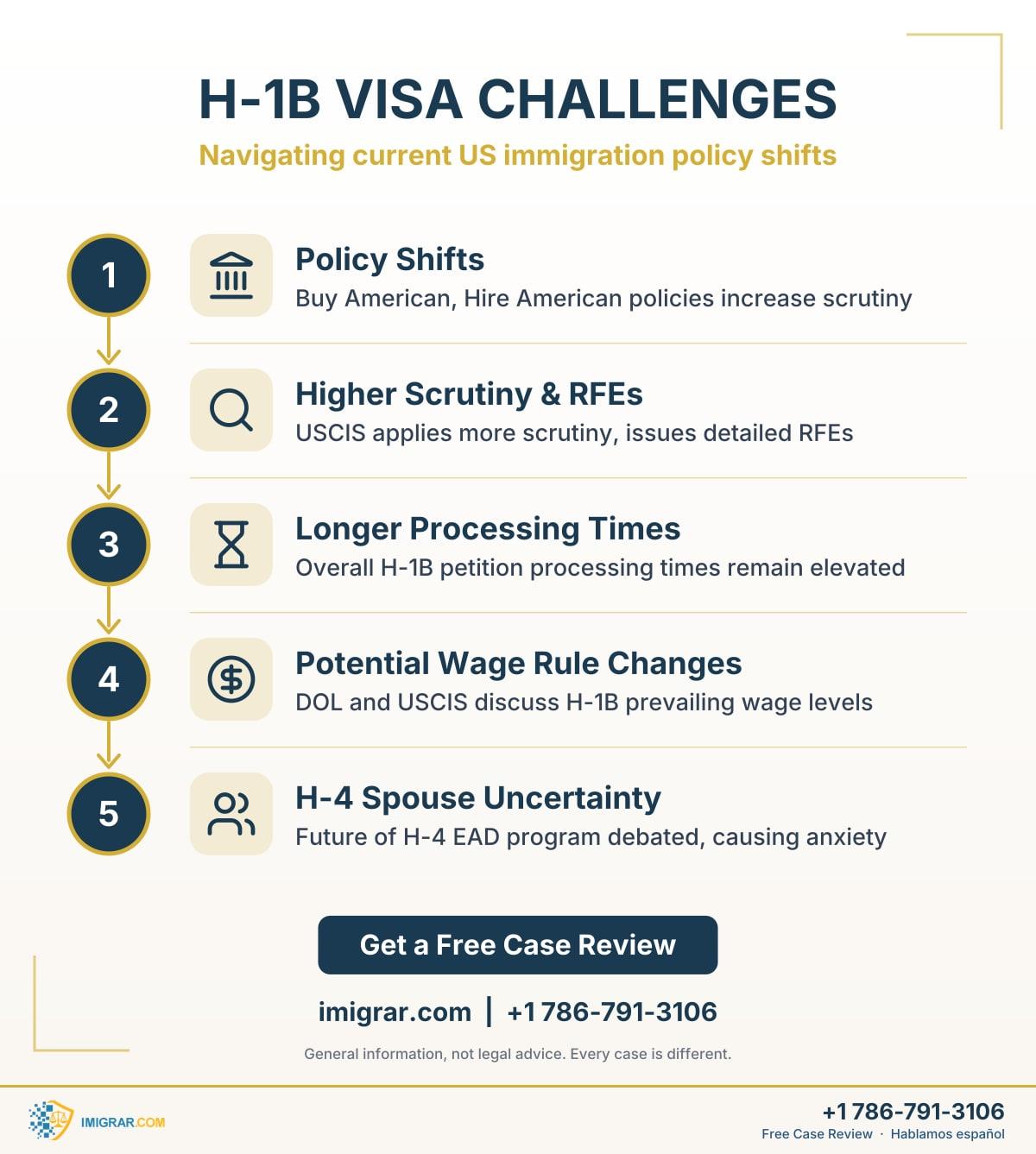
- Increased Scrutiny and Requests for Evidence (RFEs): U.S. Citizenship and Immigration Services (USCIS) is applying a higher level of scrutiny to H-1B applications, often issuing detailed Requests for Evidence (RFEs) to verify the "specialty occupation" nature of a job, the employer-employee relationship, and the prevailing wage. These RFEs add significant delays and burden to both employers and employees.
- Longer Processing Times: Despite efforts to streamline some processes, the overall processing times for H-1B petitions, transfers, and extensions have remained elevated or even increased. This uncertainty leaves workers in limbo, unable to plan their futures or travel internationally.
- Potential Wage Rule Changes: Discussions and proposed rules around H-1B prevailing wage levels continue to emerge from the Department of Labor (DOL) and USCIS. The goal is to ensure H-1B workers are paid at a level that does not undercut American workers, which can create challenges for some employers and potentially impact the eligibility of certain positions.
- Uncertainty for H-4 Spouses: Policies impacting H-4 EAD (Employment Authorization Document) for spouses of H-1B holders continue to be a source of concern. While the program remains in place, its future is often debated, adding another layer of anxiety for families.
These factors combine to create an environment where highly skilled professionals, who once viewed the U.S. as the pinnacle for career growth, are now finding the path increasingly arduous and unpredictable. The result, as reported by Bloomberg, is that many are choosing to leave, seeking stability and clearer pathways in other countries.
How it can affect Florida residents
Florida, particularly the Central Florida region including Orlando, is a rapidly growing hub for tech, aerospace, simulation, and entertainment industries. These sectors heavily rely on a diverse and skilled workforce, often including H-1B visa holders. The current challenges directly impact:
- Florida Tech Companies: Local businesses struggle to retain critical talent and attract new skilled professionals when the H-1B program becomes less reliable. This can hinder innovation, growth, and competitiveness. For companies along the I-4 corridor from Orlando to Tampa, talent acquisition is a constant challenge, now exacerbated by H-1B issues.
- H-1B Holders and Their Families in Florida: If you are an H-1B visa holder living in Orlando, Tampa, Miami, or anywhere else in Florida, these policies directly affect your job security, ability to extend your visa, and your family's future. Delays can mean lost job opportunities, stress over maintaining legal status, and uncertainty for your children's education or your spouse's employment via H-4 EAD.
- The Local Economy: A brain drain of skilled tech workers can lead to a loss of economic contributions, innovation, and tax revenue for Florida. These individuals are often homeowners, consumers, and active members of their communities in Orange County and beyond.
At Imigrar, we are acutely aware of these local impacts. Our Orlando office serves clients nationwide, but we have a deep understanding of the unique challenges faced by immigrants and businesses in our home state. We are here to provide clear, actionable advice to help you navigate these turbulent waters.
What H-1B Visa Challenges Are (and Why It Matters)
The H-1B visa program is a cornerstone of the U.S. immigration system for attracting global talent, especially in specialized fields. However, under the current administration, the program is experiencing significant operational and policy-based challenges that are causing widespread concern. Understanding these challenges is crucial for anyone involved with or considering the H-1B visa.
A plain-English definition
The H-1B visa is a nonimmigrant visa that allows U.S. employers to temporarily employ foreign workers in "specialty occupations." A specialty occupation is defined as one that requires a theoretical and practical application of a body of highly specialized knowledge, and a bachelor's degree or higher in the specific specialty (or its equivalent) as a minimum for entry into the occupation. Common H-1B fields include information technology, engineering, medicine, science, and mathematics.
Essentially, if a U.S. company needs a highly skilled professional for a job that demands a specific degree, and they can't find a qualified American worker, they can sponsor an H-1B visa for a foreign national. The visa is typically valid for three years and can be extended to a maximum of six years, with potential extensions beyond that if the worker is on a path to permanent residency (a green card).
Why is it currently challenging? The Trump administration's ongoing "Buy American, Hire American" policies have led to a more restrictive interpretation of H-1B regulations. This means:
- More Denials: USCIS is denying a higher percentage of H-1B petitions, even for roles that were historically approved without issue.
- Increased RFEs: Employers are receiving more Requests for Evidence (RFEs), demanding extensive documentation to prove the job is truly a "specialty occupation," that there's a legitimate employer-employee relationship, and that the wage offered meets or exceeds the prevailing wage.
- Longer Wait Times: Even with premium processing options, the overall processing of H-1B petitions, extensions, and transfers can take an exceptionally long time, leading to anxiety and uncertainty for workers and their families.
- Scrutiny on Offsite Placements: Petitions for H-1B workers placed at third-party client sites face particular scrutiny, with USCIS often questioning the employer-employee relationship.
These challenges make the H-1B process significantly more complex and unpredictable than in previous years, forcing many talented individuals and their sponsoring employers to rethink their strategies.
Key terms you need to know
Navigating the H-1B landscape requires understanding specific terminology. Here are some essential terms:
- H-1B Visa: A nonimmigrant visa that permits U.S. employers to temporarily employ foreign workers in specialty occupations.
- Specialty Occupation: An occupation that requires a theoretical and practical application of a body of highly specialized knowledge and a bachelor's or higher degree in the specific specialty.
- Cap-Subject: Refers to the annual limit on the number of H-1B visas issued. The current annual cap is 65,000, with an additional 20,000 for those with a U.S. master's degree or higher (the "master's cap").
- H-1B Cap Registration: The electronic lottery system used by USCIS to select petitions for the annual H-1B cap. Employers must register prospective employees, and only selected registrations can proceed to file a full petition.
- Labor Condition Application (LCA) (ETA Form 9035): A form certified by the Department of Labor (DOL) that an employer must file before filing an H-1B petition. It attests that the employer will pay the H-1B worker at least the prevailing wage or actual wage, whichever is higher, and will provide working conditions that do not adversely affect U.S. workers.
- Form I-129, Petition for a Nonimmigrant Worker: The primary form filed by a U.S. employer with USCIS to petition for an H-1B worker.
- Request for Evidence (RFE): A formal request from USCIS for additional documentation or information to support an immigration petition. RFEs are common under the current administration and can significantly delay processing.
- Notice of Intent to Deny (NOID): A notice from USCIS indicating that they intend to deny a petition, outlining the reasons. This is a critical point requiring immediate and robust legal response.
- Premium Processing: An optional service offered by USCIS for an additional fee (**Form I-907**) that guarantees processing of certain petitions (including H-1B) within 15 calendar days. It can be crucial for urgent cases but does not guarantee approval.
- Dual Intent: A legal concept that allows an individual to hold a nonimmigrant visa (like the H-1B) while also intending to apply for permanent residency (a green card). The H-1B visa is one of the few nonimmigrant visas that permits dual intent.
- H-4 Visa: A nonimmigrant visa for the spouse and unmarried children (under 21) of H-1B visa holders.
- H-4 EAD (Employment Authorization Document): An employment authorization for certain H-4 spouses, allowing them to work in the U.S. This program has faced scrutiny under the current administration, but currently remains in effect.
- Portability: The ability of an H-1B worker to start working for a new H-1B employer once the new employer files an H-1B petition on their behalf, even before the new petition is approved.
Don't let complex H-1B terminology confuse you. Imigrar's experienced attorneys in Orlando can simplify your immigration journey. Contact us at +1 786-791-3106 for expert guidance. Se Habla Español.
Current Immigration Law: The Foundation for H-1B Visas
The H-1B visa program operates under the framework of the Immigration and Nationality Act (INA), specifically INA § 101(a)(15)(H)(i)(b). While the core statutes remain, the interpretation and enforcement of these laws by USCIS have become significantly stricter under the current Trump administration. It's crucial for H-1B workers and their employers to understand this foundation and the current operational environment.
Federal requirements
At its core, the federal law governing H-1B visas requires:
- Specialty Occupation: The position offered must qualify as a "specialty occupation," meaning it requires at least a bachelor's degree in a specific field. Under the current administration, USCIS has significantly narrowed its interpretation of what constitutes a specialty occupation, leading to more RFEs challenging whether a position truly meets this standard. This is particularly true for positions that might seem generic or where the degree requirement is not clearly and consistently met by industry standards.
- Employer-Employee Relationship: There must be a legitimate employer-employee relationship between the petitioning U.S. employer and the H-1B beneficiary. This aspect is heavily scrutinized, especially for IT consulting firms or staffing agencies placing H-1B workers at third-party client sites. USCIS often demands extensive documentation to prove the employer's right to control the worker's employment.
- Certified Labor Condition Application (LCA): Before filing **Form I-129**, the employer must obtain a certified **Labor Condition Application (LCA)** (ETA Form 9035) from the Department of Labor (DOL). The LCA attests that the employer will pay the H-1B worker at least the prevailing wage for the occupation in the area of employment, or the actual wage paid to similarly qualified U.S. workers, whichever is higher. It also ensures working conditions will not adversely affect U.S. workers. The Trump administration has focused on stricter enforcement of prevailing wage requirements.
- Educational/Experience Qualifications: The H-1B beneficiary must meet the minimum educational and/or experience requirements for the specialty occupation. This typically means a bachelor's degree or its foreign equivalent, or a license, or work experience equivalent to a bachelor's degree.
- Cap-Subject Limitations: As a cap-subject visa, H-1Bs are subject to an annual numerical limit (currently 85,000, including 20,000 for U.S. master's degrees). Petitions are selected through an electronic registration and lottery system.
Important: The Trump administration's "Buy American, Hire American" policies, enacted through executive orders and subsequent USCIS guidance, continue to shape the adjudication process. This has led to:
- A presumption against approval for certain types of H-1B petitions, particularly those involving third-party worksites.
- Increased evidentiary burdens on petitioners to prove eligibility.
- More stringent interpretations of "specialty occupation" and the employer-employee relationship.
- Heightened scrutiny on the qualifications of the beneficiary, including the equivalency of foreign degrees.
These policy shifts mean that while the laws themselves haven't fundamentally changed, the way they are interpreted and applied has become significantly more challenging for H-1B petitioners.
Florida-specific considerations
While immigration law is federal, there are practical considerations for H-1B workers and employers in Florida:
- No State-Specific H-1B Laws: Florida does not have its own specific H-1B visa laws. Federal immigration law governs all H-1B matters across the United States.
- Impact on Local Industries: Florida's key industries, such as technology, healthcare, and tourism, rely on skilled foreign talent. The increased difficulties in obtaining and extending H-1B visas directly affect the ability of companies in Orlando, Miami, and Tampa to recruit and retain these essential professionals.
- Orlando USCIS Field Office: While H-1B petitions (**Form I-129**) are processed by USCIS service centers, the Orlando USCIS Field Office may handle certain immigration interviews for H-1B holders transitioning to green card status via **Form I-485** (Adjustment of Status). Understanding local office procedures and expectations, while generally consistent with national policy, can be beneficial.
- Employer Compliance: Florida employers sponsoring H-1B workers must not only comply with federal immigration regulations but also with Florida's state labor laws, licensing requirements for certain professions, and other employment standards.
For more detailed information on H-1B requirements and forms, visit the USCIS official website. You can also find specific forms like **Form I-129** (Petition for a Nonimmigrant Worker), **Form I-907** (Request for Premium Processing Service), and **Form I-765** (Application for Employment Authorization for H-4 spouses) directly on the USCIS Forms page.
Navigating H-1B Challenges: A Complete Step-by-Step Guide
Facing H-1B delays or increased scrutiny can be daunting. This guide provides a strategic, step-by-step approach to help you understand your options and take proactive measures. While this guide offers comprehensive information, consulting with an experienced immigration attorney is always the best course of action.
1) Evaluate Your Current H-1B Status and Options
Before making any moves, thoroughly understand your current immigration standing. This is the foundation for any future strategy.
- Check Visa Validity and I-94 Record: Confirm the expiration date on your current H-1B visa stamp and, more importantly, your **Form I-94** Arrival/Departure Record. The I-94 dictates your authorized period of stay. You can access your electronic I-94 record at CBP's official website.
- Review Your I-797 Approval Notices: Keep all **Form I-797** Approval Notices for your H-1B petitions. These documents prove your status and are essential for any future applications.
- Understand Any RFE or NOID: If you or your employer received a **Request for Evidence (RFE)** or a **Notice of Intent to Deny (NOID)**, carefully read it to understand the specific issues USCIS has identified. This is a critical juncture where legal counsel is highly recommended.
- Assess Employer's Commitment: Have an honest discussion with your employer about their commitment to your H-1B petition, especially if facing an RFE or denial. Their support is paramount.
- Documents Needed:
- Current passport and visa stamp
- **Form I-94** Arrival/Departure Record
- All **Form I-797** Approval Notices (H-1B, H-4, etc.)
- Offer letters and employment contracts
- Latest pay stubs and W-2s
- Educational degrees and transcripts
- Any RFEs or NOIDs received
2) Explore H-1B Transfer or Extension Strategies
If your H-1B is expiring or you're seeking a new employer, strategic planning for transfers and extensions is vital, especially given current processing times.
- H-1B Extension: If you wish to continue working for your current employer, they must file a new **Form I-129** before your current H-1B expiration. Due to current delays, it's advisable to file at least 6 months in advance. Filing on time allows you to continue working for up to 240 days while the extension is pending.
- H-1B Transfer (Change of Employer): If you find a new employer, they must file a new **Form I-129** on your behalf. H-1B portability rules generally allow you to start working for the new employer once the new petition is *filed* with USCIS, even before it's approved. This is a powerful tool if your current situation is unstable.
- Consider Premium Processing (**Form I-907**): For an additional fee, you can expedite the processing of your H-1B petition to 15 calendar days. This can be invaluable for maintaining continuous employment, especially if your current H-1B is nearing expiration.
- Documents Needed for Transfer/Extension:
- Original **LCA (ETA Form 9035)** certified by DOL for the new/extended position
- New job offer letter from the employer
- Detailed job description, including duties and required qualifications
- Employer's Federal Employer Identification Number (EIN)
- Company's financial statements and business plan (for new employers)
- All documents from Step 1
- Updated resume and letters of experience
3) Consider Alternative Nonimmigrant Visas
If the H-1B path becomes too challenging or doesn't fit your long-term goals, several other nonimmigrant visa categories might be suitable. This is a crucial area to discuss with an attorney.
- L-1 Visa (Intracompany Transferee): If you've worked for a foreign company that has a parent, subsidiary, affiliate, or branch office in the U.S. for at least one continuous year within the last three, you might qualify for an L-1 visa as a manager/executive (L-1A) or specialized knowledge employee (L-1B).
- O-1 Visa (Individuals with Extraordinary Ability): For individuals with extraordinary ability in the sciences, arts, education, business, or athletics, or extraordinary achievement in the motion picture or television industry. This requires significant evidence of sustained national or international acclaim.
- E-2 Visa (Treaty Investors): For nationals of countries with which the U.S. maintains a treaty of commerce and navigation, who are investing a substantial amount of capital in a U.S. business, or coming to the U.S. to develop and direct the operations of an enterprise in which they have invested.
- TN Visa (NAFTA Professionals): For Canadian and Mexican citizens in specific professions to work in the U.S. (e.g., engineers, computer systems analysts). This is a simpler process for eligible individuals.
- Warning: Each of these visas has unique, stringent requirements. Do not assume eligibility without a thorough legal assessment.
- Documents Needed (varies greatly by visa type):
- For L-1: Proof of employment abroad, company organizational charts, business plans.
- For O-1: Awards, publications, media recognition, expert testimonials, high salary contracts.
- For E-2: Business plan, proof of investment funds, source of funds.
- For TN: Proof of nationality, professional qualifications, job offer.
4) Pursue Employment-Based Green Card Pathways
For many H-1B workers, the ultimate goal is permanent residency. Starting this process early provides long-term stability, especially with current H-1B uncertainties and green card processing delays.
- EB-1 (Extraordinary Ability, Outstanding Researchers/Professors, Multinational Managers/Executives):
- EB-1A (Extraordinary Ability): For individuals with extraordinary ability in the sciences, arts, education, business, or athletics, demonstrated by sustained national or international acclaim. No employer sponsorship needed (self-petition).
- EB-1B (Outstanding Researchers/Professors): For outstanding researchers or professors with at least three years experience, sponsored by a U.S. employer.
- EB-1C (Multinational Manager or Executive): For multinational managers or executives transferred to the U.S. to work for the same employer or an affiliate, having worked abroad for at least one year in the preceding three.
- EB-2 (Advanced Degree or Exceptional Ability, often with National Interest Waiver - NIW):
- For professionals holding advanced degrees (Master's or higher) or individuals with exceptional ability in the sciences, arts, or business. Requires a job offer and a PERM Labor Certification in most cases.
- National Interest Waiver (NIW): An exception to the PERM requirement for individuals whose work is in the national interest of the U.S. This allows self-petitioning.
- EB-3 (Skilled Workers, Professionals, Other Workers):
- For skilled workers (requiring at least 2 years of experience or training), professionals (requiring a bachelor's degree), and "other workers" (requiring less than 2 years of experience). Generally requires a job offer and PERM Labor Certification.
- Important: Most EB-2 and EB-3 categories require a **PERM Labor Certification** from the DOL, a lengthy process to prove no qualified U.S. workers are available. Then, an **I-140** (Immigrant Petition for Alien Worker) is filed with USCIS, followed by **Adjustment of Status (Form I-485)** or Consular Processing.
- Documents Needed (highly extensive and varies):
- Educational degrees, transcripts, evaluations
- Letters of experience from previous employers
- Publications, awards, expert testimonials (for EB-1A, EB-1B, NIW)
- Detailed job offer and description
- PERM Labor Certification documents (if applicable)
- Financial documents of employer (if employer-sponsored)
5) Strategize for Family-Based Options or Departure
Sometimes, family ties offer a pathway to stability, or a planned departure becomes necessary.
- Family-Based Green Card: If you are married to a U.S. Citizen or Lawful Permanent Resident (LPR), you may be eligible for a family-based green card. U.S. Citizen spouses can file an **Form I-130** (Petition for Alien Relative), followed by **Form I-485** (Adjustment of Status) if you are in the U.S. and eligible.
- Planned Departure: If no other options are viable, plan your departure from the U.S. carefully to avoid accumulating unlawful presence, which can trigger re-entry bars. Consult an attorney to ensure you depart legally and understand any implications for future U.S. visa applications.
- Documents Needed:
- Marriage certificate, birth certificates
- Divorce decrees (if applicable)
- Financial documents (**Form I-864**, Affidavit of Support)
- Proof of bona fide marriage (photos, joint accounts, leases, etc.)
6) Document Everything Meticulously
Regardless of the path you choose, thorough documentation is non-negotiable, especially with the current level of scrutiny. Accuracy and completeness are key to avoiding RFEs or denials.
- Maintain a Comprehensive File: Keep both physical and digital copies of every single document related to your immigration journey – applications, receipts, approval notices (**Form I-797**), RFEs, correspondence with USCIS/DOL, job offer letters, pay stubs, tax returns, educational documents, and personal records.
- Organize and Label: Use clear labels and folders. If you have multiple petitions or family members, organize documents separately.
- Ensure Legibility and Translation: All copies must be clear and legible. Any documents not in English must be accompanied by a certified English translation.
- Review for Consistency: Ensure all information across all your applications and supporting documents is consistent. Discrepancies can lead to RFEs.
- Documents Needed:
- A well-organized personal immigration file containing all documents listed in steps 1-5.
- Copies of all submitted forms and supporting evidence.
- Proof of payment for all filing fees.
- Any communications from USCIS, DOL, or Department of State.
Practical Steps You Can Take Today to Protect Your Status
In this challenging immigration climate, being proactive and well-informed is your best defense. Here are practical steps you can take starting today to safeguard your H-1B status and explore future opportunities.
Actionable Checklist (5+ items)
- Consult an Immigration Attorney Immediately: If you've received an RFE or NOID, or if your H-1B is nearing expiration, do not delay. An experienced attorney can assess your specific situation, provide tailored advice, and help you strategize. For Central Florida residents, Imigrar in Orlando is ready to help.
- Review Your Current I-94 and Visa Expiry Dates: Mark these critical dates on your calendar. Plan for extensions or transfers well in advance, ideally 6-8 months before expiration, to account for current USCIS processing delays. Check your I-94 online at CBP's official website.
- Gather and Organize All Immigration and Employment Documents: Create a comprehensive digital and physical folder. This includes all **Form I-797** approval notices, **Form I-94** records, passports, visa stamps, educational degrees, transcripts, job offer letters, employment contracts, pay stubs, and tax returns.
- Initiate Discussions with Your Employer about Green Card Sponsorship: Even if you're early in your H-1B journey, having a conversation about potential employment-based green card sponsorship (EB-1, EB-2, EB-3) can align expectations and start a long-term strategy. Remember, the green card process itself can take several years.
- Research Alternative Visa Categories: Don't put all your eggs in the H-1B basket. Explore if you might qualify for other nonimmigrant visas (like L-1, O-1, E-2, TN) or even direct green card options (like EB-1A or EB-2 NIW if you can self-petition).
- Stay Informed about USCIS Processing Times: Regularly check the USCIS Processing Times website for the latest estimates. This helps manage expectations and informs your strategy for filing extensions or other petitions.
- Monitor Policy Changes: Keep abreast of news and official announcements regarding Trump administration immigration policies, especially those impacting H-1B, H-4 EAD, and employment-based green cards. Reliable legal counsel will also keep you informed.
Document Preparation Guidance
Meticulous document preparation is paramount to avoid RFEs and ensure a smooth process.
- Quality over Quantity (but ensure completeness): Provide all requested documents clearly and concisely. Do not send irrelevant documents, but ensure every requirement is met with strong evidence.
- Certified Translations: Any document not in English must be accompanied by a full, certified English translation. The translator must certify that they are competent to translate and that the translation is accurate.
- Copies, Not Originals: Unless specifically requested, always submit copies of documents, not originals. Keep your originals safe.
- Organize and Index: For larger submissions, use tabs and an index to help the USCIS officer quickly find relevant information. This is particularly helpful for RFE responses.
- Consistency is Key: Ensure all information (names, dates, addresses, job titles) across all your documents is consistent. Discrepancies can raise red flags.
Timeline Expectations
Understanding realistic timelines is vital for planning, especially when facing current delays:
- H-1B Cap Registration: Typically in March each year, with results in late March/early April.
- H-1B Petition Filing: If selected in the lottery, petitions are filed starting April 1st.
- Standard H-1B Processing: Can take anywhere from 6 to 18+ months depending on the service center and complexity of the case.
- Premium Processing (**Form I-907**): Guarantees a decision (approval, RFE, NOID, or denial) within 15 calendar days for an additional fee.
- RFE Responses: Typically, you have 60-90 days to respond to an RFE, and the USCIS processing clock resets after they receive your response. This can add several months to the overall timeline.
- Green Card Processing: Highly variable. PERM Labor Certification alone can take 6-18 months. **Form I-140** (Immigrant Petition) can take 6-12 months (or 15 days with premium processing). **Form I-485** (Adjustment of Status) depends on visa bulletin availability and field office processing, often 1-3+ years.
Important: Always plan with buffer time. The current immigration climate under the Trump administration favors longer processing times and increased scrutiny, making proactive planning more critical than ever.
How Imigrar Helps Immigrants in Orlando and Nationwide
At Imigrar, our core mission is "Keep Families Together." We understand that the current H-1B challenges and broader immigration landscape can be incredibly stressful for individuals and families. Our dedicated team of immigration attorneys in Orlando is here to provide expert, compassionate, and results-oriented legal assistance.
Our experience and expertise
Our firm specializes in a wide range of immigration services, with a particular focus on employment-based visas and green card petitions. We have extensive experience in:
- Navigating H-1B Petitions, Extensions, and Transfers: We guide employers and employees through the entire H-1B process, from initial cap registration to petition filing, and strategic responses to RFEs and NOIDs. We are deeply familiar with the increased scrutiny under the current Trump administration and develop robust strategies to address these challenges.
- Responding to Complex RFEs and NOIDs: Our attorneys excel at crafting comprehensive and persuasive responses to challenging RFEs and NOIDs, often turning potential denials into approvals. We understand the specific concerns USCIS raises regarding "specialty occupation" and employer-employee relationships.
- Exploring Alternative Visa Pathways: If H-1B becomes unfeasible, we help clients explore and apply for other nonimmigrant visas like L-1, O-1, E-2, or TN, assessing eligibility and managing the application process.
- Facilitating Employment-Based Green Cards: We assist clients in pursuing permanent residency through various employment-based categories (EB-1, EB-2, EB-3), including PERM Labor Certification, National Interest Waivers (NIW), and Adjustment of Status. This provides a long-term solution for stability.
- Family-Based Immigration: True to our tagline, we also provide robust support for family-based petitions, helping U.S. citizens and green card holders sponsor their relatives.
Our team stays up-to-date on the latest policy changes and interpretations from USCIS, the Department of Labor, and the Department of State, ensuring our advice is always current and strategically sound. For those in Orlando, Central Florida, and across the I-4 corridor, we offer localized insights combined with national expertise.
Free consultation offer
We believe everyone deserves access to clear, accurate legal advice, especially when their future is on the line. That's why Imigrar offers a free, no-obligation consultation. During this consultation, we will:
- Review your specific immigration situation.
- Discuss the challenges you are facing, particularly concerning H-1B visas and current Trump administration policies.
- Explain your options in plain English.
- Outline potential strategies and next steps.
Don't face these complex challenges alone. Whether you are an H-1B worker in Orlando, an employer seeking to retain talent in Orange County, or an immigrant anywhere in the U.S., Imigrar is here to be your trusted legal partner.
Se Habla Español. We are proud to serve both English and Spanish-speaking communities, ensuring clear communication and culturally sensitive legal support.
Ready to discuss your H-1B options or green card path? Contact Imigrar for a free consultation. Call us today at +1 786-791-3106 or reach out online. We're here to help you "Keep Families Together." Se Habla Español.
Frequently Asked Questions About H-1B Challenges
Q: What exactly are the "Trump administration's policies" impacting H-1B visas?
A: Under President Trump's current administration, the overarching policy is "Buy American, Hire American." This directive has led to a significantly stricter interpretation and enforcement of existing H-1B regulations. Specifically, USCIS has increased scrutiny on whether a job truly qualifies as a "specialty occupation," whether there is a legitimate employer-employee relationship (especially for third-party placements), and whether the prevailing wage requirements are met. This results in more **Requests for Evidence (RFEs)**, higher denial rates, and longer processing times for H-1B petitions, extensions, and transfers. There are also ongoing discussions about potential changes to the H-1B lottery system and prevailing wage calculations to prioritize higher-skilled and higher-paid workers.
Q: My H-1B is expiring soon, and processing times are long. What should I do?
A: Important: File your H-1B extension petition (**Form I-129**) with your employer as early as possible, ideally at least 6 months before your current **Form I-94** expires. Filing on time allows you to continue working for your employer for up to 240 days while your extension is pending. If you face an imminent expiration or need to travel, consider requesting **Premium Processing** by filing **Form I-907** for an additional fee, which guarantees a 15-calendar-day processing time. Consult an immigration attorney in Orlando or nationwide to ensure your application is robust and to explore all options for maintaining your legal status.
Q: Can I transfer my H-1B to a new employer if my current employer's petition is facing an RFE or is still pending?
A: Yes, generally you can. The H-1B portability rules allow you to change employers even if your current H-1B petition (extension or transfer) is pending or has received an RFE. Your new employer would file a new **Form I-129** on your behalf. Once the new petition is *filed* with USCIS, you can generally begin working for the new employer. This is a crucial option for H-1B workers seeking more stability or better opportunities amidst current delays and uncertainties. However, it's vital to work with an attorney to ensure a smooth transition and understand any potential risks.
Q: What if my H-4 spouse's EAD is delayed or denied?
A: Delays or denials of an H-4 EAD (**Form I-765**) can be incredibly disruptive for families. Often, H-4 EAD processing is tied to the processing of the principal H-1B holder's petition. If your spouse's H-4 EAD is delayed, ensure their H-4 status is valid and their application was filed correctly. If it's denied, you need to understand the specific reason for denial. This could range from insufficient evidence to an error in the application, or it could be related to the stricter adjudication environment under the current administration. An attorney can help review the denial, advise on options like appealing the decision, refiling, or exploring other potential avenues for employment authorization.
Q: What are the typical costs associated with an H-1B transfer or green card application?
A: Immigration costs can be substantial and vary widely. For an H-1B transfer, typical USCIS filing fees include the **Form I-129** petition fee, ACWIA fee, fraud prevention and detection fee, and potentially a public law 114-113 fee. These can total over $2,000, plus the optional **Premium Processing** fee (**Form I-907**) of around $2,805. Legal fees for H-1B transfers or extensions typically range from $1,500 to $5,000, depending on complexity. For a green card application, costs are significantly higher and more complex. They can include PERM Labor Certification fees (often borne by the employer), **Form I-140** fees, **Form I-485** Adjustment of Status fees, biometric fees, medical exam fees, and attorney fees. Total costs for an employment-based green card can easily range from $5,000 to $20,000 or more, not including legal fees which can add another $5,000 to $15,000+ depending on the category and complexity. It's essential to get a detailed breakdown from your attorney.
Q: If my H-1B is denied, what are my options to stay in the U.S. or reapply?
A: A denial of an H-1B petition is a serious matter and can lead to a loss of lawful status. Your options depend heavily on the reason for denial, whether you have any grace period, and if you have other potential immigration pathways. Possible options include:
- Appeal or Motion to Reopen/Reconsider: If you believe the denial was based on a legal error or new evidence can be presented, your attorney might advise filing an appeal or a motion to reopen/reconsider.
- Change of Status: If you are eligible for another nonimmigrant visa category (e.g., F-1 student, B-2 visitor – though usually not recommended from a denied H-1B), you might be able to file a change of status application, but this is highly risky after a denial.
- Depart and Reapply: Often, the safest option is to depart the U.S. within the grace period (if applicable) or before accruing unlawful presence, and then reapply for a different visa from abroad if eligible.
Common Mistakes H-1B Workers Make (and How to Avoid Them)
The current immigration environment leaves little room for error. Avoiding common pitfalls can significantly increase your chances of success and reduce stress. Here are some prevalent mistakes H-1B workers and their employers make, and how to steer clear of them.
Mistake #1: Underestimating Processing Times and Procrastinating
Many H-1B workers, having experienced relatively smooth processes in the past, fail to account for the current reality of increased delays under the Trump administration. Waiting until the last minute to file extensions, transfers, or even green card petitions is a recipe for disaster.
How to Avoid: Plan proactively. For H-1B extensions or transfers, initiate the process with your employer at least 6 to 8 months before your **Form I-94** expiration. This buffer time is crucial to accommodate potential USCIS delays, RFEs, or unforeseen complications. For green card pathways, start the conversation with your employer and an attorney as early as possible in your H-1B journey, as these processes can take several years. Utilize resources like the USCIS Processing Times website to stay informed.
Mistake #2: Providing Incomplete or Inconsistent Documentation
The vast majority of **Requests for Evidence (RFEs)**, and even outright denials, stem from incomplete, inconsistent, or insufficient documentation. Under the current administration, USCIS is particularly vigilant about the "specialty occupation" requirement and the legitimate employer-employee relationship, especially for IT consulting firms or those working at client sites.
How to Avoid: Meticulously gather every required document. Ensure all information across your applications, supporting letters, and personal documents (passport, degrees, previous visas) is perfectly consistent. If there are discrepancies, be prepared to explain them with clear evidence. For specialty occupation arguments, provide detailed job duties, organizational charts, and expert letters from professors or industry leaders. For employer-employee relationships, provide extensive evidence of the employer's control (performance reviews, proprietary tools, detailed project assignments). Work with an experienced attorney to review your entire submission for completeness and consistency before filing. Reminder: All non-English documents require certified translations.
Mistake #3: Not Exploring Alternative Visa or Green Card Pathways Early Enough
Many H-1B workers focus solely on maintaining their H-1B status without concurrently exploring other long-term options. When H-1B challenges arise (e.g., an RFE that leads to a denial, or a company restructuring), they find themselves without a backup plan and very limited time.
How to Avoid: Diversify your immigration strategy. From the outset, discuss with an immigration attorney your eligibility for other nonimmigrant visas (like L-1, O-1, or E-2) or direct pathways to permanent residency (EB-1, EB-2 National Interest Waiver) that might allow you to self-petition or avoid the PERM process. Even if these seem like long shots initially, understanding your potential eligibility can provide crucial alternatives if the H-1B path becomes untenable. Proactive exploration of these options ensures you have a safety net and a clear path forward, rather than being forced into a reactive, time-sensitive scramble.
Navigating the complex and often unpredictable landscape of H-1B visas under the current administration requires not just legal expertise, but also strategic foresight and meticulous preparation. At Imigrar, we stand ready to be your trusted partner, providing the guidance and support you need to secure your future in the U.S. and keep your family together.
Facing H-1B challenges in Orlando or nationwide? Don't risk your immigration status. Call Imigrar today for a free, confidential consultation. Our experienced team is here to help. Phone: +1 786-791-3106. Se Habla Español.
Related Topics
Need Legal Assistance?
Our experienced immigration attorneys are here to help with your case. Contact Imigrar today for a free consultation and let us guide you through the legal process with confidence.
📍 Orlando, Florida • Serving clients nationwide
📧 info@imigrar.com