
H-1B Visa Crisis: Why Tech Workers Are Leaving & How to Navigate Current Policies
H-1B visa holders are abandoning U.S. tech jobs due to increased delays and the Trump administration's stringent policies. Learn what this means for you and how Imigrar can help.
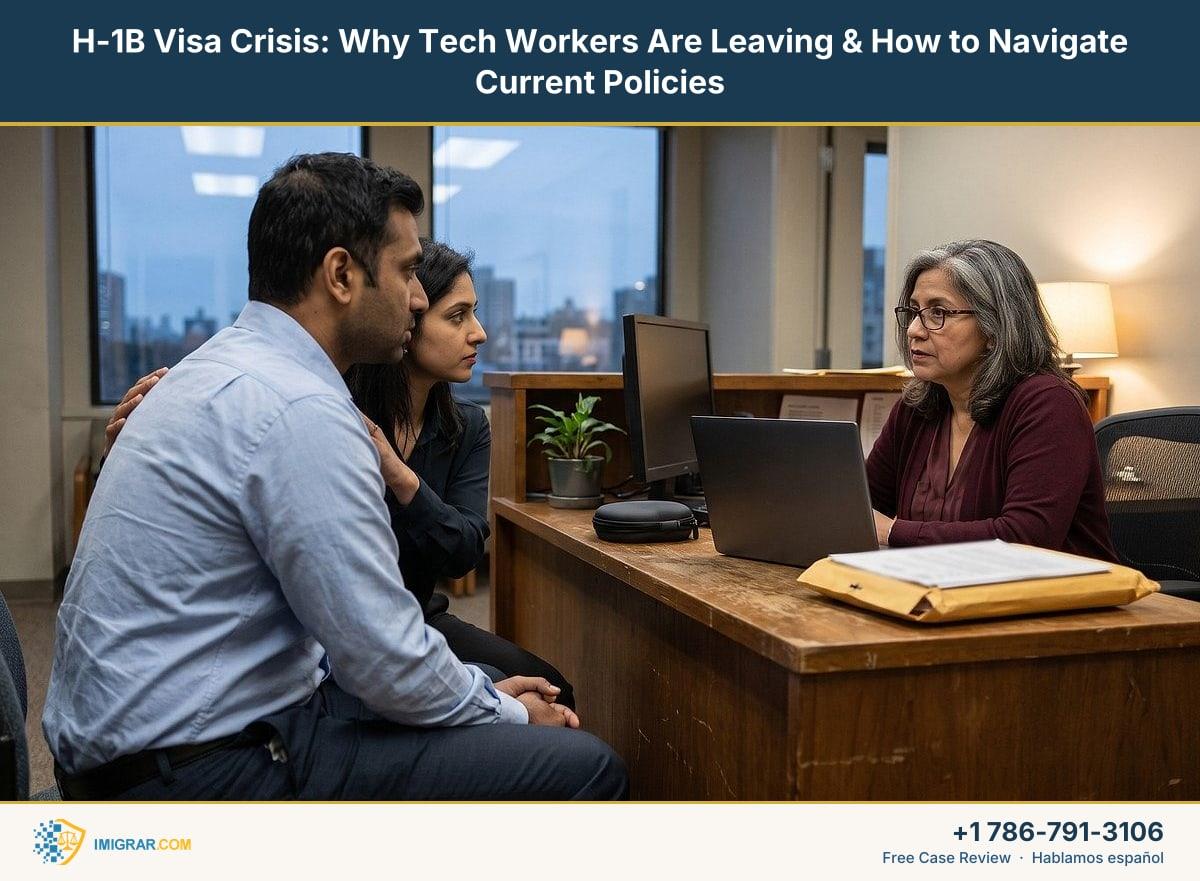
At Imigrar, we understand the incredible contributions H-1B visa holders make to the U.S. economy, particularly in the thriving technology sector. Our mission is to "Keep Families Together" and ensure that skilled professionals can continue to pursue their American dreams without unnecessary obstacles. This commitment drives us to provide clear, actionable guidance, especially in turbulent times.
The reporting that sparked this guide
Recent news highlights a growing concern among H-1B visa workers in the American tech industry: a significant number are becoming "fed up" with the current immigration landscape and opting to abandon their U.S. positions. This trend, reported by Bloomberg on November 20, 2026, points to severe H-1B visa delays and the ongoing impact of the Trump administration's policies as primary drivers for this exodus. We encourage you to read the full report for context: H-1B Visa Workers Are Fed Up and Abandoning American Tech Jobs (Bloomberg).
Need Help? Our Orlando immigration team is ready to assist. Call +1 786-791-3106 for a free consultation, or message us online. Se Habla Español.
What This News Means for Immigrants in Orlando and Across Florida
This Bloomberg report paints a stark picture for many H-1B visa holders and their families, signaling a period of increased uncertainty and frustration. For those working in or aspiring to work in the U.S. tech sector, particularly from right here in Orlando and across Florida, understanding the implications is crucial.
Why this news is showing up now
The current climate for H-1B visa holders is a direct result of several converging factors. The Trump administration, now in its second term, continues to implement and expand upon its "Buy American, Hire American" policies. While the stated goal is to protect American workers, the practical effect has been a significant increase in scrutiny and administrative hurdles for H-1B petitions.
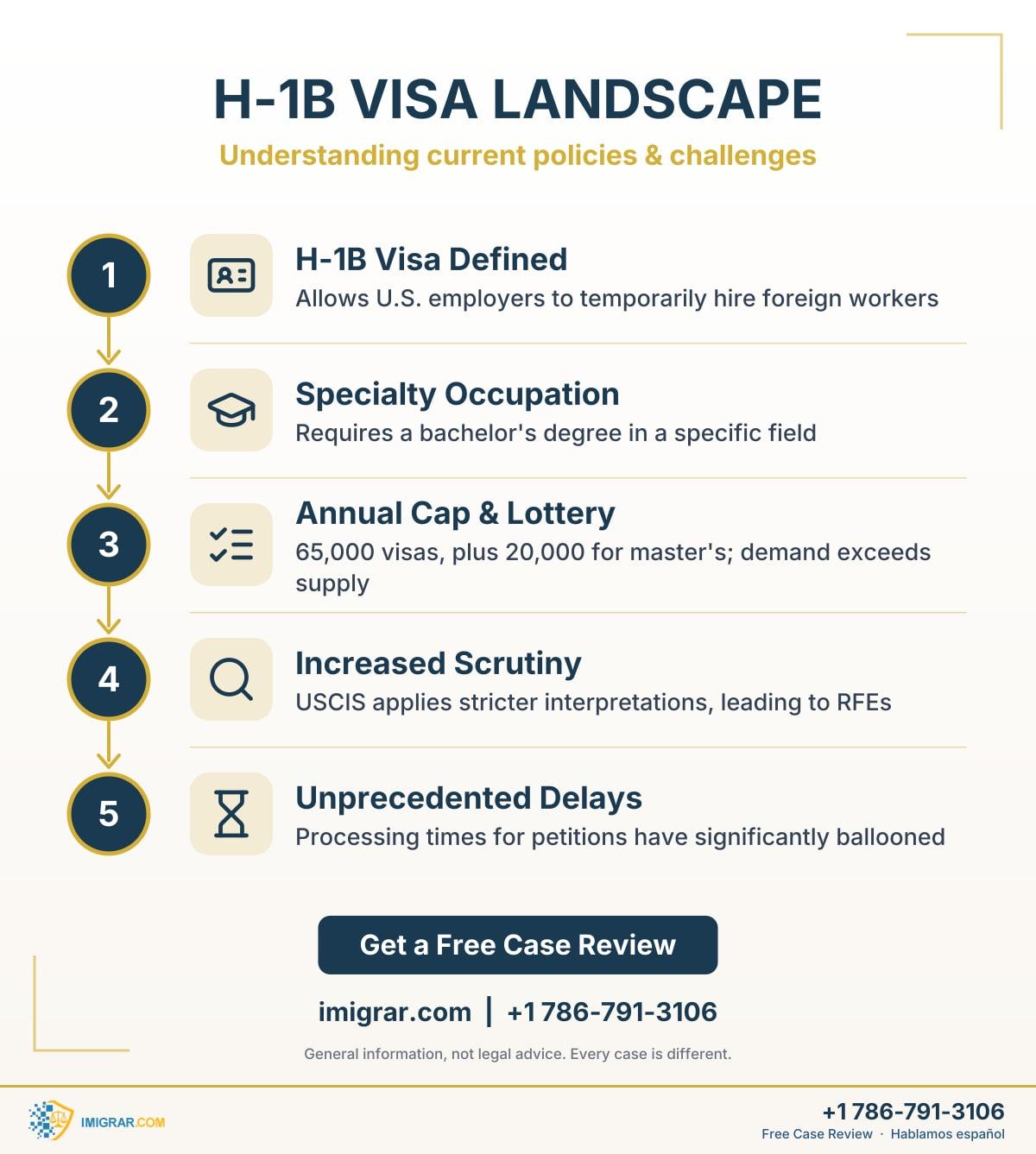
- Increased Scrutiny: U.S. Citizenship and Immigration Services (USCIS) is applying stricter interpretations of what constitutes a "specialty occupation," leading to a surge in Requests for Evidence (RFEs). These RFEs often challenge the validity of the job itself or the applicant's qualifications, even for highly skilled professionals.
- Unprecedented Delays: Processing times for H-1B petitions, amendments, and extensions have ballooned. Even with premium processing options, many cases face prolonged adjudication, creating immense stress and uncertainty for workers and their employers. The sheer volume of RFEs and the more rigorous review process contribute directly to these delays.
- Economic Pressures: While the U.S. tech sector remains robust, the unpredictability of immigration status makes long-term planning difficult. H-1B workers, who are often integral to critical projects, are finding it harder to justify remaining in a state of perpetual limbo, especially when other countries are actively recruiting skilled talent with more streamlined immigration pathways.
- Impact on Families: The delays and policy changes don't just affect the primary H-1B holder; they impact entire families. Spouses on H-4 visas, particularly those with Employment Authorization Documents (EADs), face their own uncertainties, further complicating family planning and financial stability.
How it can affect Florida residents
Florida, particularly the Orlando metropolitan area and the I-4 corridor, is a growing tech hub. Companies across the state rely on skilled foreign talent to fill critical roles in software development, engineering, data science, and IT. This news has direct implications for our local community:
- Talent Drain: If H-1B workers are leaving the U.S. or choosing not to come in the first place, Florida's tech companies could face a significant talent shortage. This could stifle innovation, slow economic growth, and make it harder for local businesses to compete globally.
- Uncertainty for Current H-1B Holders: For thousands of H-1B visa holders already working in Orlando, Tampa, and other Florida cities, this news amplifies existing anxieties about their future. They may be facing upcoming extensions, transfers, or green card applications under these stricter conditions, leading to fears of job loss or forced departure.
- Impact on Families in Central Florida: Many H-1B families have established roots in Central Florida, with children in local schools and spouses contributing to the community. The threat of visa delays or denials can disrupt their entire lives, forcing difficult decisions about their future in the U.S.
- Employer Challenges: Florida-based tech companies, from startups to established enterprises, are grappling with how to retain their best H-1B talent and navigate the complexities of sponsoring new workers. The increased legal costs and administrative burden associated with RFEs and delays can be substantial.
At Imigrar, we are deeply committed to assisting individuals and families in Orlando and across Florida navigate these complex challenges. We understand the local context and the specific needs of our community.
What H-1B Visa Issues Are (and Why It Matters)
The H-1B visa program is a cornerstone of American innovation, designed to allow U.S. employers to temporarily employ foreign workers in specialty occupations. However, the current environment has transformed what was once a relatively predictable process into a minefield of uncertainty.
A plain-English definition
The H-1B visa is a non-immigrant visa that allows U.S. employers to temporarily hire foreign workers in "specialty occupations." These are professions that generally require a bachelor's degree or higher in a specific field, such as IT, engineering, medicine, mathematics, science, architecture, or accounting. The program is crucial for industries, especially tech, that often face a shortage of qualified domestic workers. However, due to annual caps and the current administration's policies, obtaining and maintaining an H-1B visa has become significantly more challenging, leading to frustration and the departure of many skilled professionals.
Key terms you need to know
- Specialty Occupation: A position that requires a theoretical and practical application of a body of highly specialized knowledge, and a bachelor's or higher degree in the specific specialty (or its equivalent) as a minimum for entry into the occupation in the United States. This is a key area of scrutiny under the current administration.
- LCA (Labor Condition Application): Before an H-1B petition can be filed with USCIS, the employer must file an LCA with the U.S. Department of Labor (DOL). This certifies that the employer will pay the H-1B worker at least the prevailing wage for the occupation in the area of employment and will provide working conditions that do not adversely affect U.S. workers.
- H-1B Cap: The annual limit on the number of H-1B visas issued. Currently, the cap is 65,000 visas, with an additional 20,000 reserved for those with a U.S. master's degree or higher (the "master's cap"). Demand far outstrips supply, leading to an annual lottery.
- H-1B Lottery: Because the number of H-1B petitions often exceeds the annual cap, USCIS conducts a random lottery to select petitions for processing. This lottery typically occurs in March for an October 1 start date.
- RFE (Request for Evidence): A notice from USCIS asking for more information or documentation to support a petition. Under the current administration, RFEs for H-1B petitions have become far more common and detailed, often challenging the very nature of the specialty occupation or the employer-employee relationship.
- Premium Processing: An optional service offered by USCIS that guarantees processing of certain petitions (including H-1B) within 15 calendar days for an additional fee. While it speeds up initial processing, it does not prevent an RFE or eventual denial.
- Dual Intent: A legal concept that allows a foreign national to simultaneously hold nonimmigrant intent (to return home after a temporary stay) and immigrant intent (to eventually seek permanent residency, i.e., a Green Card). The H-1B visa is a dual intent visa, which is critical for those who wish to pursue a Green Card path.
- H-4 Visa: The visa category for the spouse and unmarried children under 21 of H-1B visa holders. Certain H-4 spouses may be eligible for Employment Authorization Documents (EADs), though this benefit has faced scrutiny and attempts at revocation by the current administration.
Navigating these terms and processes can be overwhelming. Our Orlando immigration attorneys are here to clarify your options and guide you. Call +1 786-791-3106 for a free consultation. Se Habla Español.
Current Immigration Law: The Foundation
The H-1B visa program operates under the Immigration and Nationality Act (INA). While the foundational laws remain, the current administration's interpretation and enforcement have significantly altered the landscape for applicants and employers.
Federal requirements
The H-1B visa is authorized under Section 101(a)(15)(H)(i)(b) of the INA, codified at 8 U.S.C. § 1101(a)(15)(H)(i)(b). Key federal requirements include:
- Employer Sponsorship: An H-1B visa cannot be self-petitioned. A U.S. employer must sponsor the foreign worker.
- Specialty Occupation: The job must meet the definition of a specialty occupation. This is where the current administration's policies have had the most impact, with USCIS demanding significantly more evidence to prove that a position truly requires a bachelor's degree in a specific field. Cases involving entry-level positions or those with broad duties are frequently challenged.
- Required Qualifications: The foreign worker must possess the required qualifications for the specialty occupation, typically a bachelor's degree or its equivalent.
- Labor Condition Application (LCA): As per 20 CFR Part 655, Subpart H, an employer must file and obtain certification of an LCA from the Department of Labor (DOL) before filing Form I-129. The LCA ensures that the H-1B worker is paid at least the prevailing wage for the occupation in the intended area of employment and that working conditions will not adversely affect U.S. workers.
- Annual Cap: As stipulated by INA § 214(g), 8 U.S.C. § 1184(g), there is an annual cap of 65,000 H-1B visas, plus an additional 20,000 for those with a U.S. master's degree or higher. Petitions are selected via a lottery if demand exceeds the cap.
- Maximum Stay: An H-1B visa is generally granted for an initial period of up to three years, with extensions possible for a maximum total stay of six years. Further extensions beyond six years are possible under specific circumstances, such as if a Green Card application is pending.
Current Administration's Impact: The Trump administration has continued to emphasize a "merit-based" approach to immigration, which, in practice, has translated into heightened scrutiny for H-1B petitions. This includes:
- Increased RFE Rates: USCIS has significantly increased the rate at which RFEs are issued, particularly for IT consulting positions, entry-level roles, and petitions from smaller companies. These RFEs often demand extensive documentation to prove the specialty occupation requirement, the employer-employee relationship, and the availability of work for the entire requested validity period.
- "Nebraska Service Center Memo" Interpretations: While official memos may be rescinded, the operational impact of stricter interpretations regarding "specialty occupation" and "employer-employee relationship" persists, leading to more denials.
- Prevailing Wage Challenges: There have been ongoing efforts to modify prevailing wage calculations, potentially requiring employers to pay higher wages. This directly impacts the LCA process and can deter some employers from sponsoring H-1B workers.
- H-4 EAD Status: The H-4 EAD program, which allows certain H-4 spouses to work, remains under constant threat of revocation by the current administration, adding further instability for H-1B families.
For the most up-to-date information on forms and policies, always refer to the USCIS official website.
Florida-specific considerations
While immigration law is federal, its impact is felt locally. For Florida residents and businesses, understanding the federal landscape is paramount. There are no state-specific immigration laws that directly govern H-1B visas, but the local economy and legal environment play a role:
- Growing Tech Sector: Florida's tech sector, particularly in areas like Orlando, Tampa, and Miami, is a significant employer of H-1B visa holders. The challenges faced by these workers directly impact the state's economic growth and innovation.
- Local USCIS Field Offices: While H-1B petitions are processed by USCIS service centers, local field offices (like the Orlando USCIS Field Office) handle interviews for certain related applications, such as Adjustment of Status (Form I-485) or family-based petitions. Understanding local office procedures and potential interview backlogs is important for long-term planning.
- Access to Legal Expertise: Given the complexities and high stakes, having experienced immigration counsel familiar with both federal law and local court trends is vital. Imigrar, based in Orlando, provides this essential local expertise.
How to Navigate H-1B Challenges: A Complete Step-by-Step Guide
Navigating the H-1B visa process in the current climate requires meticulous preparation, a thorough understanding of the requirements, and often, expert legal guidance. This guide outlines the typical steps involved, with an emphasis on current challenges.
1) Employer Sponsorship and Labor Condition Application (LCA) Filing
The journey begins with an eligible U.S. employer offering a job in a specialty occupation. The employer must agree to sponsor the H-1B worker.
- Employer Actions: The employer determines the prevailing wage for the position based on the occupation, industry, and geographic location (e.g., Orlando, FL). They then prepare and file an LCA (Form ETA-9035) with the U.S. Department of Labor (DOL).
- LCA Certification: The DOL reviews the LCA to ensure compliance with wage and working condition requirements. This process typically takes 7-10 business days. Once certified, the employer can proceed.
- Required Documents (Employer):
- Job description, duties, and minimum requirements for the position.
- Information about the company, including EIN.
- Prevailing wage determination (often obtained through online tools or private surveys).
- LCA posting notices (required at the worksite).
- Warning: The current administration's focus on prevailing wages means employers must be extra diligent in ensuring their LCA accurately reflects the wage for the role and location.
2) H-1B Cap Registration and Lottery (If Applicable)
If the petition is subject to the annual H-1B cap (most new H-1B petitions are), the employer must participate in the electronic registration process.
- Registration Period: USCIS typically opens a registration period in March each year for the fiscal year beginning October 1st.
- Electronic Registration: The employer (or their authorized representative) creates a USCIS online account and submits basic information about the company and the prospective H-1B worker. A non-refundable fee is required for each registration.
- Lottery Selection: If the number of registrations exceeds the annual cap, USCIS conducts a random lottery. Selected registrants are notified, usually by late March. Only selected registrants can proceed to file a full H-1B petition.
- Required Information for Registration:
- Employer's name, EIN, and mailing address.
- Authorized signatory's name, title, and contact information.
- Beneficiary's full name, date of birth, country of birth, country of citizenship, passport number.
- Beneficiary's highest degree, U.S. master's degree (if applicable).
- Important: Non-selection in the lottery means the employer cannot file an H-1B petition for that fiscal year unless the beneficiary is cap-exempt.
3) Filing the H-1B Petition (Form I-129)
Once an LCA is certified and, if applicable, the H-1B registration is selected, the employer files Form I-129, Petition for a Nonimmigrant Worker, with USCIS.
- Petition Filing: The comprehensive petition package includes Form I-129, supporting documentation, certified LCA, and all required fees. This must be filed within the designated filing window specified in the selection notice.
- Supporting Documents (Employer):
- Certified LCA.
- Letter of support from the employer detailing the specialty occupation, job duties, salary, and the need for the H-1B worker.
- Company brochures, annual reports, tax returns, and other evidence of the employer's business operations.
- Evidence of employer-employee relationship (e.g., organizational charts, client contracts for consulting firms).
- Warning: This is a critical area of scrutiny. For consulting companies, detailed client letters and contracts proving specific work assignments for the full duration are often requested.
- Supporting Documents (Beneficiary):
- Copies of all educational degrees, diplomas, and transcripts (foreign degrees must be evaluated by a credential evaluation service).
- Experience letters from previous employers.
- Copy of passport, visa, I-94 record, and any previous U.S. visa documents.
- Resume/CV.
- Premium Processing (Optional): Employers can opt to file Form I-907, Request for Premium Processing Service, for expedited adjudication within 15 calendar days for an additional fee. This service is often suspended or unavailable during peak filing periods or for certain types of petitions.
4) Responding to Requests for Evidence (RFEs)
Under the current administration, receiving an RFE is increasingly common. This is a critical stage that requires a strategic and comprehensive response.
- RFE Content: An RFE will detail specific deficiencies or questions about the petition. Common RFE topics include:
- Specialty Occupation: USCIS questioning whether the job truly requires a bachelor's degree in a specific field.
- Employer-Employee Relationship: Particularly for third-party placements or consulting roles, proving that the petitioner has the right to control the H-1B worker.
- Availability of Work: Ensuring that there is sufficient work for the H-1B worker for the entire requested validity period.
- Beneficiary Qualifications: Questions about the foreign degree equivalency or the worker's experience.
- Response Strategy: A strong RFE response requires providing clear, concise, and compelling evidence addressing each point raised by USCIS. This often involves new documentation, expert opinion letters, and detailed legal arguments.
- Timeline: USCIS typically provides a deadline (e.g., 87 days) to respond to an RFE. Failure to respond adequately or on time will lead to a denial.
- Reminder: This is where expert legal counsel is invaluable. An experienced attorney can help strategize the response and gather the necessary evidence to overcome USCIS's challenges.
5) Petition Approval and Visa Stamping (if applicable) / Change of Status
If the petition is approved, the next step depends on the beneficiary's location.
- For Beneficiaries Outside the U.S.: USCIS sends an approval notice (Form I-797) to the employer. The beneficiary then applies for an H-1B visa stamp at a U.S. embassy or consulate in their home country. This involves scheduling an interview, completing Form DS-160, and attending the interview.
- For Beneficiaries Already in the U.S. (Change of Status): If the beneficiary is already in the U.S. on a different nonimmigrant visa (e.g., F-1 OPT, L-1), the approved Form I-129 may include an automatic change of status to H-1B, effective October 1st (if cap-subject). The approval notice will indicate the new status and validity period.
- Required Documents (Visa Interview):
- Valid passport.
- Form DS-160 confirmation page.
- Appointment confirmation page.
- Original Form I-797 approval notice.
- LCA.
- Employer's letter of support.
- Educational documents, resume.
- Recent passport-style photograph.
- Warning: Even with an approved petition, visa stamping at a consulate can be challenging, with increased administrative processing (AP) delays and potential denials based on consular officer discretion.
6) Maintaining H-1B Status and Employment
Once H-1B status is granted, it's crucial to maintain compliance.
- Employer-Specific: The H-1B visa is employer-specific. If the H-1B worker wishes to change employers, a new H-1B petition must be filed by the new employer (this is known as an H-1B transfer).
- Work Location Changes: Significant changes in job duties, salary, or work location (especially to a different Metropolitan Statistical Area) may require filing an H-1B amendment.
- Maintaining Status: The H-1B worker must continuously be employed in the specialty occupation as described in the petition. Any period of unemployment can jeopardize status.
- Extensions: Before the H-1B visa expires, the employer must file for an extension using Form I-129. This process is similar to the initial filing, often facing similar RFE challenges.
- Required Documents (Transfers/Amendments/Extensions): Similar to initial filing, plus current pay stubs, W-2s, and evidence of current H-1B status.
Feeling lost in the details? Imigrar's experienced Orlando immigration lawyers can simplify the H-1B process for you. Contact us today for a free consultation at +1 786-791-3106. Se Habla Español.
Practical Steps You Can Take Today
In the face of increased H-1B scrutiny and delays, proactive planning and meticulous preparation are more important than ever. Here’s an actionable checklist:
Actionable Checklist:
- Consult an Experienced Immigration Attorney EARLY: Do not wait until you receive an RFE or a denial. Proactive legal counsel can help you prepare the strongest possible petition from the outset, anticipate potential challenges, and explore alternative visa options if H-1B becomes untenable.
- Gather Comprehensive Documentation: Start collecting all necessary personal and professional documents immediately. This includes educational degrees, transcripts, professional evaluations, work experience letters, passports, and previous visa records.
- Understand Your Employer's Role: Ensure your employer is fully aware of their responsibilities, including prevailing wage requirements, LCA postings, and the need for detailed support letters and project documentation (especially for consulting roles).
- Review Your Job Description: Work with your employer to ensure your job description clearly aligns with a "specialty occupation" and accurately reflects your duties. Be prepared to articulate how your role requires a specific bachelor's degree.
- Monitor USCIS Processing Times: Keep an eye on the USCIS Processing Times tool for the service center handling your petition. While these are estimates, they provide a general idea of current backlogs.
- Explore Backup Options: Discuss with your attorney potential alternative visa categories (e.g., O-1 for extraordinary ability, L-1 for intracompany transferees if eligible, or even exploring employment-based Green Card options if appropriate) should the H-1B path become too difficult or delayed.
- Maintain Flawless Immigration Records: Keep copies of all immigration documents, approval notices, EADs, I-94 records, and entry/exit stamps. Maintain consistent employment records, including pay stubs and W-2s.
Document Preparation Guidance:
- Organize Digitally and Physically: Create both digital and physical folders for all your immigration documents. Label clearly and chronologically.
- Certify Copies: For any document requiring a copy, ensure it's a clear, legible reproduction. Your attorney will advise if certified copies or original documents are needed for specific filings.
- Translations: Any document not in English must be accompanied by a certified English translation.
- Employer Collaboration: Work closely with your employer's HR or legal team to ensure all company-specific documents (e.g., employer letters, client contracts) are robust and consistent.
Timeline Expectations:
The H-1B process can be lengthy and unpredictable, especially with current delays.
- LCA Certification: Typically 7-10 business days.
- H-1B Cap Registration: Usually a few weeks in March.
- Lottery Selection: By late March.
- Petition Filing Window: From April 1st for 90 days.
- Initial USCIS Processing (without RFE): Can range from 3-9 months, even up to a year or more for some service centers, without premium processing. With premium processing, it's 15 calendar days to an initial decision (approval, RFE, or denial).
- RFE Response and Adjudication: If an RFE is issued, responding takes time (often 1-3 months of preparation), and USCIS then takes additional months to adjudicate the response.
- Visa Interview (if applicable): Scheduling can take weeks to months, and administrative processing after an interview can add several weeks or even months.
Important: These timelines are estimates and can fluctuate wildly. The current administration's policies have pushed many processing times to the longer end of these estimates, and often beyond.
How Imigrar Helps Immigrants in Orlando
At Imigrar, we understand the immense pressure and uncertainty faced by H-1B visa holders and their families, especially in the current climate. Our Orlando-based immigration law firm is dedicated to providing expert, compassionate, and results-driven legal representation.
- Our Experience and Expertise: Our team of seasoned immigration attorneys possesses in-depth knowledge of H-1B visa regulations, current USCIS policies, and the evolving landscape under the Trump administration. We stay abreast of every policy change, RFE trend, and processing update to provide you with the most accurate and effective legal strategies.
- Comprehensive Case Management: From initial eligibility assessment and LCA filing to petition preparation, RFE responses, and Green Card pathways, we handle every aspect of your case with meticulous attention to detail. We work closely with both employers and beneficiaries to ensure all documentation is robust and meets USCIS's stringent requirements.
- Strategic RFE Response: Given the prevalence of RFEs, our expertise in crafting compelling and evidence-backed responses is invaluable. We analyze each RFE, identify the core issues, and gather the necessary evidence to strengthen your case and maximize your chances of approval.
- Personalized Guidance: We believe in personalized legal service. We take the time to understand your unique situation, answer all your questions, and guide you through every step of the process, ensuring you feel informed and supported.
- Serving Orlando and Beyond: While we are rooted in Orlando, Florida, our services extend nationwide. We are proud to serve the diverse immigrant communities of Central Florida, including Orange County, and clients across the U.S.
Don't let the complexities and uncertainties of current H-1B policies derail your career and family plans. Let Imigrar be your trusted guide.
We offer a free consultation to discuss your H-1B concerns, evaluate your situation, and outline the best path forward. Call us today to speak with an experienced attorney.
Se Habla Español.
Frequently Asked Questions
Q: What should I do if my H-1B petition is facing extreme delays or an RFE under the current administration?
A: The first and most critical step is to consult with an experienced immigration attorney immediately. Do not attempt to respond to an RFE without legal guidance. An attorney can analyze the RFE, help gather the necessary evidence, and craft a comprehensive and legally sound response. For delays, an attorney can help monitor your case, inquire with USCIS, and explore options like filing an ombudsman request if appropriate. Proactive engagement with legal counsel can significantly improve your chances of a positive outcome.
Q: How does the current administration's stance on "specialty occupation" affect my H-1B eligibility?
A: The Trump administration continues to apply a much stricter interpretation of what constitutes a "specialty occupation." This means USCIS is more likely to challenge positions that are entry-level, have broad duties, or are common in IT consulting. To counter this, your employer must provide robust evidence demonstrating that your specific job duties are complex and specialized, requiring a bachelor's degree in a specific field. Your educational background must also clearly align with these requirements. An attorney can help you and your employer prepare a petition that anticipates and addresses these stringent requirements.
Q: I'm currently on an H-1B visa in Orlando and my employer is a consulting firm. Am I at higher risk?
A: Unfortunately, yes. Consulting firms, especially those placing H-1B workers at third-party client sites, have faced significantly higher scrutiny under the current administration. USCIS frequently issues RFEs challenging the "employer-employee relationship" and the availability of non-speculative work for the entire visa validity period. If you are in this situation, it is crucial to ensure your employer provides extensive documentation, including detailed client letters, statements of work, and project descriptions, proving a valid employer-employee relationship and specific, ongoing work for you. Consult with an attorney to review your specific situation and discuss strategies.
Q: What are the typical timelines for H-1B processing, especially with the current delays?
A: While USCIS publishes processing times, the reality is often longer due to increased RFEs and administrative backlogs. For a cap-subject H-1B petition, after registration and lottery selection (March), the petition is filed (April-June). Initial processing can take anywhere from 6 to 12+ months without premium processing. If an RFE is issued, expect an additional 3-6 months for response preparation and adjudication. Premium processing (Form I-907) guarantees a 15-day initial decision but does not prevent an RFE or eventual lengthy RFE response adjudication. Visa stamping abroad can also add weeks or months due to administrative processing. Always check USCIS Processing Times for the latest estimates, but prepare for potential delays beyond those listed.
Q: What documents are most crucial for an H-1B petition or RFE response in this current environment?
A: Beyond the standard forms (**Form I-129**, LCA), the most crucial documents now are those that unequivocally prove the "specialty occupation" and "employer-employee relationship." This includes: detailed job descriptions, organizational charts, comprehensive employer support letters, client letters (for third-party placements), project plans, contracts, educational degrees and transcripts, professional evaluations, and expert opinion letters (e.g., from university professors or industry experts) validating the specialty nature of the role. For RFE responses, each document must directly address the specific points raised by USCIS.
Q: What happens if my H-1B petition is denied, and what are my options?
A: A denial can be devastating, but it's not always the end of the road. Your options depend on your current immigration status. If you are in the U.S. and your H-1B petition was for a change of status, you might need to leave the U.S. within a grace period, or explore other nonimmigrant visa options if eligible (e.g., O-1, L-1, F-1 OPT if still valid). If you were applying from abroad, you would not be able to enter on H-1B. An attorney can help you understand the reason for denial, discuss if an appeal or motion to reconsider is viable, or explore other visa categories you might qualify for. Sometimes, refiling with stronger evidence is an option if the denial was due to correctable deficiencies.
Don't face immigration challenges alone. Imigrar is here to help keep your family together. Call us at +1 786-791-3106 for a free, confidential consultation. Se Habla Español.
Common Mistakes (and How to Avoid Them)
Navigating the H-1B process is fraught with potential pitfalls, especially with the current administration's stringent policies. Avoiding these common mistakes can significantly improve your chances of success.
Mistake #1: Underestimating the "Specialty Occupation" Requirement
Many petitioners assume that because a job title sounds "techy" or requires a degree, it automatically qualifies as a specialty occupation. However, USCIS is now routinely challenging whether the specific duties of a position are truly complex enough to require a bachelor's degree in a specialized field. They often argue that general business degrees or a range of degrees could qualify, thus failing the "specialty" test.
How to Avoid: Provide exhaustive documentation proving the specialized nature of the role. This includes a detailed job description, organizational charts showing where the role fits, specific project plans, and, if necessary, an expert opinion letter from a university professor or industry leader. Clearly articulate how the position requires the theoretical and practical application of highly specialized knowledge gained through a specific bachelor's degree.
Mistake #2: Insufficient Documentation for Employer-Employee Relationship (especially for consulting firms)
For H-1B workers placed at third-party client sites, USCIS frequently issues RFEs questioning whether a valid employer-employee relationship exists between the petitioner and the beneficiary. They want to ensure the petitioner (the H-1B sponsor) has the right to control the worker, not the client. Additionally, they often demand proof of actual, non-speculative work for the entire requested validity period.
How to Avoid: Employers must provide robust evidence of control, such as a detailed contract between the petitioner and the client, a letter from the client describing the H-1B worker's role and the petitioner's oversight, a detailed project plan for the entire requested period, performance reviews conducted by the petitioner, and evidence that the petitioner provides benefits and training. Vague or generic client letters are almost certain to trigger an RFE or denial.
Mistake #3: Failing to Respond Adequately or on Time to an RFE
Receiving an RFE is stressful, but a panicked or incomplete response can be fatal to your petition. Many individuals or even some legal representatives fail to fully address every point raised in the RFE with sufficient evidence or legal argument, or they miss the strict deadline for submission.
How to Avoid: Engage an experienced immigration attorney as soon as an RFE is received. They will meticulously review the RFE, identify all issues, and strategize a comprehensive response. This includes gathering new and compelling evidence, preparing affidavits, and crafting a strong legal brief. Ensure all documents are translated if necessary and submitted well before the deadline. A timely, well-organized, and thorough response is crucial for overcoming an RFE.
For further authoritative information, please refer to:
- USCIS official website
- U.S. Department of State
- Executive Office for Immigration Review
- USCIS Processing Times
- USCIS Forms
The current landscape for H-1B visa holders is undeniably challenging, but with the right knowledge and expert legal support, you can navigate these complexities successfully. Don't let uncertainty derail your American dream. Whether you are in Orlando, across Florida, or anywhere in the U.S., Imigrar is here to help.
Ready to take the next step? Contact Imigrar today for a free consultation. Our dedicated team is ready to provide the guidance you need. Call us at +1 786-791-3106 or message us online. Se Habla Español. We are committed to helping you "Keep Families Together."
Related Topics
Need Legal Assistance?
Our experienced immigration attorneys are here to help with your case. Contact Imigrar today for a free consultation and let us guide you through the legal process with confidence.
📍 Orlando, Florida • Serving clients nationwide
📧 info@imigrar.com