
SIJ Green Card Changes: Navigating USCIS Rules for Abused Children
Understand the current Trump administration's tightened USCIS rules for abused migrant children seeking Green Cards. Imigrar guides you through the complex SIJ process.
At Imigrar, we understand that navigating the U.S. immigration system can be daunting, especially for those facing unique vulnerabilities. For abused, neglected, or abandoned children, the path to safety and stability often involves seeking Special Immigrant Juvenile (SIJ) status, a crucial step towards obtaining a Green Card. However, under the current administration, the rules surrounding SIJ applications have seen significant tightening, making expert legal guidance more critical than ever.
Need Help? Our Orlando immigration team is ready to assist. Call +1 786-791-3106 for a free consultation, or message us online. Se Habla Español.
The reporting that sparked this guide
The information discussed in this guide draws attention to critical policy shifts that began years ago and have continued to evolve under the current administration. We are addressing concerns highlighted by reports such as: Green Card Update: USCIS Tightens Rules for Abused Migrant Children (Newsweek). While this particular report dates back to 2018, its observations on the increasing scrutiny and heightened requirements for SIJ applications remain highly relevant, as these trends have persisted and intensified, especially during the current second term of President Donald Trump’s administration.
What This News Means for Immigrants in Orlando and Across Florida
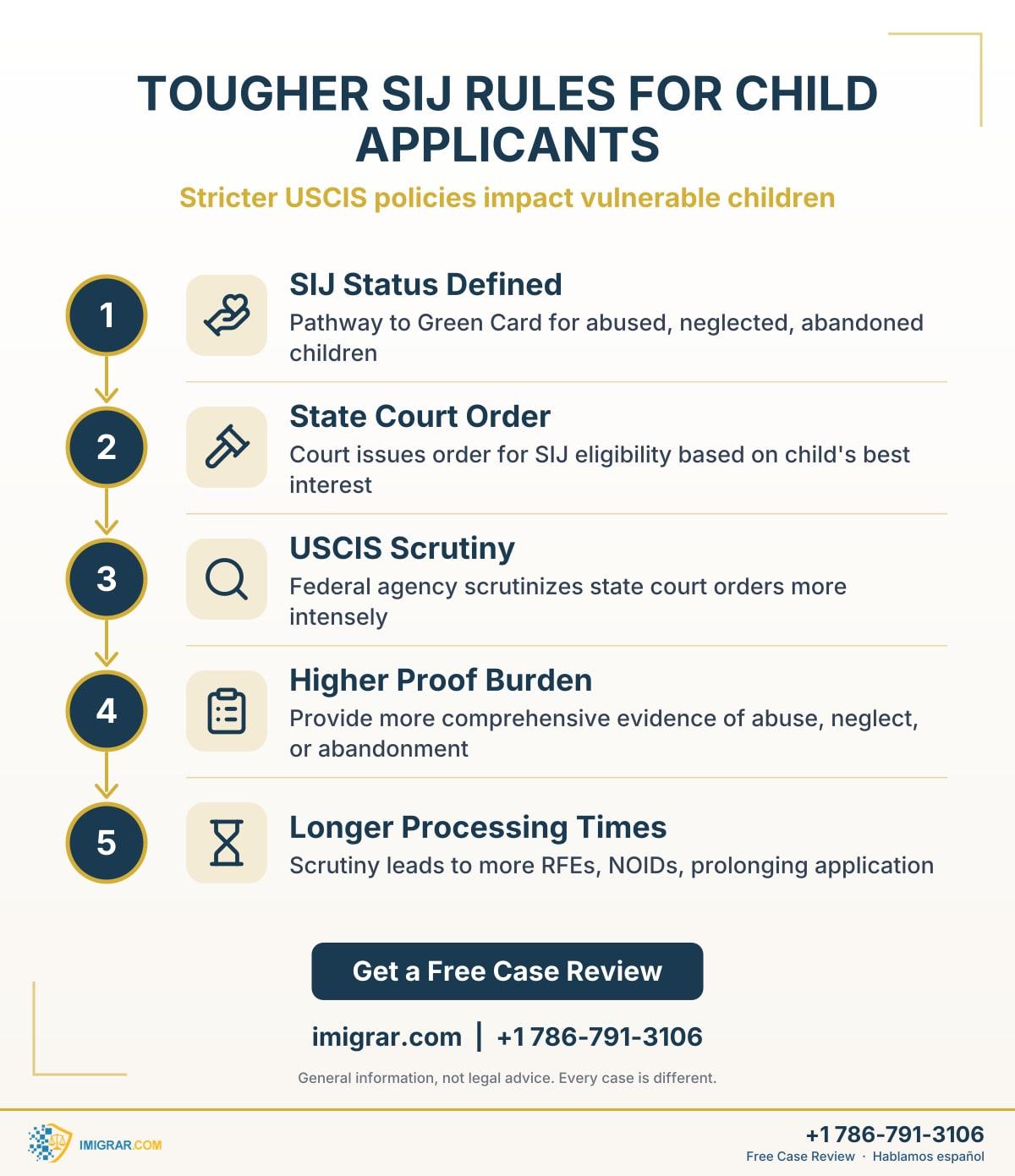
For vulnerable children and their advocates in Florida, the ongoing tightening of immigration rules, particularly concerning Special Immigrant Juvenile (SIJ) status, presents significant challenges. The Trump administration’s consistent emphasis on stricter immigration enforcement means that applications for humanitarian protections like SIJ are subject to more intense scrutiny, higher evidentiary burdens, and often longer processing times. This environment demands meticulous preparation and experienced legal representation.
Why this news is showing up now
The Newsweek article from 2018 served as an early indicator of a significant shift in U.S. Citizenship and Immigration Services (USCIS) policy regarding SIJ applications. At that time, it signaled an increase in denials and requests for evidence (RFEs), indicating a more restrictive interpretation of eligibility requirements. Fast forward to 2026, and President Donald Trump’s administration, now in its second term, has continued to prioritize stringent immigration enforcement across all categories. The initial tightening observed in 2018 has not only persisted but has been further codified and reinforced through updated policy manuals and increased training for USCIS officers, aligning with the administration's broader immigration agenda. What was once a subtle shift is now an established operational standard.
This means that the challenges faced by SIJ applicants today are a direct continuation and intensification of policies initiated in the administration's first term. The current administration maintains a firm stance on limiting immigration and ensuring all applications meet the highest possible evidentiary standards, particularly for those seeking a pathway to a Green Card. Therefore, the concerns raised years ago are even more pressing now, requiring applicants and their legal teams to be exceptionally prepared and resilient.
How it can affect Florida residents
Florida, with its diverse population and significant immigrant communities, is particularly impacted by these federal policy changes. Many children seeking SIJ status reside in Central Florida, including Orlando, and their cases are processed through local family courts and ultimately by USCIS. The Orlando USCIS Field Office, like others nationwide, operates under these heightened scrutiny directives.
- Increased Scrutiny at Local Level: Florida state courts play a crucial role in the SIJ process by issuing dependency or custody orders that form the foundation of an SIJ petition. While state courts focus on the child's best interests, USCIS’s stricter interpretation means that the federal immigration agency will scrutinize these state court orders more intensely, looking for specific findings that unequivocally meet federal SIJ requirements.
- Higher Burden of Proof: Applicants in Orlando and throughout Florida must now provide more comprehensive evidence to prove abuse, neglect, or abandonment, and that reunification with one or both parents is not viable. This includes detailed court documents, police reports, psychological evaluations, and testimony.
- Longer Processing Times: The increased scrutiny often translates to more Requests for Evidence (RFEs) and Notices of Intent to Deny (NOIDs), which prolong the application timeline. For children already in vulnerable situations, these delays can be emotionally and practically devastating.
- Complex Navigation: The interplay between state dependency/family law and federal immigration law becomes even more complex. An attorney skilled in both areas, like those at Imigrar, is essential to ensure the state court order is drafted precisely to satisfy federal SIJ criteria.
- Impact on Family Reunification: While SIJ is for children without parental support, the broader context of family separation policies under the current administration adds to the anxiety for many immigrant families. Even though SIJ is a protection for vulnerable children, the general climate of heightened immigration enforcement affects the overall process and emotional toll on these young applicants.
For Central Florida residents, understanding these intricacies and securing expert legal representation is paramount to successfully navigating the SIJ Green Card process in this challenging environment.
What Special Immigrant Juvenile (SIJ) Status Is (and Why It Matters)
Special Immigrant Juvenile (SIJ) status provides a pathway to a Green Card for certain undocumented immigrant children in the United States who have been abused, neglected, or abandoned by one or both parents. This humanitarian provision is designed to protect vulnerable children and offer them a chance at safety and stability in the U.S.
A plain-English definition
Imagine a child who has come to the U.S. alone or with family, but has suffered severe mistreatment – abuse, neglect, or abandonment – by their parent(s). If a U.S. state court (like a family court in Orlando) determines that it's not safe for this child to return to their parent(s) or country of origin, and that it’s in their best interest to remain in the U.S., they might be eligible for something called Special Immigrant Juvenile (SIJ) status. This status allows them to apply for a Green Card, providing them with legal permanent residency and protection from deportation.
It’s a crucial lifeline for children who have experienced profound trauma and have no parent to care for them. However, securing this status requires proving to both a state court and the federal government (USCIS) that the child meets very specific, strict criteria.
Key terms you need to know
- Special Immigrant Juvenile (SIJ) Status: A special immigration classification available to children under 21 years old who have been declared dependent on a juvenile court or legally committed to a state agency, and for whom reunification with one or both parents is not possible due to abuse, neglect, or abandonment, and it is not in their best interest to return to their home country.
- Green Card (Lawful Permanent Resident Status): An immigration document that allows a non-U.S. citizen to live and work permanently in the United States. SIJ status is a pathway to obtaining a Green Card.
- USCIS (U.S. Citizenship and Immigration Services): The federal agency that oversees lawful immigration to the United States. They process SIJ petitions and Green Card applications.
- Adjustment of Status: The process by which an eligible individual already in the United States can apply for lawful permanent resident status (a Green Card) without having to return to their home country to complete visa processing. This is the typical path for SIJ recipients already in the U.S.
- Juvenile Court: In Florida, this refers to state courts (e.g., family court, dependency court) that have jurisdiction over children, particularly in cases of abuse, neglect, or abandonment. This court issues the "predicate order" necessary for SIJ.
- Predicate Order: The specific order issued by a state juvenile court that makes the necessary findings for a child to be eligible for SIJ status. These findings *must* explicitly state that the child is dependent on the court or committed to a state agency, reunification with one or both parents is not viable due to abuse, neglect, or abandonment, and it is not in the child’s best interest to return to their country of nationality or last habitual residence.
- Abuse, Neglect, Abandonment: The specific grounds for parental mistreatment that must be established in the state court proceeding. These terms have legal definitions that vary slightly by state but generally refer to physical, emotional, or sexual harm; failure to provide basic necessities; or desertion by a parent.
- Unaccompanied Alien Child (UAC): A child who has no lawful immigration status in the U.S., is under 18 years of age, and has no parent or legal guardian in the U.S. available to provide care and physical custody. Many SIJ applicants are UACs.
Understanding these terms is fundamental to comprehending the SIJ process and the heightened requirements currently imposed by the Trump administration. The precision required in proving these conditions has never been greater.
Need Help? Our Orlando immigration team is ready to assist. Call +1 786-791-3106 for a free consultation, or message us online. Se Habla Español.
Current Immigration Law: The Foundation
The legal basis for Special Immigrant Juvenile (SIJ) status is rooted in federal law, specifically the Immigration and Nationality Act (INA). However, the implementation of these laws, particularly under the current Trump administration, involves complex interactions with state law and rigorous interpretation by USCIS. The tightening of rules means that applicants must adhere to the letter of the law and provide exhaustive evidence to meet the high bar set by current policies.
Federal requirements
The core federal requirements for SIJ status are outlined in Section 101(a)(27)(J) of the Immigration and Nationality Act (8 U.S.C. § 1101(a)(27)(J)). To be eligible, an individual must meet all the following criteria at the time of filing Form I-360, Petition for Amerasian, Widow(er), or Special Immigrant:
- Age: Be under 21 years of age at the time of filing the Form I-360.
- Marital Status: Be unmarried.
- State Court Order: Obtain a valid order from a U.S. state juvenile court that makes specific findings:
- The child has been declared dependent on a juvenile court, or the court has legally committed or placed the child under the custody of a state agency or an individual appointed by the court.
- Reunification with one or both of the child’s parents is not viable due to abuse, neglect, or abandonment, or a similar basis found under state law.
- It is not in the child’s best interest to return to their or their parent's previous country of nationality or last habitual residence.
- USCIS Consent: USCIS must specifically consent to the juvenile court’s jurisdiction over the child’s dependency or custody proceedings. This consent is generally *not* required for the initial state court order, but it’s a federal requirement that the state court process was undertaken for a *bona fide* purpose other than simply obtaining an immigration benefit. The current administration has significantly increased scrutiny on this aspect, ensuring the state court proceedings were legitimate and not merely a vehicle for immigration.
Important: The Trump administration's current policies often scrutinize the timing and nature of the state court order, looking for any indication that the primary purpose of seeking the state court's intervention was to obtain an immigration benefit, rather than to genuinely address the child's welfare. This places a heavy burden on applicants to demonstrate the legitimacy and necessity of the state court's findings.
Reference the official guidelines for SIJ on the USCIS official website.
Florida-specific considerations
For children residing in Orlando and across Florida, the state court process is a critical first step. Florida law provides avenues for children to be declared dependent or placed in the custody of a suitable adult or state agency:
- Dependency Court: Chapters 39 and 984 of the Florida Statutes govern child welfare and dependency proceedings. If a child is found to be abused, neglected, or abandoned, the court can declare them dependent and place them under the supervision of the Florida Department of Children and Families (DCF) or a suitable relative/non-relative.
- Guardianship/Custody Proceedings: In other cases, a child may be placed in the custody of a guardian or a relative through family court proceedings, often under Chapter 751 of the Florida Statutes (Temporary Custody by Extended Family Members) or Chapter 744 (Guardianship).
Critical Florida Court Findings: When seeking a predicate order in a Florida state court, it is absolutely essential that the court explicitly makes the three federal findings required for SIJ status. Generic dependency or custody orders are often insufficient. An experienced attorney will ensure the court order specifically states:
- The child is dependent on the court or committed to the custody of a specific individual/entity.
- Reunification with one or both parents is not viable due to specific findings of abuse, neglect, or abandonment.
- It is not in the child’s best interest to be returned to their country of origin.
The Orlando immigration courts and the USCIS Field Office in Orlando are accustomed to reviewing these types of state court orders. However, the current administration's stricter enforcement means that even minor omissions or ambiguities in the Florida court order can lead to significant delays or denials at the federal level.
Warning: The specific language used in the Florida state court order is paramount. Attorneys must work closely with the state court judge to ensure the order contains all the necessary statutory language to meet federal SIJ requirements. Failure to do so is a common reason for USCIS denials.
The primary forms you will encounter in the SIJ process are:
- Form I-360, Petition for Amerasian, Widow(er), or Special Immigrant (for SIJ classification)
- Form I-485, Application to Register Permanent Residence or Adjust Status (for the Green Card)
- Form I-765, Application for Employment Authorization (optional, but recommended for work permit)
- Form I-131, Application for Travel Document (optional, for advance parole if travel is needed)
- Form I-601, Application for Waiver of Grounds of Inadmissibility (if applicable)
For detailed information on all USCIS forms, visit USCIS Forms.
How to Secure SIJ Status and Your Green Card: A Complete Step-by-Step Guide
Obtaining SIJ status and ultimately a Green Card is a multi-step process that requires careful coordination between state and federal legal systems. Under the current administration’s tightened rules, each step demands meticulous attention to detail and robust evidence. This guide outlines the essential phases for applicants in Orlando and nationwide.
1) Obtain a State Court Order with Required Findings
This is the foundational step. Before you can even apply to USCIS for SIJ status, you must secure an order from a Florida state juvenile or family court that makes specific findings about the child's situation. This process can be complex and typically involves:
- Filing a Petition: A petition is filed with the appropriate Florida state court (e.g., dependency court, family court in Orange County) seeking to establish the child's dependency, custody, or guardianship.
- Establishing Grounds: Evidence must be presented to the state court demonstrating that the child has been abused, neglected, or abandoned by one or both parents. This could involve testimony, school records, police reports, medical records, or social worker reports.
- Court Hearings: The court will hold hearings to determine the facts of the case and the child’s best interests.
- Issuance of Predicate Order: If the court agrees, it will issue an order. This order *must* contain the three critical federal SIJ findings:
- The child is dependent on the court or committed to the custody of a state agency or court-appointed individual.
- Reunification with one or both parents is not viable due to abuse, neglect, or abandonment.
- It is not in the child’s best interest to return to their country of origin.
Required Documents for this step (prepared for court):
- Petition for Dependency, Guardianship, or Custody.
- Affidavits or sworn statements detailing abuse, neglect, or abandonment.
- Any available evidence of abuse (e.g., medical records, police reports, school records, therapist notes).
- Proof of child's age and identity (birth certificate).
- Court summons/notices to parents (if applicable and possible).
- Proposed court order with specific SIJ language.
Timeline Expectation: This stage can take anywhere from a few months to over a year, depending on court dockets, the complexity of the case, and the cooperation of parties. In Orlando, family court schedules can be quite busy, so early preparation is key.
2) File Form I-360, Petition for Amerasian, Widow(er), or Special Immigrant
Once you have the certified state court order, the next step is to file Form I-360 with USCIS. This petition requests that USCIS classify the child as a Special Immigrant Juvenile.
- Complete Form I-360: Fill out the form meticulously, ensuring all questions are answered truthfully and completely.
- Gather Supporting Documentation: This is where the bulk of your evidence comes in. Under the current administration, USCIS requires extensive documentation to prove eligibility.
- Prepare a Cover Letter: A detailed cover letter from your attorney outlining the petition, the legal basis, and the attached evidence is highly recommended.
- Mail the Petition: Send the complete package to the USCIS service center with jurisdiction over your case.
- Certified copy of the state court order containing all required SIJ findings.
- Child’s birth certificate (original or certified copy, with certified English translation if applicable).
- Proof of child's identity (e.g., passport, national identity document).
- Proof of child’s current immigration status (if any).
- Affidavits from individuals with direct knowledge of the child's abuse, neglect, or abandonment (e.g., foster parents, social workers, teachers, family members).
- Any additional evidence of abuse, neglect, or abandonment (e.g., police reports, medical records, school records, psychological evaluations).
- Proof of the child's age (under 21 and unmarried).
- Proof of the petitioner's relationship to the child (if applicable, e.g., guardian).
- A copy of the child's Form I-94, Arrival/Departure Record (if they entered legally).
Required Documents for Form I-360:
Reminder: All foreign language documents must be accompanied by a complete English translation certified by a competent translator. Under the current administration, USCIS is particularly strict about the quality and completeness of translations.
3) Respond to Requests for Evidence (RFEs) or Notices of Intent to Deny (NOIDs)
Given the current administration's heightened scrutiny, it is increasingly common for USCIS to issue RFEs or NOIDs for SIJ petitions. These documents indicate that USCIS requires more information or intends to deny the petition based on perceived deficiencies.
- Careful Review: Thoroughly review the RFE or NOID with your attorney to understand exactly what information or clarification USCIS is requesting.
- Gather Additional Evidence: Respond by providing all requested documents and explanations within the specified timeframe (typically 60-90 days). This may involve obtaining new records, writing detailed affidavits, or clarifying previous submissions.
- Legal Argument: Your attorney may need to prepare a legal brief explaining why the previously submitted evidence, or the new evidence, meets the SIJ requirements.
Warning: Failing to respond adequately or on time to an RFE or NOID will almost certainly lead to a denial. This stage is critical and often requires the most intensive legal work.
4) Attend Biometrics Appointment and Interview (if required)
After USCIS receives your Form I-360, they will send a notice for a biometrics appointment. This involves capturing fingerprints, photographs, and a signature for background checks. While SIJ petitioners are generally not required to attend an interview for the Form I-360 itself, an interview may be required for the subsequent Form I-485, Adjustment of Status.
- Biometrics: Attend the appointment at a local Application Support Center (ASC), such as the one serving the Orlando area.
- Interview (for I-485): If an interview is scheduled for the Green Card application (Form I-485), the child (and their guardian/attorney) will need to appear at the Orlando USCIS Field Office. The officer will review the application, ask questions about the child’s background, the abuse, and the state court findings.
Important: An attorney should accompany the child and guardian to any interview to provide legal support and ensure the child's rights are protected. The current administration's interview policies can be rigorous, even for vulnerable populations.
5) File Form I-485, Application to Register Permanent Residence or Adjust Status (Green Card)
Once the Form I-360 is approved, the child is granted SIJ classification. The next step is to apply for the Green Card through Adjustment of Status, using Form I-485. For SIJ applicants, there is no visa backlog, meaning they can typically file the Form I-485 concurrently with or soon after the Form I-360, provided a visa number is immediately available.
- Complete Form I-485: Fill out the application carefully.
- Gather Supporting Documents: This includes the approved Form I-360 notice, proof of identity, medical examination (Form I-693), and other standard Green Card application documents.
- Medical Examination: Obtain a medical examination from a USCIS-approved civil surgeon. The sealed results on Form I-693 must be submitted with the Form I-485 or at the interview.
- File Concurrently or Separately: Depending on the case, Form I-485 can be filed at the same time as Form I-360 (concurrent filing) or after the Form I-360 is approved. Concurrent filing is often preferred to expedite the process.
- Copy of the approved Form I-360 notice.
- Child’s birth certificate (with certified English translation).
- Copy of passport, Form I-94 (if applicable), and any other immigration documents.
- Two passport-style photographs.
- Form I-693, Report of Medical Examination and Vaccination Record (sealed envelope).
- Form I-864, Affidavit of Support (Note: SIJ applicants are generally exempt from this requirement, but it’s crucial to confirm with an attorney).
- Police clearances and court records (if applicable, demonstrating no criminal history).
- Evidence of continuous presence in the U.S. (if applicable).
- Form G-325A, Biographic Information (if applicable).
Required Documents for Form I-485:
Timeline Expectation: The processing times for Form I-485 can vary significantly. You can check current processing times for the Orlando Field Office and relevant service centers on the USCIS Processing Times website.
6) Receive Decision and Green Card
If all goes well, USCIS will approve the Form I-485, and the child will be granted Lawful Permanent Resident (LPR) status. The Green Card will be mailed to the child (or their guardian/attorney).
- Approval Notice: USCIS will mail an approval notice for the Form I-485.
- Green Card Issuance: The physical Green Card will arrive by mail shortly after the approval.
Congratulations: Upon receiving the Green Card, the child officially becomes a Lawful Permanent Resident of the United States, gaining stability, safety, and a pathway to future opportunities, including U.S. citizenship. This is the culmination of a long and challenging journey, offering protection from the very circumstances that necessitated the SIJ process.
Practical Steps You Can Take Today
Navigating the SIJ process under the current administration's stricter rules requires proactive and diligent preparation. Here’s an actionable checklist to help you get started:
- Consult an Experienced Immigration Attorney Immediately: This is the most critical first step. The complexities of state court orders and federal SIJ requirements, coupled with heightened USCIS scrutiny, make legal representation indispensable. An attorney can assess eligibility, guide the state court process, and prepare a robust federal petition. Contact Imigrar for a free consultation.
- Gather All Available Documents: Start collecting any and all documents related to the child’s identity, entry into the U.S., and evidence of abuse, neglect, or abandonment. This includes birth certificates, passports, Form I-94s, school records, medical records, police reports, and any court documents. Organize them meticulously.
- Document Everything Related to Abuse/Neglect: If the child is still experiencing or has recently experienced abuse, neglect, or abandonment, ensure there is a clear record. Contact child protective services (DCF in Florida) if necessary. Every report, every communication, every piece of evidence will be vital.
- Secure a Safe Living Environment: Ensure the child is in a safe and stable living situation. This is crucial for their well-being and strengthens the argument for their best interest to remain in the U.S.
- Understand the Predicate Order Requirements: Familiarize yourself with the specific findings a Florida state court must make for SIJ eligibility. Discuss these with your attorney to ensure the state court petition and order are precisely tailored.
- Prepare for Financial Costs: Be aware of the fees associated with USCIS filings (e.g., Form I-360, Form I-485, biometrics, medical exam) and legal fees. While some fees can be waived for those with limited income, planning is essential.
- Maintain Communication with Your Legal Team: Respond promptly to requests for information or documents from your attorney. Open and consistent communication is key to a smooth process.
- Stay Informed (Through Reliable Sources): Follow updates from official sources like USCIS and reputable legal news outlets. Avoid misinformation, especially regarding immigration policies under the current administration.
Document preparation guidance
- Originals vs. Copies: Always submit copies of documents unless USCIS specifically requests originals. Keep your original documents safe.
- Translations: Any document not in English must be accompanied by a complete and accurate English translation, certified by the translator.
- Organization: Organize your documents logically, using tabs and a detailed cover letter to help USCIS officers review your application efficiently.
- Affidavits: If providing affidavits, ensure they are detailed, sworn statements, signed and dated, ideally notarized, from individuals with firsthand knowledge.
Timeline expectations
The SIJ process is lengthy, and current USCIS policies under the Trump administration have often led to extended processing times. While specific timelines vary, here’s a general expectation:
- State Court Order: 6 months to 1.5 years (can vary significantly based on court backlog and case complexity in Florida).
- Form I-360 Processing: 6 months to 2 years (or more, especially with RFEs). Check USCIS Processing Times for current estimates.
- Form I-485 Processing (after I-360 approval): 8 months to 2 years (can be longer if an interview is required at the Orlando Field Office or if additional RFEs are issued).
Overall: Expect the entire process from initial state court petition to receiving a Green Card to take anywhere from 2.5 to 5 years, or potentially longer, under the current climate. Patience and persistent legal advocacy are vital.
How Imigrar Helps Immigrants in Orlando
At Imigrar, we understand the profound vulnerability of children seeking SIJ status and the critical importance of keeping families together, even when those families are formed through legal guardianship. Based in Orlando, Florida, our firm is uniquely positioned to assist clients throughout Central Florida and nationwide in navigating the complex and often emotionally charged SIJ Green Card process, especially under the current administration's challenging policies.
Our experience and expertise
Our team of dedicated immigration attorneys possesses extensive experience in Special Immigrant Juvenile cases. We are intimately familiar with both federal immigration law and Florida state family and dependency court procedures. This dual expertise is crucial because a successful SIJ petition hinges on securing a precisely worded predicate order from a Florida state court, which then must withstand the rigorous scrutiny of USCIS.
- Dual Legal Expertise: We bridge the gap between Florida state family law and federal immigration law, ensuring that the state court order meets all federal SIJ requirements. This is a critical area where many self-represented individuals or less experienced firms encounter difficulties, leading to delays or denials.
- Navigating Current Policies: We stay abreast of the latest policy changes, adjudicatory trends, and enforcement priorities of the Donald Trump administration regarding SIJ petitions. This allows us to anticipate challenges, prepare robust evidence packages, and strategically respond to RFEs or NOIDs.
- Comprehensive Case Management: From the initial consultation and eligibility assessment to preparing state court petitions, filing Form I-360 and Form I-485, responding to USCIS requests, and representing clients at interviews at the Orlando USCIS Field Office, we provide end-to-end legal support.
- Compassionate Advocacy: We recognize the traumatic experiences many SIJ applicants have endured. Our approach is not only legally sound but also deeply empathetic, ensuring that children and their guardians feel supported and understood throughout the process. Our tagline, "Keep Families Together," extends to ensuring vulnerable children find lasting safety and stability.
- Local Knowledge: Our Orlando location means we have direct experience with the local court systems in Orange County and surrounding areas, as well as the practices of the Orlando USCIS Field Office. This local insight can be invaluable in streamlining processes and addressing specific regional nuances.
Free consultation offer
The journey to SIJ status and a Green Card is too important to navigate alone. We invite you to contact Imigrar for a **free, confidential consultation** to discuss your unique situation. We will assess your eligibility, explain the process in clear terms, and outline how we can help protect the future of a vulnerable child.
Call us today at +1 786-791-3106 or message us online to schedule your free consultation. Our team is ready to provide the expert guidance and compassionate advocacy you need.
Se Habla Español. We are proud to serve our Spanish-speaking community, ensuring clear communication and accessible legal services.
Ready to Start? Don't face complex SIJ rules alone. Contact Imigrar for expert legal assistance in Orlando. Call +1 786-791-3106 for a free consultation. Se Habla Español.
Frequently Asked Questions
Q: Who is eligible for Special Immigrant Juvenile (SIJ) status?
A: Eligibility for SIJ status is highly specific. The child must be under 21 years old and unmarried at the time of filing Form I-360. Crucially, a U.S. state juvenile court (like a family court in Florida) must have declared the child dependent on the court or committed them to a state agency or an individual. The court must also find that reunification with one or both parents is not viable due to abuse, neglect, or abandonment, and that it is not in the child’s best interest to return to their country of origin. Under the current Trump administration, USCIS scrutinizes these state court findings intensely, requiring clear and explicit language in the court order. Consulting with an experienced attorney is vital to determine if a child meets these stringent federal and state requirements.
Q: How does SIJ status impact a child's immigration status immediately?
A: Being granted SIJ classification (after Form I-360 approval) provides a pathway to a Green Card. While the Form I-360 approval itself doesn't grant permanent residency, it makes the child eligible to apply for Adjustment of Status (Green Card) without the usual visa backlogs. This means they can typically file Form I-485 concurrently or immediately after Form I-360 approval. During the processing of the Form I-485, the child may be eligible for an Employment Authorization Document (EAD or work permit) and advance parole (travel document), offering some immediate stability and the ability to legally work and travel. This is a significant step towards securing a permanent legal status and protection from deportation.
Q: What is the typical timeline for the SIJ Green Card process?
A: The SIJ Green Card process is lengthy and, under the current administration, has seen increased processing times. Generally, obtaining the necessary state court order in Florida can take 6 months to over a year. Processing of Form I-360 by USCIS can range from 6 months to 2 years, often with additional time if Requests for Evidence (RFEs) are issued. The subsequent Form I-485 for the Green Card can take another 8 months to 2 years, including potential interviews at the Orlando USCIS Field Office. Overall, applicants should realistically expect the entire journey from initial state court petition to receiving a Green Card to span 2.5 to 5 years, or even longer. Patience and consistent legal follow-up are essential.
Q: What specific documents are required for an SIJ application?
A: The core documents are the certified state court order with the required SIJ findings, the child’s birth certificate (with certified English translation), and Form I-360. For the subsequent Green Card application (Form I-485), you’ll need the Form I-360 approval notice, passport-style photos, a medical examination (Form I-693), and potentially other identity and background documents. Under the current administration, USCIS demands comprehensive evidence of the abuse, neglect, or abandonment, including affidavits from credible witnesses, school records, medical reports, police reports, and any other relevant documentation. An experienced attorney can provide a tailored list and assist in compiling a strong application package.
Q: What are the costs associated with applying for SIJ status and a Green Card?
A: The costs include USCIS filing fees for Form I-360 (currently $435, though often waivable for SIJ applicants), Form I-485 (currently $1,225 for children, though often waivable for SIJ applicants), and the biometrics fee (currently $85, also often waivable). Additionally, there are fees for the required medical examination (Form I-693), which can range from $200-$500, and potentially fees for obtaining birth certificates or other records. Attorney fees for legal representation are a separate consideration but are a crucial investment given the complexity of the process and the heightened scrutiny under the current administration. Imigrar offers a free initial consultation to discuss potential costs and legal strategies.
Q: What happens if an SIJ petition or Green Card application is denied?
A: A denial can have serious consequences, potentially leading to deportation proceedings if the child does not have another lawful immigration status. If an SIJ petition (Form I-360) is denied, you may be able to appeal the decision to the Administrative Appeals Office (AAO) or file a motion to reopen/reconsider with USCIS. If the Green Card application (Form I-485) is denied, you might be able to appeal to the Board of Immigration Appeals (BIA) or file a motion with USCIS. The specific actions depend on the reason for denial. It is absolutely critical to consult with an immigration attorney immediately upon receiving a denial notice to understand your options and take timely action. Do not delay, as strict deadlines apply to appeals and motions.
Common Mistakes (and How to Avoid Them)
The SIJ process is fraught with potential pitfalls, especially with the current administration's increased scrutiny. Avoiding these common mistakes is crucial for a successful outcome.
Mistake #1: Inadequate State Court Order
Description: Many applicants obtain a state court order that grants dependency or custody but fails to include the *exact* federal statutory language required for SIJ status. For example, an order might state "reunification is not possible" but omit "due to abuse, neglect, or abandonment" or fail to explicitly state "it is not in the child’s best interest to return to their country of origin." Under the Trump administration's policies, USCIS officers are trained to look for these precise phrases.
How to Avoid: Work with an attorney experienced in both Florida family law and immigration law from the very beginning of the state court process. They can draft the proposed order to ensure it contains all the necessary federal findings, explicitly and unambiguously. Do not assume a standard dependency order will suffice; it almost certainly won't for SIJ purposes.
Mistake #2: Insufficient Evidence of Abuse, Neglect, or Abandonment
Description: USCIS, under current policies, requires robust and compelling evidence that the child has been abused, neglected, or abandoned. Simply stating it happened, or providing minimal documentation, is no longer enough. Many applications are denied or subjected to RFEs because the evidence is weak, inconsistent, or not directly linked to the federal definitions. This is particularly true when the abuse occurred in another country.
How to Avoid: Compile an exhaustive collection of evidence. This includes detailed affidavits from the child (if appropriate for their age and trauma), guardians, social workers, teachers, and other witnesses. Gather all available police reports, medical records, psychological evaluations, school records, and court documents. The evidence must clearly demonstrate the abuse, neglect, or abandonment and its impact on the child, as well as the viability of parental reunification. Be prepared to provide evidence even for events that occurred years ago or in another country, translated and authenticated.
Mistake #3: Missing Deadlines or Incomplete Filings
Description: The SIJ process involves multiple forms, fees, and strict deadlines. Missing a deadline for an RFE, failing to submit all required forms and supporting documents, or submitting incomplete forms can lead to significant delays, RFEs, or outright denials. Even minor errors, like incorrect fee payments or unsigned forms, can cause rejections, wasting precious time and resources.
How to Avoid: Engage an experienced immigration attorney. They will ensure all forms are correctly filled out, all necessary documents are included, fees are paid properly, and deadlines are met. Utilize checklists, create organized files, and maintain open communication with your legal team. For Central Florida residents, understanding the specific filing requirements for the Orlando USCIS Field Office or relevant service centers is also key.
Mistake #4: Not Addressing Inadmissibility Grounds
Description: Some SIJ applicants may have inadmissibility issues (e.g., certain unlawful entries, past criminal offenses, misrepresentations) that could prevent them from obtaining a Green Card, even if their SIJ petition is approved. Failing to identify and address these issues upfront is a common mistake.
How to Avoid: A thorough legal consultation is essential to identify any potential grounds of inadmissibility. If applicable, an attorney can help you determine if a waiver (such as Form I-601, Application for Waiver of Grounds of Inadmissibility) is available and prepare a strong application for it. SIJ applicants are often eligible for more favorable waiver standards, but these must be properly requested and justified.
Don't Risk Denial. Navigate complex SIJ rules with confidence. Imigrar is here to help. Call +1 786-791-3106 for a free consultation. Se Habla Español.
The path to a Green Card for abused migrant children through SIJ status is more challenging than ever under the current U.S. administration. The increased scrutiny and tightened rules demand a strategic, informed, and compassionate legal approach. At Imigrar, we are committed to providing that expertise to families and children in Orlando, across Florida, and nationwide.
Our goal is to ensure that vulnerable children receive the protection and stability they deserve. Don't face this complex process alone. Contact our experienced legal team today.
Call Imigrar now at +1 786-791-3106 for a free consultation. Se Habla Español. Let us help you keep families together and secure a brighter future.
Official Government References:
- U.S. Citizenship and Immigration Services (USCIS) official website
- U.S. Department of State
- Executive Office for Immigration Review (EOIR)
- USCIS Processing Times
- USCIS Forms
- USCIS Policy Manual
- American Immigration Lawyers Association (AILA) - a valuable resource for immigration policy updates.
Related Topics
Need Legal Assistance?
Our experienced immigration attorneys are here to help with your case. Contact Imigrar today for a free consultation and let us guide you through the legal process with confidence.
📍 Orlando, Florida • Serving clients nationwide
📧 info@imigrar.com