
Public Charge Confusion: Navigating Trump's New Guidance for Florida Immigrants
Understand the current administration's Public Charge policies and their impact on families in Orlando and across Florida. Imigrar offers expert guidance.
What This News Means for Immigrants in Orlando and Across Florida
The landscape of U.S. immigration law is constantly evolving, and few areas have seen as much volatility and uncertainty in recent years as the Public Charge rule. A recent report from KFF (Kaiser Family Foundation) highlights that new guidance, intended to clarify the rule, still leaves critical questions unanswered. This ambiguity is likely to deepen the "chilling effect" – the widespread fear among immigrant families of using essential public benefits, even those explicitly excluded from public charge considerations. For immigrants residing in Orlando, Central Florida, and throughout the state, understanding these nuances under President Donald Trump’s current administration is not just important, it’s absolutely vital for protecting your family’s well-being and immigration future.
Why this news is showing up now
The KFF report surfaces at a critical juncture, reflecting ongoing concerns about the Public Charge rule under President Trump’s second term. While the administration that preceded President Trump's second term worked to revert to a pre-2019 standard, aiming to reduce the chilling effect, the current administration continues to uphold a strict interpretation of self-sufficiency for immigrants.
The 2019 Public Charge rule, implemented during President Trump's first term, significantly broadened the definition of who could be deemed a "public charge," leading to widespread confusion and fear. It expanded the list of benefits that could be considered, including certain forms of Medicaid, housing assistance, and Supplemental Nutrition Assistance Program (SNAP) benefits. Although the administration preceding President Trump's second term sought to rescind and replace this rule with a more lenient approach, the underlying statute regarding public charge inadmissibility remains.
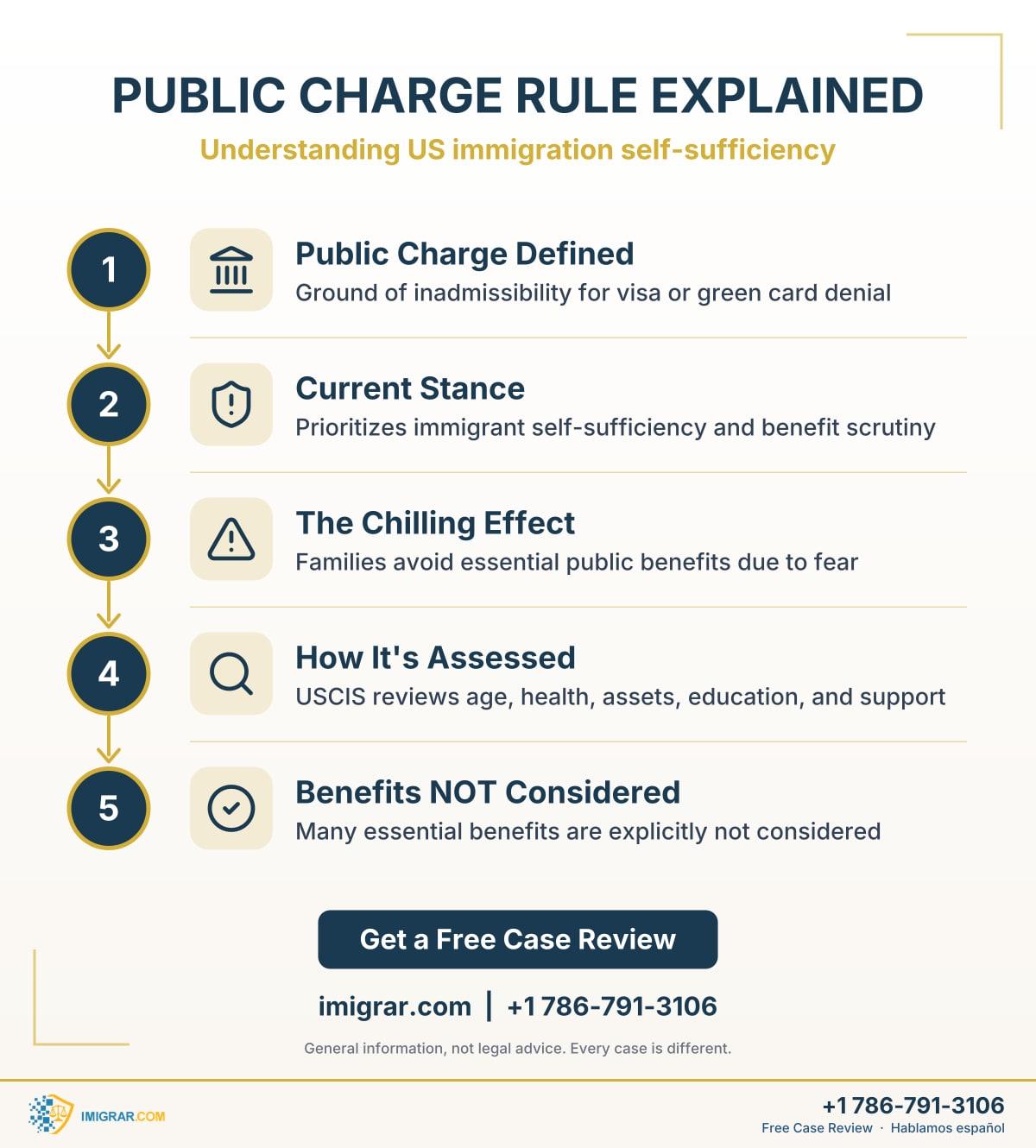
The "new guidance" referred to by KFF is likely a clarification or reiteration of the existing framework, or perhaps a response to lingering questions from the earlier policy shifts. However, the KFF report indicates that these clarifications aren't entirely resolving the deeply ingrained anxieties. Instead, they highlight that the current administration's stance, even if not a direct return to the most stringent 2019 rule, still operates within a framework that prioritizes immigrant self-sufficiency and scrutinizes benefit usage, thereby maintaining and potentially deepening the chilling effect. This means that even with updated instructions, the fundamental concern for many families – that using any public benefit could jeopardize their immigration status – persists.
How it can affect Florida residents
Florida is home to a vibrant and diverse immigrant population, from agricultural workers in the southern counties to service industry professionals in Orlando and Tampa. The implications of ambiguous Public Charge guidance ripple through these communities in profound ways:
- Healthcare Access: Many families, out of fear, may forego essential medical care, even emergency services that are explicitly not considered for public charge determinations. This can lead to worsening health conditions and greater strain on emergency rooms in cities like Orlando and across Orange County.
- Food Security: Families might hesitate to enroll eligible children in school lunch programs or apply for WIC (Special Supplemental Nutrition Program for Women, Infants, and Children), which are vital for child nutrition and explicitly not considered public charge benefits. This fear can lead to food insecurity for vulnerable populations.
- Housing Stability: Immigrants might avoid housing assistance, even if eligible and not subject to public charge rules, fearing it could negatively impact their future. This contributes to housing insecurity, a significant concern in rapidly growing areas along the I-4 corridor.
- Economic Impact: The chilling effect can force families into deeper poverty, as they avoid support systems designed to help them achieve self-sufficiency. This creates a cycle that is counterproductive to the very goals of the Public Charge rule.
- Legal Uncertainty: For individuals in Orlando preparing for an Adjustment of Status interview at the Orlando USCIS Field Office, the uncertainty surrounding Public Charge can be overwhelming. They need clear, accurate advice to navigate the complex application process and ensure they are not inadvertently jeopardizing their case.
Important: The fear surrounding Public Charge often leads to families withdrawing from benefits they are legally entitled to and which would not impact their immigration case. This is precisely the chilling effect that the KFF report highlights. Understanding the specifics of what is and isn't counted is paramount.
Need Help? Navigating complex Public Charge rules requires expert legal insight. Our Orlando immigration team is ready to assist. Call +1 786-791-3106 for a free consultation, or message us online. Se Habla Español.
What Public Charge Is (and Why It Matters)
The Public Charge rule is one of the most historically significant and currently impactful aspects of U.S. immigration law. It's a ground of inadmissibility, meaning that if an individual is deemed likely to become a public charge, they can be denied a visa or Adjustment of Status to lawful permanent resident (green card) status. For many families seeking to build a life in the United States, especially here in Florida, understanding this rule is fundamental to their immigration journey.
A plain-English definition
At its core, the Public Charge rule aims to ensure that individuals seeking to immigrate to the U.S. will be self-sufficient and not primarily dependent on the government for their basic needs. In simpler terms, the U.S. government wants to know that you or your sponsor can financially support you, preventing you from becoming a burden on taxpayer-funded public assistance programs.
The assessment isn't about whether you've ever used a public benefit. It's about whether, based on a "totality of the circumstances" review, you are likely to become primarily dependent on certain specified public benefits in the future. This forward-looking assessment is what makes the rule so complex and often generates fear.
Key terms you need to know
To truly grasp the implications of the Public Charge rule, you need to understand several key terms:
- Public Charge: An individual who is likely to become primarily dependent on the government for subsistence, as demonstrated by either the receipt of public cash assistance for income maintenance or long-term institutionalization at government expense. This is the definition currently being applied by USCIS.
- Totality of the Circumstances: This is the comprehensive assessment method USCIS officers use to determine public charge inadmissibility. They don't just look at one factor; they consider all relevant factors, both positive and negative, including:
- Age: Are you of working age?
- Health: Do you have any conditions that might prevent you from working?
- Family Status: How many dependents do you have?
- Assets, Resources, and Financial Status: Do you own property, have savings, or other financial means? What is your income level?
- Education and Skills: What is your educational background and work experience?
- Affidavit of Support (Form I-864): A legally enforceable contract from a U.S. citizen or lawful permanent resident sponsor who pledges to financially support the immigrant. This is often the most critical factor.
- Affidavit of Support (Form I-864): A sworn document required for most family-based immigrants and some employment-based immigrants. The petitioner (or a joint sponsor) must demonstrate income at or above 125% of the Federal Poverty Guidelines for their household size. This form is a legally binding promise to support the immigrant.
- Public Benefits (Considered): Under the current guidance, the benefits that are considered in a public charge determination are generally limited to:
- Supplemental Security Income (SSI)
- Temporary Assistance for Needy Families (TANF) cash assistance
- State, tribal, territorial, or local cash assistance programs for income maintenance (often called "General Assistance")
- Long-term institutionalization at government expense (e.g., in a nursing home)
- Public Benefits (NOT Considered): This is a crucial distinction. Many essential benefits are explicitly not considered for public charge determinations and can be used without fear. These include:
- Medicaid and other health insurance and health services (except for long-term institutionalization at government expense)
- Children's Health Insurance Program (CHIP)
- Supplemental Nutrition Assistance Program (SNAP), formerly food stamps
- Special Supplemental Nutrition Program for Women, Infants, and Children (WIC)
- Housing benefits
- Child care services
- Energy assistance
- Food pantries, homeless shelters
- Disaster relief and emergency medical care
- Foster care and adoption assistance
- Educational assistance (Head Start, student loans, grants)
- Job training programs
- Chilling Effect: This term describes the phenomenon where immigrant families, out of fear and confusion, avoid using any public benefits, even those that are explicitly not considered for public charge purposes and are critical for their health and well-being. The KFF report indicates this effect is deepening, impacting communities across Florida.
- Admissibility: This refers to an immigrant’s eligibility to enter the U.S. or to adjust their status to a lawful permanent resident. The Public Charge rule is a ground of inadmissibility, meaning a finding that someone is likely to become a public charge can lead to denial of their immigration application.
Understanding these terms is your first step in navigating the Public Charge rule. The current administration, under President Trump, continues to emphasize the importance of self-sufficiency, making a thorough understanding of these definitions more critical than ever for individuals and families in Orlando and nationwide.
Current Immigration Law: The Foundation of Public Charge
The Public Charge rule is not a new invention; it has been a part of U.S. immigration law for over a century. However, its interpretation and enforcement have varied significantly over time, especially with different administrations. Under President Donald Trump's current administration, the emphasis on self-sufficiency remains a cornerstone of immigration policy, and while the 2019 rule is no longer in effect, the underlying statute and its principles are being applied with continued scrutiny.
Federal requirements
The legal foundation for the Public Charge rule is found in the Immigration and Nationality Act (INA), specifically Section 212(a)(4). This section states that an applicant who is "likely at any time to become a public charge" is inadmissible to the United States.
The current regulations governing the Public Charge determination are primarily found at 8 CFR 212.22. These regulations outline the "totality of the circumstances" test, which is the framework USCIS officers use to make a decision. When assessing whether an individual is likely to become a public charge, officers must consider, at a minimum, the following factors:
- Age: Younger and older applicants might be scrutinized more closely if they are not in a position to work or support themselves.
- Health: A medical condition that requires extensive, ongoing care at government expense could be a negative factor.
- Family Status: The number of dependents an applicant has can impact their financial stability assessment.
- Assets, Resources, and Financial Status: This is a crucial area. Officers examine income, savings, investments, property ownership, and any debts. Strong financial resources are a significant positive factor.
- Education and Skills: Higher education, specialized skills, and a history of stable employment demonstrate an ability to earn a living.
- Affidavit of Support (Form I-864): For most family-based immigration cases, and certain employment-based cases, a legally binding Affidavit of Support is required. This form, submitted by a U.S. citizen or lawful permanent resident sponsor, ensures that the immigrant will be financially supported. The sponsor must meet specific income requirements (typically 125% of the Federal Poverty Guidelines). A robust and complete Form I-864 is often the most important positive factor.
Reminder: The current administration, while not using the specific 2019 rule, continues to apply these statutory and regulatory factors with an emphasis on demonstrating financial independence. Applicants must provide compelling evidence of their ability to support themselves and their families. This applies to individuals applying for Adjustment of Status within the U.S. (e.g., at the Orlando USCIS Field Office) and those seeking immigrant visas abroad through a U.S. embassy or consulate.
You can find more detailed information and official forms on the USCIS official website.
Florida-specific considerations
While Public Charge is a federal immigration law, its impact is felt locally, and specific state policies can influence how immigrant families interact with services. Florida is known for its conservative approach to social welfare programs. While this doesn't directly alter the federal Public Charge rule, it creates an environment where:
- Access to State Benefits: Florida's stricter eligibility requirements for certain state-funded programs might mean fewer immigrants are enrolled in programs that could theoretically be considered (though the list of considered benefits is very narrow federally).
- Fear Amplification: The general political climate regarding immigration in Florida, coupled with the state's approach to social services, can heighten the chilling effect. Immigrant families in Orlando, Tampa, Miami, and other parts of the state may be even more hesitant to use any benefit, regardless of federal guidelines, out of concern for attracting attention or jeopardizing their status.
- Local Resources: It’s important for immigrants in Florida to know which local resources are safe to use. Many community-based organizations, food banks, and health clinics offer services that are not government-funded and therefore have no bearing on Public Charge. For Central Florida residents, understanding these local options is crucial.
Warning: Do not make assumptions about which benefits are counted. Always consult with an experienced immigration attorney to understand your specific situation. The consequences of a wrong assumption can be severe.
How to Navigate Public Charge Concerns: A Complete Step-by-Step Guide
Successfully navigating the Public Charge determination requires careful preparation, thorough documentation, and a clear understanding of the current administration's expectations. This comprehensive guide will walk you through the essential steps to strengthen your case, whether you are applying for a green card through Adjustment of Status in Orlando or an immigrant visa abroad.
1) Understand the "Totality of the Circumstances" Test and Assess Your Profile
Before you even gather documents, you need to understand how USCIS will evaluate your case. The "totality of the circumstances" test means they look at everything. Take an honest inventory of your strengths and weaknesses concerning each factor:
- Age: Are you within typical working age (e.g., 18-65)? If you are younger or older, how will you demonstrate self-sufficiency or support?
- Health: Do you have any chronic conditions that might require extensive medical care? If so, how will you show you can cover these costs (e.g., private insurance, family support)?
- Family Status: How many dependents do you have? This impacts the income threshold your sponsor needs to meet.
- Assets, Resources, and Financial Status: What is your current income? Do you have savings, investments, or property? What are your debts?
- Education and Skills: What degrees, certifications, or vocational training do you possess? What is your work history and professional experience?
- Affidavit of Support (Form I-864) Potential: Who will be your sponsor? Do they meet the income requirements?
Actionable Advice: Create a personal checklist based on these factors. Identify areas where you are strong and areas where you might need to gather more evidence or seek additional support. For example, if your income is low, focus on documenting assets or finding a strong joint sponsor.
2) Gather Comprehensive Financial Documentation for Yourself
Your financial stability is a cornerstone of the Public Charge assessment. USCIS needs to see clear, consistent proof of your ability to support yourself.
Required Documents (Applicant):
- Tax Returns: Copies of your federal income tax returns (and state, if applicable) for the past three to five years, including all W-2s and 1099s. These are critical for demonstrating consistent income.
- Proof of Income: Recent pay stubs (e.g., for the last six months), employment verification letters from your current and previous employers detailing your position, salary, and duration of employment.
- Bank Statements: Statements from all checking, savings, and investment accounts for the past 12-24 months, showing consistent balances and financial activity.
- Property Deeds/Mortgage Statements: If you own property, include documentation of ownership and current value.
- Investment Portfolios: Statements from any stocks, bonds, or other investments.
- Proof of Other Assets: Documentation of any other significant assets that contribute to your financial well-being (e.g., retirement accounts).
- Debt Documentation: While not always required, having a clear picture of your debts (e.g., credit card statements, loan agreements) can demonstrate responsible financial management if your assets outweigh your liabilities.
Important: Ensure all financial documents are well-organized and clearly label what each document represents. If documents are not in English, they must be accompanied by certified English translations.
3) Secure a Robust Affidavit of Support (Form I-864)
For most family-based immigrants and some employment-based immigrants, a sponsor must submit Form I-864, Affidavit of Support. This is a legally binding contract where the sponsor pledges financial support for you. A strong Form I-864 is often the most critical positive factor in a public charge determination.
Key Requirements for the Sponsor:
- U.S. Citizen or Lawful Permanent Resident: The sponsor must hold one of these statuses.
- Domicile in the U.S.: The sponsor must reside in the United States.
- Income Requirement: The sponsor's household income must be at least 125% of the Federal Poverty Guidelines for their household size. For active military personnel petitioning for a spouse or child, the requirement is 100%.
Required Documents (Sponsor for Form I-864):
- Form I-864, Affidavit of Support: Completed and signed.
- Proof of U.S. Citizenship or LPR Status: Copy of U.S. passport, birth certificate, naturalization certificate, or green card.
- Tax Returns: Federal income tax returns for the past three years, including W-2s, 1099s, and all supporting schedules. These demonstrate consistent income.
- Proof of Income: Recent pay stubs (e.g., last six months), employment verification letter detailing position, salary, and duration of employment.
- Bank Statements: Statements from all checking, savings, and investment accounts.
- Proof of Assets (if income is insufficient): If the sponsor's income alone doesn't meet the 125% threshold, they may use assets (e.g., real estate, stocks, bonds) to make up the difference. The value of these assets must generally be five times the difference between the sponsor's income and the poverty guideline (three times for spouses and children of U.S. citizens).
Reminder: The sponsor's income and assets are crucial. If the primary sponsor does not meet the income requirements, a joint sponsor may be required. A joint sponsor must independently meet all the same requirements as the primary sponsor.
4) Document Your Education, Skills, and Employment History
Your potential to be self-sufficient is heavily weighed by your education, skills, and work experience. This demonstrates your ability to secure employment and contribute economically.
Required Documents (Applicant):
- Educational Transcripts and Diplomas: Copies of high school diplomas, university degrees, vocational certificates, and any other educational achievements.
- Professional Licenses/Certifications: If you hold any professional licenses (e.g., nursing, engineering), include copies.
- Resume/Curriculum Vitae (CV): A detailed document outlining your work history, skills, and educational background.
- Employment Letters: Letters from previous and current employers confirming your employment, job duties, salary, and duration.
- Letters of Recommendation: While not strictly required, strong letters from former employers or professors can be a positive factor.
Practical Tip: Even if your education or work history is from outside the U.S., document it thoroughly. USCIS values demonstrated potential for employment. If you’ve completed job training programs in Florida, be sure to highlight those.
5) Understand Public Benefit Usage (and Non-Usage)
This is where much of the chilling effect originates. It's crucial to distinguish between benefits that are considered for public charge and those that are not.
Benefits NOT Considered for Public Charge (Safe to Use):
- Medicaid and other health services (except for long-term institutionalization at government expense), including preventative care, emergency services, and health insurance under the Affordable Care Act.
- Children's Health Insurance Program (CHIP).
- Supplemental Nutrition Assistance Program (SNAP) (food stamps).
- Special Supplemental Nutrition Program for Women, Infants, and Children (WIC).
- Housing assistance (e.g., Section 8, public housing).
- Child care services.
- Energy assistance.
- Food pantries, soup kitchens, homeless shelters.
- Disaster relief.
- Foster care and adoption assistance.
- Educational assistance (Head Start, student loans, grants, school lunch programs).
- Job training programs.
- COVID-19 related testing, treatment, or preventative services.
Benefits THAT ARE Considered for Public Charge (Use with Caution):
- Supplemental Security Income (SSI)
- Temporary Assistance for Needy Families (TANF) (cash assistance)
- State, tribal, territorial, or local cash assistance programs for income maintenance
- Long-term institutionalization at government expense
Actionable Advice: Review your and your family's history of benefit usage. If you have used any of the "considered" benefits, gather documentation showing the dates, amounts, and reasons for use. Be prepared to explain how you are now self-sufficient. For Orlando residents, especially those in vulnerable communities, this distinction can make a huge difference in accessing necessary support without jeopardizing immigration goals.
6) Prepare for the Interview and Potential Requests for Evidence (RFEs)
After submitting your application, you will likely have an interview, usually at a USCIS Field Office (for Adjustment of Status, the Orlando USCIS Field Office for Central Florida residents) or a U.S. consulate abroad. USCIS may also issue a Request for Evidence (RFE) if they need more information.
Interview Preparation:
- Review all submitted documents thoroughly.
- Be prepared to answer questions about your financial situation, employment history, education, and any past use of public benefits.
- Practice answering questions clearly and concisely.
- Bring original copies of all documents, even if you submitted copies.
Responding to an RFE:
- An RFE indicates USCIS needs more information to make a decision.
- Read the RFE carefully and understand exactly what is being requested.
- Gather all requested documents and information.
- Submit your response by the deadline provided.
- Warning: Do not ignore an RFE. Failure to respond adequately and on time will almost certainly lead to a denial.
7) Seek Expert Legal Counsel from Imigrar
The Public Charge rule is complex, and the current administration's approach adds layers of uncertainty. Attempting to navigate it alone can lead to critical errors.
Our Role:
- We can help you understand the specific implications of the Public Charge rule for your unique situation.
- We will assist you in gathering and organizing all necessary documentation.
- We can prepare you for your interview, including mock interview sessions.
- We will represent you in responding to RFEs or other USCIS inquiries.
- Our expertise ensures your application is as strong as possible, minimizing risks.
Need Expert Guidance? Don't leave your immigration future to chance. Our Orlando immigration lawyers are specialists in Public Charge issues. Call +1 786-791-3106 for a free consultation, or message us online. Se Habla Español.
Practical Steps You Can Take Today to Strengthen Your Public Charge Case
Proactive preparation is your best defense against potential Public Charge inadmissibility. Here are concrete steps you can take starting today to strengthen your immigration application, particularly for residents of Orlando and Central Florida.
Review Your Financial Health:
- Action: Compile all your financial records: bank statements, pay stubs, tax returns for the past 3-5 years, investment statements, and property deeds.
- Goal: Understand your current income, assets, and debts. Identify any gaps in documentation.
- Timeline: Start immediately. This is an ongoing process.
Understand Your Public Benefit Usage History:
- Action: Make a list of any public benefits you or your family members have received, noting the dates, types of benefits, and who received them.
- Goal: Differentiate between "considered" and "not considered" benefits. If you received any considered benefits, prepare a concise explanation of the circumstances and how you are now self-sufficient.
- Timeline: Complete this assessment as soon as possible.
Identify a Strong Sponsor for Form I-864:
- Action: If you require an Affidavit of Support, talk to your petitioner (or a potential joint sponsor) about their willingness and ability to meet the income requirements (125% of the Federal Poverty Guidelines).
- Goal: Ensure your sponsor has sufficient income and assets and is prepared to provide all necessary documentation (tax returns, employment letters, bank statements).
- Timeline: Begin this conversation early in your application process.
Enhance Your Employability and Skills:
- Action: If you have gaps in employment or limited skills, consider enrolling in vocational training, English language courses, or adult education programs available in Orlando or nearby communities.
- Goal: Demonstrate your commitment to self-sufficiency and improve your future earning potential. Document any certificates or diplomas received.
- Timeline: Ongoing, but prioritize if this is a weak area of your profile.
Build a Strong Document Portfolio:
- Action: Create a dedicated folder (physical and/or digital) for all immigration-related documents. Organize them by category (financial, educational, personal identification, sponsor documents).
- Goal: Have all required documents readily accessible, complete, and properly translated if necessary.
- Timeline: Start immediately and maintain throughout the application process.
Consult with an Immigration Attorney:
- Action: Schedule a consultation with an experienced immigration lawyer, like the team at Imigrar.
- Goal: Get personalized advice, understand current policies under President Trump’s administration, identify potential issues, and ensure your application strategy is sound.
- Timeline: This should be one of your very first steps.
Document Preparation Guidance:
- Originals vs. Copies: Always keep your original documents. Submit high-quality photocopies unless USCIS specifically requests originals.
- Translations: Any document not in English must be accompanied by a complete and accurate English translation, certified by the translator.
- Organization: Present your documents in a clear, logical order, preferably with tabs or labels. This makes it easier for USCIS officers to review your case, especially at busy field offices like the Orlando USCIS Field Office.
Timeline Expectations: The public charge assessment is part of the overall immigration application process (e.g., Form I-485 for Adjustment of Status). Processing times vary significantly based on the type of application and the specific USCIS field office or service center.
- Form I-485 Processing: Can range from 12 months to several years.
- Form I-864 Review: Typically reviewed concurrently with the underlying application.
- RFEs: If an RFE is issued, you typically have 60 to 90 days to respond. This will extend your overall processing time.
You can check current processing times on the USCIS Processing Times website. Reminder: Proactive preparation of all documents can help avoid delays caused by RFEs.
How Imigrar Helps Immigrants in Orlando and Beyond
The complexities of U.S. immigration law, particularly regarding the Public Charge rule under President Donald Trump’s current administration, can be daunting. At Imigrar, we understand the anxieties and uncertainties that immigrant families face, especially here in our vibrant community of Orlando and across Florida. Our mission, "Keep Families Together," guides every action we take, and we are dedicated to providing clear, compassionate, and effective legal representation.
Our Experience and Expertise:
- Deep Understanding of Public Charge: Our attorneys possess extensive knowledge of the Public Charge rule, its historical context, and its current application by USCIS. We stay meticulously updated on all new guidance, policy memos, and enforcement priorities from the Trump administration.
- Navigating Policy Shifts: We are adept at interpreting and advising clients through the frequent shifts in immigration policy. We understand the nuances of the "new guidance" cited by KFF and how it impacts your case, ensuring you don't fall victim to the chilling effect by unnecessarily avoiding crucial benefits.
- Comprehensive Case Preparation: We work diligently with you to gather all necessary documentation, including robust financial evidence and a strong Affidavit of Support (Form I-864). We ensure your application is meticulously prepared and presented to meet all federal requirements.
- Local Insight: As an Orlando-based firm, we have firsthand experience with the Orlando USCIS Field Office and understand local considerations for immigrants in Central Florida, Orange County, and along the I-4 corridor.
- Client-Centered Approach: We prioritize your family's needs and concerns. We provide clear, plain-English explanations of complex legal terms and processes, ensuring you are informed and confident every step of the way.
Free Consultation Offer: We believe that everyone deserves access to expert legal advice, especially when their family's future is at stake. That's why we offer a free initial consultation. This is an opportunity for you to:
- Discuss your specific immigration situation.
- Understand how the Public Charge rule may apply to you.
- Ask questions and get preliminary advice.
- Learn how Imigrar can assist you in achieving your immigration goals.
Don't let fear or confusion dictate your family's choices. Reach out to Imigrar today. Our dedicated team is here to help you navigate the immigration system with confidence and peace of mind. Se Habla Español.
Frequently Asked Questions About Public Charge and Immigration
Understanding the Public Charge rule is critical for immigrants and their families. Here are answers to some of the most common questions we receive at Imigrar, offering practical guidance for your situation in Orlando and beyond.
Q: What exactly are "public benefits" that immigration considers for public charge?
A: Under the current guidance, the public benefits that USCIS considers for a **Public Charge** determination are very specific and limited. They include: **Supplemental Security Income (SSI)**, **Temporary Assistance for Needy Families (TANF)** cash assistance, state/local cash assistance for income maintenance (often called "General Assistance"), and long-term institutionalization at government expense (e.g., in a nursing home). It's crucial to remember that a vast majority of public benefits, such as **Medicaid** (except for long-term care), **SNAP** (food stamps), **WIC**, school lunches, housing assistance, and emergency medical care, are *not* considered. This distinction is vital to prevent the "chilling effect" from causing families to forego needed assistance.
Q: Will using Medicaid for my child make me a public charge?
A: No, generally, using **Medicaid** for your child will *not* make you a public charge. The rule specifically excludes **Medicaid** and other health benefits (like **CHIP**) for children and pregnant women from public charge considerations. It also excludes most other forms of **Medicaid** (unless it's for long-term institutional care at government expense). The focus is on the *applicant* being primarily dependent on cash assistance for *their own* subsistence or long-term institutional care. Many families in Orlando and across Florida mistakenly fear using these essential child health services, but they are safe to use.
Q: How does my sponsor's income affect my public charge determination?
A: Your sponsor's income, demonstrated through **Form I-864, Affidavit of Support**, is often the most critical positive factor in a **Public Charge** determination. The sponsor must demonstrate an income at or above 125% of the **Federal Poverty Guidelines** for their household size. If your sponsor meets this threshold and provides thorough documentation (tax returns, pay stubs, employment letters), it strongly indicates that you have a means of financial support and are therefore unlikely to become a public charge. If the sponsor's income is insufficient, they may use assets, or a **joint sponsor** may be required. A strong **Form I-864** can significantly mitigate concerns about your own financial resources.
Q: What if I used public benefits in the past, before this new guidance?
A: The **Public Charge** rule is primarily forward-looking, assessing whether you are *likely* to become a public charge in the future. Past use of benefits is part of the "totality of the circumstances" review. However, if the benefits were received before the effective date of the 2019 rule (which is no longer in effect) or were benefits that are *not* currently considered (like **SNAP** or **Medicaid**), their impact is minimal or non-existent. If you did use cash assistance or long-term institutional care in the past, you would need to demonstrate that those circumstances have changed and you are now **self-sufficient** (e.g., through employment, a strong sponsor, or significant assets). Consulting with an Imigrar attorney can help you explain your history effectively.
Q: What is the "chilling effect," and how can I avoid it?
A: The "chilling effect" is the widespread fear among immigrant families that using *any* public benefit, even those explicitly *not* considered for **Public Charge** purposes, could jeopardize their immigration status. This fear often leads families to forgo essential services like school lunches, **WIC**, or preventative healthcare. To avoid the **chilling effect**, it's crucial to get accurate information. Understand the specific list of benefits that *are* considered and those that *are not*. Educate yourself and your family. If you are unsure, always consult with an experienced immigration attorney before making decisions about essential services. Our team in Orlando can provide this clarity.
Q: What happens if USCIS determines I am likely to become a public charge?
A: If USCIS determines you are likely to become a public charge, your application for a visa or **Adjustment of Status** will likely be denied. For those applying for **Adjustment of Status** at the Orlando USCIS Field Office, this can be a devastating outcome. In some cases, USCIS might issue a **Request for Evidence (RFE)**, giving you an opportunity to submit more documentation to prove your financial stability or secure a stronger **Affidavit of Support**. If denied, you may have options to appeal or refile, but these processes are complex and often require expert legal assistance. It's always best to prepare a strong case upfront to avoid a denial.
Q: Does the Public Charge rule apply to all immigrants?
A: No, the **Public Charge** rule does not apply to all immigrants. It primarily applies to individuals seeking to obtain an immigrant visa or **Adjustment of Status** to lawful permanent resident (green card) status. Certain categories of immigrants are exempt from the **Public Charge** ground of inadmissibility, including: refugees, asylees, certain victims of trafficking (**T-visa** holders), victims of qualifying criminal activity (**U-visa** holders), certain special immigrant juveniles, and some other humanitarian categories. If you are unsure if the rule applies to your specific immigration status or application, it is essential to seek legal advice from an attorney at Imigrar.
Q: How long does the public charge review process add to my application timeline?
A: The **Public Charge** review is an integral part of your overall immigration application processing. It doesn't typically add a separate, distinct timeframe. Instead, the assessment is conducted concurrently with the review of your **Form I-485** (for **Adjustment of Status**) or your immigrant visa application. However, if USCIS issues a **Request for Evidence (RFE)** related to public charge, your application processing will be paused until you submit the requested documentation, which can add several weeks or months to your overall timeline. Thorough preparation and a complete application, guided by an attorney, are key to minimizing delays.
Common Mistakes (and How to Avoid Them) in Public Charge Cases
The complexities of the Public Charge rule, especially with the ongoing policy discussions under President Trump’s administration, can lead to common pitfalls for immigrants and their families. Avoiding these mistakes is crucial for a successful immigration journey.
Mistake #1: Misunderstanding Which Benefits Are Counted
This is arguably the most prevalent mistake and the root cause of the **chilling effect**. Many immigrants mistakenly believe that using *any* public benefit, such as **Medicaid** for their child, school lunch programs, or **WIC**, will automatically make them a **public charge**.
How to Avoid It: Educate yourself and your family on the specific list of benefits that are *not* considered for public charge (e.g., **Medicaid** for non-long-term care, **CHIP**, **SNAP**, **WIC**, housing assistance, disaster relief, educational assistance). Do not forgo essential services out of unnecessary fear. If in doubt, consult with an immigration attorney to clarify your specific situation.
Mistake #2: Insufficient Documentation of Financial Stability
Applicants often underestimate the sheer volume and detail of financial documentation required to demonstrate **self-sufficiency**. This includes not only their own records but also those of their sponsor. Missing tax returns, incomplete bank statements, or vague employment letters can lead to delays or denials.
How to Avoid It: Begin gathering all financial documents early. This includes federal tax returns (with W-2s/1099s) for the past 3-5 years, recent pay stubs, bank statements for 12-24 months, and letters from employers verifying employment and salary. Ensure your sponsor provides equally thorough documentation for their **Form I-864**. Organize everything meticulously and ensure all non-English documents are professionally translated and certified. This proactive approach is especially important for those applying at the Orlando USCIS Field Office.
Mistake #3: Failing to Provide a Strong Affidavit of Support (Form I-864)
For most family-based immigration cases, the **Affidavit of Support (Form I-864)** is a cornerstone. A common mistake is assuming the sponsor's income is sufficient without verifying against the **Federal Poverty Guidelines** or failing to provide all supporting documents for the sponsor. Sometimes, a sponsor might be willing but doesn't fully understand their obligations or the necessary paperwork.
How to Avoid It: Carefully review the **Form I-864** requirements with your sponsor. Calculate their household size and compare their income to the current **Federal Poverty Guidelines** (125% for most cases). If their income is borderline or insufficient, be prepared to use assets or secure a qualified **joint sponsor**. Ensure the sponsor provides all required tax documents, employment letters, and proof of U.S. citizenship or LPR status. A strong, fully documented **Form I-864** can be the most significant positive factor in your case.
Mistake #4: Not Seeking Legal Counsel Early
Many immigrants attempt to navigate the complex immigration system and the **Public Charge** rule on their own, only seeking legal help after receiving an **RFE** or a denial. By then, it can be more challenging and costly to rectify mistakes.
How to Avoid It: Consult with an experienced immigration attorney at Imigrar *before* you even begin your application. An attorney can assess your specific situation, identify potential **Public Charge** concerns, help you gather the right evidence, prepare you for interviews, and ensure your application is as strong as possible from the outset. This early intervention is invaluable for preventing issues and increasing your chances of success, especially under the current administration's policies.
Don't Risk Your Future. The complexities of Public Charge can be overwhelming. Let Imigrar's experienced immigration lawyers guide you. Call +1 786-791-3106 for a free consultation, or message us online. We are proud to serve immigrants in Orlando, across Florida, and nationwide. Se Habla Español.
External Authority Links
- USCIS official website
- U.S. Department of State
- Executive Office for Immigration Review
- USCIS Processing Times
- USCIS Forms
- Federal Register: Inadmissibility on Public Charge Grounds (2021 Rule, for historical context of current policy)
- USCIS Poverty Guidelines (Form I-864P)
Keep Families Together.
At Imigrar, we understand the profound importance of family. Our dedicated immigration legal team in Orlando, Florida, is committed to providing expert, compassionate, and effective representation for clients nationwide. Whether you're navigating the complexities of the Public Charge rule, applying for a green card, or seeking to unite your family, we are here to help.
Don't let fear or confusion jeopardize your immigration goals. Contact us today for a free consultation to discuss your unique situation. We are ready to listen, guide, and advocate for you.
Call us now: +1 786-791-3106. Se Habla Español.
Related Topics
Need Legal Assistance?
Our experienced immigration attorneys are here to help with your case. Contact Imigrar today for a free consultation and let us guide you through the legal process with confidence.
📍 Orlando, Florida • Serving clients nationwide
📧 info@imigrar.com