
Birthright Citizenship Blocked: What It Means for Families in Florida
A second judicial block on President Trump's order to curtail birthright citizenship brings clarity amidst legal challenges. Learn what this means for your U.S.-born child in Florida, how to secure their status, and why legal guidance is critical now.
The legal landscape surrounding immigration is constantly evolving, and for families in Orlando, Central Florida, and across the nation, staying informed is paramount. At Imigrar, we understand the anxiety that news headlines can bring, especially when they touch upon fundamental rights like citizenship. Today, we delve into a significant development concerning birthright citizenship – a cornerstone of American law that is once again at the forefront of national debate.
Feeling Anxious About Your Child's Citizenship? Don't navigate these complex legal waters alone. Our experienced Orlando immigration team at Imigrar is here to provide clarity and peace of mind. Call +1 786-791-3106 for a free consultation to understand your rights and options, or message us online. Se Habla Español.
The reporting that sparked this guide:
Trump's newest order curtailing birthright citizenship is blocked by second judge (Reuters)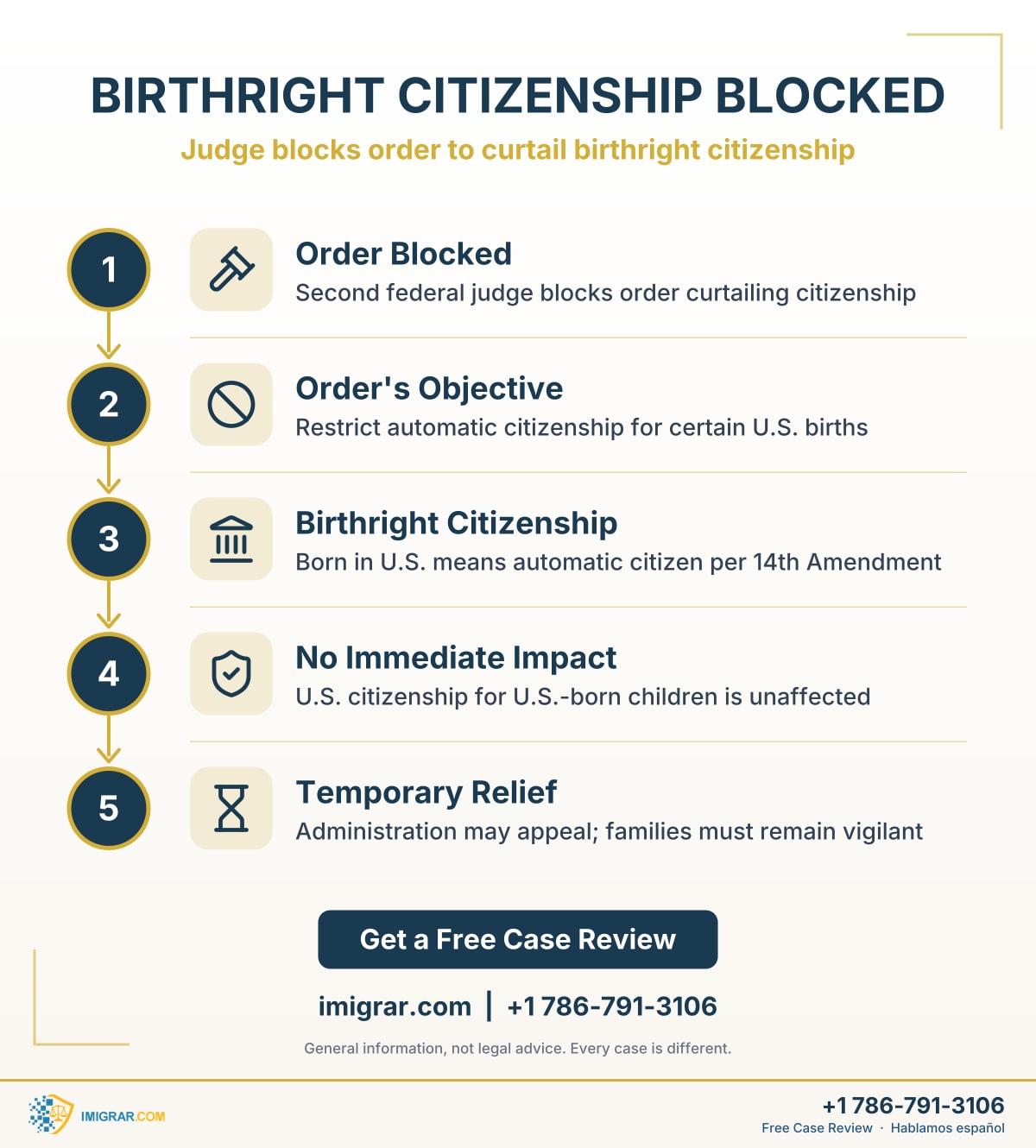
What This News Means for Immigrants in Orlando and Across Florida
The recent Reuters report, published on November 25, 2026, details a crucial development: a second federal judge has issued an injunction, effectively blocking President Donald Trump's latest executive order aimed at curtailing birthright citizenship. For countless families in Florida, this news is a beacon of temporary stability amidst ongoing legal challenges.
Why this news is showing up now
President Trump's administration has consistently expressed a desire to reinterpret or eliminate birthright citizenship, arguing that the 14th Amendment, which grants citizenship to those "subject to the jurisdiction" of the United States, was never intended to apply to children born to parents who are not legal residents. This stance has led to several executive actions and legal efforts throughout his presidency.
The order in question, issued by President Trump's administration, sought to direct federal agencies, including the USCIS official website and the U.S. Department of State, to implement new interpretations of the 14th Amendment that would restrict automatic citizenship for certain children born on U.S. soil. However, these executive actions have faced immediate legal challenges from various advocacy groups and states, leading to judicial intervention.
The fact that a second judge has now blocked this newest order underscores the strong legal opposition and the judicial branch's role in upholding constitutional interpretations. This isn't the first time such an order has been challenged or blocked, indicating a pattern of the administration pursuing its policy goals while courts act as a check on executive power. The timing reflects the ongoing legal battle and the determined efforts by both the administration and its opponents to shape the future of immigration law in the United States.
How it can affect Florida residents
For families residing in Florida, particularly those in diverse communities like Orlando, Kissimmee, and along the I-4 corridor, this news carries significant weight. Florida is home to a vast immigrant population, and many families include children born in the U.S. to non-citizen parents. The judicial block means that, for the time being, the current interpretation of birthright citizenship remains firmly in place. This provides a critical measure of relief and certainty:
- No Immediate Change to Citizenship Status: If your child was born in the U.S., including here in Florida, their U.S. citizenship is currently unaffected by President Trump's recent executive order. The court's ruling ensures the status quo.
- Continued Access to Documentation: You can continue to apply for and obtain official documents like U.S. birth certificates from the Florida Department of Health and U.S. passports from the Department of State for your U.S.-born children without new restrictions based on this specific order.
- Reduced Anxiety (for now): The block alleviates immediate concerns that your child’s citizenship might be retroactively questioned or that new bureaucratic hurdles would be erected for future births.
- Legal Precedent Reinforced: Each time such an order is blocked, it reinforces the long-standing legal precedent established by the Supreme Court in *United States v. Wong Kim Ark*.
However, it's crucial to understand that this is a temporary victory. The administration may appeal these rulings or pursue other legal avenues. Therefore, while there is no immediate adverse impact, families must remain vigilant and proactive in documenting their children's citizenship. For Central Florida residents, understanding the process for obtaining vital records and passports is more important than ever. Imigrar is dedicated to helping families in Orlando and nationwide navigate these complexities and "Keep Families Together."
What Birthright Citizenship Is (and Why It Matters)
At the heart of the recent legal challenges and public debate is the concept of Birthright Citizenship. It's a principle deeply embedded in American law and history, yet frequently misunderstood.
A plain-English definition
In the simplest terms, Birthright Citizenship means that any person born within the geographical boundaries of the United States (including its territories) is automatically a citizen of the United States, regardless of the immigration status of their parents. This principle is enshrined in the 14th Amendment of the U.S. Constitution.
The key phrase is "All persons born or naturalized in the United States, and subject to the jurisdiction thereof, are citizens of the United States and of the State wherein they reside." For over a century, the overwhelming legal interpretation, backed by Supreme Court precedent, has been that "subject to the jurisdiction thereof" includes nearly everyone born on U.S. soil, except for children of foreign diplomats or invading forces, who are not considered subject to U.S. law in the same way.
This means that if a child is born in an Orlando hospital, for example, they are a U.S. citizen from the moment of birth, even if their parents are undocumented, on a visa, or in any other immigration status.
Key terms you need to know
Understanding these terms will help you grasp the nuances of the current debate and the legal protections in place:
- Birthright Citizenship: The legal right to citizenship for those born within a country's territory. In the U.S., this is primarily based on the 14th Amendment.
- 14th Amendment: Ratified in 1868, this amendment to the U.S. Constitution has several sections, but Section 1 is the foundation of birthright citizenship. It was primarily enacted to grant citizenship to formerly enslaved people after the Civil War.
- "Subject to the jurisdiction thereof": This crucial phrase in the 14th Amendment is the subject of much debate. Courts have historically interpreted it to mean subject to U.S. law, which applies to nearly everyone within U.S. borders, including non-citizens. President Trump's administration seeks a narrower interpretation.
- Executive Order: A directive issued by the President of the United States that manages operations of the federal government. While it has the force of law, it can be challenged in court and cannot override the Constitution or existing statutes.
- Judicial Block / Injunction: A court order that prevents an individual or entity (in this case, the federal government) from performing a specified act. A preliminary injunction is temporary, while a permanent injunction is final. The recent block is likely a temporary injunction preventing the order from taking effect while the case proceeds.
- USCIS (U.S. Citizenship and Immigration Services): The federal agency responsible for administering the country's lawful immigration system, including processing naturalization applications and issuing Certificates of Citizenship.
- U.S. Department of State: The federal executive department responsible for foreign policy, including issuing U.S. passports, which serve as primary proof of U.S. citizenship.
- *United States v. Wong Kim Ark* (1898): A landmark Supreme Court case that affirmed the interpretation of the 14th Amendment, explicitly ruling that a child born in the United States to non-citizen parents who were permanent residents was a U.S. citizen. This case is the bedrock of current birthright citizenship law.
Understanding these terms illuminates the current legal battle: President Trump's administration is attempting to change a long-standing interpretation of the Constitution through executive action, which is then being challenged and halted by the judicial branch based on existing law and precedent. For you, as an immigrant in Florida, this means the current law, which includes birthright citizenship, remains in effect.
Current Immigration Law: The Foundation of Birthright Citizenship
Despite the ongoing legal challenges and attempts by President Trump's administration to alter its interpretation, the legal foundation of birthright citizenship remains unchanged. The current law, as interpreted by the Supreme Court for over a century, unequivocally grants U.S. citizenship to nearly all individuals born on U.S. soil.
Federal requirements
The bedrock of birthright citizenship is the 14th Amendment, Section 1 of the United States Constitution. It states: "All persons born or naturalized in the United States, and subject to the jurisdiction thereof, are citizens of the United States and of the State wherein they reside."
The crucial phrase "subject to the jurisdiction thereof" has been the subject of debate, but the prevailing legal interpretation, affirmed by the U.S. Supreme Court in the landmark 1898 case of *United States v. Wong Kim Ark*, establishes that this clause grants citizenship to virtually all individuals born within U.S. territory, regardless of their parents' nationality or immigration status. The only generally recognized exceptions are children born to foreign diplomats (who are not subject to U.S. law in the same way as other residents) or enemy forces during an occupation.
Therefore, under current federal law:
- Automatic Citizenship: A child born in any U.S. state or territory (including Puerto Rico, Guam, U.S. Virgin Islands, and the Northern Mariana Islands) is automatically a U.S. citizen at birth.
- Parental Status Irrelevant: The immigration status of the child's parents (whether they are U.S. citizens, green card holders, visa holders, or undocumented) does not prevent the child from acquiring U.S. citizenship.
- Proof of Citizenship: The primary documents used to prove birthright citizenship are an official U.S. birth certificate and a U.S. passport. In some cases, a Certificate of Citizenship (obtained through Form N-600, Application for Certificate of Citizenship, from USCIS official website) may be sought, particularly if a birth certificate is unavailable or if there are complex circumstances.
It is important to emphasize that while President Trump's administration has sought to challenge this interpretation, the federal courts have repeatedly blocked these efforts. This means the law, as currently enforced and interpreted, adheres to the established precedent.
Florida-specific considerations
While the right to birthright citizenship is a federal matter, the process of documenting that citizenship begins at the state level. For Florida residents, this involves the Florida Department of Health:
- Birth Registration in Florida: When a child is born in Florida, the hospital or birthing center facilitates the registration of the birth with the Florida Department of Health, Bureau of Vital Statistics. This process results in the issuance of an official Florida birth certificate. This document is the initial and most critical piece of evidence for a child born in the state.
- Obtaining a Florida Birth Certificate: Parents can obtain certified copies of their child's birth certificate from the Florida Department of Health. This process typically requires an application, valid identification for the parents, and a fee. For residents of Orange County and surrounding areas, this can be done through local vital statistics offices or by mail.
- Local USCIS Field Office (Indirect Relevance): While the Orlando USCIS Field Office does not process birthright citizenship applications (as it's automatic), it is the local point of contact for other immigration matters. If you were to apply for a Certificate of Citizenship for your U.S.-born child using Form N-600, any potential interview or document submission might occur at a local USCIS office. However, for most U.S.-born citizens, a birth certificate and passport are sufficient.
Important: There are no special "Florida-specific" requirements for a child to gain birthright citizenship beyond being born within the state's borders. The state's role is purely in the civil registration of the birth, which then serves as evidence for federal recognition of citizenship.
To access official forms and detailed instructions, always refer to the USCIS Forms page. For passport applications and requirements, the U.S. Department of State website is your authoritative source.
Need Clarity on Your Child's Citizenship Documentation? Amidst uncertain times, ensuring your child's U.S. citizenship is properly documented is vital. Imigrar offers expert legal assistance for families in Orlando and across Florida. Contact us at +1 786-791-3106 for a free consultation. Se Habla Español.
How to Secure and Document Your U.S.-Born Child's Citizenship: A Complete Step-by-Step Guide
Given the ongoing legal debates, it's more crucial than ever for parents of U.S.-born children to ensure their child's citizenship is properly secured and documented. This guide outlines the essential steps to take.
1) Register Your Child's Birth Immediately After Delivery
The very first step happens almost automatically when your child is born in a hospital or birthing center in the United States, including any facility in Orlando or Central Florida. Hospital staff are typically responsible for preparing the necessary paperwork to register the birth with the state's vital statistics office.
- Detailed Explanation: Ensure that all information provided to the hospital for the birth registration is accurate, especially the child's name, date of birth, place of birth, and parents' information. Any errors can cause significant delays and complications later on. Review the forms carefully before signing.
-
Required Documents (for hospital submission):
- Parents' valid government-issued identification (e.g., driver's license, passport).
- Parents' social security numbers (if applicable).
- Marriage certificate (if applicable, though not always required for birth registration).
- Hospital medical records for the birth.
2) Obtain the Official Florida Birth Certificate
Once the birth is registered, the state will issue an official birth certificate. This is the foundational document proving your child's U.S. citizenship by birth.
- Detailed Explanation: For children born in Florida, you will need to obtain a certified copy of the birth certificate from the Florida Department of Health, Bureau of Vital Statistics. You can usually request this online, by mail, or in person at a county health department office. There is typically a fee for certified copies. It's advisable to get several certified copies as you will need them for various applications.
-
Required Documents (for birth certificate application in Florida):
- Completed application form for a Florida Birth Certificate.
- Valid government-issued photo identification for the applicant (parent).
- Proof of relationship to the child (if not listed as a parent on the original birth record).
- Applicable fees.
3) Apply for Your Child's U.S. Passport
A U.S. passport is the most universally accepted and convenient proof of U.S. citizenship and identity for international travel. It is highly recommended to obtain one for your U.S.-born child as soon as possible.
- Detailed Explanation: You apply for a child's passport (under 16) by submitting Form DS-11, Application for a U.S. Passport, in person at a passport acceptance facility (many post offices, libraries, or county clerks serve as these, including several in the Orlando area). Both parents must generally appear with the child, or one parent must appear with the other parent's notarized consent.
-
Required Documents (for U.S. Passport):
- Completed, but unsigned, Form DS-11 (you will sign in front of an acceptance agent).
- Child's original certified U.S. Birth Certificate (will be mailed back to you).
- Proof of parental relationship (the birth certificate serves this purpose).
- Parents' valid government-issued identification (e.g., driver's license, passport).
- One passport-compliant photo of the child.
- Applicable fees (application and execution fees).
- If only one parent can appear, a notarized Form DS-3053 (Statement of Consent) from the non-appearing parent, along with a copy of their ID.
- Reference: Visit the U.S. Department of State website for the most current requirements.
4) Consider a Certificate of Citizenship (Optional, but Recommended for Certain Cases)
While a U.S. birth certificate and passport are generally sufficient, some parents opt for a Certificate of Citizenship, particularly if they anticipate future challenges or have complex immigration histories themselves. This document is issued by USCIS.
- Detailed Explanation: This involves filing Form N-600, Application for Certificate of Citizenship, with USCIS. This process is more involved and can take significantly longer than obtaining a passport. It provides an additional, strong federal document proving citizenship. While not strictly necessary for most U.S.-born children, it offers an extra layer of official recognition.
-
Required Documents (for Form N-600):
- Completed Form N-600 and applicable fees.
- Child's original certified U.S. Birth Certificate.
- Parents' marriage certificate (if applicable).
- Parents' immigration documents (e.g., green cards, visas, naturalization certificates).
- Passport-style photos of the child.
- Any other evidence requested by USCIS to prove birth in the U.S.
- Reference: Find Form N-600 and its instructions on the USCIS Forms page.
5) Maintain Meticulous Records
Once you have obtained these vital documents, the next crucial step is to safeguard them and ensure they are readily accessible.
- Detailed Explanation: Create a secure, waterproof, and fireproof location for all original documents (birth certificates, passports, social security cards). Make several certified copies and keep them in a separate, secure location. Consider digital backups, encrypted and password-protected. This proactive approach ensures you are prepared for any future needs or unexpected challenges.
-
Documents to Maintain:
- Original U.S. Birth Certificate.
- U.S. Passport.
- Social Security Card.
- Any medical records from birth.
- Parents' identification and immigration documents.
6) Understand Travel Implications for U.S. Citizen Children
If your U.S.-born child will travel internationally, it's important to understand the specific requirements for U.S. citizens.
- Detailed Explanation: All U.S. citizens, including infants and children, require a valid U.S. passport for international air travel. For land and sea travel to certain contiguous territories (like Canada and Mexico), other forms of documentation might be accepted, but a passport is always the safest and most recommended option. Be aware of any specific requirements for traveling with minors if only one parent is present.
-
Required Documents:
- Valid U.S. Passport for the child.
- Depending on destination, any required visas for the child.
- If traveling with only one parent, a notarized letter of consent from the absent parent might be needed.
7) Seek Legal Counsel if You Have Concerns
The current legal climate is dynamic. If you have any doubts, specific questions about your family's unique situation, or concerns about future challenges, consulting an experienced immigration attorney is invaluable.
- Detailed Explanation: An attorney can review your documents, provide personalized advice, help you navigate complex processes like the Form N-600 application, and keep you informed about ongoing legal developments. This is particularly important for families whose parental immigration status is complex or uncertain.
-
Documents to Bring to Consultation:
- Child's birth certificate.
- Child's passport (if available).
- Parents' identification and immigration documents.
- Any correspondence from government agencies regarding citizenship or immigration.
Practical Steps You Can Take Today to Protect Your Child's Future
In light of the continued legal challenges to birthright citizenship, proactive measures are essential. Here’s an actionable checklist for families in Orlando, Central Florida, and beyond:
- Verify and Correct All Birth Documents: Double-check your child's birth certificate for any errors in names, dates, or other information. If you find discrepancies, initiate the correction process with the Florida Department of Health immediately. Accuracy is Important: for all future applications.
- Apply for a U.S. Passport Promptly: If your U.S.-born child does not yet have a U.S. passport, make this a priority. As noted, the passport is the most robust and widely accepted proof of U.S. citizenship. Don't delay; processing times can vary, especially around peak travel seasons. Check USCIS Processing Times for general government timelines, though passport processing is handled by the Department of State.
- Consult an Immigration Attorney: This is a critical step, especially if you have a complex family situation, concerns about your own immigration status, or simply want peace of mind. An attorney can explain the nuances of the law and help you prepare for any potential future changes. For Central Florida residents, Imigrar is ready to assist.
- Stay Informed Through Official Channels: Avoid relying solely on social media or unofficial news sources. Bookmark official government websites like USCIS official website and U.S. Department of State, and consult with legal professionals for accurate, up-to-date information.
- Educate Yourself on Parental Rights: Understand your rights and responsibilities as parents, particularly concerning your U.S. citizen child. This includes knowing what documents your child needs for school, medical care, and travel.
- Create a Secure Document Storage System: Gather all original vital documents (birth certificates, passports, social security cards) in a secure, fireproof, and waterproof location. Make physical and digital copies, stored separately and securely. This foresight can save immense stress in the future.
-
Understand Timeline Expectations:
- Florida Birth Certificate: Typically available within a few weeks after birth registration.
- U.S. Passport: Standard processing can take 6-8 weeks, but expedited services are available for an extra fee (e.g., 2-3 weeks). Plan ahead, especially if international travel is anticipated.
- Form N-600 (Certificate of Citizenship): This process can be lengthy, often taking several months to over a year, depending on the USCIS service center workload and individual case complexity.
How Imigrar Helps Immigrants in Orlando and Beyond
At Imigrar, our mission is clear: "Keep Families Together." We understand the unique challenges and anxieties that immigrant families face, especially when fundamental rights like birthright citizenship are debated and challenged. Located in Orlando, Florida, we proudly serve clients not only across Central Florida – including Orange, Osceola, Seminole, and Volusia counties – but also nationwide.
Our experience and expertise
Our team of dedicated immigration attorneys possesses extensive experience in navigating the intricate and often shifting landscape of U.S. immigration law. We specialize in a broad range of services, including:
- Family-Based Immigration: Assisting U.S. citizens and lawful permanent residents in petitioning for their family members, ensuring loved ones can unite or remain together.
- Citizenship and Naturalization: Guiding eligible individuals through the complex process of becoming U.S. citizens, including applications for Certificates of Citizenship (Form N-600) for those who acquired citizenship at birth or through their parents.
- Visa Applications: Helping clients with various non-immigrant and immigrant visa categories.
- Deportation Defense: Providing robust legal representation for individuals facing removal proceedings.
- Adjustment of Status: Assisting those eligible to obtain permanent residency while remaining in the United States.
We stay abreast of all legal developments, including executive orders, judicial injunctions, and policy changes from President Trump's administration, to provide the most current and accurate advice. Our expertise means we can clearly explain what the news means for you, how current laws apply, and the most effective strategies to protect your family's future.
Free consultation offer
We believe that access to legal advice should not be a barrier. That's why Imigrar offers a free, no-obligation consultation. During this consultation, you can discuss your specific situation, ask questions about birthright citizenship, understand the implications of recent legal news, and explore your options with an experienced attorney.
Whether you're in Orlando, Miami, Tampa, or anywhere else in the U.S., our team is ready to listen and provide personalized guidance. We are committed to making the legal process as transparent and stress-free as possible for our clients.
Se Habla Español: Our team is fully bilingual, ensuring that Spanish-speaking clients receive comprehensive legal advice and support in their native language, fostering clear communication and understanding.
Your Family's Future Deserves Expert Protection. Don't leave your child's citizenship to chance. Imigrar is your trusted partner in navigating U.S. immigration law. Call us today at +1 786-791-3106 for your free consultation. We are here to help "Keep Families Together." Se Habla Español.
Frequently Asked Questions About Birthright Citizenship and Current Challenges
Q: Does President Trump's order mean my child born in the U.S. is not a citizen?
A: No, absolutely not. The Reuters report explicitly states that President Trump's newest order curtailing birthright citizenship has been blocked by a second federal judge. This means the order is currently not in effect. As per the 14th Amendment and over a century of legal precedent (including *United States v. Wong Kim Ark*), a child born on U.S. soil is a U.S. citizen, regardless of their parents' immigration status, unless the parents are foreign diplomats. For now, the law stands as it has for decades, ensuring your U.S.-born child's citizenship is secure.
Q: What is the significance of the second judge blocking the order?
A: The significance is twofold. First, it reinforces the existing legal interpretation of the 14th Amendment and the principle of Birthright Citizenship. Courts are consistently upholding the established law against executive challenges. Second, it provides a crucial injunction, preventing the administration's policy from taking effect, thereby offering continued stability and clarity for families. Each judicial block signals a strong legal defense of this constitutional right, though the administration may continue to appeal or pursue other avenues.
Q: My child was born in Orlando; how does this news affect their citizenship?
A: For your child born in Orlando or anywhere else in Florida, their U.S. citizenship is currently secure and unaffected by this executive order. The judicial block ensures that the legal status quo remains. You should continue to ensure you have all necessary documentation, such as their official Florida birth certificate and a U.S. passport. The legal challenges primarily highlight the importance of being proactive in documenting your child's citizenship rather than indicating an immediate change to their status.
Q: What documents do I need to prove my U.S.-born child's citizenship?
A: The primary and most important documents to prove your U.S.-born child's citizenship are their official U.S. Birth Certificate (issued by the state where they were born, such as the Florida Department of Health) and a U.S. Passport. A passport is especially useful for travel and is widely accepted. For additional peace of mind or in complex situations, you can also apply for a Certificate of Citizenship from USCIS by filing Form N-600. Always keep original documents safe and have certified copies readily available.
Q: What are the potential future challenges to birthright citizenship?
A: While the current order is blocked, the issue is far from settled. President Trump's administration may continue to pursue legal appeals, issue new executive orders with different language, or seek legislative changes from Congress. The ultimate goal of some is to bring a case before the Supreme Court to reinterpret the 14th Amendment. This means the debate and legal challenges are likely to persist, making it essential for families to stay informed and seek legal counsel.
Q: Should I be worried about my child's current U.S. passport being revoked?
A: It is highly unlikely that a U.S. passport issued to a child born in the U.S. would be revoked under the current legal framework. A U.S. passport is valid proof of citizenship. Any attempt to retroactively revoke citizenship for U.S.-born individuals would face immense legal and constitutional hurdles far beyond the scope of the executive order currently being challenged. The judicial blocks reinforce the stability of current law. Continue to travel with your child's valid U.S. passport as usual.
Q: Does my own immigration status affect my U.S.-born child's citizenship?
A: No, generally, your immigration status does not affect your U.S.-born child's citizenship. As long as your child was born on U.S. soil and you are not a foreign diplomat, your child is a U.S. citizen by birth, regardless of whether you are a green card holder, on a visa, or undocumented. This is a core tenet of Birthright Citizenship under the 14th Amendment.
Q: What happens if the administration eventually succeeds in curtailing birthright citizenship?
A: If, hypothetically, the administration's efforts to curtail birthright citizenship were to ultimately succeed (either through a Supreme Court ruling or a constitutional amendment), it would represent a monumental shift in U.S. law. However, such a change would likely apply prospectively, meaning it would affect children born *after* the change, not retroactively strip citizenship from those already born and documented as U.S. citizens. The legal process for such a change would be lengthy and face significant opposition. For now, the legal blocks ensure current law prevails.
Common Mistakes (and How to Avoid Them)
Navigating immigration law, especially during periods of intense debate and executive actions, can be confusing. Here are some common mistakes parents make and how to avoid them to protect your U.S.-born child's citizenship.
Mistake #1: Delaying Documentation
Many parents, especially those who feel their child's citizenship is self-evident, might delay obtaining crucial documents like a birth certificate or a U.S. passport. This delay can lead to significant problems down the line.
- Why it's a mistake: The longer you wait, the more difficult it can become to gather necessary supporting documents or resolve any discrepancies. In times of legal uncertainty, having undisputed, official proof of citizenship is paramount. Delays can also impact school enrollment, travel, and access to other rights and benefits.
- How to avoid it: Prioritize obtaining your child's official birth certificate from the Florida Department of Health immediately after birth. Follow up by applying for their U.S. passport as soon as possible. These two documents are the strongest proofs of Birthright Citizenship.
Mistake #2: Relying on Unofficial Information and Rumors
In the age of social media, misinformation spreads rapidly. News about executive orders, court blocks, and policy debates can be easily misinterpreted or sensationalized, leading to unnecessary panic or, conversely, a false sense of security.
- Why it's a mistake: Believing rumors or unverified information can lead to poor decisions, missed deadlines, or heightened anxiety. Relying on anecdotes or social media advice is dangerous when dealing with legal matters as critical as citizenship.
- How to avoid it: Always refer to official government websites (like USCIS official website and U.S. Department of State) for forms and policy updates. More importantly, consult with a qualified immigration attorney, like those at Imigrar, who can provide accurate, up-to-date legal advice tailored to your specific situation.
Mistake #3: Assuming the Law Has Already Changed
News headlines about President Trump's administration's attempts to curtail Birthright Citizenship can be alarming. It's a common mistake to assume that a proposed change or an executive order automatically alters current law, even if it's been judicially blocked.
- Why it's a mistake: Misinterpreting a judicial block as a permanent change can lead to inaction or incorrect assumptions about your child's status. For example, some might mistakenly believe their U.S.-born child is no longer a citizen, causing undue stress or leading them to forgo applying for a passport.
- How to avoid it: Understand the difference between a proposed policy, an executive order, and an actual change in the law. A judicial block means the executive order is *not in effect*. The 14th Amendment, as interpreted by the Supreme Court, remains the law of the land. Imigrar is committed to clarifying these distinctions for our clients in Orlando and beyond.
Mistake #4: Not Consulting an Immigration Attorney
Many families try to navigate the complex immigration system on their own, often to save money or because they believe their case is straightforward. However, an attorney's expertise is invaluable, especially during periods of legal uncertainty.
- Why it's a mistake: Immigration law is incredibly complex and constantly changing. Mistakes on forms, missed deadlines, or a lack of understanding of nuanced legal arguments can have severe, long-lasting consequences. An attorney can spot potential issues, provide strategic advice, and represent your interests effectively.
- How to avoid it: Reach out to an experienced immigration law firm like Imigrar. Our free consultation can help you understand your situation and determine if legal representation is right for you. Even a simple review of your documents by an expert can provide significant peace of mind.
Don't Make a Costly Mistake. Protect your family and your child's future by getting expert legal advice. The team at Imigrar is here to guide you through every step. Call +1 786-791-3106 for a free, confidential consultation. Se Habla Español.
The recent news of a second judicial block on President Trump's order to curtail birthright citizenship offers a moment of crucial stability for immigrant families across Florida and the nation. It reinforces that the 14th Amendment and its long-standing interpretation remain the law of the land. However, this ongoing legal battle also serves as a powerful reminder of the importance of vigilance, accurate information, and proactive documentation.
At Imigrar, we understand the anxieties these headlines can cause. Our dedicated team in Orlando, Florida, is committed to providing expert legal counsel, ensuring your family understands its rights, and helping you navigate the complexities of U.S. immigration law. We are here to help you secure your U.S.-born child's future and "Keep Families Together."
Ready to secure your family's future with confidence? Don't wait for the next headline. Contact Imigrar today for a free consultation. Our compassionate and knowledgeable attorneys are ready to provide the clarity and support you need. Call us now at +1 786-791-3106 or visit our website to schedule your appointment. Se Habla Español.
Related Topics
Need Legal Assistance?
Our experienced immigration attorneys are here to help with your case. Contact Imigrar today for a free consultation and let us guide you through the legal process with confidence.
📍 Orlando, Florida • Serving clients nationwide
📧 info@imigrar.com