
Green Card Alert: Revised PERM Form & What It Means for Indian Workers & H-1B in 2026
The Department of Labor's revised PERM Form ETA-9089 signals tougher green card paths for Indian H-1B and F-1 OPT workers. Learn how these changes affect you.

The reporting that sparked this guide:
What This News Means for Immigrants in Orlando and Across Florida
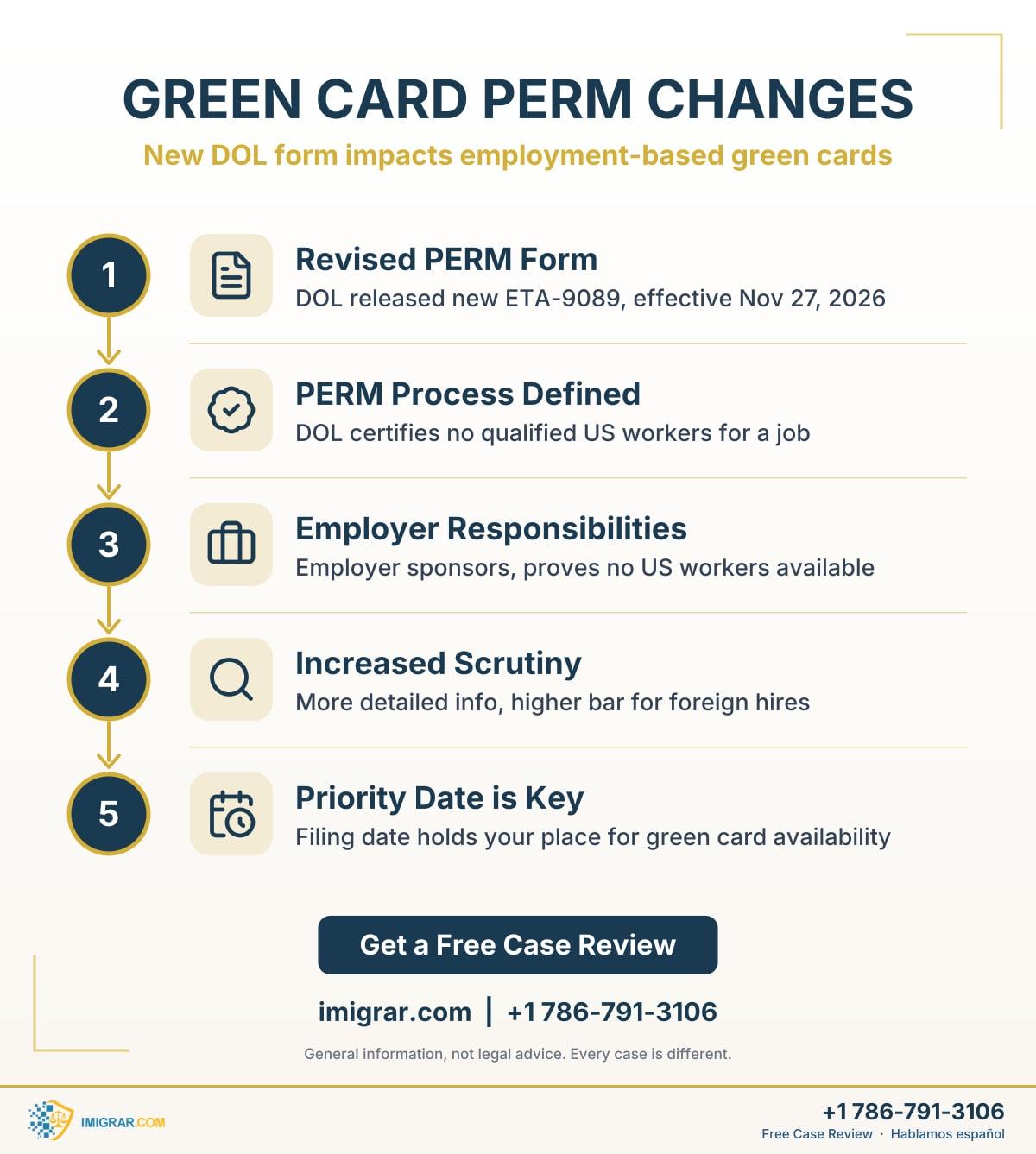
The landscape of U.S. immigration is constantly evolving, and for skilled foreign workers, particularly those from India on H-1B and F-1 OPT visas, staying informed is not just beneficial—it's essential for their future. The recent release of a revised PERM Form ETA-9089 by the U.S. Department of Labor (DOL), as reported by The Times of India, marks a significant development that could make the green card process more challenging. As of November 27, 2026, these changes are current and impactful.
Why this news is showing up now
The **Trump administration** has consistently prioritized policies aimed at strengthening the U.S. workforce and ensuring that American jobs are protected. The **Department of Labor’s** decision to release a revised **PERM Form ETA-9089** is a direct reflection of this ongoing commitment. This revision is not just a minor update; it's a precursor to a more comprehensive overhaul of the PERM program, signaling increased scrutiny and potentially more stringent requirements for employers seeking to sponsor foreign workers for **green cards**. The administration's focus on "Buy American, Hire American" principles means that every step of the employment-based **green card** process is being examined for ways to enhance labor market protections for U.S. workers. This revised form is the **DOL's** initial step in that direction, requiring employers to provide more detailed information and attestations, ultimately aiming to make it harder to justify hiring a foreign national over a qualified U.S. worker. For those currently on **F-1 OPT** or **H-1B** visas, understanding these shifts is paramount to navigating their path to permanent residency.How it can affect Florida residents
Florida, especially booming regions like Orlando, has a vibrant and diverse economy that significantly benefits from skilled foreign talent. Our state's tech sector, burgeoning healthcare industry, and robust tourism and hospitality enterprises often rely on professionals who initially arrive on **F-1 OPT** or **H-1B** visas. For these individuals, and the Florida-based companies that employ them, a tougher **PERM** process means direct challenges. Employers in cities like Orlando, Tampa, and Miami, who frequently sponsor **H-1B** workers, will face increased administrative burdens, potentially longer processing times, and a higher bar for proving that no qualified U.S. workers are available. This could impact not only the ability of foreign nationals to secure **green cards** but also the growth and innovation of local businesses that depend on their expertise. For Central Florida residents, particularly those working along the **I-4 corridor** in tech or medical fields, these changes necessitate a proactive approach to their immigration strategy.Need Help? Our Orlando immigration team is ready to assist. Call +1 786-791-3106 for a free consultation, or message us online. Se Habla Español.
What PERM Is (and Why It Matters)
For many foreign nationals seeking permanent residency in the U.S. through employment, the Program Electronic Review Management (PERM) process is the critical first hurdle. It’s often misunderstood, but its importance cannot be overstated as it forms the bedrock of many employment-based green card applications.
A plain-English definition
Simply put, **PERM** is the process by which the **U.S. Department of Labor (DOL)** certifies that a U.S. employer has tested the U.S. labor market and found no qualified, willing, and available U.S. workers for a specific job opening. This certification is a mandatory prerequisite for most employment-based **green card** categories, primarily **EB-2** (for professionals with advanced degrees or exceptional ability) and **EB-3** (for skilled workers, professionals, or other workers). The employer, not the foreign worker, initiates and sponsors this process. The core idea behind **PERM** is to protect the U.S. labor market by ensuring that foreign workers are not taking jobs away from qualified Americans. Without a certified **PERM** application, an employer typically cannot proceed with sponsoring a foreign national for a **green card** in these categories. This makes the **PERM** process, and now its revised form, particularly significant for **H-1B** and **F-1 OPT** graduates who aspire to transition from temporary work visas to permanent resident status.Key terms you need to know
Navigating the **PERM** process requires understanding specific terminology. Here are the crucial terms:- PERM (Program Electronic Review Management): The electronic system and process used by the DOL to certify that there are no qualified U.S. workers for a position. This is the first step for many employment-based green cards.
- Form ETA-9089: This is the official application form for PERM labor certification filed by the employer with the DOL. The recent revisions directly impact this form.
- Employer Sponsorship: In most employment-based green card cases, the U.S. employer must sponsor the foreign national. They initiate the PERM process and commit to hiring the foreign worker permanently.
- Prevailing Wage: This is the minimum wage that the DOL determines must be paid to the foreign worker to ensure that U.S. workers are not adversely affected. Employers must obtain a Prevailing Wage Determination (PWD) before recruitment.
- Labor Market Test: The set of mandatory recruitment steps an employer must undertake to demonstrate that there are no qualified U.S. workers for the position. This includes advertising the job in various forums.
- Priority Date: This is the date the PERM application (Form ETA-9089) is filed with the DOL. It essentially holds your place in line for green card availability, which is particularly important for countries like India that face significant visa backlogs.
- Employment-Based Green Card (EB-2/EB-3): These are categories of green cards for skilled foreign workers. EB-2 is for professionals with advanced degrees or exceptional ability, while EB-3 is for skilled workers, professionals, and other workers. Most Indian professionals pursuing green cards fall into these categories.
- F-1 OPT (Optional Practical Training): A temporary employment authorization for F-1 student visa holders to gain practical experience directly related to their major area of study. Many transition from F-1 OPT to H-1B and then pursue green cards.
- H-1B Visa: A non-immigrant visa that allows U.S. employers to temporarily employ foreign workers in specialty occupations. This is a common stepping stone for foreign professionals, especially from India, before pursuing a green card.
- Adjustment of Status (AOS): The process of applying for a green card while remaining in the United States. This involves filing Form I-485 with USCIS.
Current Immigration Law: The Foundation of Employment-Based Green Cards
The framework for employment-based immigration in the United States is established by the Immigration and Nationality Act (INA), a complex body of law that dictates who can enter and remain in the country. The Trump administration continues to shape the interpretation and enforcement of these laws, with a clear emphasis on securing U.S. jobs and applying stricter scrutiny to all immigration processes. This policy stance directly influences agencies like the Department of Labor (DOL) and U.S. Citizenship and Immigration Services (USCIS), leading to revisions like the new PERM Form ETA-9089. Understanding the foundational laws is crucial for anyone navigating the green card process today.
Federal requirements
The primary federal statute governing labor certification, and thus the **PERM** process, is **INA §212(a)(5)(A)**. This section mandates that certain immigrants seeking to enter the U.S. for the purpose of performing skilled or unskilled labor must first obtain a labor certification from the **Secretary of Labor**. The certification attests that: 1. There are not sufficient U.S. workers who are able, willing, qualified, and available at the place to which the alien is destined to perform the skilled or unskilled labor. 2. The employment of such alien will not adversely affect the wages and working conditions of U.S. workers similarly employed.These statutory requirements are implemented through detailed regulations found in 20 CFR Part 656, which specifically govern the PERM program. Key federal requirements for employers include:
- Legitimate Job Offer: The employer must have a genuine, full-time, permanent job offer for the foreign national.
- Prevailing Wage: The employer must commit to paying at least the prevailing wage for the occupation in the area of intended employment, as determined by the DOL.
- Recruitment Efforts: The employer must conduct specific recruitment activities (the Labor Market Test) to demonstrate that no qualified U.S. workers are available for the position. This is where the revised Form ETA-9089 will likely introduce new questions and require more detailed attestations about the recruitment process.
- Foreign National's Qualifications: The foreign national must meet the minimum job requirements as advertised during recruitment, without the employer having tailored the requirements specifically to the foreign national's background.
The federal agencies involved are the DOL (for PERM certification) and USCIS (for immigrant petitions and Adjustment of Status). Key USCIS forms you'll encounter include:
- Form I-140, Immigrant Petition for Alien Worker: Filed by the employer after the PERM certification is approved, proving the employer's ability to pay the offered wage and the employee's qualifications.
- Form I-485, Application to Register Permanent Residence or Adjust Status: Filed by the foreign national (and their dependents) to apply for a green card if they are already in the U.S.
- For detailed information on forms and policies, always refer to the USCIS official website.
Florida-specific considerations
While immigration law is federal, its impact is keenly felt at the state level. Florida's dynamic economy, particularly in sectors like technology, advanced manufacturing, and healthcare, relies heavily on a skilled workforce, often comprising foreign nationals on **H-1B** and **F-1 OPT** visas. The **Trump administration's** current emphasis on "Hire American" policies means that Florida employers sponsoring **green cards** must be even more meticulous in their **PERM** applications.For residents of Orlando and Central Florida, the local USCIS Field Office in Orlando plays a crucial role for those undergoing Adjustment of Status. While the PERM process is handled by the DOL federally, any subsequent Form I-485 filings and interviews for Central Florida residents will be processed through this local office. This means understanding local processing times and requirements can be beneficial. Florida employers must ensure their recruitment practices for PERM comply with both federal DOL regulations and potentially state-specific advertising norms, though the federal rules are paramount. The revised PERM form will directly impact how Orlando-based companies recruit and document their efforts to hire U.S. workers before sponsoring foreign talent.
How to Navigate the Revised PERM Process: A Complete Step-by-Step Guide
The PERM process is intricate, requiring precision and adherence to strict regulations. With the Department of Labor’s revised Form ETA-9089, it’s more critical than ever to understand each step. This guide outlines the typical journey for an employer sponsoring a foreign worker, such as an H-1B or F-1 OPT graduate, for a green card.
1) Employer Initiates the Process and Defines Job Requirements
The journey begins when a U.S. employer identifies a need for a permanent employee and determines that a foreign national is the best fit, often after they have been working for the company on an **H-1B** or **F-1 OPT** visa. This initial stage is crucial for laying a solid foundation for the entire **green card** process.- Identify the Job: The employer must define the specific job duties, responsibilities, and the minimum education, experience, and special requirements for the position. These requirements must be genuine business necessities and typical for the occupation.
- Documentation: Gather detailed job descriptions, organizational charts, and any previous job postings for similar roles. This helps demonstrate the legitimacy of the requirements.
- Warning: The job requirements cannot be tailored to the foreign worker's specific qualifications if those qualifications exceed what is normally required for the job, as this could lead to a PERM denial. This is an area the Trump administration's DOL is likely to scrutinize more closely with the revised form.
2) Obtaining a Prevailing Wage Determination (PWD)
Before any recruitment efforts can begin, the employer must request a **Prevailing Wage Determination (PWD)** from the **DOL’s** National Processing Center. This step ensures that the foreign worker will be paid at least the prevailing wage for that occupation in the specific geographic area (e.g., Orlando, FL).- File Form ETA-9141: The employer files Form ETA-9141, Application for Prevailing Wage Determination, with the DOL. This form includes a detailed description of the job duties, minimum requirements, and the geographic area of employment.
- Timeline: Obtaining a PWD can take several months, so it’s important to initiate this step early.
- Documents: Form ETA-9141, a comprehensive job description, and any supporting documentation for unusual job requirements.
3) Conducting Required Recruitment Efforts
This is often the most complex and time-sensitive part of the **PERM** process. The employer must conduct specific recruitment activities to test the U.S. labor market and demonstrate that no qualified U.S. workers are available for the position. These efforts must occur within a specific window—no more than 180 days and no less than 30 days before filing **Form ETA-9089**.- Mandatory Advertisements:
- State Workforce Agency (SWA) Job Order: A job order must be placed with the SWA (e.g., Florida Department of Economic Opportunity) for 30 days.
- Newspaper Advertisements: Two advertisements must be placed on two different Sundays in a newspaper of general circulation in the area of intended employment. For positions requiring a master's or Ph.D. degree, a professional journal may be substituted for one Sunday newspaper advertisement.
- Additional Recruitment Steps (Professional Occupations): For professional occupations, the employer must choose at least three additional recruitment steps from a list of ten, including:
- Employer's website
- Job search websites (e.g., LinkedIn, Indeed)
- On-campus recruiting
- Trade or professional organizations
- Private employment firms
- Employee referral program
- Campus placement offices
- Local and ethnic newspapers
- Radio and television advertisements
- Review of Applicants: The employer must review all resumes received as a result of the recruitment and interview any seemingly qualified U.S. applicants.
- Important: All U.S. applicants must be rejected only for lawful, job-related reasons.
- Documents: Copies of all advertisements, recruitment reports detailing dates and media, all resumes received, interview notes, and a written explanation for why each U.S. applicant was not qualified.
Need Help? Our Orlando immigration team is ready to assist. Call +1 786-791-3106 for a free consultation, or message us online. Se Habla Español.
4) Filing the Revised PERM Form ETA-9089
Once all recruitment efforts are completed and documented, and no qualified U.S. workers were found, the employer can file **Form ETA-9089**, Application for Permanent Employment Certification, electronically with the **DOL**. This is where the impact of the *revised* form will be most evident.- Accuracy is Paramount: The revised form is expected to include new questions and require more detailed attestations from the employer. It is crucial that all information is accurate and consistent with the PWD and recruitment efforts. Any discrepancies can lead to an audit or denial.
- Establish Priority Date: The date the Form ETA-9089 is filed electronically becomes the foreign national's Priority Date, which is critical for visa quota purposes, especially for Indian nationals facing backlogs.
- Documents: All recruitment evidence (as mentioned in Step 3), the certified PWD, the employer's Federal Employer Identification Number (FEIN), and basic information about the foreign national (passport, visa history, educational degrees, transcripts, experience letters).
5) PERM Certification and Filing Form I-140
If the **DOL** approves the **PERM** application, they will issue a certification. This allows the employer to move forward with the immigrant petition.- PERM Certification: The DOL will send an electronic certification for Form ETA-9089.
- File Form I-140: Within 180 days of the PERM certification, the employer must file Form I-140, Immigrant Petition for Alien Worker, with USCIS. This petition establishes that the employer has the financial ability to pay the offered wage and that the foreign national meets the job requirements.
- Premium Processing: For an additional fee, Form I-140 can be processed under premium processing, guaranteeing a decision within 15 calendar days. This can significantly speed up the process.
- Documents: The certified Form ETA-9089, employer's financial statements (e.g., annual reports, tax returns) to prove ability to pay, the foreign national's academic credentials, and letters verifying work experience. All documents must be consistent with the PERM application.
- External Link: For more on USCIS forms, visit USCIS Forms.
6) Adjustment of Status (Form I-485) or Consular Processing
The final step is for the foreign national (and their eligible dependents) to apply for the actual **green card**. This can be done either through **Adjustment of Status (AOS)** if they are in the U.S. or through Consular Processing if they are outside the U.S. or prefer to apply abroad. This step can only proceed when the foreign national's **Priority Date** is current according to the monthly **Visa Bulletin** published by the U.S. Department of State.- Adjustment of Status (AOS): If the foreign national is physically present in the U.S. and their Priority Date is current, they can file Form I-485, Application to Register Permanent Residence or Adjust Status, with USCIS. Concurrent filing of Form I-485 with Form I-140 is possible if the Priority Date is current at the time of Form I-140 filing.
- Documents for Form I-485: Form I-485, Form I-765 (Application for Employment Authorization Document - EAD), Form I-131 (Application for Travel Document - Advance Parole), Form I-693 (Report of Medical Examination and Vaccination Record), birth certificate, passport copies, photos, marriage certificate (if applicable), police clearances, and evidence of lawful status in the U.S.
- Interview: For residents of Central Florida, an interview at the Orlando USCIS Field Office may be required.
- Consular Processing: If the foreign national is outside the U.S. or chooses to apply through a U.S. consulate or embassy abroad, they will undergo consular processing.
- Process: Once the Priority Date is current and Form I-140 is approved, the National Visa Center (NVC) will contact the applicant to collect required documents and schedule an interview at the designated U.S. consulate.
- Documents: Similar to AOS, but submitted to the NVC and presented at the consulate.
Practical Steps You Can Take Today to Prepare
The revised PERM form is here, and a larger overhaul is anticipated. For H-1B and F-1 OPT graduates, especially those from India, proactive preparation is the best defense against potential delays and increased scrutiny. Here’s an actionable checklist to help you get ready.
Actionable Checklist:
- Review Your Qualifications: Carefully compare your educational background, work experience, and skills against the job description your employer intends to use for your PERM application. Ensure they align perfectly. Any discrepancies could raise red flags with the DOL.
- Gather Essential Documents: Start collecting all vital personal and professional documents immediately. This includes original birth certificates, marriage certificates (if applicable), academic transcripts and diplomas (with certified translations if not in English), detailed experience letters from all previous employers, copies of all past visa approvals (I-797s), I-20s (for F-1 OPT), and passport copies. Organize them both digitally and physically.
- Communicate with Your Employer: Initiate a conversation with your employer and their HR/legal team. Understand their strategy for navigating the revised PERM process and their timeline. Ensure they are aware of the new requirements and are working with experienced legal counsel.
- Consult an Experienced Immigration Attorney: This is perhaps the most crucial step. The complexity of the PERM process, especially with new regulations under the Trump administration, demands expert legal guidance. An attorney can help identify potential issues, ensure compliance, and strategically prepare your case.
- Stay Informed on Policy Updates: Regularly monitor official updates from the DOL and USCIS. Pay close attention to the monthly Visa Bulletin for changes in Priority Dates, as delays can be significant for Indian nationals.
- Maintain Lawful Non-Immigrant Status: Ensure your current visa status (H-1B, F-1 OPT) remains valid throughout the entire PERM and green card process. Do not let your status lapse. Work with your employer and attorney to file extensions well in advance.
- Understand the Prevailing Wage: Familiarize yourself with how Prevailing Wage Determinations are made and ensure the proposed salary aligns with DOL standards for your occupation and geographic location (e.g., Orlando).
Document Preparation Guidance:
- Organization: Create a master checklist of all required documents. Keep original documents secure and provide copies for applications. Use digital folders for easy access and backup.
- Translations: Any document not in English must be accompanied by a certified English translation. This means a translator attests in writing that they are competent to translate and that the translation is accurate.
- Experience Letters: These are critical. They should be on company letterhead, signed by an authorized person, clearly state your job title, duties, dates of employment, and salary. Generic letters are insufficient.
- Consistency: Ensure all your documents (resumes, academic records, experience letters) are consistent regarding dates, job titles, and duties. Inconsistencies can lead to audits or denials.
Timeline Expectations:
- PERM Process (DOL): This phase alone, including PWD and recruitment, can take anywhere from 1 to 2 years, largely due to DOL processing times and potential audits.
- Form I-140 Processing (USCIS): Typically several months, but premium processing can reduce this to 15 calendar days.
- Form I-485 / Consular Processing (USCIS/DOS): This is the most variable stage. For Indian nationals, due to country-specific quotas and backlogs, it can take many years for your Priority Date to become current, even after Form I-140 approval. Check USCIS Processing Times and the Visa Bulletin regularly.
- Warning: The revised PERM form, and any subsequent overhaul, could introduce new complexities or increased scrutiny, potentially lengthening these timelines further. Start early and be patient.
How Imigrar Helps Immigrants in Orlando Navigate Complex PERM Changes
At Imigrar, we understand that the prospect of a tougher green card process, particularly with the revised PERM Form ETA-9089, can be daunting for skilled foreign workers and their employers. Our mission, "Keep Families Together," extends to ensuring that deserving professionals can achieve their American dream of permanent residency.
Based in Orlando, Florida, our firm specializes in employment-based immigration, providing comprehensive support to H-1B and F-1 OPT graduates, as well as the businesses that employ them, not just in Central Florida but nationwide. We bring extensive experience and expertise to navigating the intricate world of PERM labor certification and subsequent green card applications.
Our Experience and Expertise:
- Up-to-Date Knowledge: We stay abreast of all the latest changes from the Department of Labor and USCIS, including the nuances introduced by the revised PERM form and the Trump administration's evolving immigration policies.
- Strategic Guidance: We work closely with employers to develop robust PERM strategies, ensuring job requirements are defensible, recruitment efforts comply with all regulations, and the Prevailing Wage Determination is accurately obtained.
- Meticulous Preparation: Our team meticulously prepares all necessary documentation, from the initial Form ETA-9089 to Form I-140 and Form I-485, minimizing the risk of audits or requests for evidence.
- Audit Response Expertise: Should an audit occur, we have the experience to respond effectively and efficiently, protecting your application.
- Local Insight: For clients in Orlando and surrounding areas, we offer specific insights into local USCIS procedures and any regional considerations that may impact your case.
We offer a free consultation to discuss your specific situation, evaluate your eligibility, and outline a clear path forward. Don't let the complexity of the revised PERM process deter you. Our dedicated team is here to provide clarity, support, and peace of mind.
Se Habla Español.
Frequently Asked Questions About the Revised PERM Process
Navigating the PERM process can raise many questions, especially with new forms and potential policy shifts. Here are answers to some of the most common concerns.
Q: Will the revised PERM form affect my existing H-1B or F-1 OPT status?
A: The revised **PERM** form directly pertains to your application for permanent residency (a **green card**), not your temporary non-immigrant status like **H-1B** or **F-1 OPT**. Your ability to maintain your current status is governed by separate regulations. However, if the **PERM** process becomes significantly tougher or slower due to the revised form, it could indirectly impact your long-term immigration strategy, especially if you are nearing the maximum allowable period for your temporary visa. It's crucial to ensure your **H-1B** or **F-1 OPT** status remains valid throughout the entire **green card** journey. Our Orlando immigration lawyers can help you strategize to maintain your lawful status.
Q: What are the key changes in the revised Form ETA-9089?
A: While specific detailed instructions accompanying the revised **Form ETA-9089** are still being fully analyzed by the legal community, the **Trump administration's** **Department of Labor** has indicated a move towards greater transparency and more stringent requirements. We anticipate new questions focusing on more detailed employer attestations regarding job requirements, recruitment efforts, and the justification for hiring a foreign worker over a U.S. worker. This aims to strengthen the **labor market test** and ensure that U.S. workers are genuinely unavailable. Employers will likely need to provide more explicit documentation and explanations, making the application process more rigorous. Staying updated with our firm and official **DOL** announcements is critical.
Q: How will the revised form impact the processing timeline for my green card?
A: The revised **PERM** form could potentially lengthen overall **green card** processing times. Initially, employers and their attorneys will need time to adapt to new questions and requirements, which might lead to more audits or requests for information from the **DOL**. Increased scrutiny often translates to slower processing. Combined with existing backlogs for Indian nationals in the **EB-2** and **EB-3** categories, this means a longer wait for your **Priority Date** to become current. Proactive and meticulous preparation is now more important than ever to avoid delays. Check USCIS Processing Times for general trends, but be aware that PERM-specific impacts may not be immediately reflected.
Q: What documents should I prepare now, even before my employer starts the PERM process?
A: Even before your employer initiates the **PERM** process, you can significantly help by preparing essential documents. Start gathering your academic degrees and transcripts (with certified English translations), detailed letters from all previous employers verifying your work experience, passport copies, birth certificate, and marriage certificate (if applicable). For **F-1 OPT** and **H-1B** holders, compile all your **I-20s**, **EAD cards**, and **I-797 approval notices**. Having these documents organized and readily available will streamline the application process for your employer and attorney, potentially saving valuable time. Our Orlando immigration team can provide a comprehensive checklist.
Q: What are the typical costs associated with the PERM and green card process?
A: The costs involved are significant and typically shared between the employer and employee. There are currently no direct **DOL** filing fees for **PERM**, but employers incur substantial costs for mandatory recruitment advertisements (which can range from hundreds to thousands of dollars). **USCIS** filing fees include **Form I-140** (approx. $700, usually paid by the employer) and **Form I-485** (approx. $1,225 per adult, including biometrics, often paid by the employee). Additional costs include **Form I-693** (medical examination, varies by doctor), and attorney fees for both the **PERM** and **green card** stages. Premium processing for **Form I-140** is an extra fee (currently $2,805). It's important to discuss cost allocation with your employer upfront.
Q: What happens if my PERM application is denied or audited?
A: If your **PERM** application is audited, it means the **DOL** requires the employer to submit all documentation related to recruitment efforts, the **Prevailing Wage Determination**, and the foreign national's qualifications. This adds significant time (often several months) and complexity to the process. If your **PERM** application is denied, it generally means the **DOL** found issues with the recruitment, job requirements, or other aspects. A denial typically requires the employer to re-file the application, which means losing your original **Priority Date**. In such cases, expert legal counsel is critical to analyze the reasons for denial, advise on potential appeals, or guide the employer through a new filing process to avoid repeating past mistakes. The Executive Office for Immigration Review handles appeals in some immigration matters, but PERM denials are typically addressed by refiling.
Need Help? Our Orlando immigration team is ready to assist. Call +1 786-791-3106 for a free consultation, or message us online. Se Habla Español.
Common Mistakes in the PERM Process (and How to Avoid Them)
The PERM process is fraught with potential pitfalls. Even minor errors can lead to audits, delays, or outright denials, setting back your green card journey by months or even years. With the revised Form ETA-9089 and the Trump administration's increased scrutiny, avoiding these common mistakes is more critical than ever.
Mistake #1: Inaccurate or Inconsistent Job Requirements
**Description:** A frequent error is for employers to define job duties or minimum requirements that are either too restrictive, seemingly tailored specifically to the foreign worker's resume, or inconsistent with industry standards for the position. Alternatively, requirements might be too vague. The **DOL** looks for genuine job offers that could reasonably be filled by a U.S. worker. If the requirements appear to be designed to exclude U.S. applicants, it will trigger an audit or denial. **How to Avoid:** Work closely with an experienced immigration attorney, like those at Imigrar, to draft job descriptions and requirements that are defensible, reflect the actual business necessity, and align with standard practices for the occupation. Ensure consistency across all documentation, including internal job descriptions and the **Prevailing Wage Determination** request.Mistake #2: Failure to Conduct Proper Recruitment
**Description:** The **DOL** has very specific rules regarding the timing, placement, and content of recruitment advertisements. Common mistakes include missing deadlines for placing advertisements, failing to use the correct recruitment media (e.g., incorrect newspaper or professional journal), inadequate documentation of recruitment efforts, or failing to properly evaluate and reject U.S. applicants for lawful, job-related reasons. Any deviation from the strict **DOL** guidelines can invalidate the entire **Labor Market Test**. **How to Avoid:** Develop a meticulous recruitment plan with your immigration attorney. This includes creating a calendar with all deadlines, ensuring proper placement of advertisements, and maintaining thorough documentation of every step. Keep copies of all ads, responses received, interview notes, and detailed, non-discriminatory reasons for rejecting U.S. applicants.Mistake #3: Neglecting to Maintain Lawful Status
**Description:** While the **PERM** process and subsequent **Form I-140** are pending, the foreign national must continuously maintain their underlying non-immigrant status (e.g., **H-1B**, **F-1 OPT**). If your temporary visa status lapses, or you fall out of status, it can jeopardize your ability to file for **Adjustment of Status (Form I-485)** later. This is particularly important for those in Orlando and Central Florida who may be looking to adjust their status locally. **How to Avoid:** Always be aware of your current visa expiration dates. Work proactively with your employer and immigration attorney to file extensions or changes of status well in advance. For **H-1B** holders, understand the 6-year limit and the conditions under which you may be eligible for extensions beyond that if your **PERM** or **Form I-140** is pending for a specific duration. Consistent, lawful status is non-negotiable for a successful **green card** application.Feeling overwhelmed by the new PERM changes? Don't navigate the complex U.S. immigration system alone. Imigrar is your trusted partner, dedicated to helping families and professionals in Orlando and across the nation achieve their immigration goals. Our expert team is ready to provide the strategic guidance and meticulous support you need to succeed. Call us today for a free consultation and let us help you keep your family together.
Call Imigrar now: +1 786-791-3106
Se Habla Español.
Related Topics
Need Legal Assistance?
Our experienced immigration attorneys are here to help with your case. Contact Imigrar today for a free consultation and let us guide you through the legal process with confidence.
📍 Orlando, Florida • Serving clients nationwide
📧 info@imigrar.com