
ICE Agreements & Your Rights: What the Loudoun Ruling Means for Florida
Understand the impact of the Loudoun County ruling on ICE agreements and your rights as an immigrant in Florida. Learn practical steps to protect your family.

ICE Agreements & Your Rights: What the Loudoun Ruling Means for Immigrants in Florida
The landscape of immigration enforcement is constantly shifting, and recent developments, like the Loudoun County Sheriff’s Office decision to end its immigration agreement with U.S. Immigration and Customs Enforcement (ICE), send ripples across the nation. For immigrants and their families in Orlando and throughout Florida, understanding these changes is crucial to safeguarding your rights and your future. At Imigrar, "Keep Families Together" isn't just a tagline – it's our mission. We are dedicated to providing clear, actionable guidance to navigate the complexities of U.S. immigration law, especially during times of heightened enforcement under the current Trump administration.Need Help? Our Orlando immigration team is ready to assist. Call +1 786-791-3106 for a free consultation, or message us online. Se Habla Español.
NEWS SOURCE REFERENCE SECTION
The reporting that sparked this guide: Loudoun County Sheriff’s Office ends ICE immigration agreement after court ruling (WUSA9)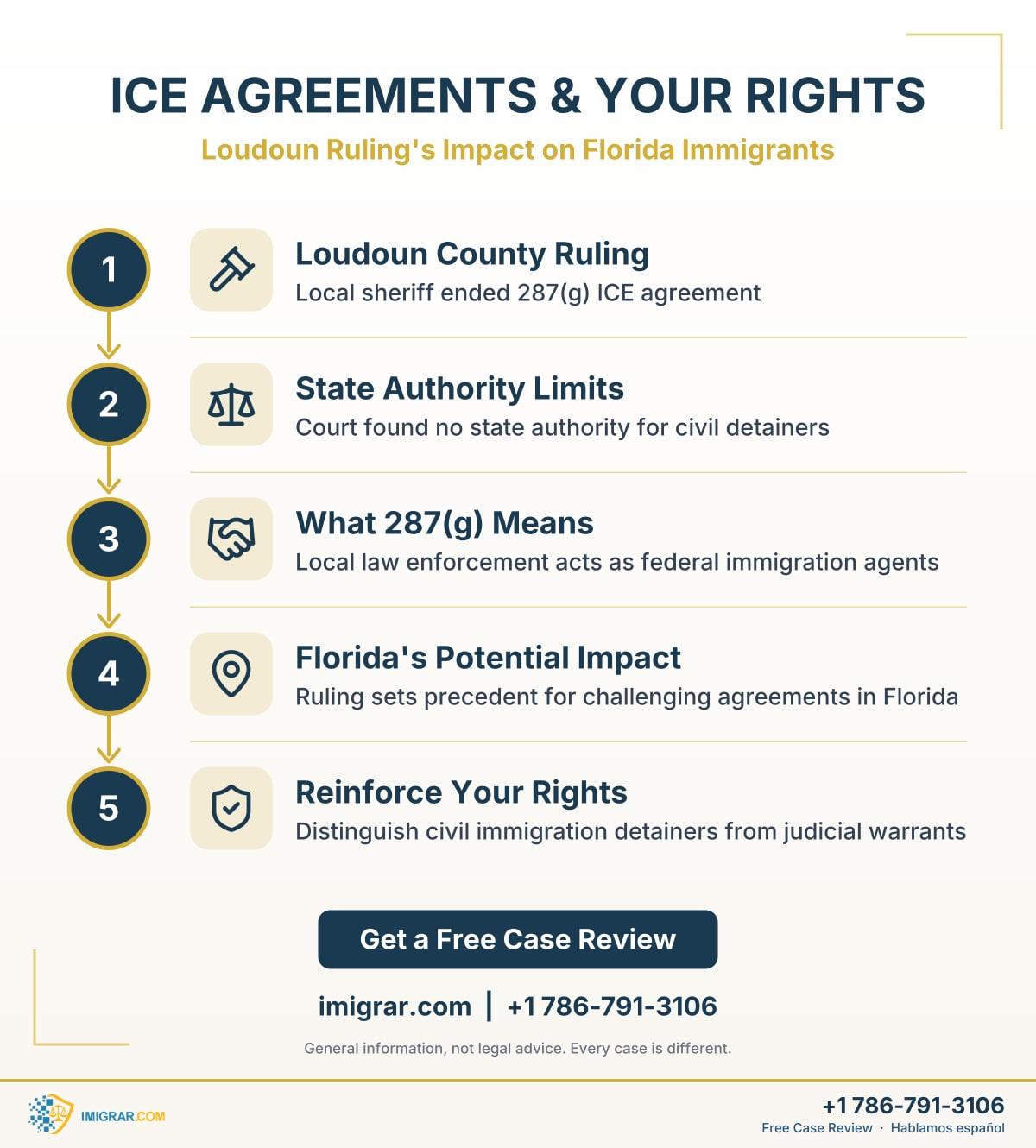
What This News Means for Immigrants in Orlando and Across Florida
The decision by the Loudoun County Sheriff’s Office (LCSO) to terminate its 287(g) agreement with ICE is a significant development. While this specific event occurred in Virginia, its implications resonate nationwide, including here in Florida. It underscores the ongoing legal scrutiny and public debate surrounding these agreements, which deputize local law enforcement to act as federal immigration agents.Why this news is showing up now
The Loudoun County Sheriff’s Office ended its 287(g) agreement following a pivotal court ruling. Specifically, the Virginia Court of Appeals determined that the LCSO lacked the authority under state law to enforce federal civil immigration detainers. This ruling highlighted a critical legal distinction: while 287(g) agreements empower local officers to enforce *federal* immigration law, they must still operate within the bounds of their *state* authority. The court found that Virginia state law did not grant local sheriff’s offices the power to hold individuals solely based on a civil immigration detainer request from ICE, without an underlying state criminal charge or judicial warrant. This is not an isolated incident; similar legal challenges and policy reevaluations have occurred in various jurisdictions across the country as advocacy groups and legal organizations push for greater accountability and adherence to state legal frameworks. The current Trump administration maintains a strong stance on immigration enforcement, prioritizing partnerships with local law enforcement. However, these partnerships are increasingly being challenged in courts, leading to decisions like the one in Loudoun that compel local agencies to reassess their agreements. This ongoing tension between federal enforcement priorities and state legal limitations is why this news is particularly relevant in late 2026.How it can affect Florida residents
While the Loudoun ruling directly applies to Virginia, it sets an important precedent and provides a legal blueprint for challenges in other states, including Florida. Many Florida counties currently have 287(g) agreements in place, or other forms of cooperation with ICE. The legal arguments successfully made in Loudoun County could be adapted and used to challenge similar agreements in Florida, especially regarding the legality of honoring ICE detainers without a judicial warrant under Florida state law. For Florida residents, this news brings several key considerations:- Increased Scrutiny of Local Agreements: The Loudoun decision encourages greater scrutiny of existing 287(g) agreements and other ICE cooperation policies within Florida counties. Immigrant advocates and legal organizations may use this precedent to challenge agreements in Orange County, Seminole County, and other jurisdictions across Central Florida and the state.
- Potential for Policy Shifts: Local law enforcement agencies in Florida might review their own agreements in light of the Loudoun ruling to ensure they are operating within their state-granted authority. While the Trump administration emphasizes robust cooperation, local agencies must balance federal priorities with state legal requirements.
- Understanding Your Local Context: It becomes even more critical for immigrants in Florida to understand the specific policies of their local sheriff’s office and police departments regarding ICE cooperation. Not all agencies participate in 287(g), and those that do may implement them differently.
- Reinforcement of Rights: The ruling reinforces the importance of knowing your rights, particularly the distinction between civil immigration detainers and judicial warrants. It highlights that local law enforcement may not always have the authority to hold you based solely on an ICE request without a state criminal charge or a warrant signed by a judge.
What 287(g) Agreements Are (and Why It Matters)
The 287(g) program is a critical component of the federal government's immigration enforcement strategy, particularly under the current Trump administration. Understanding this program is vital for any immigrant navigating the U.S. legal system.A plain-English definition
A 287(g) agreement is a formal partnership between U.S. Immigration and Customs Enforcement (ICE) and a state or local law enforcement agency (like a sheriff’s office or police department). Under these agreements, ICE provides training to designated state and local officers, who then become authorized to perform certain federal immigration enforcement functions. Essentially, it deputizes local law enforcement to act as federal immigration agents, typically within a jail setting, but sometimes in the field. The goal, from the federal perspective, is to enhance public safety by identifying and removing non-citizens who have committed crimes. However, critics argue that these agreements can lead to racial profiling, erode trust between immigrant communities and local police, and divert local resources.Key terms you need to know
To fully grasp the implications of 287(g) agreements and related immigration enforcement, it's essential to understand these key terms:- Section 287(g) of the Immigration and Nationality Act (INA): This is the specific federal law that authorizes the Secretary of Homeland Security to enter into agreements with state and local law enforcement agencies, deputizing their officers to perform certain immigration enforcement functions.
- Memorandum of Agreement (MOA): This is the formal document signed between ICE and a state or local law enforcement agency, outlining the terms, scope, and responsibilities of a 287(g) partnership. Each MOA is specific to the participating agency.
- ICE Detainer (Immigration Detainer Request): This is a request from ICE to a state or local law enforcement agency to maintain custody of an individual for up to 48 hours (excluding weekends and holidays) after that individual would otherwise be released, so that ICE can take them into federal custody. The Loudoun ruling specifically challenged the legality of honoring these detainers based solely on an ICE request, without a judicial warrant.
- Probable Cause: A legal standard that means there is a reasonable basis for believing that a crime may have been committed, or that evidence of a crime exists. For immigration enforcement, this usually refers to probable cause that an individual is removable under federal immigration law.
- Civil Immigration Violation: These are violations of immigration law that do not carry criminal penalties but can lead to deportation (removal). Examples include overstaying a visa, entering the U.S. without inspection, or working without authorization. Most ICE detainers are issued based on probable cause of a civil immigration violation.
- Criminal Immigration Violation: These are violations of immigration law that are also considered federal crimes, carrying potential prison sentences in addition to deportation. Examples include alien smuggling, illegal re-entry after deportation, or document fraud.
- Judicial Warrant: A document issued by a federal judge or magistrate that authorizes law enforcement to make an arrest or conduct a search. This is distinct from an administrative warrant (Form I-200 or Form I-205) issued by an ICE officer, which is not signed by a judge. The distinction between these types of warrants was central to the Loudoun County court's decision regarding detainers.
- Immigration Bond: A sum of money paid to the Department of Homeland Security (DHS) to secure the release of an individual from immigration detention. It ensures the individual will appear for all future immigration court hearings.
- Notice to Appear (NTA): Form I-862. This is the charging document in immigration court proceedings, formally notifying an individual that the government believes they are subject to removal from the U.S. and initiating deportation proceedings.
Current Immigration Law: The Foundation
U.S. immigration law is complex, and it forms the bedrock upon which enforcement actions like 287(g) agreements operate. Understanding the legal framework is essential for anyone impacted by these policies. The current Trump administration has consistently prioritized robust immigration enforcement, leading to a firm stance on utilizing all available tools, including 287(g) partnerships, to secure borders and interior enforcement.Federal requirements
The primary federal law governing immigration is the Immigration and Nationality Act (INA). Section 287(g) of the INA specifically authorizes the Secretary of Homeland Security to deputize state and local law enforcement officers to perform functions of federal immigration officers. For an agency to participate in the 287(g) program, it must:- Enter into a formal Memorandum of Agreement (MOA) with ICE. This MOA details the scope of the partnership, the duties to be performed by local officers, and the training requirements.
- Ensure designated officers receive mandatory training provided by ICE, covering federal immigration law, civil rights, and cultural awareness.
- Operate under federal authority when performing immigration functions, meaning they are subject to federal regulations and oversight while acting as immigration officers.
- Collect and report data to ICE regarding their activities under the agreement.
Florida-specific considerations
Florida, with its significant immigrant population and strategic location, has a complex relationship with federal immigration enforcement. While the Loudoun County ruling is specific to Virginia, its legal reasoning regarding state authority can be highly relevant here.- State Legislation: Florida has its own state laws that impact how local law enforcement interacts with federal immigration authorities. For example, Florida Statute § 908.10 concerning immigration detainers has been a subject of debate. While it generally supports cooperation with ICE, legal challenges often focus on the specific wording and whether it grants local agencies the authority to hold individuals solely on an ICE detainer without a judicial warrant or a state criminal charge, similar to the issue in Loudoun.
- Existing 287(g) Agreements: Several counties in Florida have 287(g) agreements with ICE. These include counties in various parts of the state, potentially impacting residents in Central Florida, South Florida, and beyond. It is crucial for residents to know if their local sheriff's office participates in such an agreement.
- Sanctuary Policies (or lack thereof): Florida state law prohibits "sanctuary policies" that limit local law enforcement cooperation with federal immigration authorities. This means local agencies are generally compelled to cooperate with ICE requests, though the *extent* and *legality* of that cooperation (especially concerning detainers) can still be challenged in court, as seen in Virginia.
- Orlando and Central Florida: For residents of Orlando and surrounding areas like Orange County, Seminole County, and Osceola County, awareness of local law enforcement policies is paramount. While the Orlando Police Department does not have a 287(g) agreement, the Orange County Sheriff's Office or other county-level agencies may have different policies or levels of cooperation with ICE.
Need Help? Our Orlando immigration team is ready to assist. Call +1 786-791-3106 for a free consultation, or message us online. Se Habla Español.
Relevant USCIS Forms (Understanding your status and potential relief)
While 287(g) primarily deals with enforcement, understanding your immigration status and potential avenues for relief is critical if you encounter law enforcement. These forms are not directly related to 287(g) enforcement itself, but rather to the immigration processes that might become relevant if you are detained or are seeking to regularize your status to avoid such encounters.- Form I-94, Arrival/Departure Record: This document proves lawful admission and authorized period of stay for non-immigrants. It's crucial for demonstrating legal presence.
- Form I-130, Petition for Alien Relative: If you are a U.S. citizen or lawful permanent resident sponsoring a family member for a green card, this is the first step. A pending or approved Form I-130 can sometimes be relevant in immigration proceedings, showing a path to legal status.
- Form I-485, Application to Register Permanent Residence or Adjust Status: This form is used by individuals already in the U.S. to apply for lawful permanent resident status (a green card) without having to leave the country. Having a pending Form I-485 can provide certain protections against removal, especially if accompanied by an employment authorization document (EAD) based on the application.
- Form I-589, Application for Asylum and for Withholding of Removal: If you fear persecution in your home country, this form is used to seek asylum. If detained, you may have the right to apply for asylum, and understanding this process is vital.
- Form I-246, Application for Stay of Deportation or Removal: In some limited circumstances, individuals facing removal can apply for a temporary stay of deportation. This is a complex application usually filed with the Executive Office for Immigration Review (EOIR) or ICE directly.
- Form I-601A, Application for Provisional Unlawful Presence Waiver: If you need to depart the U.S. for consular processing but have accrued unlawful presence, this waiver can be filed while still in the U.S., potentially shortening the time spent abroad separated from family.
How to Protect Your Rights During Immigration Enforcement: A Complete Step-by-Step Guide
In an environment where local law enforcement may be deputized to enforce federal immigration laws, knowing your rights and having a plan is essential. This guide provides actionable steps for immigrants and their families in Orlando and across Florida.1) Understand Your Rights (The "Know Your Rights" Card)
Your fundamental constitutional rights apply regardless of your immigration status. It's crucial to understand and assert them.- Right to Remain Silent: You have the right to refuse to answer questions about your immigration status, country of birth, or how you entered the U.S. You can simply state, "I choose to remain silent."
- Right to an Attorney: You have the right to speak with an attorney. Do not answer questions or sign anything without legal counsel present. You can say, "I want to speak to my lawyer."
- Do Not Open Your Door Without a Judicial Warrant: If an officer comes to your home, they generally cannot enter without a warrant signed by a judge. An administrative warrant (Form I-200 or Form I-205) signed by an ICE officer is *not* a judicial warrant. You can ask them to slide the warrant under the door or hold it up to a window. If they don't have a judicial warrant, you can keep your door closed.
- Do Not Resist Arrest: While you have rights, do not physically resist if officers attempt to arrest you. Doing so can lead to criminal charges.
- Carry a "Know Your Rights" Card: Keep a card (available from many immigrant rights organizations) that explains your rights in English and Spanish. Show it to officers if you are stopped.
2) Verify Warrants and Authority
Distinguishing between types of warrants and understanding an officer's authority is critical.- Ask for Identification: Politely ask officers for their badge number and agency.
- Demand a Judicial Warrant: If officers claim to have a warrant to enter your home or arrest you, ask to see it. Crucially, ask if it is a "judicial warrant signed by a judge." An ICE administrative warrant (Form I-200, Warrant for Arrest of Alien; or Form I-205, Warrant of Removal/Deportation) is *not* a judicial warrant and does not authorize entry into your home without consent.
- Understand the Scope: A warrant for your arrest does not necessarily authorize officers to search your home. A search warrant specifies the areas to be searched and items to be seized.
3) Do Not Sign Anything You Don't Understand
Signing documents without fully comprehending their implications can have severe consequences for your immigration case.- Refuse to Sign Voluntary Departure: You may be pressured to sign documents, such as a "Voluntary Departure" agreement. While this might seem like an easier option, it means you agree to leave the U.S. without a formal removal order, often waiving important rights and making it difficult to return legally in the future. Always consult an attorney before signing.
- Do Not Waive Your Rights: Officers might ask you to sign a waiver of rights. Do not do so without consulting an attorney.
- Seek Legal Review: If you are presented with any document, politely state that you need to have your attorney review it before you can sign.
4) Prepare an Emergency Plan for Your Family
Having a plan in place can significantly reduce stress and ensure your family's well-being if you are detained or deported.- Designate Guardianship: If you have minor children, identify a trusted family member or friend who can care for them. Formalize this with legal documents such as a temporary guardianship agreement or power of attorney.
- Financial Preparedness: Have access to funds for legal fees, bonds, and family expenses. Know how to access bank accounts and pay bills.
- Important Contacts: Create a list of emergency contacts, including your attorney, family members, and children's schools, and ensure trusted individuals have a copy.
- Practice the Plan: Discuss the emergency plan with your family members so everyone knows what to do if you are not home.
5) Gather and Organize Important Immigration Documents
Having vital documents readily accessible can be crucial for your legal defense.- Originals and Copies: Keep original documents in a secure, fireproof location, and have multiple copies (digital and physical) stored elsewhere with a trusted person.
- Key Documents Include:
- Passports and birth certificates (for all family members)
- Marriage certificates
- Visa documents, I-94 Arrival/Departure Records
- Green Card (Form I-551) or employment authorization document (EAD, Form I-766)
- Notices from USCIS or immigration court (e.g., Notice to Appear - Form I-862)
- Proof of continuous residence (utility bills, rent receipts, school records)
- Medical records, especially if you have a medical condition
- Any existing immigration court orders or decisions
- Do Not Carry Originals: Carry copies of your documents, not originals, in case they are lost or confiscated.
6) Seek Qualified Legal Counsel Immediately
This is the single most important step you can take. An experienced immigration attorney can protect your rights and explore all available legal options.- Memorize Your Attorney's Number: Keep your attorney's phone number or Imigrar's number (+1 786-791-3106) on you and memorized.
- Do Not Waive Your Right to Counsel: If detained, repeatedly state that you wish to speak with your attorney.
- Imigrar's Expertise: Our team at Imigrar specializes in complex immigration cases, including those involving detention and removal. We can assess your situation, advise on bond eligibility, and represent you in immigration court.
7) Stay Informed About Local Policies
The Loudoun ruling highlights the importance of local policies.- Research Your Local Sheriff's Office: Find out if your local sheriff's office (e.g., Orange County Sheriff's Office) has a 287(g) agreement or other formal cooperation with ICE. This information is often available on their website or through local advocacy groups.
- Community Engagement: Participate in local community meetings or organizations that monitor immigration enforcement policies.
- Legal Updates: Follow reliable immigration news sources and consult with your attorney for updates relevant to your area, especially here in Orlando and Central Florida.
Need Help? Our Orlando immigration team is ready to assist. Call +1 786-791-3106 for a free consultation, or message us online. Se Habla Español.
Practical Steps You Can Take Today
Being proactive is the best defense. Here’s a checklist of practical steps you can implement today to prepare for potential immigration enforcement encounters.Actionable Checklist:
- Know Your Rights Card: Print or obtain a "Know Your Rights" card from a reputable immigrant rights organization. Keep it in your wallet and share it with family members.
- Emergency Contact List: Create a list of critical phone numbers (attorney, family, children's school, doctor) and ensure multiple trusted individuals have access to it.
- Legal Counsel Information: Memorize our phone number at Imigrar: +1 786-791-3106. Save it in your phone and your family members' phones.
- Family Emergency Plan: Discuss and formalize a plan for childcare, financial access, and communication if a family member is detained. Consider designating a temporary guardian for minor children.
- Document Organization: Gather all important immigration and personal documents. Make copies and store them securely, both physically and digitally, with a trusted contact. Do not carry original, irreplaceable documents.
- Consult with an Attorney: Schedule a consultation with Imigrar to review your immigration history and understand your current status and any potential risks. This is especially important if you are in Orlando or anywhere along the I-4 corridor, where enforcement can be active.
- Stay Informed: Regularly check reliable news sources and legal updates regarding immigration policy in Florida and nationally.
- Avoid Self-Incrimination: Practice the right to remain silent. Do not discuss your immigration status with anyone other than your attorney.
Document Preparation Guidance:
- Centralized Storage: Keep all original documents in a waterproof, fireproof safe or secure location.
- Digital Backups: Scan all important documents and store them on a secure cloud service or encrypted drive, accessible to your trusted contact.
- Family Binder: Create a physical binder with copies of all essential documents (passports, birth certificates, marriage certificates, green cards, visas, I-94s, NTA, medical records, property deeds, financial statements). This binder should be easily accessible to your designated emergency contact.
- Evidence of Presence and Ties: Collect documents that prove your continuous residence in the U.S. and strong community ties (utility bills, school records, employment history, tax returns, bank statements, religious institution letters). These can be vital in immigration court.
Timeline Expectations:
If you or a family member is detained by ICE or local law enforcement operating under a 287(g) agreement, the timeline for proceedings can be extremely rapid and stressful.- Immediate Detention: Detainees may be transferred to an ICE detention facility within hours or days.
- Initial Hearing (Master Calendar Hearing): This is often the first appearance before an Immigration Judge, potentially within weeks of detention.
- Bond Hearing: If eligible for bond, a hearing could be scheduled relatively quickly, but securing release requires prompt legal action and funds.
- Removal Proceedings: The entire deportation process can move very fast, especially for individuals deemed a "priority" by the current administration. You may have limited time to gather evidence and prepare your defense.
How Imigrar Helps Immigrants in Orlando
At Imigrar, we understand the immense pressure and uncertainty that immigration enforcement actions can bring, especially under the current administration's policies. Our firm is built on the principle of keeping families together, and we are here to guide you through every step.Our experience and expertise
Our team of dedicated immigration attorneys has extensive experience navigating the complexities of U.S. immigration law. We specialize in:- Detention and Removal Defense: We represent clients in immigration court, fighting against deportation and seeking all available forms of relief, including asylum, cancellation of removal, and waivers.
- 287(g) and ICE Enforcement Issues: We are knowledgeable about the nuances of 287(g) agreements and other local-federal enforcement partnerships. We can advise you on your rights during encounters with law enforcement in Orlando, Orange County, and across Florida, and challenge unlawful detentions.
- Family-Based Immigration: We assist families in obtaining green cards and visas, ensuring that loved ones can live together legally in the U.S.
- Humanitarian Relief: We guide clients through processes like U Visas, VAWA, and Special Immigrant Juvenile Status for those who have been victims of crime or abuse.
- Consular Processing and Adjustment of Status: We help clients navigate the path to lawful permanent residency, whether through the U.S. or from abroad.
Free consultation offer
We believe that everyone deserves access to quality legal advice. That’s why we offer a free, confidential consultation to discuss your specific situation. During this consultation, we will:- Listen carefully to your story and understand your concerns.
- Provide an initial assessment of your immigration status and potential risks.
- Explain your legal options clearly and in plain language.
- Outline how Imigrar can assist you in protecting your rights and pursuing your immigration goals.
Frequently Asked Questions About Immigration Enforcement and Your Rights
Q: Does my immigration status affect how 287(g) applies to me?
A: Yes, absolutely. While 287(g) agreements allow local law enforcement to question individuals about their immigration status, the impact varies. If you are a U.S. citizen, 287(g) should not directly affect you, though you should still be prepared to assert your rights. If you are a lawful permanent resident (green card holder), you have significant rights, but you can still be detained and placed in removal proceedings if you have committed certain criminal offenses. If you are undocumented or have an expired visa, you are at higher risk of detention and deportation under these agreements. However, even undocumented individuals have constitutional rights, including the right to remain silent and to speak with an attorney. Always carry proof of your current immigration status, but do not carry original documents that you cannot afford to lose.
Q: If I am detained under a 287(g) agreement, what happens to my immigration status?
A: If you are detained under a 287(g) agreement, it typically means you have been identified as potentially removable by ICE. This usually leads to being transferred to ICE custody and placed in removal (deportation) proceedings before an Immigration Judge. The detention itself doesn't automatically change your status, but it initiates a legal process that could lead to a final order of removal. At this point, it is crucial to seek legal counsel immediately. An attorney can assess if you are eligible for bond, challenge the basis of your detention, and explore any forms of relief from removal, such as asylum, cancellation of removal, or waivers. For Central Florida residents, being detained could mean transfer to a detention facility outside of Orlando, making local legal support even more vital.
Q: How quickly can I be deported if I'm detained under a 287(g) agreement?
A: The timeline for deportation can vary greatly, but it can be alarmingly fast, especially under the current Trump administration’s enforcement priorities. If you are deemed to have a criminal record or have previously been ordered deported, you could be subject to expedited removal. Even in standard removal proceedings, the process can move quickly, with initial hearings within weeks. Without legal representation, it is very difficult to navigate the system and present a defense effectively, which can lead to a quick deportation order. This is why contacting an immigration attorney like those at Imigrar immediately upon detention is paramount. We work to slow down the process, secure bond if possible, and build a strong defense.
Q: What documents should I always carry with me?
A: It is generally advisable to carry copies of your most important identification documents, but *never* originals of irreplaceable documents like your green card or passport. If you are a lawful permanent resident, you are legally required to carry your green card (Form I-551). However, you can carry a high-quality color copy and keep the original in a secure location. For others, carrying a state ID or driver's license, along with a copy of your birth certificate or any immigration documents (like a work permit or visa stamp), is a good practice. If you are undocumented, you are not required to carry any specific immigration documents. Regardless of status, always carry a "Know Your Rights" card and the phone number for your immigration attorney, such as Imigrar at +1 786-791-3106.
Q: What are the potential costs if I'm involved in an enforcement action?
A: The costs associated with an immigration enforcement action can be substantial. These include:
- Legal Fees: Hiring an immigration attorney for detention and removal defense.
- Bond: If you are eligible for an immigration bond, the amount can range from a few thousand to tens of thousands of dollars.
- Filing Fees: Fees for any applications for relief from removal (e.g., Form I-589 for asylum, waivers, etc.).
- Travel Costs: If family members need to travel to detention facilities or court hearings.
- Lost Wages: Due to detention or time spent on legal proceedings.
Q: What happens if my application for relief or bond is denied?
A: If your application for bond is denied, it means you will remain in detention while your immigration case proceeds. If an application for relief (e.g., asylum, cancellation of removal) is denied by an Immigration Judge, you generally have the right to appeal that decision to the Board of Immigration Appeals (BIA). If the BIA also denies your appeal, you may have further avenues for appeal to a federal circuit court. However, these appeals are complex and time-sensitive. If all appeals are exhausted and a final order of removal is issued, you will be deported. It's crucial to have an attorney who can advise you on the appeals process, manage deadlines, and represent you at each stage. Warning: Missing an appeal deadline can permanently close your case.
Q: How does the Loudoun County ruling impact other counties in Florida that have 287(g) agreements?
A: While the Loudoun County ruling is specific to Virginia, it creates a powerful legal precedent that can be used to challenge similar 287(g) agreements in Florida. The core of the Loudoun decision was that local law enforcement lacked the *state-level authority* to honor ICE civil immigration detainers without a judicial warrant. This legal argument can be applied in Florida, where state laws might also be interpreted as not granting such broad authority to local sheriffs. It means that existing 287(g) agreements in counties like Orange County or others in Florida could face similar legal challenges, potentially leading to policy changes or even termination of agreements if courts rule similarly. For immigrants, this reinforces the need to know your local sheriff's policies and to understand the distinction between judicial and administrative warrants when encountering law enforcement.
Need Help? Our Orlando immigration team is ready to assist. Call +1 786-791-3106 for a free consultation, or message us online. Se Habla Español.
Common Mistakes Immigrants Make During Enforcement Encounters (and How to Avoid Them)
Navigating an encounter with law enforcement, especially when immigration is involved, can be terrifying. Many common mistakes can inadvertently jeopardize an immigrant's case. Knowing these pitfalls can help you protect yourself and your family.Mistake #1: Discussing Your Immigration Status with Law Enforcement
Many immigrants, out of fear or a desire to be cooperative, mistakenly answer questions about their immigration status, country of origin, or how they entered the U.S. This is a common and often detrimental mistake.How to Avoid: You have the constitutional right to remain silent. You are not required to answer questions about your immigration status. Politely state, "I choose to remain silent," or "I want to speak with my attorney." Do not volunteer any information, and do not present false documents. The only information you are generally required to provide is your name. For Florida residents, this applies whether you are stopped on the I-4 corridor, at your workplace, or in your home in Orlando.
Mistake #2: Opening Your Door to Officers Without a Judicial Warrant
When law enforcement, including ICE or local police acting under a 287(g) agreement, comes to your home, many individuals mistakenly open their door without verifying the officers' authority.How to Avoid: You are not required to open your door to law enforcement officers unless they present a *judicial warrant* signed by a judge. This warrant must specifically authorize entry into your home. An administrative warrant (Form I-200 or Form I-205) issued by an ICE officer is *not* a judicial warrant and does not authorize entry without your consent. Ask them to slide the warrant under the door or hold it up to a window so you can inspect it. If they do not have a judicial warrant, you can keep your door closed. If they claim to have a warrant, verify it is signed by a judge and authorizes entry into your specific residence. If they force their way in without a judicial warrant, do not resist physically, but clearly state, "I do not consent to your entry or search."
Mistake #3: Not Having an Emergency Plan or Legal Counsel Information
Many families operate without a clear plan for what to do if a family member is detained or deported, or without immediate access to legal counsel information. This leads to confusion, panic, and lost time when every moment counts.How to Avoid: Proactive planning is paramount.
- Create a Family Emergency Plan: Designate guardians for children, establish communication protocols, and ensure trusted individuals know how to access important documents and financial resources.
- Keep Legal Counsel Information Accessible: Memorize the phone number for Imigrar: +1 786-791-3106. Write it down and keep it on your person, in your phone, and share it with trusted family members. Do not rely solely on your phone, as it might be confiscated.
- Consult an Attorney Preemptively: Schedule a consultation with Imigrar to understand your specific situation, potential risks, and available legal options *before* an emergency arises. This is especially vital for immigrants living in areas with active 287(g) agreements or high ICE enforcement, including many parts of Florida.
Your Trusted Partner in Orlando and Beyond
The shifting sands of immigration policy, exemplified by decisions like the Loudoun County ruling, remind us that vigilance and preparedness are essential for immigrant communities. While the Trump administration maintains a strong enforcement posture, understanding your rights and having a robust legal strategy can make all the difference. At Imigrar, we are committed to being your unwavering advocate. Our team of experienced immigration attorneys in Orlando understands the unique challenges faced by immigrants and their families in Florida. We offer compassionate, expert guidance to help you navigate complex legal terrain, protect your rights, and pursue your immigration goals. Don't wait for an emergency to act. Take control of your future today.Need Help? Our Orlando immigration team is ready to assist. Call +1 786-791-3106 for a free consultation, or message us online. Se Habla Español.
Additional Resources and Official Government References:
- USCIS official website - For all forms, policies, and general information on immigration benefits.
- U.S. Department of State - For visa information, consular processing, and the Visa Bulletin.
- Executive Office for Immigration Review (EOIR) - For information on immigration court proceedings, including detention and removal.
- USCIS Processing Times - To check current processing times for various immigration applications.
- USCIS Forms - Direct access to all official USCIS forms and instructions.
- ICE 287(g) Program Information - Official information from ICE regarding the 287(g) program (current policies under the Trump administration).
- ACLU of Florida - Provides information on civil rights and immigrant rights in Florida.
Related Topics
Need Legal Assistance?
Our experienced immigration attorneys are here to help with your case. Contact Imigrar today for a free consultation and let us guide you through the legal process with confidence.
📍 Orlando, Florida • Serving clients nationwide
📧 info@imigrar.com