
H-1B Visa Outlook 2026: Infosys Surge & Texas Policy Shifts Under Trump
Infosys H-1B approvals are up, but Texas policies are shifting. Understand the Trump administration's impact on skilled worker visas, and how Imigrar can help your family in Florida.
The landscape of U.S. immigration is constantly evolving, and for skilled professionals seeking to live and work in the United States, staying informed is paramount. Recent developments highlight both opportunities and challenges within the H-1B visa program, particularly under the current Donald Trump administration. From significant increases in approvals for major tech companies to state-level policy shifts, understanding these dynamics is crucial for anyone navigating the complex world of employment-based immigration.
The reporting that sparked this guide:
What This News Means for Immigrants in Orlando and Across Florida
This headline, signaling an eightfold rise in H-1B approvals for a tech giant like Infosys while simultaneously highlighting impending policy changes in Texas, sends mixed signals across the immigration community. For immigrants and their families in Orlando and throughout Florida, this news underscores both the persistent demand for skilled talent and the increasing complexities introduced by evolving federal and state policies.
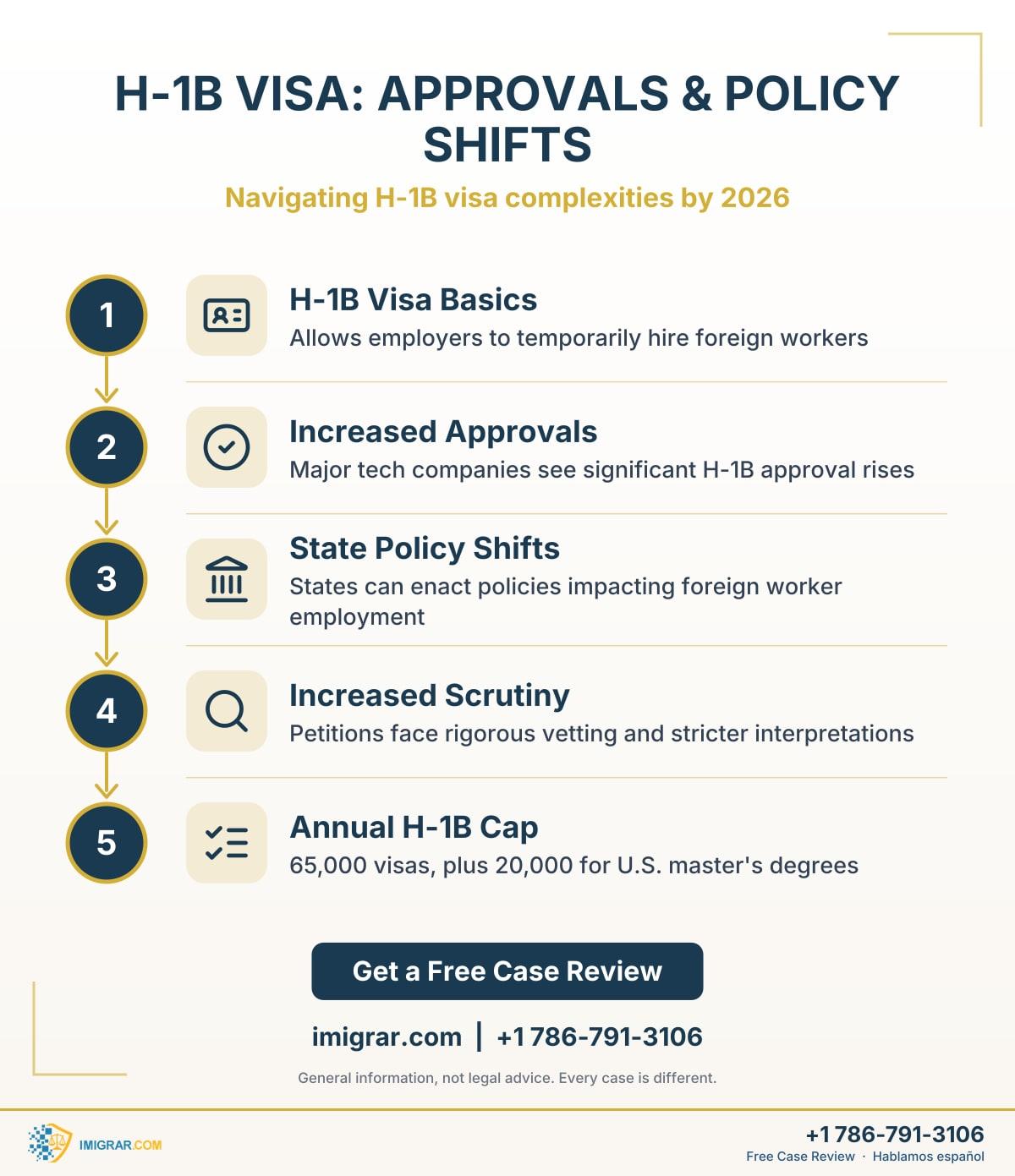
Why this news is showing up now
The surge in H-1B approvals for a company like Infosys, a major global IT services and consulting firm, is a significant indicator. It suggests that even amidst the current Trump administration’s overarching "America First" agenda and its emphasis on prioritizing U.S. workers, there remains a critical need for highly skilled foreign talent in specific sectors. Companies that strategically align their H-1B petitions with the administration's focus on high-wage, high-skill roles, and that demonstrate a clear benefit to the U.S. economy, may see greater success. This increase could reflect Infosys’s refined strategy in identifying and sponsoring candidates for specialty occupations that meet stringent government criteria, or it could point to a targeted, sector-specific demand that the administration is tacitly acknowledging.
Simultaneously, the news of Texas preparing to change its visa policy reflects a growing trend of states asserting their own influence over immigration matters. While federal law governs visa issuance, states can enact policies that impact the employment of foreign nationals, the operations of sponsoring companies, or even the licensing of professionals. By November 2026, many of these "preparations" in Texas have likely materialized into concrete policies, influencing how H-1B workers are employed or regulated within the state. These changes are often driven by state economic priorities, political ideologies, and a desire to align with or amplify federal directives, particularly concerning workforce protection and economic nationalism.
How it can affect Florida residents
For individuals residing in Central Florida, the I-4 corridor, and other parts of the Sunshine State, these developments have important implications:
- H-1B Opportunities: The Infosys trend suggests that despite a generally restrictive federal environment, the H-1B program remains a viable path for highly skilled professionals. Florida’s burgeoning tech, healthcare, and aerospace industries, particularly in hubs like Orlando, Tampa, and Miami, are continually seeking specialized talent. This news can offer a glimmer of hope for prospective H-1B beneficiaries and their sponsoring employers in Florida, indicating that strategic, well-prepared petitions can still succeed.
- Ripple Effect of State Policies: While Texas's policies are state-specific, they often set precedents or inspire similar legislative efforts in other states. Florida, a state with its own complex political and economic landscape, could potentially consider or even implement comparable measures to regulate the employment of foreign workers or to increase oversight on companies utilizing visa programs. This could impact everything from state-level business registrations to professional licensing requirements for H-1B holders.
- Increased Scrutiny: The current administration consistently emphasizes rigorous vetting and enforcement across all immigration programs. This means H-1B petitions, even those filed by established companies, are likely to face high levels of scrutiny, including more Requests for Evidence (RFEs) and stricter interpretations of eligibility requirements. This applies equally to Florida-based employers and employees.
- The Need for Vigilance: Immigrants and employers in Florida must remain exceptionally vigilant about changes at both the federal and state levels. What happens in Texas today could influence policy discussions in Tallahassee tomorrow. Navigating this dynamic environment requires expert legal guidance to ensure compliance and maximize success.
At Imigrar, we understand these intricate connections and the anxieties they can create. Our Orlando immigration team is dedicated to keeping our clients informed and prepared, ensuring that families can stay together and professionals can achieve their American dreams.
Navigating H-1B complexities? Our Orlando immigration team is ready to assist. Call +1 786-791-3106 for a free consultation, or message us online. Se Habla Español.
What the H-1B Visa and Texas Policy Changes Are (and Why They Matter)
To fully grasp the implications of the recent news, it's essential to understand the core components: the H-1B visa program itself and the nature of state-level immigration policy shifts.
A plain-English definition
The H-1B visa is a nonimmigrant visa that allows U.S. employers to temporarily employ foreign workers in specialty occupations. These occupations generally require a bachelor's degree or higher in a specific field. The H-1B program is crucial for U.S. companies that need to fill highly specialized positions where qualified American workers are in short supply, particularly in fields like technology, engineering, medicine, and scientific research.
The program operates under an annual numerical limit, known as the H-1B cap, which is currently set at 65,000 visas, with an additional 20,000 visas reserved for those holding a U.S. master's degree or higher. Due to high demand, USCIS typically conducts a lottery to select petitions when the number of registrations exceeds the available visas. This lottery system often leads to intense competition and uncertainty for both employers and prospective employees.
The "Texas prepares to change visa policy" aspect refers to initiatives at the state level that aim to regulate, restrict, or influence the employment of foreign nationals within Texas. While states cannot issue visas, they can implement laws affecting employers (e.g., stricter E-Verify mandates, state-level audits of H-1B dependent companies, or requirements for state registration of foreign workers in certain professions) or even impose licensing hurdles that disproportionately affect non-citizens. These policies often reflect a push to prioritize local workers and ensure compliance with state-specific employment regulations, sometimes mirroring or even exceeding federal immigration enforcement efforts.
Key terms you need to know
- Specialty Occupation: This is the cornerstone of the H-1B visa. It refers to an occupation that requires the theoretical and practical application of a body of highly specialized knowledge, and a bachelor's or higher degree (or its equivalent) in a specific specialty as a minimum for entry into the occupation in the United States. Examples include IT professionals, engineers, doctors, architects, and scientists.
- H-1B Cap: The annual numerical limit on the number of H-1B visas issued each fiscal year. As of 2026, this is 65,000 for the regular cap and an additional 20,000 for the U.S. master's cap.
- Cap-Exempt: Certain employers are exempt from the annual H-1B cap. These typically include institutions of higher education, non-profit organizations affiliated with or related to institutions of higher education, and non-profit research organizations or governmental research organizations.
- LCA (Labor Condition Application): This is Form ETA-9035, which the employer must file with the U.S. Department of Labor (DOL) before filing the H-1B petition with USCIS. In the LCA, the employer attests that they will pay the H-1B worker at least the prevailing wage for the occupation in that geographic area or the actual wage paid to other employees with similar experience and qualifications, whichever is higher. They also attest that the employment of the H-1B worker will not adversely affect the working conditions of U.S. workers similarly employed.
- Petition for a Nonimmigrant Worker (Form I-129): This is the primary form filed by the employer with U.S. Citizenship and Immigration Services (USCIS) to request H-1B classification for the foreign worker.
- Prevailing Wage: The average wage paid to similarly employed workers in a specific occupation in the geographic area of intended employment. This is a critical component of the LCA, ensuring H-1B workers are not used to undercut U.S. worker wages.
- Request for Evidence (RFE): A letter from USCIS requesting additional documentation or clarification to support a petition. Under the current administration, RFE rates have sometimes been higher, requiring petitioners to provide more robust evidence.
- Consular Processing: The process where an applicant obtains their visa at a U.S. embassy or consulate outside the United States.
- Change of Status: The process by which an individual already in the U.S. in one nonimmigrant status applies to USCIS to change to another nonimmigrant status (e.g., from F-1 student to H-1B worker) without leaving the country.
Current Immigration Law: The Foundation for H-1B Visas
The H-1B visa program is governed by federal law, primarily the Immigration and Nationality Act (INA) and its corresponding regulations. Understanding this legal framework is crucial, especially as the current Trump administration continues to shape its interpretation and enforcement.
Federal requirements
The statutory basis for the H-1B visa is found in Section 101(a)(15)(H)(i)(b) of the Immigration and Nationality Act (INA). Further detailed regulations are outlined in Title 8 of the Code of Federal Regulations (8 CFR), specifically 8 CFR 214.2(h).
For an H-1B petition to be approved, several core federal requirements must be met:
- Specialty Occupation: The position offered by the employer must qualify as a specialty occupation. USCIS scrutinizes this heavily, often requiring detailed explanations of the job duties, the specific academic field required, and how the beneficiary's qualifications align.
- Beneficiary Qualifications: The foreign worker (beneficiary) must possess the required qualifications for the specialty occupation, typically a bachelor's degree or its equivalent in a related field. Professional licenses, if required for the occupation, must also be held.
- Employer Sponsorship: The U.S. employer must file the petition on behalf of the foreign worker. The employer must be a legitimate entity with an Employer Identification Number (EIN) and the financial capacity to pay the offered wage.
- Labor Condition Application (LCA): Prior to filing the H-1B petition with USCIS, the employer must obtain a certified Form ETA-9035 (Labor Condition Application) from the Department of Labor (DOL). This form attests to compliance with prevailing wage requirements and working conditions.
- H-1B Cap Compliance: Unless the employer is cap-exempt (e.g., a university or non-profit research organization), the petition must be filed during the annual cap registration and selection period.
- Prevailing Wage: The employer must pay the H-1B employee at least the higher of the actual wage paid to other employees in the same position or the prevailing wage for that occupation in the geographic area of employment. This is a significant focus of the current administration's enforcement efforts to prevent wage suppression.
The current Trump administration's approach to H-1B visas continues to be shaped by its "Buy American, Hire American" executive order. This directive has led to increased scrutiny, higher RFE rates, and a more stringent interpretation of "specialty occupation" and employer-employee relationships. While the Infosys report indicates that approvals are still possible, it underscores the need for exceptional care and comprehensive documentation in preparing H-1B petitions. The administration prioritizes positions that clearly demonstrate a need for highly skilled foreign talent that cannot be met by the U.S. workforce and that offer competitive wages, aligning with the intent to protect U.S. workers.
Florida-specific considerations
While Florida does not have its own H-1B visa program, state laws and regulations can indirectly impact H-1B workers and their employers:
- Professional Licensing: Many specialty occupations require state-specific professional licenses (e.g., for engineers, medical professionals, architects). H-1B beneficiaries must ensure they meet Florida's licensing requirements, which can sometimes involve specific educational equivalencies or examination processes.
- State-Level Employment Regulations: Florida has its own employment laws, including those related to worker protections, wages, and discrimination. H-1B employers in Florida must comply with both federal and state employment laws.
- E-Verify Mandates: While E-Verify is a federal program, some states, including Florida, have enacted laws mandating its use for certain employers, particularly those with government contracts. H-1B employers in Florida must ensure compliance with any such state-specific E-Verify requirements.
- Economic Landscape: Florida's diverse economy, with strong sectors in tourism, technology (especially in Orlando and the I-4 corridor), healthcare, and aerospace, creates a unique demand for H-1B talent. The presence of major tech companies, theme parks, and research institutions in Central Florida means a constant need for specialized skills, making the H-1B program vital for the region's growth.
- Orlando USCIS Field Office: For H-1B workers in Florida who later seek to adjust their status to permanent residency (e.g., through an employment-based green card), the local Orlando USCIS Field Office plays a role in interviews and local processing. Understanding its procedures and potential backlogs is important.
Navigating the federal H-1B requirements while remaining compliant with Florida-specific considerations requires experienced legal counsel. The team at Imigrar stays abreast of both federal immigration law and relevant Florida state regulations to provide comprehensive guidance.
Important: Always refer to official government sources for the most current information. The USCIS official website is your primary resource for forms, instructions, and policy updates.
Need expert H-1B guidance? Our Orlando immigration team is ready to assist. Call +1 786-791-3106 for a free consultation, or message us online. Se Habla Español.
How to Navigate the H-1B Process: A Complete Step-by-Step Guide
The H-1B visa process is intricate and requires meticulous attention to detail. This guide outlines the typical steps involved for a new H-1B petition, keeping in mind the current administration's heightened scrutiny and the potential for state-level influences.
1) Employer Assessment & LCA Filing
The journey begins with the prospective employer. They must first assess if the position they wish to fill qualifies as a specialty occupation and if the foreign national meets the minimum educational and experience requirements. This involves a detailed review of the job duties, the required academic background, and the beneficiary's credentials.
Once the employer confirms eligibility, they must file Form ETA-9035, Labor Condition Application (LCA), with the U.S. Department of Labor (DOL). This form attests to several crucial conditions, including the employer's commitment to pay the H-1B worker at least the prevailing wage or the actual wage, whichever is higher, and to provide working conditions that will not adversely affect U.S. workers.
- Required Documents/Information:
- Detailed job description, including duties and responsibilities.
- Employer's Federal Employer Identification Number (EIN).
- Proposed wage for the position.
- Geographic location of employment.
- Information about the prevailing wage for the occupation in that area.
- Employer's contact information.
- Timeline Expectation: DOL processing of LCA typically takes 7-10 business days.
2) H-1B Registration & Lottery (If Applicable)
For cap-subject H-1B petitions, the employer must participate in the electronic registration process. This usually occurs in March each year for the fiscal year beginning October 1st. During this period, the employer (or their authorized representative, like Imigrar) submits basic information about the company and the prospective H-1B employee to USCIS.
If the number of registrations exceeds the available annual H-1B cap, USCIS conducts a lottery to select the registrations that will be eligible to file a full H-1B petition. Only those selected in the lottery can proceed to the next step.
- Required Documents/Information for Registration:
- Employer's legal name, address, EIN.
- Beneficiary's full name, date of birth, country of birth, country of citizenship, passport number.
- Beneficiary's highest degree obtained, institution, and major.
- Confirmation of eligibility for the U.S. master's cap (if applicable).
- Timeline Expectation: Registration window is typically in March. Lottery results are usually announced by the end of March.
3) Petition Filing (Form I-129)
If the registration is selected (or if the employer is cap-exempt), the employer can then proceed to file the full H-1B petition using Form I-129, Petition for a Nonimmigrant Worker, with USCIS. This step requires extensive documentation to prove that both the position and the beneficiary meet all H-1B requirements. This package must include the certified LCA.
- Required Documents (Comprehensive List):
- Certified Form ETA-9035 (LCA).
- Completed and signed Form I-129 and relevant supplements (e.g., H-1B Data Collection and Filing Fee Exemption Supplement).
- Employer's letter of support detailing the specialty occupation, job duties, salary, and why the beneficiary is qualified.
- Beneficiary's academic credentials:
- Copies of bachelor's, master's, or higher degrees.
- Official academic transcripts.
- Foreign degree evaluations (if applicable) by a credential evaluation service to determine U.S. equivalency.
- Letters from previous employers verifying professional experience (if experience is used to equate to a degree).
- Beneficiary's resume/CV.
- Copies of beneficiary's passport (biographic page, previous U.S. visas, entry stamps).
- Proof of beneficiary's current immigration status in the U.S. (if applicable, e.g., Form I-94, Form I-20 for F-1 students).
- Employer's financial documents:
- Company tax returns (federal).
- Annual reports, financial statements.
- Business license, articles of incorporation.
- Detailed job description, including specific duties, responsibilities, and required skills.
- Organizational chart showing where the H-1B position fits within the company structure.
- Evidence that the position qualifies as a specialty occupation (e.g., industry standards, expert opinions).
- Any required state professional licenses for the occupation in Florida (if applicable).
- Applicable USCIS filing fees (check current fees on USCIS Forms page).
- Timeline Expectation: USCIS provides a specific filing window for selected petitions (typically April 1 to June 30).
4) USCIS Processing & Adjudication
Once USCIS receives the complete petition, it undergoes review. During this stage, USCIS may issue a Request for Evidence (RFE) if they determine that additional information or documentation is needed to make a decision. Responding comprehensively and timely to an RFE is critical. Under the current administration, RFEs are common, particularly concerning specialty occupation, employer-employee relationship, and wage requirements.
Employers have the option to pay an additional fee for premium processing using Form I-907, which guarantees USCIS will take action on the petition within 15 calendar days (either approval, denial, RFE, or Notice of Intent to Deny). Otherwise, standard processing times can range from several months to over a year, depending on the service center workload. You can check current processing times on the USCIS Processing Times page.
If approved, USCIS issues Form I-797, Approval Notice. If the beneficiary is already in the U.S. and applied for a Change of Status, the Form I-797 will indicate the change to H-1B status. If the beneficiary is abroad, the Form I-797 serves as notification for consular processing.
- Timeline Expectation: Standard processing can be 6-12+ months. Premium processing is 15 calendar days.
5) Visa Interview (Consular Processing) or Change of Status
This step depends on the beneficiary's location:
- If abroad (Consular Processing): The beneficiary must attend a visa interview at a U.S. Embassy or Consulate in their home country (or country of residence). They will need the original Form I-797 Approval Notice, a completed DS-160 online nonimmigrant visa application, a valid passport, required photographs, and supporting documents (academic credentials, job offer letter, etc.).
- If in the U.S. (Change of Status): If the beneficiary was already in the U.S. in a valid nonimmigrant status (e.g., F-1 student) and the H-1B petition included a request for a Change of Status, their status will automatically change to H-1B upon approval, typically effective October 1st for cap-subject petitions. No interview is required in this scenario, but they will receive an updated Form I-94 record.
- Required Documents (for Consular Interview):
- Valid passport.
- DS-160 confirmation page.
- Appointment confirmation letter.
- Original Form I-797 Approval Notice.
- Passport-style photographs.
- Academic degrees and transcripts.
- Resume/CV.
- Job offer letter from the U.S. employer.
- Proof of previous U.S. visa status (if applicable).
- Financial documents (if requested).
- Timeline Expectation: Consular interview wait times vary by embassy/consulate.
6) Maintaining H-1B Status
Once H-1B status is granted, the beneficiary must maintain it by adhering to all terms and conditions. This includes working only for the sponsoring employer in the approved specialty occupation and being paid the attested wage. Any material changes, such as a new employer (requiring a new H-1B petition), significant changes in job duties, or changes in work location, must be properly documented and often require filing an amended petition with USCIS.
H-1B status is generally granted for an initial period of up to three years and can be extended for a maximum total of six years. Spouses and unmarried children under 21 of H-1B holders may be eligible for H-4 dependent status.
- Reminder: Keep all immigration documents safe and organized. Consult with an attorney before making any changes that might affect your H-1B status.
Practical Steps You Can Take Today
The H-1B process demands foresight and meticulous preparation. Here are practical steps you can take right now to strengthen your position, whether you are a prospective H-1B beneficiary or an employer in Orlando or elsewhere in Florida.
Actionable checklist
- Research and Connect with Potential Employers: Identify U.S. companies, especially those in Florida's growing tech and specialty sectors (e.g., Orlando's simulation and aerospace industries, healthcare providers), that have a history of sponsoring H-1B visas. Network aggressively and tailor your applications to highlight your specialty occupation skills.
- Gather All Academic and Professional Documents: Start compiling originals and certified copies of all your educational degrees, transcripts, professional certifications, and letters of experience. If your degree is from outside the U.S., research credential evaluation services for a U.S. equivalency report.
- Update Your Resume and Portfolio: Ensure your resume clearly articulates your qualifications for a specialty occupation. Use keywords relevant to your field and emphasize how your skills align with the specific job requirements. If applicable, prepare a professional portfolio.
- Understand the H-1B Lottery Timeline: Mark your calendar for the annual H-1B registration period (typically March). Plan to have all necessary information ready well in advance if you anticipate being cap-subject.
- Consult an Experienced Immigration Attorney Early: This is perhaps the most crucial step. An attorney can assess your eligibility, guide your employer, help prepare a robust petition, and strategize for potential challenges (like RFEs or navigating new state policies).
- Stay Informed on Policy Changes: Regularly check official government websites (USCIS, Department of State) and reliable legal news sources. Pay close attention to any new executive orders from the current administration or state-level legislative actions (like those in Texas) that could impact H-1B employment or professional licensing in Florida.
Document preparation guidance
- Originals vs. Copies: Always keep your original documents. Provide USCIS with high-quality photocopies unless specifically requested otherwise. If original documents are required (e.g., during a consular interview), you will be notified.
- Certified Translations: Any document not in English must be accompanied by a complete and accurate English translation, certified by the translator as competent to translate from the foreign language into English and that the translation is accurate.
- Digital Copies: Scan and save digital copies of all your documents. This creates a backup and makes it easier to share information with your legal team.
- Organization: Arrange documents logically, following the order requested by USCIS or your attorney. Use tabs and labels for clarity.
Timeline expectations
While specific processing times can vary greatly, especially under the current administration, here’s a general overview:
- LCA Filing & Certification: Typically 7-10 business days.
- H-1B Registration: A one-to-two-week window in March.
- Lottery Results: End of March.
- Petition Filing (if selected): April 1st through June 30th.
- USCIS Processing (Standard): Can range from 6 months to over a year. Check USCIS Processing Times for current estimates.
- Premium Processing: 15 calendar days for a response from USCIS.
- Consular Interview (if applicable): Wait times vary significantly by embassy/consulate. After approval, scheduling can take weeks to months.
Warning: These timelines are estimates. Unforeseen administrative changes, policy directives from the current administration, or high volumes of applications can significantly impact processing speed. Always plan for potential delays.
How Imigrar Helps Immigrants in Orlando and Across Florida
At Imigrar, we understand that navigating the H-1B visa process, especially amidst evolving policies from the current administration and state-level changes, can be overwhelming. Our firm is dedicated to providing expert, compassionate, and results-driven immigration legal services to individuals and businesses in Orlando, across Florida, and nationwide.
Our experienced team possesses deep knowledge of the H-1B program and the nuances of federal immigration law. We stay meticulously updated on all policy shifts, including the impact of the current Trump administration’s directives and any new state-level regulations, such as those emanating from Texas, which could have ripple effects on Florida's immigration landscape. This allows us to anticipate challenges and develop proactive strategies for our clients.
We assist employers in Orlando and beyond with every stage of the H-1B process, from determining specialty occupation eligibility and filing the LCA, to preparing robust Form I-129 petitions, responding to complex Requests for Evidence (RFEs), and guiding beneficiaries through consular processing or change of status. We understand the high stakes involved in securing and maintaining H-1B status for critical employees.
For individuals, we provide clear, actionable advice, helping you understand your eligibility, gather necessary documentation, and prepare for potential interviews. Our goal is to demystify the legal process and empower you with the knowledge needed to make informed decisions.
Our Commitment to Orlando and Florida: As an Orlando-based firm, we are intimately familiar with the local economic environment and the specific needs of businesses and immigrant communities in Central Florida, including the procedures of the Orlando USCIS Field Office. Our tagline, "Keep Families Together," reflects our core mission: to help professionals achieve their career aspirations while ensuring their families can remain united in the United States.
We offer a free consultation to discuss your H-1B questions and assess your unique situation. Don't face the complexities of immigration law alone. Let Imigrar be your trusted guide.
Se Habla Español. We are proud to serve both English and Spanish-speaking communities, ensuring clear communication and understanding throughout your immigration journey.
Ready to start your H-1B application? Our Orlando immigration team is ready to assist. Call +1 786-791-3106 for a free consultation, or message us online. Se Habla Español.
Frequently Asked Questions About H-1B Visas and Current Policies
Q: Am I eligible for an H-1B visa?
A: Eligibility for an H-1B visa primarily depends on two factors: the job offered and your qualifications. The job must be a specialty occupation, meaning it requires a bachelor's degree or higher in a specific field. You, as the beneficiary, must possess that bachelor's degree (or its foreign equivalent) or have equivalent work experience. Additionally, a U.S. employer must sponsor your petition. Even with reports like the Infosys surge, individual eligibility is always assessed rigorously. Consulting an attorney can help determine if your specific situation meets the criteria.
Q: How do the current administration's policies impact H-1B visas?
A: The current Trump administration continues to prioritize "America First" policies, leading to increased scrutiny of H-1B petitions. This often translates into higher rates of Requests for Evidence (RFEs), particularly concerning the "specialty occupation" definition, the employer-employee relationship, and prevailing wage compliance. While the overall rhetoric might be restrictive, the Infosys report suggests that companies with well-prepared petitions for high-skill, high-wage roles that align with U.S. economic needs can still achieve approvals. It's a nuanced environment where vigilance and strong legal representation are more important than ever.
Q: What is the timeline for H-1B processing?
A: The H-1B timeline is multi-stage. It begins with LCA certification (7-10 business days), followed by the H-1B registration in March. If selected in the lottery, the full petition (Form I-129) is filed between April 1st and June 30th. USCIS standard processing can take anywhere from 6 months to over a year. Premium processing (Form I-907) guarantees a response within 15 calendar days. If consular processing is required, visa interview wait times vary by embassy. For the most current estimates, always check the USCIS Processing Times page.
Q: What documents are absolutely essential for an H-1B application?
A: Key essential documents include the certified Form ETA-9035 (LCA), the completed Form I-129, the employer's support letter, your academic degrees and transcripts (with foreign credential evaluations if applicable), your resume, copies of your passport, and proof of your current immigration status (if in the U.S.). Detailed job descriptions, organizational charts, and financial documents from the employer are also critical. Meticulous preparation and organization are vital for success, especially with the current administration's scrutiny.
Q: How much does an H-1B visa application cost?
A: The costs for an H-1B application can vary. USCIS fees include the base filing fee for Form I-129 ($460), the American Competitiveness and Workforce Improvement Act (ACWIA) fee (ranging from $750 to $1,500 depending on employer size), the fraud prevention and detection fee ($500), and potentially a Public Law 114-113 fee ($4,000 for certain employers). Premium processing (Form I-907) is an additional $2,805. Attorney fees also apply. It's crucial for employers to understand these costs and budget accordingly. Imigrar offers transparent fee structures.
Q: What happens if my H-1B petition is denied?
A: If your H-1B petition is denied, it's important not to panic but to act quickly. Your options depend on the reason for denial. You may be able to file a motion to reconsider or reopen (Form I-290B) if you believe the denial was based on an error or if new evidence is available. In some cases, if the denial was due to a correctable issue (e.g., insufficient evidence, but the underlying eligibility exists), the employer might be able to refile a new petition, though this would likely require participating in the next lottery if cap-subject. Alternatively, you might explore other nonimmigrant visa options (e.g., L-1 for intracompany transfers, O-1 for extraordinary ability). An experienced immigration attorney can analyze the denial notice and advise on the best course of action.
Q: How could Texas's new visa policies affect H-1B holders in Florida?
A: While Texas's policies are state-specific, they can have broader implications. They may set legal precedents that influence federal immigration enforcement or inspire similar legislative efforts in other states, including Florida. For instance, if Texas introduces stricter state-level audits for H-1B employers or specific professional licensing requirements for foreign workers, other states might follow suit. This means H-1B holders and employers in Florida must be aware of such trends, as they could lead to increased scrutiny, new compliance burdens, or a more challenging environment for foreign talent, even without direct Florida-specific legislation. Staying informed and having expert legal counsel is critical to navigate these potential ripple effects.
Common H-1B Application Mistakes (and How to Avoid Them)
The H-1B process is fraught with potential pitfalls, especially under the current administration's stricter enforcement. Avoiding common mistakes is key to a successful outcome.
Mistake #1: Underestimating the "Specialty Occupation" Requirement
Description: A frequent reason for H-1B denials and RFEs is the failure to adequately demonstrate that the position qualifies as a specialty occupation. Many employers assume a bachelor's degree is enough, but USCIS requires proof that the job duties are complex and specialized enough to *require* a specific bachelor's degree or higher in a related field. Generic job titles or duties often lead to scrutiny.
How to Avoid: Provide a highly detailed job description that explicitly links each duty to the specialized knowledge gained through a specific degree. Include an organizational chart, demonstrate industry standards, and if necessary, provide an expert opinion letter. Clearly articulate *why* a general degree isn't sufficient for the role.
Mistake #2: Incomplete or Inaccurate Documentation
Description: Missing documents, providing incorrect information on forms, or submitting uncertified translations can lead to delays, RFEs, or outright denials. USCIS expects every piece of information to be accurate and fully supported by evidence. Even minor discrepancies can raise red flags.
How to Avoid: Create a comprehensive checklist of all required documents (your attorney can provide one). Double-check all forms for accuracy. Ensure all foreign language documents are accompanied by certified English translations. Perform a meticulous review of the entire petition package before submission. Work with an experienced legal team like Imigrar to ensure no detail is overlooked.
Mistake #3: Missing Deadlines or Lottery Registration
Description: For cap-subject H-1B visas, missing the electronic registration window (typically in March) means you lose the opportunity to apply for that fiscal year. Similarly, if your registration is selected, failing to file the full Form I-129 petition within the specific USCIS-provided window will result in the loss of your lottery selection.
How to Avoid: Plan well in advance. Set multiple reminders for the registration period. If working with an attorney, ensure they manage these critical deadlines. For selected petitions, begin preparing your Form I-129 package immediately upon notification to allow ample time for assembly and review before the filing deadline.
Mistake #4: Not Responding Adequately to RFEs
Description: Receiving an RFE is not a denial, but a request for more information. A common mistake is providing a rushed, incomplete, or irrelevant response that fails to address the specific concerns raised by USCIS. This often leads to a denial.
How to Avoid: Carefully analyze the RFE to understand its core questions. Gather all requested evidence, and provide a comprehensive, well-organized, and persuasive response. It's often beneficial to provide more evidence than requested if it helps clarify the issue. Always seek legal counsel to prepare RFE responses, as this is a critical stage where expert arguments and evidence presentation are paramount.
Mistake #5: Ignoring State-Specific Nuances or New Administration Directives
Description: Focusing solely on federal H-1B requirements while overlooking state-level policies (like the changes in Texas) or specific directives from the current administration can lead to unexpected compliance issues or challenges in employment. For example, if a state mandates specific professional licenses for foreign workers, ignoring this could invalidate employment.
How to Avoid: Work with an immigration attorney who stays abreast of both federal immigration law and relevant state-specific regulations. This is especially important for Florida residents, as state policies can indirectly impact H-1B employment. Regularly check official government updates and consult your legal team to ensure your petition and employment practices remain compliant with all applicable laws and policies.
Don't risk common mistakes. Our Orlando immigration team provides meticulous guidance. Call +1 786-791-3106 for a free consultation, or message us online. Se Habla Español.
The H-1B visa program remains a critical pathway for skilled professionals to contribute to the U.S. economy, even as the landscape evolves under the current administration and with state-level policy shifts. While the Infosys report offers a glimpse of success for some, the underlying complexities and heightened scrutiny require careful navigation.
For individuals and employers in Orlando, Central Florida, and across the nation, understanding these dynamics and preparing meticulously is essential. At Imigrar, our mission is to empower you with knowledge and provide expert legal support, ensuring your journey through the U.S. immigration system is as smooth and successful as possible. We are committed to helping you achieve your professional goals and, most importantly, to "Keep Families Together."
Contact Imigrar today for a free consultation. Se Habla Español.
Call us now: +1 786-791-3106
Related Topics
Need Legal Assistance?
Our experienced immigration attorneys are here to help with your case. Contact Imigrar today for a free consultation and let us guide you through the legal process with confidence.
📍 Orlando, Florida • Serving clients nationwide
📧 info@imigrar.com