
EB-1A Visa Denials Soar: What Immigrants With Extraordinary Ability Need to Know Now
Denials for the 'extraordinary ability' EB-1A visa, once used by Melania Trump, are escalating under the current administration. Learn how to navigate these challenges and protect your path to U.S. residency.
In the dynamic landscape of U.S. immigration, policies and their enforcement can shift rapidly, often leaving individuals seeking permanent residency with uncertainty. For those possessing truly exceptional talents, the Employment-Based First Preference (EB-1A) visa, often referred to as the "extraordinary ability" or "Einstein" visa, has long represented a prestigious pathway to the American dream. However, recent reports highlight a significant and troubling trend: a dramatic increase in denial rates for this very program under President Trump's current administration.
At Imigrar, an Orlando-based immigration law firm dedicated to helping families and individuals nationwide, we understand the profound implications of these changes. Our mission is to provide clarity, strategic guidance, and unwavering support, ensuring that even in challenging times, your path to a secure future in the U.S. remains viable. We believe in keeping families together and empowering those who contribute meaningfully to our nation.
The reporting that sparked this guide
What This News Means for Immigrants in Orlando and Across Florida
The Washington Post's recent reporting casts a critical light on the current state of the EB-1A visa program, revealing a sharp uptick in denials. For individuals who believe their exceptional talents qualify them for this esteemed visa, this news is not just a statistic; it represents a direct challenge to their aspirations and future in the United States.
Why this news is showing up now
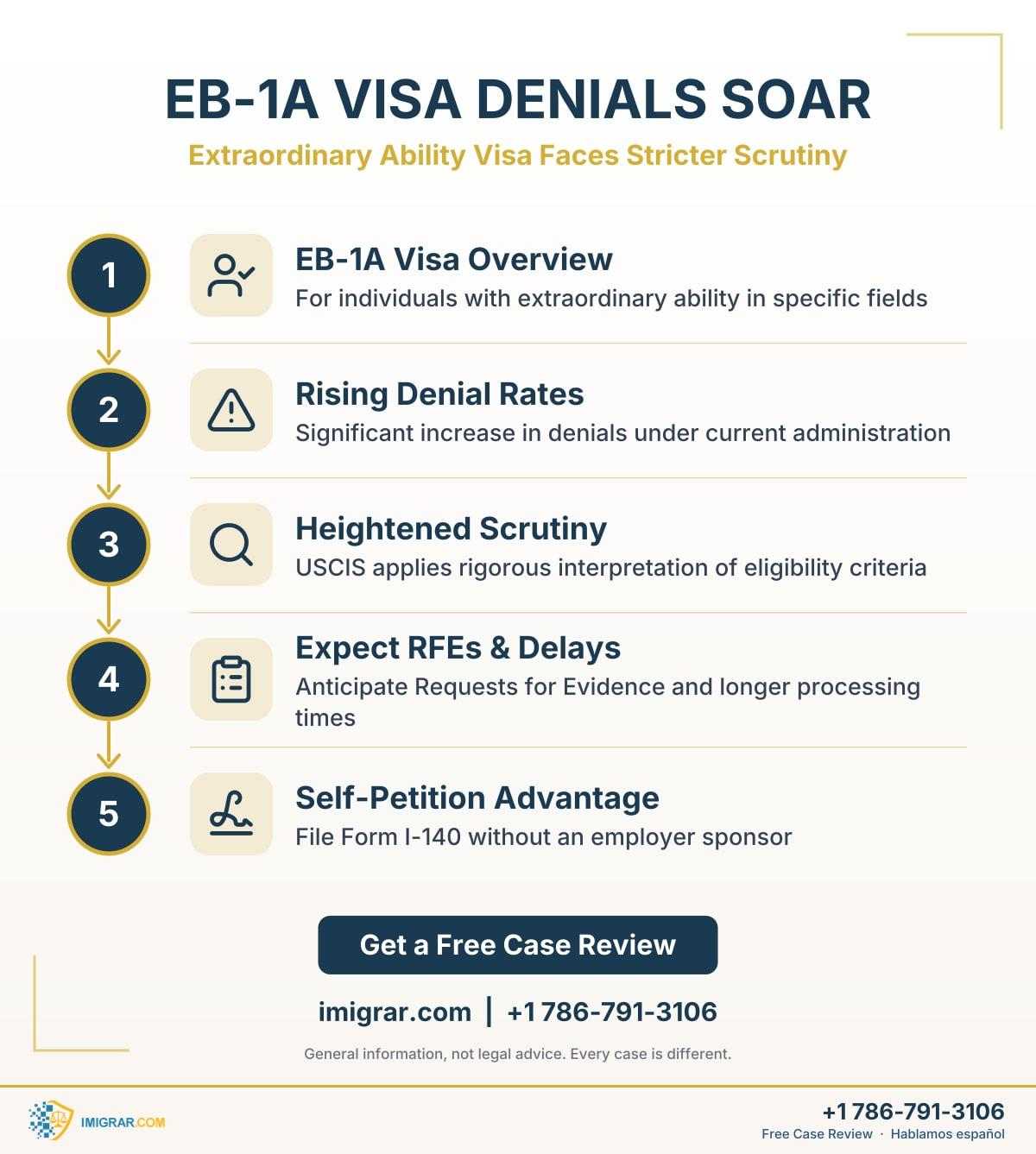
The escalation in EB-1A visa denials is a direct reflection of the current administration's ongoing efforts to implement stricter immigration enforcement and a more restrictive approach to various visa categories. Since President Trump's second term began on January 20, 2025, U.S. Citizenship and Immigration Services (USCIS) is operating under directives that emphasize heightened scrutiny of petitions, stricter interpretation of eligibility criteria, and increased requests for evidence (RFEs). This shift is part of a broader policy push to prioritize specific national interests as defined by the current administration, leading to a more challenging environment for applicants across the board, including those seeking visas based on extraordinary ability. The focus is increasingly on the *quantity and quality* of evidence, with a clear expectation for petitioners to demonstrate not just achievement, but a sustained, international impact and continued value to the United States.
How it can affect Florida residents
Florida, particularly the Central Florida region anchored by Orlando, is a vibrant hub for innovation, entertainment, tourism, healthcare, and technology. These sectors often attract individuals with extraordinary abilities – scientists conducting groundbreaking research, artists shaping cultural landscapes, entrepreneurs driving economic growth, and medical professionals advancing public health. For these talented individuals residing in Orlando, Miami, Tampa, or anywhere along the I-4 corridor and beyond, the increased denial rates mean:
- Heightened Scrutiny: Your EB-1A petition will likely face more rigorous examination than in previous years. USCIS officers are currently applying stricter interpretations of the "extraordinary ability" criteria, demanding more compelling and exhaustive evidence.
- Increased RFEs: You should anticipate receiving a Request for Evidence (RFE), which requires you to submit additional documentation to support your claim. Responding effectively to an RFE is critical and often determines the outcome of your case.
- Longer Processing Times: The increased scrutiny and volume of RFEs can contribute to longer processing times for **Form I-140** and subsequent applications like **Form I-485**. Checking the USCIS Processing Times page regularly is essential.
- Greater Need for Expert Legal Counsel: Navigating these elevated hurdles without experienced legal representation is significantly riskier. An expert immigration attorney can help you build an airtight case, anticipate potential challenges, and respond strategically to USCIS inquiries.
For Central Florida residents, especially those working in the burgeoning tech parks or medical cities around Orlando, understanding these shifts is paramount. The Orlando USCIS Field Office, like others nationwide, is implementing these more stringent guidelines, making professional guidance more valuable than ever.
Need Help? Our Orlando immigration team is ready to assist. Call +1 786-791-3106 for a free consultation, or message us online. Se Habla Español.
What the Extraordinary Ability (EB-1A) Visa Is (and Why It Matters)
The EB-1A visa is one of the most coveted pathways to U.S. permanent residency, designed for individuals who have demonstrated extraordinary ability in the sciences, arts, education, business, or athletics. It falls under the Employment-Based First Preference (EB-1) category, which is reserved for priority workers and typically has fewer backlogs than other employment-based categories, making it a faster route to a Green Card for eligible individuals.
A plain-English definition
Think of the EB-1A visa as the "top tier" Green Card for exceptional talent. It's for people who are at the very peak of their field, recognized nationally or internationally for their achievements. Unlike many other employment-based visas, the EB-1A often does not require an employer to sponsor the applicant, and it doesn't require a labor certification. This means a qualifying individual can "self-petition," making it an incredibly attractive option for truly extraordinary professionals. The core idea is that your presence and contributions will significantly benefit the United States, justifying your permanent residence.
Key terms you need to know
- Extraordinary Ability: This is the cornerstone of the EB-1A visa. It means you have a level of expertise indicating that you are one of the small percentage who has risen to the very top of your field of endeavor.
- EB-1A Visa: The specific classification for individuals with extraordinary ability in sciences, arts, education, business, or athletics. It’s an employment-based, first-preference visa category.
- Self-Petition: The ability for an individual to file their own immigrant petition (**Form I-140**) without an employer sponsor. This is a significant advantage of the EB-1A visa.
- USCIS (U.S. Citizenship and Immigration Services): The government agency responsible for adjudicating immigration petitions and applications, including the EB-1A.
- Petitioner: In the case of an EB-1A self-petition, the individual applicant is both the petitioner and the beneficiary. If an employer petitions, the employer is the petitioner.
- Beneficiary: The individual for whom the immigration benefit (the Green Card) is sought.
- Green Card / Permanent Residence: The ultimate goal of the EB-1A process, granting the beneficiary authorization to live and work permanently in the United States.
- Form I-140, Immigrant Petition for Alien Worker: The primary form filed with USCIS to request an EB-1A classification.
- Form I-485, Application to Register Permanent Residence or Adjust Status: The form filed by individuals already in the U.S. to change their immigration status to a permanent resident (Green Card holder) after their **Form I-140** is approved and a visa is available.
- Consular Processing: The alternative to **Adjustment of Status** for individuals outside the U.S. or ineligible to adjust status. It involves attending an interview at a U.S. embassy or consulate in their home country.
- Priority Date: The date USCIS receives your **Form I-140** petition. This date is crucial for determining visa availability, although EB-1A is often "current" for most nationalities, meaning a visa number is usually immediately available upon petition approval.
Current Immigration Law: The Foundation
The legal framework for the EB-1A visa is found in the Immigration and Nationality Act (INA), specifically INA Section 203(b)(1)(A). This statute outlines the stringent requirements for proving "extraordinary ability." The law demands a high standard of proof, and under the current administration, USCIS is interpreting these standards with unprecedented rigor.
Federal requirements
To qualify for an EB-1A visa, you must demonstrate "extraordinary ability" in the sciences, arts, education, business, or athletics through sustained national or international acclaim. This ability must be recognized in your field through extensive documentation, and you must intend to continue working in your field in the U.S. The law requires you to meet at least 3 of the following 10 criteria, or provide evidence of a one-time achievement (like a Nobel Prize or Olympic Medal):
- Receipt of Lesser Nationally or Internationally Recognized Prizes or Awards: Documentation of awards for excellence in your field.
- Membership in Associations Requiring Outstanding Achievement: Proof of membership in associations that demand outstanding achievement of their members, as judged by recognized national or international experts.
- Published Material About You in Professional or Major Trade Publications or Other Major Media: Articles, news features, or publications about your work in significant media outlets.
- Serving as a Judge of Others' Work: Evidence of your participation, either individually or on a panel, as a judge of the work of others in your field.
- Original Scientific, Scholarly, Artistic, Athletic, or Business-Related Contributions of Major Significance: Documentation of your original contributions that have had a major impact on your field.
- Authorship of Scholarly Articles in Professional or Major Trade Publications or Other Major Media: Evidence of your published articles in reputable journals or major media.
- Display of Your Work at Artistic Exhibitions or Showcases: Proof that your artistic work has been displayed at exhibitions or showcases.
- Performance in a Leading or Critical Role for Organizations with a Distinguished Reputation: Documentation of your leadership or critical role in organizations that have a distinguished reputation.
- High Salary or Other Significantly High Remuneration: Evidence of a high salary or other substantial payment for your services compared to others in your field.
- Commercial Success in the Performing Arts: Documentation of commercial successes, such as box office receipts or sales records for your performances.
Important: Simply meeting three criteria is not enough. USCIS officers are currently evaluating whether, taken together, the evidence demonstrates that the applicant has achieved "sustained national or international acclaim" and that their achievements are truly "extraordinary." A strong petition requires a narrative that ties all evidence together to paint a comprehensive picture of your exceptional standing in your field. Under the current administration, the emphasis is heavily on the *quality* and *impact* of your achievements, not just the quantity of documents submitted.
The primary form for initiating this process is **Form I-140, Immigrant Petition for Alien Worker**. Once **Form I-140** is approved and a visa is available, individuals physically present in the U.S. can apply for **Adjustment of Status** using **Form I-485**. Those outside the U.S. will undergo Consular Processing.
For official information and to download forms, always refer to the USCIS official website.
Florida-specific considerations
While immigration law is federal, the local context can influence an applicant's ability to gather evidence and demonstrate impact. Florida is home to numerous institutions and industries that foster extraordinary talent:
- Academic & Research Institutions: Universities like the University of Central Florida (UCF) in Orlando, the University of Florida, and the University of Miami are research powerhouses. Faculty members, post-doctoral researchers, and scientists at these institutions often produce groundbreaking work that could qualify for EB-1A.
- Healthcare Innovation: Orlando's "Medical City" in Lake Nona is a hub for medical research, biotechnology, and advanced healthcare. Physicians, medical researchers, and innovators in this sector frequently meet the criteria for extraordinary ability.
- Arts & Entertainment: With major theme parks, performing arts centers, and a thriving independent arts scene, Florida attracts exceptional artists, performers, and creative professionals.
- Business & Technology: The Orlando tech scene, with its growing startups and established companies, provides opportunities for entrepreneurs and business leaders to make significant contributions.
If your case is in Orlando, your ability to connect with local professional associations, secure letters of recommendation from distinguished experts within Florida's leading institutions, and highlight your contributions to the state's economy and culture can strengthen your petition. The Orlando USCIS Field Office processes many applications from professionals in these fields, and understanding how to tailor your evidence to showcase your local, national, and international impact is key.
How to Apply for an Extraordinary Ability (EB-1A) Visa: A Complete Step-by-Step Guide
Applying for an EB-1A visa is a complex process that demands meticulous preparation and a deep understanding of USCIS requirements. Given the current administration's heightened scrutiny, following each step precisely and strategically is more critical than ever.
1) Self-Assessment & Eligibility Confirmation
Before investing time and resources, a thorough self-assessment is crucial. You must objectively determine if you meet at least three of the ten USCIS criteria for extraordinary ability. This isn't just about having achievements; it's about having *documented* achievements that meet the stringent legal definitions.
- Review the 10 Criteria: Go through each of the ten criteria listed above. For each, ask yourself: "Do I have strong, verifiable evidence that unequivocally proves I meet this criterion?"
- Gather Initial Documentation: Collect any certificates, awards, publications, media mentions, or letters of recommendation you already possess. This initial collection helps you visualize the strength of your potential case.
- Consult an Expert: This is arguably the most important initial step. An experienced immigration attorney specializing in EB-1A visas can provide an honest assessment of your qualifications and advise on whether pursuing this visa is viable. They can identify gaps in your evidence and suggest strategies for strengthening your case.
2) Gathering Comprehensive Evidence
This is the most time-consuming and critical phase. The success of your EB-1A petition hinges entirely on the quality and quantity of your evidence. Under the current administration, USCIS demands overwhelming proof.
- Detailed List of Required Documents (Examples):
- Awards: Copies of certificates, plaques, official letters for national or international awards (Criterion 1).
- Memberships: Official letters from associations, membership certificates, bylaws showing criteria for membership (Criterion 2).
- Published Materials ABOUT You: Copies of articles, interviews, news segments from major media outlets or professional publications, including translation if not in English (Criterion 3).
- Judging Experience: Official invitations, programs, letters from organizers, or peer review certificates confirming your role as a judge or reviewer (Criterion 4).
- Original Contributions: Patents, citations to your work, letters from independent experts detailing the major significance of your contributions, evidence of commercial success directly tied to your work (Criterion 5).
- Scholarly Articles BY You: Copies of published articles in peer-reviewed journals, books, conference proceedings (Criterion 6).
- Artistic Displays: Exhibition catalogs, gallery invitations, reviews of your work, sales records (Criterion 7).
- Leading/Critical Role: Organizational charts, job descriptions, letters from senior management describing your responsibilities and the organization's distinguished reputation (Criterion 8).
- High Salary: Employment contracts, pay stubs, W-2 forms, tax returns, and salary surveys or expert opinions showing your compensation is significantly higher than peers (Criterion 9).
- Commercial Success (Arts): Box office receipts, sales figures, contracts, professional reviews (Criterion 10).
- Expert Letters: Crucial letters from independent experts (not collaborators or former supervisors, unless their independence can be clearly established) in your field, attesting to your extraordinary ability and the significance of your contributions. These letters must be detailed and specific.
- Resume/CV: A comprehensive document outlining your career, achievements, and publications.
- Proof of Intent to Work in Field: Letters of intent, job offers, business plans, or academic appointments in your field in the U.S.
- Organize and Translate: All documents must be clearly organized, labeled, and indexed. Any document not in English must be accompanied by a certified English translation.
3) Preparing and Filing Form I-140, Immigrant Petition for Alien Worker
Once your evidence is meticulously gathered and organized, your attorney will prepare the **Form I-140** petition packet.
- Petition Letter: This is the cornerstone of your submission. Your attorney will draft a comprehensive letter that argues how your evidence meets at least three of the ten criteria, and how, in the totality of the circumstances, you demonstrate sustained national or international acclaim and extraordinary ability. This letter must directly address current USCIS interpretations and anticipate potential challenges.
- Assemble the Petition: The **Form I-140** itself, the petition letter, and all supporting evidence are assembled into a robust package. This typically includes a table of contents and tabs for each piece of evidence for easy navigation by the USCIS officer.
- File with USCIS: The complete petition is mailed to the appropriate USCIS Service Center. You will receive a **Form I-797C, Notice of Action**, confirming receipt and providing a **Priority Date**.
- Premium Processing (Optional): You may choose to file **Form I-907, Request for Premium Processing Service**, for an expedited review (typically within 15 calendar days). While this costs an additional fee, it can provide a quicker initial decision or RFE.
4) Responding to Requests for Evidence (RFEs)
Given the current climate, receiving an **RFE** is increasingly common. This is not necessarily a denial, but a critical opportunity to strengthen your case.
- Analyze the RFE: USCIS will send a letter detailing specific areas where your initial evidence was deemed insufficient. Your attorney will carefully analyze these points.
- Gather Additional Evidence: This might involve obtaining new expert letters, more detailed documentation of your impact, or clarifying existing evidence.
- Craft a Robust Response: A detailed response letter, addressing each point of the RFE with new or refined evidence, is prepared and submitted within the specified deadline (usually 87 days).
5) Adjusting Status (Form I-485) or Consular Processing
Once your **Form I-140** is approved and a visa number is available (which is often immediately for EB-1A), you proceed to the final stage.
- Adjustment of Status (if in U.S.): If you are lawfully present in the U.S., you file **Form I-485, Application to Register Permanent Residence or Adjust Status**. This typically involves:
- **Form I-485** itself.
- **Form I-765, Application for Employment Authorization (EAD)**.
- **Form I-131, Application for Travel Document (Advance Parole)**.
- Birth certificate, marriage certificate (if applicable), passport photos, medical examination results (**Form I-693**), police clearances, and other biographical documents.
You may also attend a biometric services appointment for fingerprints and photos.
- Consular Processing (if outside U.S. or ineligible for Adjustment): If you are outside the U.S., your approved petition is sent to the U.S. Department of State's National Visa Center (NVC). You will then submit required documents, pay fees, and attend a visa interview at a U.S. embassy or consulate in your home country.
6) The Interview & Final Decision
Whether through **Adjustment of Status** or Consular Processing, an interview is typically the final step.
- Prepare for the Interview: Your attorney will help you prepare for common questions about your background, achievements, and intentions in the U.S.
- Attend the Interview: For Adjustment of Status, this typically takes place at a local USCIS Field Office (e.g., the Orlando USCIS Field Office). For Consular Processing, it's at a U.S. embassy or consulate abroad.
- Decision: Following a successful interview, USCIS or the Consular Officer will make a final decision. If approved, you will receive your Green Card or immigrant visa.
Concerned about the new EB-1A challenges? Imigrar has the expertise to guide you. Contact our Orlando office at +1 786-791-3106 for a free consultation. Se Habla Español.
Practical Steps You Can Take Today
Even with increased scrutiny, the EB-1A visa remains a viable option for truly exceptional individuals. Taking proactive steps can significantly enhance your chances of success.
Actionable checklist with 5+ items
- Self-Assess Honestly: Review the 10 criteria again. Do you genuinely meet at least three with strong, documented evidence? If unsure, seek professional advice.
- Start Document Gathering NOW: Begin compiling every piece of evidence related to your achievements. Think broadly: awards, publications, media mentions, judging roles, significant contributions, high salary.
- Identify Potential Expert Recommenders: Make a list of independent, distinguished experts in your field who know your work and can write strong letters of recommendation. They should ideally not be current collaborators or direct supervisors.
- Research Your Field's "Top": Understand what constitutes "the top" in your specific niche. What are the key awards, publications, or metrics that demonstrate national or international acclaim?
- Consult an Experienced Immigration Attorney: This is critical. An attorney specializing in EB-1A cases can provide an objective assessment, help you identify and strengthen evidence, and strategically present your case to USCIS.
- Stay Informed: Regularly check official USCIS updates and reputable immigration news sources. The landscape can change.
Document preparation guidance
- Quality Over Quantity (but quantity helps): While you need to meet 3 criteria, the overall strength of your petition matters. Provide as much compelling evidence as possible, but ensure each piece is relevant and impactful.
- Clarity and Organization: USCIS officers review thousands of petitions. Make their job easier. Use clear labels, a comprehensive table of contents, and logical organization.
- Certifications and Translations: All copies of documents must be clearly legible. Any document not in English must be accompanied by a complete and accurate English translation, certified by the translator.
- Expert Letters: These are paramount. They should come from independent experts who clearly explain your extraordinary ability and the significance of your contributions to the field. Avoid generic letters; specificity is key.
Timeline expectations
The EB-1A process, especially under current conditions, can take a significant amount of time. While the EB-1A category itself is often "current" (meaning a visa number is usually immediately available), the adjudication process for your petition can vary.
- Evidence Gathering: 3-6 months or more, depending on how much documentation you already have and how many new letters you need to secure.
- Petition Preparation: 1-2 months, depending on the complexity of your case and your attorney's workload.
- USCIS Processing for Form I-140:
- Regular Processing: Varies significantly by Service Center. Check the USCIS Processing Times page, but expect several months to over a year.
- Premium Processing: 15 calendar days for an initial decision or RFE.
- RFE Response Period: Typically up to 87 days to respond, followed by further USCIS review.
- Adjustment of Status (**Form I-485**) / Consular Processing:
- Adjustment: Can take 6-18 months or more after **Form I-140** approval, including biometrics and interview.
- Consular Processing: Generally 3-6 months after NVC processing is complete, leading to an interview.
Reminder: These are estimates. Individual circumstances, USCIS workload, and policy shifts can all affect actual timelines. The current administration's increased scrutiny can extend these periods, especially if RFEs are issued.
How Imigrar Helps Immigrants in Orlando
At Imigrar, our commitment is to "Keep Families Together" by providing unparalleled legal expertise and compassionate support to immigrants across the U.S., from our base in Orlando, Florida. We understand that applying for an EB-1A visa is a monumental undertaking, even more so with the current administration's heightened scrutiny.
Our experience and expertise
Our team of dedicated immigration attorneys possesses extensive experience in navigating the complexities of employment-based visas, including the challenging EB-1A category. We stay abreast of the latest USCIS policy changes, interpretations, and adjudicatory trends under the current administration. Our expertise allows us to:
- Strategic Case Assessment: We conduct a thorough evaluation of your qualifications, identifying your strongest points and potential weaknesses, and advising on the most strategic approach.
- Meticulous Evidence Collection: We guide you through the exhaustive process of gathering, organizing, and presenting compelling evidence that directly addresses USCIS criteria and expectations.
- Powerful Petition Drafting: Our attorneys craft persuasive and legally sound petition letters that clearly articulate your extraordinary ability and its national or international acclaim, anticipating and mitigating potential RFEs.
- Effective RFE Responses: Should you receive an RFE, we develop comprehensive and strategic responses, ensuring all USCIS concerns are addressed with robust supporting documentation.
- Interview Preparation: We prepare you thoroughly for your Adjustment of Status or Consular Processing interview, ensuring you feel confident and ready to articulate your case.
- Ongoing Communication: We keep you informed at every stage of the process, providing clear explanations and prompt updates.
For clients in Orlando and throughout Florida, we are intimately familiar with the local USCIS field office procedures and regional considerations that can impact your case. We leverage this local knowledge alongside our national expertise to provide the best possible representation.
Free consultation offer
Understanding your options and the current challenges is the first step. Imigrar offers a free, confidential consultation to discuss your specific situation, assess your eligibility for an EB-1A visa, and outline a tailored strategy for success. There's no obligation, just expert advice to help you navigate these uncertain times.
Se Habla Español: We are proud to serve our diverse community, and our team is fully bilingual, offering services in both English and Spanish to ensure clear and effective communication.
Frequently Asked Questions
Q: Given the increased denials, is it still worth applying for an EB-1A visa?
A: Absolutely, for those who truly qualify. While the current administration's policies have made the process more challenging, the EB-1A remains a premier pathway for individuals with extraordinary ability. The key is to build an exceptionally strong, meticulously documented case with expert legal counsel. If you meet the criteria and have compelling evidence, pursuing this visa can still be a successful route to permanent residency.
Q: What kind of evidence is considered "major significance" for my contributions?
A: "Major significance" means your contributions have had a profound impact on your field, transcending typical professional achievements. This could include breakthroughs that have been widely adopted, innovations that have fundamentally changed practices, or research that has opened new avenues of study. Evidence often includes patents, high citation counts of your publications (especially compared to peers), independent expert testimonials, evidence of implementation of your innovations, or widespread media recognition of your contributions. Simply performing well in your job is not enough; you must demonstrate a broader, transformative impact.
Q: How does my immigration status in the U.S. affect my EB-1A application?
A: Your current immigration status is primarily relevant for the final step: whether you can adjust status in the U.S. (**Form I-485**) or must undergo consular processing abroad. To adjust status, you must generally be in a lawful nonimmigrant status at the time of filing and maintain it until the Green Card is issued. If you are out of status or have certain immigration violations, you might only be able to pursue consular processing, which carries its own set of requirements and potential challenges (e.g., bars to re-entry). It's crucial to discuss your full immigration history with an attorney to determine the best path.
Q: What are the typical timelines for the EB-1A process, especially now?
A: As outlined above, timelines can vary significantly. Under the current administration, anticipate longer processing times due to increased scrutiny and RFEs. While **Form I-140** can be premium processed for an initial decision in 15 days, the full journey from evidence gathering to Green Card can easily take 1.5 to 3 years or even longer, depending on your individual circumstances, the complexity of your case, and USCIS workload. It is always best to start as early as possible.
Q: What are the total costs involved in applying for an EB-1A visa?
A: The costs include government filing fees and legal fees.
- USCIS Filing Fees:
- **Form I-140**: $715 (as of current date)
- **Form I-907** (Premium Processing, optional): $2,805 (as of current date)
- **Form I-485**: $1,440 (including biometric services for most adults, as of current date)
- **Form I-765** (EAD, if filing with **I-485**): No separate fee
- **Form I-131** (Advance Parole, if filing with **I-485**): No separate fee
- Medical Examination (**Form I-693**): Varies by civil surgeon, typically $200-$500.
- Legal Fees: These vary widely based on the complexity of the case, the attorney's experience, and the extent of services provided. Obtaining a quote during your free consultation is essential.
- Other Costs: Translation services, courier fees, expert witness fees (if applicable), and travel for interviews.
Q: What happens if my EB-1A petition is denied?
A: A denial is certainly disappointing, but it's not always the end of the road. If your **Form I-140** is denied, your attorney can review the denial notice to understand the reasons. Options may include:
- Filing a Motion to Reopen or Reconsider (**Form I-290B**): If there was a legal error in the decision or if new facts can be presented.
- Filing a New Petition: Often, if the denial was due to insufficient evidence, gathering stronger evidence and filing a completely new **Form I-140** is a viable strategy. This is especially common when the initial petition was self-filed or prepared without expert guidance.
- Exploring Other Visa Options: If the EB-1A is clearly not appropriate, your attorney can help you identify other employment-based or family-based visa categories for which you might qualify.
Common Mistakes (and How to Avoid Them)
The EB-1A visa is not for the faint of heart, and mistakes can be costly, especially with the current administration's strict approach. Avoiding these common pitfalls is essential for success.
Mistake #1: Underestimating the "Extraordinary" Standard
Many applicants believe their impressive professional achievements are enough. However, USCIS's definition of "extraordinary" is exceptionally high. It's not just about being good at what you do; it's about being at the absolute pinnacle of your field, with sustained national or international acclaim.
How to Avoid: Conduct a rigorous self-assessment against the 10 criteria. Don't just tick boxes; critically evaluate if your evidence truly demonstrates exceptionalism, not just competence. Seek an objective, expert opinion from an immigration attorney from the outset. They can tell you if your case is strong enough or if you need to build more evidence.
Mistake #2: Insufficient or Poorly Presented Evidence
A common pitfall is submitting a large volume of unorganized or irrelevant documents. Another is providing evidence that is weak or doesn't directly address the USCIS criteria. For example, generic letters of recommendation from colleagues or supervisors often hold little weight.
How to Avoid: Focus on quality, impact, and relevance. Every piece of evidence should directly support one or more of the 10 criteria. Ensure all documents are clearly labeled, organized, and accompanied by a compelling petition letter that ties everything together. Prioritize strong, independent letters from internationally recognized experts who can genuinely attest to your unique contributions and standing in the field.
Mistake #3: Ignoring or Inadequately Responding to Requests for Evidence (RFEs)
Receiving an RFE can be disheartening, but it's a critical opportunity. Many applicants either provide a rushed, insufficient response or misunderstand what USCIS is truly asking for. Under the current administration, RFEs are more common and more demanding.
How to Avoid: Treat an RFE as a second chance to prove your case. Work closely with an experienced attorney to thoroughly analyze the RFE, understand the underlying concerns, and gather *new* and *stronger* evidence specifically tailored to address each point raised by USCIS. A robust RFE response can often turn a potentially denied case into an approval.
Mistake #4: Attempting to Self-Petition Without Expert Legal Guidance
While the EB-1A allows for self-petitioning, navigating its complexities without an attorney, especially in the current climate, is highly risky. The legal nuances, the exacting standards of proof, and the strategic presentation required are often beyond the scope of a layperson.
How to Avoid: Engage an experienced immigration attorney specializing in EB-1A visas. Their expertise is invaluable in assessing eligibility, strategizing evidence collection, drafting persuasive legal arguments, and skillfully responding to USCIS inquiries. An attorney can significantly increase your chances of success and save you time, stress, and potentially costly denials.
Ready to start your EB-1A journey with confidence? Don't face the new challenges alone. Call Imigrar in Orlando at +1 786-791-3106 for a free consultation. Se Habla Español.
Keep Your Extraordinary Ability on the Path to the U.S.
The current landscape for the EB-1A "extraordinary ability" visa is undoubtedly more challenging under President Trump's second term, with increased denials reflecting a stricter enforcement environment. However, for individuals who truly embody the spirit of extraordinary achievement, the path to permanent residency in the United States remains open and attainable. The key lies in understanding the heightened scrutiny, meticulously preparing your case, and securing expert legal guidance.
At Imigrar, we are committed to helping you navigate these complexities. Our experienced Orlando immigration attorneys are dedicated to building compelling cases that showcase your unique talents and contributions, ensuring your petition stands the best possible chance of approval. We believe in your ability to enrich the United States, and we are here to help you achieve your dreams of a secure future.
Don't let policy shifts deter your aspirations. If you possess extraordinary ability and are seeking to make the U.S. your permanent home, contact Imigrar today. We offer a free consultation to discuss your case, answer your questions, and develop a strategic plan tailored to your unique situation. We are here to help you keep your family together and build a new life in America.
Call us now at +1 786-791-3106 or message us online. Se Habla Español. Your extraordinary journey starts here.
Related Topics
Need Legal Assistance?
Our experienced immigration attorneys are here to help with your case. Contact Imigrar today for a free consultation and let us guide you through the legal process with confidence.
📍 Orlando, Florida • Serving clients nationwide
📧 info@imigrar.com