
H-1B Visa Lottery FY2027: New Rules & How to Prepare in Orlando
Understand the critical H-1B visa lottery changes for FY2027. Imigrar guides you through new rules, timelines, and how to maximize your chances, serving Orlando and nationwide.
Navigating the complex world of U.S. immigration law can be challenging, especially when crucial programs like the H-1B visa lottery undergo significant changes. For skilled foreign workers and the U.S. employers who seek their talent, the H-1B visa is a lifeline to opportunity. As we approach the registration period for the Fiscal Year 2027 (FY2027) H-1B lottery, new rules are set to impact how applications are submitted and selected. Understanding these changes is not just important—it’s essential for anyone hoping to secure an H-1B visa.
At Imigrar, an immigration law firm based in Orlando, Florida, we are committed to keeping families together and helping talented individuals achieve their professional goals in the United States. We serve clients nationwide and are deeply invested in providing clear, actionable guidance on the latest immigration developments. This comprehensive guide will break down the H-1B visa lottery changes for FY2027, explaining what they mean for you and how to prepare effectively.
Need Help Navigating H-1B Changes? Our Orlando immigration team is ready to assist. Call +1 786-791-3106 for a free consultation, or message us online. Se Habla Español.
The reporting that sparked this guide
The information and guidance in this article are inspired by recent discussions and announcements regarding upcoming modifications to the H-1B visa lottery process. For ongoing developments and official updates, we encourage you to monitor reputable legal news sources and government publications.
H-1B Visa Lottery Changes for FY2027 (Legal News)
What This News Means for Immigrants in Orlando and Across Florida
The H-1B visa program is a cornerstone for many professionals seeking to work in the U.S. and for American companies needing specialized skills. Any changes to its lottery system send ripples across the nation, and Florida is no exception. Our state, particularly the vibrant tech and tourism hubs around Orlando, Tampa, and Miami, relies heavily on skilled foreign talent, making these updates particularly relevant for our local economy and immigrant communities.
Why this news is showing up now
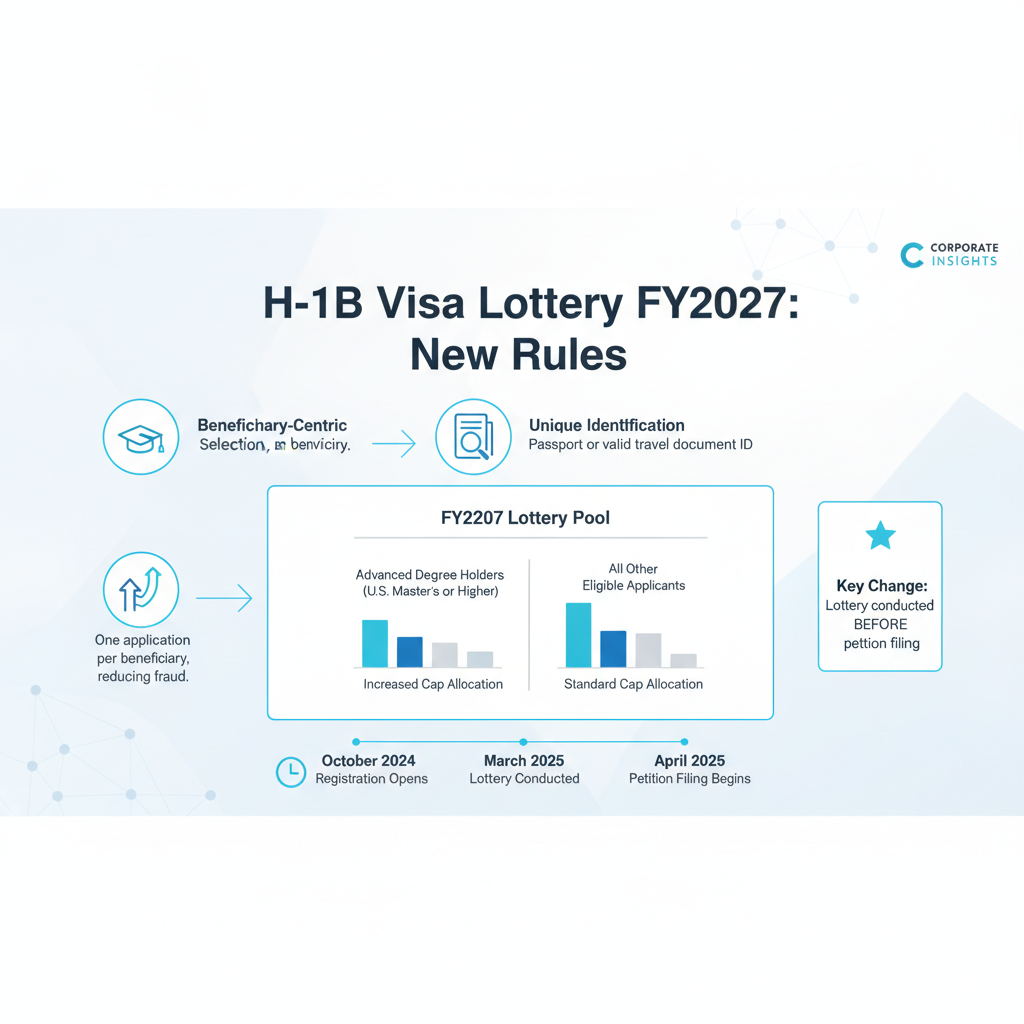
The U.S. government, through the Department of Homeland Security (DHS) and U.S. Citizenship and Immigration Services (USCIS), frequently reviews and updates immigration regulations to address program integrity, efficiency, and evolving economic needs. The H-1B visa program, with its annual cap and high demand, is often a target for such adjustments. For Fiscal Year 2027, which begins on October 1, 2026, the lottery registration period typically opens in March 2027. USCIS often finalizes and announces significant procedural changes months in advance to give petitioners and beneficiaries time to prepare. The current focus is on enhancing the integrity of the lottery process and preventing fraud, building on the "beneficiary-centric" selection process introduced in recent years.
This news is emerging now as USCIS aims to refine the registration process further, ensuring that each eligible beneficiary has an equal chance, regardless of how many employers register on their behalf. This proactive communication allows employers and prospective H-1B workers to understand the new landscape before the crucial FY2027 registration window opens.
How it can affect Florida residents
Florida is a dynamic state, a magnet for innovation, hospitality, healthcare, and technology. Cities like Orlando, often referred to as "Medical City" and a growing tech hub, attract a diverse pool of international talent. For Florida residents currently on F-1 OPT/STEM OPT, J-1, or other nonimmigrant statuses hoping to transition to H-1B, these changes are paramount. Similarly, for Florida-based companies, from large corporations along the I-4 corridor to burgeoning startups in Orange County, understanding the new rules is critical for their talent acquisition strategies.
- Increased Scrutiny: The new rules aim to curb fraudulent multiple registrations. This means USCIS will likely employ more rigorous checks on registrations, potentially leading to increased Requests for Evidence (RFEs) or even denials if inconsistencies are found.
- Fairer Chances: The "beneficiary-centric" approach, which ensures each unique beneficiary has one chance in the lottery regardless of multiple registrations, is being further solidified. This is good news for genuinely qualified individuals, as it levels the playing field.
- Employer Responsibility: Florida employers must be more diligent than ever in their H-1B registration processes. Any involvement in schemes to submit multiple registrations for a single beneficiary could lead to severe penalties.
- Timelines: While the core H-1B timeline for FY2027 (March 2027 registration) remains, any new requirements could add complexity to the initial preparation phase, necessitating earlier engagement with legal counsel.
For those living in Central Florida, whether you’re a recent graduate from UCF or a professional working in the Lake Nona area, these changes directly impact your path to long-term employment in the U.S. Imigrar is here to help you navigate these evolving regulations with confidence.
What H-1B Visa Lottery Changes for FY2027 Is (and Why It Matters)
The H-1B visa program allows U.S. employers to temporarily employ foreign workers in specialty occupations. A specialty occupation generally requires a bachelor's degree or higher in a specific field. Due to overwhelming demand, USCIS conducts a lottery to select enough petitions to meet the annual cap.
A plain-English definition
Imagine the H-1B visa as a special work permit for highly skilled jobs, like engineers, doctors, IT professionals, or architects. Each year, the U.S. government only issues a limited number of these visas—typically 85,000, with 20,000 reserved for those with a U.S. master's degree or higher. Because far more people apply than there are visas available, USCIS runs a computer-generated random selection process, known as the "H-1B Lottery."
The "changes for FY2027" refer to new rules that USCIS is implementing to make this lottery process fairer and to prevent fraud. The most significant change, which has been evolving over recent years and is now firmly established for FY2027, is the shift to a "beneficiary-centric" selection process. This means that instead of giving each *employer* a chance for every registration they submit (even if it's for the same person), the lottery now focuses on the *individual foreign worker*. Each unique individual (beneficiary) gets only one chance in the lottery, no matter how many employers register them. This aims to stop companies from submitting multiple registrations for the same person to increase their odds unnaturally.
Important: These changes are designed to enhance the integrity of the H-1B program, ensuring that the lottery truly provides an equal opportunity for all eligible beneficiaries and their sponsoring employers.
Key terms you need to know
- H-1B Visa: A nonimmigrant visa that allows U.S. employers to temporarily employ foreign workers in specialty occupations.
- Specialty Occupation: An occupation that requires theoretical and practical application of a body of highly specialized knowledge, and a bachelor's or higher degree in the specific specialty (or its equivalent) as a minimum for entry into the occupation in the U.S.
- Cap-Subject H-1B: H-1B petitions that are subject to the annual statutory cap (currently 65,000 regular cap + 20,000 U.S. master’s cap).
- Cap-Exempt H-1B: Certain employers (e.g., institutions of higher education, non-profit research organizations) are exempt from the annual cap.
- Beneficiary: The foreign worker for whom the H-1B visa is being sought.
- Petitioner: The U.S. employer filing the H-1B petition on behalf of the foreign worker.
- H-1B Electronic Registration Process: The online system where prospective petitioners (employers) submit registrations for beneficiaries during a designated period. This is the first step before the lottery.
- Lottery Selection: The random computer-generated process USCIS uses to select registrations when the number of eligible registrations exceeds the annual cap.
- LCA (Labor Condition Application): Form ETA-9035. An application filed with the Department of Labor (DOL) by the employer, attesting to certain wage and working conditions for the H-1B worker. This must be certified before filing the H-1B petition.
- Form I-129, Petition for a Nonimmigrant Worker: The primary form filed by the employer with USCIS after a registration is selected in the lottery.
- Premium Processing: An optional service offered by USCIS for an additional fee, guaranteeing processing within a specified timeframe (typically 15 calendar days).
Current Immigration Law: The Foundation
The H-1B visa program is governed primarily by the Immigration and Nationality Act (INA), specifically Sections 101(a)(15)(H)(i)(b) and 214(g). These statutes establish the framework for specialty occupations, the annual numerical limitations (the "cap"), and the general eligibility criteria for both employers and beneficiaries.
Federal requirements
To qualify for an H-1B visa, both the employer (petitioner) and the foreign worker (beneficiary) must meet specific federal requirements:
For the Employer (Petitioner):
- The employer must offer a job in a specialty occupation.
- The employer must file a Labor Condition Application (LCA), Form ETA-9035, with the Department of Labor (DOL) and receive certification. This form attests that the employer will pay the H-1B worker at least the prevailing wage for the occupation in the area of employment or the actual wage paid to other employees with similar experience and qualifications, whichever is higher. It also attests to providing working conditions that will not adversely affect other workers.
- The employer must have an Employer Identification Number (EIN).
- The employer must demonstrate a legitimate need for the H-1B worker.
For the Employee (Beneficiary):
- The beneficiary must hold a bachelor's degree or its equivalent, or a higher degree required by the specialty occupation, from an accredited college or university.
- Alternatively, the beneficiary may possess an unrestricted state license, or certifications demonstrating professional standing, which authorizes them to fully practice the specialty occupation.
- Another path to eligibility is through work experience equivalent to a bachelor's degree. Generally, three years of progressive work experience in the specialty field can be considered equivalent to one year of college education.
- The beneficiary must meet the minimum requirements of the specialty occupation.
The H-1B cap is set at 65,000 visas annually for the regular cap, with an additional 20,000 visas reserved for those with a U.S. master's degree or higher. These numbers reset each fiscal year. USCIS utilizes an electronic registration system to manage the lottery selection process for these cap-subject petitions.
For official information and forms, always refer to the USCIS official website.
Florida-specific considerations
While H-1B is a federal program, its impact and application have unique nuances in Florida. The state's diverse economy means H-1B workers are sought across various sectors:
- Technology: Major tech hubs in Orlando, Tampa, and South Florida frequently recruit H-1B workers for roles in software development, data analytics, cybersecurity, and IT consulting.
- Healthcare: Florida's growing healthcare sector, including hospitals and research institutions around "Medical City" in Orlando, sponsors H-1B visas for doctors, nurses, and medical researchers.
- Hospitality & Tourism: While less common for the H-1B (which focuses on specialty occupations), some highly specialized roles in management, finance, or unique cultural expertise within the tourism industry might qualify.
- Education: Universities and colleges across Florida, including the University of Central Florida (UCF), are often cap-exempt employers, sponsoring H-1B visas for professors and researchers without going through the lottery.
For employers in Central Florida, understanding the prevailing wage for specific occupations in areas like Orlando or Kissimmee is crucial for the LCA process. The Orlando USCIS Field Office primarily handles interviews for adjustment of status applications, but the initial H-1B petitions are processed at designated service centers (e.g., California Service Center or Vermont Service Center).
How to Navigate the New H-1B Lottery Rules: A Complete Step-by-Step Guide
Successfully securing an H-1B visa, especially with the new rules for FY2027, requires meticulous preparation and adherence to strict timelines. This guide outlines the essential steps for both employers and beneficiaries.
1) Employer Assessment, LCA, and Beneficiary Qualification
Before any registration can occur, the employer must confirm the position qualifies as a specialty occupation and the beneficiary meets the educational requirements.
- Employer Actions:
- Job Analysis: Determine if the job duties require a bachelor's degree or higher in a specific field.
- Wage Determination: Research the prevailing wage for the occupation in the specific geographic area of employment (e.g., Orlando, FL). This is a critical component of the LCA.
- LCA Filing (Form ETA-9035): The employer must file a Labor Condition Application with the Department of Labor. This attests to paying the prevailing wage and providing appropriate working conditions. The LCA must be certified by DOL before the H-1B petition can be filed.
- Internal Review: Ensure the company can meet all H-1B compliance requirements, including public access file maintenance.
- Beneficiary Actions:
- Credential Evaluation: If your degree is from outside the U.S., obtain an official academic credential evaluation to determine its U.S. equivalent.
- Resume/CV Preparation: Ensure your professional experience and qualifications are clearly documented.
- Proof of Status: Gather documents proving your current immigration status (e.g., I-20 for F-1, DS-2019 for J-1, I-94 arrival record).
- Required Documents for this step (internal for employer/beneficiary):
- Detailed Job Description
- Beneficiary's Degree Certificates and Transcripts
- Foreign Degree Evaluation (if applicable)
- Beneficiary's Resume/CV
- Current Immigration Documents (Passport, Visa, I-94, I-20/DS-2019, EAD)
- DOL's Prevailing Wage Determination (if obtained through a specific request)
Timeline Expectation: LCA processing can take 7-10 business days. This must be completed *before* the H-1B petition filing, but not necessarily before registration.
2) H-1B Electronic Registration Period (March 2027)
This is the initial, crucial step for cap-subject H-1B visas. The employer submits an electronic registration for each beneficiary they wish to sponsor.
- Employer Actions:
- Create/Access USCIS Online Account: The employer (or their authorized representative, like Imigrar) must have a USCIS online account.
- Submit Registration: During the designated registration period (typically in March, over a 2-3 week window), submit one electronic registration per beneficiary.
- Pay Registration Fee: A non-refundable fee (historically $10, but could increase for FY2027) is required for each registration.
- Ensure Accuracy: Double-check all beneficiary information (name, date of birth, country of birth, passport number, master’s degree eligibility) as this is directly linked to the "beneficiary-centric" selection.
- Beneficiary Actions:
- Provide Accurate Information: Ensure your employer or attorney has your precise personal details and passport information.
- Communicate with Employer: Verify that your employer is aware of the new "beneficiary-centric" rules and is only submitting one registration for you, or is coordinating if multiple employers plan to register you (though only one will be selected per beneficiary).
- Required Documents for this step (information required for online form):
- Beneficiary's Full Legal Name
- Beneficiary's Date of Birth
- Beneficiary's Country of Birth
- Beneficiary's Passport Number
- U.S. Master's Degree Information (if applicable)
- Employer's Name, EIN, and Address
- Attorney/Representative G-28 Information (if applicable)
Warning: Under the new rules, if multiple registrations are submitted by related entities for the same beneficiary to unfairly increase selection chances, *all* registrations for that beneficiary may be denied or revoked.
3) Lottery Selection and Petition Filing (April - June 2027)
After the registration period closes, USCIS conducts the lottery. If selected, the employer receives a notification and can proceed to file the full H-1B petition.
- Employer Actions:
- Monitor Selection Status: Check the USCIS online account for selection notifications (typically by late March or early April).
- Prepare Form I-129: If selected, prepare and file Form I-129, Petition for a Nonimmigrant Worker, along with all supporting documentation.
- Gather Supporting Evidence: Collect evidence for the specialty occupation, beneficiary qualifications, employer-employee relationship, and certified LCA.
- Adhere to Filing Window: USCIS provides a specific 90-day window to file the H-1B petition after selection notification. Missing this deadline means the selection is forfeited.
- Pay Filing Fees: Submit all required USCIS fees, including the base filing fee, ACWIA fee, fraud prevention and detection fee, and public law 114-113 fee (if applicable).
- Beneficiary Actions:
- Provide Documents Promptly: Supply any requested personal documents, such as academic records, employment verification letters, and passport copies, to your employer or attorney.
- Maintain Status: Ensure you maintain your current nonimmigrant status (e.g., F-1 OPT) during this period.
- Required Documents for this step (for Form I-129 filing):
- Certified LCA (Form ETA-9035)
- Beneficiary's Academic Degrees, Transcripts, and Evaluations
- Beneficiary's Resume/CV
- Letters of Recommendation/Experience (if applicable)
- Employer's Federal EIN documentation
- Company Brochures, Financial Statements, Tax Returns (to establish employer's legitimacy and ability to pay)
- Offer Letter/Employment Contract
- Detailed Itinerary of Services (if applicable)
- Copy of Beneficiary's Passport, Visa, I-94, current I-20/DS-2019/EAD
- Photographs of Beneficiary (if applying for Change of Status with Form I-539/I-765 for dependents)
Selected in the H-1B Lottery? Don't miss your filing window! Contact Imigrar in Orlando for expert guidance on preparing your Form I-129 petition. Call +1 786-791-3106 or reach out online. Se Habla Español.
4) USCIS Processing and RFE Response (June - September 2027)
Once filed, USCIS reviews the petition. This stage can involve requests for additional evidence.
- USCIS Actions:
- Receipt Notice: USCIS issues a receipt notice (Form I-797C) confirming receipt of the petition.
- Petition Adjudication: The petition is reviewed by an immigration officer.
- Request for Evidence (RFE): If the officer needs more information, an RFE is issued, requiring a detailed response.
- Employer/Beneficiary Actions:
- Monitor Status: Track the petition status via the USCIS Case Status Online tool.
- Respond to RFE: If an RFE is issued, work closely with your attorney to gather and submit a comprehensive response within the specified deadline (usually 60-90 days).
- Premium Processing (Optional): If speedy adjudication is desired, the employer can upgrade to premium processing after filing, ensuring a decision within 15 calendar days.
- Required Documents for RFE Response: Varies greatly depending on the RFE, but often includes:
- Additional evidence of specialty occupation (expert opinion letters)
- Further proof of employer-employee relationship (client letters, contracts)
- Evidence of beneficiary's qualifications (more detailed evaluations, experience letters)
- Wage documentation, tax returns, financial statements
Reminder: A well-prepared initial petition can significantly reduce the likelihood of an RFE. If an RFE is received, a prompt and thorough response is critical.
5) Petition Approval and Change of Status/Consular Processing (September 2027 onwards)
Upon approval, the H-1B status officially begins on October 1, 2027. The next step depends on whether the beneficiary is inside or outside the U.S.
- For Beneficiaries in the U.S. (Change of Status):
- If the petition included a request for Change of Status (COS) from another nonimmigrant visa (e.g., F-1 OPT) to H-1B, and the beneficiary maintains status until October 1, the approval notice (Form I-797A) serves as proof of new H-1B status.
- The beneficiary can begin working for the H-1B employer on October 1, 2027.
- Dependents (spouse and unmarried children under 21) can also apply for H-4 status, often concurrently with the H-1B.
- For Beneficiaries Outside the U.S. (Consular Processing):
- The approved petition (Form I-797B) is sent to the Department of State's National Visa Center (NVC).
- The NVC will send instructions for visa interview scheduling at a U.S. embassy or consulate abroad.
- The beneficiary must attend an interview, typically in their home country, to obtain the H-1B visa stamp in their passport.
- Required Documents for Consular Processing/Change of Status:
- Form I-797A/B (H-1B Approval Notice)
- Valid Passport
- DS-160 Confirmation Page (Online Nonimmigrant Visa Application)
- Visa Interview Appointment Confirmation
- Beneficiary's Birth Certificate, Marriage Certificate (if applicable for dependents)
- Educational Documents
- Letters of Employment
- Evidence of Ties to Home Country (for consular processing)
Important: If changing status, maintaining legal nonimmigrant status up to the H-1B start date of October 1 is paramount. Any gap in status can jeopardize the change of status approval.
6) Visa Stamping and Entry into the U.S. (For Consular Processing) or Commencement of Employment
This is the final stage for beneficiaries to either enter the U.S. or officially start their H-1B employment.
- For Consular Processing:
- After a successful interview, the U.S. consulate will stamp the H-1B visa into the beneficiary's passport.
- The beneficiary can then travel to the U.S. and present their passport with the H-1B visa at the port of entry. The earliest they can enter is 10 days before the H-1B start date (e.g., September 21, 2027).
- Upon entry, U.S. Customs and Border Protection (CBP) will issue an I-94 arrival record, which indicates the H-1B status and period of admission.
- For Change of Status:
- The beneficiary begins working for the H-1B sponsoring employer on October 1, 2027.
- The employer must complete Form I-9, Employment Eligibility Verification, using the Form I-797A approval notice and I-94 information.
- Required Documents for Entry/I-9:
- Passport with H-1B Visa Stamp (for consular processing)
- Form I-797A/B Approval Notice
- Copy of the H-1B Petition (recommended)
- Original educational documents
- Employment Offer Letter
- I-94 Arrival Record (printed from CBP website)
7) Maintaining H-1B Status
Once H-1B status is acquired, maintaining it is crucial for continued legal employment in the U.S.
- Employer Responsibilities:
- Wage Compliance: Continue to pay the H-1B worker at least the prevailing or actual wage.
- Work Location Changes: If the H-1B worker changes work locations significantly (e.g., moving from Orlando to Tampa), an H-1B amendment may be required.
- Termination: If employment is terminated, the employer must notify USCIS and is generally responsible for reasonable costs of return transportation for the beneficiary.
Related Topics
Need Legal Assistance?
Our experienced immigration attorneys are here to help with your case. Contact Imigrar today for a free consultation and let us guide you through the legal process with confidence.
📍 Orlando, Florida • Serving clients nationwide
📧 info@imigrar.com