
DACA Renewal Guide 2026: Updates for Florida & Orlando Dreamers
Stay informed on DACA updates and renewal essentials for 2026. This guide provides step-by-step instructions, legal context, and expert advice for Dreamers in Florida and nationwide.

As an immigration law firm dedicated to keeping families together, Imigrar understands the profound importance of the Deferred Action for Childhood Arrivals (DACA) program for hundreds of thousands of young people across the United States, including countless individuals and families right here in Orlando and throughout Florida. The landscape surrounding DACA is constantly evolving, marked by legal challenges and administrative updates that demand vigilance and accurate information.
Need Help? Our Orlando immigration team is ready to assist. Navigating DACA renewals can be complex, and expert guidance ensures accuracy and peace of mind. Call +1 786-791-3106 for a free consultation, or message us online. Se Habla Español.
The reporting that sparked this guide
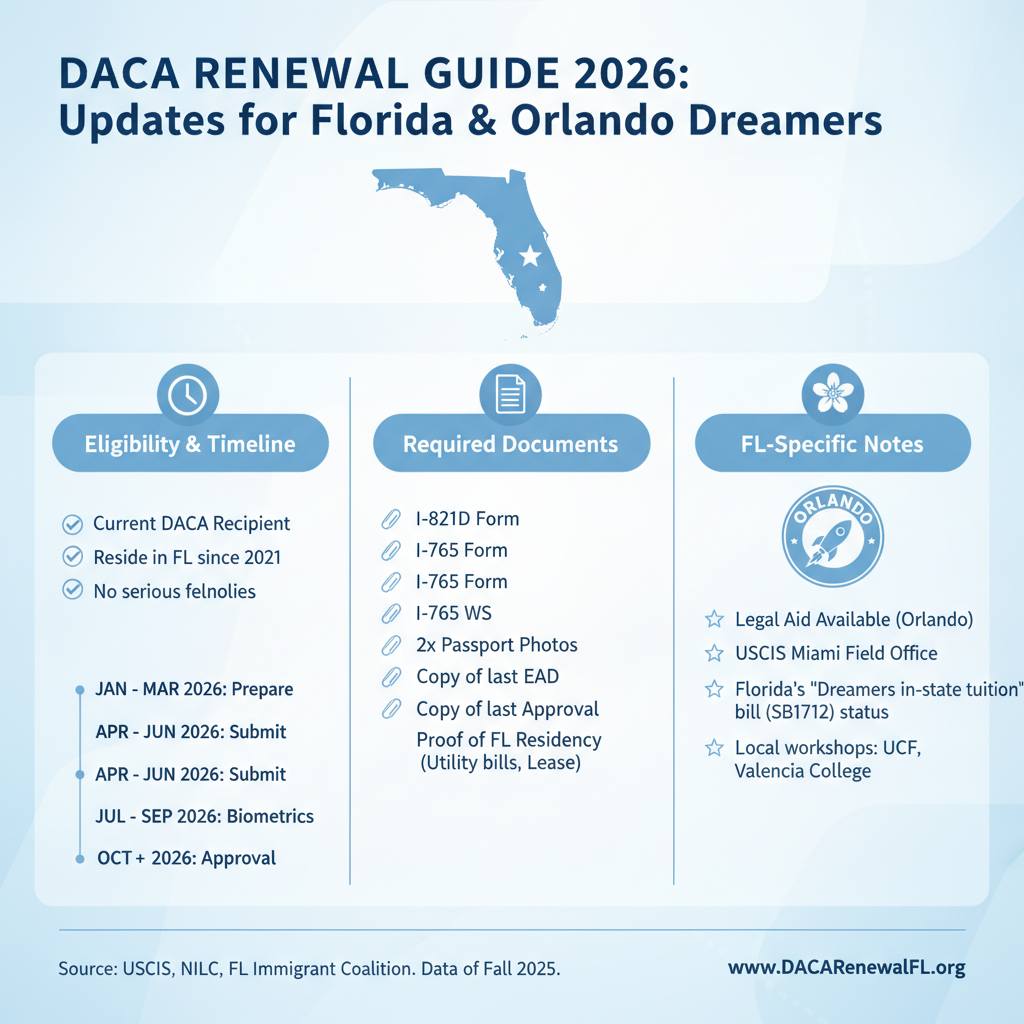
Recent reports from USCIS and other reputable immigration news sources continue to highlight the critical need for DACA recipients to understand the ongoing status of the program and, most importantly, the imperative to renew their status promptly and accurately. These updates frequently address the program's legal standing, processing times, and crucial reminders for eligibility and application procedures.
DACA Program Updates and Renewal Information (USCIS)
What This News Means for Immigrants in Orlando and Across Florida
The continuous flow of news regarding DACA is a stark reminder that while the program remains active for renewals, its future is still subject to legal and political developments. For **DACA recipients** and their families, staying informed isn't just helpful; it's essential for maintaining stability and planning for the future.
Why this news is showing up now
The **DACA program** has been a subject of intense legal and political debate since its inception in 2012. Most recently, the program's legality was challenged, leading to a September 2023 ruling by the U.S. Court of Appeals for the Fifth Circuit. This ruling affirmed the previous decision by a Texas federal court that declared the program unlawful. However, critically, the Fifth Circuit *maintained a stay* on the injunction, which means that current **DACA recipients** can continue to renew their status and their **Employment Authorization Documents (EADs)**. New applications, however, are still not being accepted by USCIS. This ongoing legal back-and-forth means that the program's status is always under review, and any new administrative or judicial decision can significantly impact recipients. Therefore, USCIS regularly issues updates and reminders to ensure those eligible for renewal are aware of the current operational guidelines.
How it can affect Florida residents
Florida is home to one of the largest populations of **DACA recipients** in the United States. According to the Center for American Progress, Florida had over 26,000 active DACA recipients as of March 2023, many residing in major metropolitan areas like Orlando, Miami, and Tampa. For these individuals, DACA provides temporary protection from deportation, a **work permit (EAD)**, and in Florida, eligibility for a driver's license. The ongoing uncertainty surrounding the program's long-term future creates anxiety and necessitates proactive measures.
Specifically, for **Central Florida residents**, an expiring DACA status can mean losing the ability to work legally, pursue higher education, or even drive. A lapse in status can disrupt livelihoods, educational paths, and overall stability for individuals and their families. This makes timely and accurate renewal not just a bureaucratic task but a critical lifeline. Navigating the renewal process correctly is paramount to avoiding disruptions to employment, education, and daily life in cities like Orlando and across Orange County.
What Deferred Action for Childhood Arrivals (DACA) Is (and Why It Matters)
Understanding **DACA** is the first step toward securing your future. While often misunderstood, it's a vital program for many young immigrants.
A plain-English definition
**Deferred Action for Childhood Arrivals (DACA)** is a U.S. immigration policy established in June 2012. It allows certain undocumented immigrants who entered the country as children to receive a renewable two-year period of deferred action from deportation and eligibility for a **work permit (Employment Authorization Document, or EAD)**. This means that while DACA does not grant lawful immigration status or a pathway to a Green Card or U.S. citizenship, it provides a temporary reprieve from deportation and the ability to work legally in the U.S. For many, it has enabled them to pursue education, build careers, and contribute significantly to their communities without the constant fear of removal.
Key terms you need to know
To navigate the **DACA program** effectively, it's crucial to understand the terminology:
- DACA (Deferred Action for Childhood Arrivals): The policy itself, offering temporary protection and work authorization.
- Dreamers: A commonly used term for young undocumented immigrants, including DACA recipients, who were brought to the U.S. as children.
- USCIS (U.S. Citizenship and Immigration Services): The government agency responsible for administering DACA and other immigration benefits.
- EAD (Employment Authorization Document): Also known as a work permit, this card allows DACA recipients to work legally in the U.S.
- Deferred Action: A discretionary decision by the U.S. government to postpone removal proceedings against an individual. It does not grant legal status but delays enforcement action.
- Form I-821D: The official application form for **Consideration of Deferred Action for Childhood Arrivals**. This form is essential for both initial DACA requests (when accepted) and renewals.
- Form I-765: The **Application for Employment Authorization**, which must be filed concurrently with **Form I-821D** to receive a work permit.
- Form I-765WS: The **Worksheet for Form I-765**, which provides additional information required for the employment authorization application.
- Advance Parole: A document that allows certain non-citizens, including DACA recipients, to travel outside the U.S. and lawfully return without jeopardizing their status. This requires a separate application (**Form I-131**) and is granted only for specific humanitarian, educational, or employment purposes.
Expert Guidance for Your DACA Renewal: Don't risk your DACA status with errors or delays. Imigrar's experienced immigration attorneys in Orlando can guide you through every step of the renewal process, ensuring accuracy and timeliness. Call +1 786-791-3106 for a free consultation. Se Habla Español.
Current Immigration Law: The Foundation for DACA
The **DACA program** operates within a complex legal framework, constantly influenced by executive actions, judicial rulings, and the absence of comprehensive legislative reform. It's crucial for **DACA recipients** to understand this foundation to appreciate the importance of adhering to renewal guidelines.
The **DACA program** was established through an executive memorandum by the Secretary of Homeland Security in 2012. It was never passed as a federal statute by Congress. This executive origin has been the primary basis for numerous legal challenges, arguing that the executive branch overstepped its authority. The most significant recent development stems from a September 2023 ruling by the U.S. Court of Appeals for the Fifth Circuit. This court upheld a 2021 decision by a Texas federal judge, which found the 2012 DACA memorandum unlawful. However, the Fifth Circuit’s ruling maintained a temporary stay on the injunction, meaning that while the program is deemed unlawful, current **DACA recipients** can continue to apply for renewals. **Important:** As of November 2026, USCIS is *not* accepting new DACA applications from individuals who have not previously been granted DACA.
Federal requirements for DACA Renewal
To be eligible for **DACA renewal**, you must meet specific federal criteria, demonstrating that you continue to satisfy the original DACA guidelines and have maintained a clean record. These requirements are outlined by **USCIS** and must be strictly followed:
- You must have previously been granted DACA.
- You must not have departed the United States on or after August 15, 2012, without first obtaining **Advance Parole**.
- You must have continuously resided in the United States since you submitted your most recent DACA request that was approved.
- You must not have been convicted of a felony, a significant misdemeanor, or three or more other misdemeanors, and must not otherwise pose a threat to national security or public safety.
The primary forms required for renewal are **Form I-821D**, **Form I-765**, and **Form I-765WS**. These forms must be completed accurately and submitted with the correct filing fees and supporting documentation. Always refer to the official USCIS Forms page for the most current versions and instructions.
Florida-specific considerations
While DACA is a federal program, its impact on Florida residents has state-level implications. Florida has a substantial **DACA population**, and many aspects of daily life are tied to having a valid **EAD** and DACA status:
- Driver's Licenses: In Florida, DACA recipients are generally eligible to obtain a driver's license, which is crucial for employment, education, and navigating the extensive I-4 corridor in Central Florida. A lapse in DACA status means losing this privilege.
- In-State Tuition: While a complex issue, some DACA recipients in Florida may qualify for in-state tuition at public colleges and universities, depending on specific state policies and individual circumstances. Maintaining DACA status is often a prerequisite for such considerations.
- Employment: With a valid **EAD**, DACA recipients can work legally in Florida, contributing to the state's economy and supporting their families. Losing this authorization can lead to significant financial hardship for individuals and their communities, including those in Orlando and Orange County.
Staying informed about both federal and state-level policies is paramount. The **Orlando USCIS Field Office** and various community organizations serve as resources, but professional legal advice is invaluable. For more details on federal requirements, visit the USCIS official website.
How to Renew Your DACA: A Complete Step-by-Step Guide
The **DACA renewal process** requires meticulous attention to detail and timely action. Follow these steps carefully to ensure a successful application and avoid any lapse in your deferred action status or work authorization.
1) Determine Your Eligibility and Renewal Window
Before anything else, confirm your eligibility for renewal. You must meet all the federal requirements mentioned above. Then, identify your optimal renewal window. **USCIS** strongly recommends filing your renewal application approximately **120 to 150 days** (about 4 to 5 months) before your current DACA and **EAD** expire. This timeframe allows for potential processing delays and helps prevent a gap in your work authorization.
- Check Your Expiration Date: Locate your most recent **Form I-797 (Approval Notice)** and your **Employment Authorization Document (EAD)** card to confirm the expiration dates.
- Verify Continuous Residence: Ensure you have maintained continuous residence in the U.S. since your last DACA approval.
- Review Your Record: Confirm you have not been convicted of any disqualifying criminal offenses since your last DACA approval.
2) Gather Required Documents
Thorough document preparation is critical. Start gathering these items well in advance:
- Previous DACA Approval Notices: Copies of your **Form I-797** (Approval Notices) for your previous DACA grants.
- Current Employment Authorization Document (EAD): A clear copy of the front and back of your current work permit.
- Proof of Continuous Residence: Documents that show you have continuously resided in the U.S. since your last DACA approval. Examples include:
- School transcripts or diplomas
- Employment records (pay stubs, W-2s)
- Bank statements
- Utility bills (electricity, water, gas)
- Rental agreements or mortgage statements
- Medical records
- Passport entry stamps (if applicable and lawfully obtained with **Advance Parole**)
- Passport-Style Photos: Two identical, color passport-style photographs taken within 30 days of filing. Write your name and A-Number lightly in pencil on the back of each photo.
- Proof of Identity: A copy of your passport, birth certificate with photo ID, or other government-issued identification.
- Criminal Records (if applicable): If you have ever been arrested or cited for any offense, even if charges were dismissed, you must include certified court dispositions and police reports. Do NOT omit this information.
3) Complete Forms I-821D, I-765, and I-765WS
Accurate completion of these forms is paramount. Always download the latest versions from the USCIS Forms page. Read the instructions for each form carefully before you begin.
- Form I-821D, Consideration of Deferred Action for Childhood Arrivals: Fill out every section completely. If a question does not apply, write "N/A" (Not Applicable). Ensure all personal information, addresses, and dates are accurate and consistent with previous applications.
- Form I-765, Application for Employment Authorization: This form requests your **Employment Authorization Document (EAD)**. For DACA renewal, your eligibility category will typically be (c)(33).
- Form I-765WS, Worksheet for Form I-765: This worksheet provides additional information required for the **Form I-765**, particularly regarding economic need.
- Signatures: Crucially, sign and date all three forms in blue ink. An unsigned form will be rejected.
4) Prepare Your Filing Fee
The filing fee for DACA renewal is a combined fee for **Form I-765** and the biometrics services. As of November 2026, the total fee is **$495**, consisting of $410 for **Form I-765** and an $85 biometrics services fee. **Warning:** Fee waivers are generally *not* available for DACA renewal applications, and partial payments will lead to rejection.
- Payment Options: You can pay by money order, personal check, cashier's check, or by credit card using **Form G-1450, Authorization for Credit Card Transactions**.
- Checks/Money Orders: Make payable to "U.S. Department of Homeland Security." Do not use abbreviations.
- Important: Ensure your payment method is current and has sufficient funds.
5) Assemble Your Application Packet
Organize your documents neatly to facilitate USCIS processing. While not mandatory, a cover letter summarizing the contents of your application can be helpful.
- Order of Documents:
- Payment (check on top or **Form G-1450**)
- **Form I-821D**
- **Form I-765**
- **Form I-765WS**
- Supporting documents (copies of previous approvals, EAD, proof of residence, photos, criminal dispositions if applicable).
- Copies vs. Originals: Always send copies of supporting documents, not originals, unless USCIS specifically requests them. Keep all your original documents safe.
- Make a Complete Copy: Before mailing, make a complete copy of your entire application packet for your records. This is vital for future reference or if USCIS requests additional information.
6) Mail Your Application to the Correct USCIS Lockbox
The mailing address for DACA renewal applications depends on your state of residence. For Florida residents, **DACA renewal applications** are typically sent to a specific USCIS Lockbox facility. Always consult the "Where to File" section in the official instructions for **Form I-821D** on the USCIS official website to ensure you send it to the correct address. Sending it to the wrong address can cause significant delays or rejection.
- Recommended Mailing Method: Use certified mail with return receipt requested. This provides proof that your application was delivered to USCIS and when.
7) Attend Biometrics Appointment (If Required)
After USCIS receives your application, you will typically receive a receipt notice and, within a few weeks, an appointment notice for biometrics (fingerprints, photograph, and signature). This appointment is usually held at your local Application Support Center (ASC), such as the one in Orlando, Florida.
- What to Bring: Your biometrics appointment notice and a valid photo identification (e.g., driver's license, passport).
- Importance: Attending this appointment is mandatory. Failure to appear can lead to your application being denied.
Need to Discuss Your DACA Renewal? Our Orlando immigration team is here to provide clarity and support. Call +1 786-791-3106 for a free consultation to ensure your application is perfect. Se Habla Español.
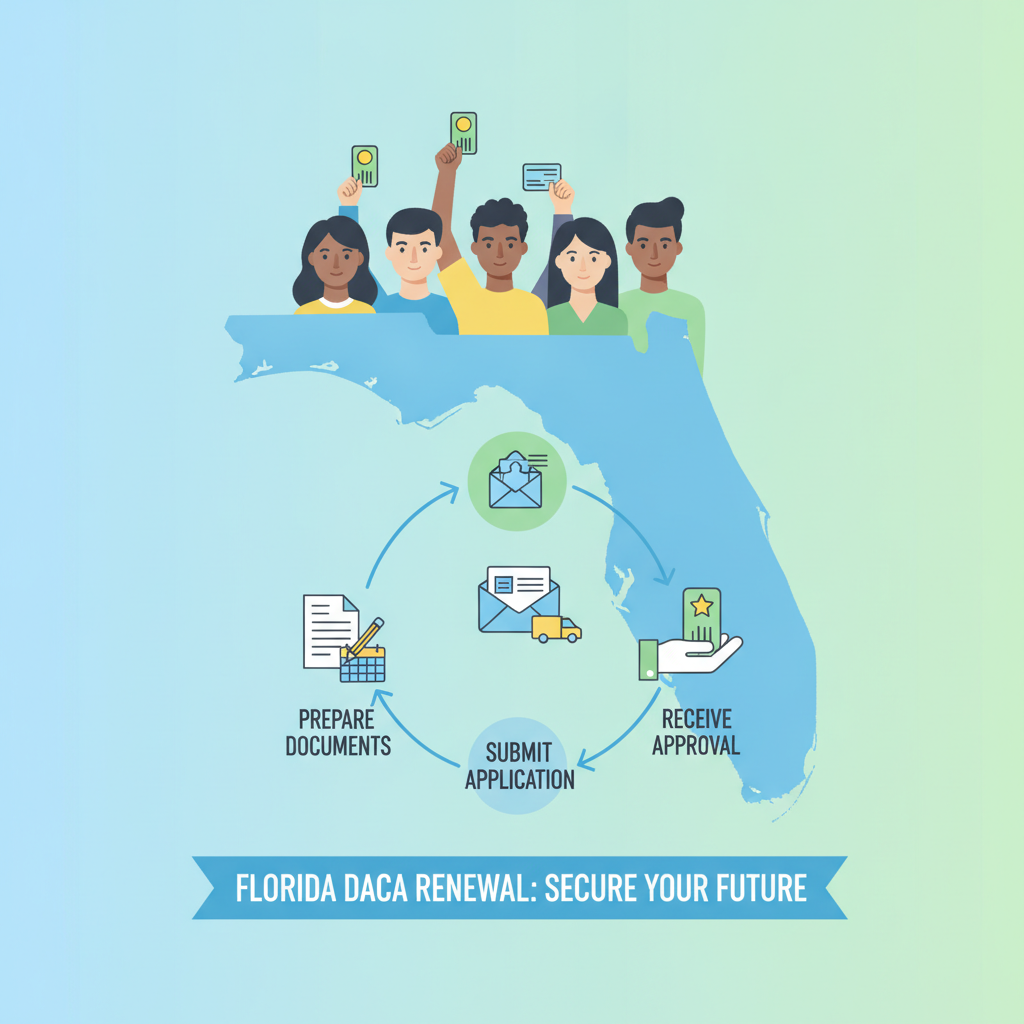
Practical Steps You Can Take Today for DACA Renewal
Proactive planning is your best defense against potential delays or issues with your **DACA renewal**. Here’s an actionable checklist to help you get started immediately.
Actionable Checklist (5+ items):
- Check Your DACA Expiration Date: Locate your **EAD** and **Form I-797** right now. Mark your expiration date clearly on a calendar and set reminders for the **120-150 day** renewal window.
- Start Gathering Documents Early: Don't wait until the last minute. Begin collecting all necessary documents, especially those that might take time to obtain (e.g., certified court dispositions, school records from past years).
- Create a Detailed Checklist: Use this guide or the USCIS instructions to create your own
Related Topics
Need Legal Assistance?
Our experienced immigration attorneys are here to help with your case. Contact Imigrar today for a free consultation and let us guide you through the legal process with confidence.
📍 Orlando, Florida • Serving clients nationwide
📧 info@imigrar.com