
Master Your Green Card Interview: Orlando's Complete Prep Guide
Prepare for your Green Card interview with Imigrar's expert tips. Learn what to expect, gather documents, and ensure success for your residency in the U.S.
The reporting that sparked this guide: Green Card Interview Preparation Tips (Immigration Law)
What This News Means for Immigrants in Orlando and Across Florida
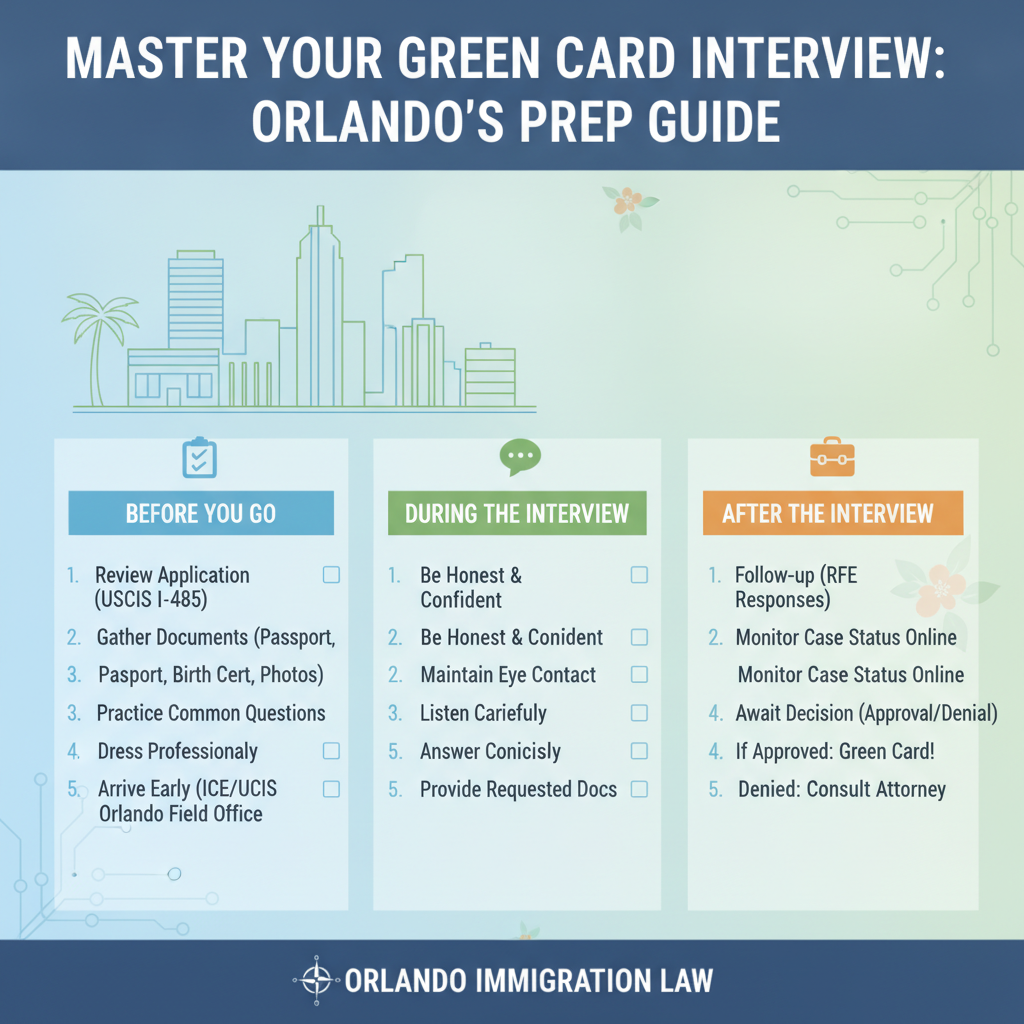
As of November 9, 2026, the landscape of U.S. immigration continues to evolve, but one constant remains: the critical importance of the Green Card interview for many aspiring permanent residents. Recent discussions in immigration law circles, as highlighted by our source, underscore the ongoing emphasis on thorough preparation for these interviews. For families and individuals seeking to solidify their future in the United States, understanding and mastering the interview process is not just a recommendation—it's a necessity.
Why this news is showing up now
The focus on Green Card interview preparation is not new, but it gains renewed prominence periodically due to several factors. Firstly, U.S. Citizenship and Immigration Services (USCIS) continues to refine its interview protocols, often with an increased emphasis on verifying the authenticity of relationships and the accuracy of submitted information. Secondly, as processing times fluctuate, applicants often experience extended periods between filing their initial petitions and receiving an interview notice, making the need for a refresher on best practices more acute. Finally, with ongoing efforts to enhance national security and combat immigration fraud, USCIS officers are trained to conduct comprehensive interviews, making robust preparation more critical than ever. The current environment, while generally stable, still calls for vigilance and meticulousness from all applicants.
How it can affect Florida residents
For immigrants residing in Orlando, across Central Florida, and throughout the Sunshine State, these trends have direct implications. Florida is home to a vast and diverse immigrant population, with many navigating the complex path to permanent residency. Whether you’re attending an interview at the Orlando USCIS Field Office on Tradeport Drive or another location, the principles of preparation remain the same, but the local context adds a layer of familiarity. Florida residents often encounter specific processing patterns and local office nuances. Preparing thoroughly means not just understanding federal requirements but also being ready for the specific environment of your local USCIS office. Our firm, Imigrar, based right here in Orlando, is acutely aware of these local considerations and is dedicated to helping our neighbors successfully navigate this vital step.
Need Help Preparing for Your Green Card Interview? Our Orlando immigration team is ready to assist. Call +1 786-791-3106 for a free consultation, or message us online. Se Habla Español.
What Green Card Interviews Are (and Why They Matter)
A Green Card interview is a pivotal step for many individuals seeking lawful permanent residence in the United States. It's your opportunity to meet with a USCIS officer, confirm the information provided in your application, and demonstrate your eligibility for a Green Card. This interview is not merely a formality; it's a critical assessment of your case, especially for family-based petitions, where the authenticity of relationships is paramount.
A plain-English definition
Simply put, a Green Card interview is a mandatory meeting with an immigration officer where you (and often your sponsoring relative) answer questions about your application for permanent residency. The officer's main goal is to verify that all information on your forms is accurate, that you meet all legal requirements for a Green Card, and that there are no red flags, such as fraud or misrepresentation. For those applying through Adjustment of Status (meaning you’re already in the U.S.), this interview typically occurs at a local USCIS field office. If you're applying from outside the U.S. through Consular Processing, your interview will be at a U.S. embassy or consulate in your home country.
Key terms you need to know
Navigating the immigration process requires understanding specific terminology. Here are some key terms related to your Green Card interview:
- Green Card (Form I-551): The official document proving your status as a lawful permanent resident of the United States.
- Adjustment of Status (AOS): The process of applying for a Green Card while physically present in the United States. This is primarily done by filing Form I-485.
- Consular Processing: The process of applying for an immigrant visa at a U.S. embassy or consulate abroad, which then allows you to enter the U.S. as a permanent resident.
- USCIS Officer: The immigration official who conducts your interview and makes a decision on your Green Card application.
- Sponsor/Petitioner: The U.S. citizen or lawful permanent resident who filed an immigrant petition (e.g., Form I-130) on your behalf. They often attend the interview with you, especially for marriage-based cases.
- Beneficiary: The immigrant seeking the Green Card.
- Affidavit of Support (Form I-864): A legally binding document signed by the sponsor, promising financial support to the immigrant. This ensures the immigrant won't become a public charge.
- Bona Fide Marriage: A marriage entered into in good faith, not solely for immigration purposes. Proving a bona fide marriage is crucial for marriage-based Green Card applications.
- Priority Date: The date USCIS received your immigrant petition (e.g., Form I-130). For some categories, this date must become "current" before you can apply for a Green Card or immigrant visa.
Current Immigration Law: The Foundation
The Green Card interview process is governed by the comprehensive framework of U.S. immigration law, primarily the Immigration and Nationality Act (INA). Understanding the legal basis for your application is fundamental to successful preparation. While the specifics can be intricate, the core principles revolve around eligibility, admissibility, and the burden of proof resting on the applicant.
Federal requirements
The primary federal law governing Green Card applications and interviews is the Immigration and Nationality Act (INA). Specifically, for those adjusting status within the U.S., Section 245(a) of the INA outlines the general eligibility requirements. This section stipulates that an applicant must have been inspected and admitted or paroled into the U.S., be eligible for an immigrant visa, and have an immigrant visa immediately available at the time of filing their Form I-485, Application to Register Permanent Residence or Adjust Status. For family-based petitions, the relationship must be legitimate, as defined by INA sections related to family immigration (e.g., INA 201, 203). Admissibility is also a crucial factor, addressed under INA 212(a), which lists various grounds of inadmissibility, including health-related grounds, criminal grounds, security grounds, and public charge concerns.
Applicants must demonstrate that they meet all statutory and regulatory requirements for the specific Green Card category they are applying under. This involves submitting a variety of forms:
- Form I-130, Petition for Alien Relative: Filed by a U.S. citizen or Green Card holder to establish a qualifying relationship with an eligible relative.
- Form I-485, Application to Register Permanent Residence or Adjust Status: The primary application form for those seeking a Green Card while in the U.S.
- Form I-864, Affidavit of Support: Submitted by the financial sponsor to show they can support the applicant and prevent them from becoming a public charge.
- Form I-693, Report of Medical Examination and Vaccination Record: Completed by a USCIS-approved civil surgeon to ensure the applicant meets health-related admissibility standards.
- Form I-765, Application for Employment Authorization: Often filed concurrently with Form I-485 to obtain work authorization while the Green Card application is pending.
- Form I-131, Application for Travel Document: Filed concurrently for advance parole, allowing travel outside the U.S. while Form I-485 is pending.
All these forms and their accompanying evidence are reviewed during the interview. You can find detailed instructions and download these forms directly from the USCIS Forms page on the USCIS official website.
Florida-specific considerations
While U.S. immigration law is federal, its application often involves local procedures and contexts. For Florida residents, particularly those in the Orlando area, your interview will likely take place at the Orlando USCIS Field Office. While the legal requirements are the same nationwide, the specific officers, their interviewing styles, and the general atmosphere can vary from office to office. There are no Florida-specific immigration laws that impact Green Card eligibility; all federal statutes apply equally. However, understanding the local office's procedures for scheduling, check-in, and document submission can be advantageous. For example, knowing the best time to arrive for your appointment to avoid traffic on the I-4 corridor or navigating the parking situation near the office can reduce stress on interview day. Our team at Imigrar is familiar with the Orlando office and can provide tailored advice for your local experience.
Overwhelmed by Immigration Law? Let Imigrar simplify the process for you. Our Orlando-based firm serves clients nationwide. Call +1 786-791-3106 for a free consultation. Se Habla Español.
How to Prepare for Your Green Card Interview: A Complete Step-by-Step Guide
The Green Card interview is a crucial step toward obtaining permanent residency in the U.S. Proper preparation can significantly increase your chances of a successful outcome. This comprehensive guide outlines the essential steps to ensure you are fully ready for this important day.
1) Gather All Original Documents and Copies
This is arguably the most critical step. The USCIS officer will need to review original documents and may keep copies for their file. Create an organized folder or binder with clearly labeled sections.
- Personal Identification:
- Original passport (current and expired, if applicable)
- Original birth certificate (for both applicant and petitioner)
- Government-issued photo ID (e.g., driver's license, state ID)
- Marriage certificate (if applicable, original)
- Divorce decrees or death certificates for any previous marriages (original)
- Immigration Documents:
- Your interview notice (Important: You cannot enter the building without it!)
- Copies of all forms submitted (Form I-130, Form I-485, Form I-864, etc.)
- Original work permit (Form I-765) and travel document (Form I-131), if you have them
- Copy of your entire Green Card application package, as filed
- Most recent Form I-94 (Arrival/Departure Record)
- Any previous notices or receipts from USCIS
- Financial Documents (for sponsor):
- Most recent federal income tax returns (IRS transcripts preferred)
- W-2s, 1099s, or other income statements for the past three years
- Proof of assets (bank statements, property deeds, etc.) if relying on assets
- Employment verification letter from sponsor's employer
- Pay stubs for the last six months
- Medical Examination:
- Sealed Form I-693 envelope (if not already submitted)
- Copy of your Form I-693 for your records
- Photos:
- Two identical, passport-style photos (2x2 inches, white background) taken within the last 30 days. Even if you submitted them, bringing extras is a good precaution.
Reminder: For any document not in English, you must provide a certified English translation along with a copy of the original document.
2) Review Your Application Forms Thoroughly
You must be intimately familiar with every piece of information you submitted to USCIS. The officer will compare your interview answers to the details on your application forms.
- Read through your entire Green Card application package, including Form I-130, Form I-485, and all supporting documents.
- Pay close attention to dates, addresses, employment history, travel history, and answers to all "yes/no" questions (Part 8 of Form I-485, for example).
- Identify any discrepancies or errors. If you find a mistake, be prepared to explain it truthfully and calmly. Bringing documentation to support the correction is ideal.
- If you have an attorney, they will help you review your file and identify potential areas of concern.
3) Prepare for Interview Questions
Anticipating the types of questions you might be asked will help you formulate clear, concise, and truthful answers. Questions will vary depending on your Green Card category, but some general areas are common.
- General Questions:
- Confirming biographical information (name, date of birth, place of birth)
- Travel history to and from the U.S.
- Employment history
- Education history
- Criminal history (if any)
- Membership in organizations
- Marriage-Based Green Card Specific Questions (for both spouses):
- How and where did you meet?
- When did you get married?
- Where do you live? Do you share a bedroom?
- What did you do on your last holiday together?
- What are your spouse's habits? (e.g., what do they eat for breakfast, when do they wake up?)
- Who pays the bills?
- Details about your wedding, family members, friends.
- Family-Based (non-marriage) Specific Questions:
- Details about the relationship with your petitioner (parent-child, sibling, etc.).
- Proof of shared parentage (birth certificates).
- How often do you communicate?
- Details about family history and events.
Important: Always answer truthfully and directly. If you don't understand a question, ask the officer to rephrase it. Do not guess or provide false information.
4) Organize Your Evidence of Bona Fide Relationship (Marriage-Based)
For marriage-based Green Cards, providing compelling evidence of a genuine marriage is paramount. This evidence should demonstrate commingling of finances, shared life experiences, and mutual commitment.
- Financial Commingling:
- Joint bank accounts (statements showing active use)
- Joint credit cards (statements)
- Joint leases or mortgages
- Joint utility bills (electricity, water, internet)
- Joint tax returns
- Life insurance policies with spouse as beneficiary
- Joint health or auto insurance policies
- Shared Life:
- Photos together (dating, engagement, wedding, holidays, with family/friends) – organize chronologically with dates and descriptions.
- Correspondence (emails, text messages, cards, letters)
- Travel itineraries and tickets from trips together
- Affidavits from friends and family testifying to your relationship (with their contact info)
- Children's birth certificates (if applicable)
- Any documents showing shared responsibilities or activities (e.g., gym memberships, club memberships)
- Other Evidence:
- Lease agreements showing both names
- Vehicle titles with both names
- Any other documents that prove you live together and share a life.
Tip: Present your evidence clearly and concisely. Use tabs in your binder to make it easy for the officer to review. More evidence is generally better, but focus on quality and relevance.
5) Understand the Interview Process and Setting
Knowing what to expect on the day of the interview can alleviate anxiety.
- Arrival: Arrive at the Orlando USCIS Field Office (or other location) at least 30-45 minutes before your scheduled appointment. This allows time for security checks, parking, and finding your waiting area.
- Check-in: You will check in at the front desk, show your interview notice and photo ID. You will then be directed to a waiting area.
- The Interview Room: An officer will call your name. You will typically be led to a small office. The officer will swear you in, asking you to affirm that your testimony will be truthful.
- Role of Your Attorney: If you bring an attorney (highly recommended!), they will be present to observe, clarify questions, and protect your rights. They cannot answer for you but can object to improper questions or help you understand complex legal terms.
- Interpreter: If you are not fluent in English, bring a certified interpreter. If USCIS provides one, they will be present. Se Habla Español.
- Decision: The officer may make a decision on the spot, or they may tell you that a decision will be mailed. Sometimes, further evidence (Request for Evidence - RFE) or a second interview may be requested.
6) Practice and Mentally Prepare
Rehearsing your answers and understanding the gravity of the situation can boost your confidence.
- Mock Interview: Ask a trusted friend, family member, or your attorney to conduct a mock interview. Have them ask you common questions and critique your answers for clarity, consistency, and completeness.
- Manage Stress: The interview can be nerve-wracking. Practice relaxation techniques. Remember that the officer is doing their job, and your goal is to cooperate fully and honestly.
- Be Respectful and Polite: Address the officer respectfully, make eye contact, and maintain a professional demeanor.
7) What to Do on Interview Day
Final tips for the day of your Green Card interview.
- Dress Appropriately: Business casual attire is usually best. It shows respect for the process.
- Bring Everything: Even if you think you won't need a specific document, bring it. It's better to have too much than too little.
- Be Truthful: Always tell the truth. Providing false information or misrepresenting facts can lead to a denial, accusations of fraud, and even future immigration bars.
- Listen Carefully: Pay close attention to each question before answering. If you don't understand, ask for clarification.
- Answer Clearly and Concisely: Don't volunteer extra information unless asked. Stick to the facts.
- Remain Calm: If the officer seems skeptical or asks challenging questions, stay calm and respond truthfully. Avoid arguing or becoming defensive.
Practical Steps You Can Take Today
Don't wait until you receive your interview notice to start preparing. Proactive steps can make all the difference.
Actionable Checklist:
- Consult an Immigration Attorney: Schedule a free consultation with Imigrar today. Our experienced team can review your case, identify potential issues, and guide you through the entire process.
- Start Organizing Documents: Begin creating your interview binder. Gather originals and make copies of all personal, financial, and immigration-related documents.
- Review Your Filed Applications: Dig out your copies of Form I-130, Form I-485, and all supporting documents. Familiarize yourself with every answer you provided.
- Collect Relationship Evidence (if applicable): For marriage-based cases, start compiling photos, joint bills, bank statements, and other proof of your bona fide marriage.
- Check USCIS Processing Times: Regularly monitor the USCIS Processing Times page for the Orlando USCIS Field Office (or relevant office) to get an estimate of when your interview might be scheduled. This helps manage expectations.
- Address Any Changes: If there have been significant changes since you filed (new address, new job, new child, divorce, etc.), gather documentation to explain these changes and be prepared to inform USCIS.
Document preparation guidance
Organization is key. Use a sturdy binder with dividers for different categories of documents. Label each section clearly (e.g., "Personal IDs," "Marriage Evidence," "Financial Documents"). Always keep originals separate from copies, but have both readily accessible. For photos, arrange them chronologically in a small album or print them with dates and short descriptions on the back. Consider creating a table of contents for your binder to help the officer navigate your documents quickly.
Timeline expectations
The timeline from filing your application to receiving an interview notice can vary significantly based on the type of Green Card, the USCIS field office, and current backlogs. For example, family-based Adjustment of Status applications processed at the Orlando USCIS Field Office can range from several months to over a year or even two. After the interview, a decision can be made on the spot, or it might take several weeks to a few months to receive a final decision by mail. USCIS aims to process cases efficiently, but unforeseen circumstances can lead to delays. Staying informed via the USCIS Processing Times tool is crucial.
How Imigrar Helps Immigrants in Orlando
At Imigrar, our mission is to "Keep Families Together." We understand that the Green Card interview is a high-stakes moment for many, filled with anticipation and often anxiety. Based in Orlando, Florida, we are intimately familiar with the local USCIS procedures and the unique needs of our diverse community, while serving clients nationwide.
Our experienced immigration attorneys provide comprehensive legal support throughout the entire Green Card process, from the initial filing of petitions like Form I-130 and Form I-485 to the final interview. We don't just fill out forms; we build your case strategically, ensuring all legal requirements are met and potential issues are addressed proactively. Our expertise includes:
- Thorough Application Review: We meticulously review all your submitted forms and supporting documents to ensure accuracy and consistency, identifying any potential red flags before the interview.
- Personalized Interview Preparation: We conduct mock interviews, preparing you for the types of questions you'll face and helping you articulate your answers clearly and confidently. We’ll discuss specific questions related to your case, including proving a bona fide marriage for spousal petitions.
- Document Organization: We guide you on how to organize your evidence effectively, ensuring you bring all necessary originals and copies to the interview.
- Attorney Representation at the Interview: Our attorneys can accompany you to the interview at the Orlando USCIS Field Office (or other locations for our nationwide clients), providing legal guidance, clarifying questions, and protecting your rights throughout the process. This can significantly reduce stress and enhance your confidence.
- Post-Interview Follow-up: Should USCIS issue a Request for Evidence (RFE) or if further action is needed, we will guide you through the necessary steps.
We believe that every immigrant deserves competent and compassionate legal representation. We offer a free consultation to discuss your specific situation, assess your needs, and outline how we can help you achieve your immigration goals. Our team is fluent in both English and Spanish, ensuring clear and effective communication: Se Habla Español.

Frequently Asked Questions
Q: Do all Green Card applicants need an interview?
A: Not always, but most do. While USCIS has the discretion to waive interviews for certain categories, particularly for employment-based applications where the applicant has a strong record and clear eligibility, the vast majority of family-based applicants (especially marriage-based) will require an interview. The purpose is to verify information, ensure eligibility, and confirm the authenticity of relationships. Even some employment-based cases may require an interview, especially if there are any complexities or inconsistencies in the application.
Q: What happens if my current immigration status expires before my Green Card interview?
A: If you properly filed your Form I-485 (Adjustment of Status) application while you were in a valid non-immigrant status, you are generally considered to be in a "period of authorized stay" while your application is pending, even if your underlying non-immigrant visa (like a B
Related Topics
Need Legal Assistance?
Our experienced immigration attorneys are here to help with your case. Contact Imigrar today for a free consultation and let us guide you through the legal process with confidence.
📍 Orlando, Florida • Serving clients nationwide
📧 info@imigrar.com