
H-1B Visa Lottery FY2027: Navigating New Rules for Tech Talent &
The H-1B visa lottery for Fiscal Year 2027 brought significant changes to how registrations are selected. Understand what these new, beneficiary-centric rules mean for your immigration journey, employer sponsorship, and how to prepare for future H-1B applications with expert guidance from Imigrar.

The landscape of U.S. immigration is constantly evolving, and few areas see as much change and demand as the H-1B specialty occupation visa program. For Fiscal Year 2027 (FY2027), the H-1B lottery process underwent significant modifications, impacting thousands of skilled professionals and U.S. employers nationwide, including many here in Orlando and across Florida. At Imigrar, we understand the complexities these changes introduce and are dedicated to keeping you informed and prepared.
Navigating the New H-1B Rules? Don't face the H-1B lottery alone. Our Orlando immigration team is ready to assist. Call +1 786-791-3106 for a free consultation, or message us online to discuss your options. Se Habla Español.
The reporting that sparked this guide:
H-1B Visa Lottery Changes for FY2027 (Legal News)
What This News Means for Immigrants in Orlando and Across Florida
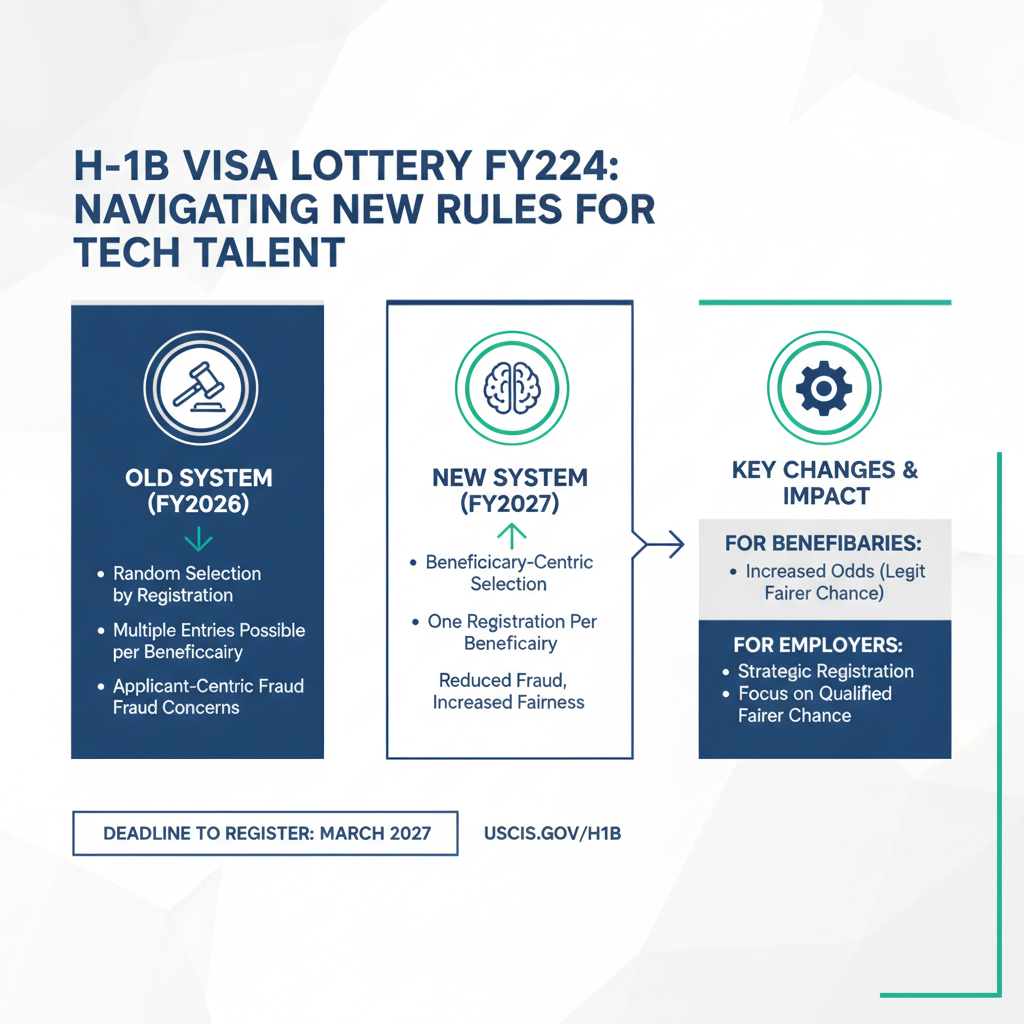
The H-1B visa program is a lifeline for U.S. companies seeking highly skilled foreign professionals, particularly in STEM fields, and for talented individuals looking to contribute to the American economy. With the H-1B cap often vastly oversubscribed, the annual lottery is a high-stakes event. The recent changes for FY2027 have introduced new layers of strategy and compliance that every prospective H-1B applicant and sponsoring employer in Florida needs to understand.
Why this news is showing up now
The H-1B visa program operates on a fiscal year basis, with the annual lottery registration period typically occurring in March for the fiscal year starting October 1st of the same calendar year. For example, the FY2027 lottery registration period was in March 2026, for positions starting October 1, 2026. While the lottery itself has concluded for FY2027, the impact of the new rules is still being felt as petitions are processed, approvals are granted, and companies strategize for future years.
The "new rules" for the H-1B lottery, specifically the shift to a beneficiary-centric selection process, were officially implemented by U.S. Citizenship and Immigration Services (USCIS) to combat fraud and enhance the integrity of the H-1B cap registration system. This significant policy update aims to ensure that each unique beneficiary has an equal chance of selection, regardless of how many employers registered them. These changes, initially proposed and finalized for previous fiscal years, solidified their impact for the FY2027 cycle, making them a crucial topic for ongoing discussion and guidance.
How it can affect Florida residents
Florida, particularly the Orlando and Central Florida region, is a hub for technology, tourism, aerospace, and healthcare industries. These sectors frequently rely on H-1B visa holders to fill specialized roles. For Florida residents who are international students (on F-1 visas with OPT/STEM OPT) or individuals already working in the U.S. on other non-immigrant visas, the H-1B lottery is often their primary path to long-term employment and potential permanent residency.
- For H-1B Beneficiaries in Florida: If you were registered for the FY2027 lottery, the new beneficiary-centric selection method meant that your individual eligibility was key. This change primarily aimed to reduce the advantage held by individuals who had multiple employers submit registrations on their behalf, a practice that inflated selection rates in previous years. While this theoretically levels the playing field, it also means that your employer's compliance with the new rules was paramount. If selected, understanding the next steps for Form I-129, Petition for a Nonimmigrant Worker, and subsequent processing is critical. If not selected, exploring alternative visa options or strategizing for future lotteries becomes your immediate focus.
- For Florida Employers: Companies across the I-4 corridor, from Tampa to Orlando, that rely on foreign talent for specialized positions, had to adapt their H-1B sponsorship strategies. The new rules placed a greater onus on ensuring legitimate job offers and preventing fraudulent multiple registrations, which could lead to disqualification. Employers must now meticulously vet their registration submissions and collaborate closely with experienced immigration counsel to avoid pitfalls. The integrity of their H-1B program is more critical than ever.
- Increased Scrutiny: USCIS has signaled increased scrutiny on H-1B petitions following the lottery, especially those where questions of employer-employee relationships or specialty occupation requirements might arise. This means that if your petition was selected, the subsequent filing and documentation must be exceptionally robust.
Whether you're an individual seeking an H-1B visa or an employer in Orlando looking to sponsor talent, understanding these changes is not just beneficial—it's essential for success. Imigrar is here to provide the clarity and guidance you need.
What H-1B Visa Lottery Changes for FY2027 Is (and Why It Matters)
The H-1B visa is a non-immigrant visa that allows U.S. employers to temporarily employ foreign workers in specialty occupations. These occupations generally require a bachelor's degree or higher in a specific field. Due to high demand, USCIS established an annual cap on the number of H-1B visas issued, currently 85,000 per fiscal year (65,000 for the regular cap and an additional 20,000 for those with a U.S. master's degree or higher, known as the "master's cap"). When demand exceeds this cap, a lottery system is used to select registrations.
A plain-English definition
The "H-1B Visa Lottery Changes for FY2027" refers to the specific modifications USCIS implemented in how they conduct the annual lottery to select H-1B registrations. Previously, if multiple employers registered the same foreign national, each registration had an equal chance of being selected. This led to concerns about fraud and gaming the system, as individuals could significantly increase their odds by having many employers submit registrations on their behalf.
For FY2027 (and solidified from previous years), USCIS shifted to a beneficiary-centric selection process. In simple terms, this means that USCIS now selects registrations based on the *individual beneficiary*, not based on the number of registrations submitted for them. If one individual has multiple legitimate registrations from different employers, they are still only entered into the lottery once. If that individual is selected, then *all* employers who registered them are notified, and *any one* of those employers can then proceed to file an H-1B petition on their behalf. This change was designed to ensure fairness, reduce the incentive for fraudulent multiple registrations, and give every eligible individual a truly equal chance at selection.
Important: This change does *not* mean an individual can only be registered by one employer. It means that if they are registered by multiple employers, their name only appears once in the lottery selection pool, and if their name is chosen, any of the registering employers can then file the petition.
Key terms you need to know
- H-1B Visa: A non-immigrant visa that allows U.S. employers to temporarily employ foreign workers in specialty occupations.
- Specialty Occupation: An occupation that requires a theoretical and practical application of a body of highly specialized knowledge, and a bachelor's or higher degree in the specific specialty (or its equivalent) as a minimum for entry into the occupation in the United States.
- USCIS: U.S. Citizenship and Immigration Services, the federal agency that oversees lawful immigration to the United States.
- Fiscal Year (FY): The U.S. government's accounting year, which runs from October 1st to September 30th. H-1B visas are allocated per fiscal year.
- Annual Cap: The statutory limit on the number of H-1B visas issued each fiscal year. Currently 65,000 for the regular cap and 20,000 for the U.S. master's cap.
- H-1B Lottery (Cap Lottery): The random selection process used when the number of eligible H-1B registrations exceeds the annual cap.
- H-1B Registration: An electronic process where prospective H-1B petitioners (employers) submit basic information about the company and the foreign national beneficiary to USCIS during a designated registration period. This is the first step to enter the lottery.
- Beneficiary-Centric Selection: The new method implemented for the FY2027 lottery (and prior years) where selection is based on the unique beneficiary, ensuring each individual has an equal chance, regardless of how many registrations are submitted on their behalf by different employers.
- Petition: The formal application submitted by an employer to USCIS on behalf of a foreign worker, typically Form I-129, Petition for a Nonimmigrant Worker, after a lottery selection.
- LCA (Labor Condition Application): Form ETA-9035, filed with the U.S. Department of Labor (DOL) by an employer before filing an H-1B petition. It attests to certain wage and working conditions for the H-1B worker.
Current Immigration Law: The Foundation
The H-1B visa program is authorized under the Immigration and Nationality Act (INA). Specifically, Section 101(a)(15)(H)(i)(b) of the INA defines the H-1B non-immigrant classification. The regulations governing the H-1B program are found in 8 CFR Part 214.2(h).
The core principle remains that the H-1B visa is for individuals who will be employed in a "specialty occupation" where they hold the requisite theoretical and practical knowledge, typically demonstrated by a bachelor's degree or its equivalent. The employer must also demonstrate a legitimate employer-employee relationship and the ability to pay the prevailing wage.
Federal requirements
To qualify for an H-1B visa, both the employer and the beneficiary must meet specific federal requirements:
For the Employer (Petitioner):
- Valid U.S. Employer: Must be a legitimate U.S. employer with an Employer Identification Number (EIN).
- Specialty Occupation Job Offer: The employer must offer a job that qualifies as a specialty occupation. This means the job duties must be complex and specialized enough to generally require a bachelor's degree or higher in a specific field.
- Prevailing Wage: The employer must agree to pay the H-1B worker at least the actual wage paid to other employees with similar experience and qualifications, or the prevailing wage for that occupation in the area of intended employment, whichever is higher. This is attested to in the Labor Condition Application (LCA).
- No Adverse Impact: The employment of the H-1B worker must not adversely affect the working conditions of U.S. workers similarly employed.
- Compliance with LCA: The employer must abide by the terms and conditions of the certified LCA.
For the Beneficiary (Employee):
- Specialty Occupation Qualification: The individual must possess a bachelor's degree or its equivalent, or a license in a specialty occupation field, or work experience equivalent to a bachelor's degree.
- Job Match: The individual's qualifications must match the requirements of the specialty occupation job offered by the employer.
- Valid Passport: Must possess a valid passport from their country of citizenship.
The primary form for an H-1B petition is Form I-129, Petition for a Nonimmigrant Worker. This form is filed by the employer on behalf of the beneficiary after a successful lottery selection. Before filing Form I-129, the employer must submit and receive certification for a Labor Condition Application (LCA), Form ETA-9035, from the U.S. Department of Labor.
For official information and forms, always refer to the USCIS official website.
Florida-specific considerations
While H-1B requirements are federal, the local economic landscape and specific industries in Florida can influence the types of H-1B petitions filed and the scrutiny they might receive.
- Industry Focus: Central Florida's growing tech sector (e.g., Lake Nona's Medical City, simulation and gaming industries), aerospace (Space Coast), and advanced manufacturing often sponsor H-1B visas. Petitions for these industries may be viewed favorably if the specialty occupation requirements are clearly met.
- Prevailing Wage: The prevailing wage determination is specific to the geographic area of employment. For those working in Orlando, Tampa, or Miami, the prevailing wage will reflect the local market conditions. This is a critical factor for employers to ensure compliance.
- Local USCIS Office: While H-1B petitions are generally processed at USCIS service centers, the Orlando USCIS Field Office may be involved in certain aspects, such as interviews for adjustment of status if an H-1B worker later seeks a Green Card. Understanding local office procedures, even if indirectly related to the H-1B filing, can be helpful for a comprehensive immigration strategy.
- Economic Development: Florida's proactive approach to attracting businesses can lead to more opportunities for H-1B workers in growing companies. However, this also means increased competition for the limited H-1B slots.
Concerned about H-1B eligibility or compliance? Imigrar has extensive experience assisting both individuals and businesses throughout Florida with H-1B petitions. Contact us at +1 786-791-3106 for a free, confidential consultation. Se Habla Español.
How to Navigate the H-1B Process with New Rules: A Complete Step-by-Step Guide
The H-1B process, especially with the FY2027 lottery changes, requires meticulous planning and execution. This guide outlines the typical steps involved, emphasizing the critical points related to the beneficiary-centric selection.
1) Employer Sponsorship and Labor Condition Application (LCA)
The H-1B process always begins with an employer. An eligible U.S. employer must offer a job that qualifies as a specialty occupation to a foreign national. This initial phase is crucial for establishing the foundation of the petition.
- Job Offer and Qualification Assessment: The employer formally offers a position. Immigration counsel (like Imigrar) then assesses if the job qualifies as a specialty occupation and if the foreign national beneficiary meets the educational and experiential requirements for that role. This involves reviewing the job description, the beneficiary’s resume, transcripts, and any professional licenses.
- Prevailing Wage Determination: The employer must determine the prevailing wage for the offered position in the specific geographic area (e.g., Orlando, FL). This involves using data from the Department of Labor (DOL) through sources like the Foreign Labor Certification Data Center (FLCDataCenter) or obtaining an independent wage survey. The employer must commit to paying at least this prevailing wage or the actual wage paid to similarly qualified U.S. workers, whichever is higher.
- File Labor Condition Application (LCA) - Form ETA-9035: Once the prevailing wage is determined, the employer files a Labor Condition Application (LCA) with the U.S. Department of Labor (DOL). This form attests that the employer will pay the required wage, provide working conditions that will not adversely affect U.S. workers, and notify employees of the H-1B filing. The LCA process typically takes 7-10 business days for certification.
Required Documents (Employer):
- Detailed job description, including duties, responsibilities, and minimum requirements.
- Employer's Federal Employer Identification Number (EIN).
- Company’s financial statements or annual reports (to demonstrate ability to pay).
- Employer's business license and registration documents.
Required Documents (Beneficiary - for assessment):
- Current resume/CV.
- All academic transcripts (bachelor's, master's, etc.).
- Degree certificates.
- Foreign degree evaluations (if applicable).
- Professional licenses or certifications.
- Passport biographical page.
- Current visa documents (e.g., F-1, OPT EAD, H-4, L-1, etc.).
Reminder: The LCA must be certified by the DOL *before* the H-1B registration can be submitted to USCIS. This step often occurs in late February or early March, just prior to the H-1B registration window.
2) H-1B Electronic Registration (The Lottery Phase for FY2027)
This step is where the FY2027 changes significantly impacted the process. The electronic registration period for FY2027 typically opened in early March 2026. Employers must submit a registration for each beneficiary they wish to sponsor.
- Registration Submission: The employer (or their authorized legal representative) creates a USCIS online account and submits an electronic registration for each prospective H-1B beneficiary. This registration includes basic information about the employer and the beneficiary, along with the certified LCA information. A non-refundable fee of $10 per registration is required.
- Beneficiary-Centric Selection in Action: For FY2027, if a beneficiary had multiple registrations submitted on their behalf by different employers, USCIS grouped these registrations by the unique beneficiary. The lottery was then run based on the unique beneficiary, not on the number of registrations. This means each unique beneficiary had only one chance of being selected, regardless of how many employers registered them.
- Lottery Selection Notification: USCIS typically announces the lottery results within a few weeks after the registration period closes. If a beneficiary is selected, *all* employers who submitted a registration for that selected beneficiary are notified that their registration for that specific beneficiary has been selected.
Key Information for Registration:
- Employer's legal name, address, EIN.
- Authorized signatory information.
- Beneficiary's full legal name, date of birth, country of birth, country of citizenship, passport number.
- Beneficiary's gender.
- Whether the beneficiary holds a U.S. master's degree or higher.
- Certified LCA number.
Warning: Intentional misrepresentation or submitting fraudulent registrations can lead to severe penalties, including denial of current and future petitions, and potential criminal charges. USCIS is actively investigating and prosecuting such cases, especially in light of the new beneficiary-centric rules.
3) Petition Filing (Form I-129)
Only employers whose registrations were selected in the lottery can proceed to file an H-1B petition.
- Assemble the Petition Package: The employer, with legal counsel, meticulously prepares the H-1B petition package. This includes Form I-129, Petition for a Nonimmigrant Worker, along with all supporting documentation proving the specialty occupation, the beneficiary's qualifications, the employer-employee relationship, and the ability to pay the prevailing wage. The certified LCA must be included.
- Filing Window: USCIS provides a specific filing window (typically 90 days) for selected registrations. It is critical to file the complete petition package within this window.
- USCIS Filing Fees: The petition must include various USCIS filing fees, which can include the base filing fee, ACWIA fee, fraud prevention and detection fee, and (if applicable) the Public Law 114-113 fee. There is also an optional premium processing fee for expedited adjudication.
Required Documents (Petition Package - comprehensive list):
- Form I-129, Petition for a Nonimmigrant Worker.
- H-1B Data Collection and Filing Fee Exemption Supplement (Part B of Form I-129).
- Certified Form ETA-9035, Labor Condition Application (LCA).
- Copy of the H-1B registration selection notice.
- Beneficiary's educational documents (transcripts, degree certificates, foreign degree evaluations).
- Beneficiary's resume/CV.
- Copies of beneficiary's passport, visa, I-94 arrival/departure record, and previous I-797 approval notices (if applicable).
- Employer support letter detailing the job offer, specialty occupation duties, and beneficiary's qualifications.
- Organizational charts, client letters, or statements of work (SOWs) for third-party placements.
- Employer's financial documents (e.g., tax returns, annual reports, bank statements) to prove financial viability and ability to pay.
- Lease agreements, business licenses, and other corporate documents.
- Photos of the workplace (optional, but can be helpful).
- Any other evidence proving specialty occupation, employer-employee relationship, and beneficiary qualifications.
4) USCIS Processing and Approval
Once the petition is filed, USCIS reviews the submission. The processing time can vary significantly, from a few weeks with premium processing to several months or more under regular processing.
- Receipt Notice: USCIS sends a receipt notice (Form I-797C) confirming receipt of the petition. This notice includes a receipt number that can be used to track the case status online at USCIS Processing Times.
- Requests for Evidence (RFEs): It is common for USCIS to issue a Request for Evidence (RFE) if they require more information or clarification. RFEs often focus on specialty occupation, employer-employee relationship, or beneficiary qualifications. A timely and comprehensive RFE response is critical.
- Petition Approval: If the petition is approved, USCIS issues an approval notice (Form I-797A or Form I-797B). If the beneficiary is already in the U.S., Form I-797A includes an updated Form I-94, reflecting the change of status to H-1B, allowing them to start work on October 1st (or later, if the petition was approved after October 1st). If the beneficiary is outside the U.S., Form I-797B indicates that they must obtain an H-1B visa stamp at a U.S. consulate abroad.
Important: The approval notice is valid for up to three years, though initial approvals might be shorter depending on the visa availability and project duration. The total maximum duration for an H-1B status is generally six years, with some exceptions for those pursuing permanent residency.
5) Visa Stamping (Consular Processing) or Change of Status
This step depends on whether the beneficiary is inside or outside the U.S. when the H-1B petition is approved.
- Change of Status (U.S. Beneficiary): If the beneficiary is already in the U.S. on a valid non-immigrant status (e.g., F-1 OPT, L-1, H-4) and the H-1B petition was filed with a change of status request, the approval notice (Form I-797A) will include an updated I-94 record. The beneficiary can begin working for the H-1B employer on the H-1B start date (typically October 1st) if their petition was approved for a change of status.
- Consular Processing (Outside U.S. Beneficiary): If the beneficiary is outside the U.S. or opted for consular processing, they must attend an H-1B visa interview at a U.S. embassy or consulate in their home country (or a third country if eligible). This involves submitting a DS-160 online application, paying the visa fees, and attending the interview. If approved, the visa will be stamped in their passport.
Required Documents for Consular Processing Interview:
- Valid passport.
- Printed DS-160 confirmation page.
- Appointment confirmation page.
- H-1B approval notice (Form I-797B).
- LCA (Form ETA-9035).
- Employer support letter and detailed job description.
- Beneficiary's educational documents, resume.
- Proof of ties to home country (property deeds, family ties, bank statements) – to demonstrate non-immigrant intent.
- Passport-sized photos.
Warning: Consular officers have discretion. Even with an approved petition, a visa can be denied if the officer suspects misrepresentation, lack of non-immigrant intent, or other inadmissibility grounds. For Central Florida residents, preparing thoroughly for this interview is essential.
6) Begin H-1B Employment
Once the H-1B status is effective (either through change of status or visa stamping and entry into the U.S.), the beneficiary can begin working for the sponsoring employer.
- Start Date: Work can commence on the H-1B petition's start date, which is typically October 1st for cap-subject petitions.
- I-9 Compliance: The employer must complete Form I-9, Employment Eligibility Verification, for the H-1B employee.
- Maintaining Status: The H-1B employee must continuously maintain their status by working for the sponsoring employer in the approved specialty occupation and adhering to all visa terms. Any significant changes in employment (e.g., new employer, significant change in duties, change in work location) typically require a new or amended H-1B petition.
Reminder: For those in Orlando or elsewhere in Florida on an H-1B, it is crucial to understand that your status is tied to your specific employer and job. Consulting with an attorney at Imigrar before making any significant career changes is highly recommended.

Practical Steps You Can Take Today
Whether you're preparing for a future H-1B lottery or navigating the aftermath of the FY2027 changes, proactive steps are key. Here's an actionable checklist:
Actionable Checklist:
- Review Your Qualifications: Ensure your educational background and work experience clearly align with a specialty occupation. If you have a foreign degree, consider getting an official evaluation now.
- Network Actively: Connect with potential employers, especially in
Related Topics
Need Legal Assistance?
Our experienced immigration attorneys are here to help with your case. Contact Imigrar today for a free consultation and let us guide you through the legal process with confidence.
📍 Orlando, Florida • Serving clients nationwide
📧 info@imigrar.com