
H-1B Visa Lottery Changes FY2027: What Immigrants Need to Know
Understand the critical H-1B visa lottery changes for FY2027. Imigrar guides you through new rules, deadlines, and how these updates impact your U.S. immigration journey.
The reporting that sparked this guide
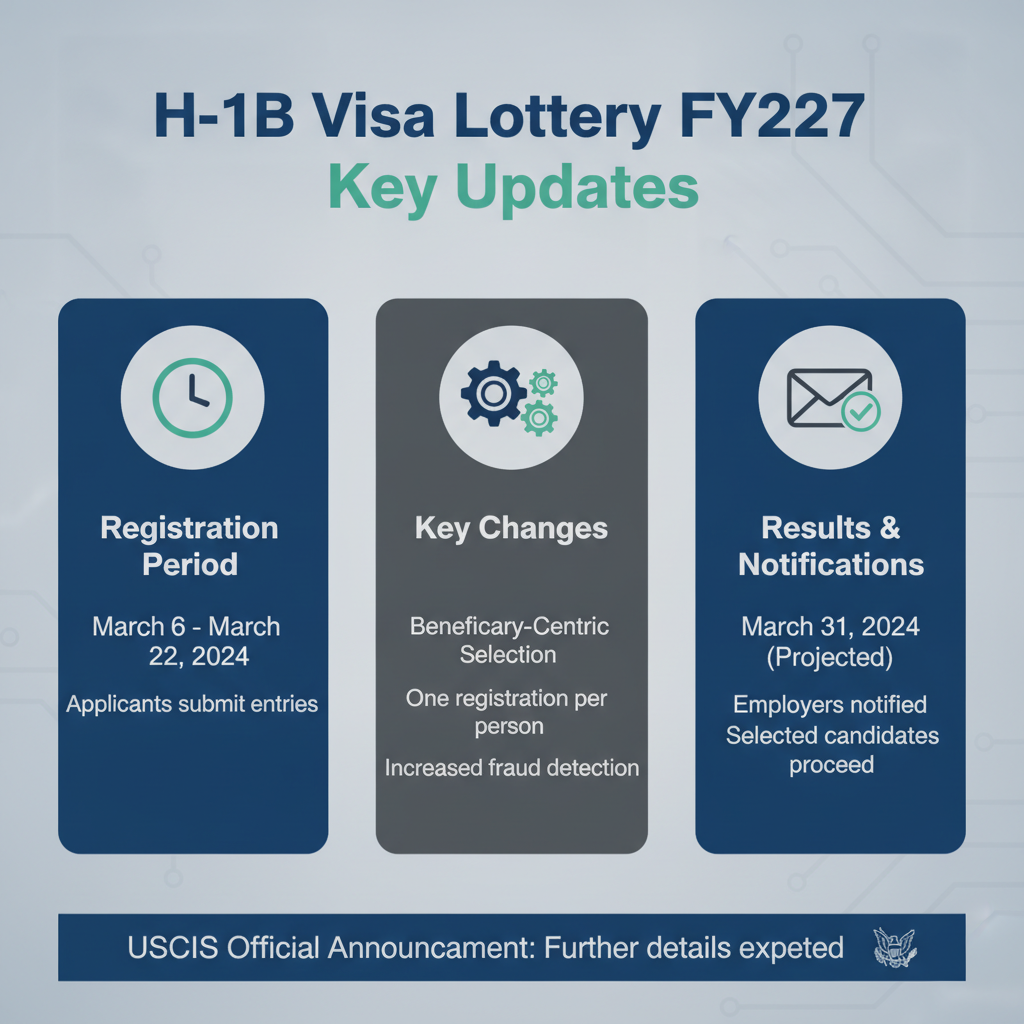
The information and analysis presented in this guide are inspired by recent legal news regarding updates to the H-1B visa program, specifically concerning the upcoming Fiscal Year 2027 (FY2027) lottery process. Staying informed about these developments is crucial for anyone considering this path to U.S. employment.
What This News Means for Immigrants in Orlando and Across Florida
The H-1B visa program is a cornerstone of U.S. immigration for skilled foreign workers, particularly those in specialty occupations. Each year, demand far outstrips the available visas, making the annual lottery a high-stakes event. The U.S. Citizenship and Immigration Services (USCIS) regularly refines its processes to combat fraud, improve efficiency, and adapt to evolving needs. For Fiscal Year 2027 (FY2027), several key adjustments have been announced or reinforced, which could significantly alter the landscape for prospective H-1B beneficiaries and their sponsoring employers.
At Imigrar, we understand the profound impact these changes can have on individuals and families striving to build their lives and careers in the United States. Our commitment is to provide clear, actionable guidance to help you navigate these complex regulations.
Why this news is showing up now
Immigration law and policy are constantly evolving. USCIS typically announces changes to major programs like the H-1B lottery well in advance of the registration period to allow petitioners and beneficiaries ample time to prepare. The H-1B cap for a given fiscal year (FY) usually begins on October 1st. Therefore, the lottery registration for FY2027 typically opens in March of 2026, meaning that USCIS would have announced any significant procedural or fee changes in late 2025 or early 2026. The news you’re seeing now likely reflects the full implementation and impact assessment of these changes as the FY2027 cycle unfolds or concludes, providing clarity on how the new rules affected the selection process and subsequent petition filings.
These updates often stem from USCIS's ongoing efforts to enhance the integrity of the H-1B program, address concerns about fraud, and streamline the application process. For instance, recent years have seen a shift towards beneficiary-centric selection and increased scrutiny on multiple registrations, alongside adjustments to filing fees. These aren't isolated events but part of a continuous regulatory refinement process that impacts every H-1B cycle.
How it can affect Florida residents
Florida, and particularly the Orlando area, is a vibrant hub for technology, tourism, healthcare, and aerospace industries, all of which rely heavily on skilled foreign talent. Many employers in Orlando, Tampa, Miami, and throughout the I-4 corridor sponsor H-1B visas for professionals in IT, engineering, finance, and specialized hospitality roles.
- Increased Scrutiny for Employers: Florida businesses sponsoring H-1B workers will need to be acutely aware of the enhanced fraud detection measures. This means ensuring all employer-employee relationships are clearly defined and legitimate, especially for third-party placements.
- Impact on Beneficiaries: For individuals living in Florida or those hoping to move here for an H-1B sponsored job, the changes, particularly regarding beneficiary-centric selection, offer a fairer chance by reducing the advantage of multiple employer registrations for a single individual. However, the overall competitiveness of the lottery remains high.
- Economic Implications: Changes to the H-1B program can influence the talent pool available to Florida companies, potentially affecting innovation and growth in key sectors. Understanding these rules is vital for businesses to plan their workforce strategies effectively.
- Legal Preparedness: Given the complexities, Florida residents and businesses must engage with experienced immigration counsel. The Orlando USCIS Field Office and related processing centers will be handling these petitions, and local expertise can be invaluable.
Navigating H-1B changes can be overwhelming. Don't face it alone. Our Orlando immigration team at Imigrar is here to help you understand the FY2027 updates and strategize your application. Call +1 786-791-3106 for a free consultation, or message us online. Se Habla Español.
What H-1B Visa Lottery Changes for FY2027 Is (and Why It Matters)
The H-1B visa is a nonimmigrant visa that allows U.S. employers to temporarily employ foreign workers in specialty occupations. These occupations generally require a bachelor's degree or higher in a specific specialty. The H-1B program is vital for U.S. companies that need to fill highly skilled positions where U.S. workers are in short supply, and it provides a pathway for talented individuals worldwide to contribute to the American economy.
However, the number of H-1B visas issued each fiscal year is capped by Congress. Currently, the annual cap is 65,000 visas, with an additional 20,000 visas reserved for those with a U.S. master's degree or higher (the "Master's Cap"). Demand consistently exceeds this supply, necessitating an annual lottery to select eligible registrations.
The "H-1B Visa Lottery Changes for FY2027" refers to the specific modifications, updates, and reinforcements of existing policies that USCIS has implemented for the H-1B cap registration and selection process for the fiscal year beginning October 1, 2026. These changes are crucial because they directly impact the fairness, integrity, and success rate of H-1B petitions.
A plain-English definition
Imagine a very popular school that only has a limited number of spots each year. Many students apply, so the school uses a lottery system to decide who gets in. The H-1B visa is like a spot at that school for skilled workers. Because too many skilled workers want to come to the U.S. for jobs (more than the spots available), the government uses a lottery to pick who gets a chance to apply for the visa.
The "changes for FY2027" are simply new rules or adjustments to how that lottery works for the year starting October 1, 2026. These rules are put in place by the government agency that handles immigration, USCIS. For FY2027, the most significant "changes" are a reinforcement of the beneficiary-centric selection process, which means the lottery now focuses on each individual foreign worker (beneficiary) rather than the number of employers who registered for them. This aims to prevent fraud where multiple employers might register the same person to increase their chances. Additionally, there are updated fees and a continued emphasis on preventing fraud in the registration process.
Why it matters: These changes are designed to make the lottery fairer, reduce fraud, and ensure that those who are selected are genuinely seeking to fill a specialty occupation. For you, it means understanding these new rules is absolutely vital to ensure your registration and subsequent petition are compliant and have the best possible chance of success.
Key terms you need to know
- H-1B Visa: A nonimmigrant visa that allows U.S. employers to temporarily employ foreign workers in specialty occupations.
- Specialty Occupation: An occupation that requires theoretical and practical application of a body of highly specialized knowledge, and a bachelor's or higher degree in the specific specialty (or its equivalent) as a minimum for entry into the occupation in the United States.
- USCIS (U.S. Citizenship and Immigration Services): The government agency that oversees lawful immigration to the United States, including processing H-1B petitions. USCIS official website
- Beneficiary: The foreign national who will be employed in the specialty occupation.
- Petitioner: The U.S. employer who files the H-1B petition on behalf of the beneficiary.
- Cap-Subject H-1B: An H-1B petition that is subject to the annual statutory cap of 65,000 visas, plus the 20,000 Master's Cap.
- Cap-Exempt H-1B: H-1B petitions filed by certain employers (e.g., institutions of higher education, non-profit research organizations) that are not subject to the annual cap.
- H-1B Registration Period: The designated annual period during which prospective petitioners must electronically register beneficiaries for the lottery. For FY2027, this typically happens in March 2026.
- Lottery Selection: The random selection process USCIS uses to choose enough registrations to meet the annual cap.
- Selection Notice: The notification sent by USCIS to petitioners whose registrations have been selected in the lottery, granting them permission to file an H-1B petition.
- LCA (Labor Condition Application): Form ETA-9035, certified by the U.S. Department of Labor (DOL), which attests that the employer will pay the H-1B worker the prevailing wage or actual wage, whichever is higher, and provide working conditions that will not adversely affect other workers. This must be certified *before* filing the H-1B petition.
- Prevailing Wage: The average wage paid to similarly employed workers in a specific occupation in the area of intended employment.
- Form I-129, Petition for a Nonimmigrant Worker: The primary form filed by the employer to request H-1B classification for the beneficiary.
- Form I-797, Notice of Action: Various notices issued by USCIS, including selection notices, receipt notices, approval notices, or Requests for Evidence (RFEs).
- RFE (Request for Evidence): A notice from USCIS requesting additional information or documentation to support an H-1B petition.
- Premium Processing: An optional service offered by USCIS that guarantees processing of certain petitions (including H-1B) within a specified timeframe (currently 15 calendar days) for an additional fee.
- Fiscal Year (FY): The U.S. government's fiscal year runs from October 1st to September 30th. FY2027 begins on October 1, 2026, and ends on September 30, 2027.
- Beneficiary-Centric Selection: The lottery process for FY2027 (and onward) prioritizes selection based on unique beneficiaries, not on the number of registrations submitted on their behalf. If a beneficiary has multiple registrations, they are only entered into the lottery once. If selected, all petitioners who registered for that beneficiary are notified that they are eligible to file a petition. This aims to prevent fraud and ensure fairness.
Current Immigration Law: The Foundation
The H-1B visa program is governed primarily by the Immigration and Nationality Act (INA) and its corresponding regulations found in the Code of Federal Regulations (8 CFR and 20 CFR). Understanding these legal underpinnings is crucial for appreciating the scope and limitations of the H-1B program and the recent changes.
Federal requirements
The legal basis for the H-1B visa is found in Section 101(a)(15)(H)(i)(b) of the Immigration and Nationality Act (INA). This section defines the H-1B nonimmigrant as an alien who is coming temporarily to the United States to perform services in a specialty occupation.
Key federal requirements for an H-1B petition include:
- Specialty Occupation: The position offered must qualify as a specialty occupation. This means it must require a bachelor's degree or higher in a specific field as a minimum for entry. (INA § 214(i)(1) and 8 CFR § 214.2(h)(4)(ii)).
- Beneficiary Qualifications: The beneficiary must possess the required degree or its equivalent, or hold a license that authorizes them to practice in the specialty occupation, or have experience in the specialty equivalent to a bachelor's degree. (INA § 214(i)(2) and 8 CFR § 214.2(h)(4)(iii)).
- Employer-Employee Relationship: There must be a valid employer-employee relationship between the petitioning U.S. employer and the H-1B beneficiary. USCIS scrutinizes this, especially for third-party placements, to ensure the employer has the right to control the beneficiary's work. (8 CFR § 214.2(h)(4)(ii)).
- Labor Condition Application (LCA): Before filing an H-1B petition with USCIS, the employer must obtain a certified Form ETA-9035, Labor Condition Application, from the U.S. Department of Labor (DOL). The LCA attests to several conditions, including that the employer will pay the H-1B worker at least the prevailing wage for the occupation in the area of employment, or the actual wage paid to similarly qualified workers, whichever is higher. It also ensures working conditions will not adversely affect U.S. workers. (INA § 212(n) and 20 CFR Part 655).
- Cap Limitations: The statutory annual cap limits the number of H-1B visas. The current cap is 65,000, with an additional 20,000 for U.S. Master's degree holders. Cap-subject petitions can only be filed after a successful lottery selection. (INA § 214(g)).
- Period of Admission: An H-1B visa is generally granted for an initial period of up to three years, extendable up to a maximum of six years. Exceptions apply for individuals with approved I-140 immigrant petitions awaiting visa availability. (INA § 214(g)(4) and 8 CFR § 214.2(h)(9)).
These federal requirements form the backbone of the H-1B program, and any changes, like those for FY2027, operate within this existing legal framework.
Florida-specific considerations
While H-1B law is federal, its application has practical implications for Florida residents and businesses:
- Industry Demand: Florida's diverse economy means high demand for H-1B workers in various sectors. For instance, the Orlando and Space Coast regions have strong aerospace and defense industries, requiring engineers and specialized technicians. Miami and Fort Lauderdale's finance and international business sectors need analysts and IT professionals. The entire state's robust tourism and hospitality sector also seeks specialized management and IT talent.
- Prevailing Wage Determinations: The prevailing wage for a specific occupation can vary significantly based on the geographic location within Florida (e.g., Orlando vs. Miami vs. Tallahassee). Employers must ensure their LCA accurately reflects the correct wage for the area of intended employment.
- Orlando USCIS Field Office: While H-1B petitions are processed by USCIS service centers, the Orlando USCIS Field Office may be involved in certain aspects, such as interviews for Adjustment of Status (changing from H-1B to green card) or other related immigration matters for those residing in Central Florida. It's important to understand your local USCIS office's role.
- State-Specific Licenses: For certain specialty occupations in Florida (e.g., healthcare, engineering), the beneficiary may need to obtain a state-specific professional license. This process must be understood and initiated, if required, as part of the H-1B employment.
Understanding these local nuances, in addition to the federal law, is critical for a successful H-1B journey in Florida.
Official Forms to Know: The primary form for an H-1B petition is Form I-129, Petition for a Nonimmigrant Worker. Other related forms include Form ETA-9035 (LCA), and potentially Form I-907, Request for Premium Processing Service. Always refer to the USCIS Forms page for the latest versions and instructions.
Confused by H-1B legal jargon? Imigrar simplifies the process. Our bilingual team (Se Habla Español) offers expert guidance for H-1B applicants and employers throughout Florida. Call us at +1 786-791-3106 for your free consultation.

How to Navigate the FY2027 H-1B Lottery Changes: A Complete Step-by-Step Guide
The H-1B lottery process is intricate, and the FY2027 changes add layers of detail that require careful attention. This step-by-step guide will walk you through the essential stages, incorporating the latest procedural updates.
1) Employer Assessment & Labor Condition Application (LCA) Preparation
Before any lottery registration can occur, the prospective H-1B employer must confirm that the offered position qualifies as a specialty occupation and that the beneficiary meets the educational requirements. This initial assessment is crucial.
- Job Qualification: Ensure the job duties are complex enough to require a bachelor's degree or higher in a specific field.
- Beneficiary Qualification: Verify the beneficiary's educational credentials (degree, transcripts) or work experience equivalency.
- Prevailing Wage Determination: The employer must determine the appropriate prevailing wage for the occupation in the specific geographic area (e.g., Orlando, FL). This is typically done using data from the U.S. Department of Labor's Online Wage Library or private wage surveys.
- LCA Filing: Once the wage is determined, the employer files Form ETA-9035, Labor Condition Application, with the U.S. Department of Labor. This form attests to the employer's compliance with wage and working condition requirements. The DOL typically certifies the LCA within 7 business days.
Required Documents (Employer):
- Detailed job description, including duties, responsibilities, and minimum requirements.
- Proof of employer's Federal Employer Identification Number (FEIN).
- Wage determination for the occupation and location.
- Certified Form ETA-9035 (LCA).
2) H-1B Electronic Registration & Lottery (FY2027)
This is the gateway to the H-1B program. For FY2027, USCIS continues with the electronic registration process, reinforcing the beneficiary-centric selection model. The typical registration window is in March of the calendar year preceding the fiscal year (e.g., March 2026 for FY2027).
- Create/Access USCIS Online Account: Both the prospective petitioner (employer) and their authorized representative (attorney) must have a USCIS online account.
- Beneficiary Information: The employer, or their attorney, enters specific information about the beneficiary, including their full legal name, date of birth, country of birth, country of citizenship, passport number, and highest level of education.
- Employer Information: Details about the petitioning employer, including their name, address, and FEIN.
- Registration Fee: The employer pays the required H-1B registration fee for each beneficiary. For FY2025, USCIS significantly increased this fee from $10 to $215. This increased fee would likely apply to FY2027 as well.
- Beneficiary-Centric Selection: Important: Under this model, each unique beneficiary is entered into the lottery ONCE, regardless of how many employers register them. If a beneficiary is selected, all employers who registered for them will receive a selection notice. This aims to prevent fraud and ensure fairness.
- Submission: Submit the electronic registration within the designated window.
Required Information/Documents:
- Beneficiary's valid passport information.
- Beneficiary's date of birth, country of birth, country of citizenship.
- Beneficiary's highest level of education.
- Employer's legal name, address, and FEIN.
- Details of the attorney/representative (if applicable).
- Payment method for the registration fee.
3) Lottery Selection & Notification
After the registration period closes, USCIS conducts the lottery. The selection process usually takes a few weeks.
- Lottery Conducted: USCIS conducts the electronic lottery, first for the Master's Cap, then for the Regular Cap, selecting enough registrations to meet the annual limits.
- Selection Notices: USCIS notifies selected petitioners (and their representatives) through their USCIS online accounts. Non-selected registrations will also be updated.
- Filing Window: The selection notice will include a specific 90-day window during which the petitioner can file the full H-1B petition (Form I-129) for the selected beneficiary. Warning: Missing this window will result in the forfeiture of the selection.
Required Information:
- Access to your USCIS online account to check status.
- Printout of the H-1B Selection Notice once received.
4) H-1B Petition Filing (Form I-129)
Upon receiving a selection notice, the employer must prepare and file the complete H-1B petition with USCIS within the specified 90-day filing window.
- Gather Documents: Collect all necessary supporting documents for both the employer and the beneficiary.
- Prepare Form I-129: Complete Form I-129, Petition for a Nonimmigrant Worker, accurately and thoroughly.
- Fee Payment: Pay all required USCIS fees, which include the I-129 filing fee, ACWIA fee, fraud prevention and detection fee, and if applicable, the Public Law 114-113 fee. These fees vary based on employer size and other factors and are also subject to change by USCIS. For FY2025, USCIS announced significant fee increases for Form I-129.
- Premium Processing (Optional): If expedited processing is desired, file Form I-907, Request for Premium Processing Service, along with the additional fee. This guarantees a 15-calendar-day processing time once received.
- Submission: Mail the complete petition package to the correct USCIS Service Center as indicated in the Form I-129 instructions.
Required Documents (Petitioner & Beneficiary):
- Certified Form ETA-9035 (LCA).
- Completed and signed Form I-129.
- Proof of beneficiary's qualifications (diplomas, transcripts, evaluation of foreign degrees, professional licenses, employment letters).
- Employer's business documents (federal tax ID, business license, financial statements, organizational charts, marketing materials, photos of premises, client contracts).
- Detailed letter from employer describing the specialty occupation, the beneficiary's qualifications, and the terms of employment.
- Beneficiary's resume/CV.
- Copy of beneficiary's passport, visa, I-94 record, and previous I-797 approval notices (if applicable).
- Evidence of a valid employer-employee relationship.
- Any other relevant supporting documentation to prove specialty occupation, beneficiary qualifications, and employer legitimacy.
- Checks for all required USCIS filing fees.
5) USCIS Processing & RFE Response
After filing, USCIS processes the petition. This stage can involve requests for additional information.
- Receipt Notice: USCIS issues a Form I-797C, Notice of Action, acknowledging receipt of the petition.
- Processing: USCIS reviews the petition. You can check general USCIS Processing Times online, but individual cases vary.
- Request for Evidence (RFE): If USCIS needs more information or clarification, they will issue an RFE. Responding to an RFE is critical and requires careful legal strategy and strong supporting documentation, typically within a specific deadline (e.g., 87 days).
- Approval/Denial: USCIS will either approve the petition (Form I-797A or I-797B) or deny it.
Required Action:
- Monitor USCIS case status online.
- Promptly respond to any RFEs with comprehensive documentation and legal arguments.
6) Visa Interview (for Consular Processing)
If the beneficiary is outside the U.S. or needs to travel abroad to activate their H-1B status, they will undergo consular processing.
- DS-160 Filing: The beneficiary completes and submits Form DS-160, Online Nonimmigrant Visa Application, to the U.S. Department of State.
- Fee Payment & Scheduling: Pay the visa application fee and
Related Topics
Need Legal Assistance?
Our experienced immigration attorneys are here to help with your case. Contact Imigrar today for a free consultation and let us guide you through the legal process with confidence.
📍 Orlando, Florida • Serving clients nationwide
📧 info@imigrar.com