
Naturalization Test 2026: Preparing for Citizenship Changes in
Major changes to the U.S. naturalization civics test are expected in 2026. Learn what this means for immigrants in Orlando and nationwide, and how to prepare for your path to U.S. citizenship. Imigrar is here to help.
The journey to U.S. citizenship is a profound step for many immigrants, symbolizing a new chapter of belonging and opportunity. It involves meeting specific eligibility criteria, demonstrating English proficiency, and passing a civics test that assesses an applicant's knowledge of U.S. history and government. As an immigration law firm dedicated to helping families achieve their American dream, Imigrar understands the significance of this process and the anxieties that can accompany it.
Today, we address a crucial development that will impact prospective citizens nationwide: Naturalization Test Changes Coming in 2026 (Citizenship). These anticipated revisions to the civics test component of the naturalization process require careful attention and preparation. For immigrants in Orlando, across Florida, and throughout the United States, understanding these changes is paramount to successfully navigating the path to citizenship.
Concerned about the upcoming Naturalization Test changes? Don't navigate this complex process alone. Our experienced Orlando immigration team at Imigrar is ready to assist you. Call +1 786-791-3106 for a free consultation, or message us online. Se Habla Español.
What This News Means for Immigrants in Orlando and Across Florida
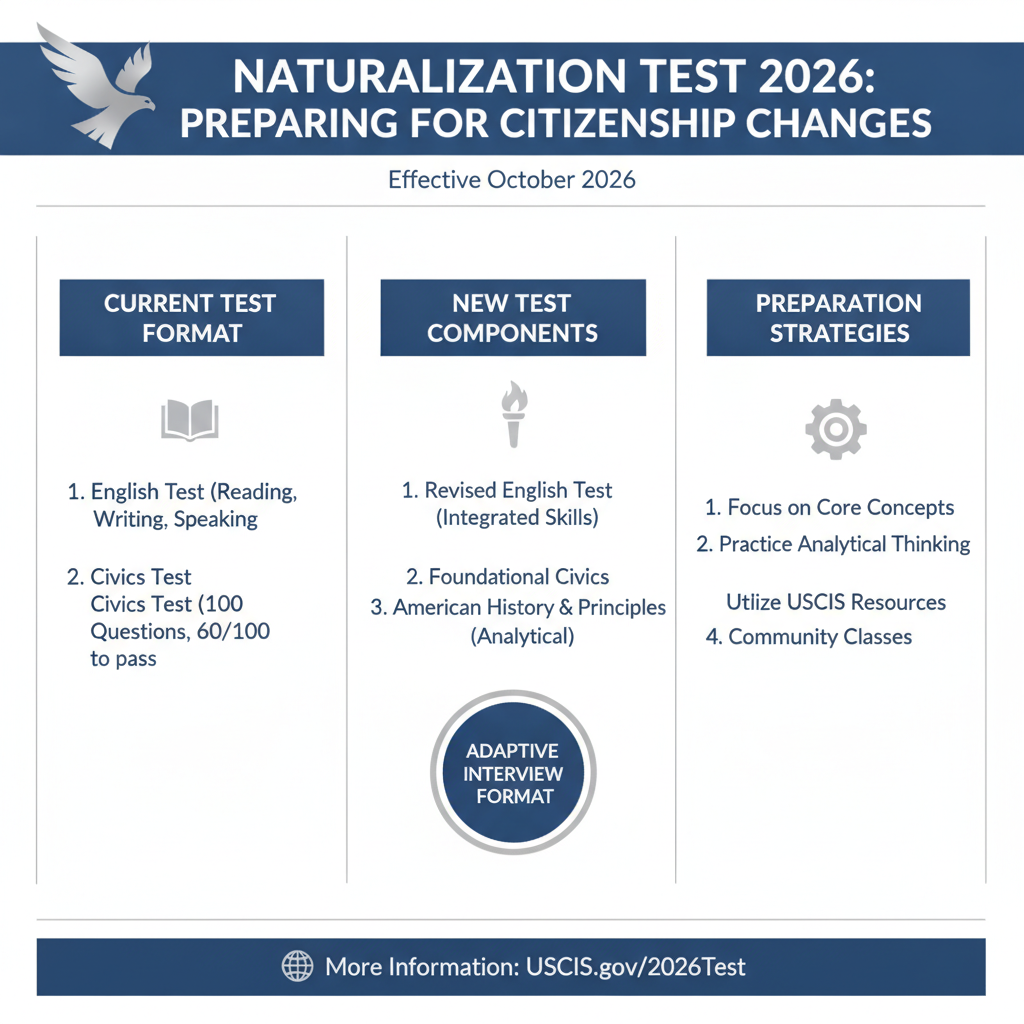
The news of impending changes to the Naturalization Test in 2026 is a significant development for anyone considering applying for U.S. citizenship. At Imigrar, we believe in keeping our clients informed and empowered, especially when government policy shifts can directly impact their lives and futures.
Why this news is showing up now
The United States Citizenship and Immigration Services (USCIS) regularly reviews its policies and procedures to ensure they are effective and relevant. The Naturalization Civics Test, in particular, has seen revisions over the years, most recently in 2020 under the previous administration, which was then reverted to the 2008 version in 2021. The current administration, under the Biden-Harris administration, has signaled its intent to implement new changes to the civics test component, with a target implementation date in 2026. This is part of an ongoing effort to update and refine the test to better assess an applicant's understanding of U.S. civic principles and history.
These discussions and pilot programs often begin years in advance. USCIS conducted a pilot program for a revised civics test in late 2023 and early 2024 to gather data and feedback on potential new question formats and content. This proactive approach allows the agency to evaluate proposed changes before a formal rollout, ensuring that the test remains a fair and meaningful assessment of civic knowledge. The "news" you're seeing now is a reflection of these ongoing efforts and the confirmed timeline for a future implementation.
How it can affect Florida residents
Florida is home to a vibrant and diverse immigrant community, including many individuals and families on the path to U.S. citizenship. From the bustling streets of Miami to the family-friendly neighborhoods of Orlando and the serene coasts of Tampa, countless residents are working towards naturalization. For these individuals, the 2026 Naturalization Test changes will directly impact their preparation and application strategy.
- Increased Preparation Time: The new test is expected to involve more critical thinking and potentially scenario-based questions, moving beyond simple memorization. This will likely require a deeper understanding of U.S. civics, prompting applicants to dedicate more time to studying the underlying principles rather than just rote learning facts.
- Adjusted Study Materials: Current study guides and flashcards, based on the 2008 version of the civics test, will need to be updated. Future applicants will rely on new official USCIS study materials.
- Strategic Application Timing: Some eligible applicants might consider filing their Form N-400, Application for Naturalization, sooner rather than later to potentially be interviewed under the current test format. However, it's crucial to ensure you meet all eligibility requirements before applying.
- Local Resources and Support: Organizations and legal firms like Imigrar in Orlando will need to update their resources and advice to align with the new test format. This ensures that Central Florida residents receive the most accurate and effective guidance.
- Impact on Diverse Communities: Florida’s diverse population, including large Spanish-speaking and Haitian Creole-speaking communities, will need access to updated materials in their native languages, as well as culturally sensitive preparation methods.
Important: While the changes are slated for 2026, the exact effective date and the specific content of the new test are still being finalized by USCIS. We strongly advise all prospective applicants to stay informed and seek legal counsel to understand how these developments might specifically affect their individual circumstances.
What Naturalization Test Changes Are (and Why They Matter)
To fully grasp the significance of the upcoming changes, it's essential to understand the core components of U.S. naturalization and the role the civics test plays in this journey.
A plain-English definition
Naturalization is the process by which a foreign citizen or national becomes a citizen of the United States. It's the final step for many immigrants who have legally resided in the U.S. for a specified period, typically as lawful permanent residents (Green Card holders). To naturalize, applicants must meet several requirements, including demonstrating continuous residency, good moral character, English language proficiency, and knowledge of U.S. history and government.
The Naturalization Test is a critical part of this process. It comprises two main parts:
- English Test: Evaluates an applicant's ability to read, write, and speak basic English.
- Civics Test: Assesses an applicant's knowledge and understanding of U.S. history, government, and civics.
The "changes coming in 2026" primarily refer to proposed revisions to the Civics Test portion. While the exact details are still emerging, the intent is to update the questions and potentially the format to ensure a deeper understanding of U.S. democratic principles, rather than just memorization of facts. This matters because it directly impacts how future applicants will need to prepare and demonstrate their civic knowledge, potentially making the test more challenging for those accustomed to the current format.
Key terms you need to know
Navigating immigration law requires understanding specific terminology. Here are some key terms related to naturalization:
- Naturalization: The process of becoming a U.S. citizen after birth.
- U.S. Citizenship and Immigration Services (USCIS): The government agency responsible for overseeing lawful immigration to the United States, including processing naturalization applications.
- Lawful Permanent Resident (LPR) / Green Card Holder: An individual who has been granted the privilege of permanently residing in the United States. This is generally a prerequisite for naturalization.
- Form N-400, Application for Naturalization: The official form submitted to USCIS to apply for U.S. citizenship.
- Civics Test: The portion of the naturalization interview that tests an applicant's knowledge of U.S. history and government. This is the part undergoing changes.
- English Test: The portion of the naturalization interview that tests an applicant's ability to read, write, and speak basic English.
- Good Moral Character: A legal requirement for naturalization, generally meaning adherence to the laws of the United States and demonstrating positive societal conduct.
- Continuous Residence: The requirement to maintain a permanent home in the U.S. for a specified period (typically 5 years, or 3 years if married to a U.S. citizen) before applying for naturalization.
- Physical Presence: The requirement to be physically present in the U.S. for a certain cumulative period within your continuous residence period.
- Oath of Allegiance: The final step in the naturalization process, where an applicant formally pledges loyalty to the United States.
- Exemptions: Certain waivers or exceptions to the English and/or Civics Test requirements, often based on age, length of residency, or medical conditions.
Understanding these terms is fundamental to comprehending the naturalization process and preparing for any upcoming changes. The shift in the civics test content matters because it reflects a desire for more nuanced civic understanding, potentially moving away from simple factual recall towards an assessment of how an individual understands and can apply democratic principles.
Have questions about naturalization terms or your eligibility? Our Orlando immigration attorneys at Imigrar can provide clear answers and personalized guidance. Contact us at +1 786-791-3106 for a free consultation. Se Habla Español.
Current Immigration Law: The Foundation of U.S. Citizenship
Before delving into the specifics of the upcoming changes, it’s crucial to understand the current legal framework governing naturalization. The requirements for becoming a U.S. citizen are primarily established by the Immigration and Nationality Act (INA). This act serves as the bedrock of U.S. immigration law, outlining who is eligible and what steps they must take.
Specifically, Section 312 of the INA (8 U.S.C. § 1423) mandates that naturalization applicants demonstrate an ability to read, write, and speak English, and possess a knowledge and understanding of the fundamentals of the history, principles, and form of government of the United States. This is the statutory basis for both the English and Civics tests.
Federal requirements
To be eligible for naturalization under current federal law, most applicants must meet the following criteria:
- Age: Be at least 18 years old at the time of filing Form N-400.
- Lawful Permanent Residency: Be a Lawful Permanent Resident (Green Card holder) for at least 5 years (or 3 years if married to a U.S. citizen and meet specific conditions).
- Continuous Residence: Have resided continuously in the U.S. as an LPR for at least 5 years (or 3 years) immediately preceding the date of filing Form N-400.
- Physical Presence: Have been physically present in the U.S. for at least half of the required continuous residence period (e.g., 30 months out of 5 years, or 18 months out of 3 years).
- Residency in Filing State/USCIS District: Have resided for at least 3 months in the state or USCIS district where the application is filed. For those in Orlando, this means living in Florida for at least 3 months.
- Good Moral Character: Demonstrate good moral character for the statutory period (typically 5 or 3 years) preceding the application and up to the Oath of Allegiance. This involves adhering to U.S. laws and not committing certain crimes.
- English Language Proficiency: Be able to read, write, and speak basic English. There are exceptions for applicants who are 50 years old and have lived in the U.S. for 20 years (50/20 rule) or 55 years old and have lived in the U.S. for 15 years (55/15 rule).
- Knowledge of U.S. History and Government (Civics): Pass the civics test. Exceptions apply for applicants meeting the 50/20 or 55/15 rules, or those with a qualifying medical disability.
- Attachment to the Principles of the U.S. Constitution: Demonstrate a willingness to support and defend the U.S. Constitution and take the Oath of Allegiance.
The current civics test consists of 100 questions, and applicants are asked up to 10 questions, needing to answer 6 correctly to pass. The English test involves reading one of three sentences correctly, writing one of three sentences correctly, and demonstrating an ability to understand and speak English during the interview.
Florida-specific considerations
While naturalization is a federal process, there are practical considerations for applicants residing in Florida, especially in the Orlando area:
- Orlando USCIS Field Office: Most interviews for Central Florida residents are conducted at the Orlando USCIS Field Office. Familiarity with local office procedures and processing times (which can be checked on the USCIS Processing Times website) is helpful.
- Diverse Population: Florida, particularly the I-4 corridor connecting Orlando and Tampa, boasts a highly diverse population. Imigrar, with its ability to serve clients in English and Spanish, is well-equipped to assist these communities. We understand the unique challenges faced by immigrants from various cultural and linguistic backgrounds.
- Community Resources: Orlando and Orange County offer numerous community organizations that provide English language classes and civics education, which can be invaluable for preparation.
- Legal Expertise: Navigating the federal requirements, understanding potential exemptions, and preparing for the interview is best done with the guidance of an experienced immigration attorney based in Florida. Our firm's deep understanding of local dynamics combined with federal law ensures comprehensive support.
Understanding the current legal landscape is the first step. As we approach 2026, these foundational requirements will remain, but the specifics of how civic knowledge is assessed will evolve, making informed preparation even more critical.
How to Prepare for the Naturalization Test (Current and Future): A Complete Step-by-Step Guide
The journey to U.S. citizenship is a multi-step process. While the exact civics test questions will change in 2026, the overall application and interview structure will largely remain the same. This guide outlines the essential steps, providing practical advice to help you prepare effectively, regardless of when you apply.
1) Determine Your Eligibility and Gather Initial Documents
Before anything else, confirm you meet the fundamental requirements for naturalization. This includes age, continuous residence, physical presence, and good moral character. Use the USCIS website or consult with an attorney to verify your eligibility.
Required Documents for Initial Assessment:
- Your Green Card (Form I-551)
- Any previous passports (U.S. and foreign)
- Marriage certificate (if applicable, for 3-year residency rule)
- Divorce decrees (if applicable)
- Proof of name change (if applicable)
- Tax returns for the past 5 (or 3) years
- Records of all trips outside the U.S. (dates of departure and return)
- Selective Service registration card (for males 18-25)
2) Prepare and File Form N-400, Application for Naturalization
This is the official application form for naturalization. It’s a detailed document that asks about your personal history, residency, employment, travel, family, and good moral character. Accuracy and completeness are paramount. Any inconsistencies or omissions can lead to delays or even denial. Our team at Imigrar specializes in helping clients complete this form correctly.
Required Documents to Submit with Form N-400:
- A copy of both sides of your Green Card (Form I-551)
- Two passport-style photos (if filing by mail, though often taken digitally at biometrics)
- Fee payment (check, money order, or credit card using Form G-1450). Be aware of the current USCIS filing fees.
- Additional documents may be required based on your specific situation (e.g., marriage certificates, court dispositions for arrests).
Warning: Never submit original documents unless specifically requested by USCIS. Always keep copies of everything you send.
3) Attend Your Biometrics Appointment
After filing Form N-400, USCIS will send you an appointment notice (Form I-797C, Notice of Action) for a biometrics appointment at an Application Support Center (ASC). At this appointment, your fingerprints, photograph, and signature will be collected. These are used to conduct background checks and verify your identity.
Required Documents for Biometrics:
- Your Biometrics Appointment Notice (Form I-797C)
- A valid photo identification (e.g., Green Card, state ID, passport)
Reminder: Do not miss this appointment. If you have an unavoidable conflict, follow the instructions on the notice to reschedule.
4) Prepare for the Naturalization Interview and Tests
This is where the English and Civics tests come into play. While the English test generally remains consistent, the Civics Test is the component slated for changes in 2026. Regardless of the test version, thorough preparation is key.
- English Test Preparation: Practice reading simple English sentences aloud, writing short sentences, and conversing in basic English. USCIS provides lists of vocabulary for reading and writing.
- Civics Test Preparation (Current Test): Study the 100 civics questions and answers provided by USCIS. These are available on the USCIS official website. Focus on the 60/20 and 65/20 exemptions if they apply to you.
- Civics Test Preparation (Future 2026 Test): While specific questions are not yet released, anticipate a shift towards more analytical or scenario-based questions. Instead of just memorizing facts, aim to understand the underlying principles of U.S. government, history, and rights. Follow USCIS announcements closely for new study materials. Our Orlando team will be on the forefront of these updates.
Required Documents for Interview Preparation:
- All original documents that you submitted copies of with your Form N-400.
- Any updated information since you filed your application (e.g., new address, recent travel, new arrests, changes in marital status).
- Your appointment notice for the interview.
5) Attend Your Naturalization Interview
You will receive an interview appointment notice (Form I-797C) indicating the date, time, and location (likely the Orlando USCIS Field Office for Central Florida residents). During the interview, a USCIS officer will review your Form N-400, ask about your eligibility, conduct the English test (reading, writing, speaking), and administer the Civics Test. Be honest, polite, and answer all questions truthfully. If you don't understand a question, ask the officer to rephrase it.
6) Receive a Decision and Attend the Oath of Allegiance Ceremony
After the interview, the officer will give you a decision on Form N-652, Naturalization Interview Results. If approved, you will typically receive a notice (Form N-445, Notice of Naturalization Oath Ceremony) for your Oath of Allegiance Ceremony. This is the final step where you surrender your Green Card and receive your Certificate of Naturalization, officially becoming a U.S. citizen.
Required Documents for Oath Ceremony:
- Your Form N-445.
- Your Green Card (to be surrendered).
- Any re-entry permits or other immigration documents.
Important: Do not travel outside the U.S. between your interview and the Oath Ceremony without consulting USCIS or an attorney, as it could jeopardize your application.
Practical Steps You Can Take Today
Even with the 2026 Naturalization Test changes on the horizon, there are many proactive steps you can take now to strengthen your naturalization application and prepare for future requirements.
Ready to start your naturalization journey? Imigrar can help you prepare for the current test and navigate upcoming changes. Contact our Orlando office at +1 786-791-3106 for a free consultation. Se Habla Español.
Actionable Checklist for Naturalization Preparation:
- Verify Eligibility: Double-check all eligibility requirements (age, residency, good moral character) against your personal timeline and history. Ensure you meet the 3-month residency requirement for Florida before filing.
- Organize Your Documents: Start gathering all necessary documents immediately. This includes your Green Card, passports, marriage/divorce certificates, tax returns for the statutory period, and records of all trips outside the U.S.
- Improve Your English: Even if the civics test changes, the English test (reading, writing, speaking) will remain. Enroll in ESL classes, practice speaking English daily, read English newspapers, and watch English-language TV.
- Begin Civics Study (Current Test): Familiarize yourself with the current 100 civics questions and answers available on the USCIS official website. This foundational knowledge will still be beneficial, even if the format changes.
- Stay Informed About 2026 Changes: Regularly check USCIS announcements regarding the new test format and study materials. Imigrar will also provide updates as they become available.
- Review Your Travel History: Create a detailed list of all international travel, including departure and return dates. This is critical for the continuous residence and physical presence requirements.
- Address Any Legal Issues: If you have any arrests, citations, or criminal history, gather all certified court dispositions. Consult with an attorney to assess how these might impact your good moral character requirement.
- Consult with an Immigration Attorney: This is arguably the most important step. An attorney can review your eligibility, help you prepare Form N-400 accurately, advise on potential issues, and guide you through the interview process, especially with impending changes.
Document Preparation Guidance
Thorough document preparation is crucial. Here’s a detailed approach:
- Create a Master Checklist: Use the USCIS instructions for Form N-400 and your attorney's guidance to create a personalized checklist of all required documents.
- Organize by Category: Group documents by type (e.g., personal identification, residency proof, financial records, travel history). Use folders or binders.
- Copies vs. Originals: Always make high-quality photocopies of every document you submit. Keep the originals safe. Only bring originals to your interview when specifically requested.
- Certified Translations: If any document is not in English (e.g., a foreign birth certificate), you must provide a complete and accurate English translation, certified by a competent translator.
- Keep Records Updated: If your address, marital status, or employment changes after filing Form N-400, immediately inform USCIS and update your attorney.
Timeline Expectations
The naturalization process can take time, and processing times vary by USCIS field office. For the Orlando USCIS Field Office, you can check current estimates on the USCIS Processing Times website. Generally, the process from filing Form N-400 to taking the Oath of Allegiance can range from 8 to 24 months, or even longer in some cases. Factors influencing this include:
- USCIS Workload: The volume of applications USCIS receives.
- Background Checks: The time it takes for security checks to clear.
- Interview Scheduling: Availability at your local field office (e.g., Orlando).
- Application Accuracy: Errors or missing information can cause significant delays.
Important: The impending 2026 test changes might cause a surge in applications filed before the new test takes effect, potentially leading to increased processing times. Conversely, USCIS might streamline processes to accommodate. It's best to apply when you are fully ready and eligible, rather than rushing. An attorney can help you strategize the optimal filing time.

How Imigrar Helps Immigrants in Orlando Prepare for Citizenship
At Imigrar, our mission is
Related Topics
Need Legal Assistance?
Our experienced immigration attorneys are here to help with your case. Contact Imigrar today for a free consultation and let us guide you through the legal process with confidence.
📍 Orlando, Florida • Serving clients nationwide
📧 info@imigrar.com