
H-1B Lottery Shake-Up: FY2027 Changes & Your Path Forward
Unpack the H-1B visa lottery changes for FY2027. Imigrar guides you through new rules, requirements, and how to prepare for future H-1B success.

The reporting that sparked this guide: H-1B Visa Lottery Changes for FY2027 (Legal News)
What This News Means for Immigrants in Orlando and Across Florida
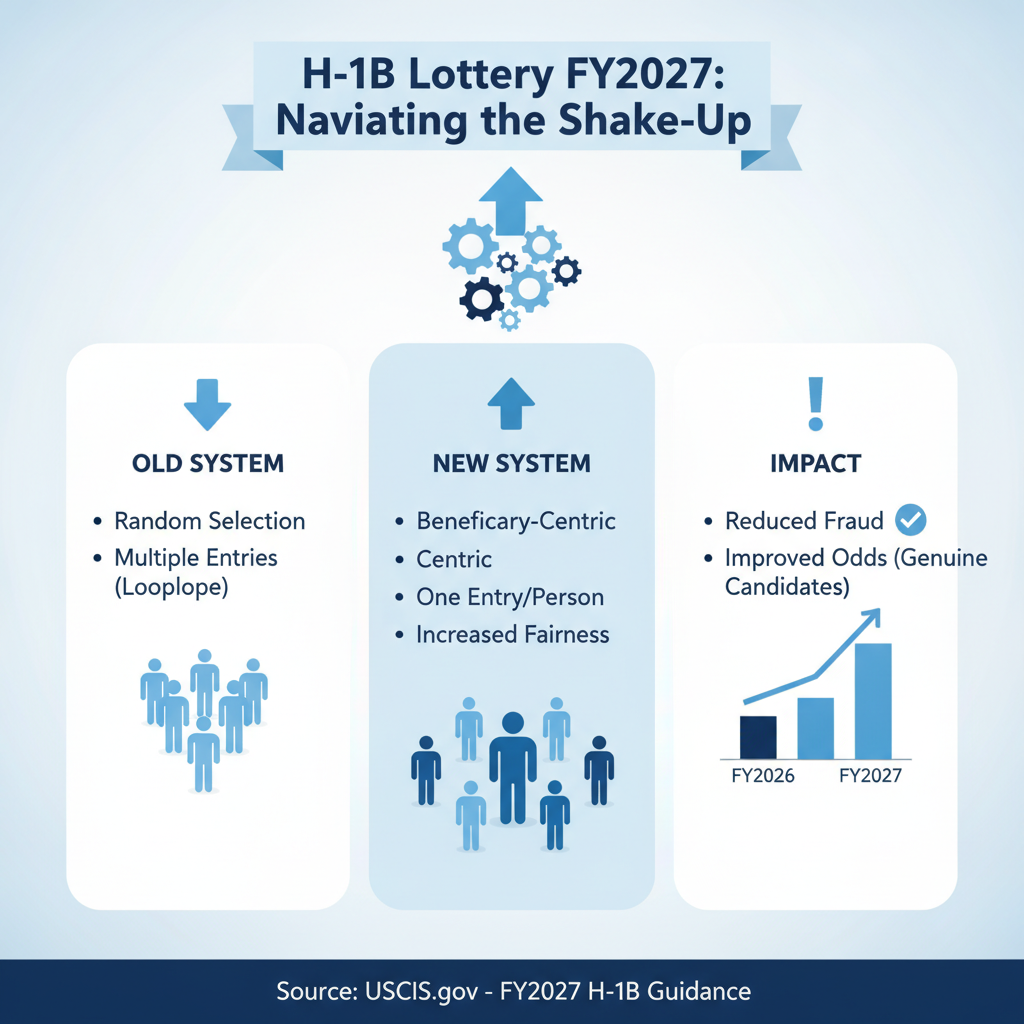
The H-1B visa program is a cornerstone for many skilled foreign workers seeking to contribute their talents to the U.S. economy, particularly in critical sectors like technology, healthcare, and engineering. For years, the demand for H-1B visas has far outstripped the supply, leading to an annual lottery system that can feel more like a gamble than a strategic career move. Recent changes affecting the H-1B visa lottery for Fiscal Year 2027 (FY2027) have introduced significant shifts in how this crucial process operates, and understanding these updates is paramount for anyone hoping to secure an H-1B visa in the coming years.
Why this news is showing up now
While the H-1B lottery for FY2027 concluded its registration period in March 2026 and initial selections were made shortly thereafter, the implications of the new rules introduced for that cycle are still very much a trending topic. Immigration attorneys, employers, and beneficiaries are analyzing the impact of these changes, reflecting on the FY2027 outcomes, and preparing strategies for the upcoming FY2028 lottery. The U.S. Citizenship and Immigration Services (USCIS) implemented these reforms to enhance the integrity of the H-1B cap registration process, combat fraud, and ensure a more equitable selection method. As we move further into late 2026, the full scope of how these changes affect application strategies, processing times, and overall success rates is becoming clearer, making it vital for prospective applicants and sponsoring employers to be fully informed.
This period of analysis and adaptation means that guidance on these new rules is more important than ever. Lessons learned from the FY2027 lottery will directly inform best practices for FY2028 and beyond. At Imigrar, we understand that uncertainty can be stressful, and our goal is to provide clear, actionable insights to help you navigate these evolving regulations.
How it can affect Florida residents
Florida, and particularly the vibrant Orlando metro area, is a magnet for talent and innovation. Our state boasts growing tech hubs, world-class healthcare facilities, and a booming tourism and hospitality sector that relies heavily on skilled professionals. Many of these industries actively sponsor H-1B visas for foreign workers who bring specialized skills that are in high demand. For Central Florida residents, including those currently on F-1 OPT (Optional Practical Training) or other nonimmigrant visas, these H-1B lottery changes have direct and significant consequences.
- Increased Competition & Integrity: The new rules, especially the beneficiary-centric selection, aim to reduce the chances of individuals being registered by multiple employers, theoretically leveling the playing field. While this is good for integrity, it means every legitimate registration faces the true, intense competition of the cap.
- Employer Strategy: Florida-based employers, from tech startups in Orlando’s Research Park to healthcare systems in Orange County, must adapt their H-1B sponsorship strategies. Understanding the updated registration process and the heightened scrutiny from USCIS is crucial to avoid costly mistakes and potential fraud investigations.
- Planning for the Future: If you're a student at the University of Central Florida (UCF), Florida International University (FIU), or the University of Florida (UF) on an F-1 visa, or a professional working on OPT along the I-4 corridor, these changes directly impact your long-term immigration plans. Early preparation, understanding the new timelines, and ensuring your employer is compliant are more critical than ever.
The H-1B visa is often the first step towards a more permanent life in the U.S. for many skilled professionals and their families. For those who call Orlando home, or aspire to, staying informed about these changes is not just about compliance – it's about securing your future. Imigrar is deeply rooted in the Orlando community and understands the unique needs of immigrants in Florida. We are here to help you decipher these complex rules and build a robust strategy.
Need Help? Our Orlando immigration team is ready to assist. Call +1 786-791-3106 for a free consultation, or message us online. Se Habla Español.
What H-1B Visa Lottery Changes Are (and Why It Matters)
The H-1B visa program is vital for U.S. companies seeking to employ foreign workers in specialty occupations. These are roles that generally require a bachelor's degree or higher in a specific field. Due to high demand, USCIS utilizes a lottery system to allocate the limited number of visas available each fiscal year. The changes implemented for the FY2027 lottery, and continuing for subsequent years, significantly alter this lottery process, primarily focusing on increasing fairness and combating fraud.
A plain-English definition
In simple terms, the "H-1B visa lottery changes" mean that USCIS has updated the rules for how it selects eligible individuals when there are more H-1B visa requests than available visas. Previously, the system allowed multiple employers to register the same individual, which some exploited to unfairly increase their chances. The new system is designed to prevent this by selecting individuals (beneficiaries) instead of registrations. This makes the lottery fairer, ensuring that each unique individual has an equal chance, regardless of how many employers registered them.
Think of it like this: instead of putting a ticket for every company that wants to sponsor you into a hat (where one person could have many tickets if multiple companies registered them), USCIS now puts *your name* into the hat just once, even if five different companies want to sponsor you. If your name is drawn, then one of those companies can proceed with filing a petition for you. This change is monumental for the integrity of the program.
Key terms you need to know
Navigating the H-1B process requires understanding specific terminology. Here are some key terms:
- H-1B Visa: A nonimmigrant visa that allows U.S. employers to temporarily employ foreign workers in specialty occupations.
- Specialty Occupation: An occupation that requires theoretical and practical application of a body of highly specialized knowledge, and a bachelor's or higher degree in the specific specialty (or its equivalent) as a minimum for entry into the occupation in the United States.
- Cap-Subject: Refers to H-1B petitions that are subject to the annual statutory cap on the number of H-1B visas issued each fiscal year. Most H-1B petitions fall under this category.
- Annual Cap: The statutory limit on the number of H-1B visas available each fiscal year. Currently, this is 65,000 for the regular cap and an additional 20,000 for the U.S. master's degree exemption (the "master's cap").
- Beneficiary: The foreign worker who is the subject of the H-1B petition.
- Registrant: The prospective U.S. employer or its authorized representative who submits the H-1B cap registration.
- H-1B Registration Process: An electronic process where employers submit basic information about the company and the prospective H-1B employee (beneficiary) to USCIS during a designated registration period. This is the first step before the lottery.
- Lottery Selection: If the number of registrations exceeds the annual cap, USCIS conducts a random selection process to determine which registrations are eligible to file an H-1B petition.
- Petition: The formal application submitted to USCIS (Form I-129) after a registration has been selected in the lottery.
- LCA (Labor Condition Application): A certification from the U.S. Department of Labor (DOL) that an employer has met certain requirements concerning wages and working conditions for H-1B workers. This must be certified before filing Form I-129.
- FY (Fiscal Year): The U.S. government's fiscal year runs from October 1 to September 30. H-1B visas typically become available on October 1 of the fiscal year for which they are requested.
The primary change for FY2027 is the shift from a "registration-centric" selection process to a "beneficiary-centric" selection process. This means USCIS now reviews all registrations by a unique beneficiary, selecting that individual once, regardless of how many employers registered them. If a beneficiary is selected, all employers who registered them are notified, and only one of those employers can then proceed to file an H-1B petition on behalf of that selected beneficiary. This measure is a direct response to concerns about fraud and gaming the system by submitting multiple registrations for the same individual through related or collaborating entities.
Additionally, USCIS has increased the H-1B registration fee from $10 to $215 per registration, effective for the FY2027 lottery. This fee increase, along with enhanced authority for USCIS to deny or revoke petitions where multiple registrations were submitted by related entities to unfairly increase selection chances, underscores a broader effort to strengthen program integrity.
Current H-1B Immigration Law: The Foundation
The H-1B visa program is governed by the Immigration and Nationality Act (INA), specifically Sections 101(a)(15)(H)(i)(b) and 214(g). These statutes establish the legal framework, eligibility requirements, and annual numerical limitations (the "cap") for H-1B visas. Understanding this legal foundation is crucial before delving into the recent lottery changes.
Federal requirements
To qualify for an H-1B visa, both the employer and the employee must meet specific federal requirements:
- For the Employer (Petitioner):
- Must offer a "specialty occupation" position.
- Must file a Labor Condition Application (LCA) (Form ETA-9035) with the Department of Labor and receive certification. This ensures the employer will pay the H-1B worker at least the prevailing wage for their occupation in the area of intended employment, or the actual wage paid to other employees with similar experience and qualifications, whichever is higher.
- Must demonstrate the ability to pay the H-1B worker the required wage.
- Must have a valid Employer Identification Number (EIN).
- For the Employee (Beneficiary):
- Must hold a bachelor's degree or its equivalent, or possess a license in a specialty occupation field, or have work experience equivalent to a bachelor's degree.
- Must be qualified to perform services in the specialty occupation.
- Must meet any state licensing requirements for the occupation, if applicable.
The annual cap for H-1B visas is set at 65,000 for the regular cap, with an additional 20,000 visas reserved for those holding a U.S. master's degree or higher. Certain employers are exempt from the cap, including institutions of higher education, non-profit organizations affiliated with higher education, and non-profit research organizations or governmental research organizations. This means if your employer falls into one of these categories, you may not need to go through the lottery process.
Important: The H-1B visa is a "dual intent" visa, meaning that beneficiaries can intend to immigrate permanently to the U.S. while holding H-1B status, which is a significant advantage for those seeking green cards. This flexibility is a key reason for its popularity.
You can always find the most up-to-date regulations and guidance directly from USCIS official website.
Florida-specific considerations
While H-1B law is federal, its practical application often has regional nuances. In Florida, several factors come into play:
- Thriving Industries: Florida's economy is diverse, with strong sectors in aerospace (e.g., Space Coast), information technology (Orlando, Tampa, Miami), healthcare, and engineering. These industries are major consumers of H-1B talent. Companies throughout Central Florida, from startups to established corporations, frequently rely on H-1B visas to fill specialized roles.
- Educational Institutions: Universities like UCF, UF, USF, and FIU are significant sources of H-1B talent, particularly for the master's cap. Many international students graduate from these institutions and seek H-1B sponsorship.
- Local Economy & Wages: The prevailing wage determinations for H-1B workers are location-specific. Employers in Orlando, for example, must ensure they meet the prevailing wage requirements for Orange County, which can differ from other parts of Florida or the U.S.
- Orlando USCIS Field Office: While H-1B petitions are generally processed at service centers, if an H-1B worker needs to perform certain actions that require a local interview or other in-person interaction, the Orlando USCIS Field Office may become relevant.
For Central Florida residents and employers, understanding the federal requirements in conjunction with local economic realities is essential for a successful H-1B application. Imigrar, located in Orlando, is uniquely positioned to offer this localized insight, ensuring your petition is robust and compliant with both federal statutes and regional expectations.
How to Navigate the New H-1B Lottery System: A Complete Step-by-Step Guide
The H-1B lottery changes for FY2027 have introduced critical modifications to the registration and selection process. This guide outlines the steps involved, incorporating the new beneficiary-centric approach and other integrity measures. This process applies to cap-subject H-1B petitions.
1) Employer Assessment & LCA Filing
Before any registration can occur, a prospective H-1B employer must first determine if the position qualifies as a specialty occupation and if the prospective employee (beneficiary) meets the educational or experience requirements. If so, the employer must:
- Conduct a Prevailing Wage Determination: Research and determine the appropriate prevailing wage for the occupation in the specific geographic area of employment. This is a critical step to ensure compliance with Department of Labor (DOL) requirements.
- File a Labor Condition Application (LCA) (Form ETA-9035): The employer submits an LCA to the DOL, attesting to key conditions like wages, working conditions, and absence of strikes or lockouts. The DOL reviews and certifies the LCA, typically within 7 business days. A certified LCA is mandatory *before* an H-1B petition can be filed, though not before registration.
Required Documents/Information for this step:
- Job description and duties
- Required education and experience for the role
- Proposed salary
- Work location(s)
- Employer's Federal Employer Identification Number (EIN)
Timeline Expectation: LCA processing typically takes 7-10 business days after submission to the DOL.
2) H-1B Registration (Under New Rules)
This is where the beneficiary-centric changes are most evident. For the FY2027 lottery and beyond, the electronic registration process is critical. This typically occurs in March of the calendar year preceding the fiscal year for which the visa is sought (e.g., March 2026 for FY2027, March 2027 for FY2028).
- Employer Creates/Accesses a USCIS Online Account: The employer (or their authorized legal representative, such as Imigrar) creates or logs into a USCIS online account.
- Submit Registration for Each Beneficiary: For each prospective H-1B employee, the employer submits an electronic registration. Crucially, even if multiple employers register the same beneficiary, USCIS's system now identifies the unique beneficiary.
- Pay the Registration Fee: The employer must pay the required non-refundable H-1B registration fee, which increased to $215 per registration for FY2027.
Important: Under the new beneficiary-centric selection, if multiple valid registrations are submitted by different employers on behalf of the same beneficiary, that beneficiary is entered into the lottery only once. If selected, all employers who registered that beneficiary will receive a selection notice, but only one employer can proceed with filing a petition for that beneficiary.
Required Documents/Information for this step:
- Beneficiary's full legal name, date of birth, country of birth, country of citizenship, gender
- Beneficiary's passport number (if applicable)
- Beneficiary's highest level of education
- Employer's legal name, EIN, and U.S. mailing address
- Employer’s authorized signatory information
- Attorney/representative’s G-28 (Form G-28) information (if represented)
Timeline Expectation: The registration window is typically open for 2-3 weeks in March.
3) Lottery Selection & Notification
After the registration period closes, USCIS conducts the lottery. The selection process now prioritizes unique beneficiaries.
- Random Selection: USCIS conducts a random selection from the pool of eligible, unique beneficiaries. The master's cap selections are made first, followed by the regular cap selections.
- Notification: USCIS notifies selected registrants (employers) through their USCIS online accounts. The notification will indicate that the registration has been "Selected." Non-selected registrations will be marked "Not Selected."
Reminder: If a beneficiary is selected, and multiple employers registered them, all those employers will receive a "Selected" notification. It is then up to the beneficiary and the employers to decide which employer will file the H-1B petition.
Timeline Expectation: Selection notifications are typically issued by late March or early April.
4) Petition Filing (Form I-129)
Only after a registration has been selected can the employer proceed with filing a complete H-1B petition.
- Prepare Form I-129: The employer, often with legal counsel, prepares and compiles the Form I-129, Petition for a Nonimmigrant Worker, along with all supporting documentation. This is a comprehensive package.
- Include Certified LCA: The certified LCA (Form ETA-9035) must be included in the petition package.
- Submit to USCIS: The complete petition package, along with all required filing fees, is mailed to the designated USCIS Service Center within the specified filing window.
Required Documents for this step (examples – not exhaustive):
- Completed and signed Form I-129
- Certified LCA (Form ETA-9035)
- Copy of the H-1B registration selection notice
- Beneficiary's educational documents (degrees, transcripts, evaluations)
- Beneficiary's resume/CV
- Beneficiary's passport, visa, I-94 records
- Employer's business documents (articles of incorporation, financial statements, tax returns, office lease)
- Letter of support from the employer detailing the specialty occupation, job duties, and why the beneficiary is qualified
- Evidence of employer-employee relationship (if applicable, especially for third-party placements)
- Filing fees (check or money order)
Timeline Expectation: The filing window is usually 90 days, from April 1 to June 30 for an October 1 start date.
5) Premium Processing (Optional)
For an additional fee, employers can opt for Premium Processing to expedite the adjudication of the Form I-129.
- File Form I-907: The employer submits Form I-907, Request for Premium Processing Service, along with the required fee.
- Expedited Adjudication: USCIS guarantees a decision (approval, denial, Request for Evidence (RFE), or Notice of Intent to Deny (NOID)) within 15 calendar days.
Required Documents/Information:
- Completed and signed Form I-907
- Premium Processing fee (currently $2,805)
Timeline Expectation: 15 calendar days for a decision after receipt by USCIS.
6) Decision & Visa Stamping/Change of Status
Once USCIS adjudicates the petition, a decision is issued.
- Petition Approval: If approved, USCIS sends an I-797 Approval Notice.
- For beneficiaries outside the U.S.: They will typically undergo consular processing at a U.S. embassy or consulate abroad to obtain an H-1B visa stamp in their passport before entering the U.S.
- For beneficiaries inside the U.S. (e.g., on OPT): If a change of status was requested and approved, their status automatically changes to H-1B as of October 1.
- Request for Evidence (RFE) or Denial: If an RFE is issued, additional documentation or clarification is required. A denial means the petition was not approved, and the beneficiary/employer may need to explore other options or appeal.
Required Documents/Information for Consular Processing:
- Approved I-797 Notice of Action
- DS-160 Confirmation Page
- Passport valid for at least six months beyond the period of stay
- Passport-style photographs
- Interview appointment confirmation
- Supporting documents (educational, employment letters, etc.)
Timeline Expectation: Regular processing can take several months. Consular processing times vary by embassy/consulate.
Navigating these changes can be complex. Don't go it alone. Imigrar offers expert guidance for H-1B petitions. Call +1 786-791-3106 for a free consultation. Se Habla Español.
Practical Steps You Can Take Today for H-1B Success
The H-1B lottery is highly competitive, and with the new FY2027 changes, preparation is more critical than ever. Here’s an actionable checklist and practical advice to maximize your chances, whether you're a prospective beneficiary or a sponsoring employer in Orlando or elsewhere.
Actionable Checklist:
- Verify Eligibility:
- For Beneficiaries: Ensure your degree aligns with a specialty occupation. If your degree is from outside the U.S., consider getting an educational credential evaluation early.
- For Employers: Confirm the job duties require a bachelor's degree or higher in a specific field.
- Identify Sponsoring Employers:
- For Beneficiaries: Network extensively, especially with companies known for H-1B sponsorship in your field. Florida’s growing tech and healthcare sectors offer many opportunities.
- For Employers: If you anticipate needing H-1B workers, begin your recruitment and assessment process early.
- Gather Essential Documents:
- For Beneficiaries: Compile all academic transcripts, diplomas, previous employment records, passport, visa history, and your detailed resume.
- For Employers: Prepare company financial records, tax documents, and detailed job descriptions for the H-1B role.
- Understand the New Beneficiary-Centric Lottery:
- For Everyone: Be fully aware that each unique beneficiary has only one chance in the lottery, regardless of how many employers register them. This emphasizes the quality of the employer-employee match.
- Warning: Do not engage in any scheme involving multiple registrations by related entities, as USCIS has heightened fraud detection and enforcement.
- Plan for Timelines & Fees:
- Mark the H-1B registration window (typically early March) on your calendar.
- Budget for the increased registration fee ($215) and the substantial petition filing fees.
- Be aware of the processing times for LCAs and H-1B petitions (see USCIS Processing Times).
- Consult an Experienced Immigration Attorney:
- This is arguably the most critical step. An attorney can assess your eligibility, advise on the best strategy, prepare meticulous documentation, and navigate any complexities or RFEs.
Document Preparation Guidance:
- Accuracy is Paramount: Double-check all information for typos, inconsistencies, and errors. Even minor discrepancies can lead to RFEs or denials.
- Completeness: Ensure every required document is included. Missing documents are a common cause of delays.
- Translations: Any document not in English must be accompanied by a certified English translation.
- Organization: Present your documents clearly and logically, following USCIS guidelines for binding and labeling.
Timeline Expectations:
While specific dates vary each year, here’s a general H-1B lottery timeline:
- December-February: Employers prepare LCAs and identify beneficiaries.
- Early March: H-1B electronic registration period opens (e.g., March 1-17).
- Late March: Lottery conducted, selection notifications issued.
- April 1 - June 30: Filing window for selected H-1B petitions.
- October 1: Start date for approved H-1B petitions.
Reminder: USCIS processing times for Form I-129 can range from a few months to over a year for regular processing. Premium processing (15 calendar days) is available for an additional fee if offered by USCIS for H-1B petitions at the time of filing.

How Imigrar Helps Immigrants in Orlando Navigate H
Related Topics
Need Legal Assistance?
Our experienced immigration attorneys are here to help with your case. Contact Imigrar today for a free consultation and let us guide you through the legal process with confidence.
📍 Orlando, Florida • Serving clients nationwide
📧 info@imigrar.com