
Immigration Law••16 min read
H-1B Visa Lottery Changes FY2027: What You Need to Know
Navigate the new H-1B visa lottery rules for FY2027. Imigrar explains the beneficiary-centric selection process, key timelines, and how to prepare for this crucial work visa.

The reporting that sparked this guide: H-1B Visa Lottery Changes for FY2027 (Legal News)
What This News Means for Immigrants in Orlando and Across Florida
Why this news is showing up now
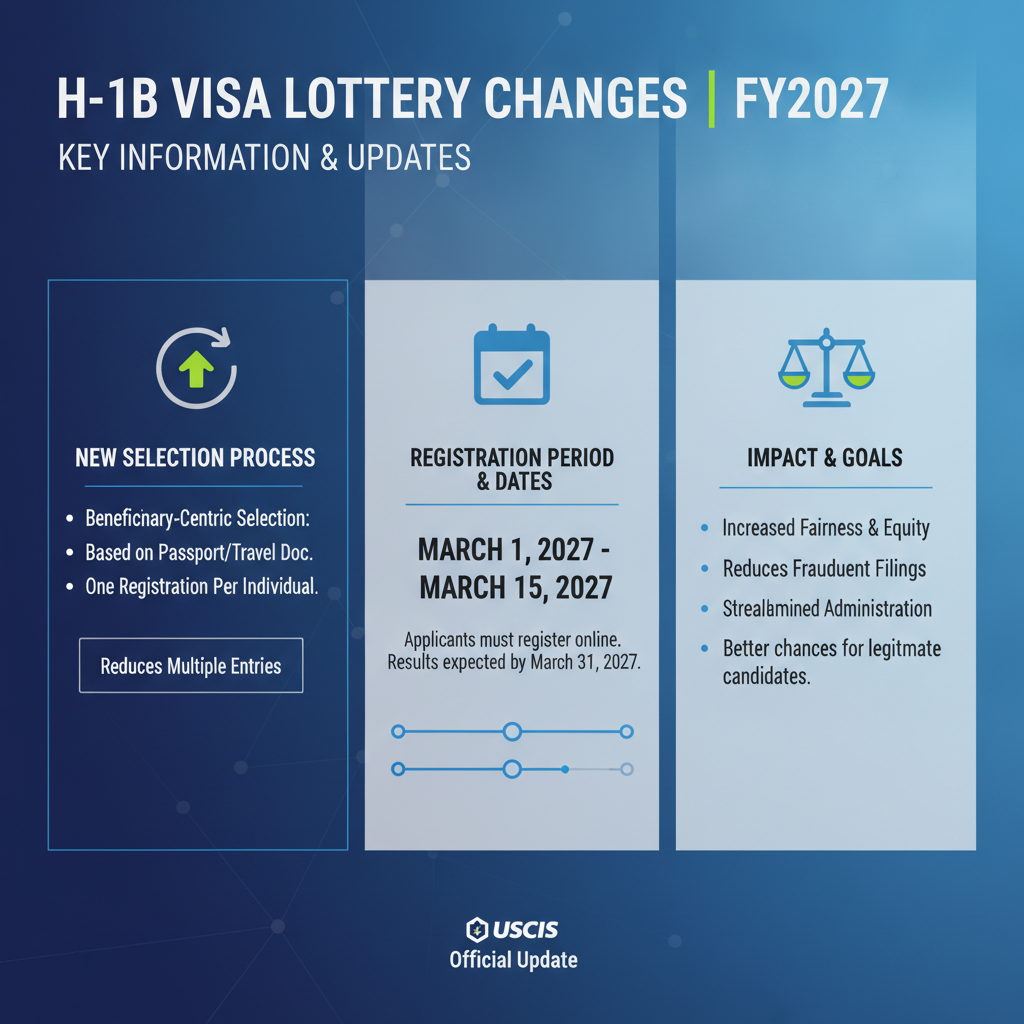
The H-1B visa program allows U.S. employers to temporarily employ foreign workers in specialty occupations. Due to the annual cap on H-1B visas, demand consistently outstrips supply, leading to a lottery system for selection. In recent years, USCIS identified a growing trend of fraud within the electronic registration process, where some beneficiaries had multiple registrations submitted on their behalf by various employers, artificially inflating their chances of selection. To combat this, the Department of Homeland Security (DHS) finalized new rules designed to enhance the integrity of the H-1B lottery. These changes, specifically for the FY2027 cap season, aim to shift the lottery from an employer-centric model to a beneficiary-centric one, ensuring a fairer chance for all eligible individuals. The announcement of these rules typically occurs in the late calendar year preceding the start of the fiscal year’s lottery registration period (e.g., late 2026 for the FY2027 lottery, which begins in March 2027). This timing gives employers and prospective beneficiaries time to understand and adapt to the new requirements before the registration window opens.How it can affect Florida residents
Florida is a vibrant economic hub, experiencing significant growth in sectors like technology, healthcare, aerospace, tourism, and advanced manufacturing. Cities like Orlando, Tampa, and Miami are magnets for skilled professionals. This means that many Florida-based companies rely on the H-1B program to fill critical talent gaps, and countless individuals living in or aspiring to move to Central Florida seek H-1B visas to advance their careers and build their lives here. The H-1B lottery changes for FY2027 will profoundly impact Florida residents in several ways: * **For Beneficiaries:** If you are a prospective H-1B worker in Orlando or anywhere in Florida, these new rules mean that you, as the individual, can only have one H-1B lottery registration submitted on your behalf. This aims to level the playing field, potentially increasing your true odds of selection by eliminating fraudulent multiple entries by others. However, it also means you must carefully coordinate with any potential employers. * **For Employers:** Florida businesses, from tech startups in the I-4 corridor to established healthcare systems, must now adapt their H-1B sponsorship strategies. They need to ensure compliance with the new "one registration per beneficiary" rule and educate their foreign national employees about this change. Employers will still initiate the registration process, but the focus shifts to the individual’s unique identifier. * **Increased Scrutiny:** The changes signal USCIS's heightened focus on program integrity. This means that all H-1B petitions, especially those from employers with a history of multiple submissions or those that raise red flags, may face increased scrutiny. * **Legal Guidance:** Navigating these updated regulations requires expert legal advice. For Central Florida residents, understanding how to comply and what evidence is needed to demonstrate a legitimate job offer and specialty occupation will be more crucial than ever. Imigrar, located in Orlando, is uniquely positioned to assist clients throughout Florida with these precise challenges.Need Help Navigating the H-1B Changes? Don't face the new H-1B lottery rules alone. Our Orlando immigration team at Imigrar is ready to assist you. Call +1 786-791-3106 for a free consultation, or message us online. Se Habla Español.
What H-1B Visa Lottery Changes for FY2027 Is (and Why It Matters)
The H-1B visa is a non-immigrant visa that allows U.S. employers to temporarily employ foreign workers in specialty occupations. These occupations generally require a bachelor's degree or higher in a specific field. The program is vital for U.S. companies seeking highly skilled talent and for foreign professionals aiming to contribute their expertise to the American economy. The "H-1B Visa Lottery Changes for FY2027" refers to new rules implemented by U.S. Citizenship and Immigration Services (USCIS) to modify the selection process for this highly sought-after visa.A plain-English definition
Imagine a coveted job opening that hundreds of thousands of people apply for, but there are only a limited number of spots. That's essentially the H-1B visa program. Each year, Congress sets a limit, or "cap," on the number of H-1B visas available. Currently, this cap is 65,000 visas for the regular quota, plus an additional 20,000 visas for those with a U.S. master's degree or higher (the "Master's Cap"). Since demand far exceeds these numbers, USCIS conducts an electronic lottery to select which registrations will proceed to the full petition stage. The "changes for FY2027" primarily mean that USCIS is updating *how* that lottery works. Previously, it was possible for one individual (beneficiary) to have multiple employers submit registrations for them, effectively giving them multiple "tickets" in the lottery. The new rules aim to stop this practice by making the selection process beneficiary-centric. This means that for the FY2027 lottery, each unique beneficiary can only have *one* registration submitted on their behalf, regardless of how many employers are willing to sponsor them. If multiple registrations are submitted for the same beneficiary, all those registrations will be considered invalid. This change is designed to create a fairer system, prevent fraud, and ensure that every eligible individual has an equal and genuine chance in the lottery.Key terms you need to know
Understanding the following terms is crucial when navigating the H-1B process, especially with the new FY2027 changes: * **H-1B Visa:** A non-immigrant visa category for foreign workers in "specialty occupations." * **Specialty Occupation:** An occupation that requires theoretical and practical application of a body of highly specialized knowledge, and a bachelor's or higher degree in the specific specialty (or its equivalent) as a minimum for entry into the occupation in the United States. Examples include IT professionals, engineers, doctors, and architects. * **Beneficiary:** The foreign national individual who will be working in the specialty occupation and for whom the H-1B petition is being filed. Under the new rules, the **beneficiary** is now the central figure for lottery registration. * **Petitioning Employer:** The U.S. company or organization that is offering the specialty occupation job and sponsoring the foreign national for the H-1B visa. * **Fiscal Year (FY):** The U.S. government's fiscal year runs from October 1 to September 30. H-1B visas become available on October 1st of the relevant fiscal year. For **FY2027**, H-1B visas will be available starting **October 1, 2026**. * **Annual Cap:** The congressionally mandated limit on the number of H-1B visas issued each fiscal year. Currently, this is 65,000 for the regular cap and an additional 20,000 for the U.S. Master's Cap. * **H-1B Lottery (or Cap Lottery):** The computerized random selection process conducted by USCIS when the number of electronic registrations submitted exceeds the annual cap. This typically occurs in March. * **Electronic Registration Process:** The online system where prospective petitioning employers submit basic information about the company and the beneficiary to enter the H-1B lottery. This is the stage where the new "one registration per beneficiary" rule applies. * **Labor Condition Application (LCA) (Form ETA-9035):** An application filed by the employer with the U.S. Department of Labor (DOL) attesting that they will pay the H-1B worker at least the prevailing wage for the occupation in that geographic area and will provide working conditions that will not adversely affect other workers. This must be certified before filing the H-1B petition. * **Form I-129, Petition for a Nonimmigrant Worker:** The primary form filed with USCIS by the employer *after* a beneficiary is selected in the lottery. This form formally requests H-1B classification for the beneficiary. * **USCIS (U.S. Citizenship and Immigration Services):** The federal agency responsible for administering immigration and naturalization adjudication functions. They oversee the H-1B program and conduct the lottery. * **DHS (Department of Homeland Security):** The overarching federal department that includes USCIS. DHS sets the policies and rules for immigration programs like the H-1B visa. Understanding these terms is fundamental to grasping the significance of the FY2027 H-1B lottery changes, which aim to streamline the process and combat abuse by focusing on the individual beneficiary’s eligibility.Current Immigration Law: The Foundation
The H-1B visa program is governed by federal immigration law, primarily the Immigration and Nationality Act (INA). While the new FY2027 rules modify the *process* for the lottery, the underlying legal framework and eligibility requirements for the H-1B visa itself remain largely consistent.Federal requirements
The H-1B visa program is authorized under Section 101(a)(15)(H)(i)(b) of the INA, and its specific requirements are detailed in Section 214(g) regarding numerical limitations (the cap) and in USCIS and Department of Labor regulations. Key federal requirements for an H-1B visa include: 1. **Specialty Occupation:** The job offered must qualify as a specialty occupation. This means it typically requires a bachelor's degree or higher in a specific field as a minimum for entry. The employer must demonstrate that the duties are complex enough to necessitate such specialized knowledge. 2. **Beneficiary Qualifications:** The foreign national (beneficiary) must possess the required bachelor's degree or its equivalent, or hold a license in a specialty occupation field, or have work experience equivalent to a bachelor's degree. 3. **Employer-Employee Relationship:** There must be a legitimate employer-employee relationship as defined by USCIS. The employer must have the right to control the beneficiary's work. 4. **Labor Condition Application (LCA):** Before filing an H-1B petition, the employer must file and obtain a certified **Form ETA-9035**, Labor Condition Application, from the U.S. Department of Labor (DOL H-1B LCA page). In this application, the employer attests that it will pay the H-1B worker at least the prevailing wage for the occupation in the area of intended employment or the actual wage paid to other employees with similar experience and qualifications, whichever is higher. The employer also attests to providing working conditions that will not adversely affect other workers and that there is no strike or lockout in the occupational classification at the place of employment. 5. **Annual Cap:** The H-1B program is subject to an annual cap of 65,000 visas, with an additional 20,000 reserved for those with a U.S. master's degree or higher. Certain employers are "cap-exempt," meaning they are not subject to the annual limit (e.g., institutions of higher education, non-profit organizations affiliated with them, and government research organizations). 6. **Petition Filing (Form I-129):** Once a beneficiary is selected in the lottery, the employer must file **Form I-129**, Petition for a Nonimmigrant Worker, with USCIS. This comprehensive petition includes all supporting documentation to prove the specialty occupation, the beneficiary’s qualifications, the employer’s ability to pay, and compliance with all H-1B regulations. You can find forms and instructions on the USCIS Forms page and general information on the USCIS official website.Florida-specific considerations
While the H-1B program is a federal one and there are no Florida-specific state laws governing H-1B eligibility or processing, the economic landscape of Florida creates unique dynamics: * **High Demand in Key Sectors:** Florida's robust economy, particularly in the Orlando metropolitan area, drives significant demand for H-1B talent. The thriving tourism and hospitality industry (especially around attractions like Disney World and Universal Studios), growing tech hubs (often referred to as "Silicon Beach" or "Tech Coast"), and expanding healthcare and aerospace sectors consistently seek skilled foreign professionals. This means that Florida employers are often among the most active participants in the H-1B lottery. * **Orlando USCIS Field Office:** While H-1B petitions are processed at USCIS service centers, not local field offices, the Orlando USCIS Field Office serves the Central Florida community for other immigration matters, such as interviews for **Adjustment of Status** or naturalization. For H-1B workers, understanding the local immigration landscape and having access to local legal counsel like Imigrar is invaluable for comprehensive immigration planning, including potential future green card processes. * **Prevalence of International Talent:** Florida's diverse population and numerous universities attract a vast pool of international students and graduates. Many of these individuals, particularly those from institutions along the I-4 corridor, hope to transition to H-1B status after completing their Optional Practical Training (OPT). The H-1B lottery changes directly impact their future career prospects in Florida. Understanding both the federal requirements and the local context is essential for a successful H-1B application. Imigrar is well-versed in these nuances and can guide clients throughout Florida.
How to Navigate the H-1B Visa Lottery Changes for FY2027: A Complete Step-by-Step Guide
The H-1B visa lottery process can be intricate, and with the FY2027 changes, it demands even more careful attention. This guide outlines the steps, incorporating the new beneficiary-centric registration rule.1) Establish a Legitimate Employer-Beneficiary Relationship & Secure a Job Offer
Before anything else, you, as the prospective H-1B beneficiary, must secure a job offer from a U.S. employer. This job must qualify as a **specialty occupation**, meaning it requires at least a bachelor's degree in a specific field. The employer must also demonstrate the ability to pay the required wage. * **Employer's Role:** The employer must genuinely intend to hire you in a specialty occupation position. They will be the petitioner. * **Beneficiary's Role:** You must meet the educational and professional requirements for the specialty occupation. * **New Rule Impact:** While multiple employers can *offer* you a job, only one can submit a lottery registration on your behalf. This requires clear communication and coordination between you and your potential employers. **Required Documents (for initial assessment):** * Detailed job offer letter outlining duties, salary, and title. * Your resume/curriculum vitae. * Academic transcripts (bachelor's degree or higher, foreign degree evaluations if applicable). * Any professional licenses or certifications.2) Employer Files and Obtains a Certified Labor Condition Application (LCA)
Once a job offer is established, the petitioning employer must file a **Form ETA-9035**, Labor Condition Application (LCA), with the U.S. Department of Labor (DOL). This step is critical as a certified LCA is required before the H-1B petition can be filed with USCIS *after* lottery selection. * **Employer's Attestations:** The LCA requires the employer to attest to paying the prevailing wage, providing appropriate working conditions, and other labor protections. * **Prevailing Wage Determination:** This is a crucial part of the LCA. The employer must obtain a prevailing wage determination for the specific occupation in the geographic area of employment (e.g., Orlando, FL). * **Timeline:** The DOL typically processes LCAs within 7-10 business days. It's advisable to file this well in advance of the H-1B registration period, as it can be needed for the full petition. **Required Documents (for LCA):** * Employer's Federal Employer Identification Number (EIN). * Detailed job description, including duties, minimum education, and experience requirements. * Proposed salary. * Worksite address.3) H-1B Electronic Registration – The Beneficiary-Centric Lottery
This is the most critical stage and where the FY2027 changes are most impactful. The H-1B electronic registration period typically opens in early March (e.g., March 2027 for FY2027). * **The New Rule: One Registration Per Beneficiary:** Each unique beneficiary, identified by their passport or travel document information, can only have *one* H-1B lottery registration submitted on their behalf in a given fiscal year. * **Important:** If USCIS finds that multiple registrations were submitted for the same beneficiary by different employers, *all* registrations for that beneficiary will be deemed invalid. This is a significant anti-fraud measure. * **Employer's Action:** The employer (or their attorney) submits the electronic registration, including basic information about the company and the beneficiary. * **Registration Fee:** A non-refundable fee (currently $10, but proposed to increase for FY2027 and subsequent years) is required for each registration. * **Coordination is Key:** If you have multiple job offers, you must choose which employer will submit your single registration. Clear communication with all potential employers is essential to avoid invalidating your chances. **Required Information/Documents (for Registration):** * Beneficiary's full legal name, date of birth, country of birth, country of citizenship, and passport number. * Employer's legal name, Federal Employer Identification Number (EIN), and mailing address. * Name and contact information of the authorized signatory. * Attorney or accredited representative's **Form G-28** (Notice of Entry of Appearance as Attorney or Accredited Representative), if applicable.4) Lottery Selection Notification
After the registration period closes, USCIS conducts the random lottery. Typically, results are announced by the end of March or early April. * **Notification:** Employers (or their attorneys) will receive electronic notifications through their USCIS online accounts, indicating whether their registration was "Selected," "Not Selected," or "Denied" (if it was a duplicate or otherwise invalid). * **What if Selected?** If your registration is "Selected," the employer then has a specific window to file the full H-1B petition. * **What if Not Selected?** If "Not Selected," you cannot proceed with an H-1B cap-subject petition for that fiscal year, unless USCIS conducts a second lottery (which is rare but possible if not enough petitions are filed from the initial selections). You would need to wait for the next fiscal year's lottery.5) Petition Filing (Form I-129) for Selected Beneficiaries
If your registration is selected, the petitioning employer must file a complete **Form I-129**, Petition for a Nonimmigrant Worker, with USCIS. This filing window typically runs from April 1st to June 30th for the FY2027 cap season. * **Comprehensive Documentation:** This is where all the detailed evidence is submitted. The petition must prove that the job is a specialty occupation, that you are qualified, and that the employer meets all legal requirements. * **Premium Processing:** Employers can opt for premium processing for an additional fee, which guarantees USCIS action (approval, denial, Request for Evidence (RFE), or notice of intent to deny) within 15 calendar days. **Required Documents (for Form I-129 petition):** * Certified **Form ETA-9035** (LCA). * **Form I-129** and H-1B Data Collection and Filing Fee Exemption Supplement. * Employer'Related Topics
H-1B VisaFY2027Visa LotteryImmigration LawWork VisaOrlando ImmigrationUSCISImigrarFlorida ImmigrationSpecialty Occupationpublished-2026-09-22-08a29f52
Need Legal Assistance?
Our experienced immigration attorneys are here to help with your case. Contact Imigrar today for a free consultation and let us guide you through the legal process with confidence.
📍 Orlando, Florida • Serving clients nationwide
📧 info@imigrar.com