
H-1B Visa Lottery FY2027: Navigating the New Rules & Protecting
Stay informed about the critical H-1B visa lottery changes for FY2027. Our comprehensive guide helps Orlando and Florida immigrants understand the new rules, timelines, and how to prepare for success.

The reporting that sparked this guide
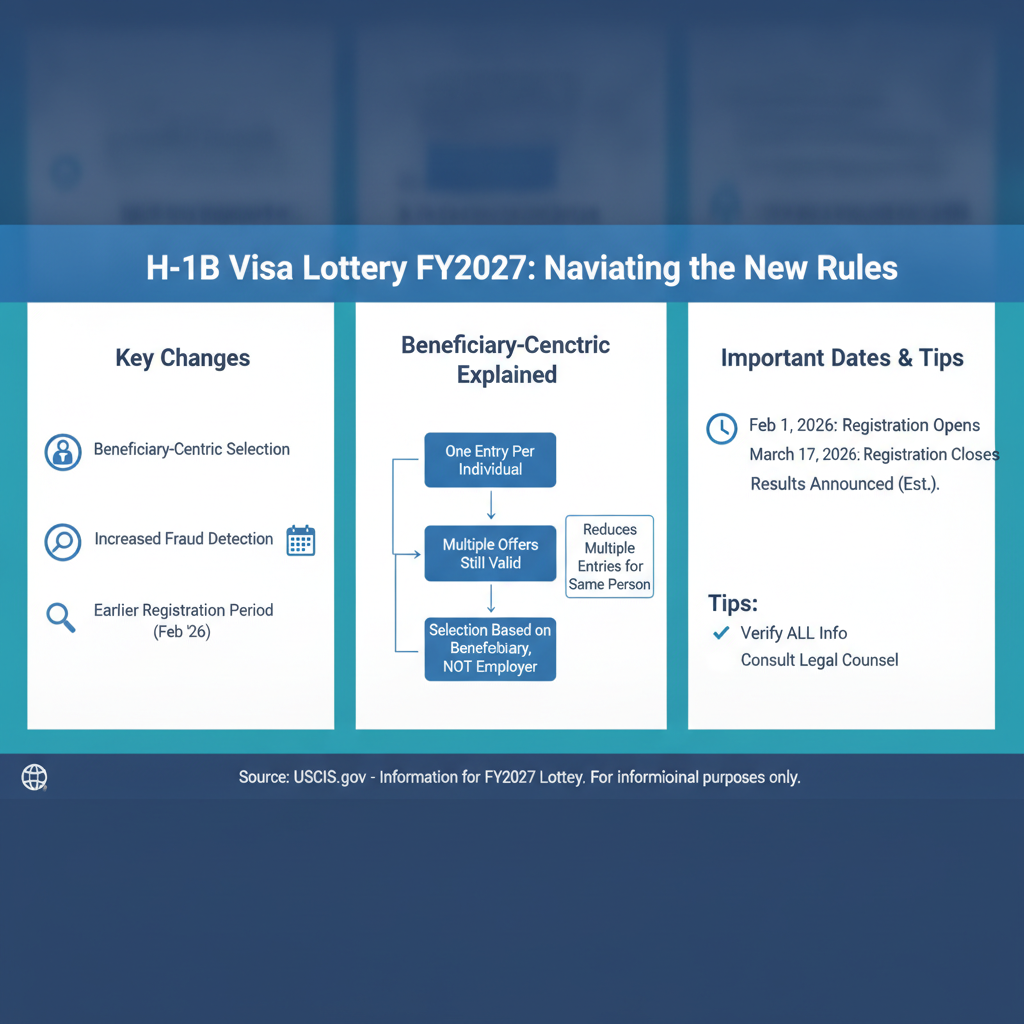
This comprehensive guide is informed by recent developments regarding the H-1B visa lottery. For more on the initial reporting, please refer to: H-1B Visa Lottery Changes for FY2027 (Legal News)
What This News Means for Immigrants in Orlando and Across Florida
The H-1B visa program is a cornerstone for highly skilled foreign professionals seeking to work in the United States, particularly in critical sectors like technology, healthcare, and engineering. For many aspiring immigrants and their employers in Orlando and across Florida, it represents a vital pathway to professional growth and permanent residency. News of changes to the H-1B visa lottery for Fiscal Year 2027 (FY2027) is therefore not just a headline; it's a critical development that could profoundly impact career trajectories and business strategies.
Why this news is showing up now
Immigration regulations, especially those governing high-demand visa categories like the H-1B, are subject to ongoing review and adjustment by U.S. Citizenship and Immigration Services (USCIS). These changes are often driven by several factors:
- Combating Fraud: USCIS regularly assesses the integrity of its programs. If patterns of abuse, such as multiple registrations for a single beneficiary by different employers, are detected, rules are updated to close loopholes.
- Program Efficiency: Efforts to streamline processes, reduce backlogs, and improve the overall efficiency of the lottery system can lead to new procedures.
- Policy Priorities: Administration priorities regarding skilled immigration, workforce needs, and national economic goals can influence regulatory shifts.
- Annual Review Cycle: Major announcements regarding the H-1B lottery typically occur in the fall or winter preceding the lottery registration period (which is usually in March for the fiscal year starting October 1st). Since today is September 21, 2026, it's the opportune time for USCIS to announce or finalize rules for the FY2027 lottery, allowing ample time for employers and beneficiaries to prepare.
How it can affect Florida residents
Florida, and particularly the Orlando metropolitan area, is a vibrant hub for innovation, tourism, healthcare, and technology. Companies across the state rely heavily on skilled foreign talent to fill critical roles. The H-1B visa is crucial for:
- Tech Sector Growth: Orlando's burgeoning tech industry, often referred to as "Silicon Sandbar," alongside the I-4 corridor's expanding defense, simulation, and aerospace sectors, attracts a significant number of H-1B professionals. Changes to the lottery can directly impact these companies' ability to recruit and retain top talent.
- University Graduates: Many international students graduating from Florida universities like the University of Central Florida (UCF), University of Florida (UF), and University of South Florida (USF) on F-1 visas (often utilizing Optional Practical Training - OPT) aspire to secure H-1B sponsorship to continue their careers in the U.S. New rules can alter their post-graduation plans and job prospects.
- Healthcare Professionals: Hospitals and healthcare providers throughout Florida also sponsor H-1B visas for doctors, nurses, and other specialists, especially in underserved areas.
- Employers: Florida employers, from startups to large corporations, must understand these changes to navigate the sponsorship process successfully, avoid compliance issues, and plan their workforce needs effectively.
- Families: For H-1B beneficiaries and their families already living in Orlando or planning to move here, these changes affect their long-term stability and ability to "Keep Families Together" – a core mission of Imigrar.
Need Help? Our Orlando immigration team is ready to assist. Call +1 786-791-3106 for a free consultation, or message us online. Se Habla Español.
What H-1B Visa Lottery Changes for FY2027 Is (and Why It Matters)
The H-1B visa program allows U.S. employers to temporarily employ foreign workers in specialty occupations. These occupations generally require a bachelor's degree or higher in a specific field. Due to overwhelming demand, the number of H-1B visas is capped annually by Congress, necessitating a lottery system for selection. The "changes for FY2027" refer to new regulations or procedures that USCIS has implemented or finalized for the H-1B cap lottery that will be conducted in early 2027 for the fiscal year beginning October 1, 2027.
A plain-English definition
Imagine a highly competitive job where thousands apply for a limited number of positions each year. The H-1B visa is like one of those positions, and the lottery is how USCIS picks who gets a chance to apply for it. The "changes" for FY2027 mean that the rules for how that lottery works have been updated. The most significant change, implemented to combat fraud, is that the lottery selection will now be primarily beneficiary-centric. This means that instead of a company registering a person, and potentially multiple companies registering the same person to increase their odds, the selection is now based on the individual foreign worker (the beneficiary) themselves. Regardless of how many different employers register on behalf of one person, that person only gets one chance in the lottery. If selected, any of the employers who registered for them can then proceed with filing the full H-1B petition. This aims to make the lottery fairer and prevent individuals from gaining an unfair advantage through multiple registrations.
Key terms you need to know
- H-1B Visa: A nonimmigrant visa that allows U.S. employers to temporarily employ foreign workers in specialty occupations.
- Specialty Occupation: An occupation that requires a theoretical and practical application of a body of highly specialized knowledge, and a bachelor's degree or higher in a specific specialty, or its equivalent.
- Beneficiary: The foreign worker who will be employed in the specialty occupation.
- Petitioner: The U.S. employer who files the H-1B petition on behalf of the beneficiary.
- H-1B Cap: The annual statutory limit on the number of H-1B visas issued each fiscal year. Currently, it is 65,000 for the regular cap and an additional 20,000 for those with a U.S. master's degree or higher (the Master's Cap).
- H-1B Lottery (Cap Lottery): The random selection process conducted by USCIS when the number of eligible registrations exceeds the annual H-1B cap.
- H-1B Registration: An electronic process where prospective petitioners (employers) submit basic information about the company and the beneficiary to USCIS during a designated period. This is the first step before the lottery.
- Beneficiary-Centric Selection: The new method for the FY2027 lottery where each unique beneficiary is entered into the lottery only once, regardless of the number of registrations submitted on their behalf by different employers.
- LCA (Labor Condition Application): Form ETA-9035, certified by the U.S. Department of Labor (DOL), which must be filed by the employer before filing an H-1B petition. It attests that the employer will pay the H-1B worker at least the prevailing wage or actual wage, whichever is higher, and provide working conditions that will not adversely affect other workers.
- Petition (Form I-129): The official application filed by the employer with USCIS after a registration is selected in the lottery.
- Change of Status (COS): An application requesting USCIS to change the nonimmigrant status of an individual already in the U.S. (e.g., from F-1 student to H-1B worker).
- Consular Processing: The process of applying for an H-1B visa stamp at a U.S. embassy or consulate abroad, typically for beneficiaries who are outside the U.S. or choose to travel.
- Premium Processing: An expedited service offered by USCIS for certain petitions, including H-1B, which guarantees processing within 15 calendar days for an additional fee.
- RFE (Request for Evidence): A notice from USCIS requesting additional documentation or information to support an H-1B petition.
- Notice of Action (Form I-797): Various notices issued by USCIS, including receipt notices, approval notices, or denial notices.
Need Help? Our Orlando immigration team is ready to assist. Call +1 786-791-3106 for a free consultation, or message us online. Se Habla Español.
Current Immigration Law: The Foundation
The H-1B visa program is governed primarily by the Immigration and Nationality Act (INA), specifically Section 101(a)(15)(H)(i)(b) and Section 214(g). These statutes establish the framework for the visa category, including the annual cap and eligibility requirements. USCIS regulations further detail the application process, documentation, and various procedures.
Federal requirements
At its core, the H-1B program requires a U.S. employer to offer a job in a "specialty occupation" to a foreign worker. Key federal requirements include:
- Specialty Occupation Definition: The job must meet the regulatory definition of a specialty occupation, typically requiring at least a bachelor's degree in a specific field.
- Educational Attainment: The beneficiary must hold a bachelor's degree or its equivalent, or possess a license in a specialty occupation field, or have work experience equivalent to a bachelor's degree.
- Employer-Employee Relationship: A valid employer-employee relationship must exist between the petitioning employer and the H-1B worker.
- Prevailing Wage: The employer must agree to pay the H-1B worker at least the prevailing wage for the occupation in the area of intended employment, or the actual wage paid to other employees with similar experience and qualifications, whichever is higher. This is attested to in the Labor Condition Application (LCA), Form ETA-9035, which is certified by the Department of Labor.
- Annual Cap: As mentioned, the H-1B visa is subject to an annual cap of 65,000, with an additional 20,000 reserved for those with a U.S. master's degree or higher. Certain employers are cap-exempt, such as institutions of higher education, non-profit organizations affiliated with higher education, and government research organizations.
- Initial Duration: H-1B visas are initially granted for up to three years and can be extended for a maximum total stay of six years. Exceptions exist for individuals with pending green card applications.
Florida-specific considerations
While H-1B law is federal, its application has local implications. For employers and beneficiaries in Florida, particularly the Orlando area:
- Local Economy: Florida's diverse economy, with its strong tourism, aerospace, tech, and healthcare sectors, means a wide range of companies seek H-1B talent. Employers in Orlando, for example, often sponsor H-1B visas for engineers in simulation and training, IT professionals in theme park technology, or specialized medical staff in our numerous hospitals.
- Prevailing Wage Data: The prevailing wage for a specific occupation can vary significantly based on the geographic area. For Central Florida residents, understanding the prevailing wage for Orange County or other nearby areas is crucial for LCA compliance.
- University Talent Pool: Florida boasts a robust higher education system, producing thousands of international graduates annually who are prime candidates for H-1B sponsorship. Employers in the I-4 corridor frequently recruit from UCF, Rollins College, and other institutions.
- Orlando USCIS Field Office: While H-1B petitions are processed at regional service centers, the Orlando USCIS Field Office handles local matters for many immigrants, though not directly H-1B adjudications. However, understanding the local immigration landscape is always beneficial.
- Compliance: Florida employers must ensure strict compliance with all H-1B regulations, including wage requirements and working conditions, to avoid penalties.
Need Help? Our Orlando immigration team is ready to assist. Call +1 786-791-3106 for a free consultation, or message us online. Se Habla Español.
How to Navigate the H-1B Visa Lottery Changes for FY2027: A Complete Step-by-Step Guide
The shift to a beneficiary-centric lottery system for FY2027 means a more focused approach for both employers and prospective H-1B workers. Here’s a detailed guide to navigating this updated process:
1) Understand the New Rules & Confirm Eligibility (October 2026 - January 2027)
Before any action, ensure you fully grasp the new beneficiary-centric selection process. This means your focus shifts from multiple employer registrations for one person to ensuring *each unique beneficiary* has one, and only one, legitimate entry.
- For Beneficiaries:
- Confirm your educational qualifications meet the "specialty occupation" criteria (bachelor's degree or equivalent in a relevant field).
- Ensure any work experience can be documented and is relevant.
- If on an F-1 visa, understand your OPT and cap-gap eligibility.
- Identify potential employers who are genuinely interested in sponsoring you and understand the new rules.
- For Employers:
- Verify the proposed position qualifies as a specialty occupation.
- Confirm the beneficiary's qualifications.
- Understand that while multiple employers *can* register for the same beneficiary, only one selection will be made per beneficiary. This means if your beneficiary is selected, you must be prepared to file the petition, knowing other employers also registered for them.
- Familiarize yourself with the latest USCIS guidance on anti-fraud measures and compliance.
- Beneficiary's academic transcripts, diplomas, and degree evaluations (if applicable).
- Beneficiary's resume/CV.
- Job description and organizational chart from the employer.
- Beneficiary's passport and visa/I-94 records (if already in the U.S.).
2) Employer Preparation & LCA Filing (January - February 2027)
This critical pre-registration phase ensures the employer meets all Department of Labor requirements before the H-1B registration period opens.
- Determine Prevailing Wage: The employer must obtain a prevailing wage determination from the DOL or use an acceptable alternative source to ensure they will pay the H-1B worker at least the legally required wage for the position and location (e.g., Orlando, Florida).
- File Form ETA-9035 (LCA): The employer must file a Labor Condition Application (LCA) with the Department of Labor. This form attests to compliance with wage and working condition requirements. The LCA must be certified by the DOL before the H-1B petition can be filed with USCIS.
- Internal Posting: Employers must post a notice of the LCA filing at the place of employment or provide it to the bargaining representative, if applicable.
- Certified Form ETA-9035 (LCA).
- Documentation of prevailing wage determination.
- Proof of internal LCA notice posting.
3) H-1B Registration Process (March 2027)
This is the gateway to the lottery. USCIS typically opens a registration window for about two weeks in March.
- Create/Access USCIS Online Account: Both the prospective petitioner (employer) and their legal representative must have a USCIS online account.
- Submit Electronic Registration: Each employer wishing to sponsor a beneficiary must submit an electronic registration for that beneficiary through the USCIS official website.
- Key Information Required: Employer's name, address, EIN, and contact information; beneficiary's full name, date of birth, country of birth, country of citizenship, passport number, and highest degree obtained.
- New Rule Impact: USCIS will use the beneficiary's passport information (and potentially other biographic data) to identify unique individuals and ensure only one entry per beneficiary in the lottery.
- Pay Registration Fee: A small, non-refundable fee (e.g., $10) is required for each registration.
- Beneficiary's valid passport information.
- Employer's EIN and contact details.
- Payment method for the registration fee.
4) Lottery Selection & Petition Filing (Late March - June 2027)
If your beneficiary's registration is selected, the real work begins.
- Selection Notification: USCIS will notify selected registrants (and their legal representatives) through their online accounts. This typically happens by late March.
- Petition Filing Window: USCIS will specify a 90-day window during which selected petitioners can file their full H-1B petition (Form I-129). For FY2027, this might be from April 1, 2027, through June 30, 2027.
- Prepare & File Form I-129: The employer, with legal assistance, compiles and files Form I-129, Petition for a Nonimmigrant Worker, along with all supporting documentation and required fees. This includes the certified LCA.
- Premium Processing Option: If available, employers can opt for Premium Processing for an additional fee to receive a decision within 15 calendar days. USCIS usually announces when premium processing will be available for cap-subject H-1B petitions.
- USCIS Selection Notice (Form I-797C).
- Certified Form ETA-9035 (LCA).
- Form I-129 and H-1B supplement.
- Company documents (e.g., business license, tax returns, articles of incorporation, financial statements, marketing materials).
- Beneficiary's educational documents (diplomas, transcripts, degree evaluations).
- Beneficiary's resume/CV.
- Evidence of employer-employee relationship (e.g., offer letter, employment agreement, pay stubs if currently employed).
- Detailed job description, duties, and qualifications required for the specialty occupation.
- Expert opinion letters (if specialty occupation or degree equivalency is in question).
- Photographs of the beneficiary (if applicable for Change of Status).
- Form I-94 (Arrival/Departure Record) and current visa/status documents (if in the U.S. and filing for Change of Status).
- Filing fees (check USCIS Forms for current fees).
5) Responding to RFEs & Approval (June - September 2027)
After filing, USCIS may issue an RFE.
- RFE Response: If an RFE is issued, it means USCIS needs more information to make a decision. A prompt and comprehensive response with the required evidence is critical.
- Approval: If the petition is approved, USCIS will issue an approval notice (Form I-797). If the beneficiary is in the U.S. and filed for a Change of Status, the I-797 will also indicate the new H-1B status and validity period, allowing them to begin working on October 1, 2027.
- Any specific documents requested in the RFE.
- A well-crafted legal argument supporting the petition.
6) Visa Interview / Change of Status (Fall 2027)
This step depends on whether the beneficiary is inside or outside the U.S.
- For Beneficiaries Outside the U.S. (Consular Processing):
- Schedule a visa interview at a U.S. embassy or consulate in their home country.
- Attend the interview with the H-1B approval notice and other required documents.
- If approved, the visa stamp will be placed in their passport, allowing entry to the U.S.
- For Beneficiaries Inside the U.S. (Change of Status):
- If the Form I-129 included a request for a Change of Status and was approved, the beneficiary's status automatically changes to H-1B on October 1, 2027.
- They can begin employment with the petitioning employer on or after this date.
- The cap-gap provision allows F-1 students whose OPT expires before October 1st to remain legally in the U.S. and work until their H-1B status begins.
- H-1B approval notice (Form I-797).
- Valid passport.
- DS-160 confirmation page (for consular processing).
- Passport-style photographs.
- Birth certificate, marriage certificate (if applicable for dependents).
- Educational and employment documentation.
7) Starting H-1B Employment (October 1, 2027)
The H-1B status officially begins on October 1, 2027, the start of the fiscal year for which the cap applies.
- Commence Employment: The beneficiary can begin working for the petitioning employer on or after October 1st.
- Maintain Status: It is crucial for H-1B workers to maintain their status by working only for the sponsoring employer, adhering to the terms of the petition, and notifying USCIS of any material changes (e.g., change of address, significant change in job duties).
- Dependents: Spouses and unmarried children under 21 of H-1B workers can apply for H-4 dependent visas. H-4 spouses may be eligible for work authorization in certain circumstances.

Practical Steps You Can Take Today
Navigating the H-1B lottery is a marathon, not a sprint. Proactive preparation, especially with the FY2027 changes, is key to success. Here are actionable steps you can take now:
- Consult with an Experienced Immigration Attorney: This is the most crucial step. The new beneficiary-centric rules, combined with the inherent complexity of H-1B petitions, make expert guidance essential. An attorney can assess eligibility, guide employers on compliance, and prepare a robust petition. Contact Imigrar today for a free consultation.
- For Beneficiaries: Secure a Sponsoring Employer: Start networking and applying for jobs now. Focus on employers who have a history of H-1B sponsorship and are aware of the new rules. Ensure they understand the beneficiary-centric lottery and are committed to sponsoring you.
- For Employers: Conduct Internal Reviews: Review your hiring practices, job descriptions, and compensation structures to ensure they align with H-1B requirements. Begin identifying potential H-1B candidates and preparing for the LCA process.
- Gather All Required Documents Early: Do not wait until the last minute. Compile educational transcripts, diplomas, degree evaluations, resumes, job descriptions, and company financial documents. Ensure passports are valid and up-to-date.
- Understand the New Lottery Mechanics: Both employers and beneficiaries must fully grasp that selection is now tied to the unique beneficiary. This reduces fraud but means the odds are fundamentally different.
- Plan for Potential RFEs: Anticipate that USCIS may issue a Request for Evidence. Having a well-prepared petition with strong initial evidence can reduce the likelihood of an RFE
Related Topics
Need Legal Assistance?
Our experienced immigration attorneys are here to help with your case. Contact Imigrar today for a free consultation and let us guide you through the legal process with confidence.
📍 Orlando, Florida • Serving clients nationwide
📧 info@imigrar.com