
H-1B Lottery Changes FY2027: What New Rules Mean for Immigrants
Understand the new H-1B visa lottery changes for Fiscal Year 2027. Imigrar guides you through the updated rules, eligibility, and application process.

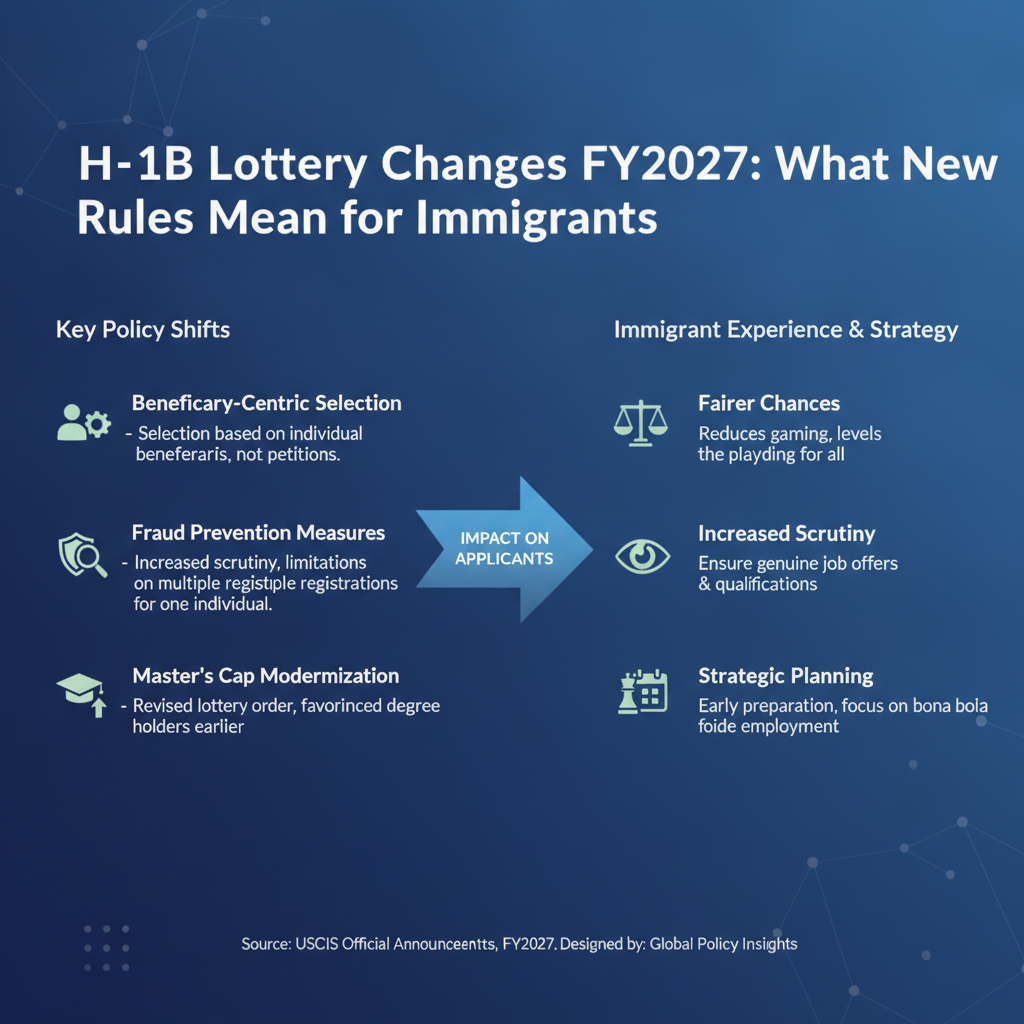
The H-1B visa program is a lifeline for U.S. employers seeking to fill specialty occupation roles with skilled foreign professionals and for foreign nationals aspiring to contribute their talents to the American economy. With its annual cap, the demand for H-1B visas consistently outstrips supply, making the lottery system a critical, often stressful, gateway. As we approach the application cycle for Fiscal Year 2027 (FY2027), significant changes are on the horizon, building upon recent USCIS reforms. These updates aim to enhance the integrity of the lottery process and reduce fraud, directly impacting how employers and beneficiaries prepare and apply.
At Imigrar, an immigration law firm based in Orlando, Florida, we understand the profound implications these changes have for individuals, families, and businesses nationwide. Our mission is to "Keep Families Together" by providing expert legal guidance through complex immigration landscapes. This comprehensive guide will break down the H-1B visa lottery changes for FY2027, offering practical advice, timelines, and official references to help you navigate this crucial process.
The reporting that sparked this guide
The information and analysis presented in this guide are based on evolving immigration policies and discussions within the legal community, highlighted by recent reports on upcoming changes to the H-1B visa lottery system. Stay informed through official channels and expert legal advice:
H-1B Visa Lottery Changes for FY2027 (Legal News)
What This News Means for Immigrants in Orlando and Across Florida
The H-1B visa program is vital to Florida's economy, supporting key sectors like technology, healthcare, tourism, and aerospace. Changes to the lottery system reverberate deeply throughout our state, affecting both employers eager to attract top talent and skilled professionals seeking opportunities in the Sunshine State.
Why this news is showing up now
Immigration policy, particularly concerning employment-based visas, is dynamic. USCIS frequently refines its processes to address evolving challenges, such as overwhelming demand, potential fraud, and administrative efficiencies. The changes for FY2027 are a continuation of these efforts, often building upon modifications introduced in previous fiscal years (like the beneficiary-centric selection process for FY2025). Announcements and discussions about these updates typically surface months in advance of the new fiscal year's registration period, allowing stakeholders time to understand and adapt. As of November 1, 2026, the immigration community is actively preparing for the upcoming FY2027 H-1B lottery cycle, which will likely commence its registration phase in early 2027 for petitions seeking an October 1, 2027, start date.
How it can affect Florida residents
For Central Florida residents and those across the state, these changes hold significant weight:
- For Prospective H-1B Beneficiaries: If you are a foreign national living in Florida on another visa (e.g., F-1 OPT) or abroad, these changes directly impact your chances of securing an H-1B visa. The shift towards a beneficiary-centric selection model, which has been the standard since FY2025, aims to prevent multiple registrations for the same individual, potentially leveling the playing field. However, increased scrutiny means every detail of your educational and professional background must be impeccably documented.
- For Florida Employers: Companies in Orlando's burgeoning tech corridor, healthcare institutions, theme park operators, and agricultural businesses rely on H-1B visas to fill specialized roles. These new rules mean employers must be even more diligent in their registration and petition filing processes, ensuring compliance and robust support for their sponsored employees. Any increase in fees or additional data requirements will also impact operational costs.
- For the Economy: Florida's economy thrives on innovation and skilled labor. A more secure and efficient H-1B process can help Florida businesses attract the talent needed to grow, while a complex or uncertain process could hinder economic development.
Understanding these shifts is not just a matter of compliance; it's about strategizing for success in a highly competitive environment. Imigrar is here to guide you through every step, ensuring you are prepared for the FY2027 H-1B lottery.
Need Help? Our Orlando immigration team is ready to assist. Call +1 786-791-3106 for a free consultation, or message us online. Se Habla Español.
What H-1B Visa Lottery Changes for FY2027 Is (and Why It Matters)
The H-1B visa program is a cornerstone of U.S. immigration policy for skilled nonimmigrant workers. Understanding its core function and recent modifications is crucial for anyone involved in the process.
A plain-English definition
The H-1B visa is a nonimmigrant visa that allows U.S. employers to temporarily employ foreign workers in specialty occupations. These occupations generally require a bachelor's degree or higher in a specific field. Examples include IT professionals, engineers, doctors, architects, and certain types of analysts. Each year, the U.S. government sets a numerical limit, or cap, on the number of H-1B visas issued. This cap is currently 65,000 regular visas, plus an additional 20,000 visas for those with a U.S. master's degree or higher (the "master's cap").
Because the demand for H-1B visas far exceeds this annual cap, the U.S. Citizenship and Immigration Services (USCIS) conducts a random lottery to select eligible registrations. The significant "changes" for FY2027 primarily build upon the beneficiary-centric selection process introduced in FY2025, which aimed to prevent fraud where multiple employers might submit registrations for the same individual to increase their chances. This new approach means the lottery selection is based on the unique beneficiary, not on the number of registrations submitted on their behalf. This fundamental shift is designed to ensure a fairer process for all applicants.
Key terms you need to know
Navigating the H-1B landscape requires familiarity with specific terminology:
- H-1B Cap: The annual numerical limit on H-1B visas. Currently, 85,000 (65,000 regular + 20,000 master's cap).
- Cap-Subject: Refers to H-1B petitions that are subject to the annual cap and must go through the lottery.
- Cap-Exempt: Certain employers are exempt from the annual cap, such as institutions of higher education, non-profit organizations affiliated with them, and non-profit research organizations.
- Specialty Occupation: An occupation that requires theoretical and practical application of a body of highly specialized knowledge, and a bachelor's or higher degree in the specific specialty (or its equivalent) as a minimum for entry into the occupation.
- LCA (Labor Condition Application): Form ETA-9035, filed by the employer with the Department of Labor (DOL) to attest to compliance with wage and working condition requirements. An approved LCA is mandatory before filing the H-1B petition.
- Beneficiary: The foreign national worker who will be employed in the H-1B position.
- Petitioner: The U.S. employer who files the H-1B petition on behalf of the beneficiary.
- Registration Period: The designated timeframe (usually in March) during which employers submit electronic registrations for the H-1B lottery.
- Selection Notice: The official notification from USCIS to employers whose registrations have been selected in the lottery.
- Fiscal Year (FY): The U.S. government's fiscal year runs from October 1 to September 30. H-1B visas approved for a given FY (e.g., FY2027) become effective on October 1st of that year.
- Beneficiary-Centric Selection: The current lottery system where each unique beneficiary is entered into the lottery only once, regardless of how many employers register them. If selected, any employer who registered that beneficiary may file a petition. This aims to prevent fraud and ensure fairness.
- Premium Processing: An optional service (Form I-907) offered by USCIS for expedited processing of certain petitions, including H-1B.
Current Immigration Law: The Foundation
The H-1B visa program is governed by specific sections of U.S. immigration law, primarily found within the Immigration and Nationality Act (INA) and its corresponding regulations in the Code of Federal Regulations (CFR). Understanding these legal underpinnings is essential for compliance.
Federal requirements
The primary legal framework for the H-1B visa is established under the Immigration and Nationality Act (INA) § 101(a)(15)(H)(i)(b), which defines the H-1B nonimmigrant classification. Further detailed regulations are found in 8 Code of Federal Regulations (CFR) § 214.2(h). Key federal requirements include:
- Specialty Occupation: The position must qualify as a specialty occupation, meaning it requires a bachelor's degree or higher in a specific field. The employer must demonstrate that the job duties are complex and specialized enough to necessitate such a degree.
- Educational Attainment: The beneficiary must hold a bachelor's degree or its equivalent, or possess a license in a specialty occupation field, or have work experience equivalent to a bachelor's degree.
- Employer-Employee Relationship: A valid employer-employee relationship must exist between the petitioning U.S. employer and the H-1B beneficiary. This means the employer must have the right to control the beneficiary's work.
- Labor Condition Application (LCA): Before filing an H-1B petition, the employer must file and obtain certification of a Labor Condition Application (Form ETA-9035) from the U.S. Department of Labor (DOL). This LCA attests that the employer will pay the H-1B worker at least the prevailing wage for the occupation in the area of employment, or the actual wage paid to other employees with similar experience and qualifications, whichever is higher. It also attests to safe working conditions.
- H-1B Cap: Unless cap-exempt, the petition is subject to the annual H-1B cap and must be selected through the lottery.
For official information, always refer to the USCIS official website.
Florida-specific considerations
While federal law governs the H-1B visa program, Florida's economic landscape creates unique considerations for H-1B applicants and employers. Florida does not have specific state laws governing H-1B visas that differ from federal regulations. However, the high demand for skilled workers in specific Florida industries means a competitive environment for H-1B applicants:
- Tech and Innovation: Orlando, Tampa, and Miami are growing tech hubs. Companies along the I-4 corridor are particularly active in sponsoring H-1B visas for software developers, IT consultants, and engineers.
- Healthcare: Florida's large and aging population drives significant demand for doctors, nurses, and allied health professionals, many of whom are sponsored through the H-1B program.
- Tourism and Hospitality: While many roles in this sector may not qualify as specialty occupations, certain positions requiring advanced degrees in hospitality management, marketing analytics, or financial management within large resort corporations might.
- Education and Research: Florida's universities and research institutions (e.g., University of Central Florida, University of Florida) are often cap-exempt, offering opportunities outside the lottery system.
Understanding the local job market and employer needs can help both beneficiaries and petitioners strategize their H-1B applications effectively. The Orlando USCIS Field Office primarily handles adjustment of status applications and interviews, but understanding its role within the broader immigration system is important for Central Florida residents.

How to Navigate the H-1B Lottery Under the New FY2027 Rules: A Complete Step-by-Step Guide
The H-1B lottery process, especially with the FY2027 changes building on the beneficiary-centric model, requires meticulous planning and execution. Here’s a detailed guide to help you and your employer navigate the journey.
1) Employer Assessment and LCA Filing
The process begins with the employer. They must first assess if the position truly qualifies as a specialty occupation and if the beneficiary meets the educational requirements. This involves reviewing the job duties, required qualifications, and the beneficiary's credentials.
- Action for Employer:
- Determine if the job requires a bachelor's degree or higher in a specific field.
- Verify the beneficiary's educational background (degree, transcripts, evaluations if foreign degree).
- Consult with an immigration attorney to ensure the position and beneficiary meet USCIS criteria.
- LCA Filing: Once confident, the employer must file a Labor Condition Application (Form ETA-9035) with the U.S. Department of Labor (DOL). This form attests that the employer will pay the H-1B worker at least the prevailing wage and provide working conditions that will not adversely affect other workers. The LCA must be certified by the DOL before an H-1B petition can be filed.
- Required Documents for LCA:
- Job description with duties and requirements.
- Employer's Federal Employer Identification Number (EIN).
- Prevailing wage determination (often obtained through DOL's Foreign Labor Certification Data Center or private wage surveys).
- Employer's attestations regarding wages and working conditions.
- Timeline Expectation: LCA processing typically takes 7-10 business days, but can vary.
2) H-1B Registration Period
Once the LCA is certified, the employer can proceed with the H-1B lottery registration. USCIS conducts an electronic registration process to manage the high volume of applications. The registration period typically opens in early March for about 2-3 weeks.
- Action for Employer:
- Create a USCIS online account (if not already done).
- Submit an electronic registration for each prospective H-1B beneficiary during the designated registration window.
- Pay the required H-1B registration fee for each submission (e.g., $10 for FY2025, but this fee could change for FY2027).
- Important: Under the beneficiary-centric selection process, each unique beneficiary should only have one registration submitted on their behalf by a single employer. However, multiple employers can register the same beneficiary. USCIS will select based on the unique beneficiary, not the number of registrations.
- Required Information for Registration:
- Employer's legal name, address, and EIN.
- Beneficiary's full legal name, date of birth, country of birth, country of citizenship, passport number.
- Beneficiary's gender.
- Beneficiary's highest degree attained.
- Employer's authorized signatory information.
- Timeline Expectation: The registration window is typically 14-18 calendar days in early March.
3) Lottery Selection and Notification
After the registration period closes, USCIS conducts the random lottery. Under the beneficiary-centric model, if a beneficiary has multiple registrations submitted by different employers, they are entered into the lottery once. If selected, any of the employers who registered that beneficiary may proceed with filing a petition.
- Action for Employer:
- Monitor the USCIS online account for selection notifications.
- If selected, the status will change to "Selected." If not selected, it will show "Not Selected" or "Denied" (if duplicate registrations were found).
- Timeline Expectation: Selection notifications are typically issued by late March.
4) Petition Filing (for Selected Beneficiaries)
Only employers with a "Selected" status for a beneficiary may proceed to file an H-1B petition. USCIS provides a specific filing window, usually 90 days, for these petitions.
- Action for Employer:
- Prepare and file Form I-129, Petition for a Nonimmigrant Worker, along with the certified LCA and all required supporting documentation, to the appropriate USCIS service center.
- Pay the required USCIS filing fees (base fee, ACWIA fee, fraud prevention and detection fee, public law 114-113 fee if applicable).
- Required Documents for I-129 Petition:
- Approved Labor Condition Application (Form ETA-9035).
- Beneficiary's educational degrees, transcripts, and foreign degree evaluations.
- Beneficiary's resume/CV and experience letters.
- Copy of beneficiary's passport, visa, I-94 record, and previous I-797 approval notices (if applicable).
- Employer's business license, tax ID, financial statements, and organizational charts.
- Detailed job description, including duties, responsibilities, and required qualifications.
- Employer support letter explaining the specialty occupation and the need for the beneficiary.
- Copies of any contracts between the employer and the beneficiary.
- Timeline Expectation: The filing window is generally 90 days from April 1st.
5) Premium Processing (Optional)
For employers who need a faster decision on the H-1B petition, Premium Processing is available. This service guarantees USCIS will take action on the petition within 15 calendar days.
- Action for Employer:
- File Form I-907, Request for Premium Processing Service, along with the substantial premium processing fee (e.g., $2,805 for FY2024, subject to change for FY2027).
- This can be filed concurrently with Form I-129 or at a later date.
- Required Documents:
- Form I-907.
- Premium Processing fee.
- Important: Premium Processing does not increase the chances of selection in the lottery; it only expedites the adjudication of a selected petition.
6) USCIS Adjudication and Approval
USCIS reviews the submitted Form I-129 and supporting documents. During this phase, USCIS may issue a Request for Evidence (RFE) if they require additional information or clarification.
- Action for Employer & Beneficiary:
- Promptly respond to any RFE with comprehensive and well-organized evidence. This is a critical stage, and a strong response can often be the difference between approval and denial.
- Upon approval, USCIS will issue an Approval Notice (Form I-797).
- Timeline Expectation: Standard processing times can range from several months to over a year, depending on the service center and USCIS workload. You can check current processing times at USCIS Processing Times.
7) Change of Status or Consular Processing
Upon approval, the beneficiary's next steps depend on their current location and immigration status.
- For Beneficiaries Already in the U.S. (Change of Status):
- If the beneficiary is currently in the U.S. in a valid nonimmigrant status (e.g., F-1 OPT) and the H-1B petition included a request for Change of Status, their H-1B status will automatically become effective on October 1st of the fiscal year. They can begin working for the H-1B employer on this date.
- For Beneficiaries Outside the U.S. (Consular Processing):
- If the beneficiary is outside the U.S. or the petition did not request a change of status, they must attend an H-1B visa interview at a U.S. Embassy or Consulate in their home country.
- Required Documents for Consular Processing:
- Approved Form I-797, Approval Notice.
- Completed DS-160, Online Nonimmigrant Visa Application.
- Valid passport (at least 6 months beyond intended stay).
- Passport-style photographs.
- Appointment confirmation page.
- Copy of the H-1B petition package submitted to USCIS.
- Letters from employer, job offer, and educational documents.
- Any other documents requested by the consulate.
- Timeline Expectation: Consular interview wait times vary significantly by country. Check the U.S. Department of State website for current wait times.
Navigating the H-1B process requires precision. Don't leave your future to chance. Imigrar's experienced attorneys can help. Call +1 786-791-3106 for a free consultation. Se Habla Español.
Related Topics
Need Legal Assistance?
Our experienced immigration attorneys are here to help with your case. Contact Imigrar today for a free consultation and let us guide you through the legal process with confidence.
📍 Orlando, Florida • Serving clients nationwide
📧 info@imigrar.com