
H-1B FY2027 Lottery Changes: Your Guide to New Rules & Success
Understand the critical H-1B visa lottery changes for FY2027. Learn new rules, requirements, and how to navigate the updated process for specialty occupation visas. Imigrar helps families stay together.

The landscape of U.S. immigration law is constantly evolving, and few areas garner as much attention and anxiety as the H-1B visa program. Designed for foreign nationals in specialty occupations, the H-1B visa is a vital pathway for skilled professionals to contribute to the American economy. As we move into late 2026, the discussion around the H-1B visa lottery for Fiscal Year 2027 (FY2027) remains highly relevant, with significant changes impacting how employers and beneficiaries navigate this competitive process.
At Imigrar, an immigration law firm based in Orlando, Florida, our mission is to "Keep Families Together." We understand the profound impact these changes have on individuals, families, and businesses nationwide. This comprehensive guide will break down the H-1B visa lottery changes for FY2027, explaining what they mean for you, detailing the updated processes, and offering actionable advice to enhance your chances of success.
Navigating H-1B changes can be complex. Don't go it alone. Our Orlando immigration team is ready to assist. Call +1 786-791-3106 for a free consultation, or message us online. Se Habla Español.
The reporting that sparked this guide
Our insights are informed by the latest developments in immigration policy, continuously monitored from official sources and reputable legal news outlets. The ongoing discussions and analyses of the H-1B Visa Lottery Changes for FY2027 (Legal News) highlight a critical shift in how U.S. Citizenship and Immigration Services (USCIS) manages this high-demand visa category. While the FY2027 registration period and lottery selection have concluded, the ramifications of these new rules are still being felt as petitions are processed and adjudicated, setting precedents for future years.
What This News Means for Immigrants in Orlando and Across Florida
For many skilled professionals and their sponsoring employers, the H-1B visa is a cornerstone of their professional journey in the United States. The recent changes, solidified for the FY2027 cap season, represent a concerted effort by USCIS to refine the lottery system, enhance fairness, and combat fraud. Understanding these updates is not just about compliance; it's about strategic planning for your future.
Why this news is showing up now
The H-1B cap-subject petition process operates on a fiscal year basis, beginning October 1st. While the registration period for FY2027 typically occurs in March of the preceding calendar year (meaning March 2026 for FY2027), and selections are announced shortly thereafter, the implications of new rules often become clearer as petitions are filed and adjudicated. By November 2026, many FY2027 petitions are either pending, have received Requests for Evidence (RFEs), or have been approved. The "news" now reflects:
- Analysis of Impact: Immigration attorneys, employers, and beneficiaries are analyzing the practical impact of the FY2027 changes, particularly the beneficiary-centric selection process and any revised fee structures, on the overall success rates and integrity of the lottery.
- USCIS Clarifications: USCIS may issue further guidance or clarifications on specific aspects of the new rules as they encounter novel scenarios during adjudication.
- Ongoing Adjudication: The processing of FY2027 H-1B petitions continues, and any new policies or stricter enforcement measures are actively shaping outcomes.
- Precedent for Future Lotteries: The experience of FY2027 is crucial for understanding how future H-1B lotteries (like FY2028) will be conducted.
This ongoing discussion ensures that all stakeholders are aware of the current operational environment and can adapt their strategies accordingly.
How it can affect Florida residents
Florida, particularly the Central Florida region around Orlando, is a rapidly growing hub for technology, aerospace, healthcare, and tourism industries. These sectors heavily rely on the H-1B program to attract and retain highly skilled foreign talent. The changes to the H-1B lottery can have several direct impacts on Florida residents:
- For Prospective H-1B Beneficiaries in Florida: If you are an international student graduating from a Florida university (like UCF, UF, or FIU) on an F-1 visa, or a professional already working in Florida on another nonimmigrant visa, the changes directly affect your pathway to an H-1B. The beneficiary-centric selection process aims to reduce fraud, ensuring that each eligible individual has an equal chance, regardless of how many employers register for them. This is a positive development for legitimate candidates.
- For Florida Employers: Companies along the I-4 corridor, from Orlando to Tampa, that depend on H-1B workers for their tech, engineering, and medical roles must understand the updated registration and filing procedures. This includes ensuring compliance with new anti-fraud measures and being prepared for potentially increased costs if fees have been adjusted. For employers, the integrity of the lottery means a fairer playing field for securing top talent.
- Increased Scrutiny: USCIS's enhanced focus on fraud prevention means that petitions for jobs in Florida, particularly those from smaller or newer companies, may face increased scrutiny. It is crucial for both employers and beneficiaries to ensure all documentation is accurate and rigorously supports the H-1B eligibility criteria.
- Economic Impact: A more stable and fair H-1B program benefits Florida's economy by allowing its key industries to access the global talent pool, fostering innovation and job creation within the state.
For those in Orlando and the broader Central Florida area, staying informed and working with experienced legal counsel is paramount to navigating these critical changes successfully.
What H-1B Visa Lottery Changes for FY2027 Is (and Why It Matters)
The H-1B visa program is a cornerstone of U.S. immigration for skilled workers. The changes introduced for FY2027 are significant and represent a continued evolution of the program, building on previous reforms to ensure fairness and efficiency.
A plain-English definition
The H-1B visa is a nonimmigrant visa that allows U.S. employers to temporarily employ foreign workers in specialty occupations. These occupations generally require a bachelor's degree or higher in a specific field. Examples include IT professionals, engineers, doctors, architects, and scientists. Because demand for H-1B visas far exceeds the annual supply, USCIS conducts an annual H-1B lottery to select eligible registrations.
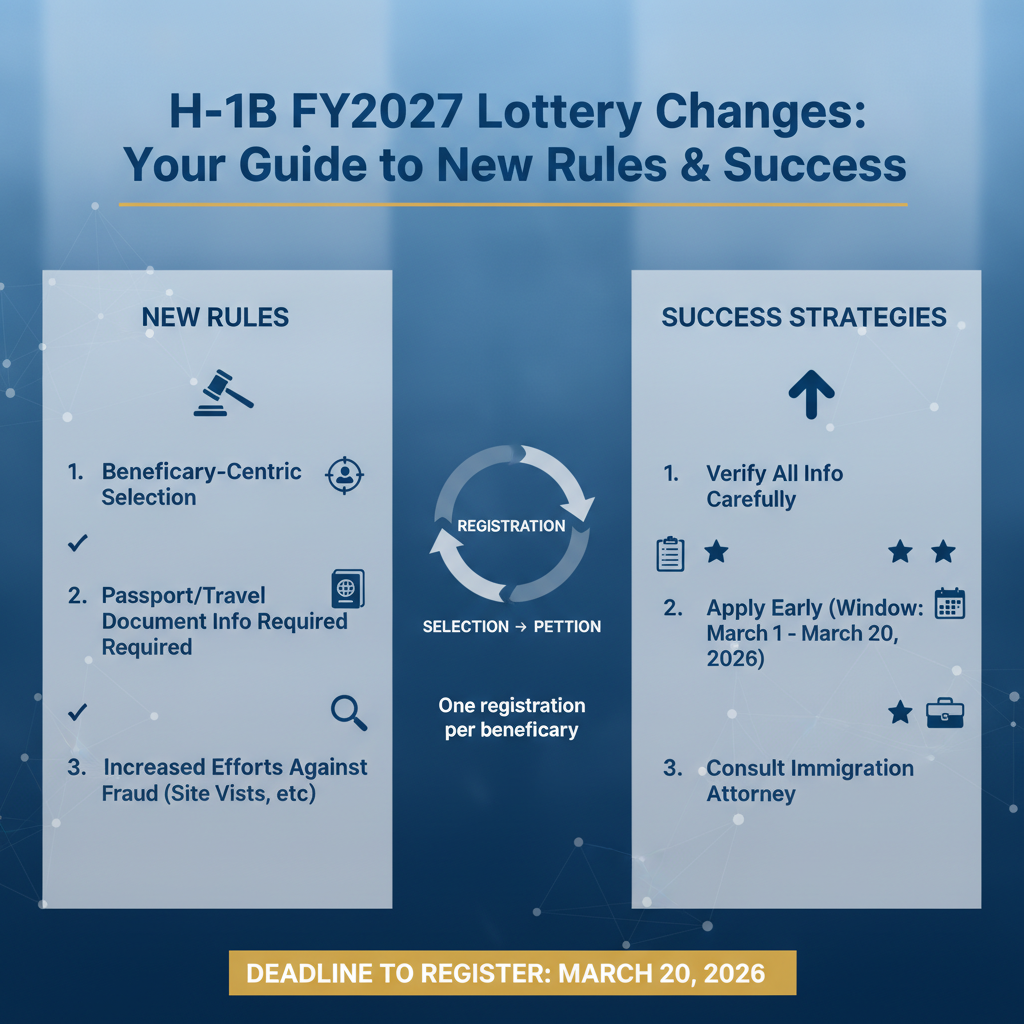
The "H-1B Visa Lottery Changes for FY2027" refer to the updated rules and procedures that USCIS implemented for the H-1B cap-subject registration and selection process for the fiscal year beginning October 1, 2026. The most pivotal of these changes, initially introduced for FY2025 and reinforced for FY2027, is the shift from an employer-centric to a beneficiary-centric selection process. This means that each individual beneficiary is entered into the lottery only once, regardless of how many employers submit registrations on their behalf. This change aims to drastically reduce the fraudulent practice of multiple registrations by a single beneficiary to increase their odds of selection.
Key terms you need to know
- Beneficiary: The foreign national worker who will be employed in a specialty occupation.
- Petitioner: The U.S. employer filing the H-1B petition on behalf of the beneficiary.
- Specialty Occupation: An occupation that requires a theoretical and practical application of a body of highly specialized knowledge, and a bachelor's or higher degree in the specific specialty (or its equivalent) as a minimum for entry into the occupation in the United States.
- H-1B Cap: The annual limit on the number of H-1B visas issued. The regular cap is 65,000, with an additional 20,000 reserved for those with a U.S. master's degree or higher (the "Master's Cap").
- Cap-Subject: Petitions that are subject to the annual H-1B cap.
- Cap-Exempt: Certain employers (e.g., higher education institutions, non-profit research organizations) are exempt from the annual cap.
- Fiscal Year (FY): The U.S. government's fiscal year runs from October 1st to September 30th. FY2027 began on October 1, 2026.
- H-1B Registration Period: A designated period (typically in March) when employers submit electronic registrations for prospective H-1B beneficiaries.
- Lottery Selection: The random process USCIS uses to select registrations when the number of eligible registrations exceeds the annual cap.
- Selection Notice: Notification from USCIS that a registration has been selected in the lottery, allowing the petitioner to file a full H-1B petition.
- Form I-129: The "Petition for a Nonimmigrant Worker" form, used by employers to petition for H-1B workers after a successful lottery selection.
- Labor Condition Application (LCA): Form ETA-9035. An application filed with the Department of Labor (DOL) that attests to the employer's compliance with wage and working condition requirements for H-1B workers. Must be certified before filing Form I-129.
- Premium Processing: An optional service that allows petitioners to request expedited processing of certain immigration forms, including Form I-129, for an additional fee.
The significance of the FY2027 changes lies in their direct impact on the integrity and fairness of the H-1B lottery. By focusing on the beneficiary, USCIS aims to eliminate the unfair advantage gained by individuals who previously had multiple employers register on their behalf, thus leveling the playing field for all legitimate applicants. This change is crucial for fostering trust in the system and ensuring that the visa program serves its intended purpose of bringing highly skilled talent to the U.S. workforce.
Current Immigration Law: The Foundation of the H-1B Visa
The H-1B visa program is governed by specific provisions within the Immigration and Nationality Act (INA) and further regulated by federal statutes and regulations. Understanding these foundational laws is essential for navigating the application process.
Federal requirements
The H-1B nonimmigrant visa category is established under Section 101(a)(15)(H)(i)(b) of the Immigration and Nationality Act (INA). Key aspects of the law include:
- Specialty Occupation Definition: INA § 214(i)(1) defines a specialty occupation as one requiring theoretical and practical application of a body of highly specialized knowledge, and attainment of a bachelor's or higher degree in the specific specialty (or its equivalent) as a minimum for entry into the occupation in the United States.
- Annual Cap: INA § 214(g) sets the annual numerical limitations (the cap) for H-1B visas. Currently, this is 65,000 for the regular cap and an additional 20,000 for the Master's cap.
- Employer Attestations: Employers must file a Labor Condition Application (LCA) with the Department of Labor, making attestations regarding wages, working conditions, and absence of strikes or lockouts. These attestations are crucial for protecting both U.S. and H-1B workers.
- Duration of Stay: An H-1B visa is generally granted for an initial period of up to three years and can be extended for a maximum total of six years.
For FY2027, the underlying federal laws remain the same, but the *implementation* and *enforcement* of these laws, particularly concerning the lottery selection mechanism and anti-fraud measures, have been strengthened. The move to a beneficiary-centric selection process is a regulatory change designed to ensure the integrity of the lottery within the existing statutory framework.
Florida-specific considerations
While immigration law is federal, the practical application often has state-level nuances, particularly concerning the job market and employer needs. In Florida:
- Demand in Key Industries: Florida's robust technology sector, burgeoning aerospace industry, and strong healthcare systems (especially in areas like Orlando and Tampa) generate significant demand for H-1B workers. Employers in these fields are frequently petitioners.
- Educational Institutions: Florida is home to numerous universities that produce a talented pool of graduates, many of whom seek H-1B sponsorship. The Master's Cap is particularly relevant for those graduating from U.S. master's or Ph.D. programs in Florida.
- Orlando USCIS Field Office: While H-1B petitions are processed at service centers, the presence of the Orlando USCIS Field Office means local access for certain immigration services related to status changes or other family-based matters that might intersect with an H-1B worker's broader immigration journey.
Understanding the federal foundation and its local implications is key. All official forms and detailed instructions can be found on the USCIS official website, which is your primary source for up-to-date information.
Worried about H-1B eligibility or compliance? Imigrar has extensive experience with H-1B petitions for clients in Orlando, across Florida, and nationwide. Let us guide you. Call +1 786-791-3106 for a free consultation. Se Habla Español.

How to Navigate the H-1B Visa Lottery Changes for FY2027: A Complete Step-by-Step Guide
The H-1B process is highly structured. For FY2027, the core steps remain, but the emphasis on accuracy and anti-fraud measures, particularly during registration, has intensified. Here’s a detailed guide:
1) Understand the FY2027 Changes and Eligibility
Before any action, both the employer and beneficiary must thoroughly understand the current H-1B requirements and the specific changes for FY2027. The most critical change for FY2027 is the beneficiary-centric selection process. This means:
- One Registration Per Beneficiary: Regardless of how many employers submit a registration on behalf of a beneficiary, that beneficiary will only be entered into the lottery *once*. This significantly reduces the statistical advantage previously gained by multiple registrations.
- Increased Anti-Fraud Measures: USCIS has enhanced its capabilities to detect multiple registrations for the same beneficiary by different employers. Any attempt to gain an unfair advantage through multiple registrations will result in the invalidation of *all* registrations submitted for that beneficiary, and potentially lead to investigations.
- Revised Fees (Potential): While not explicitly stated in all "news," USCIS frequently adjusts fees. It's crucial to verify the latest H-1B registration and petition fees directly on the USCIS Forms and Fees page.
Eligibility Check: For the Beneficiary:
- Must possess a bachelor's degree or its equivalent, or a license in a specialty occupation field, or work experience equivalent to a bachelor's degree.
- The job offered must qualify as a specialty occupation.
- Must have a valid passport.
For the Employer:
- Must have a valid Employer Identification Number (EIN).
- Must offer a job that qualifies as a specialty occupation.
- Must demonstrate the ability to pay the prevailing wage for the position.
2) Employer Sponsorship and LCA Filing
The H-1B process is employer-sponsored. The employer must initiate the process by determining if the offered position qualifies as a specialty occupation and if they meet the requirements to sponsor an H-1B worker.
Required Documents (Employer):
- Employer's EIN.
- Detailed job description, including duties, responsibilities, and minimum educational requirements.
- Evidence of the company's financial stability and ability to pay the prevailing wage.
- Any previous H-1B petition approvals for other employees (if applicable).
Action: File Labor Condition Application (LCA) - Form ETA-9035. The employer must file a Labor Condition Application (LCA) with the U.S. Department of Labor (DOL). This document attests that the employer will pay the H-1B worker at least the prevailing wage for the occupation in the area of intended employment, or the actual wage paid to other employees with similar experience and qualifications, whichever is higher. The LCA also confirms that working conditions will not adversely affect U.S. workers.
- Timeline: The DOL typically certifies an LCA within 7 business days. An approved LCA is mandatory *before* the H-1B registration can be submitted.
3) H-1B Registration Process
Once the LCA is certified, the employer can proceed with the electronic H-1B registration.
Required Information for Registration (Employer provides):
- Employer's legal name, EIN, mailing address, and authorized signatory information.
- Beneficiary's full legal name, date of birth, country of birth, country of citizenship, passport number, and gender.
- Beneficiary's U.S. master's or higher degree information (if applicable, for the Master's Cap).
- Name of the authorized representative (e.g., attorney) if applicable.
Action: Submit Electronic Registration. During the designated registration period (typically the first two weeks of March for the upcoming fiscal year), the employer (or their authorized representative like Imigrar) must electronically submit a registration for each prospective beneficiary through the USCIS online H-1B registration system. A non-refundable registration fee (e.g., $10 for FY2027, subject to change) must be paid for each registration.
Important: Under the FY2027 rules, each beneficiary can only be the subject of *one* registration. If multiple employers register the same beneficiary, USCIS will invalidate *all* registrations for that beneficiary.
4) Lottery Selection and Petition Filing
After the registration period closes, USCIS conducts the lottery.
Action: Lottery Selection. If the number of registrations exceeds the annual cap, USCIS conducts a random lottery. The Master's Cap lottery is typically conducted first, followed by the regular cap lottery. Selected registrants receive a Selection Notice.
- Timeline: Selection notifications are typically issued by late March.
Action: File Form I-129 Petition. Only if a registration is selected can the employer proceed to file the full H-1B petition using Form I-129, Petition for a Nonimmigrant Worker. USCIS provides a specific filing window (e.g., 90 days) during which the selected petition must be filed.
Required Documents for Form I-129 (Employer & Beneficiary):
- Certified LCA (Form ETA-9035).
- Copy of the H-1B Selection Notice.
- Letter from the employer confirming job offer, duties, salary, and employment terms.
- Beneficiary's educational degrees, transcripts, and evaluations of foreign degrees.
- Beneficiary's resume/CV.
- Copies of beneficiary's passport, visa, I-94 record, and previous U.S. immigration documents (e.g., Form I-20 for F-1 students, EAD cards).
- Employer's federal tax ID number (EIN), business license, and financial statements.
- Organizational charts, client letters, and project details to demonstrate specialty occupation and employer-employee relationship.
- Any requested evidence to support the petition (e.g., if beneficiary is currently on OPT in Orlando, proof of OPT status and employment).
Important: Accuracy and completeness are paramount. Any discrepancies between the registration information and the petition, or insufficient evidence, can lead to Requests for Evidence (RFEs) or denial.
5) Post-Selection and USCIS Adjudication
Once the Form I-129 petition is filed, USCIS reviews the application.
Action: USCIS Processing. USCIS reviews the submitted petition and supporting documents. They may issue an RFE if they require additional information or clarification. Responding to an RFE promptly and comprehensively is crucial.
- Timeline: Regular processing times can vary significantly, from several months to over a year. Check USCIS Processing Times for current estimates.
- Premium Processing: Employers can opt for Form I-907, Request for Premium Processing Service, which guarantees a response from USCIS within 15 calendar days for an additional fee.
Action: Petition Approval.
Upon approval, USCIS issues an I-797 Approval Notice. If the beneficiary is already in the U.S. and eligible, the approval notice will include an
You may also be interested in: Understand the new H-1B visa lottery changes for Fiscal Year 2027. Imigrar guides you through the updated rules, eligibility, and application process.... Major changes to the U.S. naturalization test are coming in 2026. Learn what to expect, how to prepare, and how Imigrar can help you achieve U.S. citi... Navigate the latest USCIS EAD processing updates for 2026. Learn how to apply, renew, and secure your work permit with expert guidance from Imigrar in... Stay informed on the latest TPS extensions for designated countries. This guide from Imigrar, your Orlando immigration law firm, covers eligibility, a...Related Articles
Related Topics
Need Legal Assistance?
Our experienced immigration attorneys are here to help with your case. Contact Imigrar today for a free consultation and let us guide you through the legal process with confidence.
📍 Orlando, Florida • Serving clients nationwide
📧 info@imigrar.com