
Family-Based Green Card Petitions: Your Orlando Guide to Keeping
Navigate family-based immigration with Imigrar's expert guide. Learn how to petition for loved ones, understand USCIS forms, and keep your family together in Orlando, Florida, with our comprehensive, step-by-step instructions.

At Imigrar, we believe in the fundamental right to Keep Families Together. For countless individuals and families in Orlando, Central Florida, and across the nation, family-based immigration serves as the primary pathway to achieving legal status and building a new life in the United States. Navigating the complexities of U.S. immigration law can be daunting, but with the right guidance, clarity and success are within reach.
This comprehensive guide is designed to demystify the family-based immigration petition process, offering a clear, step-by-step roadmap for U.S. citizens and Lawful Permanent Residents (LPRs) seeking to bring their loved ones to America. From understanding eligibility to filing the correct forms and preparing for interviews, we cover every crucial aspect to help you embark on this life-changing journey.
Need Help? Our Orlando immigration team is ready to assist. Call +1 786-791-3106 for a free consultation, or message us online. Se Habla Español.
The reporting that sparked this guide
The continuous discussion surrounding immigration policies and the personal stories of families seeking reunification consistently highlight the importance of understanding the legal pathways available. The recent trending news regarding Family-Based Immigration Petition Guide (Immigration) serves as a vital reminder of the enduring relevance and critical need for accurate, accessible information on family petitions. This topic is not just news; it represents the hopes and dreams of millions.
What This News Means for Immigrants in Orlando and Across Florida
The concept of family-based immigration is a cornerstone of U.S. law, consistently making headlines due to its profound impact on communities nationwide, including our vibrant one in Orlando, Florida. Understanding the nuances of this process is more crucial than ever for those looking to unite their families.
Why this news is showing up now
Family-based immigration is a perennial topic because it is one of the most significant avenues through which people come to the United States. While the foundational laws have been in place for decades, the "news" around it often reflects current processing challenges, USCIS policy updates, or ongoing legislative debates that could impact eligibility or timelines. For instance, discussions around visa backlogs, the efficiency of USCIS operations, or the need for comprehensive immigration reform frequently bring family petitions into the spotlight. The desire to Keep Families Together is a universal theme, and any news related to it resonates deeply with the immigrant community and their advocates.
Furthermore, as we approach late 2026, there are always ongoing conversations about potential legislative changes or administrative shifts that could affect how these petitions are handled. While no specific new law is cited in the prompt, the general interest in "Family-Based Immigration Petition Guide" signals a constant demand for clarity amidst what can often feel like a shifting legal landscape. This guide aims to provide that clarity based on current law and practice.
How it can affect Florida residents
Florida, particularly Central Florida and the Orlando metropolitan area, is home to a diverse and rapidly growing immigrant population. This means that family-based immigration is not an abstract concept here; it's a daily reality for thousands of families in Orange County and beyond. The news regarding family petitions directly impacts:
- Local Families: Many U.S. citizens and Lawful Permanent Residents living along the I-4 corridor in cities like Orlando, Kissimmee, and Sanford are actively trying to sponsor their spouses, children, or parents. Clear guidance can significantly reduce stress and improve success rates for these families.
- Economic Impact: Successful family reunification contributes to Florida's economy by adding workers, consumers, and taxpayers. Delays or confusion in the process can have ripple effects on local communities.
- Community Resources: Demand for legal services, community support, and language assistance (Se Habla Español) related to immigration is consistently high in Florida. Accurate information empowers individuals to seek appropriate help.
- USCIS Orlando Field Office: For those undergoing Adjustment of Status, the Orlando USCIS Field Office is where interviews and biometrics appointments typically occur. Understanding the process helps individuals prepare for these critical local interactions.
For Florida residents, staying informed about family-based petitions means understanding the path to a stable future for their loved ones. It means knowing how to navigate the system effectively, avoid pitfalls, and ultimately achieve the goal of family unity. Imigrar is deeply committed to serving this community, providing expert legal assistance tailored to the needs of families in Orlando and throughout Florida.
What Family-Based Immigration Petitions Are (and Why It Matters)
Family-based immigration is the cornerstone of U.S. immigration policy, reflecting a long-standing commitment to family unity. It provides a pathway for U.S. citizens and Lawful Permanent Residents (LPRs) to sponsor certain eligible family members for a green card, granting them permanent residency in the United States.
A plain-English definition
Simply put, a family-based immigration petition is a formal request filed with U.S. Citizenship and Immigration Services (USCIS) by a U.S. citizen or green card holder (the "petitioner") on behalf of a close relative (the "beneficiary") who wishes to immigrate to the United States. If approved, this petition establishes a qualifying family relationship, which is the first essential step towards the beneficiary obtaining a green card. The ultimate goal is to allow eligible family members to live, work, and study permanently in the U.S., fulfilling the Imigrar mission to Keep Families Together.
Key terms you need to know
Navigating immigration law requires understanding specific terminology. Here are some crucial terms:
- Petitioner: The U.S. citizen or Lawful Permanent Resident who files the immigration petition (Form I-130) for their relative.
- Beneficiary: The foreign national family member for whom the petition is filed, seeking to immigrate to the U.S.
- Immediate Relative: A specific category of family members that includes spouses of U.S. citizens, unmarried children under 21 of U.S. citizens, and parents of U.S. citizens (if the citizen is 21 or older). There are no annual visa quotas for Immediate Relatives, meaning a green card is generally available as soon as the petition is approved.
- Family Preference Categories: Other family relationships that are subject to annual visa quotas and can involve significant wait times. These include:
- First Preference (F1): Unmarried sons and daughters (21 years of age or older) of U.S. citizens.
- Second Preference (F2A): Spouses and children (unmarried, under 21) of Lawful Permanent Residents.
- Second Preference (F2B): Unmarried sons and daughters (21 years of age or older) of Lawful Permanent Residents.
- Third Preference (F3): Married sons and daughters of U.S. citizens.
- Fourth Preference (F4): Brothers and sisters of U.S. citizens (if the citizen is 21 years of age or older).
- Priority Date: The date USCIS officially receives your Form I-130 petition. This date is critical for beneficiaries in the Family Preference Categories, as it determines their place in the visa queue.
- Visa Bulletin: A monthly publication by the U.S. Department of State that lists the dates when immigrant visas become available for different preference categories and countries. A beneficiary's Priority Date must be "current" according to the Visa Bulletin before they can apply for a green card. You can find the latest bulletin on the U.S. Department of State website.
- Adjustment of Status (AOS): The process for beneficiaries already physically present in the U.S. to apply for a green card without leaving the country. This typically involves filing Form I-485.
- Consular Processing: The process for beneficiaries living outside the U.S. to obtain their immigrant visa at a U.S. embassy or consulate in their home country.
- Affidavit of Support (Form I-864): A legally binding document filed by the petitioner (and sometimes a joint sponsor) to demonstrate their financial ability to support the beneficiary and prevent them from becoming a "public charge."
Understanding these terms is the first step toward successfully navigating the family-based immigration process. At Imigrar, we simplify these concepts, ensuring you have a clear understanding of every stage.
Current Immigration Law: The Foundation of Family Petitions
Family-based immigration is governed primarily by the Immigration and Nationality Act (INA), specifically sections INA §201 and INA §203, which define who can immigrate based on family relationships and establish the visa preference system. These laws are complex, but understanding their core principles is vital.
Federal requirements
The U.S. government sets strict criteria for who can petition and who can be petitioned. The fundamental requirements include:
- Qualifying Relationship: The petitioner must be a U.S. citizen or a Lawful Permanent Resident and must prove a legitimate familial relationship with the beneficiary. This relationship must fall into one of the Immediate Relative or Family Preference Categories outlined above.
- Petitioner's Status: The petitioner must provide proof of their U.S. citizenship (e.g., U.S. birth certificate, naturalization certificate, U.S. passport) or LPR status (e.g., green card, Form I-551 stamp in passport).
- Financial Sponsorship: The petitioner must demonstrate the financial capacity to support the beneficiary at 125% above the Federal Poverty Guidelines, as mandated by Form I-864, Affidavit of Support. This is to ensure the immigrant will not become a "public charge" and rely on government assistance. If the petitioner's income is insufficient, a joint sponsor can be used.
- Admissibility: The beneficiary must be "admissible" to the United States. This means they must not have certain criminal records, past immigration violations, health issues, or other grounds of inadmissibility. Some grounds of inadmissibility can be waived, but this adds another layer of complexity to the process.
All forms and official instructions are available on the USCIS official website.
Florida-specific considerations
While immigration law is federal, its application often has local nuances. For residents of Orlando and Central Florida, understanding these can be beneficial:
- USCIS Orlando Field Office: If your beneficiary is applying for Adjustment of Status within the U.S., their interview will likely be scheduled at the Orlando USCIS Field Office. Familiarity with this office's procedures and common interview questions can be an advantage.
- Diverse Population: Florida's diverse immigrant communities mean that cultural and linguistic considerations are often part of the process. Imigrar proudly offers services in both English and Spanish (Se Habla Español) to ensure clear communication.
- Local Resources: Access to legal aid, community organizations, and translation services in Orange County and surrounding areas can be crucial for successful petitioning.
The complexity of these federal requirements, coupled with local processing considerations, underscores the importance of professional legal guidance. Imigrar is deeply familiar with both the overarching federal laws and the practicalities of filing in Florida.
Is your family in Orlando facing immigration challenges? Don't navigate the complex legal system alone. Imigrar offers expert legal support to ensure your family's future. Call us at +1 786-791-3106 for a free consultation. Se Habla Español.
How to File a Family-Based Immigration Petition: A Complete Step-by-Step Guide
Successfully navigating the family-based immigration process requires careful attention to detail and adherence to specific steps. This guide breaks down the journey into manageable stages, providing clarity on what to expect at each turn.
1) Determine Eligibility and Category
The first and most critical step is to determine if you, as the petitioner, are eligible to sponsor your relative and which category your relative falls under. This dictates the forms, required documents, and potential wait times.
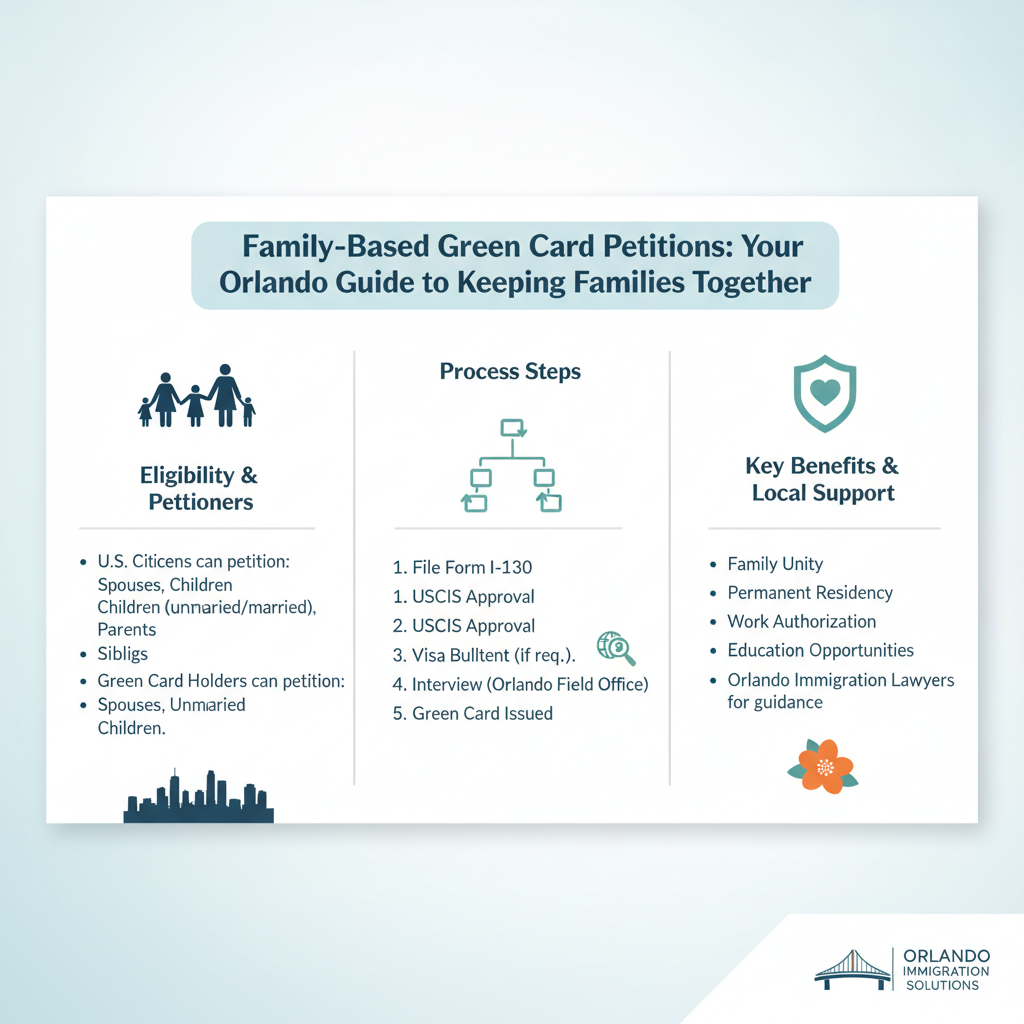
- Petitioner's Status: Are you a U.S. citizen or a Lawful Permanent Resident (Green Card holder)? Your status determines who you can petition for. U.S. citizens can petition for spouses, unmarried children (under and over 21), married children, and parents (if the citizen is 21+), and siblings (if the citizen is 21+). LPRs can petition for spouses and unmarried children (under and over 21).
- Beneficiary's Relationship: Verify the exact relationship (e.g., spouse, child, parent, sibling) and the beneficiary's marital status and age. This will place them into either an Immediate Relative category (no visa quota) or one of the Family Preference Categories (subject to visa quotas and wait times).
Required Documents (for initial assessment):
- Proof of Petitioner's U.S. Citizenship: U.S. birth certificate, naturalization certificate, or current U.S. passport.
- Proof of Petitioner's LPR Status: Copy of both sides of Form I-551 (Green Card).
- Proof of Relationship: Birth certificates (for parent-child relationships), marriage certificates (for spouse relationships), and divorce decrees for any previous marriages for both petitioner and beneficiary.
2) File Form I-130, Petition for Alien Relative
This is the foundational step. Form I-130 establishes the qualifying relationship between the petitioner and the beneficiary. It must be filed with USCIS along with supporting documents and the correct filing fee.
- Complete Form I-130: Fill out the form accurately and completely. Any errors or omissions can lead to delays or Requests for Evidence (RFEs).
- Gather Supporting Documents: Attach all necessary evidence to prove the relationship and the petitioner's status. For spousal petitions, this includes extensive evidence of a bona fide marriage (e.g., joint bank accounts, leases, photos, affidavits from friends/family).
- Pay Filing Fee: Check the USCIS Forms website for the current fee.
- Mail the Petition: Send the completed form, supporting documents, and fee to the correct USCIS filing address, which depends on your location and the type of petition.
Required Documents (with Form I-130):
- Completed and signed Form I-130.
- Proof of Petitioner's U.S. Citizenship or LPR Status (as determined in Step 1).
- Proof of Qualifying Relationship (birth certificates, marriage certificates, adoption decrees).
- Passport-style photos of both petitioner and beneficiary (if required for specific relationships, check instructions).
- Evidence of bona fide marriage (for spousal petitions): joint bank statements, utility bills, insurance policies, photos, affidavits.
- Copies of divorce decrees or death certificates for any prior marriages of both parties.
- Filing fee (check USCIS Forms for current amounts).
3) Wait for I-130 Approval and Priority Date (for Preference Categories)
Once USCIS receives your Form I-130, they will send a Form I-797C, Notice of Action (receipt notice). This notice confirms receipt and provides your Priority Date. For Immediate Relatives, once the Form I-130 is approved, a visa is immediately available. For Family Preference Categories, the Priority Date is crucial. You must wait for your Priority Date to become "current" in the monthly U.S. Department of State Visa Bulletin before the beneficiary can apply for a green card.
Reminder: Processing times for Form I-130 can vary significantly. You can check estimated times on the USCIS Processing Times website.
Documents to keep:
- Form I-797C (Receipt Notice).
- Form I-797B or Form I-797 (Approval Notice).
4) Apply for the Green Card: Adjustment of Status or Consular Processing
Once the Form I-130 is approved and a visa is available (immediately for Immediate Relatives, or when the
Related Topics
Need Legal Assistance?
Our experienced immigration attorneys are here to help with your case. Contact Imigrar today for a free consultation and let us guide you through the legal process with confidence.
📍 Orlando, Florida • Serving clients nationwide
📧 info@imigrar.com