

For countless immigrants striving to build a life in the United States, an Employment Authorization Document (EAD), often referred to as a work permit, is a critical gateway to economic stability and self-sufficiency. It allows individuals to legally work in the U.S. while pursuing their long-term immigration goals. As of March 12, 2026, staying abreast of the latest updates from U.S. Citizenship and Immigration Services (USCIS) regarding EAD applications and renewals is more important than ever. These changes can significantly impact processing times, eligibility, and the overall experience for applicants.
At Imigrar, an immigration law firm based in Orlando, Florida, we understand the profound importance of timely and accurate information. Our mission is to "Keep Families Together," and a key part of that is ensuring our clients have the ability to support themselves and their loved ones. This comprehensive guide is designed to demystify the recent USCIS updates, providing practical, actionable advice for immigrants and their families not just in Central Florida, but nationwide.
The reporting that sparked this guide
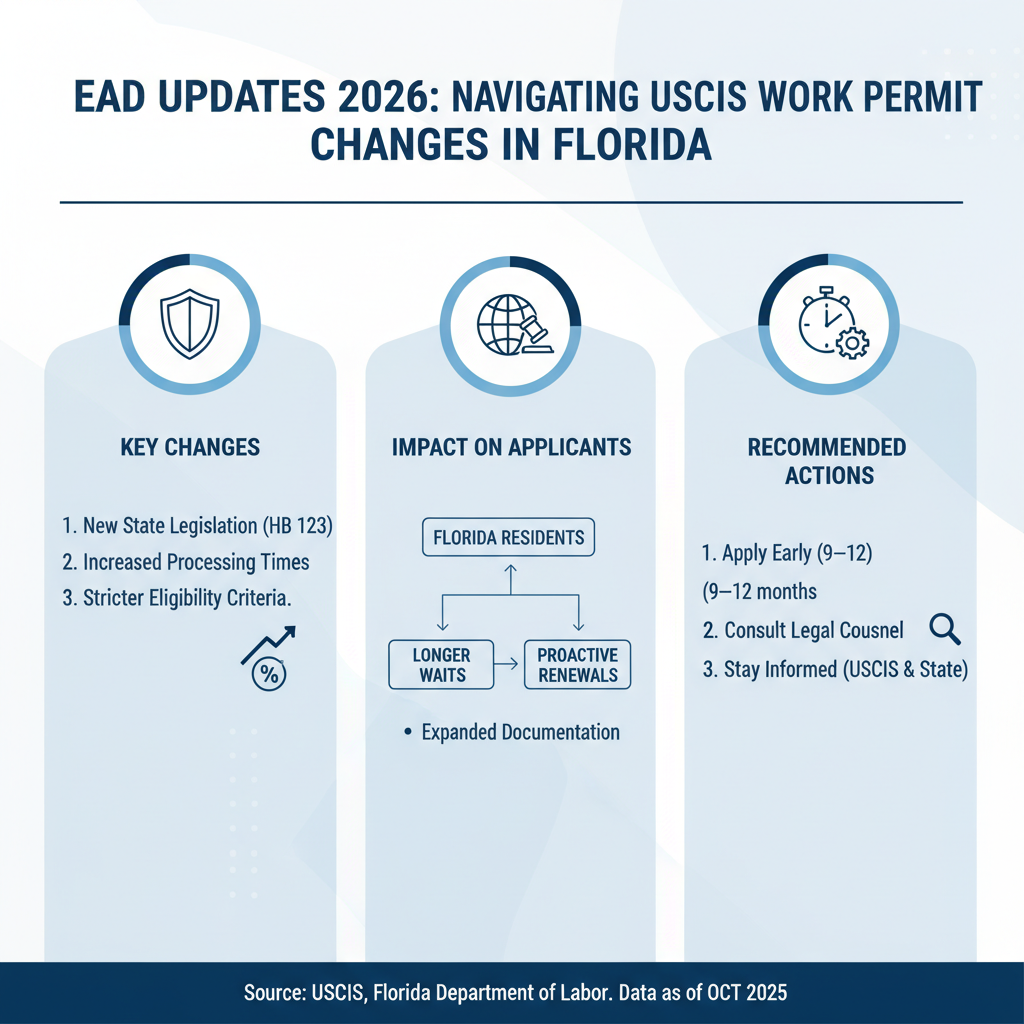
Recent reports and announcements from USCIS have highlighted ongoing efforts to streamline EAD processing, address backlogs, and clarify policies. These updates, frequently covered by immigration news outlets and official government channels, are crucial for anyone applying for or renewing their work authorization. While specific policy changes are dynamic, the consistent theme revolves around USCIS's commitment to efficiency while also grappling with high application volumes. The general trend indicates a focus on digital processing, refined eligibility criteria, and adjustments to automatic extension periods for certain categories.
Employment Authorization Document Processing (USCIS)
What This News Means for Immigrants in Orlando and Across Florida
Understanding the nuances of USCIS updates can feel overwhelming, but for those residing in Orlando, across Florida, or anywhere in the U.S., these changes directly impact your ability to work and live legally. The current landscape, as of March 2026, reflects a USCIS that is both adapting to new technologies and striving to manage an ever-increasing caseload. This means both potential opportunities for quicker processing in some areas and continued vigilance required in others.
Why this news is showing up now
The immigration system is constantly evolving, driven by legislative changes, administrative priorities, and the practical realities of managing millions of applications annually. As of March 12, 2026, the current news surrounding EAD processing stems from several factors:
- Ongoing Backlog Reduction Efforts: USCIS has been under pressure to reduce historical backlogs that accumulated over recent years. While progress has been made in some areas, the sheer volume of applications means continuous adjustments to processing strategies.
- Digital Transformation Initiatives: USCIS continues to invest in and roll out new digital tools for filing applications, communicating with applicants, and internal processing. These updates aim to improve efficiency but also require applicants to adapt to new online systems.
- Policy Clarifications and Adjustments: Periodically, USCIS issues policy memos or regulatory changes that impact specific EAD categories, processing procedures, or automatic extension rules. These are often in response to stakeholder feedback or court rulings.
- Economic and Workforce Needs: The U.S. economy's fluctuating demands for labor can influence the urgency with which certain work permit categories are processed, especially those tied to specific industries or nonimmigrant visas.
How it can affect Florida residents
Florida is home to a vibrant and diverse immigrant population, with major hubs like Orlando, Miami, and Tampa serving as significant centers for immigration activity. For Central Florida residents and those throughout the state, these EAD processing updates have direct implications:
- Orlando USCIS Field Office Impact: While EAD applications are primarily processed at national service centers, local field offices like the Orlando USCIS Field Office may handle certain interviews or requests related to underlying immigration benefits (e.g., Adjustment of Status) that an EAD is tied to. Changes in national processing can free up resources or create new bottlenecks at the local level.
- Employment Opportunities: Delays in EAD processing can mean lost job opportunities, financial hardship, and stress for families. Conversely, expedited processing or clearer guidelines can help individuals enter or re-enter the workforce more quickly, benefiting Florida's economy.
- Planning and Stability: Knowing the current processing landscape allows individuals and employers in Florida to plan more effectively. This is crucial for sectors heavily reliant on immigrant labor, such as hospitality, agriculture, and healthcare, which are prominent in Florida.
- Increased Need for Legal Guidance: With evolving policies, the complexity of navigating the system increases. This makes the role of experienced immigration attorneys in Orlando even more vital to ensure applications are complete, accurate, and submitted correctly.
Need Help? Navigating EAD applications and renewals can be complex, especially with ongoing USCIS updates. Our Orlando immigration team is ready to assist. Call +1 786-791-3106 for a free consultation, or message us online. Se Habla Español.
What Employment Authorization Documents (EADs) Are (and Why They Matter)
At its core, an Employment Authorization Document, or EAD, is a physical card that provides temporary work authorization to foreign nationals in the United States. It is often referred to as a "work permit." For many, it's the bridge between an uncertain future and the ability to legally earn a living, support a family, and contribute to their communities.
A plain-English definition
An EAD is essentially a permission slip from the U.S. government, issued by USCIS, that allows eligible non-citizens to work legally in the United States for a specific period. It's a photo identification card, similar in appearance to a driver's license, that employers use to verify an individual's authorization to work in the U.S. for I-9 purposes. It's important to understand that an EAD is separate from a visa or green card; it grants employment authorization, not permanent residency or a specific immigration status itself, though it is often a benefit derived from a pending immigration application or a specific nonimmigrant status.
Key terms you need to know
Understanding the following terms is crucial when dealing with EAD applications:
- EAD (Employment Authorization Document): The official name for the work permit card.
- Work Permit: A common, informal term for an EAD.
- USCIS (U.S. Citizenship and Immigration Services): The government agency responsible for processing EAD applications and other immigration benefits. You can find more information on their official website.
- Form I-765: The specific application form used to request an EAD. This is the heart of the EAD process.
- Adjustment of Status (AOS): The process of applying for lawful permanent resident status (a Green Card) while physically present in the United States. Many individuals with pending Form I-485, Application to Register Permanent Residence or Adjust Status, are eligible for an EAD.
- Asylum Seeker: An individual who has applied for asylum in the U.S. and whose case is pending. After a certain waiting period (currently 150 days), asylum seekers can apply for an EAD.
- DACA (Deferred Action for Childhood Arrivals): A program that provides temporary protection from deportation and work authorization to eligible young undocumented immigrants who arrived in the U.S. as children. DACA recipients apply for EADs.
- TPS (Temporary Protected Status): A temporary immigration status granted to eligible nationals of designated countries experiencing conditions that prevent their safe return, such as armed conflict or environmental disaster. TPS beneficiaries are eligible for EADs.
- Nonimmigrant Spouses: Certain spouses of nonimmigrant visa holders (e.g., H-4 spouses of H-1B workers, L-2 spouses of L-1 workers, E-1/E-2 spouses) are eligible for EADs, allowing them to work in the U.S.
- Optional Practical Training (OPT): A period during which F-1 nonimmigrant students can work in a field directly related to their major area of study. OPT is a type of EAD.
- Receipt Notice: A document sent by USCIS confirming they have received your application. It contains a receipt number which is vital for tracking your case.
- RFE (Request for Evidence): A notice from USCIS asking for additional documentation or information to support your application.
- Automatic Extension: A provision that allows certain EAD categories to continue working for a specific period (e.g., 540 days) beyond the expiration date of their current EAD, provided they filed a timely renewal application.
Current Immigration Law: The Foundation for EADs
The ability to obtain an EAD is rooted in specific provisions of U.S. immigration law, primarily the Immigration and Nationality Act (INA) and its corresponding regulations in the Code of Federal Regulations (CFR). These laws define who is eligible, under what circumstances, and for how long. While the EAD itself is a benefit, it is almost always tied to an underlying immigration status or a pending application for such status.
Federal requirements
Eligibility for an EAD is not universal; it is granted to specific categories of foreign nationals. The primary legal framework for EAD eligibility is found in 8 CFR § 274a.12. This regulation outlines approximately 40 distinct categories of individuals who may apply for an EAD. Some of the most common categories include:
- Applicants for Adjustment of Status (AOS): Individuals with a pending Form I-485, Application to Register Permanent Residence or Adjust Status. (Category (c)(9)).
- Asylum Applicants: Individuals who have filed Form I-589, Application for Asylum and for Withholding of Removal, and whose application has been pending for at least 150 days. (Category (c)(8)).
- DACA Recipients: Individuals granted Deferred Action for Childhood Arrivals. (Category (c)(33)).
- TPS Beneficiaries: Individuals granted Temporary Protected Status. (Category (a)(12) or (c)(19)).
- Certain Nonimmigrant Spouses:
- H-4 Spouses: Spouses of H-1B nonimmigrants who are either the principal beneficiary of an approved Form I-140, Immigrant Petition for Alien Worker, or have been granted H-1B status under AC21 and are seeking extension of H-1B status beyond the 6th year. (Category (c)(26)).
- L-2 Spouses: Spouses of L-1 intracompany transferees. (Category (a)(18)).
- E-1/E-2 Spouses: Spouses of E-1 Treaty Trader or E-2 Treaty Investor nonimmigrants. (Category (a)(17)).
- F-1 Students Seeking Optional Practical Training (OPT): Students authorized for post-completion or STEM OPT. (Category (c)(3)(i), (c)(3)(ii), (c)(3)(iii)).
- Refugees and Asylees: Individuals granted refugee status or asylum. (Category (a)(3) for refugees, (a)(5) for asylees).
- Parolees: Individuals paroled into the U.S. for humanitarian reasons or significant public benefit. (Category (c)(11)).
It's crucial to correctly identify your eligibility category on Form I-765, as an incorrect category can lead to delays or denial. The specific requirements for each category, including necessary supporting documentation, are detailed in the instructions for Form I-765, available on the USCIS Forms page.
Florida-specific considerations
While EAD eligibility and processing are governed by federal law, there are no Florida-specific laws that alter EAD requirements. The process is uniform across all states. However, practical considerations for Florida residents include:
- Local Filing Procedures: Your application will be sent to a USCIS Lockbox facility (often in Texas, Arizona, or Illinois, depending on the form and filing category) and then routed to a service center. The specific lockbox address can vary, so always check the USCIS Direct Filing Addresses for Form I-765 page for the most current information.
- Biometrics Appointments: If a biometrics appointment is required, residents of Orlando and surrounding areas will typically be scheduled at the local USCIS Application Support Center (ASC), such as the one serving the Orlando area.
- Economic Impact: EAD processing times and policies have a direct impact on the workforce dynamics in Florida, a state with significant agricultural, hospitality, and service industries that rely on a diverse labor force.
For all official forms, instructions, and the most up-to-date information, always refer to the USCIS official website.
Considering Your EAD Options? Don't navigate the complex federal laws alone. Imigrar is here to help keep your family together by securing your ability to work legally. Call our Orlando office today at +1 786-791-3106 for a free, confidential consultation. Se Habla Español.

How to Apply for or Renew Your EAD: A Complete Step-by-Step Guide
Applying for or renewing an Employment Authorization Document (EAD) requires meticulous attention to detail and a thorough understanding of the requirements. Missing information, incorrect forms, or late submissions can lead to significant delays or even denial. This step-by-step guide is designed to help you navigate the process effectively.
1) Determine Your EAD Eligibility Category
Before you even begin filling out forms, you must accurately identify which EAD category you fall under. This is the most critical first step, as it dictates the required documentation and often the filing location. Refer to the "Current Law Section" above and the USCIS "Explore My Options" tool or the instructions for Form I-765 for a comprehensive list. Common categories for Orlando residents often include those with pending Adjustment of Status, asylum seekers, DACA recipients, and certain nonimmigrant spouses.
- Action: Review 8 CFR § 274a.12 and the Form I-765 instructions to pinpoint your exact eligibility category (e.g., (c)(9) for AOS, (c)(8) for asylum).
- Important: An incorrect category can result in rejection or denial. When in doubt, seek legal counsel.
2) Gather Required Documents
Once your eligibility category is determined, you'll need to collect all necessary supporting documents. The specific list varies by category, but general requirements typically include:
- Proof of Identity and Nationality:
- Copy of your birth certificate with photo ID, or
- Copy of a passport or national identity document from your country of origin, or
- Copy of your visa (if applicable)
- Proof of Immigration Status:
- Copy of your Form I-94, Arrival/Departure Record (front and back, if paper; printout if electronic).
- Copy of any previous EADs (front and back).
- Copy of current or previous visas (if applicable).
- Proof of Eligibility for the Specific Category:
- For AOS applicants: Copy of Form I-485 Receipt Notice.
- For Asylum applicants: Copy of Form I-589 Receipt Notice.
- For H-4 spouses: Copy of principal H-1B spouse's Form I-797, Approval Notice, and Form I-140 approval notice (if applicable).
- For DACA recipients: Copy of previous DACA approval notices.
- For F-1 OPT: Copy of Form I-20, Certificate of Eligibility for Nonimmigrant Student Status, with the OPT recommendation.
- Two Passport-Style Photographs: Must be recent (taken within 30 days of filing), unmounted, full-face, passport-style photos. Write your name and A-number (if applicable) lightly in pencil on the back of each photo.
- Social Security Card (or proof of non-eligibility): If you do not have a Social Security Number (SSN), you can request one through Form I-765.
- Copy of Government-Issued Photo Identification: Such as a state driver's license or ID card (front and back).
Reminder: Always provide copies of documents, not originals, unless specifically requested by USCIS. Keep a complete set of copies for your own records.
3) Complete Form I-765, Application for Employment Authorization
This is the core of your application. Ensure you are using the latest version of Form I-765 from the USCIS website. Do not use outdated forms, as they will be rejected.
- Accuracy is Key: Fill out every section completely and accurately. If a question does not apply, write "N/A" (not applicable) or "None."
- Signature: Sign the form in blue or black ink. An unsigned form will be rejected.
- Part 2, Item 27 "Eligibility Category": This is where you enter the specific code you determined in Step 1 (e.g., (c)(9), (c)(8)).
- Part 2, Item 28 "Reason for Applying": Check the appropriate box: "Initial permission to accept employment," "Replacement of lost, stolen, or damaged EAD," or "Renewal of my permission to accept employment." For renewals, file within the 180-day window before your current EAD expires, or as specified by USCIS policy for automatic extensions.
4) Prepare Your Application Package and Pay Fees
Once your form is complete and documents are gathered, assemble your package carefully.
- Filing Fee: As of March 2026, the Form I-765 filing fee is typically $410. However, fees can change, and some categories (e.g., asylum applicants filing their initial EAD) may be exempt or eligible for a fee waiver. Always verify the current fee on the USCIS website or by calling USCIS.
- Payment Method: You can pay by money order, personal check, cashier's check, or credit card using Form G-1450, Authorization for Credit Card Transactions. Make checks payable to "U.S. Department of Homeland Security."
- Fee Waiver: If you cannot afford the filing fee, you may be eligible to apply for a fee waiver using Form I-912, Request for Fee Waiver. This requires demonstrating financial hardship.
- Order of Documents: While USCIS doesn't mandate a strict order, it's good practice to organize your package logically:
- Check or Form G-1450 on top.
- Form I-765 (signed).
- Supporting documents, clearly labeled or separated.
- Passport-style photos in a small envelope attached to the front of the application.
5) File Your Application with USCIS
The filing address depends on your eligibility category and whether you are filing other forms concurrently (e.g., Form I-485). Most EAD applications are sent to a USCIS Lockbox facility.
- Check Direct Filing Addresses: Always consult the USCIS Direct Filing Addresses for Form I-765 page for the correct mailing address. The address can change, so verify it immediately before mailing.
- Online Filing: USCIS is increasingly expanding online filing options. Check if your category is eligible to file Form I-765 online. Online filing can sometimes lead to faster receipt notices and easier tracking.
- Mailing Tips:
- Use a reliable mail service that provides tracking (e.g., USPS Certified Mail with Return Receipt, FedEx, UPS).
- Keep the tracking number for your records.
6) Attend Biometrics Appointment (If Required)
After filing, USCIS will send you a Form I-797C, Notice of Action, confirming receipt of your application. For many EAD categories, you will then receive a separate appointment notice for biometrics (fingerprints, photograph, and signature). This typically occurs several weeks after filing.
- Attend Promptly: It is critical to attend your biometrics appointment as scheduled at the designated Application Support Center (ASC), such as the one serving the Orlando area. Failure to attend can lead to delays or denial.
- What to Bring: Bring your appointment notice, a valid photo ID (e.g., passport, driver's license), and any other documents specified in the notice.
7) Track Your Application and Respond to RFEs
After biometrics (if required), your application will be adjudicated. This period can range from a few weeks to several months, or even longer, depending on your eligibility category and the current USCIS processing times.
- Online Case Status: Use your receipt number (from Form I-797C) to track your case status online via the USCIS Case Status Online tool.
- Processing Times: Check USCIS Processing Times for an estimate, but remember these are just averages and can fluctuate significantly.
- RFEs (Requests for Evidence): If USCIS needs more information, they will send an RFE. Warning: Respond fully and promptly


