
DACA Program Updates 2026: Essential Renewal Guide for Dreamers
Stay informed on the latest DACA updates and the critical renewal process. This comprehensive guide provides essential information for Dreamers in Orlando and across Florida, covering eligibility, required forms, timelines, and how to navigate USCIS procedures to maintain your deferred action status and work authorization.

The landscape of immigration law is constantly evolving, and for hundreds of thousands of individuals across the United States, including many in our vibrant Orlando community, staying informed on programs like Deferred Action for Childhood Arrivals (DACA) is not just important – it's critical to their futures. As your dedicated immigration law firm in Orlando, Imigrar is committed to providing timely, accurate, and actionable information to help you navigate these complex changes. Today, we delve into the latest updates regarding the DACA program and provide a comprehensive guide to its renewal process, ensuring you have the knowledge and resources to "Keep Families Together."
The reporting that sparked this guide
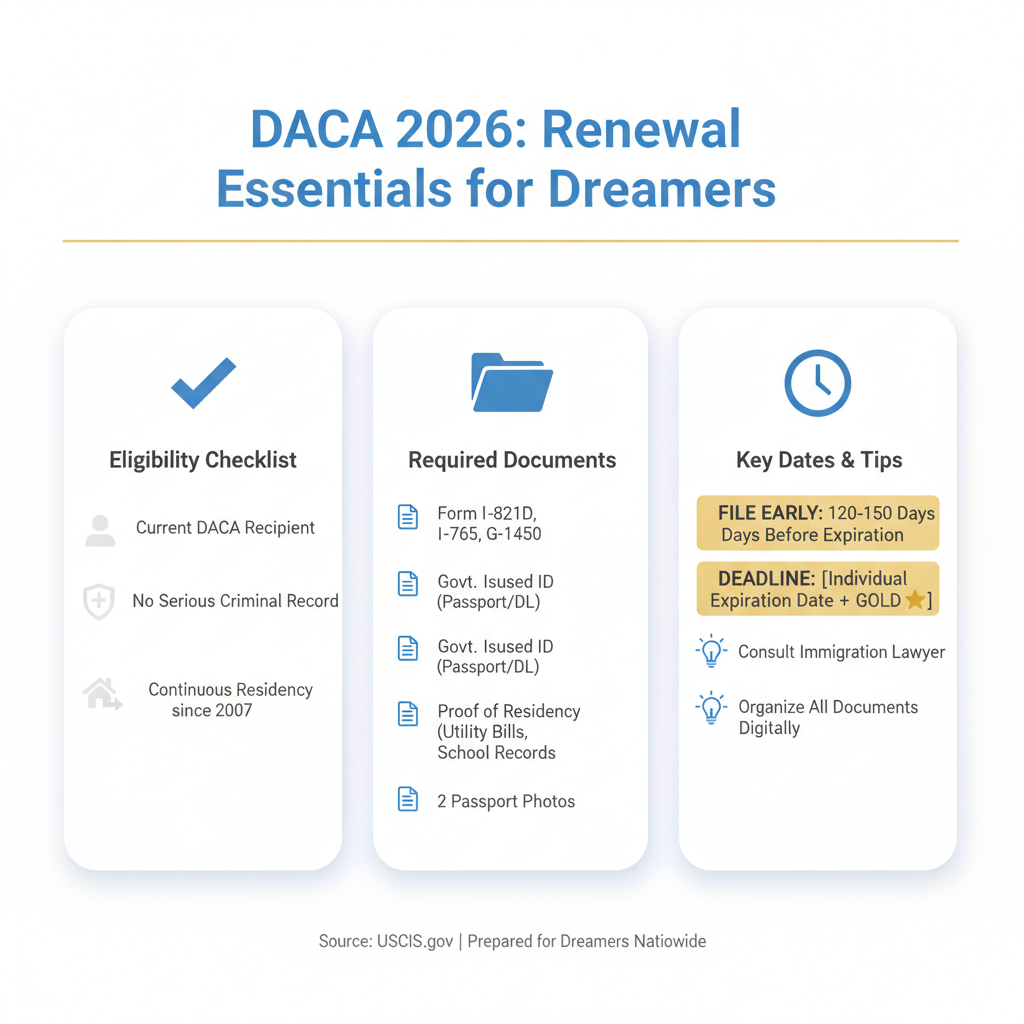
Recent developments from USCIS regarding the DACA program have once again brought this vital initiative into the spotlight. While the program's core tenets remain, administrative clarifications and ongoing legal considerations often lead to updated guidance, directly impacting DACA recipients nationwide. For the most current official information, always refer to the source:
DACA Program Updates and Renewal Information (USCIS)
What This News Means for Immigrants in Orlando and Across Florida
For DACA recipients and their families in Central Florida, news from USCIS about the program can be a source of both hope and anxiety. Understanding the nuances of these updates is crucial for maintaining your status and planning your future.
Why this news is showing up now
As of late 2026, the DACA program continues to operate under significant legal scrutiny and ongoing litigation. While federal courts have largely preserved the ability for current DACA recipients to renew their status, the program remains closed to new applicants. The "updates" from USCIS, referenced in recent reporting, are typically administrative in nature, reflecting the agency's response to judicial directives or efforts to streamline processes within the existing legal framework. This could involve clarifications on eligibility for renewal, adjustments to processing procedures, or guidance on documentation requirements. These regular administrative updates are a direct consequence of DACA's precarious legal standing, requiring USCIS to frequently issue guidance that aligns with court orders while managing the immense volume of renewal applications. The ongoing political discussions and the possibility of legislative action (such as the Dream Act) also keep DACA in the news cycle, prompting USCIS to reiterate its current operational guidelines.
How it can affect Florida residents
For the thousands of DACA recipients living in Florida, these updates have tangible effects. Florida is home to a significant DACA population, and changes to the program’s administration directly impact their ability to work legally, pursue higher education, and contribute to our economy. In Orlando and surrounding Orange County, DACA recipients are integral to our community, working in various sectors, attending local universities like UCF and Rollins College, and raising families. For Central Florida residents, understanding the latest USCIS guidance is vital for:
- Maintaining Employment Authorization: Your Employment Authorization Document (EAD) is tied to your DACA status. Any delay or issue with renewal can lead to job loss.
- Educational Opportunities: DACA recipients in Florida may be eligible for in-state tuition at public universities and colleges under certain conditions, a benefit directly dependent on maintaining DACA status.
- Driver's Licenses: A valid EAD, issued under DACA, is often required to obtain or renew a Florida driver's license.
- Family Stability: DACA status provides a degree of stability for families, allowing parents to support their children and young adults to pursue their dreams without the constant fear of deportation.
Reminder: The Orlando USCIS Field Office primarily handles interviews for family-based petitions and naturalization, but all DACA applications (initial or renewal) are filed directly with a designated USCIS Lockbox facility, not the local field office. However, you may be scheduled for a biometrics appointment at the Orlando Application Support Center (ASC) if your mailing address is in the area.
Need Help? Navigating DACA renewals can be complex. Our Orlando immigration team is ready to assist. Call +1 786-791-3106 for a free consultation, or message us online. Se Habla Español.
What DACA Is (and Why It Matters)
Deferred Action for Childhood Arrivals, or DACA, is an immigration policy established in 2012 that allows certain undocumented immigrants who entered the United States as minors to receive a renewable two-year period of deferred action from deportation and eligibility for a work permit. While DACA does not provide a path to citizenship or legal status, it offers a temporary reprieve from removal and the ability to work legally, providing a measure of stability for hundreds of thousands of individuals known as "Dreamers."
A plain-English definition
Think of DACA as a temporary pause button on deportation. If you meet specific criteria – primarily having come to the U.S. as a child, lived here continuously, and met educational and criminal background requirements – the government agrees not to deport you for a renewable two-year period. During this time, you can also apply for an Employment Authorization Document (EAD), which is your legal permission to work in the United States. This means you can get a job, obtain a driver's license in most states (including Florida), and pursue higher education without the constant fear of being removed from the country you call home.
Important: DACA is not a law passed by Congress; it is an executive action. This distinction is crucial because executive actions can be challenged in court and rescinded by future administrations, which is why DACA has faced so many legal and political challenges since its inception.
Key terms you need to know
- Deferred Action: This is the core of DACA. It means the U.S. government has chosen to "defer" or postpone taking action to remove an individual from the country. It does not grant legal status or a path to citizenship.
- Dreamers: A term commonly used to refer to young undocumented immigrants who were brought to the U.S. as children, often associated with the proposed "DREAM Act" legislation. DACA recipients are a subset of Dreamers.
- DACA Recipient: An individual who has been granted deferred action under the DACA program and typically holds a valid EAD.
- Employment Authorization Document (EAD): Also known as a work permit, this card (Form I-766) allows DACA recipients to legally work in the U.S. for the duration of their deferred action period.
- Renewal: The process of reapplying for deferred action and an EAD before your current DACA status expires. As of 2026, USCIS is only accepting DACA renewal applications, not initial applications.
- Advance Parole: A travel document that allows certain non-citizens, including DACA recipients, to travel abroad and lawfully return to the U.S. without jeopardizing their deferred action status. While DACA recipients *can* apply for advance parole, it is granted only under very specific circumstances (humanitarian, educational, or employment purposes) and carries risks.
- USCIS: U.S. Citizenship and Immigration Services, the federal agency responsible for administering immigration and naturalization benefits.
Current Immigration Law: The Foundation
The legal foundation of DACA is complex and has been subject to numerous court challenges since its creation in 2012. While DACA itself is not a specific law or statute, its operation is governed by administrative policy, executive memoranda, and most significantly, a series of federal court orders.
The program was initially established by a memorandum from the Secretary of Homeland Security on June 15, 2012. This memorandum exercised prosecutorial discretion to defer removal action against certain individuals who met specific criteria. Over the years, DACA has faced legal battles, most notably the *Texas v. United States* lawsuit, which has led to significant restrictions. As of our current date, October 29, 2026, the key takeaway is that DACA continues to exist for *renewal applicants only*. Federal court injunctions prevent USCIS from approving new DACA applications. This means that if you have never had DACA before, you cannot apply. If you have DACA and it has expired or is set to expire, you can apply for renewal.
Federal requirements
To be eligible for DACA renewal, you must meet the following federal requirements, which largely mirror the initial criteria, with specific considerations for continuous residence:
- Received DACA: You must have previously been granted deferred action under DACA.
- Not Departed U.S.: You must not have departed the United States on or after August 15, 2012, without advance parole.
- Continuous Residence: You must have continuously resided in the U.S. since the date you submitted your most recent DACA request that was approved.
- No Significant Criminal Record: You must not have been convicted of a felony, a significant misdemeanor, or three or more other misdemeanors, and not pose a threat to national security or public safety.
Warning: Any criminal interaction, even minor offenses, can jeopardize your renewal. It is imperative to disclose all interactions with law enforcement to your attorney.
For official information and forms, always refer to the USCIS official website.
Florida-specific considerations
While DACA is a federal program, its impact is felt locally, and Florida has specific considerations for DACA recipients:
- Driver's Licenses: DACA recipients with a valid Employment Authorization Document (EAD) are eligible to obtain a Florida driver's license or identification card. The license will be valid for the duration of your EAD.
- In-State Tuition: Under Florida law, certain DACA recipients may qualify for in-state tuition at Florida public colleges and universities. This eligibility typically requires demonstrating continuous physical presence in Florida for a specific period (usually 12 months prior to enrollment) and graduation from a Florida high school. This is a significant benefit for Dreamers in Orlando seeking higher education at institutions like the University of Central Florida (UCF) or Valencia College.
- Professional Licensing: The ability for DACA recipients to obtain professional licenses (e.g., nursing, teaching, cosmetology) varies by profession and state regulations. In Florida, DACA recipients may face restrictions or require specific legal guidance to pursue certain licensed professions.
- Access to Services: While DACA does not grant eligibility for most federal public benefits, DACA recipients in Florida can access certain state-specific services and programs.
Reminder: Staying informed about both federal DACA policy and Florida state laws is crucial. Consult with an experienced immigration attorney at Imigrar for personalized advice.
To renew your DACA, you will primarily use these USCIS forms:
- Form I-821D, Consideration of Deferred Action for Childhood Arrivals
- Form I-765, Application for Employment Authorization
- Form I-765WS, Worksheet
You can find these and other immigration forms directly on the USCIS Forms page.
Stressed about your DACA renewal? Let Imigrar guide you. Our Orlando-based lawyers specialize in DACA and family immigration. Call us at +1 786-791-3106 for a free, confidential consultation. ¡Se Habla Español!
How to Renew Your DACA: A Complete Step-by-Step Guide
Renewing your DACA is a critical process that requires meticulous attention to detail and timely submission. Here’s a complete step-by-step guide to help you navigate it successfully.
1) Understand Your Eligibility for Renewal
Before you even begin filling out forms, confirm that you meet the core DACA renewal eligibility criteria as outlined above. This is the most crucial first step. Ensure you have continuously resided in the U.S. since your last DACA approval and have not left the country without valid advance parole since August 15, 2012. Critically, review your criminal history. Even minor offenses you might not think are significant can impact your eligibility. If you have any concerns about your eligibility, especially regarding travel or criminal history, consult an attorney immediately.
Documents to review:
- Your previous DACA approval notice (Form I-797) and EAD card.
- Records of any travel outside the U.S. since August 15, 2012.
- Any records of arrests, citations, or criminal charges, regardless of the outcome.
2) Gather Required Documents
Thorough documentation is key to a successful DACA renewal. Begin gathering these documents well in advance of your expiration date.
Essential Documents Checklist:
- Copy of your most recent DACA approval notice (Form I-797): This proves you were previously granted DACA.
- Copy of your current Employment Authorization Document (EAD): Both front and back.
- Copies of ALL previous EAD cards issued under DACA.
- Two passport-style photos: Taken within 30 days of filing, with a white to off-white background. Write your name and Alien Registration Number (A-Number) lightly on the back.
- Proof of continuous residence since your last DACA approval: While not always requested for renewals, it's good practice to have this ready, especially if there are gaps in your work or education history. Examples include:
- School transcripts or diplomas
- Employment records (pay stubs, W-2s)
- Bank statements
- Medical records
- Rent receipts or utility bills
- Passport entry stamps (if you traveled with advance parole)
- Proof of Identity: Copy of your birth certificate with translation, passport identity page, or other national identity card.
- Criminal History Records (if applicable): Certified court dispositions for any arrests, citations, or convictions, even if dismissed or expunged. This is crucial for Central Florida residents who may have had interactions with local law enforcement in Orange, Osceola, or Seminole counties.
Important: Do not send original documents unless specifically requested by USCIS. Always keep copies of everything you submit.
3) Complete USCIS Forms I-821D, I-765, and I-765WS
These are the three primary forms for DACA renewal. Download the latest versions directly from the USCIS DACA page.
- Form I-821D, Consideration of Deferred Action for Childhood Arrivals: This form requests the deferred action itself. Fill it out completely and accurately. Pay close attention to questions about your travel history and criminal record.
- Form I-765, Application for Employment Authorization: This form requests your work permit. For DACA renewals, your eligibility category will be (c)(33).
- Form I-765WS, Worksheet: This worksheet helps you demonstrate your economic need for an employment authorization document. While it asks about income and expenses, it is not a "means test" for DACA eligibility; rather, it’s a required part of the EAD application for DACA recipients.
Tips for form completion:
- Type your answers or write legibly in black ink.
- Answer every question. If a question doesn't apply, write "N/A" (not applicable) or "None."
- Do not leave blank spaces.
- Sign and date all forms in the designated areas. An unsigned form will be rejected.
4) Prepare Your Application Packet
Once all forms are completed and documents are gathered, organize your application packet in a clear and logical order. USCIS provides specific recommendations for assembling applications.
Recommended Order for DACA Renewal Packet:
- Check or Money Order for Fees (on top)
- Cover Letter (optional, but recommended if you have any special notes or unique circumstances)
- Form I-821D
- Form I-765
- Form I-765WS
- Two passport-style photos (place in a small plastic bag and staple to the top left corner of Form I-765)
- Copies of your previous DACA approval notices (Form I-797)
- Copies of your EADs (current and all previous)
- Supporting documentation (proof of continuous residence, identity, criminal history records, etc.)
Make a complete copy of your entire assembled packet for your records before mailing. This includes the forms, supporting documents, and the check/money order.
5) Submit Your Application and Pay Fees
The total fee for DACA renewal is currently $495, which includes the Form I-765 fee ($410) and the biometrics services fee ($85). The Form I-821D does not have a separate fee. You must submit one check or money order for the full amount. Personal checks, cashier’s checks, or money orders are accepted, made payable to "U.S. Department of Homeland Security." Do NOT send cash.
Where to Mail: DACA renewal applications are sent to specific USCIS Lockbox facilities, not local field offices. The correct mailing address depends on where you live. For Florida residents, check the USCIS Direct Filing Addresses for Form I-821D to ensure you send it to the correct P.O. Box or street address (if using a courier service). Using certified mail with a return receipt is highly recommended to track delivery.
Timeline: USCIS recommends filing your DACA renewal application 150 days to 120 days before your current DACA/EAD expires. This window allows ample time for processing without having a gap in your work authorization. Filing too early (more than 150 days) might result in rejection, and filing too late (less than 90 days) significantly increases the risk of your DACA expiring before renewal is granted.
6) Attend Biometrics Appointment (If Required)
After USCIS receives your application, they will send you a receipt notice (Form I-797C). Subsequently, you may receive an appointment notice (Form I-797C) for a biometrics services appointment at an Application Support Center (ASC). For Orlando residents, this will likely be at the local ASC. It is crucial to attend this appointment. At the ASC, your fingerprints, photograph, and signature will be collected. This information is used for background checks. If you cannot make your appointment, you must reschedule as soon as possible, but this can delay your application.
7) Monitor Your Application Status and Respond to RFEs
You can track the status of your application online using the receipt number provided on your Form I-797C. Visit USCIS Case Status Online. USCIS may issue a Request for Evidence (RFE) if they need additional information or clarification. It is absolutely critical to respond to an RFE fully and by the deadline provided. Failure to do so will likely result in a denial.
Once approved, you will receive an approval notice for Form I-821D and then your new EAD card (Form I-766) in the mail. Keep these documents safe!

Practical Steps You Can Take Today
Proactive planning is your best defense against delays or complications with your DACA renewal. Here are practical steps you can take right now:
Actionable Checklist:
- Check Your DACA/EAD Expiration Date: Mark your calendar and set reminders for the 150-day renewal window. Don't wait until the last minute!
- Start Saving for Fees: The $495 fee can be a significant burden. Begin setting aside money today.
- Organize Your Documents: Create a dedicated folder for all DACA-related documents. Ensure you have copies of all previous approvals and EADs.
- Review Your Criminal History: If you've had *any* interaction with law enforcement, gather all court dispositions and police reports. Even minor incidents can require legal review.
- Update Your Address with USCIS: If you've moved, file
Related Topics
Need Legal Assistance?
Our experienced immigration attorneys are here to help with your case. Contact Imigrar today for a free consultation and let us guide you through the legal process with confidence.
📍 Orlando, Florida • Serving clients nationwide
📧 info@imigrar.com