
USCIS Processing Times 2026: Navigating Immigration Delays from
Stay informed on USCIS processing times and updates for 2026. Learn how to track your case, understand delays, and get expert help from Imigrar in Orlando, Florida.

What This News Means for Immigrants in Orlando and Across Florida
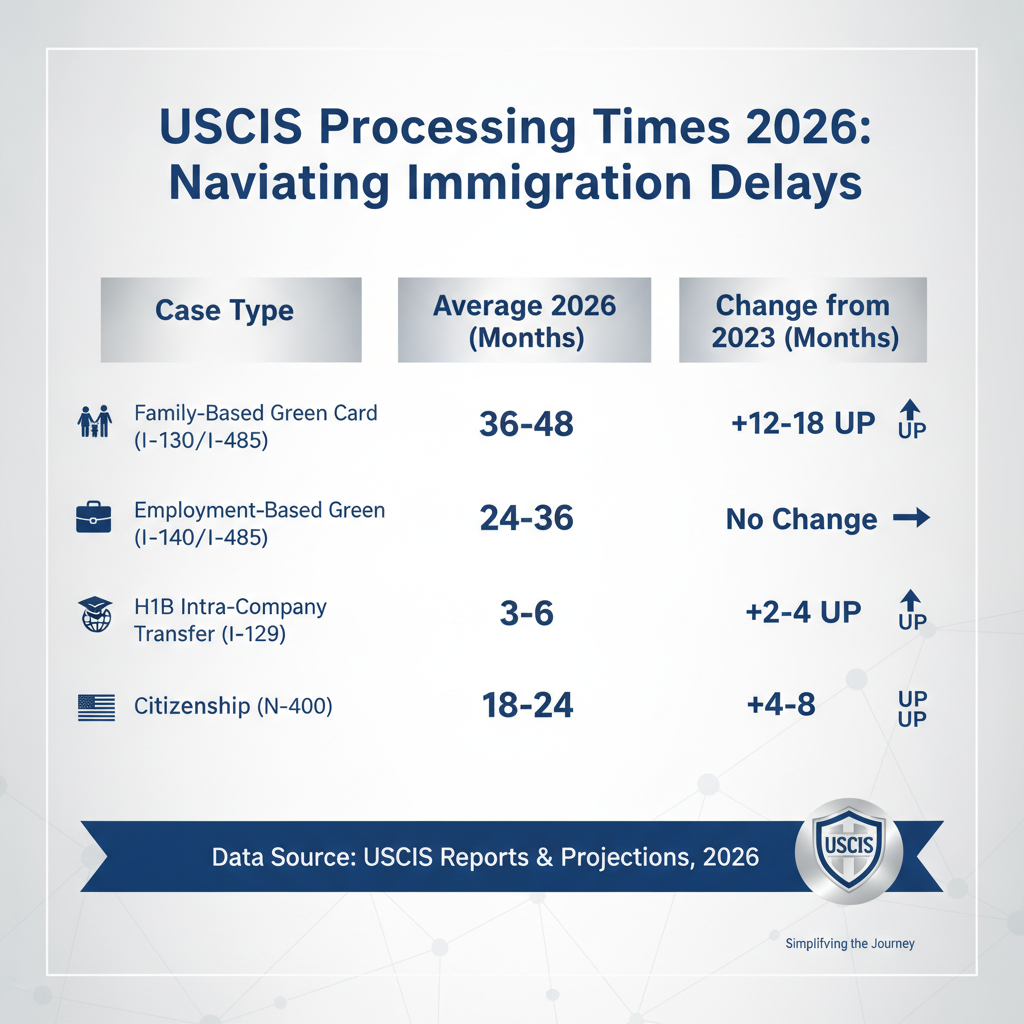
Why this news is showing up now
USCIS processing times are not static; they are dynamic estimates that fluctuate based on a multitude of factors. Each year, and often several times within a year, USCIS reviews its operational capacity, application volumes, and policy changes to update these posted times. The current updates for 2026 reflect:- Increased Application Volume: A consistent rise in applications across various categories, particularly family-based petitions and applications for adjustment of status.
- Resource Allocation: USCIS continually adjusts its staffing and technological resources, which can impact efficiency for certain forms or service centers.
- Policy Shifts: Changes in immigration policy or directives from the administration can introduce new layers of review or streamline existing processes.
- Pandemic-Related Backlogs: While significant progress has been made, the lingering effects of the COVID-19 pandemic continue to influence processing capacity, especially for forms requiring in-person interviews or biometric appointments.
- Technological Advancements: USCIS is increasingly investing in digital processing tools, which, while promising for long-term efficiency, can cause temporary shifts during implementation.
How it can affect Florida residents
Florida, with its diverse population and significant immigrant communities, is particularly sensitive to USCIS processing time fluctuations. For residents in Orlando, Tampa, Miami, and other major metropolitan areas along the I-4 corridor and beyond, these updates have direct implications:- Local Field Office Impact: The Orlando USCIS Field Office, like others across the nation, experiences varying workloads. A surge in local applications or national backlogs can directly translate to longer wait times for interviews, biometrics, and ultimately, decisions on cases such as Adjustment of Status (Form I-485) or Naturalization (Form N-400).
- Economic and Personal Planning: Delays can affect employment authorization, travel plans (especially for those with pending Advance Parole (Form I-131) applications), and the ability to reunite with family members. Businesses relying on foreign talent may also face delays in getting employees authorized.
- Family Separation Concerns: For families where some members are already in the U.S. and others are awaiting visa processing abroad, extended processing times mean longer periods of separation, directly impacting Imigrar’s core mission to "Keep Families Together."
- Legal Strategy: Understanding current trends allows your immigration attorney to advise you on the most strategic approach, whether it's preparing for potential delays, submitting specific evidence, or escalating a case when appropriate.
Feeling overwhelmed by USCIS processing times? Don't navigate the complexities alone. Our Orlando immigration team at Imigrar is here to help. Call +1 786-791-3106 for a free consultation, or message us online. Se Habla Español.
What USCIS Processing Times Are (and Why They Matter)
Navigating the U.S. immigration system can feel like moving through a maze, and one of the most frustrating aspects is often the waiting. This is where understanding USCIS processing times becomes essential. These times are not just bureaucratic figures; they are critical indicators that directly impact your life, your family, and your future in the United States.A plain-English definition
Simply put, USCIS processing times are **estimates** of how long it takes the agency to process a specific type of application or petition from the date they receive it until they make a decision. These times are published online by USCIS and are typically displayed as a range (e.g., 6 months to 10 months) for particular forms at specific service centers or field offices. It’s crucial to understand that these are **estimates**, not guarantees. Many factors can influence the actual time it takes for your individual case, including the completeness of your application, the volume of applications USCIS receives, and the specific details of your case.Key terms you need to know
To effectively monitor your case and understand the processing landscape, familiarizing yourself with these key terms is vital:- Receipt Date: This is the date USCIS officially received your application or petition. You'll find this date on your Form I-797C, Notice of Action (also known as the receipt notice). This is the starting point for calculating processing times.
- Priority Date: Primarily relevant for preference immigrant visa categories (family-sponsored and employment-based), this is the date your petition was properly filed with USCIS (or, for employment-based cases requiring PERM labor certification, the date the Department of Labor received the PERM application). Your priority date must be "current" according to the latest U.S. Department of State Visa Bulletin before your visa or green card application can be finalized.
- Service Center: USCIS has several service centers (e.g., California Service Center, Nebraska Service Center, Texas Service Center, Vermont Service Center) that process different types of applications. The service center handling your case is usually indicated on your receipt notice.
- Field Office: These are local USCIS offices (like the Orlando USCIS Field Office) that handle interviews, biometric appointments, and some local filings, particularly for Adjustment of Status (Form I-485) and Naturalization (Form N-400).
- Case Status Online: This is an online tool on the USCIS website where you can enter your 13-digit receipt number to check the latest status of your application.
- Service Request: If your application is processing outside of the "normal processing time" range published by USCIS, you may be eligible to submit an online inquiry or service request to USCIS.
- Request for Evidence (RFE): A notice from USCIS asking for additional documents or information to support your application. Responding promptly and thoroughly is critical.
- Notice of Intent to Deny (NOID): A notice from USCIS indicating their intent to deny your application unless you provide specific evidence or arguments to overcome their concerns. This is a serious notice requiring immediate attention.
Current Immigration Law: The Foundation of Processing
The U.S. immigration system is governed by the Immigration and Nationality Act (INA), a comprehensive body of federal law. While processing times themselves are administrative estimates, they are directly influenced by the legal frameworks and requirements established by the INA and subsequent regulations. Understanding this foundation helps contextualize why certain applications take longer than others and the rigorous checks involved.Federal requirements
The INA (Title 8 of the U.S. Code) outlines the eligibility criteria, procedures, and legal definitions for all immigration benefits. Every USCIS application, whether for a green card, citizenship, or a work permit, must comply with specific sections of this law. For example:- Family-Based Immigration: Sections 201-204 of the INA define immediate relatives (spouses, minor children, parents of U.S. citizens) and preference categories (unmarried adult children, married children, siblings of U.S. citizens; spouses and unmarried adult children of Lawful Permanent Residents). The annual quotas set by these sections, along with the worldwide demand, directly create the backlogs that lead to long priority date wait times, which are distinct from, but related to, processing times.
- Employment-Based Immigration: Sections 203(b) and 204 of the INA establish the various employment-based visa categories (EB-1, EB-2, EB-3, etc.) and their annual limits. The complexity of these petitions, often involving labor certifications (PERM) and specific educational or professional requirements, contributes to varying processing times.
- Adjustment of Status (Form I-485): Section 245 of the INA dictates the eligibility for individuals physically present in the U.S. to adjust their status to a lawful permanent resident. This process involves extensive background checks, medical examinations, and often interviews, all of which contribute to the processing timeline.
- Naturalization (Form N-400): Sections 310-337 of the INA lay out the requirements for U.S. citizenship, including continuous residence, physical presence, good moral character, and knowledge of U.S. history and government. The thorough review of these criteria, including interviews and background checks, impacts the time it takes to become a citizen.
Florida-specific considerations
While immigration law is federal, its implementation has local touchpoints that affect Florida residents.- Orlando USCIS Field Office: This office serves Central Florida, handling critical steps like interviews for green cards and naturalization, as well as biometric appointments. The efficiency and workload of this specific office directly impact local applicants. If your case is in Orlando, understanding the local office's processing trends can be beneficial.
- Attorney Expertise: An attorney based in Florida, particularly one familiar with the Orlando immigration community like Imigrar, can provide invaluable insights into local practices, common issues faced by Florida residents, and effective strategies for navigating the system within this region. They understand the nuances of coordinating with local USCIS officers and support staff.
- Community Resources: Florida has numerous immigrant support organizations and legal aid services that can provide assistance, though an experienced law firm offers dedicated and comprehensive legal representation.
Concerned about how federal laws impact your immigration application? Imigrar provides expert legal guidance tailored to your unique situation. Contact our Orlando office at +1 786-791-3106 for a free consultation. Se Habla Español.
How to Monitor and Manage Your Application: A Complete Step-by-Step Guide
Successfully navigating the USCIS process, especially with fluctuating processing times, requires proactive monitoring and strategic management of your application. This guide will walk you through the essential steps to stay informed and take action.1) Understand Your Receipt Notice and Case Number
Once you file an application or petition with USCIS, you will receive a **Form I-797C, Notice of Action**, typically within 2-3 weeks. This document is extremely important.- Locate Your Receipt Number: This is a 13-digit number starting with three letters (e.g., EAC, WAC, LIN, SRC, MSC, IOE). This number is your key to tracking your case online.
- Note the Receipt Date: This is the official date USCIS received your application and is the starting point for calculating processing times.
- Identify the Service Center: The notice will indicate which USCIS Service Center is processing your case. This is crucial for checking specific processing times.
2) Check USCIS Processing Times Online Regularly
This is your primary tool for managing expectations.- Visit the Official USCIS Website: Go to USCIS Processing Times.
- Select Your Form Type: Choose the specific form you filed (e.g., Form I-130, Form I-485, Form N-400).
- Select Your Field Office or Service Center: Based on your receipt notice, choose the correct location. For family-based green cards (Form I-485), it often involves both a service center (initial processing) and a field office (interview).
- Review the Posted Range: USCIS provides a range (e.g., 8 to 12 months) for most forms. Your case is typically "within normal processing time" if it falls within this range.
3) Utilize the USCIS Case Status Online Tool
Beyond the general processing times, you can check the specific status of your individual case.- Go to USCIS Case Status Online: USCIS Case Status.
- Enter Your Receipt Number: Input the 13-digit number from your Form I-797C.
- Review the Status: The tool will show you the last action taken on your case (e.g., "Case Was Received," "Biometrics Appointment Was Scheduled," "Request for Evidence Was Sent," "Card Was Produced").
4) Submit an "Outside Normal Processing Time" Service Request
If your case has been pending longer than the upper end of the published processing time range for your form and service center/field office, you may be eligible to submit an inquiry.- Confirm Eligibility: Double-check the processing times tool to ensure your case is indeed outside the normal range.
- Use the Online Tool: Visit the USCIS e-Request page.
- Select "Case outside normal processing time": Follow the prompts, providing your receipt number and other requested information.
- Await a Response: USCIS typically responds to service requests within 30 days, often with an update on your case or an explanation for the delay.
5) Respond Promptly and Thoroughly to RFEs or NOIDs
If USCIS needs more information, they will send an **RFE (Request for Evidence)** or, in more serious cases, a **NOID (Notice of Intent to Deny)**.- Read Carefully: Understand exactly what documents or information USCIS is requesting.
- Gather Required Documents:
- Original RFE/NOID letter
- All requested supporting evidence (e.g., updated financial documents, birth certificates, marriage certificates, affidavits, medical records)
- A cover letter outlining the contents of your response
- Copies of previously submitted documents, if relevant
- Consult an Attorney: It is highly recommended to consult with an immigration lawyer when responding to an RFE or NOID, as an inadequate response can lead to denial.
- Submit Before the Deadline: RFEs and NOIDs have strict deadlines (e.g., 87 days or 90-day window from the date of the notice). Missing this deadline will likely result in a denial.
- Keep Copies: Always keep a complete copy of everything you send to USCIS.
6) Prepare Meticulously for Interviews (If Applicable)
Many applications, such as Form I-485 for Adjustment of Status and Form N-400 for Naturalization, require an interview at a local USCIS Field Office (e.g., the Orlando USCIS Field Office).- Review Your Entire Application: Go through every form and document you submitted.
- Gather Original Documents:
- Interview Notice
- Passport(s), EAD card, Social Security card
- Original birth certificates, marriage certificates, divorce decrees
- Proof of bona fide marriage (for spousal petitions: joint bank accounts, leases, utility bills, photos, affidavits)
- Financial documents (tax returns, pay stubs, employment letters)
- Any RFE responses
- Medical exam results (Form I-693), if not already submitted
- Any additional documents requested in the interview notice
- Practice Answering Questions: Your attorney can help you prepare for common interview questions related to your application.
- Arrive on Time: Plan to arrive at the Orlando Field Office well in advance of your scheduled appointment.
7) Seek Legal Assistance for Complex Cases or Delays
If your case is unusually delayed, denied, or if you receive complex requests, legal intervention may be necessary.- Consult with Imigrar: Our experienced attorneys can review your case, assess the reasons for delays, and determine the best course of action.
- Attorney Inquiries: Lawyers can often make direct inquiries with USCIS that individuals cannot, and can represent you in responding to complex RFEs or NOIDs.
- Appeals or Motions to Reopen: If your case is denied, an attorney can help you understand your options, such as filing an appeal with the Executive Office for Immigration Review (EOIR) or a motion to reopen/reconsider with USCIS.
Practical Steps You Can Take Today to Navigate Processing Times
While you can't directly control USCIS processing times, there are many proactive steps you can take to ensure your application moves as smoothly as possible and to manage the waiting period effectively.Actionable checklist:
- Keep Copies of Everything: Before sending anything to USCIS, make a complete copy of your entire application packet, including all forms, supporting documents, and the cover letter. This is invaluable if documents are lost or if you need to reference specific information later.
- Stay Organized: Create a dedicated physical and digital folder for your immigration case. Label documents clearly and maintain a chronological record of all communications with USCIS.
- Check USCIS Case Status Regularly: Make it a habit to check your case status online and the general processing times at least once a month. This helps you identify if your case falls outside the normal processing window.
- Sign Up for USCIS Email/Text Alerts: This free service provides automatic updates whenever there’s a change in your case status, saving you the hassle of manual checks.
- Respond to RFEs/NOIDs Immediately: If you receive a Request for Evidence or Notice of Intent to Deny, address it promptly. Gather the requested documents and submit them well before the deadline. Do not delay.
- Update Your Address: If you move, file Form AR-11, Alien’s Change of Address Card, online or by mail within **10 days** of moving. Also, update your address for any pending applications through your USCIS online account or by calling the USCIS Contact Center. Failing to do so can lead to missed notices and serious delays.
- Be Patient (and Prepared for the Long Haul): Immigration processes often take time. Mentally prepare for potential delays and avoid making irreversible plans based on minimum estimated timelines.
- Consult an Immigration Attorney: This is perhaps the most important step. An experienced attorney can provide personalized advice, review your application for completeness, help you respond to complex inquiries, and advocate on your behalf if delays become excessive or issues arise.
Document preparation guidance
The quality and completeness of your documentation are paramount to avoiding delays.- Accuracy is Key: Ensure all information on your forms is accurate and consistent with your supporting documents. Discrepancies can trigger RFEs.
- Provide All Required Documents: Refer to the specific form instructions and the USCIS website for a comprehensive list of required documents. Do not assume USCIS has information from previous applications.
- Organize Your Submission:
- Use a cover letter listing all contents.
- Separate documents with tabs or dividers.
- Do not staple multiple documents together unless specifically instructed.
- Submit copies unless originals are explicitly requested (e.g., medical exam results, which must be in a sealed envelope).
- Translations: Any document not in English must be accompanied by a complete and certified English translation. The translator must certify that they are competent to translate and that the translation is accurate.
Timeline expectations
It's critical to manage your expectations regarding timelines:- Variability: Processing times can vary significantly by form type, service center, and the specific details of your case.
- Immediate Relatives vs. Preference Categories: While immediate relatives (spouses, minor children, parents of U.S. citizens) generally don't have long visa backlogs, their processing *times* still exist for forms like I-130 and I-485. Preference categories, however, face both processing times and potentially years-long visa bulletin backlogs due to annual limits.
- Employment Authorization (EAD) and Advance Parole (AP): If you file Form I-765 (EAD) and Form I-131 (AP) concurrently with your Form I-485, these are often processed faster than the green card itself. However, EADs can still take several months, impacting your ability to work.
- Biometrics Appointments: After filing, you'll typically receive a notice for a biometrics appointment within a few weeks to a few months. This is a crucial step for background checks.

How Imigrar Helps Immigrants in Orlando Navigate Processing Delays
At Imigrar, we understand that "Keep Families Together" is not just a tagline; it's the driving force behind everything we do. The anxiety and uncertainty caused by USCIS processing delays can be immense, impacting your ability to work, travel, and plan your future. Based right here in Orlando, Florida, our firm is dedicated to providing compassionate, effective, and professional legal assistance to immigrants and their families, not just in Central Florida but nationwide.Our experience and expertise
Our team of experienced immigration attorneys brings a wealth of knowledge and a deep understanding of the ever-evolving U.S. immigration laws and procedures. We specialize in:- Comprehensive Case Management: From initial filing to final decision, we meticulously prepare and manage your application, ensuring all forms are accurate and all required documents are included to prevent delays.
- Proactive Monitoring: We regularly monitor USCIS processing times and your individual case status, keeping you informed every step of the way. If your case falls outside normal processing times, we know when and how to appropriately submit service requests or make inquiries.
- Expert RFE/NOID Responses: Should you receive a Request for Evidence or Notice of Intent to Deny, our attorneys will analyze the request, gather compelling evidence, and craft a robust response to protect your application.
- Interview Preparation: We thoroughly prepare you for interviews at the Orlando USCIS Field Office or other locations, ensuring you feel confident and ready to answer questions about your case.
- Strategic Guidance: We provide personalized legal advice, helping you understand the potential timelines, navigate complex legal issues, and make informed decisions that align with your immigration goals.
- Advocacy for Delays: If your case experiences unreasonable delays, we can explore advanced options such as contacting congressional offices or, in extreme cases, filing a Writ of Mandamus to compel USCIS to act.
Related Topics
Need Legal Assistance?
Our experienced immigration attorneys are here to help with your case. Contact Imigrar today for a free consultation and let us guide you through the legal process with confidence.
📍 Orlando, Florida • Serving clients nationwide
📧 info@imigrar.com