
TPS Extension Updates 2026: Critical News for Florida Immigrants
Stay informed on the latest TPS extensions affecting designated countries. This guide provides critical updates, eligibility, and step-by-step re-registration advice for Florida immigrants.

The immigration landscape is constantly shifting, and staying informed is crucial for individuals and families navigating the complexities of U.S. law. At Imigrar, we understand the profound impact that policy changes and extensions have on our community, especially those relying on vital protections like Temporary Protected Status (TPS).
Today, as of 2026-10-04, the news cycle is abuzz with significant updates regarding TPS extensions for several designated countries. These developments bring both relief and a renewed sense of urgency for thousands of individuals living in the United States, including many right here in Florida.
The reporting that sparked this guide
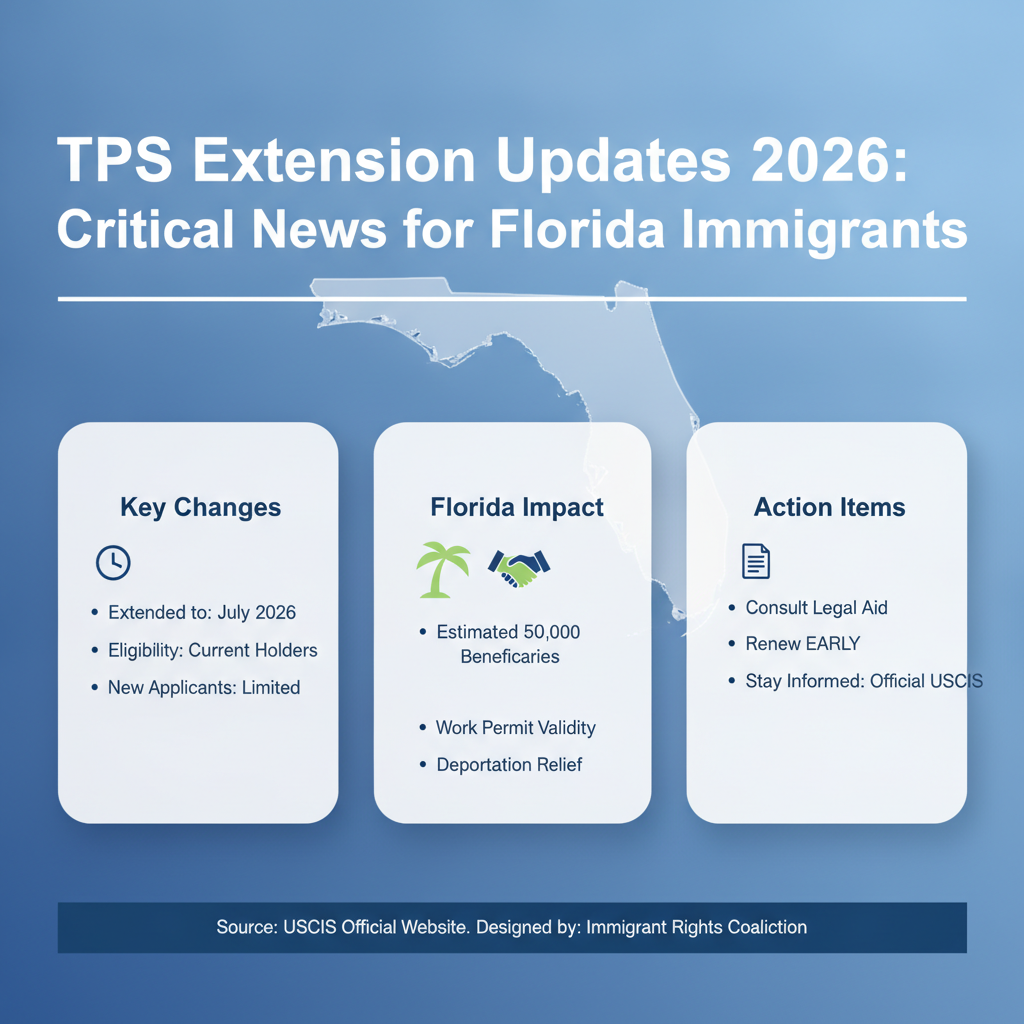
Recent legal news has highlighted the ongoing reviews and decisions by the Department of Homeland Security (DHS) concerning the status of Temporary Protected Status for several nations. These decisions, driven by evolving conditions in countries experiencing armed conflict, natural disasters, or other extraordinary and temporary circumstances, directly impact the lives and futures of those who have sought refuge in the U.S.
For the latest developments and general context, you can refer to broad immigration law coverage:
TPS (Temporary Protected Status) Extension News (Legal News)
What This News Means for Immigrants in Orlando and Across Florida
The announcement of TPS extensions is more than just a bureaucratic update; it represents continued security and the ability to live and work legally for hundreds of thousands of individuals. For families who have built lives in Florida, these extensions are a lifeline, offering stability amidst global uncertainties.
Why this news is showing up now
The U.S. government, specifically the Secretary of Homeland Security, is mandated to periodically review the conditions in countries designated for TPS. These reviews occur typically 60 days before a country's current TPS designation is set to expire. The decision to extend, re-designate, or terminate TPS is based on whether the conditions that led to the initial designation persist. As of late 2026, many existing TPS designations are approaching their expiration dates, necessitating these critical reviews and subsequent announcements.
Factors influencing these decisions include:
- Ongoing armed conflict or civil war in the country.
- Environmental disasters, such as earthquakes, hurricanes, or epidemics, that have substantially disrupted living conditions.
- Other extraordinary and temporary conditions that prevent nationals from safely returning.
The current wave of news reflects the DHS's assessment of these conditions for various countries, leading to the crucial extension announcements that are now circulating.
How it can affect Florida residents
Florida is home to one of the largest and most diverse immigrant populations in the United States. Many residents of Central Florida, including Orlando, have family ties or are originally from countries that have been granted TPS. For example, communities from nations like Haiti, Venezuela, Nicaragua, El Salvador, and Honduras have significant populations throughout the state. An extension of TPS means:
- Continued Protection from Removal: Individuals from designated countries will not be deported from the U.S.
- Work Authorization: TPS beneficiaries can continue to apply for and renew their Employment Authorization Documents (EADs), allowing them to work legally and support their families. This is vital for the economic stability of countless households in Orlando and surrounding areas like Orange County.
- Peace of Mind: The ability to plan for the future without the immediate threat of deportation provides immense psychological relief and allows families to continue building their lives here.
- Access to Driver's Licenses: In Florida, an EAD often serves as primary identification, which can be used to obtain a driver's license, facilitating daily life and commuting along the I-4 corridor.
For Central Florida residents, staying informed about these extensions is not just a matter of legal compliance but a fundamental aspect of their daily lives and future planning. It impacts everything from employment opportunities to educational pursuits and family unity.
Need Help Navigating TPS Extensions? Our Orlando immigration team at Imigrar is ready to assist you with understanding the latest TPS updates and re-registration processes. Call +1 786-791-3106 for a free consultation, or message us online. Se Habla Español.
What Temporary Protected Status (TPS) Is (and Why It Matters)
Temporary Protected Status (TPS) is a crucial humanitarian immigration program designed to protect foreign nationals from designated countries who are already present in the United States. It offers a temporary reprieve from deportation and allows beneficiaries to live and work legally in the U.S. when conditions in their home country are deemed unsafe for return. Understanding TPS is essential for anyone affected by these extensions.
A plain-English definition
Imagine your home country suddenly becomes unsafe due to a major natural disaster, a widespread epidemic, or a violent conflict. The U.S. government, recognizing these dangerous conditions, might decide it's not safe for its citizens living in the U.S. to be forced to return home. Temporary Protected Status is essentially a temporary permission to stay in the U.S., allowing you to live and work here legally until those dangerous conditions improve. It's "temporary" because it's not a permanent immigration solution like a Green Card, but it provides vital protection and stability for a designated period.
The program is a testament to the U.S.'s commitment to humanitarian principles, ensuring that individuals are not sent back to face life-threatening situations or severe hardship. It offers a period of safety, allowing beneficiaries to contribute to the U.S. economy and community, often while supporting family members back home.
Key terms you need to know
Navigating TPS requires familiarity with specific terminology. Here are some essential terms:
- Designated Country: A country whose nationals are eligible for TPS due to ongoing armed conflict, environmental disaster, or other extraordinary and temporary conditions. The Secretary of Homeland Security makes these designations.
- Initial Registration Period: The specific timeframe during which eligible nationals of a newly designated country can apply for TPS for the first time.
- Re-registration Period: The specific timeframe during which individuals who have already been granted TPS must re-apply to extend their status for the new period. Missing this deadline can lead to loss of status.
- Employment Authorization Document (EAD): Often referred to as a "work permit," this document (Form I-766) allows TPS beneficiaries to legally work in the United States. Obtaining an EAD is a critical benefit of TPS.
- Travel Authorization (Advance Parole): This is permission granted by USCIS (Form I-131) that allows a TPS beneficiary to travel outside the U.S. and be readmitted. Traveling without Advance Parole can lead to serious immigration consequences, including denial of re-entry or termination of TPS.
- Continuous Physical Presence (CPP): A requirement for TPS eligibility, meaning the applicant must have been continuously present in the U.S. since a specific date set for their country's designation.
- Continuous Residence (CR): Another eligibility requirement, meaning the applicant must have resided continuously in the U.S. since a specific date set for their country's designation. Brief, casual, and innocent departures do not typically break continuous residence.
- Secretary of Homeland Security: The high-ranking U.S. government official who has the authority to designate, extend, or terminate TPS for countries based on statutory criteria.
- USCIS (U.S. Citizenship and Immigration Services): The government agency responsible for processing TPS applications, EADs, and other immigration benefits. You can find official information and forms on the USCIS official website.
Understanding these terms is fundamental to comprehending your rights and responsibilities as a TPS beneficiary or applicant. If you have questions about any of these terms, especially concerning your specific situation, it's always best to consult with an immigration attorney.
Current Immigration Law: The Foundation of TPS
Temporary Protected Status is not a discretionary program; it is firmly rooted in U.S. immigration law. Understanding the legal framework provides clarity on eligibility, processes, and the government's authority regarding TPS designations and extensions.
Federal requirements
The authority to grant TPS is established under Section 244 of the Immigration and Nationality Act (INA), specifically 8 U.S.C. § 1254a. This statute outlines the conditions under which the Secretary of Homeland Security may designate a foreign country for TPS. The three primary statutory bases for designation are:
- Ongoing Armed Conflict: Conditions in the foreign state prevent the safe return of its nationals due to ongoing armed conflict.
- Environmental Disaster: The foreign state has experienced an earthquake, flood, drought, epidemic, or other environmental disaster resulting in a substantial, but temporary, disruption of living conditions, and the foreign state is unable to handle the return of its nationals adequately.
- Extraordinary and Temporary Conditions: The foreign state is experiencing extraordinary and temporary conditions that prevent its nationals from safely returning, provided that the designation is consistent with U.S. foreign policy interests.
To be eligible for TPS, an individual must meet several federal requirements:
- Be a national of a country designated for TPS (or a person without nationality who last habitually resided in that country).
- Have been continuously physically present in the U.S. since the effective date of the most recent designation.
- Have continuously resided in the U.S. since the date specified for their country's designation.
- Apply for TPS during the initial registration period or a re-registration period.
- Not be inadmissible under certain grounds, including some criminal and security-related grounds.
- Not have been convicted of any felony or two or more misdemeanors committed in the U.S.
- Not be subject to certain mandatory bars to asylum, such as having persecuted others or committed a serious non-political crime outside the U.S.
The application process involves filing Form I-821, Application for Temporary Protected Status, and often Form I-765, Application for Employment Authorization. USCIS reviews these applications to ensure all statutory and regulatory requirements are met.
Florida-specific considerations
While TPS is a federal program, its impact and implementation have unique considerations for Florida residents. Florida's geographical proximity to many TPS-designated countries in the Caribbean and Central and South America means that a significant portion of its immigrant population directly benefits from these protections. For instance, the large Haitian, Venezuelan, and Central American communities across the state, including in Orlando, Miami, and Tampa, are often directly affected by TPS designations and extensions.
For those living in Florida, especially in the Orlando metropolitan area, several practical aspects come into play:
- Local Resources: Many community organizations and legal aid groups in Central Florida specialize in assisting immigrant populations, including TPS applicants.
- USCIS Field Offices: The Orlando USCIS Field Office serves a vast area, and understanding its procedures for biometrics appointments and interviews (if required) is important.
- State Identification: With an approved EAD, TPS beneficiaries in Florida can apply for state identification cards or driver's licenses, which are essential for daily life, employment, and travel within the state.
- Legal Expertise: Due to the complexity and frequent changes in immigration law, having access to experienced immigration attorneys in Orlando who are familiar with federal regulations and local community needs is invaluable.
Staying current with USCIS official website announcements and seeking professional legal advice are critical steps for any Florida resident impacted by TPS news.

How to Re-register for TPS (or Apply for the First Time): A Complete Step-by-Step Guide
Whether you're re-registering for an extended TPS period or applying for the first time under a new designation, the process requires careful attention to detail and adherence to strict deadlines. This guide provides a comprehensive overview of the steps involved.
1) Determine Your Eligibility and Country's Status
Before beginning any application, it is paramount to confirm your eligibility and your country's current TPS status. USCIS announcements will specify:
- Which countries are designated or extended for TPS.
- The specific initial registration or re-registration period (e.g., a 60-day window).
- The eligibility dates for continuous physical presence (CPP) and continuous residence (CR).
Required Documents for this Step (for self-assessment):
- Your passport or national identity document from the designated country.
- Proof of your date of entry into the U.S. (e.g., I-94 arrival/departure record, airline tickets, passport stamps).
- Any previous TPS approval notices (Form I-797C, Notice of Action).
Important: Ensure you meet all general eligibility criteria, including having no disqualifying criminal record. A thorough review of your immigration history is essential.
2) Gather All Necessary Documents
This is arguably the most critical and time-consuming step. You must provide clear evidence to support your application. Start collecting these documents well in advance of the deadline.
General Required Documents for TPS Application (Initial or Re-registration):
- Proof of Identity and Nationality:
- Passport from your designated country.
- Birth certificate with photo identification.
- National identity card from your country with photo and/or fingerprint.
- Any previous EADs or TPS approval notices.
- Proof of Entry into the U.S.:
- Form I-94, Arrival/Departure Record (electronic or paper).
- Passport with U.S. entry stamp.
- Airline or other travel tickets/boarding passes.
- Proof of Continuous Residence in the U.S. (from the designated date to present):
- Rental agreements, lease agreements, or mortgage statements.
- Utility bills (electricity, water, gas, internet).
- Employment records (pay stubs, W-2s, employment verification letters).
- School records (transcripts, enrollment letters).
- Medical records (doctor's visits, hospital stays).
- Bank statements.
- Tax returns (IRS transcripts).
- Affidavits from friends, family, or employers attesting to your residence.
- Any other dated official correspondence received in the mail.
- Two Passport-Style Photos: Taken within 30 days of filing.
- Proof of Prior TPS Grant (for re-registration): Your previous TPS approval notice or EAD.
- Translations: All documents not in English must be accompanied by a certified English translation. The translator must certify that they are competent to translate and that the translation is accurate.
Reminder: Make copies of everything you submit for your records. Do not send original documents unless specifically requested by USCIS.
3) Complete and File Form I-821, Application for Temporary Protected Status
This is the primary form for TPS. Fill it out accurately and completely.
- Sections: Provide your personal information, country of birth, dates of entry, and detailed answers regarding your eligibility and criminal history.
- Criminal History: Be completely honest about any arrests, charges, or convictions, even if they were dismissed or expunged. Failure to disclose can lead to severe penalties, including a finding of fraud.
- Filing Fee: Check the USCIS website for the current filing fee for Form I-821. You may also be eligible to file Form I-912, Request for Fee Waiver, if you meet specific income guidelines.
- Signature: Ensure you sign the form. Unsigned forms will be rejected.
Warning: The instructions for Form I-821 are lengthy and complex. Reading them carefully or seeking legal assistance is highly recommended.
4) File Form I-765, Application for Employment Authorization (Optional but Recommended)
If you wish to work legally in the U.S., you must file Form I-765. Most TPS applicants file this concurrently with Form I-821.
- Filing Fee: There is a separate filing fee for Form I-765. Again, check the USCIS website for current fees and fee waiver eligibility.
- Category: For TPS applicants, the eligibility category is typically (c)(19).
- Passport Photos: Include two additional passport-style photos with your I-765 application, even if you submitted them with your I-821.
Important: If you are re-registering, ensure your current EAD does not expire before your new one is issued. USCIS often provides automatic extensions of EADs for re-registrants, but you must still re-register on time. Check the specific Federal Register notice for your country for details on automatic EAD extensions.
5) Attend Biometrics Appointment
After filing your forms, USCIS will send you an appointment notice (Form I-797C) for a biometrics services appointment at an Application Support Center (ASC). For Central Florida residents, this will likely be at the Orlando USCIS Field Office or a nearby ASC.
- What to Expect: At this appointment, your fingerprints, photograph, and signature will be taken. This data is used for background checks.
- Bring: Your appointment notice, a valid photo ID (e.g., passport, state ID, EAD), and copies of your filed applications.
- Do Not Miss It: Failure to attend your biometrics appointment can lead to denial of your application. If you have an unavoidable conflict, contact USCIS immediately to reschedule.
6) Monitor Your Application Status and Respond to RFEs
After your biometrics, the waiting period begins. You can monitor the status of your application online using the receipt number provided by USCIS.
- USCIS Case Status Online: Visit USCIS Case Status Online to track your application.
- Request for Evidence (RFE): USCIS may send you an RFE (Form I-797E) if they need more information or documents to make a decision. Respond promptly and thoroughly by the deadline provided. Failure to respond to an RFE can lead to denial.
- Change of Address: If you move, you must notify USCIS of your new address within 10 days using Form AR-11, Alien's Change of Address Card, and update your pending applications online. Failure to do so can result in missed notices and application denial.
7) Receive Your Decision and EAD
Eventually, you will receive a decision notice from USCIS. If approved, you will receive an approval notice (Form I-797) and, if you applied for it, your new EAD (Form I-766).
- Approval: Keep your approval notice and EAD in a safe place. Your EAD is your proof of work authorization and legal status under TPS.
- Denial: If your application is denied, you will receive a denial notice explaining the reasons. It is critical to contact an immigration attorney immediately to discuss potential options, such as filing a motion to reopen/reconsider or exploring other immigration relief.
Timeline Expectations: Processing times can vary significantly depending on the volume of applications and specific country designations. You can check current processing times on the
Related Topics
Need Legal Assistance?
Our experienced immigration attorneys are here to help with your case. Contact Imigrar today for a free consultation and let us guide you through the legal process with confidence.
📍 Orlando, Florida • Serving clients nationwide
📧 info@imigrar.com