
TPS Extension Updates: What Orlando Immigrants Need to Know in
Stay informed on the latest TPS (Temporary Protected Status) extensions in 2026. This comprehensive guide covers eligibility, re-registration steps, deadlines, and how Imigrar helps families in Orlando and Florida.

In the ever-evolving landscape of U.S. immigration law, staying informed is not just helpful—it's essential for the safety and stability of families. Here at Imigrar, we understand the profound impact that changes in immigration policy have on our clients in Orlando, across Florida, and nationwide. Today, we delve into crucial updates regarding Temporary Protected Status (TPS) extensions for designated countries, a topic that brings both relief and renewed urgency for many.
Urgent TPS Questions? Don't navigate these complex updates alone. Our Orlando immigration team at Imigrar is ready to assist. Call +1 786-791-3106 for a free consultation, or message us online. Se Habla Español.
The reporting that sparked this guide
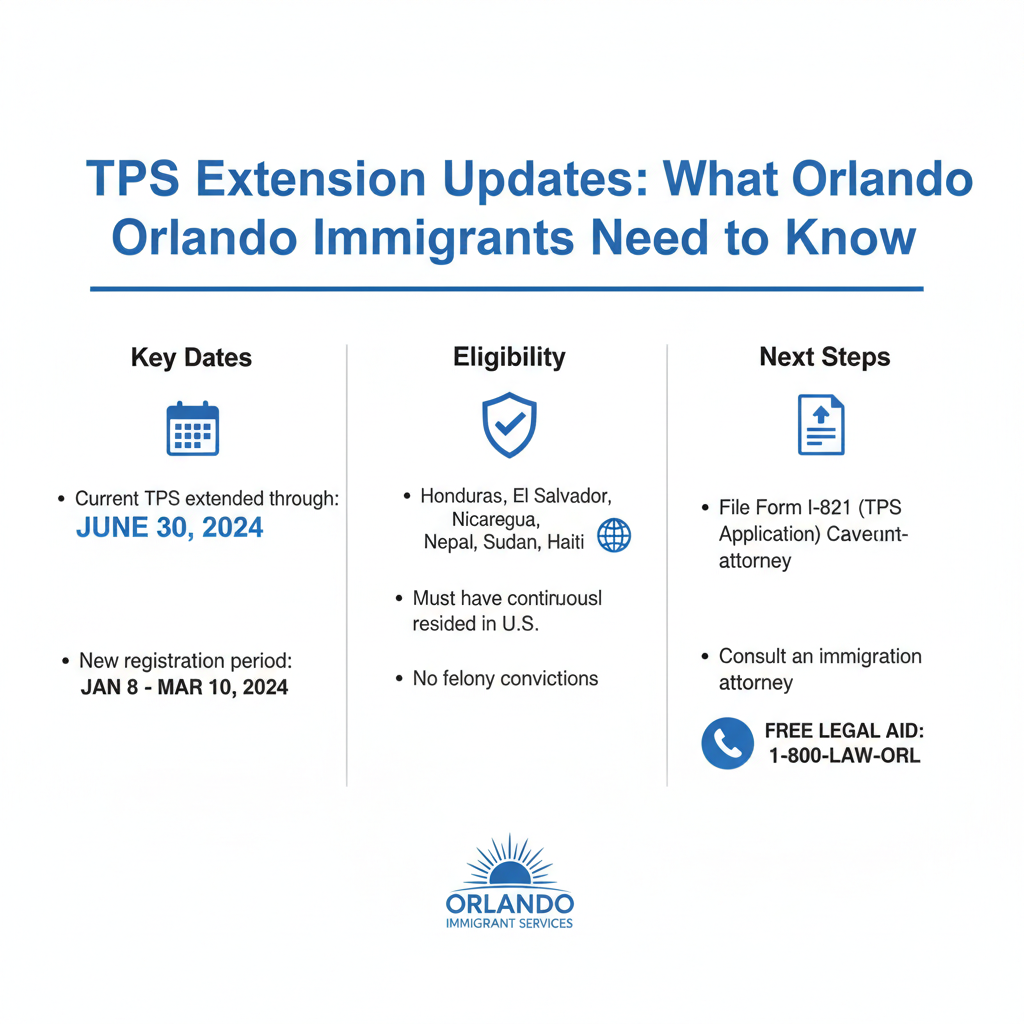
The news cycle frequently highlights the humanitarian crises and political situations around the globe that lead to significant immigration policy decisions within the United States. Recent reports concerning TPS (Temporary Protected Status) Extension News (Legal News) have signaled critical developments for individuals from various designated countries. These announcements, often made by the Department of Homeland Security (DHS) through the Federal Register, dictate the continuation of protection for hundreds of thousands of immigrants already residing in the U.S. Understanding these official notices and their implications is paramount, and Imigrar is here to break down what it means for you and your family.
What This News Means for Immigrants in Orlando and Across Florida
For individuals and families who rely on Temporary Protected Status to live and work legally in the United States, news of an extension is always met with a mix of relief and the immediate need for action. These announcements are not just bureaucratic formalities; they represent the continued ability to reside safely, maintain employment, and contribute to communities like those found throughout Central Florida.
Why this news is showing up now
TPS extensions are not arbitrary; they are the result of ongoing evaluations by the Secretary of Homeland Security. Under U.S. law, a country can be designated for TPS, or an existing designation can be extended, if conditions in that country prevent its nationals from returning safely. These conditions typically fall into three categories:
- Ongoing Armed Conflict: Civil war or other significant armed hostilities that pose a serious threat to personal safety.
- Environmental Disaster: Such as earthquakes, hurricanes, floods, or epidemics, leading to substantial, but temporary, disruption of living conditions.
- Other Extraordinary and Temporary Conditions: Any other exceptional circumstances that prevent nationals from returning safely.
The Department of Homeland Security (DHS) is legally required to review the conditions in each designated country at least 60 days before the expiration of its current TPS designation. If the conditions persist, or if new qualifying conditions arise, the Secretary of Homeland Security may decide to extend the designation for another period, typically 6, 12, or 18 months. These decisions are published in the Federal Register and often come with a specific re-registration period. The current news reflects these ongoing reviews and the subsequent official determinations for various countries.
How it can affect Florida residents
Florida is home to a vibrant and diverse immigrant population, with a significant number of individuals from TPS-designated countries. Cities like Orlando, Miami, and Tampa, and counties like Orange County, have large communities that are directly impacted by TPS decisions. For Florida residents, an extension of TPS means:
- Continued Legal Presence: Individuals can maintain their legal status in the U.S., protecting them from removal (deportation).
- Work Authorization: For many, the most critical aspect is the continued eligibility for an Employment Authorization Document (EAD), allowing them to work legally and support their families. This is vital for the local economy in areas like the I-4 corridor, which relies on a strong workforce.
- Travel Authorization: With an approved travel document (Advance Parole), TPS holders may be able to travel outside the U.S. and return, facilitating visits to family or for other urgent matters, though this should always be done with careful legal guidance.
- Stability for Families: An extension provides a critical sense of stability, allowing families to plan for their children's education, secure housing, and integrate further into their communities without the constant fear of being forced to leave.
- Economic Contribution: TPS holders are integral to Florida's economy, working in various sectors from hospitality and agriculture to construction and healthcare. Their continued presence ensures these industries thrive.
For those in Orlando and the wider Central Florida region, understanding these updates is not just about legal compliance; it's about securing your future and the future of your loved ones. Imigrar is deeply rooted in the Orlando community, and we are committed to helping our neighbors navigate these crucial immigration pathways.
What Temporary Protected Status (TPS) Is (and Why It Matters)
Temporary Protected Status (TPS) is a humanitarian immigration program established by the U.S. Congress. It provides temporary immigration benefits to eligible nationals of designated countries who are already present in the United States. It's a lifeline for many, but often misunderstood.
A plain-English definition
Simply put, Temporary Protected Status (TPS) allows people from specific countries to live and work legally in the United States for a temporary period if their home country is deemed unsafe for them to return to. The Secretary of Homeland Security designates countries for TPS due to extraordinary circumstances such as ongoing armed conflict, environmental disasters (like earthquakes or hurricanes), or other unusual and temporary conditions. While TPS offers protection from deportation and provides work authorization, it is, as its name suggests, *temporary*. It does not directly lead to a Green Card or U.S. citizenship, but it can be a crucial stepping stone or provide stability while other long-term immigration options are pursued.
Key terms you need to know
Navigating TPS requires understanding some specific terminology:
- Designated Country: A country whose nationals are eligible for TPS due to specific, unsafe conditions. The list of designated countries can change, and designations are for a specific period.
- Re-registration Period: When a country's TPS designation is extended, USCIS announces a specific window of time (often 60 days or 180 days) during which current TPS beneficiaries must apply to extend their status. Missing this deadline can lead to loss of status.
- Employment Authorization Document (EAD): Also known as a work permit, this card (Form I-766) allows TPS beneficiaries to work legally in the U.S.
- Travel Authorization (Advance Parole): A document (Form I-512) issued by USCIS that allows a TPS beneficiary to travel outside the U.S. and return without jeopardizing their TPS status. This is obtained by filing Form I-131. Important: Traveling without this document can result in inability to re-enter the U.S.
- Removal Proceedings: Legal proceedings in immigration court that could lead to deportation. TPS protects individuals from these proceedings while their status is valid.
- Continuous Physical Presence (CPP): A requirement for TPS eligibility, meaning the applicant must have been physically present in the U.S. since a specific date set for each designated country.
- Continuous Residence (CR): Another eligibility requirement, meaning the applicant has maintained residence in the U.S. since a specific date set for each designated country.
- Federal Register Notice: The official daily publication of the U.S. government that announces TPS designations, extensions, and re-registration periods. This is the primary source of official information.
- Prima Facie Eligibility: Meaning "at first sight" or "on the face of it." USCIS determines if an applicant appears eligible for TPS based on the initial application and supporting documents.
Understanding these terms is fundamental to successfully applying for or re-registering for TPS. Imigrar emphasizes the importance of accuracy and timeliness in all applications, especially when dealing with critical benefits like TPS.
Need Clarity on TPS Terms? Our team speaks your language, both English and Spanish. Get expert guidance on TPS eligibility and applications. Call Imigrar at +1 786-791-3106 for a free consultation. Se Habla Español.
Current Immigration Law: The Foundation of TPS
Temporary Protected Status is not a discretionary program; it is firmly rooted in U.S. immigration law, specifically within the Immigration and Nationality Act (INA).
Reference specific laws and statutes
TPS was established by Congress through Section 244 of the Immigration and Nationality Act (INA), codified at 8 U.S.C. § 1254a. This statute outlines the conditions under which the Secretary of Homeland Security may designate a foreign country for TPS. The law also specifies the eligibility criteria for individuals seeking TPS and the benefits associated with the status.
Key legal provisions:
- INA Section 244(b)(1): Defines the criteria for designating a country for TPS (armed conflict, environmental disaster, extraordinary and temporary conditions).
- INA Section 244(b)(3): Requires the Secretary to review conditions periodically and either extend or terminate the designation.
- INA Section 244(c)(1): Outlines the general eligibility requirements for individuals, including continuous physical presence and continuous residence.
- INA Section 244(a)(1)(A): States that an individual granted TPS shall not be deported during the period of designation.
- INA Section 244(a)(1)(B): Grants employment authorization.
- INA Section 244(a)(1)(C): Allows for travel authorization (Advance Parole).
These legal foundations ensure that TPS is administered uniformly and transparently, with decisions based on specific statutory criteria and humanitarian considerations. All official announcements regarding TPS designations and extensions are published in the Federal Register, providing a public record and notification of these critical policy decisions.
Federal requirements
To be eligible for TPS, an individual must meet several federal requirements:
- Be a national of a country designated for TPS (or a person without nationality who last habitually resided in that designated country).
- File Form I-821, Application for Temporary Protected Status, within the registration or re-registration period established for their country.
- Have been continuously physically present (CPP) in the U.S. since the effective date of the most recent designation or extension notice.
- Have been continuously residing (CR) in the U.S. since the effective date of the most recent designation or extension notice.
- Meet all other eligibility requirements, which include passing security and background checks. Certain criminal convictions or national security concerns can render an applicant ineligible.
It's crucial to understand that even if your country is designated, you must individually meet these criteria. Any breaks in continuous physical presence or residence beyond brief, innocent, and casual absences can jeopardize eligibility. For the most accurate and up-to-date information, always refer to the USCIS official website.
Florida-specific considerations
While TPS is a federal immigration benefit, its impact is felt locally. There are no state-specific TPS laws in Florida, as immigration is primarily a federal matter. However, for Florida residents, holding valid TPS status (including a valid Employment Authorization Document) allows them to:
- Obtain a Florida Driver's License or State ID: With proof of identity, legal presence (EAD, I-797 approval notice for TPS), and residency, TPS holders can apply for a Florida driver's license, which is essential for daily life and work in Orlando and beyond.
- Access Certain State and Local Services: While TPS does not grant eligibility for all public benefits, it can allow access to certain state-funded programs or services where legal presence is a requirement.
- Enroll in Educational Institutions: TPS holders are generally eligible to attend public schools and universities in Florida, often at in-state tuition rates if they meet residency requirements.
- Contribute to the Local Economy: Legally employed TPS holders pay taxes and contribute to the economic vitality of Central Florida communities, from Orlando to Kissimmee.
The Orlando USCIS Field Office typically handles interviews for adjustment of status or other benefits, but initial TPS applications and re-registrations are processed centrally by USCIS service centers. For those living in Orange County or surrounding areas, ensuring your TPS status is current is critical for maintaining your ability to live and work in Florida without fear.
How to Re-Register for TPS: A Complete Step-by-Step Guide
When a TPS designation for your country is extended, the most common action required is to re-register. This process is critical to maintain your protected status and associated benefits. Warning: Missing the re-registration deadline can lead to loss of TPS and potential removal proceedings.
1) Determine Your Eligibility and the Re-registration Window
Before doing anything, you must confirm that your country’s TPS designation has been extended and that you are eligible to re-register. Each extension notice published in the Federal Register specifies:
- The exact dates for the re-registration period (e.g., October 4, 2026, to December 3, 2026).
- The effective date of the extension.
- Any specific instructions or changes for that country.
Actionable Checklist:
- Check the USCIS TPS webpage or the Federal Register for your country’s specific notice.
- Verify you continue to meet the Continuous Physical Presence (CPP) and Continuous Residence (CR) requirements since your initial application, accounting for any brief, casual, and innocent departures.
- Ensure you have not been convicted of certain felonies or two or more misdemeanors in the U.S.
Reminder: Even if you previously had TPS, you must re-register within the specified window to maintain your status.
2) Gather Required Documents
Thorough documentation is key to a successful re-registration. While some documents may have been submitted with your initial application, it's wise to have them ready again.
Required Documents (General):
- Proof of Identity and Nationality:
- Copy of passport from your designated country (if available).
- Copy of birth certificate with photo identification.
- Any national identity document from your country bearing your photograph and/or fingerprint.
- If you do not have a passport, explain why and provide other identity documents.
- Proof of Date of Entry into the U.S.:
- Copy of passport entry stamps.
- Copy of Form I-94 (Arrival/Departure Record).
- Other travel documents or airline tickets.
- Proof of Continuous Residence in the U.S.: (From the date specified in your country’s TPS notice to the present)
- Rent receipts, utility bills (electric, water, gas, internet).
- Employment records (pay stubs, W-2 forms, letters from employers).
- School records (transcripts, report cards).
- Medical records (doctor's visits, hospital stays).
- Bank statements.
- Affidavits from friends, family, or employers attesting to your presence.
- Proof of Previous TPS Grant:
- Copy of your previous Form I-797 (Approval Notice for Form I-821).
- Copy of your expired or expiring Employment Authorization Document (EAD) (Form I-766).
Important: All documents not in English must be accompanied by a complete English translation certified by the translator. Provide copies of all documents, not originals, unless specifically requested by USCIS.
3) Complete the Necessary Forms
For TPS re-registration, you will primarily need to submit Form I-821. If you also need to renew your work permit or apply for a new one, you will file Form I-765. If you wish to travel outside the U.S., you will need to file Form I-131.
- Form I-821, Application for Temporary Protected Status:
- This is the main application for re-registration. Fill out every section accurately and completely. Refer to the specific instructions for your country's designation on the USCIS website.
- Form I-765, Application for Employment Authorization:
- If you need to extend your work permit, you must file this form along with Form I-821. Mark "c)(19)" as your eligibility category.
- Form I-131, Application for Travel Document (Advance Parole):
- If you anticipate needing to travel internationally while your TPS is valid, you must apply for Advance Parole. This form can be filed concurrently with your TPS re-registration or separately.
Recommendation: Use the latest version of these forms, available on the USCIS Forms page. Outdated forms will be rejected.
4) Prepare Your Filing Fees (or Fee Waiver Request)
There are fees associated with filing Form I-821 and Form I-765. For TPS re-registration, often only the biometrics fee is required for Form I-821, while the Form I-765 has its own separate filing fee. Form I-131 also has a filing fee.
- Biometrics Fee: Required for all applicants aged 14 to 79.
- Form I-765 Fee: If you are applying for an EAD.
- Form I-131 Fee: If you are applying for Advance Parole.
Fee Waiver: If you cannot afford the fees, you may be eligible for a fee waiver by filing Form I-912, Request for Fee Waiver. This form requires documentation of your financial hardship. If requesting a fee waiver for Form I-765, you must also request one for the biometrics fee. Warning: A denied fee waiver request will delay your application significantly, as USCIS will then require the fees before processing. It's often safer to pay the fees if possible.
5) Submit Your Application Package
Once all forms are completed, signed, and all required documents and fees (or fee waiver request) are prepared, assemble your package carefully. USCIS provides specific mailing addresses for TPS applications, which vary depending on your residential address and whether you are using the U.S. Postal Service or a private courier.
Mailing Guidance:
- Check the "Where to File" section on the USCIS website for Form I-821 to find the correct Lockbox address.
- Make a complete copy of your entire application package before mailing it. This is your personal record.
- Send your application via certified mail with a return receipt requested, or through a courier service that provides tracking. This proves that you mailed your application and when it was received.
Reminder: Submit your application within the re-registration period! For Central Florida residents, including those in Orlando, the mailing address will typically be a USCIS Lockbox facility outside of Florida.
6) Attend Biometrics Appointment (If Required)
After USCIS receives your application, you will typically receive a receipt notice (Form I-797C). Subsequently, most applicants will receive an appointment notice (Form I-797C) for a biometrics (fingerprinting, photograph, and signature) appointment at an Application Support Center (ASC).
- What to Bring: The appointment notice and a valid photo ID (e.g., driver's license, passport).
- Purpose: Biometrics are used for background and security checks.
Important: Do not miss your biometrics appointment. If you have a valid reason to reschedule, follow the instructions on your appointment notice immediately.
7) Receive Decision and New EAD
After your biometrics are processed and your application is reviewed, USCIS will make a decision. If approved, you will receive an approval notice (Form I-797) for your Form I-821 and, if applicable, your new Employment Authorization Document (EAD) (Form I-766).
- Interim EAD Extension: Often, when TPS is extended, USCIS automatically extends the validity of existing EADs for a certain period to prevent gaps in work authorization while new EADs are processed. Check the Federal Register notice for details on this automatic extension.
- Case Status: You can check the status of your application online using the receipt number on your Form I-797C at USCIS Case Status Online.
Warning: Always keep your approval notices and EADs in a safe place. These are crucial documents for proving your legal status and work authorization.
Practical Steps You Can Take Today
Don't wait until the last minute to begin your TPS re-registration process. Proactive steps can save you stress and prevent potential issues.
Actionable checklist with 5+ items
- Verify Your Country's Status: Immediately check the USCIS TPS page or the Federal Register for the latest updates on your country's designation and the specific re-registration period.
- Consult an Immigration Attorney: Even for re-registration, an attorney can ensure all forms are completed correctly, documents are sufficient, and potential issues (like criminal history or travel) are addressed. This is especially true if you are in Orlando and need local, trusted advice.
- Gather Documents Early: Start collecting all necessary identity, residence, and previous TPS approval documents now. Don't underestimate the time it takes to retrieve old utility bills or school records.
- Review Your Criminal History: If you have any arrests or convictions, discuss them with your attorney immediately. Certain offenses can make you ineligible for TPS.
- Check Your Travel History: Be prepared to accurately list all your entries and exits from the U.S. since your initial TPS grant.
- Save Money for Fees: If you plan to pay the fees, set aside the necessary funds for Form I-821 (biometrics), Form I-765 (EAD), and Form I-131 (Advance Parole).
- Update Your Address with USCIS: If you have moved, file Form AR-11, Alien's Change of Address Card, online or by mail. Missing important notices due to an outdated address can severely impact your case.
Document preparation guidance
- Originals vs. Copies: Always send copies of your supporting documents unless USCIS specifically requests originals. Keep your originals safe.
- Translations: For any document not in English, provide a complete and accurate English translation. The translator must certify that they are competent to translate and that the translation is accurate. Include the translator's name, signature, address, and date of certification.
- Organization: Organize your application package neatly. Use tabs, dividers, or paper clips (not staples for multiple documents) to separate different forms and their supporting evidence. A cover letter listing the contents can also be helpful.
- Affidavits: If you lack official documents to prove continuous residence, affidavits from credible witnesses (friends, neighbors, employers, religious leaders) can be helpful. These should be signed, dated, and notarized, explaining the witness's relationship to you and how they know of your continuous presence.
Timeline expectations
Processing times for TPS re-registration and associated EADs can vary significantly. While USCIS aims to process applications efficiently, backlogs can occur.
- Re-registration Period: You typically have a 60-day or 180-day window to re-register.
- Receipt Notice: Expect to receive a receipt notice (Form I-797C) from USCIS within 2-4 weeks after they receive your application.
- Biometrics Appointment: An appointment notice usually arrives within 3-8 weeks after filing. The appointment itself is typically 2-4 weeks after the notice.
- EAD Processing: An Employment Authorization Document (EAD) can take anywhere from 3 months to over a year to be processed. Check the USCIS Processing Times page for the latest estimates for your service center and form type.
- Automatic EAD Extension: If an automatic EAD extension is announced, your expiring EAD, combined with the Federal Register notice, serves as proof of continued work authorization for a specified period (e.g., 18 months).
- Final Decision: The overall processing time for Form I-821 can range from 6 months to over a year.
Warning: These are estimates. Individual case processing times can vary based on the complexity of the case, USCIS workload, and any requests for additional evidence (RFE).

How Imigrar Helps Immigrants in Orlando with TPS
Navigating the intricacies of TPS re-registration and extensions can be daunting, especially with the constant updates and strict deadlines. At Imigrar, we stand as a beacon of support for immigrants and their families in Orlando, Central Florida, and across the nation.
Our experience and expertise
Imigrar boasts extensive experience in all facets of immigration law, with a particular focus on humanitarian relief programs like TPS. Our dedicated legal team understands the nuances of the Immigration and Nationality Act (INA) Section 244 and the specific requirements set forth by USC
Related Topics
Need Legal Assistance?
Our experienced immigration attorneys are here to help with your case. Contact Imigrar today for a free consultation and let us guide you through the legal process with confidence.
📍 Orlando, Florida • Serving clients nationwide
📧 info@imigrar.com