
DACA Program: Navigating Renewals & Updates for Orlando
Stay informed about DACA program updates and the crucial renewal process. This guide for Orlando and Florida residents covers eligibility, step-by-step instructions, and how Imigrar can help keep your family together.

The reporting that sparked this guide: DACA Program Updates and Renewal Information (USCIS)
What This News Means for Immigrants in Orlando and Across Florida
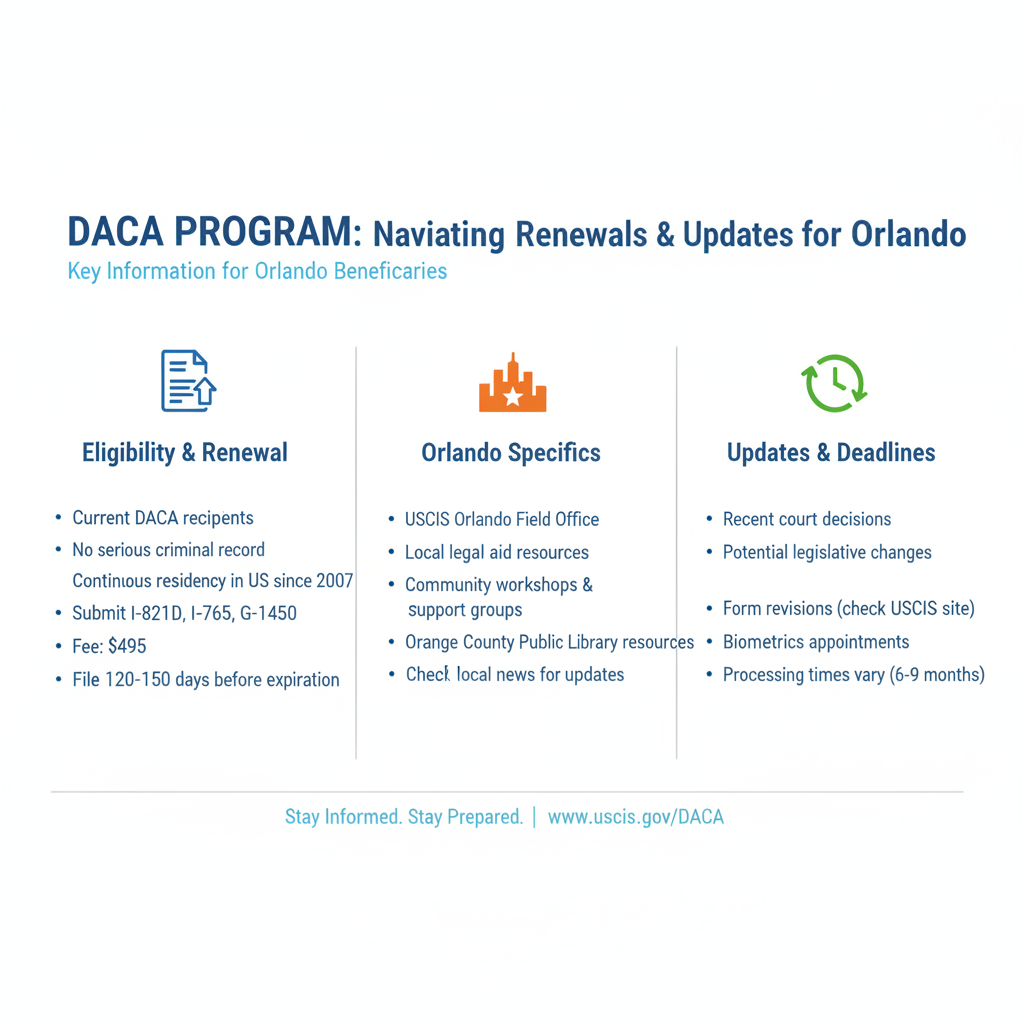
As we navigate October 2026, the Deferred Action for Childhood Arrivals (DACA) program remains a critical, yet often uncertain, lifeline for hundreds of thousands of young people across the United States, including countless individuals and families right here in Orlando and throughout Florida. The ongoing legal battles and administrative challenges surrounding DACA mean that every update, every court decision, and every pronouncement from USCIS carries significant weight. For DACA recipients, their families, and employers, staying informed is not just advised—it's absolutely essential for maintaining their current protections and planning for the future.
Why this news is showing up now
DACA has been a subject of intense legal and political debate since its inception in 2012. Over the past several years, court rulings have repeatedly affirmed the program's existence for current recipients while often blocking new initial applications. This constant back-and-forth in the judicial system, coupled with varying interpretations by different administrations, means that the program's status is rarely static. News regarding DACA is perpetually "showing up" because the program's future is not legislatively secured. Each court hearing, procedural change, or policy review by the Department of Homeland Security (DHS) or U.S. Citizenship and Immigration Services (USCIS) generates new headlines. As of late 2026, the program continues to operate under the shadow of ongoing litigation, particularly appeals that challenge its legality. These legal challenges mean that while renewals are generally being processed, the underlying framework of DACA is under constant scrutiny, requiring current recipients to be acutely aware of any changes that could impact their ability to maintain their deferred action status and work authorization.
How it can affect Florida residents
For the estimated 20,000+ DACA recipients in Florida, and particularly those in the vibrant and diverse communities of Orlando and Central Florida, these updates are not abstract legal discussions. They directly impact daily life, access to education, employment opportunities, and overall family stability. Florida has a significant population of DACA recipients who contribute to our economy and culture. Changes to DACA can affect:
- Employment: The ability to renew an Employment Authorization Document (EAD) is paramount for DACA recipients to legally work and support themselves and their families. Delays or denials can lead to job loss and financial hardship. Many DACA recipients work in critical sectors across Orlando, from hospitality and tourism to healthcare and education.
- Education: While Florida generally offers in-state tuition for DACA recipients, the stability of DACA status itself influences their ability to pursue higher education, qualify for certain scholarships, and plan their academic futures without fear of deportation. Students at institutions like the University of Central Florida (UCF), Valencia College, and Rollins College who rely on DACA need this stability.
- Driver's Licenses: In Florida, DACA recipients are eligible to obtain a driver's license, which is essential for commuting along the I-4 corridor, getting to work, and managing daily life in a car-dependent state. A lapse in DACA status can lead to the inability to renew this vital identification.
- Community Integration: DACA provides a sense of security and belonging. Any threat to the program can create immense stress and anxiety, impacting mental health and overall well-being within families and communities throughout Orange County and beyond.
Understanding the nuances of DACA updates is crucial for DACA recipients to protect their status, plan their renewals, and ensure their continued ability to thrive in Florida.
Need Help Navigating DACA Updates? Our Orlando immigration team at Imigrar is ready to assist. Call +1 786-791-3106 for a free consultation, or message us online. Se Habla Español.
What DACA Is (and Why It Matters)
A plain-English definition
DACA stands for Deferred Action for Childhood Arrivals. It's an immigration policy established in June 2012 that allows certain eligible undocumented individuals who came to the United States as children to receive temporary protection from deportation (known as "deferred action") and to obtain a renewable work permit (an Employment Authorization Document or EAD). It is important to understand that DACA is not a path to U.S. citizenship, nor does it grant lawful immigration status. It simply provides a temporary, renewable reprieve from deportation and the ability to work legally for a two-year period.
The program was created by the Secretary of Homeland Security under the Obama administration through an executive memorandum, recognizing the unique circumstances of young people often referred to as "DREAMers" who were brought to the U.S. without legal authorization as children and have grown up considering America their home. The core idea is to allow these individuals to contribute more fully to society without the constant fear of removal.
Key terms you need to know
Navigating immigration law requires understanding specific terminology. Here are some key terms related to DACA:
- Deferred Action: This is the core benefit of DACA. It means that the U.S. government has decided to "defer" or postpone any action to remove an individual from the country. It is a discretionary grant and does not confer any permanent legal status.
- Employment Authorization Document (EAD): Often referred to as a "work permit," the EAD is a physical card that proves an individual is authorized to work legally in the United States. DACA recipients receive an EAD, typically valid for two years, coinciding with their period of deferred action.
- DREAMer: This term originated from the "DREAM Act" (Development, Relief, and Education for Alien Minors Act), proposed legislation that aimed to provide a pathway to legal status for undocumented youth. While the DREAM Act has never passed Congress, the term "DREAMer" became widely used to describe the young people who would benefit from such legislation, including DACA recipients.
- USCIS: The U.S. Citizenship and Immigration Services is the government agency responsible for processing DACA applications and renewals, as well as other immigration benefits. Their official website is a primary source for forms, instructions, and updates: USCIS official website.
- Form I-821D, Consideration of Deferred Action for Childhood Arrivals: This is the primary form used to request DACA.
- Form I-765, Application for Employment Authorization: This form is used to apply for the EAD, which allows DACA recipients to work legally.
- Form I-765 Worksheet: An essential supplement to Form I-765, providing additional information related to employment authorization.
- Advance Parole (Form I-131): This is a document that can allow certain non-citizens to travel outside the U.S. and return legally. While DACA recipients were previously eligible for advance parole, its availability has been severely restricted and is almost never granted for DACA recipients as of 2026, except in extremely limited humanitarian, educational, or employment circumstances. It's crucial to consult an attorney before considering travel.
DACA matters immensely because it provides a measure of stability and opportunity for hundreds of thousands of individuals who know no other home than the United States. It allows them to pursue higher education, build careers, contribute to the economy by paying taxes, and live without the constant fear of deportation, fostering stronger families and communities, including right here in Orlando.
Current Immigration Law: The Foundation for DACA
The legal foundation for DACA is unique because it did not originate from a specific act of Congress but rather from an exercise of executive discretion by the Secretary of Homeland Security. This administrative origin is precisely why DACA has been subject to continuous legal challenges. While DACA is not codified in federal statute, its operation relies on existing immigration law principles and regulations that govern deferred action and employment authorization.
As of late 2026, the DACA program continues to face significant legal hurdles. Federal courts have largely upheld the ability of current DACA recipients to renew their deferred action and employment authorization. However, these same rulings have typically blocked USCIS from approving new initial DACA applications. This means that if you have never been granted DACA before, it is highly unlikely your application would be approved at this time. The legal landscape is fluid, and future court decisions or legislative actions could alter this status. For the most current information, always refer to the USCIS official website.
Federal requirements for DACA Renewal
To be eligible to renew your DACA, you must meet the following federal requirements, which are largely based on the original criteria, with some modifications for renewals:
- You must have previously been granted DACA.
- You must not have departed the United States on or after August 15, 2012, without first obtaining advance parole (Form I-131).
- You must have continuously resided in the United States since you submitted your most recent DACA request that was approved.
- You must not have been convicted of a felony, a significant misdemeanor, or three or more other misdemeanors, and not otherwise pose a threat to national security or public safety.
- Important: A "significant misdemeanor" includes offenses where the maximum term of imprisonment is one year or less, but which involves domestic violence, sexual abuse, burglary, unlawful possession or use of a firearm, drug distribution or trafficking, or driving under the influence (DUI) if the maximum penalty is greater than 30 days of imprisonment.
- Reminder: Even minor infractions or arrests should be disclosed and discussed with an attorney.
- You must be physically present in the United States at the time of filing your DACA renewal request.
USCIS processing involves a thorough review of these criteria. Any changes in your criminal history, residency, or travel since your last DACA approval could impact your renewal eligibility.
Florida-specific considerations
While DACA is a federal program, its impact is felt at the state level. For DACA recipients in Florida, several state-specific considerations are important:
- Driver's Licenses: The Florida Department of Highway Safety and Motor Vehicles (FLHSMV) issues driver's licenses to DACA recipients whose EAD is valid for at least 30 days. Renewing your DACA and EAD promptly is crucial to maintaining your driving privileges. The Orlando USCIS Field Office processes many of the documents necessary for these renewals.
- In-State Tuition: Florida Statute 1009.26(12)(a) generally allows DACA recipients who meet certain residency and high school graduation requirements to qualify for in-state tuition at Florida public colleges and universities. This benefit is contingent on maintaining valid DACA status. Students attending schools in Central Florida, such as the University of Central Florida, Valencia College, or Seminole State College, greatly benefit from this provision.
- Professional Licenses: DACA recipients in Florida may be eligible for certain professional licenses, depending on the profession and state regulations. It's essential to check with the relevant state licensing board.
- Community Resources: Various non-profit organizations and legal aid groups across Florida, including in the Orlando area, provide support and resources for DACA recipients, including assistance with renewals and legal advice.
The legal landscape surrounding DACA is constantly evolving, making it imperative to consult with an experienced immigration attorney for personalized advice. Imigrar is deeply familiar with both federal DACA guidelines and their specific implications for residents of Florida.

How to Renew Your DACA: A Complete Step-by-Step Guide
Renewing your DACA is a critical process that requires careful attention to detail and timely submission. Given the program's uncertain future, it is more important than ever to file your renewal correctly and on time. This guide focuses on the renewal process, as initial applications are generally not being accepted or processed by USCIS as of late 2026.
1) Determine Your Eligibility and When to File
Before you begin, confirm you meet the federal renewal requirements outlined above. The most crucial part of this step is timing. USCIS recommends filing your DACA renewal application between 120 and 150 days before your current DACA and EAD expire.
- Why the window? Filing too early might result in rejection, and filing too late could lead to a lapse in your work authorization and deferred action, potentially impacting your employment, driver's license, and even putting you at risk of deportation.
- Check Your Dates: Locate your most recent Form I-797C, Approval Notice for DACA and your current EAD card. Note the expiration dates.
- Continuous Residence: Confirm you have continuously resided in the U.S. since your last DACA approval.
- Criminal Record: Thoroughly review your criminal history, if any, since your last DACA approval. If you have had any arrests, charges, or convictions, even minor ones, you must consult an immigration attorney before filing.
2) Gather All Required Documents
Preparing your supporting documents is crucial for a smooth renewal process. Organize everything clearly and make copies of all documents for your records. Do NOT send original documents unless specifically requested by USCIS.
- Most Recent DACA Approval Notice: A copy of your Form I-797C from your last DACA approval.
- Current EAD Card: Clear photocopies of the front and back of your current Employment Authorization Document.
- Two Passport-Style Photos: These must be taken within 30 days of filing, unmounted, on a white background, and free of shadows. Write your name and A-number lightly on the back of each photo.
- Identity Documents: A copy of your birth certificate with a certified translation (if not in English), passport identity page, or other national identity document.
- Evidence of Continuous Residence (if applicable): If you have moved or have any gaps in your previous documentation, or if USCIS specifically requests it, you may need additional proof of continuous residence in the U.S. since your last DACA approval. This could include:
- School records (transcripts, report cards, diplomas)
- Employment records (pay stubs, W-2s, employment letters)
- Medical records
- Bank statements
- Utility bills
- Rental agreements
- Tax returns
- Proof of Criminal History (if applicable): If you have any arrests or convictions since your last DACA approval, you MUST include certified court dispositions for all charges, even if they were dismissed. Failure to disclose can lead to denial.
3) Complete the Necessary USCIS Forms
Accuracy is paramount when filling out USCIS forms. Any errors or omissions can lead to delays or rejection. Use black ink and type or print clearly.
- Form I-821D, Consideration of Deferred Action for Childhood Arrivals: This is the primary form. Fill out every section carefully. If a question does not apply, write "N/A" (Not Applicable). Ensure all dates and addresses are correct.
- Form I-765, Application for Employment Authorization: This form requests your work permit. For DACA renewals, under "Reason for Applying," you will typically select "Renewal of my permission to work." For item 27, "Eligibility Category," enter (c)(33).
- Form I-765 Worksheet: This is a mandatory supplement to Form I-765 for DACA applicants. It requires you to list all your periods of DACA and EAD validity.
- Signatures: Ensure you sign and date ALL forms where required. An unsigned form will be rejected. If an attorney is assisting you, they will also sign where appropriate.
Warning: Never sign a blank form or a form you haven't reviewed thoroughly.
4) Prepare Your Filing Fees
The filing fees for DACA renewal are a combination of the fees for Form I-821D and Form I-765. As of the current date (October 2026), the fee structure can change, so always verify the exact amount on the USCIS Forms page before sending your application.
- Current Fee (Verify on USCIS website): Typically, the combined fee includes the Form I-765 fee and the biometrics services fee. There is no separate fee for Form I-821D.
- Payment Methods: USCIS accepts money orders, personal checks, cashier's checks, or credit card payments using Form G-1450, Authorization for Credit Card Transactions.
- If paying by check or money order, make it payable to "U.S. Department of Homeland Security." Do NOT abbreviate.
- Write your name and Alien Registration Number (A-number) on the memo line of your check or money order.
- Fee Waivers: Fee waivers are generally NOT available for DACA renewals.
Got questions about DACA renewal forms or fees? Imigrar is here to help simplify the process. Call us at +1 786-791-3106 for expert guidance. Se Habla Español.
5) Assemble and Mail Your Application Package
Proper assembly and mailing are crucial to ensure your application reaches USCIS without issue.
- Order of Documents: While USCIS doesn't mandate a specific order, a common and recommended practice is:
- Cover Letter (optional, but recommended, especially if your case has complexities)
- Check or Money Order (or Form G-1450)
- Form I-821D
- Form I-765
- Form I-765 Worksheet
- Two passport-style photos (placed in a small envelope and stapled to the upper left corner of Form I-821D)
- Copy of current EAD (front and back)
- Copy of previous DACA approval notice (Form I-797C)
- Supporting documents (birth certificate, criminal dispositions, etc.)
- Mailing Address: The USCIS lockbox facility you send your application to depends on your state of residence. For Florida residents, check the USCIS Direct Filing Addresses for Form I-821D page for the most current address.
- Shipping Method: Always use a mailing service that provides tracking and delivery confirmation (e.g., USPS Certified Mail with Return Receipt, FedEx, UPS). This provides proof of submission.
- Keep Copies: Make a complete copy of your entire application package before mailing it.
6) Attend Biometrics Appointment (If Required)
After USCIS receives your application, they will send you a receipt notice (Form I-797C). If a biometrics appointment is required, you will receive a separate appointment notice.
- Biometrics Appointment Notice: This notice will indicate the date, time, and location of your appointment at an Application Support Center (ASC).
- What to Bring: You must bring your appointment notice, a valid photo identification (such as your current EAD or passport), and any other documents specified in the notice.
- Purpose: At the appointment, your fingerprints, photograph, and signature will be collected. This biometric data is used for background checks.
- Important: Do NOT miss this appointment. If you have an unavoidable conflict, immediately contact USCIS to request a rescheduling, though this can delay your application. For Central Florida residents, your biometrics appointment will likely be at the Orlando ASC.
7) Monitor Your Application Status
Once your application is filed, you can monitor its progress online.
- Receipt Notices: USCIS will send you a Form I-797C, Notice of Action, acknowledging receipt of your application. This notice will contain a receipt number (e.g., LIN, WAC, EAC, SRC followed by numbers), which you can use to track your case online.
- Online Case Status: Use the
Related Articles
You may also be interested in:
-
TPS Extension Updates: What Orlando Immigrants Need to Know in
Stay informed on the latest TPS (Temporary Protected Status) extensions in 2026. This comprehensive guide covers eligibility, re-registration steps, d...
-
Navigating TPS Extensions: A Florida Immigrant's Essential Guide
Stay informed on the latest TPS extensions and re-designations. This comprehensive guide from Imigrar, your Orlando immigration experts, details eligi...
-
Master Your Green Card Interview: Expert Tips for Florida
Prepare confidently for your Green Card interview with Imigrar's expert guide. Learn essential documents, common questions, and how to navigate the pr...
-
TPS Extension Confirmed: What It Means for Florida Immigrants in
Major TPS extension news brings relief and critical deadlines for immigrants in Florida. Understand the details, re-registration steps, and how Imigra...
-
TPS Extension Updates: What Orlando Immigrants Need to Know in
Related Topics
Need Legal Assistance?
Our experienced immigration attorneys are here to help with your case. Contact Imigrar today for a free consultation and let us guide you through the legal process with confidence.
📍 Orlando, Florida • Serving clients nationwide
📧 info@imigrar.com