
TPS Extension 2026: Florida Immigrants' Essential Guide
Recent TPS extensions bring crucial updates for designated countries. Learn what this means for your status in Florida, understand re-registration steps, and discover how Imigrar in Orlando can help you navigate these changes.

The immigration landscape is constantly shifting, and staying informed is paramount for individuals and families navigating the complexities of U.S. immigration law. Today, we delve into significant news regarding Temporary Protected Status (TPS) extensions for several designated countries.
At Imigrar, an immigration law firm based in Orlando, Florida, we understand that these updates can be a source of both hope and anxiety. Our mission is to "Keep Families Together" by providing clear, accurate, and actionable legal guidance. With today being September 30, 2026, it's crucial to understand the implications of these recent announcements and how they might affect your protected status.
The reporting that sparked this guide
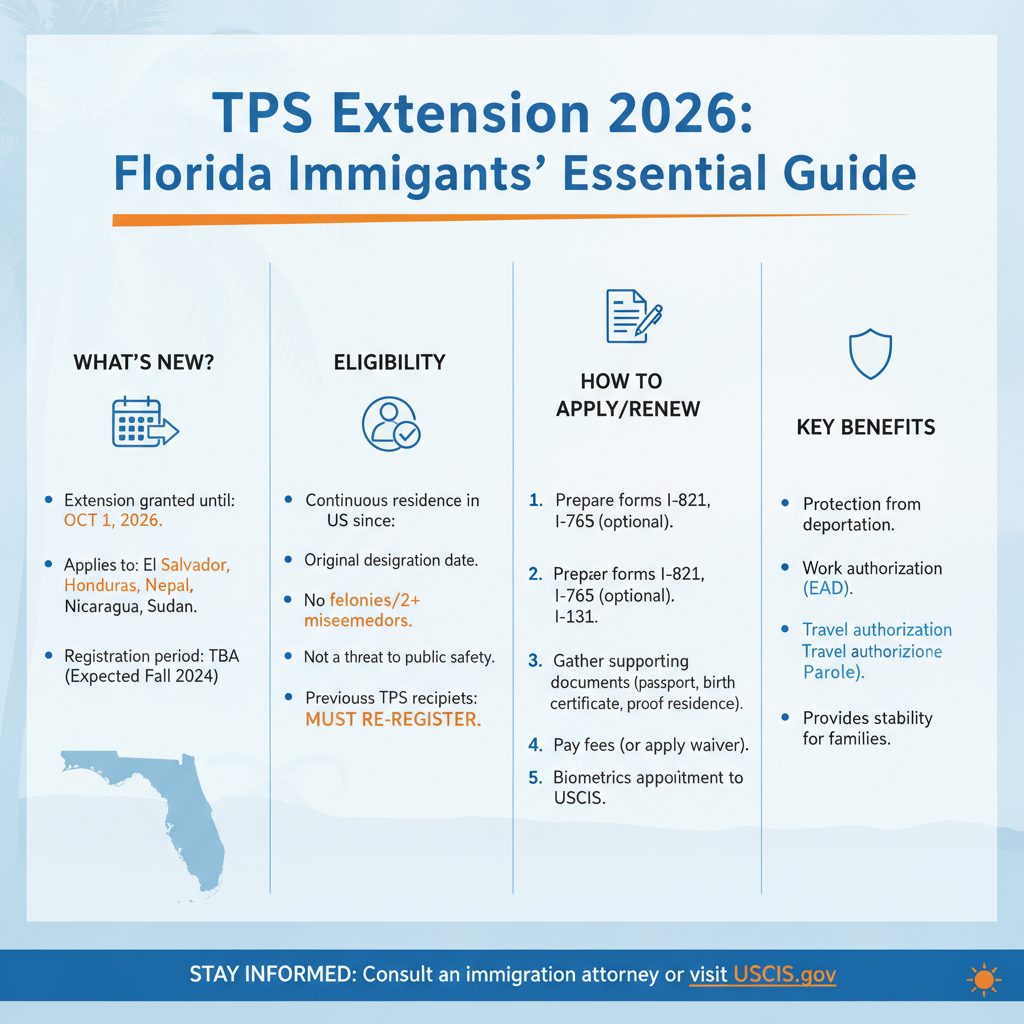
This comprehensive guide is prompted by recent developments in immigration policy and the ongoing discussions surrounding the future of humanitarian relief programs. For the latest breaking news, we monitor sources like:
TPS (Temporary Protected Status) Extension News (Legal News)
Staying abreast of these announcements is key to protecting your status.
What This News Means for Immigrants in Orlando and Across Florida
The recent news of TPS extensions for various designated countries is a lifeline for thousands of individuals and families. These extensions provide continued protection from deportation and the ability to live and work legally in the United States for an additional period. For those who have built lives here, particularly in vibrant communities like Orlando and throughout Florida, this news offers stability and the opportunity to plan for the future without the immediate threat of removal.
Why this news is showing up now
TPS is a temporary status granted to eligible nationals of certain countries who are already in the U.S. when their home country experiences conditions that make it unsafe for them to return. These conditions can include ongoing armed conflict, environmental disasters (like earthquakes or hurricanes), or other extraordinary and temporary circumstances. The Secretary of Homeland Security (DHS) is responsible for designating countries for TPS and for extending or terminating these designations based on an assessment of country conditions.
The reason this news is surfacing now, in late 2026, is due to the cyclical nature of TPS designations. Most designations are for periods of 6, 12, or 18 months. As these periods approach their expiration, DHS must review the conditions in the designated countries. If the conditions persist, the Secretary may choose to extend the designation, allowing current TPS holders to re-register and maintain their status. This continuous review and decision-making process is what drives the periodic announcements of extensions or, in some cases, terminations.
For many countries, the underlying conditions that led to their initial TPS designation have unfortunately not fully resolved. Therefore, extensions are a common outcome, reflecting the ongoing commitment to humanitarian protection for those unable to safely return home.
How it can affect Florida residents
Florida is home to a significant immigrant population, including many individuals from countries currently designated for TPS. For residents across the state, from Miami to Tampa to Jacksonville, and especially here in Central Florida, including Orlando, these extensions have profound implications:
- Continued Protection: If your country's TPS designation has been extended, you will continue to be protected from deportation and will be authorized to work in the U.S. This provides immense relief and stability for you and your family.
- Work Authorization: An extension typically comes with an automatic extension of your Employment Authorization Document (EAD) or the opportunity to apply for a new one. This is critical for maintaining employment and supporting your family.
- Travel Authorization: With an extended TPS, you may be eligible to apply for travel authorization (Advance Parole), allowing you to travel outside the U.S. and return legally.
- Planning and Stability: For families, an extension means children can continue their education in Florida schools, parents can maintain their jobs, and families can remain together, contributing to our local economy and communities. The "Keep Families Together" mission of Imigrar resonates deeply with the impact of these extensions.
- Need for Re-registration: Important: An extension does not automatically renew your status. You must re-register within the specified window to maintain your TPS and work authorization. Failing to do so can lead to loss of status.
For Central Florida residents, particularly those who interact with the Orlando USCIS Field Office, understanding these updates is critical. The Orlando community thrives on its diversity, and TPS holders are an integral part of its fabric. Ensuring they can continue to live and work here legally is vital for our region's well-being.
Need Help Navigating TPS Extensions? Our Orlando immigration team at Imigrar is ready to assist. Call +1 786-791-3106 for a free consultation to understand how recent TPS news affects you, or message us online. Se Habla Español.
What Temporary Protected Status (TPS) Is (and Why It Matters)
Temporary Protected Status (TPS) is a humanitarian immigration benefit that allows eligible individuals from certain countries experiencing extreme conditions to live and work in the United States temporarily. It is a vital program designed to protect foreign nationals when it is deemed unsafe for them to return to their home countries.
A plain-English definition
Think of TPS as a temporary pause button for deportation. If you're from a country that the U.S. government has designated for TPS, and you meet certain eligibility rules, you can stay in the U.S. legally, get a work permit, and even travel abroad and return, all without fear of being sent back to dangerous conditions in your home country. It's "temporary" because it's reviewed periodically, and it's "protected" because it shields you from deportation. It's not a path to a Green Card or citizenship on its own, but it offers crucial stability and safety.
Key terms you need to know
- Designated Country: A country whose nationals are eligible for TPS due to ongoing armed conflict, environmental disaster, or other extraordinary and temporary conditions. The Secretary of Homeland Security makes this designation. Examples include El Salvador, Haiti, Honduras, Nepal, Nicaragua, Somalia, South Sudan, Sudan, Syria, Ukraine, Venezuela, and Yemen, among others, though specific designations and extensions vary.
- Initial Registration: The first time an individual applies for TPS after their country has been designated. There is a specific registration period for this.
- Re-registration: The process by which individuals who already have TPS apply to extend their status when their country's designation is extended. This is typically done within a specific re-registration window.
- Employment Authorization Document (EAD): Often referred to as a "work permit," this document allows TPS beneficiaries to legally work in the U.S. It's typically issued on Form I-766.
- Travel Authorization (Advance Parole): A document that allows a TPS beneficiary to travel outside the U.S. and be admitted back into the U.S. upon return, without jeopardizing their TPS. This is applied for using Form I-131, Application for Travel Document.
- USCIS: The U.S. Citizenship and Immigration Services, the government agency responsible for processing TPS applications.
- Immigration and Nationality Act (INA): The body of law that governs immigration to the United States. TPS is authorized under Section 244 of the INA.
Understanding these terms is fundamental to navigating the TPS process effectively and ensuring you maintain your protected status.
Current Immigration Law: The Foundation of TPS
Temporary Protected Status is a statutory benefit authorized by Section 244 of the Immigration and Nationality Act (INA), 8 U.S.C. § 1254a. This law grants the Secretary of Homeland Security the authority to designate a foreign country for TPS if certain conditions are met. These conditions generally fall into three categories:
- Ongoing armed conflict within the state, posing a serious threat to the personal safety of returning nationals.
- An environmental disaster resulting in a substantial, but temporary, disruption of living conditions, and the foreign state is unable to handle the return of its nationals adequately.
- Other extraordinary and temporary conditions in the foreign state that prevent nationals from safely returning.
Once a country is designated, eligible individuals who are already present in the U.S. can apply for TPS. The designation period can be for 6, 12, or 18 months and is subject to review and extension based on prevailing country conditions.
Federal requirements for TPS eligibility
To be eligible for TPS, individuals must meet several federal requirements established by the INA and USCIS regulations:
- Nationality: Be a national of a country designated for TPS, or a person without nationality who last habitually resided in that country.
- Continuous Physical Presence (CPP): Have been continuously physically present in the U.S. since the effective date of the most recent designation for your country.
- Continuous Residence (CR): Have been continuously residing in the U.S. since the date specified for your country's designation. Brief, casual, and innocent departures do not break CR.
- Timely Application: Apply for TPS during the initial registration period or during any subsequent re-registration period. There are limited exceptions for late initial registration.
- Admissibility: Meet certain admissibility requirements. Generally, applicants must not have been convicted of any felony or two or more misdemeanors committed in the U.S. They must also not be found inadmissible under certain grounds of the INA (e.g., security-related grounds, drug trafficking).
- No Ineligibility Bars: Not be subject to certain mandatory bars to TPS, such as participating in the persecution of others, or engaging in terrorist activity.
Reminder: Each TPS designation and extension notice contains specific dates for CPP and CR, as well as the re-registration window. It is crucial to check the most recent Federal Register notice for your specific country.
Florida-specific considerations
While TPS is a federal immigration program and there are no Florida-specific laws governing eligibility or application, residing in Florida does have practical considerations for TPS applicants:
- USCIS Field Offices: Applicants in Florida, particularly those in Central Florida, will typically interact with the Orlando USCIS Field Office for biometrics appointments. Other field offices in the state include Miami and Tampa.
- Legal Support: Access to experienced immigration attorneys in Florida, like Imigrar in Orlando, is crucial for navigating the application process, especially given the state's diverse immigrant communities.
- Community Resources: Florida has numerous community organizations that may offer assistance or resources to TPS holders, from language support to social services.
- State ID/Driver's License: TPS beneficiaries in Florida can obtain a Florida driver's license or state identification card, which is tied to the validity of their EAD. Maintaining valid TPS and EAD is essential for renewing these state-issued documents.
- Educational Opportunities: TPS holders in Florida have access to public education, and their status can be a factor in determining eligibility for in-state tuition at public colleges and universities, though specific policies vary.
Understanding these practical aspects, alongside the federal legal framework, helps ensure a smoother process for Florida residents seeking or maintaining TPS.
For official information and forms, always refer to the USCIS official website.
Confused by TPS Regulations? Let Imigrar's expert team clarify the law for you. Our Orlando immigration lawyers provide free consultations to help you understand your rights and options. Call us at +1 786-791-3106 or contact us online. Se Habla Español.
How to Re-register for TPS: A Complete Step-by-Step Guide
If your country's TPS designation has been extended, you must re-register during the designated period to maintain your status. This process is critical, and missing the deadline can lead to the loss of your protection. Here’s a detailed step-by-step guide:
1) Determine Your Re-registration Eligibility and Window
The first and most critical step is to confirm that your country's TPS designation has indeed been extended and to identify the specific re-registration period. USCIS publishes a Federal Register notice for each country's designation or extension, which outlines these crucial dates.
- Check the Federal Register Notice: Visit the USCIS Forms page and search for your country's TPS notice. This document will specify the start and end dates of the re-registration window.
- Confirm Continuous Physical Presence (CPP) and Continuous Residence (CR) Dates: Ensure you have met the CPP and CR requirements as specified in the most recent Federal Register notice for your country.
- Review Eligibility: Reconfirm that you have not become ineligible for TPS since your last application (e.g., through new felony convictions or two or more misdemeanors).
Warning: Re-registration windows are strict, typically 60 days. Missing this window without good cause can result in denial.
2) Gather All Required Documents
Even for re-registration, it's essential to have your documents in order. While you may not need to resubmit all initial evidence, having it readily available is good practice.
- Proof of Identity and Nationality:
- Passport or national identity document from your designated country.
- Birth certificate with photo identification.
- Any previous TPS approval notices (Form I-797).
- Proof of Residence in the U.S.:
- Utility bills (electric, water, gas) showing your name and address in Florida.
- Rental agreements or mortgage statements.
- Bank statements.
- Employment records or pay stubs.
- School records for children.
- Proof of Continuous Physical Presence (CPP):
- Records showing your presence in the U.S. since the required date (e.g., entry stamps, school records, employment records, medical records).
- Previous EAD and Approval Notices: Your most recent Employment Authorization Document (EAD) and TPS approval notice.
- Marriage Certificates/Birth Certificates: If applying for family members or if your name has changed.
- Court Dispositions: If you have had any arrests or convictions since your last TPS application.
Tip: Create a checklist and make copies of everything you send to USCIS. Keep originals safe.
3) Complete and Prepare Your Forms
For re-registration, you will primarily need to submit two forms:
- Form I-821, Application for Temporary Protected Status:
- Complete all sections accurately and truthfully.
- Ensure your personal information matches your previous applications.
- Indicate that you are re-registering for TPS.
- Form I-765, Application for Employment Authorization:
- If you wish to continue working legally, you must apply for a new EAD.
- Select category (c)(10) for TPS.
- Ensure the validity period requested aligns with the TPS extension.
- Form I-601, Application for Waiver of Grounds of Inadmissibility (if applicable): If you have any new grounds of inadmissibility that arose since your initial TPS grant.
- Form I-912, Request for Fee Waiver (if applicable): If you cannot afford the filing fees.
Important: USCIS often issues an automatic extension of existing EADs for a specific period (e.g., 180 or 540 days) for re-registrants. Check the Federal Register notice for your country to see if this applies to you. Even with an automatic extension, you must still re-register.
4) Pay the Required Fees (or Request a Waiver)
There are fees associated with Form I-821 and Form I-765. For re-registrants, the Form I-821 fee is often waived, but the Form I-765 fee (for the EAD) and the biometrics fee are typically required.
- Check Current Fees: Refer to the USCIS Forms page for the most up-to-date fees. Fees can change.
- Payment Method: Pay with a money order, personal check, cashier's check, or by credit card using Form G-1450, Authorization for Credit Card Transactions.
- Fee Waiver: If you cannot afford the fees, you may apply for a fee waiver using Form I-912, Request for Fee Waiver. You must provide documentation proving your inability to pay (e.g., proof of receiving a means-tested benefit, household income below 150% of federal poverty guidelines, financial hardship).
Warning: Incorrect fees or improperly filed fee waiver requests can lead to rejection or significant delays.
5) Mail Your Application Package to the Correct USCIS Lockbox Facility
Once all forms are complete, signed, and fees/waiver requests are prepared, assemble your application package.
- Review Instructions: Carefully read the "Where to File" section of the Form I-821 instructions. The filing address depends on your mailing address and the type of service you are using (U.S. Postal Service vs. courier).
- Assemble Package: Organize your application neatly. Place the check/money order or Form G-1450 on top, followed by Form I-821, then Form I-765, and finally all supporting documents. If applicable, include Form I-912 and its evidence.
- Send with Tracking: Always send your application via certified mail with a return receipt or a courier service that provides tracking (e.g., FedEx, UPS). This provides proof of mailing and delivery.
Reminder: Ensure your mailing address is accurate, especially if you have moved. If you move after filing, update your address with USCIS using Form AR-11, Alien's Change of Address Card, and through your online USCIS account if you have one.
6) Attend Your Biometrics Appointment
After USCIS receives your application, they will send you a receipt notice (Form I-797C). Subsequently, you will receive an appointment notice (Form I-797C) for a biometrics (fingerprints, photograph, signature) appointment at an Application Support Center (ASC).
- Do Not Miss It: It is crucial to attend this appointment. Failing to do so can lead to denial of your application.
- Bring Required Documents: Bring your appointment notice, a valid photo ID (e.g., passport, state ID), and any other documents requested in the notice.
- Florida Locations: For those in Orlando, your appointment will likely be at the Orlando ASC.
Important: Biometrics collection is a standard security check and is usually quick. No legal questions are typically asked at this appointment.
7) Receive Your Decision and EAD
After your biometrics are processed, USCIS will adjudicate your application. Processing times can vary significantly. You can check current processing times on the USCIS Processing Times page.
- Approval Notice: If approved, you will receive an approval notice for your TPS (Form I-797).
- New EAD: If you applied for an EAD, you will receive a new Employment Authorization Document (Form I-766) valid through the new TPS expiration date.
- Denial: If your application is denied, you will receive a denial letter explaining the reasons. You may have options to appeal or refile (see FAQ section).
Reminder: Keep all approval notices and your EAD in a safe place. These are vital documents proving your authorized stay and work eligibility in the U.S.
Practical Steps You Can Take Today for TPS
The news of TPS extensions should prompt immediate action to secure your status. Don't wait until the last minute!
Actionable Checklist (5+ items):
- Verify Your Country's Status: Immediately check the official USCIS website or Federal Register notices to confirm if your country's TPS designation has been extended and what the new re-registration window is.
- Review Your Eligibility: Reconfirm that you still meet all TPS eligibility criteria. Have there been any changes to your criminal record or travel history since your last application?
- Locate All Past TPS Documents: Gather your previous TPS approval notices, EADs, and copies of past applications. These will be invaluable for consistent information.
- Update Your Address with USCIS: If you've moved since your last application (especially if you moved to or within Florida), file Form AR-11, Alien's Change of Address Card, online or by mail, and update your address through your USCIS online account if you have one. This ensures you receive all notices.
- Start Gathering Supporting Documents: Begin collecting any necessary identity documents, proof of residence, and evidence of continuous presence in the U.S. (e.g., utility bills, pay stubs, school records).
- Budget for Fees: If you anticipate paying the fees, start setting aside funds. If you plan to request a fee waiver, begin compiling the necessary financial documentation.
- Consult an Immigration Attorney: Even if you've re-registered before, an attorney can review your specific situation, ensure accuracy, and identify any potential issues or additional relief options. This is especially true for complex cases or if you've had changes in your personal circumstances.
Document preparation guidance
- Organize: Keep all your documents in a dedicated folder. Label sections clearly.
- Copies: Always send copies of supporting documents to USCIS, not originals, unless specifically requested. Keep your originals safe.
- Translations: Any document not in English must be accompanied by a complete and certified English translation and a certification by the translator.
- Legibility: Ensure all copies are clear and legible.
- Consistency: Make sure names, dates of birth, and other identifying information are consistent across all documents and forms.
Timeline expectations
- Re-registration Window: This is typically a 60-day window. It is essential to file your application within this period.
- Receipt Notice: You should receive a receipt notice (Form I-797C) from USCIS within 2-4 weeks after they receive your application.
- Biometrics Appointment: A biometrics appointment notice usually arrives 4-8 weeks after your application is filed. The appointment itself will follow shortly after.
- Processing Time: TPS re-registration and EAD processing times can vary significantly. Some cases are processed within a few months, while others can take 6-12 months or longer, especially if there are backlogs. Check the USCIS Processing Times page for estimates.
- EAD Automatic Extensions: Many TPS extensions come with an automatic extension of existing EADs for a certain period (e.g., 180 or 540 days) for timely re-registrants. This allows you to continue working while your new EAD application is pending. Always check the official Federal Register notice for your country to confirm this and understand the specific dates.
Important: Proactive preparation is your best strategy. Do not wait for the re-registration window to open to start gathering your documents and seeking legal advice.
How Imigrar Helps Immigrants in Orlando
Related Topics
Need Legal Assistance?
Our experienced immigration attorneys are here to help with your case. Contact Imigrar today for a free consultation and let us guide you through the legal process with confidence.
📍 Orlando, Florida • Serving clients nationwide
📧 info@imigrar.com