
Family-Based Green Card Petitions: Your 2026 Orlando Guide
Navigate family-based immigration petitions with our 2026 guide. Imigrar helps Orlando families reunite. Learn eligibility, forms, and timelines. Se Habla Español.

At Imigrar, we understand that nothing is more important than keeping families together. For many, the dream of living legally in the United States begins with a family-based immigration petition. This process, while offering a clear path to reunification, can often seem daunting and complex. That's why we've compiled this comprehensive guide to help you understand every step.
Need Help? Our Orlando immigration team is ready to assist. Call +1 786-791-3106 for a free consultation, or message us online. Se Habla Español.
The reporting that sparked this guide
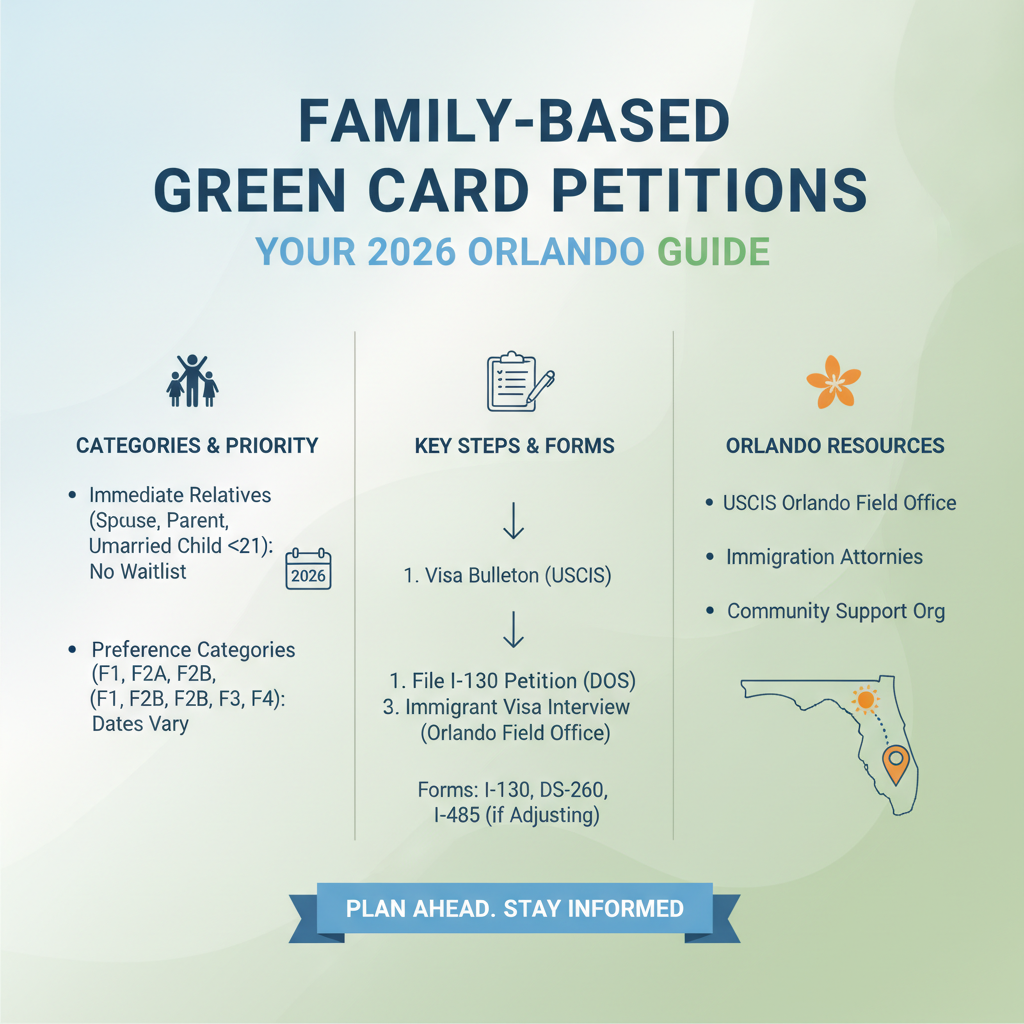
The ongoing discussion and interest in family reunification pathways in the U.S. immigration system consistently highlight the need for clear, accessible information. Reports on immigration trends and policy discussions frequently underscore the importance of family-based petitions as a cornerstone of U.S. immigration law. This guide is inspired by the continuous public and professional interest in these vital processes, as seen in general immigration news and discussions:
Family-Based Immigration Petition Guide (Immigration)
What This News Means for Immigrants in Orlando and Across Florida
The consistent focus on family-based immigration in news and policy discussions is a perennial topic because it represents the primary pathway for many individuals to immigrate to the United States. As of September 29, 2026, the underlying principles and processes for family petitions remain a critical component of U.S. immigration policy, impacting millions of lives nationwide and specifically within the vibrant immigrant communities of Florida.
Why this news is showing up now
Family-based immigration is not a new or fleeting topic; it's a foundational element of the U.S. immigration system established decades ago. Its prominence in news and legal discussions today reflects several factors:
- Ongoing Demand: There's a perpetual and high demand for family reunification. Millions of U.S. citizens and lawful permanent residents (LPRs) wish to bring their close relatives to live with them in the United States. This constant demand ensures the topic remains relevant.
- Policy Debates: While the core laws are stable, there are always discussions and proposals regarding potential reforms, processing efficiencies, and backlog reductions. These debates keep the spotlight on how family petitions are processed and their impact.
- Processing Backlogs: Many family preference categories face significant backlogs, leading to long waiting times. Updates on these backlogs, visa bulletin movements, and USCIS processing times are always newsworthy for affected families.
- Economic and Social Impact: Family immigration has profound economic and social impacts, contributing to labor forces, cultural diversity, and community building, making it a subject of continuous interest for media and policymakers alike.
- Technological Advancements: USCIS regularly updates its online portals, forms, and processing methods. News often surfaces around these changes, which can affect how petitioners and beneficiaries interact with the system.
How it can affect Florida residents
Florida, with its diverse population and position as a major gateway for immigrants, is profoundly affected by family-based immigration policies and processing. For residents in Orlando and across the Sunshine State:
- High Volume of Cases: Florida is home to a vast immigrant population, meaning a significant number of family-based petitions originate from or are destined for families residing here. This can sometimes lead to localized impacts on processing times at the Orlando USCIS Field Office or other service centers.
- Local USCIS Presence: The presence of a USCIS Field Office in Orlando means many interviews for Adjustment of Status (AOS) cases take place locally. Understanding local procedures and expectations is crucial for Central Florida residents.
- Community Impact: Successful family reunification strengthens Florida’s communities, contributing to its economy and cultural richness. Conversely, long delays or denials can have significant emotional and financial consequences for families in Orange County and beyond.
- Access to Legal Support: With a high concentration of immigrant families, there is also a robust network of legal support services. Firms like Imigrar specialize in guiding Florida residents through these complex processes, offering local expertise and support in both English and Spanish.
- Diversity of Cases: Florida's immigrant population includes individuals from Latin America, the Caribbean, Europe, and Asia, leading to a wide array of family petition scenarios, each with its unique considerations.
Understanding the intricacies of family-based immigration is not just theoretical; it has direct, tangible impacts on the lives of countless individuals and families building their futures here in Florida.
What Family-Based Immigration Petitions Are (and Why It Matters)
Family-based immigration petitions are the bedrock of the United States' commitment to keeping families together. They provide a pathway for U.S. citizens and lawful permanent residents (Green Card holders) to sponsor certain eligible family members to immigrate to the U.S. and obtain a Green Card, officially known as lawful permanent residence.
This process is central to the American dream for many, enabling spouses, children, parents, and siblings to reunite and build new lives together. It matters because it embodies the humanitarian principle of family unity and contributes significantly to the social and economic fabric of the nation.
A plain-English definition
Simply put, a family-based immigration petition is a formal request filed with U.S. Citizenship and Immigration Services (USCIS) by a U.S. citizen or a Green Card holder (the petitioner) on behalf of a qualifying foreign national relative (the beneficiary). The purpose of this petition is to establish a legitimate family relationship, which is the first crucial step toward the beneficiary being able to apply for a Green Card.
If approved, this petition doesn't automatically grant the beneficiary a Green Card, but it reserves a place for them in line, allowing them to eventually apply for permanent residency either within the U.S. (Adjustment of Status) or at a U.S. embassy or consulate abroad (Consular Processing).
Key terms you need to know
Navigating the immigration system requires understanding specific terminology. Here are some key terms:
- Petitioner: The U.S. citizen or lawful permanent resident who files the immigration petition on behalf of a family member.
- Beneficiary: The foreign national family member for whom the petition is filed, seeking to immigrate to the U.S.
- Immediate Relative: A special category of family members who are not subject to annual visa quotas, meaning their Green Card applications can be processed more quickly once the petition is approved. This includes spouses of U.S. citizens, unmarried children under 21 of U.S. citizens, and parents of U.S. citizens (if the U.S. citizen is at least 21 years old).
- Family Preference Categories: Other categories of family members who are subject to annual visa quotas, leading to potentially longer waiting times. These include:
- First Preference (F1): Unmarried sons and daughters (21 years of age or older) of U.S. citizens.
- Second Preference (F2): Spouses and children (unmarried and under 21) of lawful permanent residents (F2A), and unmarried sons and daughters (21 years of age or older) of lawful permanent residents (F2B).
- Third Preference (F3): Married sons and daughters of U.S. citizens.
- Fourth Preference (F4): Brothers and sisters of U.S. citizens (if the U.S. citizen is at least 21 years old).
- Priority Date: The date USCIS officially receives your properly filed Form I-130 petition. This date determines your place in the waiting line for a visa in the preference categories. For Immediate Relatives, the priority date is less critical as there's no visa quota.
- Visa Bulletin: A monthly publication by the U.S. Department of State that summarizes the availability of immigrant visas for the upcoming month. It indicates which priority dates are current for each family preference category. You can check the Visa Bulletin online.
- Adjustment of Status (AOS): The process for a foreign national already in the United States to apply for lawful permanent resident status without having to leave the country. This is typically done by filing Form I-485.
- Consular Processing: The process for a foreign national living outside the United States to apply for an immigrant visa at a U.S. Embassy or Consulate in their home country.
- Affidavit of Support (Form I-864): A legally binding document signed by the petitioner (and sometimes a joint sponsor) to promise financial support for the beneficiary, ensuring they will not become a "public charge" in the U.S.
Need Help? Our Orlando immigration team is ready to assist. Call +1 786-791-3106 for a free consultation, or message us online. Se Habla Español.
Current Immigration Law: The Foundation
Family-based immigration is governed primarily by the Immigration and Nationality Act (INA), specifically sections related to immigrant visas. The INA sets forth who can petition for whom, the categories of relatives, and the annual limits on immigrant visas for certain categories. Understanding these foundational laws is crucial for a successful petition.
Key statutes include INA § 201, which defines "immediate relatives" and sets worldwide levels for family-sponsored immigrants, and INA § 203, which establishes the family preference categories and the allocation of visas within those categories.
Federal requirements
To successfully petition for a family member, both the petitioner and the beneficiary must meet specific federal requirements:
- Petitioner Requirements:
- Must be a U.S. citizen or a lawful permanent resident (Green Card holder).
- Must be at least 18 years old to file the Form I-130 and at least 21 years old to petition for a parent or sibling.
- Must have a U.S. domicile (residence).
- Must be able to financially sponsor the beneficiary by signing an Affidavit of Support (Form I-864), demonstrating income at or above 125% of the federal poverty guidelines for their household size.
- Beneficiary Requirements:
- Must have a qualifying family relationship with the petitioner (e.g., spouse, child, parent, sibling).
- Must be admissible to the United States. This means they must not fall under any grounds of inadmissibility, such as certain criminal convictions, health issues, or previous immigration violations. Waivers may be available for some grounds of inadmissibility.
The primary forms involved in the initial petition stage are:
- Form I-130, Petition for Alien Relative: Filed by the U.S. citizen or LPR to establish the qualifying relationship.
- Form I-130A, Supplemental Information for Spouse Beneficiary: Required when petitioning for a spouse.
For those applying for a Green Card from within the U.S. (Adjustment of Status), additional forms are required:
- Form I-485, Application to Register Permanent Residence or Adjust Status: The main Green Card application.
- Form I-864, Affidavit of Support: To demonstrate financial sponsorship.
- Form I-765, Application for Employment Authorization: To request a work permit while the Green Card application is pending.
- Form I-131, Application for Travel Document: To request advance parole for travel outside the U.S. while the Green Card application is pending.
You can find all official forms and detailed instructions on the USCIS Forms page and the general USCIS official website.
Florida-specific considerations
While immigration law is federal, certain aspects can have local relevance for Florida residents:
- Orlando USCIS Field Office: If you are applying for Adjustment of Status and live in Central Florida, your interview will likely be scheduled at the Orlando USCIS Field Office. Understanding their specific procedures, parking, and security protocols can ease your experience.
- Local Legal Expertise: Florida's diverse population means immigration attorneys in Orlando, like Imigrar, have extensive experience with a wide array of family-based cases, including those with complexities common to specific communities (e.g., Cuban Adjustment Act cases, Venezuelan TPS-related adjustments).
- Accessibility: For those along the I-4 corridor or in Orange County, access to legal assistance and resources is generally good. However, finding competent, compassionate legal counsel who understands your unique situation and speaks your language (Se Habla Español) is paramount.
- State-Specific Documentation: While most required documents are federal, state-issued documents (e.g., Florida birth certificates, marriage licenses, divorce decrees) must meet specific USCIS standards for certified copies and translations.

How to Petition for a Family Member: A Complete Step-by-Step Guide
Petitioning for a family member involves a series of critical steps, each requiring careful attention to detail. This guide outlines the typical process, but remember that individual circumstances can vary significantly.
1) Determine Eligibility and Relationship Category
The very first step is to confirm that both the petitioner and the beneficiary meet the fundamental eligibility requirements and to identify the correct family preference category. This dictates the forms, required documents, and most importantly, the waiting time.
- Petitioner's Status: Are you a U.S. citizen or a lawful permanent resident (Green Card holder)? Your status determines who you can petition for. For example, only U.S. citizens can petition for parents or married adult children.
- Relationship Type: Accurately identify the relationship (spouse, child, parent, sibling). This will place the beneficiary into either the Immediate Relative category or one of the Family Preference Categories.
- Immediate Relatives (IR): Spouses of U.S. citizens, unmarried children under 21 of U.S. citizens, and parents of U.S. citizens (if the U.S. citizen is 21 or older). These categories do not have visa quotas, meaning once the petition is approved, a visa is generally immediately available.
- Family Preference Categories (F1, F2A, F2B, F3, F4): These are subject to annual limits, resulting in potentially long waiting lists based on the beneficiary's country of birth.
- Documents for Eligibility:
- Petitioner's Proof of Status: U.S. birth certificate, U.S. passport, Certificate of Naturalization, Certificate of Citizenship (for U.S. citizens); Green Card (Form I-551) for LPRs.
- Proof of Relationship:
- For Spouse: Marriage certificate, joint financial documents (bank statements, tax returns), utility bills, lease agreements, photos, affidavits from friends/family attesting to the bona fide marriage. Previous divorce decrees or death certificates for any prior marriages of either spouse.
- For Child: Child's birth certificate showing both parents' names, parents' marriage certificate (if applicable). For stepchildren, parents' marriage certificate showing the marriage occurred before the child turned 18. For adopted children, adoption decree.
- For Parent: Petitioner's birth certificate showing parent's name, parents' marriage certificate (if applicable).
- For Sibling: Petitioner's birth certificate and sibling's birth certificate showing common parent(s), parents' marriage certificate (if applicable).
- Translations: Any document not in English must be accompanied by a complete and certified English translation.
2) File Form I-130, Petition for Alien Relative
Once eligibility is confirmed, the petitioner files Form I-130 with USCIS. This form formally requests the U.S. government to recognize the qualifying family relationship.
- Purpose: To establish the legal relationship between the petitioner and the beneficiary.
- Who Files: The U.S. citizen or lawful permanent resident (the petitioner).
- Where to File: Generally filed with a USCIS Lockbox facility. The specific address depends on where you live and whether you are filing other forms concurrently (e.g., Form I-485). Always check the USCIS website for current filing addresses.
- Fees: As of today's date (September 29, 2026), the filing fee for Form I-130 is typically $535. Fees can change, so always verify the latest amount on the USCIS website.
- Required Documents for Form I-130:
- Completed and signed Form I-130 and Form I-130A (if applicable).
- Copy of petitioner's proof of U.S. citizenship or LPR status (e.g., U.S. passport bio page, birth certificate, Green Card front and back).
- Copy of beneficiary's birth certificate.
- Copy of marriage certificate (for spouse petitions).
- Copy of divorce decrees or death certificates for any prior marriages of petitioner and/or beneficiary.
- Passport-style photos for both petitioner and beneficiary (check specific requirements for size and background).
- Any other evidence proving the bona fide relationship (e.g., joint bank statements, utility bills, photos together, affidavits).
- Payment for the filing fee (check, money order, or credit card via Form G-1450).
Important: Make sure to keep a complete copy of everything you submit to USCIS for your records.
3) Wait for I-130 Approval and Priority Date
After filing, USCIS will send a receipt notice (Form I-797C) confirming they received your petition. This notice will contain your Priority Date. For Immediate Relatives, a visa is generally available immediately upon I-130 approval. For Family Preference Categories, the Priority Date is crucial.
- Processing Times: USCIS processing times vary significantly by form and service center. You can check current estimates on the USCIS Processing Times page. Be prepared for potential delays.
- Visa Bulletin: If your beneficiary is in a Family Preference Category, you must regularly monitor the U.S. Department of State Visa Bulletin. This monthly publication indicates when your Priority Date becomes "current," meaning an immigrant visa number is available for your beneficiary.
- I-130 Approval: Once USCIS approves your Form I-130, you will receive an approval notice (Form I-797). For Immediate Relatives, this often means the beneficiary can proceed directly to the Green Card application stage. For preference categories, it means waiting for the Priority Date to become current.
4) Apply for Green Card: Adjustment of Status or Consular Processing
Once the Form I-130 is approved and an immigrant visa is available (either immediately for IRs or when the Priority Date is current for preference categories), the beneficiary can apply for their Green Card.
The method of application depends on whether the beneficiary is currently in the United States or abroad.
Option A: Adjustment of Status (for beneficiaries in the U.S.)
If the beneficiary is physically present in the U.S. and entered legally, they may be eligible to apply for Adjustment of Status. For Immediate Relatives, the I-130 and I-485 can often be filed concurrently. For preference categories, the I-485 can only be filed when the Priority Date is current (check the "Dates for Filing" and "Final Action Dates" charts in the Visa Bulletin).
- Main Forms to File:
- Form I-485, Application to Register Permanent Residence
Related Topics
Need Legal Assistance?
Our experienced immigration attorneys are here to help with your case. Contact Imigrar today for a free consultation and let us guide you through the legal process with confidence.
📍 Orlando, Florida • Serving clients nationwide
📧 info@imigrar.com