
Prepare Now: 2026 Naturalization Test Changes Explained for US
Major changes to the US Naturalization Test are coming in 2026. Understand the new civics test questions, requirements, and how to prepare for US citizenship with Imigrar's expert guide for Florida residents.

What This News Means for Immigrants in Orlando and Across Florida
For millions of immigrants across the United States, obtaining U.S. citizenship through naturalization is the culmination of years of hard work, dedication, and a commitment to building a new life. It represents not just a legal status, but full integration into the fabric of American society, granting rights and responsibilities that are deeply cherished. As of September 30, 2026, news of upcoming changes to the Naturalization Test in 2026 is creating a buzz and, for many, a sense of urgency and perhaps some anxiety. At Imigrar, we believe in keeping families together and empowering our community with accurate, timely information. This comprehensive guide is designed to clarify these impending changes, help you understand their implications, and provide a clear path forward.Why this news is showing up now
The United States Citizenship and Immigration Services (USCIS) regularly reviews and updates its processes and requirements to ensure they remain relevant and effective. The Naturalization Test, a crucial component of the citizenship application, has seen revisions in the past, most notably in 2008 and then again with temporary changes in 2020 that were later reversed. These upcoming 2026 changes are part of USCIS's ongoing commitment to ensuring that prospective citizens have a foundational understanding of American history, government, and civic principles. The current discussions and announcements regarding the 2026 changes stem from USCIS’s continuous evaluation of the naturalization process. Agencies often announce significant policy changes well in advance to allow applicants, legal representatives, and educational institutions time to prepare. Given that it is already late 2026, these changes are likely either imminent – perhaps scheduled for implementation in late 2026 or early 2027 – or have just begun to be phased in. The goal is often to modernize the test, improve its effectiveness, and sometimes to align it with current educational best practices. While the exact scope and nature of every single change might still be under refinement, the core message is clear: **preparation will be key**.How it can affect Florida residents
Florida is home to one of the largest and most diverse immigrant populations in the nation, with vibrant communities in Orlando, Miami, Tampa, and across the state. For Central Florida residents, particularly those along the bustling I-4 corridor and in Orange County, the Orlando USCIS Field Office is a central point for naturalization interviews. Any changes to the Naturalization Test directly impact thousands of individuals and families here. * **Increased Preparation Time:** If the new test format or questions are more complex, applicants in Florida will need to dedicate more time and resources to studying. * **Access to Resources:** The availability of study materials, particularly in languages like Spanish (Se Habla Español), will be critical. Imigrar is committed to providing these resources. * **Impact on Current Applicants:** Those who have already filed their Form N-400 but have not yet had their interview may wonder if they will face the new test. USCIS typically provides a clear cutoff date, and it’s essential to understand where your application stands. * **Demand for Legal Guidance:** The complexity of new requirements often increases the need for expert legal advice. Our Orlando immigration team anticipates a surge in inquiries as residents seek clarity and professional assistance to navigate these updates.Need Help Navigating Naturalization Changes? Our Orlando immigration team is ready to assist. Call +1 786-791-3106 for a free consultation, or message us online. Se Habla Español.
What Naturalization Test Changes Are (and Why They Matter)
The naturalization process culminates in becoming a U.S. citizen, granting rights such as voting, holding federal office, and the ability to sponsor more family members. The Naturalization Test is a fundamental part of this journey, designed to assess an applicant's proficiency in English and their knowledge of U.S. civics. Changes to this test are significant because they directly impact the requirements and preparation needed for aspiring citizens.A plain-English definition
Naturalization is the process by which a lawful permanent resident (Green Card holder) voluntarily becomes a U.S. citizen. The Naturalization Test is the examination administered by USCIS during the naturalization interview. It has two main components: 1. **English Test:** Assesses your ability to read, write, and speak basic English. 2. **Civics Test:** Assesses your knowledge and understanding of U.S. history, government, and civics. The "changes coming in 2026" refer specifically to modifications in the format, content, or administration of one or both of these test components, with the civics test often being the primary focus of revisions. These changes matter because they alter the specific knowledge and skills applicants must demonstrate to pass the test and become citizens. They are not merely administrative tweaks; they can influence how you study, what materials you use, and how you approach your interview.Key terms you need to know
Understanding the terminology is crucial when discussing naturalization and its associated changes: * **Naturalization:** The process by which a foreign citizen or national becomes a U.S. citizen. * **U.S. Citizenship and Immigration Services (USCIS):** The federal agency within the Department of Homeland Security that oversees lawful immigration to the United States. They administer the Naturalization Test. * **Lawful Permanent Resident (LPR):** An individual who has been granted the privilege of residing permanently in the U.S. (also known as a Green Card holder). LPRs are generally eligible to apply for naturalization after meeting certain residency requirements. * **Form N-400, Application for Naturalization:** The official form used to apply for U.S. citizenship. * **Civics Test:** The portion of the naturalization interview that tests an applicant's knowledge of U.S. history and government. The 2026 changes primarily focus on this section. * **English Test:** The portion of the naturalization interview that assesses an applicant's ability to read, write, and speak English. This includes understanding and answering questions during the interview. * **Good Moral Character:** A legal requirement for naturalization, meaning the applicant has adhered to societal standards of morality and has not committed certain crimes or offenses during their residency period. * **Oath of Allegiance:** The final step in the naturalization process, where an applicant formally pledges loyalty to the United States. * **Exemptions:** Specific conditions (e.g., age, disability) that may excuse an applicant from certain parts of the English or Civics tests. * **Reasonable Accommodations:** Modifications made during the interview or test for individuals with disabilities, ensuring they have an equal opportunity to participate. These terms form the bedrock of the naturalization process. When changes are announced, they often relate to how these requirements are assessed or what specific knowledge falls under the "Civics Test" umbrella. The goal of USCIS is to ensure that future citizens are well-versed in the principles that govern their new nation.Current Immigration Law: The Foundation for Naturalization
The process of naturalization is governed by federal law, primarily the Immigration and Nationality Act (INA), specifically sections 310 through 347. While the test questions may change, the fundamental legal requirements for eligibility remain the same. Understanding this legal framework is crucial for any applicant.Federal requirements
To be eligible for naturalization, an applicant must meet several statutory requirements outlined in the INA. These are consistent nationwide, whether you're applying in Orlando or anywhere else: * **Age:** Be at least 18 years old at the time of filing Form N-400. * **Lawful Permanent Resident Status:** Be a lawful permanent resident (Green Card holder) for at least 5 years (or 3 years if married to a U.S. citizen and meet other requirements). * **Continuous Residence:** Have resided continuously in the U.S. for at least 5 years (or 3 years) immediately preceding the date of filing the application. This means no single trip outside the U.S. of 6 months or more, with some exceptions. * **Physical Presence:** Have been physically present in the U.S. for at least half of the required continuous residency period (e.g., 30 months out of 5 years, or 18 months out of 3 years). * **Residence in USCIS District/State:** Have resided for at least 3 months in the state or USCIS district where you file your application. For those in Central Florida, this means residing in Florida for at least 3 months before filing. * **Good Moral Character:** Demonstrate good moral character for the statutory period (5 or 3 years) leading up to the application and until the Oath of Allegiance. This is a broad requirement that considers an applicant's criminal history, financial obligations (like taxes and child support), and honesty. * **Attachment to the Principles of the U.S. Constitution:** Be willing to support and defend the U.S. Constitution and laws, and be willing to take the Oath of Allegiance. * **English Language Proficiency:** Be able to read, write, and speak basic English. There are specific exemptions for age and length of residency (e.g., 50 years old + 20 years LPR, or 55 years old + 15 years LPR). * **Civics Knowledge:** Have a basic understanding of U.S. history and government. This is the area where the 2026 changes are most impactful. These requirements are non-negotiable and form the bedrock of any naturalization application. Even with changes to the test, meeting these core criteria is paramount.Florida-specific considerations
While naturalization is a federal process, local factors can influence the experience. For applicants in Orlando and across Florida: * **Orlando USCIS Field Office:** Your interview will likely be scheduled at the Orlando Field Office, located at 6680 Corporate Centre Blvd, Orlando, FL 32822. Familiarity with this office's procedures and typical interview environment can be beneficial. * **Processing Times:** Processing times can vary significantly by field office and application type. You can check current processing times for the Orlando office and Form N-400 on the official USCIS Processing Times website. * **Community Resources:** Florida has numerous non-profit organizations and community centers that offer English classes and civics preparation courses. However, with the upcoming changes, it's crucial to ensure these resources are updated with the latest information. * **Legal Expertise:** Given Florida's diverse population, finding legal counsel that understands the nuances of various cultural backgrounds and speaks multiple languages (like Imigrar, which offers Se Habla Español) can be a significant advantage. Our firm regularly assists clients from Orange County, Seminole County, Osceola County, and beyond, navigating their naturalization journeys. **Important:** Always refer to the USCIS official website for the most current information regarding forms, fees, and policy updates, especially concerning the 2026 Naturalization Test changes.Confused by the Law? Imigrar helps clients nationwide understand complex immigration laws. For personalized guidance on naturalization in Orlando, call +1 786-791-3106 for a free consultation. Se Habla Español.

How to Navigate the Naturalization Process (with Upcoming Changes in Mind): A Complete Step-by-Step Guide
Applying for U.S. citizenship is a multi-step process that requires careful attention to detail. With the impending Naturalization Test changes in 2026, it's more important than ever to be thoroughly prepared. This guide walks you through each step, highlighting areas where the new test might affect your preparation.1) Determine Your Eligibility
The very first step is to confirm you meet all the federal eligibility requirements. This includes age, lawful permanent residency status, continuous residence, physical presence, good moral character, and attachment to the Constitution. * **Detailed Explanation:** Review your Green Card to confirm your status and the date you became a lawful permanent resident. Calculate your continuous residence and physical presence to ensure you meet the 5-year or 3-year requirement. For continuous residence, generally, trips outside the U.S. of less than 6 months do not break continuity, but trips of 6-12 months may, and trips over 1 year almost always do. For physical presence, you must be in the U.S. for at least half of the statutory period. * **Good Moral Character:** This is a subjective but critical area. Any arrests, convictions, significant traffic violations (DUI, reckless driving), failure to pay child support, or tax evasion can jeopardize your application. It's crucial to disclose everything. If you have any concerns about your good moral character, consult an attorney immediately. * **English/Civics Exemptions:** Evaluate if you qualify for any exemptions based on age and length of LPR status (e.g., the "50/20 rule" or "55/15 rule") or a medical disability. If you qualify for a medical exemption, you will need Form N-648, Medical Certification for Disability Exceptions, completed by a licensed medical professional. * **Required Documents:** * Your Green Card (Form I-551) * Passports and travel records (entry/exit stamps, visas) * Marriage certificate (if applying under the 3-year rule) * Divorce decrees or death certificates (if applicable) * Birth certificates of children (if applicable) * Any relevant criminal court documents, arrest records, or police reports (even if charges were dismissed or expunged) * Tax transcripts from the IRS for the past 5 years (or 3 years) * Form N-648 (if applying for a medical exemption)2) Prepare and File Form N-400, Application for Naturalization
Once you've confirmed eligibility, the next step is to accurately complete and submit Form N-400. This form is extensive and requires detailed personal, family, employment, and travel history. * **Detailed Explanation:** Every question on Form N-400 must be answered truthfully and completely. Incomplete or inaccurate answers can lead to delays, Requests for Evidence (RFEs), or even denial. Pay close attention to sections on travel history, employment, marital history, and questions about your "good moral character." For example, if you've ever been arrested, even if the case was dismissed, you *must* disclose it. USCIS performs thorough background checks. Ensure you use the most current version of the form from the USCIS Forms page. * **Required Documents (Copies to submit with N-400):** * Copy of your Green Card (front and back) * Copies of marriage certificates, divorce decrees, death certificates (if applicable) * Copies of court disposition documents for any arrests or convictions (even minor ones) * Two passport-style photos (if required by instructions - check current N-400 instructions carefully) * Proof of selective service registration (for males 18-26) * Any name change documents (if applicable) * A check or money order for the filing fee (and biometric services fee, if separate) made payable to "U.S. Department of Homeland Security." Fee waivers (Form I-912) may be available for eligible applicants.3) Attend Your Biometrics Appointment
After USCIS accepts your Form N-400, you will receive an appointment notice (Form I-797C, Notice of Action) for a biometrics services appointment at an Application Support Center (ASC). * **Detailed Explanation:** This appointment is typically a quick process where USCIS collects your fingerprints, photograph, and signature. These are used to conduct background and security checks. It's not an interview, but it's mandatory. Arrive on time with your appointment notice and a valid photo ID. * **Required Documents:** * Your Biometrics Appointment Notice (Form I-797C) * A valid photo identification (e.g., Green Card, passport, state ID, driver's license)4) Prepare for the Interview and the New Naturalization Test
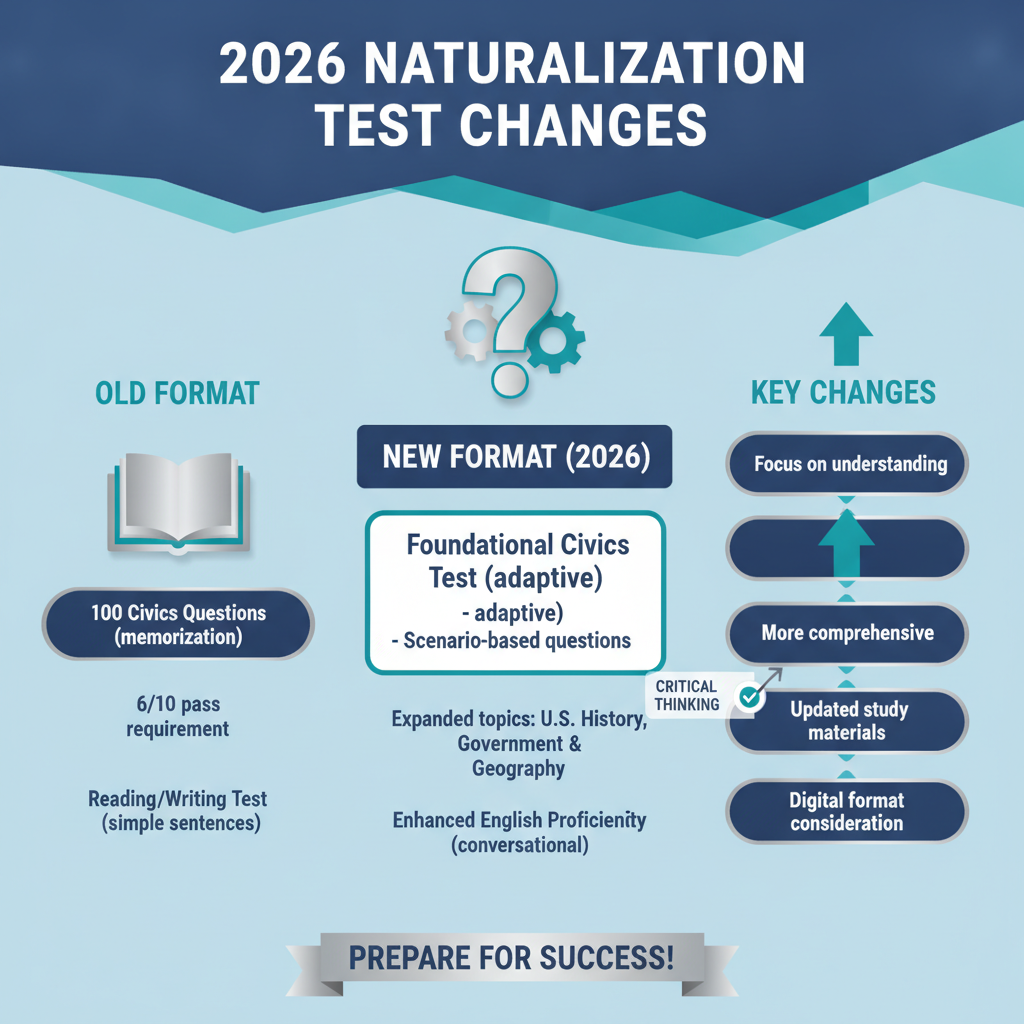
This is the most critical stage, especially with the 2026 test changes. Your naturalization interview will be conducted by a USCIS officer, who will verify your application details, assess your English proficiency, and administer the Civics Test. * **Detailed Explanation (Focus on New Test):** * **English Test:** The officer will evaluate your ability to speak and understand English by asking questions about your Form N-400 and general biographical information. You'll also read one of three sentences correctly and write one of three sentences correctly. * **Civics Test (The 2026 Changes):** This is where the significant updates are expected. While specific new questions aren't universally released *as of September 2026*, historical patterns suggest changes might focus on: * **More Analytical Questions:** Moving beyond rote memorization to scenario-based questions that require a deeper understanding of civic principles (e.g., "What is the rule of law and why is it important in a democracy?"). * **Updated Content:** Reflecting contemporary American society and governmental structure, potentially including questions on recent historical events or significant amendments. * **Interactive Elements:** There have been past considerations of incorporating more interactive or visual components, though this is less common for the civics test itself. * **Increased Number of Questions:** The 2020 test, which was later rescinded, had 20 questions (answer 12 correctly) instead of 10 (answer 6 correctly). The 2026 test *could* revert to a higher number or a different pass threshold. * **Preparation Strategy for the New Test:** * **Stay Informed:** Regularly check the USCIS official website for official announcements about the new test content, study guides, and effective dates. USCIS typically releases updated study materials well in advance. * **Beyond Memorization:** Focus on understanding the *concepts* behind the civics questions, not just memorizing answers. For instance, instead of just knowing "Who is the Speaker of the House?", understand the role of the Speaker and the legislative branch. * **Practice English:** Engage in conversations, watch English news, and practice reading and writing simple sentences. * **Mock Interviews:** Practice mock interviews with a friend, family member, or, ideally, an immigration attorney. This helps build confidence and familiarity with the interview format. * **Interview at the Orlando USCIS Field Office:** Be prepared for questions about your Form N-400, your good moral character, any trips abroad, and your commitment to the U.S. Constitution. Answer truthfully and consistently with your application. * **Required Documents (Originals to bring to interview):** * Your Interview Appointment Notice (Form I-797C) * Your Green Card (Form I-551) * All passports (current and expired) * State-issued ID (driver's license or state ID) * All documents you submitted with your Form N-400 (birth certificates, marriage/divorce certificates, court documents, tax returns, etc.) * Any updated documents since filing your application (e.g., new employment, new address, new criminal issues, new travel) * Reminder: Bring ALL original documents, even if you only submitted copies.5) Receive a Decision and Attend the Oath Ceremony
After your interview, the officer will typically issue a decision. If approved, the final step is the Oath of Allegiance ceremony. * **Detailed Explanation:** * **Approval:** If approved, you will receive Form N-445, Notice of Naturalization Oath Ceremony, with the date, time, and location of your ceremony. In Orlando, these ceremonies often take place at the federal courthouse or occasionally at the USCIS field office. * **Denial:** If your application is denied, USCIS will send you a written explanation (Form N-336, Request for a Hearing on a Decision in Naturalization Proceedings). You have the right to appeal this decision. * **Oath Ceremony:** This is a momentous occasion where you officially become a U.S. citizen. You will surrender your Green Card at this ceremony. * **Required Documents:** * Form N-445 * Your Green Card (to surrender) * Any travel documents issued by USCIS (e.g., Reentry Permit)6) Understanding Exemptions and Accommodations
It's vital to know if you qualify for any waivers or accommodations that might simplify the naturalization process, especially concerning the English and Civics tests. * **Detailed Explanation:** * **English Test Exemptions:** * **50/20 Rule:** If you are 50 years old or older and have been a lawful permanent resident for at least 20 years. * **55/15 Rule:** If you are 55 years old or older and have been a lawful permanent resident for at least 15 years. * **65/20 Rule:** If you are 65 years old or older and have been a lawful permanent resident for at least 20 years, you may take a simplified version of the Civics Test (10 questions, but identified with an asterisk * on the study guide). * **Medical Disability Exemption (Form N-648):** If you have a physical or developmental disability or mental impairment that prevents you from demonstrating knowledge of English and/or civics, you may be exempt from one or both tests. This requires a certified medical doctor or clinical psychologist to complete and sign Form N-648. The disability must have lasted or be expected to last 12 months or more. * **Reasonable Accommodations:** USCIS provides reasonable accommodations for individuals with disabilities, such as sign language interpreters, accessible interview rooms, or extended time. You must request these in advance. * **Required Documents:** * Proof of age and lengthRelated Topics
Need Legal Assistance?
Our experienced immigration attorneys are here to help with your case. Contact Imigrar today for a free consultation and let us guide you through the legal process with confidence.
📍 Orlando, Florida • Serving clients nationwide
📧 info@imigrar.com