
Orlando Green Card Interview: Your Expert Guide to Success
Facing your Green Card interview in Orlando? This comprehensive guide from Imigrar provides expert tips, document checklists, and crucial advice to help you prepare and succeed. Keep your family together.

The journey to obtaining a Green Card in the United States is a significant step for many immigrants, offering the promise of permanent residency and a stable future. A pivotal moment in this process is the Green Card interview with U.S. Citizenship and Immigration Services (USCIS). For individuals and families in Orlando, across Florida, and nationwide, preparing for this interview can feel daunting. At Imigrar, we understand the stakes, and our mission is to ensure you approach this critical meeting with confidence and clarity.
The reporting that sparked this guide
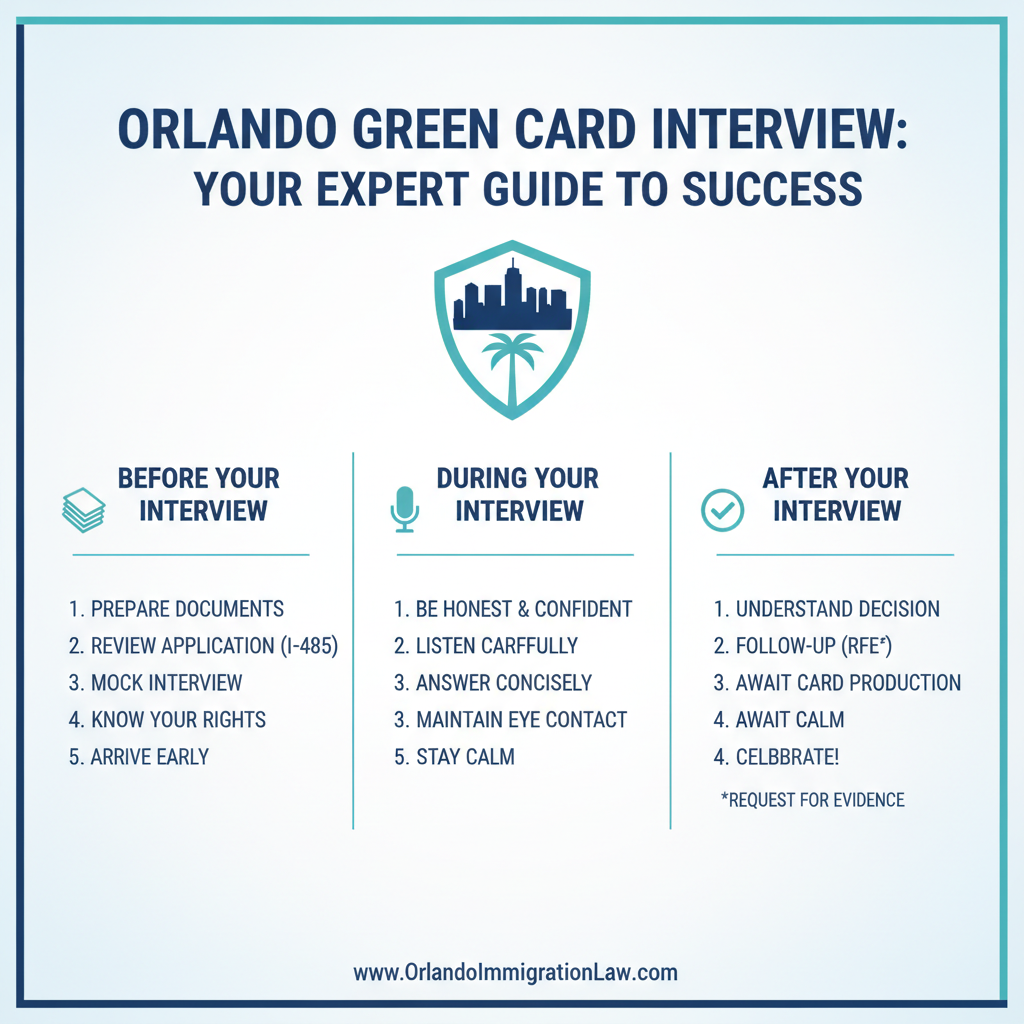
Recent discussions and widespread interest in Green Card Interview Preparation Tips (Immigration Law) highlight the ongoing importance of this stage in the immigration process. The consistent focus on interview readiness underscores that while the legal framework for obtaining a Green Card is established, the interview itself remains a significant hurdle requiring meticulous preparation and a deep understanding of what USCIS expects. This recurring interest confirms that immigrants are actively seeking reliable, actionable advice to navigate this essential step.
What This News Means for Immigrants in Orlando and Across Florida
The continued emphasis on Green Card interview preparation is not just a passing trend; it reflects the enduring complexities of U.S. immigration law and the rigorous scrutiny applied to Green Card applications. For immigrants residing in Florida, this news carries particular weight, given our state’s diverse population and high volume of immigration cases.
Why this news is showing up now
The focus on interview preparation is consistently relevant for several reasons:
- Increased Scrutiny: USCIS continues to prioritize the integrity of the immigration system. This means officers are trained to thoroughly vet applications, especially concerning eligibility for Adjustment of Status and the legitimacy of relationships (for marriage-based Green Cards).
- Evolving Policies and Procedures: While the core interview process remains, there can be subtle shifts in how officers conduct interviews, what questions they emphasize, and the types of evidence they prioritize. Staying updated is crucial.
- Backlogs and Processing Times: Despite efforts to streamline processes, backlogs can lead to longer waits. When an interview is finally scheduled, applicants often feel immense pressure, making preparation even more critical to avoid further delays or denials.
- Applicant Anxiety: The interview is often the culmination of a long, expensive, and emotionally taxing application process. Natural anxiety drives many to seek comprehensive guidance to ensure they don't jeopardize their case at this final stage.
How it can affect Florida residents
For individuals and families living in Florida, especially in bustling metropolitan areas like Orlando, the implications are direct:
- High Volume at Field Offices: Florida is home to several major USCIS Field Offices, including the Orlando USCIS Field Office. These offices process a substantial number of Green Card interviews daily. The sheer volume means that officers are highly experienced, but also that preparation must be impeccable to stand out and avoid any red flags.
- Diverse Case Types: Orlando, situated at the heart of Central Florida, sees a wide range of Green Card applications, from marriage-based petitions for couples along the I-4 corridor to employment-based petitions for professionals moving to Orange County. Each case type has specific interview nuances that residents must understand.
- Importance of Local Counsel: Navigating the specific practices of the Orlando Field Office can be challenging without local expertise. An immigration attorney familiar with the local USCIS environment can provide invaluable insights.
- Language Barriers: While USCIS provides interpreters, many applicants prefer to have their own attorney present who can bridge potential communication gaps and advocate on their behalf. Given Orlando's diverse population, Se Habla Español services are particularly vital.
Need Help? Our Orlando immigration team is ready to assist. Call +1 786-791-3106 for a free consultation, or message us online. Se Habla Español.
What the Green Card Interview Is (and Why It Matters)
The Green Card interview is a critical juncture in the process of becoming a lawful permanent resident of the United States. It is a face-to-face meeting with a USCIS immigration officer who will review your application, verify your identity, assess your eligibility, and determine if you meet all legal requirements for a Green Card.
A plain-English definition
Simply put, a Green Card (officially known as a Permanent Resident Card) allows you to live and work permanently in the United States. The Green Card interview is essentially a formal conversation with a government official. During this meeting, the officer will ask you questions about your application, your background, and your relationship (if applicable, for family-based petitions) to ensure that everything you've submitted is true and that you qualify for permanent residency under U.S. immigration law. It’s your chance to confirm the information in your forms and provide any additional evidence the officer might request.
Key terms you need to know
Understanding these terms will help you navigate the Green Card process more effectively:
- Green Card: The common term for a Permanent Resident Card, which proves your authorization to live and work permanently in the U.S.
- USCIS: U.S. Citizenship and Immigration Services, the federal agency responsible for administering immigration and naturalization benefits. This is the agency that conducts your interview.
- Adjustment of Status (AOS): The process of applying for lawful permanent resident status (a Green Card) while you are physically present in the United States. This is contrasted with Consular Processing, where you apply for your Green Card through a U.S. embassy or consulate abroad.
- Petitioner: The U.S. citizen or lawful permanent resident who files an immigration petition (e.g., Form I-130, Petition for Alien Relative) on behalf of an eligible foreign national.
- Beneficiary/Applicant: The foreign national seeking immigration benefits, such as a Green Card. You are the applicant for the Green Card.
- Sponsor: The individual (often the petitioner) who signs an Affidavit of Support (Form I-864), pledging financial support for the immigrant to ensure they do not become a public charge.
- Priority Date: The date USCIS receives your immigration petition (e.g., Form I-130). This date determines your place in the visa queue for certain preference categories.
- Notice of Action (Form I-797): A receipt or approval notice sent by USCIS after they receive or make a decision on your application. Your interview notice will be a type of I-797.
- Request for Evidence (RFE): A letter from USCIS asking for more information or documents to support your application.
- Oath: At the start of the interview, you will be asked to swear or affirm that your testimony will be truthful.
The interview matters immensely because it is often the final hurdle before your Green Card is approved. It’s the USCIS officer's opportunity to resolve any doubts, clarify discrepancies, and ensure you genuinely qualify. A well-prepared interview can lead to swift approval, while a poorly handled one can result in delays, an RFE, or even denial.
Current Immigration Law: The Foundation
The Green Card interview process is firmly rooted in the Immigration and Nationality Act (INA), which is the body of law governing immigration to the United States. Understanding the legal framework helps demystify the interview and highlights why certain questions are asked and certain documents are required.
Federal requirements
The authority for Green Card interviews stems from federal law, primarily the Immigration and Nationality Act (INA). Key sections of the INA dictate who is eligible for a Green Card, the grounds for inadmissibility (reasons someone might be denied), and the procedures for applying. For instance:
- INA Section 201-204: These sections establish the categories for family-sponsored and employment-based immigration, outlining who can petition for whom and the annual visa limits.
- INA Section 212: This crucial section details the "grounds of inadmissibility," which are reasons an applicant might be barred from entering or remaining in the U.S. These grounds include health-related issues, criminal history, security risks, public charge concerns, and past immigration violations. The interview is a primary mechanism for USCIS to assess these grounds.
- INA Section 245: This section specifically governs Adjustment of Status for individuals already in the U.S. It sets forth the conditions under which a nonimmigrant can adjust their status to that of a lawful permanent resident, often requiring them to have entered the U.S. lawfully and maintained valid status.
During the interview, the USCIS officer is essentially applying these federal laws to your specific case. They will verify that you meet the eligibility criteria for your Green Card category (e.g., a legitimate marriage for marriage-based, a valid job offer for employment-based) and that no grounds of inadmissibility apply to you. This is why honesty and thorough documentation are paramount.
Key USCIS forms central to the Green Card process include:
- Form I-130, Petition for Alien Relative: Filed by a U.S. citizen or lawful permanent resident to establish a qualifying relationship with a foreign national.
- Form I-485, Application to Register Permanent Residence or Adjust Status: The primary application form for the Green Card itself, filed by the foreign national.
- Form I-864, Affidavit of Support: Filed by the financial sponsor to demonstrate they can support the applicant and prevent them from becoming a public charge.
- Form I-765, Application for Employment Authorization: Often filed concurrently with Form I-485 to obtain work authorization while the Green Card application is pending.
- Form I-131, Application for Travel Document: Often filed concurrently with Form I-485 to obtain advance parole (permission to travel outside the U.S. and return without abandoning the Green Card application).
You can find all official forms and detailed instructions on the USCIS official website.
Florida-specific considerations
While U.S. immigration law is federal, its application can have practical nuances at the local level. In Florida, particularly around the Orlando area:
- Orlando USCIS Field Office: If your case is in Orlando, your interview will likely be scheduled at the Orlando Field Office. Each field office develops certain local practices, although the core legal requirements remain the same. Officers here are accustomed to a wide range of cases, reflecting Florida's diverse immigrant population.
- Common Interview Types: For Central Florida residents, marriage-based Green Card interviews are very common. Officers are highly trained in identifying bona fide marriages versus fraudulent ones, making detailed evidence and consistent testimony critical. Employment-based and family-preference interviews are also frequently conducted.
- Processing Times: While processing times are federal, local office workloads can influence specific wait times. You can check current estimates for the Orlando Field Office on the USCIS Processing Times page.
Important: There are no specific "Florida-only" immigration laws that govern Green Card eligibility or interviews. The state does not have its own immigration system. All Green Card applications are processed under federal law. However, local legal counsel with experience at the Orlando Field Office can provide insights into what to expect based on current local practices.
How to Prepare for Your Green Card Interview: A Complete Step-by-Step Guide
Preparing for your Green Card interview is key to a successful outcome. This detailed guide will walk you through the essential steps, ensuring you are well-equipped for this critical meeting.
1) Understand Your Interview Notice and Type
Your journey begins when you receive your interview notice (Form I-797C, Notice of Action) from USCIS. This document is crucial and will specify:
- Date and Time: Mark this immediately and plan your travel.
- Location: For Orlando residents, this will typically be the Orlando USCIS Field Office.
- Required Documents: The notice will include a list of original documents you must bring. This list is *in addition* to what you've already submitted and is often generic, so you'll need to bring more than just what's listed.
- Interview Type: Understand if it's a marriage-based interview (where both spouses attend), an individual interview for employment-based or other family-based categories, or a "Stokes" interview (a second, more intense marriage-based interview).
Actionable Tip: Read your interview notice thoroughly the moment you receive it. Do not discard it. It contains vital information.
2) Gather and Organize All Required Documents
This is arguably the most critical step. USCIS officers are looking for consistency and completeness. You must bring originals, copies, and, if applicable, certified translations of *all* documents related to your case.
General Required Documents:
- Your interview notice (Form I-797C).
- Government-issued photo identification (e.g., passport, driver's license).
- All original passports and travel documents (current and expired).
- Original birth certificates for yourself, your petitioner (if applicable), and any children.
- Original marriage certificate (if applicable).
- Original divorce decrees or death certificates for any previous marriages of yourself or your petitioner.
- Medical Examination Report (Form I-693) in a sealed envelope, if not already submitted and still valid.
- Copies of all forms you submitted (Form I-130, Form I-485, Form I-864, etc.).
- Original work authorization card (EAD) and advance parole document (if applicable).
- Two passport-style photos (even if you submitted them previously).
For Marriage-Based Green Cards (in addition to above):
The core purpose of a marriage-based interview is to prove your marriage is legitimate and not solely for immigration purposes. Bring extensive evidence of your bona fide relationship:
- Financial Commingling:
- Joint bank account statements (spanning months/years).
- Joint credit card statements.
- Joint tax returns (transcripts are best, available from IRS.gov).
- Joint leases or mortgage statements.
- Joint utility bills (electricity, water, internet).
- Joint car titles, insurance policies (health, life, auto).
- Shared Life:
- Lease agreements or property deeds in both names.
- Utility bills addressed to both spouses at the same address.
- Mail addressed to both spouses at the same address.
- Photos together (dating, engagement, wedding, family events, vacations) – printed, organized, and dated.
- Affidavits from friends, family, or employers attesting to the bona fide nature of your relationship.
- Children's birth certificates (if you have children together).
- Travel itineraries and tickets from trips together.
- Evidence of shared experiences (e.g., gym memberships, club memberships, social media posts).
- Communication:
- Call logs, text messages, emails, chat histories (select key conversations, don't bring thousands).
- Cards or letters exchanged.
Reminder: Organize your documents in a binder or folder with dividers. Have originals easily accessible and a separate set of copies ready to submit. If any document is not in English, it must be accompanied by a certified English translation.
3) Review Your Application Forms Thoroughly
The USCIS officer will base their questions on the information you provided in your forms (e.g., Form I-130, Form I-485, Form I-864). You must be intimately familiar with every detail. If you worked with an attorney, they should have provided you with copies of everything submitted.
- Read through every question and your corresponding answer.
- Ensure consistency between all forms. Discrepancies, even minor ones, can raise red flags.
- Make sure you remember dates, addresses, employment history, and travel history exactly as reported.
- If there have been any changes since you filed (e.g., new address, new job, new baby), be prepared to explain these and bring updated documentation.
Warning: Any inconsistencies between your testimony and your application forms, or between the petitioner's and beneficiary's testimony, can lead to serious issues, including accusations of misrepresentation.
4) Practice Answering Potential Questions
While you cannot predict every question, many are common. Practice answering them truthfully and consistently. If you have an attorney, conduct a mock interview with them.
Common Interview Questions:
- About your application: "Why are you applying for a Green Card?", "What is your current address?", "Where do you work?", "What is your date of birth?"
- About your background: "Have you ever been arrested or convicted of a crime?", "Have you ever violated immigration laws?", "Have you ever been a member of any organization?" (referencing questions from Form I-485).
- For marriage-based cases:
- "How and when did you meet your spouse?"
- "When did you get married?"
- "Who proposed?"
- "Describe your wedding day."
- "Where do you live now?"
- "Who does the cooking/cleaning?"
- "What did you do last weekend together?"
- "What are your spouse's parents' names?"
- "What color is your spouse's toothbrush?" (These specific, sometimes intimate questions are designed to gauge daily life knowledge.)
Tip: Answer questions directly and truthfully. Do not volunteer extra information unless asked. If you don't know an answer, say so honestly. If you don't understand a question, ask the officer to repeat or rephrase it. Do not guess.
5) Prepare for the Day of the Interview
The day of the interview requires logistical planning and mental preparation.
- Dress Code: Dress professionally, as if for a job interview. It shows respect for the process.
- Arrive Early: Plan to arrive at least 30-45 minutes before your scheduled time. This allows for security checks, finding parking (which can be challenging in Orlando), and settling your nerves. Being late can lead to rescheduling or even denial.
- Bring Everyone Required: If it's a marriage-based interview, both spouses must attend. If you have an attorney, they should accompany you. If you need an interpreter and USCIS is providing one, they will be there. If you bring your own, ensure they are certified and not a family member or friend.
- Mentally Prepare: Stay calm. It's normal to be nervous, but try to relax. Remember your goal: to honestly and accurately present your case.
6) What to Expect During the Interview
The interview process typically follows a standard format:
- Check-in: You'll check in at the front desk upon arrival.
- Waiting Area: You'll wait until your name is called.
- Oath: The officer will call you into their office and have you (and your spouse, if applicable) swear to tell the truth.
- Identity Verification: The officer will verify your identity, often by checking your passport or other IDs and taking your fingerprints.
- Questions: The officer will review your application forms and ask questions based on the information provided, as well as general eligibility questions. They may also ask to see specific documents from your organized binder.
- Review of Evidence: For marriage-based cases, the officer will thoroughly review your relationship evidence. They may keep copies of some documents.
- Decision or Next Steps: In some cases, the officer may approve your Green Card on the spot. More often, they will say they need to review your case further. They might issue a Request for Evidence (RFE) if they need more documents, or a "Notice of Intent to Deny" (NOID) if they have serious concerns.
Important: Maintain a respectful and cooperative demeanor throughout the interview. Answer truthfully, even if the answer is difficult. Do not argue with the officer.
7) Post-Interview Actions and Follow-Up
Your involvement doesn't necessarily end when you leave the office.
- If Approved: Congratulations! You will typically receive your Green Card in the mail within a few weeks.
- If RFE Issued: Respond promptly and thoroughly to any Request for Evidence within the specified deadline (usually 87 days). This is your chance to provide missing information.
- If Denied or NOID Issued: This is a serious situation. You will receive a written explanation. It is crucial to consult with an immigration attorney immediately to discuss your options, which may include filing a motion to reopen/reconsider, an appeal, or refiling your application.
- Waiting for a Decision: If no decision is made on the spot, monitor your case status online using your receipt number on the USCIS Case Status tool. If you don't hear anything within the expected processing time, your attorney can help you inquire.
Need Help? Our Orlando immigration team is ready to assist. Call +1 786-791-3106 for a free consultation, or message us online. Se Habla Español.

Practical Steps You Can Take Today
Don't wait until the last minute to prepare for your Green Card interview. Here's an actionable checklist to help you start today:
- Review Your Entire Application Packet: Find the copies of all forms (Form I-130, Form I-485, Form I-864, etc.) you submitted to USCIS. Read through every question and your answer. Highlight any areas where you might have questions or where information has changed.
- Start Gathering Documents: Begin compiling all original documents and their copies. Create a checklist based on the "Required Documents" section above and your specific interview notice. For marriage-based cases, start collecting every piece of evidence of your bona fide marriage – bank statements, utility bills, photos, etc.
- Organize Your Evidence: Purchase a binder with dividers. Label each section (e.g., "Passports," "Birth Certificates," "Marriage Certificate," "Joint Finances," "Photos"). Place originals in one section, and a full set of copies in another. This organization will impress the officer and make your interview smoother.
- Practice Potential Questions: Sit down with your spouse, a trusted friend, or your attorney and practice answering common interview questions. Focus on being truthful, consistent, and concise. Pay particular attention to dates, addresses, and key life events.
- Update Your Medical Exam (if needed): Your Form I-693 (Report of Medical Examination and Vaccination Record) is generally valid for two years from the civil surgeon's signature date. If your interview notice comes much later after submission, or if your medical exam is nearing its expiration, you might need a new one. USCIS will typically ask for an updated one if it's expired.
- Consult with an Immigration Attorney: This is perhaps the most important step. An experienced immigration attorney can review your entire application, identify potential issues, help you gather and organize documents, conduct a mock interview, and accompany you to the actual interview at the Orlando USCIS Field Office.
Document preparation guidance
- Originals vs. Copies: Always bring ALL originals of every document you've ever submitted or intend to show. Have a complete set of copies for the officer to keep.
- Translations: Any document not in English must be accompanied by a complete and accurate English translation, certified by the translator. The certification must include a statement that the translator is competent to translate and that the translation is accurate.
- Photos: For marriage-based cases, bring a selection of 20-30 printed photos spanning your relationship, from dating to recent events. Arrange them chronologically, and briefly label them on the back with dates and descriptions. Don't bring digital photos on a phone or laptop unless specifically requested.
- Financial Documents: For Form I-864, bring the petitioner's most recent tax transcripts (from IRS.gov) and pay stubs for the last six months.
Timeline expectations
The Green Card process can vary significantly. As of late 2026, processing times continue to fluctuate. Here’s a general idea:
- Interview Scheduling: After USCIS reviews your application (Form I-4
Related Topics
Need Legal Assistance?
Our experienced immigration attorneys are here to help with your case. Contact Imigrar today for a free consultation and let us guide you through the legal process with confidence.
📍 Orlando, Florida • Serving clients nationwide
📧 info@imigrar.com