
DACA Renewal 2026: Updates & Your Step-by-Step Guide for Florida
Stay informed about DACA updates and learn how to renew your DACA status in 2026. This guide offers practical steps, requirements, and expert advice for DACA recipients in Orlando and across Florida.

For hundreds of thousands of young immigrants across the United States, including a significant population right here in Orlando and Central Florida, the Deferred Action for Childhood Arrivals (DACA) program represents a lifeline. It provides temporary protection from deportation and the ability to work legally, offering a sense of stability that many have never known. However, DACA has been – and continues to be – a program shrouded in uncertainty, making it crucial for beneficiaries to stay informed about the latest updates and ensure their renewals are handled flawlessly.
At Imigrar, we understand the profound impact DACA has on individuals and families. Our mission, "Keep Families Together," resonates deeply with the spirit of DACA, and we are committed to providing accurate, timely, and actionable guidance to our community. This comprehensive guide is designed to cut through the noise, offering clarity on the latest DACA developments and a precise roadmap for successful renewal in 2026.
Is your DACA status expiring soon? Don't risk your protection and work authorization. Our Orlando immigration team specializes in DACA renewals and can help you navigate the process with confidence. Call +1 786-791-3106 for a free consultation today, or message us online. Se Habla Español.
The reporting that sparked this guide
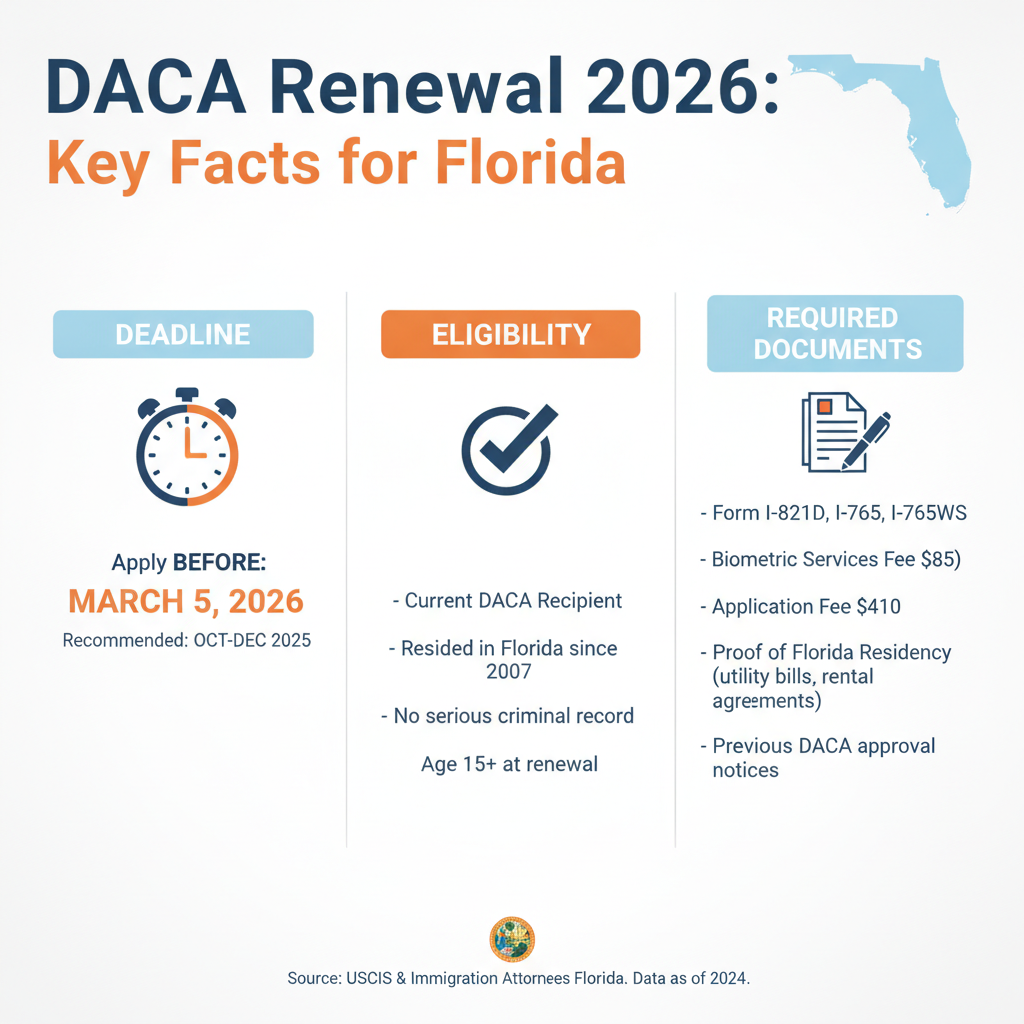
The ongoing legal and administrative landscape surrounding DACA ensures that it remains a frequent topic in immigration news. Recent updates from USCIS and ongoing discussions in federal courts continue to shape the program's future. For the latest details and official announcements, we always recommend referring to authoritative sources:
DACA Program Updates and Renewal Information (USCIS)
What This News Means for Immigrants in Orlando and Across Florida
The DACA program, which has provided deferred action and work authorization to eligible undocumented youth since 2012, remains a subject of intense legal and political debate. As of late 2026, the program's future continues to be contested in the courts, meaning USCIS is generally only accepting DACA renewal requests, not initial applications. This legal limbo creates anxiety and urgency for current DACA recipients to maintain their status.
Why this news is showing up now
The DACA program has been under constant scrutiny and legal challenge since its inception. Federal court decisions, particularly from the Fifth Circuit Court of Appeals and subsequent reviews, have repeatedly cast doubt on its legality. These challenges stem from arguments about the executive branch's authority to create such a program without congressional approval. While the courts have allowed for the continuation of renewals for existing beneficiaries, they have largely prohibited USCIS from processing new DACA applications. This ongoing legal battle means that every few months, there are new procedural updates, court filings, or administrative adjustments from USCIS regarding how the program can operate under these constraints. This constant flux necessitates continuous reporting and vigilance for DACA recipients and their legal representatives.
How it can affect Florida residents
Florida is home to a significant population of DACA recipients, often referred to as "Dreamers." Many of these individuals contribute to our state's economy, attend our universities, and are integral members of our communities, from Miami to Jacksonville, and especially here in the Orlando metropolitan area. The legal uncertainties surrounding DACA directly impact their ability to plan for their futures, pursue higher education, and maintain stable employment. For Central Florida residents, a lapse in DACA status can mean losing a driver's license (which DACA recipients are eligible for in Florida), employment authorization, and protection from deportation. The emotional toll of this uncertainty on individuals and their families is immense. Imigrar is deeply rooted in this community, and we see firsthand the concerns and questions our clients face. Staying informed and acting proactively on renewals is paramount for Florida's DACA population.
What DACA Is (and Why It Matters)
The Deferred Action for Childhood Arrivals (DACA) program was established by the Obama administration in 2012. It was a response to the inability of Congress to pass comprehensive immigration reform, specifically the DREAM Act, which aimed to provide a pathway to legal status for young undocumented immigrants.
A plain-English definition
In simple terms, DACA is a policy that allows certain undocumented immigrants who came to the United States as children to receive a temporary reprieve from deportation and to obtain work authorization. It is not a path to U.S. citizenship or lawful permanent residency (a Green Card), but rather a temporary, renewable benefit that offers a degree of stability and protection. DACA recipients are granted "deferred action," meaning the government agrees to defer or postpone any removal (deportation) proceedings against them for a period, typically two years. Along with deferred action, eligible individuals can apply for an Employment Authorization Document (EAD), which allows them to work legally in the U.S.
Key terms you need to know
- Deferred Action: A discretionary determination by the U.S. government to defer or postpone removal proceedings against an individual. It does not confer lawful status.
- Employment Authorization Document (EAD): Also known as a work permit, this card allows DACA recipients to legally work in the United States. It typically has a two-year validity period, aligning with DACA status.
- USCIS: U.S. Citizenship and Immigration Services. This is the government agency responsible for processing DACA applications and renewals.
- Dreamers: A term often used to refer to young undocumented immigrants who were brought to the U.S. as children, many of whom are eligible for or have DACA. The term originates from the proposed "DREAM Act."
- Advance Parole: A travel document that can be granted to DACA recipients (under specific circumstances) allowing them to travel outside the U.S. and lawfully re-enter. This is a complex area with specific rules and risks.
- Unlawful Presence: The period of time an individual has been in the U.S. without being admitted or paroled, or after the expiration of a period of stay authorized by the Attorney General. DACA provides temporary protection from the accrual of unlawful presence.
DACA matters immensely because it enables young people, many of whom have known no other home than the U.S., to pursue education, build careers, and contribute to their communities without the constant fear of deportation. It allows them to obtain driver's licenses, open bank accounts, and live more openly, fostering integration and economic growth. For the Orlando economy and communities across Florida, DACA recipients are vital contributors, and their ability to renew their status is critical for their continued participation.
Current Immigration Law: The Foundation for DACA
DACA itself is not a federal statute enacted by Congress but rather an exercise of prosecutorial discretion by the executive branch. This discretionary nature is precisely why it has been subject to continuous legal challenges. However, its operation is intertwined with existing immigration law, primarily the Immigration and Nationality Act (INA). DACA provides a temporary administrative relief from certain provisions of the INA related to unlawful presence and removability.
The current legal status of DACA is complex and has been shaped by numerous court rulings. As of late 2026, federal courts have maintained injunctions that prohibit USCIS from approving initial DACA requests. However, these injunctions generally allow USCIS to continue accepting and processing DACA renewal requests from individuals who have previously been granted DACA.
Federal requirements for DACA Renewal
While new DACA applications are largely halted, individuals who have previously been granted DACA and whose deferred action has not been terminated can apply for renewal. The eligibility criteria for renewal are largely consistent with the original requirements, with an emphasis on continuous residence and good moral character:
- Received DACA Previously: You must have been granted DACA at some point in the past.
- Continuous Residence: You must have continuously resided in the United States since the date you submitted your most recent DACA request that was approved.
- No Disqualifying Criminal History or Public Safety Threat: You must not have been convicted of a felony, a significant misdemeanor, or three or more other misdemeanors, and must not otherwise pose a threat to national security or public safety.
Important: Even minor interactions with law enforcement can impact your eligibility. It's crucial to disclose all relevant information and consult with an immigration attorney if you have any criminal history.
The forms required for DACA renewal are:
- Form I-821D, Consideration of Deferred Action for Childhood Arrivals
- Form I-765, Application for Employment Authorization
- Form I-765WS, Worksheet (for Form I-765)
These forms, along with detailed instructions and current filing fees, are available on the official USCIS website. You should always refer to the most recent versions.
Florida-specific considerations
While DACA is a federal program, its impact is felt at the state level. For DACA recipients in Florida:
- Driver's Licenses: DACA recipients in Florida are eligible to apply for a Florida driver's license upon receiving their EAD. Maintaining your DACA status is essential to renew your driver's license. The Florida Department of Highway Safety and Motor Vehicles (FLHSMV) will require proof of valid immigration status and employment authorization.
- In-State Tuition: Eligibility for in-state tuition for DACA recipients in Florida can be complex and depends on specific state laws and university policies. While DACA itself doesn't automatically grant in-state tuition, some legislative efforts or specific university policies may provide options. Always check with the specific educational institution.
- Community Resources: Organizations and legal aid groups across Florida, including in Orlando and Orange County, offer support, workshops, and sometimes financial assistance for DACA renewals. Imigrar works closely with community partners to ensure our clients have access to all available resources.
- Local USCIS Field Office: While DACA applications are sent to a USCIS Lockbox, if you receive a Request for Evidence (RFE) or an interview notice (rare for DACA renewals), your local Orlando USCIS Field Office may be involved.
Confused about DACA renewal requirements? Don't leave your future to chance. Imigrar provides expert legal guidance for DACA recipients in Orlando and nationwide. Call +1 786-791-3106 for a free consultation. Se Habla Español.
How to Renew Your DACA: A Complete Step-by-Step Guide
Renewing your DACA status is a critical process that requires meticulous attention to detail and timely action. A lapse in your deferred action can lead to loss of employment authorization and potential exposure to deportation proceedings. Follow these steps carefully to ensure a successful renewal.
1) Understand Eligibility and Timing for Renewal
Before you begin, confirm you meet the renewal eligibility criteria: you must have previously received DACA, maintained continuous residence in the U.S. since your last approved request, and not have any new disqualifying criminal convictions or pose a threat to national security or public safety. The most crucial aspect is timing.
- When to File: USCIS recommends filing your DACA renewal request between 120 and 150 days (approximately 4 to 5 months) before your current DACA and EAD expire. Filing too early could lead to rejection, and filing too late risks a lapse in your work authorization and deferred action.
- Why Timing Matters: USCIS processing times can vary. Filing within the recommended window allows ample time for processing, including potential requests for evidence or biometrics appointments, without your status expiring.
- Check Expiration Dates: Locate your current DACA approval notice (Form I-797C) and your EAD card (Form I-766) to confirm the exact expiration dates.
2) Gather Required Documents
While DACA renewals generally require less documentation than initial requests, you must still provide evidence to support your continuous eligibility. Organize these documents carefully:
- Previous DACA and EAD Documents:
- Copy of your most recent DACA approval notice (Form I-797C).
- Copy of your most recent Employment Authorization Document (EAD) (Form I-766) – both front and back.
- Proof of Continuous Residence (since your last DACA approval): USCIS wants to see that you have not left the U.S. without proper authorization or for extended periods. Examples include:
- School records (transcripts, report cards).
- Employment records (pay stubs, W-2s, employment letters).
- Bank statements.
- Utility bills.
- Rental agreements or mortgage statements.
- Medical records.
- Receipts, money order stubs, or other dated transactions.
- Any previous travel documents (e.g., if you obtained Advance Parole).
- Identification Documents:
- Copy of your birth certificate (with certified translation if not in English).
- Copy of your passport identity page or national identity document.
- Copy of your previous DACA application (if you kept one) for reference.
- Passport-style Photos: Two identical, color passport-style photographs taken within 30 days of filing. Write your name and Alien Registration Number (A-Number) lightly on the back of each photo.
- Criminal History Documents (if applicable): If you have any arrests, citations, or convictions (even if charges were dropped or expunged) since your last DACA approval, you must obtain certified court dispositions and police records. Warning: Do not omit this information; it can lead to denial and more serious immigration consequences.
Reminder: Always send copies, never originals, unless USCIS specifically requests them. Keep a complete copy of your entire application package for your records.
3) Complete Forms I-821D, I-765, and I-765WS
These forms are the core of your DACA renewal application. Download the latest versions directly from the USCIS website to ensure you are using the correct forms. Fill them out accurately and completely, preferably by typing or using black ink.
- Form I-821D, Consideration of Deferred Action for Childhood Arrivals:
- Carefully review all sections. Pay close attention to Part 1 (Information About You), Part 2 (Eligibility Information), and Part 3 (Biographic Information).
- Ensure consistency with your previous DACA application, unless there have been factual changes (e.g., a new address).
- Answer all questions truthfully.
- Form I-765, Application for Employment Authorization:
- This form is for your work permit. In Part 2, Question 27, select "c)(33)" as your eligibility category for DACA.
- Fill in all requested personal information.
- Form I-765WS, Worksheet:
- This worksheet explains your economic need for employment authorization. Provide clear and concise answers regarding your income, expenses, and assets.
- Signature: Ensure all forms requiring your signature are signed in blue or black ink. An unsigned form will be rejected. If an attorney is assisting you, they will sign Form G-28, Notice of Entry of Appearance as Attorney or Accredited Representative.
4) Pay Filing Fees
The DACA renewal process involves mandatory filing fees. As of late 2026, the combined fee for Form I-821D and Form I-765 is $495. This includes the $85 biometrics services fee and the $410 filing fee for the EAD.
- Payment Methods: You can pay by money order, personal check, cashier's check, or by credit card using Form G-1450, Authorization for Credit Card Transactions.
- To Whom Payable: Make checks or money orders payable to "U.S. Department of Homeland Security." Do not abbreviate.
- Fee Waivers: Fee waivers for DACA renewal are extremely rare and only granted in very limited circumstances (e.g., if you are under 18, homeless, in foster care, and have an income less than 150% of the poverty level). Consult with an attorney if you believe you qualify for a fee waiver, as improper requests can delay your application.
5) Assemble and Mail Your Application Package
Proper assembly and mailing are crucial to avoid delays or rejection.
- Order of Documents:
- Payment (check, money order, or G-1450 on top).
- Form I-821D
- Form I-765
- Form I-765WS
- Supporting documentation for Form I-821D (proof of continuous residence, identification, photos).
- Supporting documentation for Form I-765 (usually just the photos if not already submitted with I-821D).
- Any other supporting documents (e.g., criminal dispositions).
- Packaging: Secure all documents with a binder clip or paper clip. Do not staple entire packages together.
- Mailing Address: Send your application to the correct USCIS Lockbox facility. The address depends on the state you reside in. For Florida residents, you will typically mail your DACA renewal package to the USCIS Chicago Lockbox. Always double-check the "Direct Filing Addresses for Form I-821D" page on the USCIS website for the most current address.
- Shipping: Use a reputable mail service (e.g., USPS Priority Mail, FedEx, UPS) that provides tracking and delivery confirmation. This is your proof of timely filing.
6) Attend Biometrics Appointment (If Required)
After USCIS accepts your application, you will typically receive a receipt notice (Form I-797C) and, in most cases, an appointment notice for biometrics (fingerprints, photograph, and signature). This appointment usually takes place at an Application Support Center (ASC) near you, such as the Orlando ASC.
- What to Bring: Your appointment notice, a valid photo ID (like your driver's license or passport).
- Purpose: Biometrics are used for background checks and identity verification.
- Important: Do not miss your biometrics appointment. If you have a legitimate reason to reschedule, follow the instructions on your appointment notice immediately.
7) Monitor Your Case Status
Once you have your receipt number (from Form I-797C), you can track the status of your application online.
- USCIS Online Tools: Visit USCIS Case Status Online and enter your receipt number.
- Processing Times: Check USCIS Processing Times for an estimate of how long your specific service center is taking to process DACA renewals.
- Respond to RFEs: If USCIS sends a Request for Evidence (RFE), respond promptly and thoroughly with the requested documents. Failure to respond can lead to denial.
- Approval: If your renewal is approved, you will receive an approval notice and then your new EAD card in the mail.
Practical Steps You Can Take Today
Don't wait until the last minute to start your DACA renewal process. Proactive preparation can significantly reduce stress and the risk of delays or denial. Here's an actionable checklist:
- 1. Mark Your Calendar: Note your current DACA and EAD expiration dates. Set a reminder for 150 days before expiration to start gathering documents and preparing your application.
- 2. Create a Dedicated Folder: Start a physical and digital folder for all DACA-related documents. Keep all past approval notices, EAD cards, and copies of previous applications in one secure place.
- 3. Review Past Applications: If you have copies of your previous DACA applications, review them to ensure consistency with your current submission. Note any changes in address, employment, or education.
- 4. Update Your Address with USCIS: If you've moved since your last DACA approval, file Form AR-11, Alien's Change of Address Card, online or by mail. This ensures you receive all USCIS correspondence.
- 5. Gather Continuous Residence Evidence: Start collecting recent utility bills, bank statements, pay stubs, and any other documents that prove your continuous residence in the U.S. since your last DACA approval. Aim for at least one document per quarter, if possible.
- 6. Check for Criminal History: If you've had any encounters with law enforcement, no matter how minor, since your last DACA approval, begin the process of obtaining certified court dispositions and police reports immediately. This can take time.
- 7. Save for Fees: The $495 filing fee is a significant expense. Start saving now to ensure you have the funds ready when it's time to file.
- 8. Consult an Attorney: Even if your case seems straightforward, a free consultation with an experienced immigration attorney can provide peace of mind and catch potential issues you might overlook. This is especially important if you have any changes in your personal circumstances, travel history, or criminal record.
Document preparation guidance
- Make Copies: Always make a complete set of copies of your entire application package before mailing it.
- Organize: Use tabs or dividers to clearly separate different types of documents (e.g., "Form I-821D," "Proof of Residence," "Photos").
- Translations: Any document not in English must be accompanied by a complete and accurate English translation and a certification by the translator that they are competent to translate from the foreign language into English and that the translation is accurate.
- Clarity: Ensure all copies are clear and legible.
Timeline expectations
While USCIS processing times vary, here's a general timeline for DACA renewal:
- 150-120 days before expiration: Begin preparing your application and gather documents.
- 120-150 days before expiration: Mail your completed application package.
- 1-3 weeks after mailing: Receive USCIS receipt notices (Form I-797C) for Form I-821D and Form I-765.
- 3-8 weeks after mailing: Receive biometrics appointment notice.
- 4-12 weeks after mailing: Attend biometrics appointment.
- 3-6 months after mailing: Receive DACA approval notice and new EAD card.
Warning: These are estimates. Always check the official USCIS Processing Times website for the most current information. If your EAD expires before you receive your new one, you will temporarily lose your authorization to work.

How Imigrar Helps Immigrants in Orlando
Navigating the DACA renewal process, especially with its ever-changing legal landscape, can be daunting. At Imigrar, our dedicated team of immigration attorneys in Orlando is here to provide the expert guidance and support you need to ensure a smooth and successful renewal.
Our experience and expertise
Imigrar has extensive experience assisting DACA recipients throughout Florida, including the vibrant communities of Orlando, Kissimmee, and across the I-4 corridor. We stay abreast of all the latest DACA program updates, court rulings, and USCIS policy changes. Our expertise allows us to:
- Thoroughly Review Eligibility: We meticulously assess your individual circumstances to confirm you meet all renewal requirements, including continuous residence and criminal history checks.
- Accurately Prepare Your Application: We ensure all forms (Form I-821D, Form I-765, Form I-765WS) are completed correctly and consistently, minimizing the risk of RFEs or denials due to errors.
- Organize Supporting Documents: We help you gather, organize, and present all necessary supporting evidence in a clear and compelling manner.
- Address Complex Issues: If you have any criminal history, travel outside the U.S., or other unique circumstances, we provide strategic advice and representation to navigate these complexities.
- Monitor Your Case: We track your application's progress with USCIS and communicate any updates or actions required.
- Protect Your Rights: We advocate on your behalf and ensure your rights are protected throughout the entire process.
Our firm's tagline, "Keep Families Together," is at the heart of everything we do. We understand that DACA is not just about a document; it's about the ability to live, work, and thrive without fear, contributing to the fabric of our community here in Central Florida.
Free consultation offer
We invite DACA recipients and their families in Orlando and nationwide to take advantage of our free consultation. During this initial meeting, we can discuss your specific situation, answer your questions about DACA renewal, and outline how Imigrar can
Related Topics
Need Legal Assistance?
Our experienced immigration attorneys are here to help with your case. Contact Imigrar today for a free consultation and let us guide you through the legal process with confidence.
📍 Orlando, Florida • Serving clients nationwide
📧 info@imigrar.com