
Naturalization Test 2026: Your Guide to Upcoming Changes for US
Prepare for significant changes to the USCIS Naturalization Civics Test coming in 2026. Imigrar provides a comprehensive guide for Orlando and Florida residents.

Here at Imigrar, your trusted immigration law firm in Orlando, Florida, we are committed to keeping you informed about the latest developments that impact your journey to U.S. citizenship. As 2026 approaches, a significant change is on the horizon: an updated Naturalization Civics Test. This guide is designed to provide you with a comprehensive understanding of these upcoming changes, what they mean for you, and how you can best prepare.
The path to becoming a U.S. citizen through naturalization is a monumental step, signifying a deep commitment to American values and society. It offers incredible benefits, from voting rights and enhanced travel freedom to the ability to sponsor more family members. Understanding the requirements, especially the civics test, is crucial. With the new test format slated for implementation, proactive preparation is more important than ever.
The reporting that sparked this guide
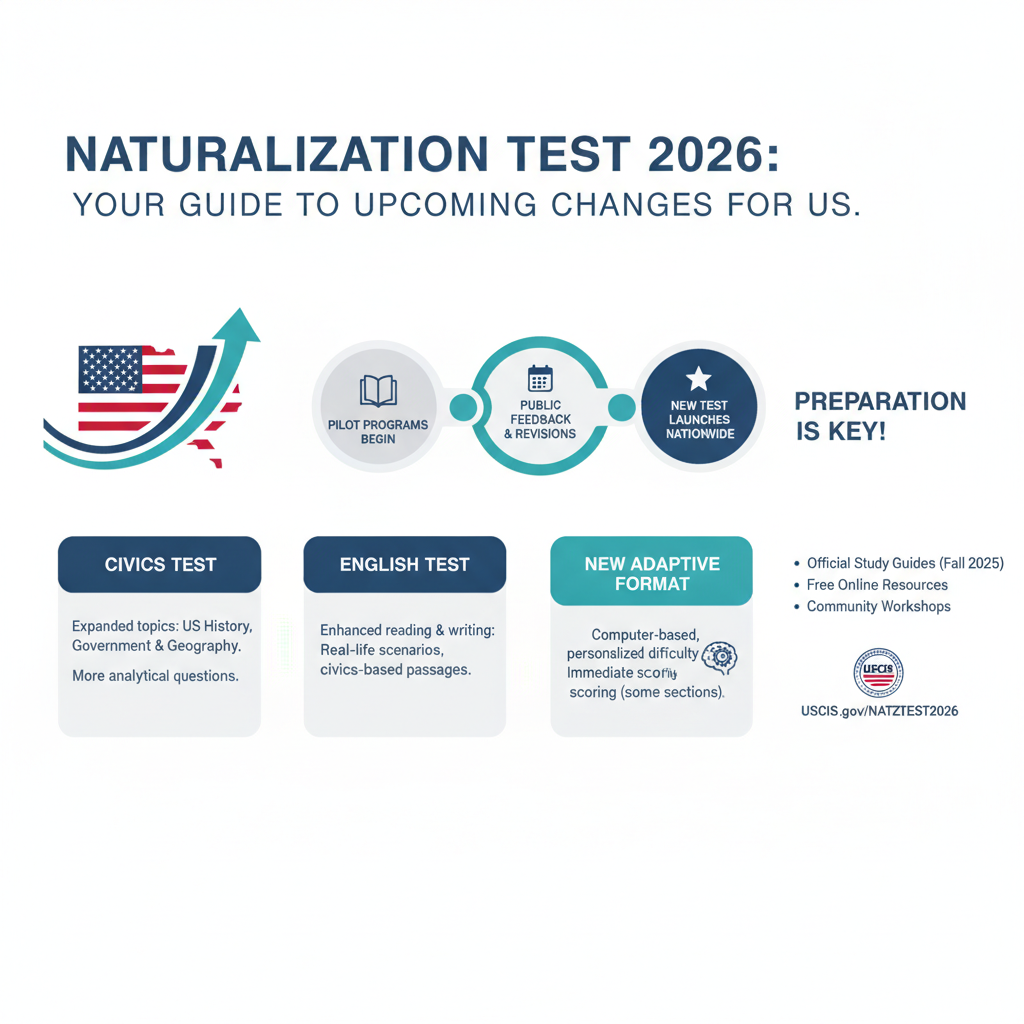
The news of impending changes to the Naturalization Test has been a trending topic in immigration circles, reflecting ongoing efforts by U.S. Citizenship and Immigration Services (USCIS) to refine the naturalization process. While the core purpose of the test remains the same – to ensure applicants have a foundational understanding of U.S. history, government, and civics – the method of assessment is evolving.
The discussions and pilot programs surrounding these changes have been widely reported, highlighting USCIS’s intention to introduce a more interactive and potentially more challenging examination of an applicant's civic knowledge. Staying informed through official channels and reliable news sources is vital for anyone pursuing citizenship.
Naturalization Test Changes Coming in 2026 (Citizenship)
What This News Means for Immigrants in Orlando and Across Florida
The upcoming changes to the Naturalization Civics Test in 2026 are not just a bureaucratic update; they represent a tangible shift in how aspiring citizens will demonstrate their knowledge of American civics. For the vibrant immigrant communities in Orlando, throughout Central Florida, and across the entire state, understanding these changes is paramount to a successful naturalization application.
Why this news is showing up now
The discussion around Naturalization Test changes isn't new; USCIS periodically reviews and updates its processes to ensure they are fair, effective, and relevant. The current cycle of proposed changes, which became public knowledge through official announcements and pilot programs, reflects a desire to potentially make the civics portion more conversational and less reliant on rote memorization. USCIS conducted a pilot program for a revised civics test in late 2023 and early 2024, gathering data and feedback from applicants and interviewers. The findings from this pilot program are now guiding the final design and implementation timeline for the 2026 changes. This is why the news is gaining significant traction now, as the implementation date draws closer, allowing ample time for applicants and legal professionals to prepare.
How it can affect Florida residents
Florida is home to one of the largest and most diverse immigrant populations in the United States. From the bustling metropolitan areas of Orlando and Miami to the agricultural heartlands and coastal communities, countless individuals are on their journey to U.S. citizenship. The Naturalization Test changes will directly impact thousands of Florida residents who plan to file their Form N-400, Application for Naturalization, in late 2025 or throughout 2026 and beyond.
- Increased Preparation Time: For residents in Orlando and other areas, these changes mean that preparation for the civics test will likely require a different approach. Simply memorizing the 100 current questions may no longer be sufficient.
- Local Resources: Community organizations, adult education centers, and legal aid services across Florida, including those in Orange County and along the I-4 corridor, will need to update their civics education materials to reflect the new test format and questions.
- Orlando USCIS Field Office: Applicants whose interviews are scheduled at the Orlando USCIS Field Office, or other field offices across Florida, will be subject to the new test format once it is fully implemented. It's crucial to confirm which test version will be administered based on your interview date.
- Language Access: While the English language requirement remains, the conversational nature of the new civics test could present different challenges or opportunities for applicants, particularly those whose primary language is not English. Imigrar is proud to offer services in both English and Spanish (Se Habla Español) to help bridge this gap.
Important: The specific date of implementation will determine which test version you take. Generally, USCIS administers the test version in effect on the date of your initial naturalization interview. Therefore, if you apply now, you might still take the current test, but if your interview is scheduled for 2026 or later, you could face the new version.
Need Help Navigating the Naturalization Process? The upcoming changes can be complex, but you don't have to face them alone. Our Orlando immigration team is ready to assist. Call +1 786-791-3106 for a free consultation, or message us online. Se Habla Español.
What Naturalization Test Changes Are (and Why It Matters)
The Naturalization Test is a critical component of the U.S. citizenship application process. It assesses an applicant's ability to read, write, and speak basic English, and their knowledge of U.S. history and government (civics). The changes coming in 2026 primarily focus on the civics portion, aiming to make it a more comprehensive and interactive evaluation.
A plain-English definition
The "Naturalization Test Changes" refer to modifications being made by U.S. Citizenship and Immigration Services (USCIS) to the civics portion of the exam that aspiring U.S. citizens must pass. Currently, applicants are asked up to 10 questions from a list of 100 civics questions. With the proposed changes, the test is expected to become more conversational. Instead of simply answering a specific list of questions, applicants might be presented with scenarios or asked to explain concepts in their own words, demonstrating a deeper understanding rather than just memorization. The English language portion (reading, writing, speaking) is also subject to review but typically sees fewer drastic changes.
Why it matters: These changes are significant because they require a different approach to preparation. Applicants will need to understand the underlying principles of U.S. civics, not just recall facts. For many immigrants, especially those who learn English as a second language, this shift could present new challenges. Successfully navigating these changes is essential for achieving the dream of U.S. citizenship.
Key terms you need to know
To fully grasp the implications of these changes, it’s helpful to understand the key terms associated with the naturalization process:
- Naturalization: The process by which a foreign citizen or national becomes a citizen of the United States.
- USCIS (U.S. Citizenship and Immigration Services): The government agency responsible for overseeing lawful immigration to the United States, including processing naturalization applications. You can find more information on their official website.
- Form N-400, Application for Naturalization: The official form filed with USCIS to apply for U.S. citizenship.
- Naturalization Test: Comprised of two main parts: an English test (reading, writing, and speaking) and a civics test (knowledge of U.S. history and government).
- Civics Test: The portion of the naturalization test that assesses an applicant's knowledge of U.S. history and government. This is the part undergoing significant changes in 2026.
- Oath of Allegiance: The final step in the naturalization process, where applicants formally pledge loyalty to the United States.
- Good Moral Character: A legal requirement for naturalization, generally meaning that an applicant has not committed certain crimes or offenses during the statutory period prior to applying.
- Statutory Period: The specific period of time (usually 3 or 5 years) immediately preceding the filing of Form N-400 during which an applicant must meet certain residency and good moral character requirements.
Current Immigration Law: The Foundation
The framework for U.S. naturalization is established by federal law, primarily the Immigration and Nationality Act (INA). While the test questions may change, the fundamental legal requirements for eligibility remain constant. Understanding this foundation is crucial regardless of the test format.
Federal requirements
The eligibility requirements for naturalization are primarily found in Chapter 2 of Title III of the Immigration and Nationality Act (INA), specifically Section 312 for English and civics requirements, and Section 316 for general eligibility. To be eligible for naturalization, an applicant must generally meet the following federal criteria:
- Age: Be at least 18 years old at the time of filing Form N-400.
- Lawful Permanent Resident (Green Card Holder): Have been a lawful permanent resident of the United States for at least five years, or three years if married to a U.S. citizen and meeting certain conditions.
- Continuous Residence: Have resided continuously in the U.S. for at least five years (or three years if applicable) immediately preceding the date of filing the application and up to the time of naturalization.
- Physical Presence: Have been physically present in the U.S. for at least half of the continuous residence period (e.g., 30 months out of 5 years).
- Residency in USCIS District or State: Have resided for at least three months in the state or USCIS district where the application is filed. For residents of Orlando and Central Florida, this typically means residency within the jurisdiction of the Orlando USCIS Field Office.
- Good Moral Character: Demonstrate good moral character for the statutory period (typically the last 3 or 5 years).
- Attachment to the Principles of the U.S. Constitution: Be able to demonstrate an attachment to the principles of the U.S. Constitution and be well-disposed to the good order and happiness of the United States.
- English Language Proficiency: Be able to read, write, and speak basic English. There are exceptions for age and length of permanent residency (e.g., the "50/20" and "55/15" rules, and certain medical disabilities).
- Civics Knowledge: Demonstrate knowledge and understanding of U.S. history and government. This is the portion impacted by the 2026 changes.
- Oath of Allegiance: Be willing to take the Oath of Allegiance to the United States.
Reminder: These are general requirements. Specific circumstances can lead to variations or additional requirements. It's always best to consult with an experienced immigration attorney.
Florida-specific considerations
While naturalization is a federal process, there are practical considerations for Florida residents:
- Orlando USCIS Field Office: Most applicants residing in Central Florida, including Orlando, Orange County, and surrounding areas along the I-4 corridor, will have their naturalization interview conducted at the Orlando USCIS Field Office. Understanding the local office's procedures and typical processing times is beneficial. You can check current processing times at USCIS Processing Times.
- Local Resources: Florida has numerous community organizations and educational institutions that offer citizenship preparation classes. These resources will be adapting their curricula to the new test format.
- Diverse Population Needs: Florida's diverse population means that language support and culturally sensitive guidance are often crucial. Imigrar is proud to serve this diversity, offering services in both English and Spanish (Se Habla Español).
USCIS Forms: The primary form for naturalization is Form N-400, Application for Naturalization. If you are a child of a U.S. citizen seeking a Certificate of Citizenship, you might also be concerned with Form N-600, Application for Certificate of Citizenship. All official USCIS forms can be found at USCIS Forms.
Thinking of Applying for Naturalization? The rules are changing. Ensure your application is strong and you're prepared for the new test. Contact Imigrar for personalized legal guidance. Call +1 786-791-3106 for a free consultation, or message us online. Se Habla Español.
How to Prepare for the New Naturalization Test: A Complete Step-by-Step Guide
Successfully navigating the naturalization process, especially with the upcoming test changes in 2026, requires careful planning and diligent preparation. This step-by-step guide will help you understand the journey ahead.
1) Understand the Current and Upcoming Changes (Stay Informed)
The first and most crucial step is to stay informed. USCIS will provide official guidelines and study materials for the new test. Do not rely on unofficial sources for the most up-to-date information.
- Monitor USCIS Announcements: Regularly check the USCIS official website for specific details on the 2026 Naturalization Test changes, including the exact implementation date, new study materials, and any updated policies.
- Review Pilot Program Information: While the pilot program is concluded, understanding its structure (e.g., the conversational nature, new question types) can give you insight into the likely format of the final test.
- Determine Your Test Version: The test version you take will generally be based on the date of your initial naturalization interview. If your interview is scheduled before the official 2026 implementation date, you will likely take the current test. If it's on or after, prepare for the new one. Confirm this with USCIS or your attorney.
2) Assess Your Eligibility and File Form N-400
Before preparing for any test, ensure you meet all the fundamental eligibility requirements for naturalization. This includes age, continuous residence, physical presence, good moral character, and residency in the USCIS district (e.g., Orlando, Florida) for at least three months.
- Gather Personal Documents:
- Your Green Card (Permanent Resident Card)
- Social Security Card
- State identification (e.g., Florida Driver's License or ID card)
- All passports (current and expired)
- Marriage certificate (if applicable, especially if applying based on 3-year residency)
- Divorce decrees or death certificates for previous spouses (if applicable)
- Birth certificates of your children (if applicable)
- Review Financial and Criminal History: Collect tax transcripts for the last 5 years (or 3 years if applicable), and any court disposition records for arrests or citations, even minor ones.
- Complete Form N-400: Fill out Form N-400, Application for Naturalization accurately and completely. Any errors or omissions can cause delays or even denial.
- Biometrics Appointment: After filing, you will receive a notice for a biometrics appointment at an Application Support Center (ASC), where your fingerprints, photograph, and signature will be collected.
3) Master the English Language Requirement
The English test consists of three parts: reading, writing, and speaking. The upcoming civics test changes may emphasize conversational English even more, making strong English skills vital.
- Speaking Test: Assessed during your interview. The USCIS officer will gauge your ability to understand and respond to questions about your Form N-400 application and personal history. Practice speaking English regularly, especially answering questions about your background.
- Reading Test: You must read one out of three sentences correctly to demonstrate your ability to read English. Practice reading simple sentences from the USCIS vocabulary list.
- Writing Test: You must write one out of three sentences correctly to demonstrate your ability to write English. Practice writing simple sentences dictated by someone else, using the USCIS vocabulary list.
- Utilize Resources: Enroll in English as a Second Language (ESL) classes offered by local community colleges or organizations in Orlando or online. Use language learning apps and practice with native speakers.
4) Study the Civics Questions (Old & New Formats)
This is where the 2026 changes will be most prominent. You must be prepared for the new, potentially more interactive, civics test.
- Current 100 Questions: Even with changes, the core concepts from the existing 100 civics questions will likely remain relevant. Start by learning these thoroughly.
- New Study Materials: As soon as USCIS releases new official study guides, question lists, or practice tests for the 2026 version, immerse yourself in them. These will be your primary resources.
- Focus on Concepts, Not Just Memorization: Instead of just memorizing answers, understand *why* certain facts are important. For example, don't just know the three branches of government; understand their roles and how they interact.
- Practice Explaining: Practice explaining civics concepts in your own words. Ask friends or family to quiz you using open-ended questions.
- Documents for Study:
- Official USCIS Civics Test Study Guide (current and 2026 version when released)
- Flashcards (digital or physical)
- U.S. Constitution and Bill of Rights (simplified versions available)
- Practice tests and quizzes
5) Gather Required Documents for the Interview
Your interview is a critical juncture where you present your case and take the English and civics tests. Organization is key.
- Originals and Copies: Bring the originals of all documents you submitted with your Form N-400, plus copies. This includes your Green Card, passports, marriage/divorce certificates, birth certificates, and any court dispositions.
- Updated Documents: If anything has changed since you filed your application (e.g., new address, new job, new marital status, travel history), bring supporting documentation for these updates.
- Proof of Residency: Utility bills, lease agreements, or other documents proving your continuous residence in Florida, especially in the Orlando area, for the statutory period.
- Tax Transcripts: Bring tax transcripts for the last 5 years (or 3 years if applicable) to demonstrate good moral character.
6) Practice Your Interview Skills
The naturalization interview is a formal process. Knowing what to expect and practicing can significantly reduce anxiety.
- Review Your N-400: The USCIS officer will ask questions based on your application. Know every answer you provided.
- Mock Interviews: Practice mock interviews with a friend, family member, or an attorney. Have them ask you questions about your application, your background, and civics topics.
- Be Honest and Clear: Always answer truthfully and clearly. If you don't understand a question, politely ask the officer to repeat or rephrase it.
- Dress Professionally: Present yourself well.
7) Attend Your Interview and Oath Ceremony
This is the culmination of your journey.
- Attend Interview: Arrive on time at the Orlando USCIS Field Office (or your designated office) with all your documents. Remain calm and confident.
- Decision: The officer will inform you of their decision. If approved, you will likely receive a notice for your Oath of Allegiance ceremony. If your case is continued, you may need to provide more documents or re-take a portion of the test.
- Oath Ceremony: This is the final step. You will return your Green Card, take the Oath of Allegiance, and receive your Certificate of Naturalization, officially making you a U.S. citizen.
Practical Steps You Can Take Today
Even with the 2026 changes on the horizon, there are many proactive steps you can take right now to strengthen your naturalization application and prepare for the updated test.
Actionable Checklist (Start Today!)
- Review Eligibility: Go through the federal requirements (age, residency, good moral character) and ensure you meet them. If you’re unsure about any aspect, consult with an immigration attorney.
- Gather Documents: Start collecting all necessary personal and financial documents, including your Green Card, passports, tax records, and any court documents. Organize them in a secure folder.
- Improve English Skills: Dedicate time daily to improving your English. Read English newspapers or books, watch English-language TV, and practice speaking with others. Focus on conversational skills as these will be crucial for the new test format.
- Begin Civics Study (Current Questions): While new materials are coming, the current 100 civics questions cover fundamental U.S. history and government. Learning these now will build a strong foundation for the 2026 test. Understand the concepts behind the answers.
- Consult an Attorney: Schedule a free consultation with Imigrar. We can assess your specific situation, advise on eligibility, and help you prepare for the upcoming changes. Our team in Orlando is ready to help.
- Financial Planning: Be aware of the USCIS filing fees for Form N-400. While fees can change, budgeting for them is a practical step.
Document Preparation Guidance
- Originals vs. Copies: Always bring original documents to your interview, but also have clear photocopies. You will usually submit copies with your application and show originals at the interview.
- Translations: If any document is not in English (e.g., a foreign marriage certificate), it must be accompanied by a certified English translation. The translator must certify that they are competent to translate and that the translation is accurate.
- Organization: Arrange your documents logically in a binder or folder. Create a checklist to ensure nothing is missed.
- Updates: Keep your documents up to date. If you get married, divorced, travel, or change jobs after filing, collect the new supporting documents.
Timeline Expectations
- Application Filing: You can file Form N-400 90 days before you meet your continuous residence requirement (e.g., 4 years and 9 months as a green card holder for the 5-year rule).
- Processing Times: USCIS processing times vary significantly by field office and case complexity. For the Orlando USCIS Field Office, you can check current estimates at USCIS Processing Times. Be prepared for your application to take anywhere from 6 months to over a year.
- Test Version Cut-off: The crucial timeline will be the official implementation date of the new Naturalization Test in 2026. If your interview is scheduled *before* this date, you'll likely take the current test. If it's *on or after*, you'll face the new one. USCIS will provide clear guidance on this.
- Study Time: Dedicate consistent time each week to studying English and civics. For the new test, aim for a deeper understanding, which may require more study time than just memorizing facts.

How Imigrar Helps Immigrants in Orlando
The journey to U.S. citizenship is one of the most significant steps in an immigrant's life. At Imigrar, we understand the complexities, the anxieties, and the profound hope that comes with this process. With the Naturalization Test changes coming in 2026, having an experienced legal team by your side is more important than ever.
Located in Orlando, Florida, Imigrar serves clients nationwide, but our roots are deep in the Central Florida community. We are dedicated to helping families stay together and achieve their American dreams.
- Our Experience and Expertise: Our attorneys possess extensive knowledge of U.S. immigration law, including the intricacies of the naturalization process. We stay up-to-date on all USCIS policy changes, including the upcoming civics test modifications, to provide you with accurate and timely advice. We have successfully guided countless individuals through their citizenship applications, from initial eligibility assessment to the final Oath of Allegiance.
- Personalized Guidance: We don't believe in one-size-fits-all solutions. We take the time to understand your unique situation, assess your eligibility, identify potential challenges, and develop a tailored strategy for your naturalization application. This includes advising you on how best to prepare for the new test format.
- Comprehensive Application Support: Our team assists you with every step of the Form N-400 application process. We help you accurately complete the form, gather all necessary supporting documents, and organize your submission to minimize delays and avoid common mistakes.
- Interview Preparation: We offer thorough interview preparation, conducting mock interviews to familiarize you with the types of questions an officer might ask, both about your application and the civics test. We help you build confidence and ensure you are ready to articulate your answers clearly and effectively.
- Representation at Interview: While not always required, having an attorney present at your naturalization interview can provide immense peace of mind and professional advocacy, especially if there are complexities in your case or if you face the new test format.
- Free Consultation Offer: We believe everyone deserves access to expert legal advice. That’s why we offer a free consultation to discuss your naturalization
Related Topics
Need Legal Assistance?
Our experienced immigration attorneys are here to help with your case. Contact Imigrar today for a free consultation and let us guide you through the legal process with confidence.
📍 Orlando, Florida • Serving clients nationwide
📧 info@imigrar.com