
Navigating FY2027 H-1B Visa Lottery Changes: Your Imigrar Guide
Unpack the H-1B Visa Lottery changes for FY2027. This comprehensive guide from Imigrar, your Orlando immigration law firm, breaks down new rules, timelines, and how to succeed. Keep your family together.

Navigating the FY2027 H-1B Visa Lottery Changes: Your Comprehensive Guide from Imigrar
The landscape of U.S. immigration law is constantly evolving, and for those seeking to live and work in the United States, staying informed is paramount. The H-1B visa, a cornerstone for skilled foreign workers, is no exception. As we move through late 2026, the implications of the H-1B visa lottery changes for Fiscal Year 2027 (FY2027) are becoming clearer, profoundly impacting employers and prospective employees nationwide, including right here in Orlando and across Florida. At Imigrar, an immigration law firm based in Orlando, Florida, our mission is to "Keep Families Together." We understand the complexities of these changes and are dedicated to providing professional, accurate, and actionable guidance to help you navigate this critical process. Whether you’re an employer in Central Florida looking to sponsor talent or a skilled professional dreaming of a career in the U.S., understanding these new rules is essential.The reporting that sparked this guide
What This News Means for Immigrants in Orlando and Across Florida
The H-1B visa program is a lifeline for U.S. employers seeking to hire highly skilled foreign workers in specialty occupations, and it's a dream for countless professionals globally. For Fiscal Year 2027, which began on October 1, 2026, the U.S. Citizenship and Immigration Services (USCIS) implemented significant changes to the H-1B cap registration process. These modifications, building upon reforms introduced in previous years, aim to enhance the integrity of the lottery system and reduce the potential for fraud.Why this news is showing up now
The H-1B cap registration for FY2027 typically opened in March 2026, with selections announced shortly thereafter. By November 2026, when this article is being published, employers who were selected in the lottery would have already filed their **Form I-129**, Petition for a Nonimmigrant Worker, and are either awaiting adjudication or have received approvals. The "news" now revolves around the *impact* and *lessons learned* from this first full cycle of the revised lottery system. Many are still processing the implications, especially regarding selection rates, processing times, and the new requirements for petition filings. This period is crucial for evaluating the effectiveness of the changes and preparing for future H-1B cycles (e.g., FY2028). It’s also a time when USCIS may issue further clarifications or updates based on their experience with the FY2027 cycle.How it can affect Florida residents
Florida, particularly the Orlando and Tampa Bay areas along the **I-4 corridor**, is a rapidly growing hub for technology, tourism, aerospace, and healthcare industries. These sectors heavily rely on skilled foreign talent, making the H-1B visa program incredibly important for the state's economic development. * **For Florida Employers:** Businesses in Orlando, Miami, and beyond must fully understand the beneficiary-centric selection process. This means ensuring that each **unique beneficiary** is registered only once per employer, even if multiple employers are registering for the same individual. The changes aim to level the playing field, making it harder for companies to game the system by submitting multiple registrations for the same individual through related entities. This requires stringent internal compliance and careful coordination. * **For Prospective H-1B Employees in Florida:** If you are a foreign national currently studying (e.g., on an F-1 visa with Optional Practical Training, **OPT**) or working in Florida, the new rules directly impact your chances of selection. While the beneficiary-centric approach aims to increase fairness, the overall cap remains the same (65,000 regular cap, plus 20,000 for the U.S. master’s cap). This means competition remains fierce. Ensuring you have legitimate job offers from bona fide employers is more critical than ever. * **For Families in Florida:** The H-1B visa is often the first step towards long-term residency and keeping families together in the U.S. Any changes to its process directly affect the stability and future planning for H-1B workers and their dependents (H-4 visa holders). Understanding the new timelines and requirements is vital for family unity.Need Help Navigating H-1B Changes? Our Orlando immigration team is ready to assist. Call +1 786-791-3106 for a free consultation, or message us online. Se Habla Español.
What H-1B Visa Lottery Changes Is (and Why It Matters)
The H-1B visa program allows U.S. employers to temporarily employ foreign workers in specialty occupations. These occupations generally require a bachelor's degree or higher in a specific specialty. The "lottery" comes into play because Congress sets an annual cap on the number of H-1B visas issued each fiscal year. When demand exceeds this cap, USCIS conducts a random selection process – the H-1B lottery.A plain-English definition
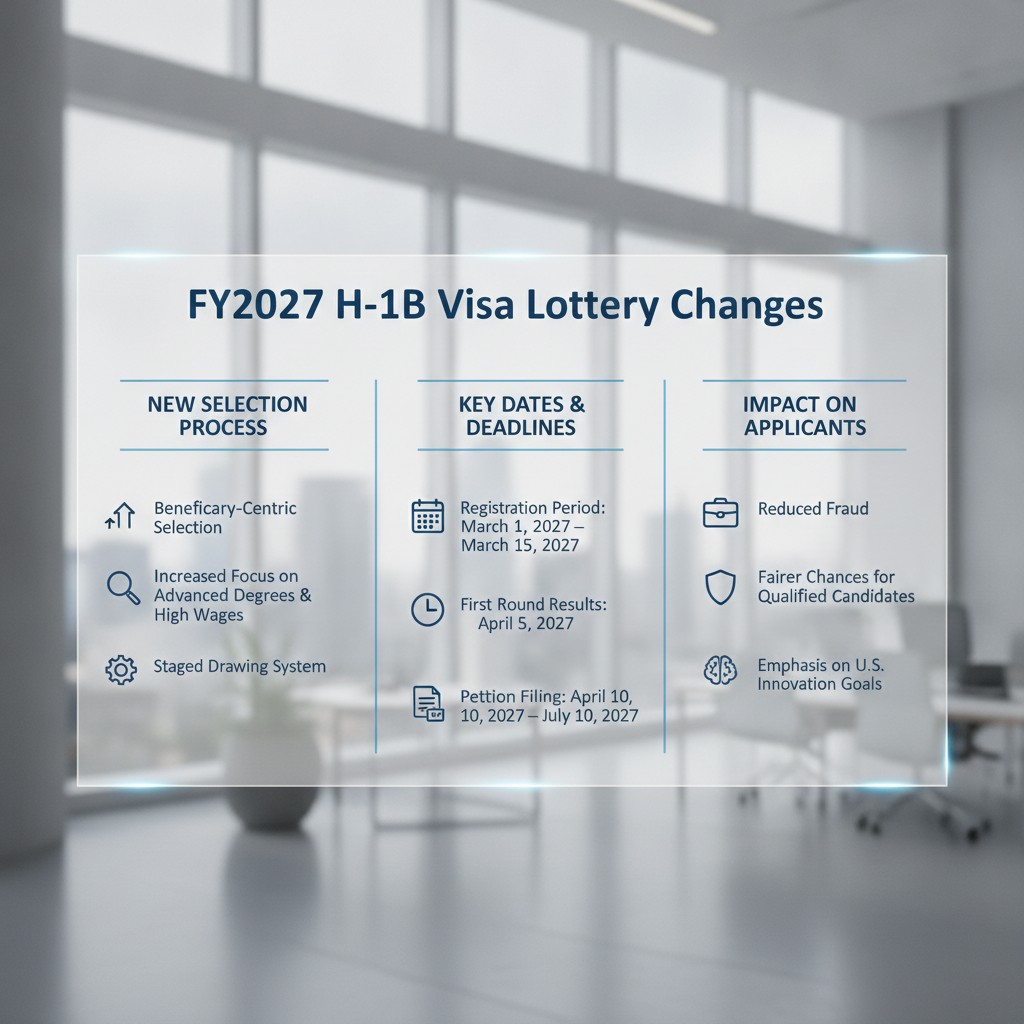
Simply put, the **H-1B visa lottery changes for FY2027** refer to the updated rules that USCIS implemented for how it selects registrations when the number of H-1B petitions exceeds the annual cap. The most significant shift, which first took effect for FY2025 and continued for FY2027, is the move from a **registrant-centric** selection process to a **beneficiary-centric** one. * **Old System (Registrant-Centric):** Each *registration* submitted by an employer was entered into the lottery. If a foreign national had multiple employers submit registrations on their behalf, they effectively had multiple "tickets" in the lottery, increasing their individual odds of selection, even if those additional registrations were not always for bona fide job offers. This led to concerns about fraud and unfair advantages. * **New System (Beneficiary-Centric):** For FY2027, the selection is based on each **unique beneficiary**. This means that regardless of how many employers submit a registration on behalf of a single foreign national, that individual is entered into the lottery only **one time**. If a beneficiary is selected, all employers who registered that beneficiary are notified and are eligible to file a petition on their behalf. This change aims to restore fairness, prevent individuals from artificially inflating their selection chances through multiple registrations, and ensure that every eligible beneficiary has an equal opportunity for selection.Key terms you need to know
Understanding these terms is crucial for navigating the H-1B process: * **H-1B Cap:** The annual limit on the number of H-1B visas issued. Currently, this is 65,000 for the regular cap, plus an additional 20,000 for those with a U.S. master's degree or higher (**Master's Cap**). * **Specialty Occupation:** An occupation that requires theoretical and practical application of a body of highly specialized knowledge, and a bachelor's or higher degree in the specific specialty (or its equivalent) as a minimum for entry into the occupation. * **Beneficiary:** The foreign national who will be employed in the specialty occupation. * **Petitioner:** The U.S. employer who is sponsoring the foreign national for the H-1B visa. * **H-1B Registration:** The initial online process where employers submit basic information about the beneficiary and the job offer to USCIS during a designated registration period (typically in March). This is the step that enters the beneficiary into the lottery. * **Selection Notice:** The notification from USCIS that a beneficiary's registration has been selected in the lottery, allowing the petitioning employer to file a full **Form I-129** petition. * **Form I-129, Petition for a Nonimmigrant Worker:** The primary form used by employers to petition USCIS for nonimmigrant workers, including H-1B. * **Cap-Exempt:** Certain employers are exempt from the annual H-1B cap, such as institutions of higher education, non-profit organizations affiliated with higher education, and non-profit research organizations or governmental research organizations. * **DHS Final Rule (89 FR 19528):** The official regulatory publication outlining the new beneficiary-centric selection process and other integrity measures for the H-1B program. This rule became effective March 4, 2024, impacting the FY2025 lottery and subsequent lotteries, including FY2027. The importance of these changes cannot be overstated. By focusing on the unique beneficiary, USCIS aims to ensure that the lottery process is more equitable and less susceptible to manipulation. This means that legitimate job offers from bona fide employers have a fairer chance, which ultimately benefits the U.S. economy and the integrity of the immigration system.Current Immigration Law: The Foundation
The H-1B visa program is authorized under the Immigration and Nationality Act (INA). Specifically, it falls under **INA § 101(a)(15)(H)(i)(b)**, which defines the H-1B nonimmigrant classification, and **INA § 214(g)**, which establishes the annual numerical limitations (the cap) and other conditions.Federal requirements
To qualify for an H-1B visa, both the employer and the prospective employee must meet specific federal requirements: * **For the Employer (Petitioner):** * Must have a U.S. Employer Identification Number (EIN). * Must offer a "specialty occupation" position. * Must agree to pay the beneficiary the higher of the actual wage paid to other employees with similar experience and qualifications, or the prevailing wage for the occupational classification in the area of intended employment. This is documented through a certified **Labor Condition Application (LCA)**, **Form ETA-9035**, filed with the U.S. Department of Labor (DOL). * Must have a bona fide job offer for the beneficiary. * **For the Employee (Beneficiary):** * Must hold a bachelor's degree or its equivalent, or a higher degree in a specialty occupation field. * Must possess a state license, if required, to practice the occupation. * Must have the qualifications required for the specialty occupation. * Must have a valid passport. **Important:** The H-1B visa is typically granted for an initial period of up to three years and can be extended for a total of six years. In certain circumstances, extensions beyond six years are possible, particularly if a green card process has been initiated.Florida-specific considerations
While H-1B is a federal program, its implementation has practical considerations for Florida residents and businesses: * **Prevailing Wage Determinations:** The prevailing wage for an occupation can vary significantly by geographic location. Employers in Orlando, Tampa, or Miami will need to adhere to the prevailing wage data specific to their Metropolitan Statistical Area (MSA), as determined by the DOL. * **Local Office Processing:** While H-1B petitions are processed by USCIS service centers, individuals seeking to change status or extend their stay might interact with the **Orlando USCIS Field Office** for biometrics appointments or interviews, although this is less common for initial H-1B petitions. * **State Licensing:** Certain professions in Florida, such as healthcare (doctors, nurses), engineering, and architecture, require specific state licenses. H-1B petitions for these roles often necessitate proof of licensure or eligibility for licensure. * **Economic Impact:** The H-1B program is crucial for Florida's growing tech sector, particularly in areas like simulation and modeling in Orlando, aerospace in Brevard County, and financial tech in South Florida. The changes impact the talent pipeline for these vital industries. For detailed information on forms, fees, and regulations, always refer to the USCIS official website.Considering an H-1B Petition? Imigrar provides expert legal guidance to employers and employees nationwide. Call +1 786-791-3106 for a free consultation. Se Habla Español.
How to Navigate the FY2027 H-1B Lottery Changes: A Complete Step-by-Step Guide
The H-1B process, especially with the lottery, can be daunting. The FY2027 changes add another layer of complexity. Here’s a comprehensive guide, incorporating the new rules:1) Employer Determines Eligibility and Need for H-1B Sponsorship
Before anything else, the U.S. employer must identify a need for a foreign worker in a specialty occupation. This means the job itself must require at least a bachelor's degree in a specific field. * **Documents Required (Internal Employer Assessment):** * Detailed job description outlining duties, responsibilities, and minimum educational requirements. * Organizational chart demonstrating where the position fits within the company. * Evidence of the employer's need for the position (e.g., business expansion plans, lack of qualified U.S. workers). * **Reminder:** The employer must be a legitimate U.S. entity with a valid EIN.2) Employer Files and Certifies a Labor Condition Application (LCA) with DOL
The employer must file **Form ETA-9035**, Labor Condition Application (LCA), with the U.S. Department of Labor (DOL). This form attests that the employer will pay the H-1B worker at least the prevailing wage or the actual wage, whichever is higher, and will provide working conditions that will not adversely affect other workers. * **Documents Required:** * Employer's EIN. * Detailed job description and requirements. * Proposed annual salary. * Worksite location(s). * **Important:** The LCA must be certified by the DOL before an H-1B petition can be filed. This process typically takes **7-10 business days**.3) Employer Registers for the H-1B Lottery (March 2026 for FY2027)
This is where the beneficiary-centric changes come into full effect. The employer (or their authorized representative, like Imigrar) creates a **USCIS online account** and submits an H-1B cap registration for each prospective beneficiary during the designated registration period (typically in March). * **Key Changes for FY2027:** * **Beneficiary-Centric Selection:** USCIS assigns a unique **beneficiary identification number** (e.g., passport number) to each individual. Even if multiple employers register the same beneficiary, that beneficiary only receives one entry in the lottery pool. * **Increased Registration Fee:** The fee for the H-1B cap registration increased for FY2027. For the FY2027 lottery, the fee was $10 per registration. However, USCIS has finalized a rule to increase the H-1B cap registration fee to $215 for the FY2028 cap season onwards. This is a significant increase. * **Documents/Information Required for Registration:** * Employer's legal name, mailing address, and EIN. * Employer's authorized signatory information. * Beneficiary's full legal name, date of birth, country of birth, country of citizenship, passport number, and gender. * Beneficiary's highest level of education and institution. * Whether the beneficiary holds a U.S. master's degree or higher. * **Warning:** Providing false information or engaging in fraudulent multiple registrations for the same beneficiary (even if through related entities) can lead to denial, revocation, and even criminal charges.4) If Selected, Employer Files Form I-129 Petition and Supporting Documents
If a beneficiary's registration is selected in the lottery (notifications typically occur in late March/early April), the employer is notified and has a **90-day window** to file the complete **Form I-129** petition with USCIS. * **Documents Required (Comprehensive List):** * **Form I-129**, Petition for a Nonimmigrant Worker. * Certified **LCA (Form ETA-9035)**. * Copy of the H-1B selection notice. * Petitioner's federal EIN confirmation. * Detailed **employer support letter** explaining the company, the job, the beneficiary's qualifications, and why the position is a specialty occupation. * Beneficiary's educational documents (diplomas, transcripts, foreign degree evaluations). * Beneficiary's resume/CV. * Copies of beneficiary's passport, visa, **Form I-94** (Arrival/Departure Record), and previous **Forms I-797** (Approval Notices) if applicable. * Evidence of employer's ability to pay the proffered wage (e.g., financial statements, tax returns). * Contracts, letters of support, or statements of work for third-party placements. * Photos (passport-style) of the beneficiary. * Applicable filing fees (base fee, ACWIA fee, fraud prevention and detection fee, public law 114-113 fee, premium processing fee if requested). * **Important:** The **start date flexibility** introduced for FY2025 (and applicable to FY2027) allows employers to request a start date later than October 1st, reflecting the reality of petition processing times. However, the petition still needs to be filed within the designated window.5) USCIS Processes the H-1B Petition
USCIS reviews the filed **Form I-129** petition and supporting documents. This involves checking for completeness, eligibility, and adherence to all H-1B regulations. * **Processing Times:** Standard processing can take anywhere from **6 to 12 months**, or even longer, depending on the service center and current caseload. You can check current processing times on the USCIS Processing Times page. * **Premium Processing:** For an additional fee, employers can opt for **Premium Processing**, which guarantees a response from USCIS (approval, denial, Request for Evidence, or Notice of Intent to Deny) within **15 calendar days**. This is highly recommended for time-sensitive cases. * **Request for Evidence (RFE):** USCIS may issue an RFE if they need more information or clarification. Responding to an RFE accurately and promptly is crucial. * **Site Visits:** USCIS conducts random site visits to employer locations, particularly for new employers or those sponsoring H-1B workers at third-party client sites, to verify the information provided in the petition.6) H-1B Petition Approval and Status Change or Visa Stamping
If the petition is approved, USCIS issues an **Approval Notice (Form I-797)**. * **For beneficiaries already in the U.S. (e.g., F-1 OPT) with a Change of Status request:** The approval notice will typically include an **I-94** reflecting the change to H-1B status, effective October 1st. The beneficiary can begin working for the H-1B employer on this date. * **For beneficiaries outside the U.S. or needing to travel:** They must apply for an H-1B visa stamp at a U.S. embassy or consulate abroad. This involves scheduling an interview, paying a visa application fee, and providing biometric data. The U.S. Department of State website provides consulate-specific information.7) Commencing H-1B Employment
Once the H-1B status is effective (October 1st for most, or upon entry with an H-1B visa), the beneficiary can begin working for the petitioning employer. * **Important:** H-1B status is employer-specific. If the H-1B worker wishes to change employers, the new employer must file a new H-1B petition (which is typically cap-exempt if the worker already holds H-1B status).Practical Steps You Can Take Today
Navigating the H-1B process, especially with the FY2027 changes, requires meticulous planning and execution. Here are actionable steps you can take: * **Educate Yourself and Your Employer:** Understand the beneficiary-centric selection process and its implications. Review the official USCIS guidance on the USCIS Forms page. * **Start Document Preparation Early:** Gather all necessary personal and educational documents well in advance. This includes diplomas, transcripts, foreign degree evaluations, passports, and previous visa documents. For employers, ensure job descriptions are precise and meet specialty occupation criteria. * **Verify Employer Legitimacy:** If you are a beneficiary, ensure your potential employer is a legitimate business with a strong track record. USCIS is scrutinizing employer-employee relationships more closely. * **Consult with an Experienced Immigration Attorney:** This is perhaps the most critical step. An attorney can assess eligibility, guide through the LCA process, prepare accurate registrations, and file robust **Form I-129** petitions, significantly increasing the chances of success. Imigrar offers free consultations to discuss your specific situation. * **Prepare for Potential RFEs:** Anticipate that USCIS might issue a Request for Evidence. Work with your attorney to gather any additional documentation or clarifications that might be requested. * **Budget for All Fees:** Beyond legal fees, remember to account for USCIS filing fees, LCA fees (if applicable), premium processing fees (if desired), and potential visa stamping fees. * **Monitor Processing Times and Updates:** Keep an eye on USCIS announcements and processing times. Immigration law is dynamic, and staying informed is key. **Timeline Expectations:** * **Late 2026 - Early 2027:** Evaluation of FY2027 lottery results and approvals. Planning for FY2028. * **March 2027:** H-1B cap registration period for **FY2028**. * **Late March/Early April 2027:** FY2028 H-1B lottery selection notifications. * **April - June 2027:** Filing of **Form I-129** petitions for selected FY2028 registrations. * **October 1, 2027:** Earliest start date for approved FY2028 H-1B petitions.How Imigrar Helps Immigrants in Orlando
At Imigrar, our commitment is to provide compassionate, expert legal representation to immigrants and their families in Orlando, Central Florida, and across the nation. We understand that navigating U.S. immigration law can be complex and stressful, especially with significant changes like those to the H-1B lottery. Our team of dedicated immigration attorneys possesses extensive experience in H-1B visa petitions, L-1 visas, O-1 visas, green cards, family petitions, and more. We pride ourselves on our meticulous approach, ensuring every detail is accurate and every argument is compelling. We stay abreast of the latest legal developments, including the nuances of the FY2027 H-1B changes, to provide our clients with the most current and effective strategies. If your case involves the Orlando USCIS Field Office, or if you're an employer along the **I-4 corridor** seeking to sponsor talent, we are uniquely positioned to provide localized insight combined with national expertise. We offer a **free consultation** to discuss your H-1B needs, assess your eligibility, and outline a clear path forward. Our goal is to simplify the complex, provide peace of mind, and ultimately, "Keep Families Together." Se Habla Español. We are proud to serve the diverse communities of Florida and beyond, ensuring language is never a barrier to receiving top-tier legal assistance.
Frequently Asked Questions
Q: What is the main change in the H-1B lottery for FY2027?
A: The primary change is the shift to a **beneficiary-centric** selection process. This means each unique foreign national (beneficiary) is entered into the lottery only once, regardless of how many employers register on their behalf. This aims to prevent fraud and ensure a fairer chance for all eligible individuals.
Q: How does the beneficiary-centric selection impact my eligibility concerns?
A: It doesn't change the fundamental eligibility criteria for the H-1B visa itself (e.g., holding a bachelor's degree in a specialty occupation). However, it does mean that simply having multiple employers register you will no longer increase your individual odds of selection. Your focus should be on securing a legitimate job offer from a bona fide employer that meets H-1B requirements.
Q: What is the impact on my current immigration status if I'm selected in the FY2027 lottery?
A: If you are currently in the U.S. on another nonimmigrant status (e.g., F-1 OPT, L-1, TN) and your H-1B petition is approved with a Change of Status request, your status will automatically change to H-1B on October 1st (or the petition's effective date). You can then begin working for your H-1B employer. If you are outside the U.S., you will need to apply for an H-1B visa stamp at a U.S. consulate abroad to enter the country in H-1B status.
Q: What are the typical timeline and processing expectations for an H-1B petition after selection?
A: After selection, employers typically have **90 days** to file the **Form I-129** petition. Standard processing times can range from **6 to 12 months** or more. If you opt for **Premium Processing**, USCIS guarantees a response within **15 calendar days** for an additional fee. The earliest start date for approved H-1B petitions is October 1st of the fiscal year.
Q: What documents are absolutely essential for an H-1B petition under the new rules?
A: Key documents include the certified **Labor Condition Application (LCA)**, the **Form I-129** petition, copies of the beneficiary's passport, visa, **Form I-94**, academic credentials (diplomas, transcripts, foreign degree evaluations), and a detailed employer support letter. For a comprehensive list, consult with an attorney or refer to the USCIS Forms section for Form I-129 instructions.
Q: What are the cost considerations
Related Topics
Need Legal Assistance?
Our experienced immigration attorneys are here to help with your case. Contact Imigrar today for a free consultation and let us guide you through the legal process with confidence.
📍 Orlando, Florida • Serving clients nationwide
📧 info@imigrar.com