
Navigating EAD Processing: Your Guide to USCIS Updates & Work
Stay informed on the latest USCIS EAD processing updates. This comprehensive guide helps Orlando and Florida immigrants understand work permit applications, renewals, and how to keep families together.

The ability to work legally in the United States is a cornerstone of building a new life for many immigrants. For those residing in Orlando, across Florida, and nationwide, the Employment Authorization Document (EAD), often referred to as a work permit, is critical. Recently, USCIS has continued to address processing backlogs and implement updates that directly impact EAD applicants and those seeking renewals. Understanding these changes is vital for maintaining your legal right to work and support your family.
At Imigrar, an immigration law firm based in Orlando, Florida, we are committed to helping you navigate the complexities of U.S. immigration law. Our mission, "Keep Families Together," drives us to provide clear, actionable guidance on crucial topics like EAD processing. This comprehensive guide will break down the latest developments, provide a step-by-step application process, and offer practical advice to empower you.
Need Help? Our Orlando immigration team is ready to assist. Call +1 786-791-3106 for a free consultation, or message us online. Se Habla Español.
The reporting that sparked this guide:
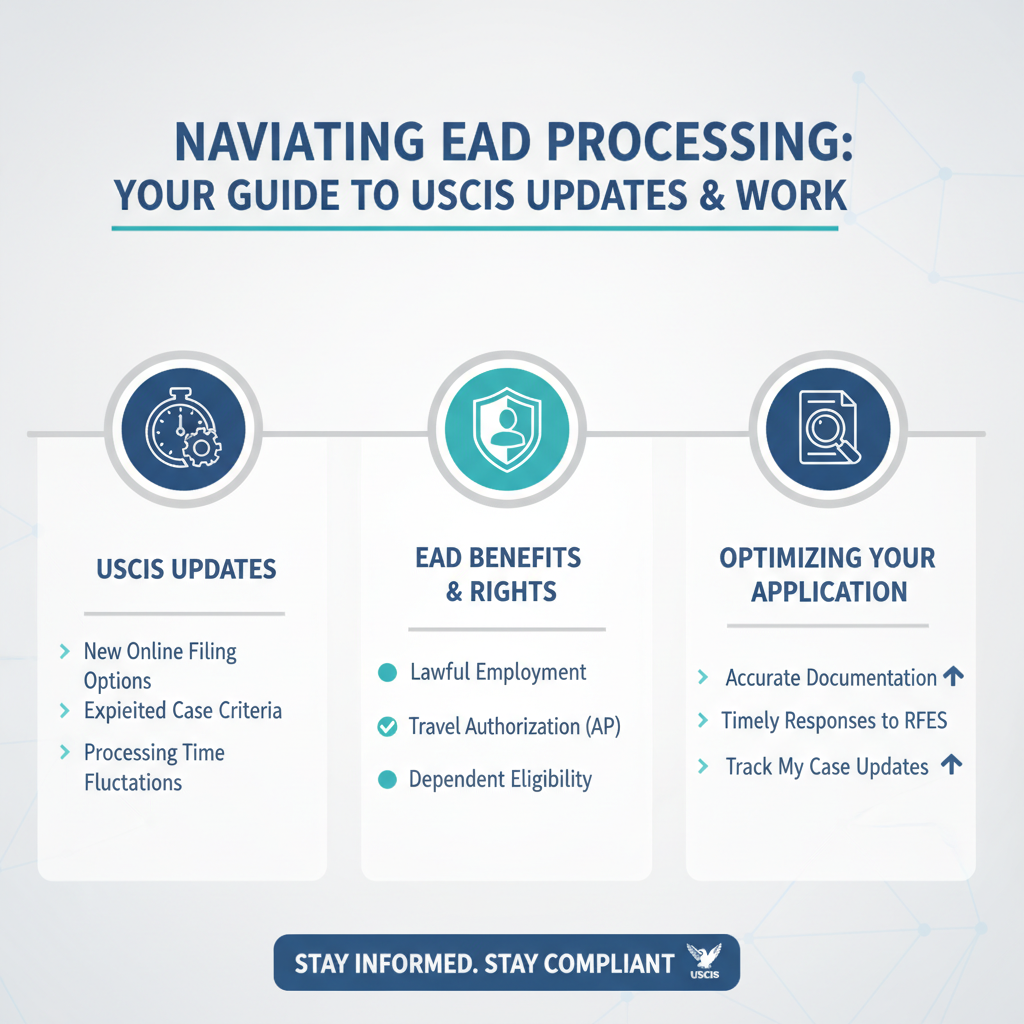
Employment Authorization Document Processing (USCIS)
What This News Means for Immigrants in Orlando and Across Florida
In late 2026, the ongoing efforts by U.S. Citizenship and Immigration Services (USCIS) to streamline processing and reduce backlogs, particularly for Employment Authorization Documents (EADs), remain a significant topic. These updates are a direct response to past challenges that led to extensive delays, leaving many immigrants unable to work and support themselves or their families. For individuals and families throughout Florida, especially in rapidly growing areas like Orlando and along the I-4 corridor, these changes have profound implications.
Why this news is showing up now
The "news" surrounding EAD processing isn't a single, isolated event but rather a continuous narrative of USCIS adapting to unprecedented application volumes and striving to improve efficiency. Over the past few years, USCIS has faced immense pressure to address the growing backlog of cases, including Form I-765 applications for employment authorization. In response, they've implemented a series of initiatives:
- Increased Staffing and Resource Allocation: USCIS has been working to hire additional personnel and reallocate resources to tackle the backlog head-on. This includes training new officers and modernizing internal systems.
- Temporary Policy Changes: While the 540-day automatic extension for certain EAD categories was a temporary measure introduced in 2022 to prevent gaps in employment authorization, the agency continues to evaluate and adjust policies to maintain work authorization for eligible applicants. The principle behind such measures—to prevent eligible individuals from losing their ability to work due to processing delays—remains a guiding factor in their ongoing updates.
- Expansion of Premium Processing: For certain EAD categories, USCIS has expanded premium processing options, allowing applicants to pay an additional fee for expedited adjudication. This provides a crucial option for those with urgent needs, though it comes at an extra cost.
- Digitalization Efforts: A long-term goal for USCIS is to move towards more online filing and digital processing, which aims to reduce manual errors and speed up adjudication times. The ability to file Form I-765 online for many categories is a key part of this modernization.
- Public Engagement and Transparency: USCIS regularly publishes processing times and updates on its website, providing a level of transparency that allows applicants and legal practitioners to track progress and anticipate timelines. These ongoing updates are what keep EAD processing in the news cycle.
These efforts collectively aim to prevent the severe work disruptions experienced in previous years, emphasizing USCIS's commitment to ensuring eligible individuals can maintain employment.
How it can affect Florida residents
For the diverse immigrant communities across Florida, from Miami to Tampa to Orlando and Jacksonville, these USCIS updates have direct and significant impacts:
- Reduced Anxiety and Economic Stability: Faster processing times, or even the assurance of automatic extensions during renewal periods, directly translates to reduced anxiety for individuals and families. It means a steady income can be maintained, allowing residents to pay bills, support their dependents, and contribute to the local economy in places like Orange County.
- Workforce Continuity for Employers: Florida's economy relies heavily on a robust workforce. Employers, particularly in sectors like hospitality, agriculture, and healthcare that often employ immigrants, benefit immensely from a stable workforce. Predictable EAD processing means less disruption for businesses in Orlando and throughout the state.
- Planning for the Future: Immigrants seeking to adjust their status, asylum seekers, DACA recipients, and H-4 visa holders in Central Florida rely on EADs to plan their lives, pursue education, or start businesses. Clearer timelines allow for better long-term planning.
- Local USCIS Impact: While EAD applications are generally processed at service centers, the Orlando USCIS Field Office plays a role in related processes, such as biometrics appointments. Efficient service center operations ease the burden on local field offices and ensure smoother overall processing for Florida residents.
- Importance of Timely Filing: With ongoing changes, the message for Florida residents is clear: stay informed and file your applications, especially renewals, as early as possible. Understanding your specific eligibility category and the associated processing times is more critical than ever.
Important: The landscape of EAD processing is dynamic. While the goal is improvement, individual case processing times can still vary based on factors like the application category, completeness of the submission, and current USCIS workload. This is why professional legal guidance is invaluable.
What Employment Authorization Document (EAD) Processing Is (and Why It Matters)
The Employment Authorization Document (EAD) is a critical document for many non-U.S. citizens who wish to work legally in the United States. It serves as proof that an individual is authorized by the U.S. government to be employed in the country for a specific period. Without an EAD, most non-immigrants and some immigrants cannot legally hold a job, which can severely impact their ability to support themselves and their families.
A plain-English definition
Think of an EAD as your official permission slip from the U.S. government to work. It’s a card, similar to a driver’s license, that proves you are allowed to be employed in the United States. It does not grant you immigration status itself, but rather grants you the ability to work based on an underlying immigration status or application you have pending. For example, if you are seeking asylum, have applied for a Green Card (Adjustment of Status), or are a spouse of certain visa holders, you might be eligible for an EAD while your main immigration case is being processed.
The process of "EAD processing" refers to the entire journey of applying for this document, from submitting your application to USCIS, through background checks and biometrics, to the final decision and mailing of your card. With millions of applications annually, USCIS constantly works to manage this high volume efficiently.
Key terms you need to know
Navigating immigration law requires understanding specific terminology. Here are some key terms related to EADs:
- Employment Authorization Document (EAD): The official card issued by USCIS that proves you are authorized to work in the U.S. Also known as a "work permit."
- USCIS (U.S. Citizenship and Immigration Services): The federal agency responsible for administering the country's lawful immigration system, including processing EAD applications. USCIS official website
- Form I-765, Application for Employment Authorization: This is the specific form you must file with USCIS to apply for or renew your EAD.
- Adjustment of Status (AOS): The process of applying for lawful permanent resident status (a Green Card) while physically present in the United States. Individuals with a pending Form I-485 (Application to Adjust Status) are often eligible for an EAD.
- Asylum: Protection granted to foreign nationals who meet the definition of refugee and are already in the U.S. or seeking admission at a port of entry. Asylum applicants with pending Form I-589 applications are typically eligible for EADs after a certain waiting period.
- Deferred Action for Childhood Arrivals (DACA): A policy that allows certain undocumented immigrants who entered the U.S. as children to receive a renewable two-year period of deferred action from deportation and eligibility for an EAD.
- Temporary Protected Status (TPS): A temporary immigration status granted to eligible nationals of certain countries designated by the Secretary of Homeland Security due to conditions in the country that temporarily prevent its nationals from returning safely. TPS beneficiaries are eligible for EADs.
- Optional Practical Training (OPT): A period during which F-1 nonimmigrant students can work in a field directly related to their major area of study. OPT students require an EAD.
- H-4 EAD: Employment authorization specifically for certain H-4 dependent spouses of H-1B nonimmigrants who are seeking lawful permanent resident status.
- Biometrics Appointment: An appointment at an Application Support Center (ASC) where USCIS collects fingerprints, photographs, and a signature for background checks. Many EAD applicants are required to attend one.
- Request for Evidence (RFE): A notice from USCIS asking for additional information or documents to support your application.
- Notice of Intent to Deny (NOID): A notice from USCIS indicating their intention to deny your application, allowing you a chance to respond before a final decision.
- Processing Times: The estimated time it takes USCIS to process a specific type of application. These can vary significantly by form type and service center. USCIS Processing Times
Understanding these terms is the first step to successfully navigating your EAD application or renewal. The process, while seemingly straightforward, requires meticulous attention to detail and knowledge of your specific eligibility category.
Current Immigration Law: The Foundation for EADs
The authority for granting employment authorization to non-citizens in the United States stems primarily from the Immigration and Nationality Act (INA) and its implementing regulations in the Code of Federal Regulations (CFR). While there isn't one single law specifically titled "EAD Law," various sections of the INA and 8 CFR outline the eligibility categories and procedures for obtaining work authorization.
At its core, the INA, particularly sections like INA § 274A (which defines unlawful employment of aliens and establishes employer sanctions), necessitates that non-citizens prove their authorization to work. The regulations at 8 CFR § 274a.12 specifically list the different categories of non-citizens who are eligible for employment authorization and can apply for an EAD by filing Form I-765.
Federal requirements
Federal law dictates the comprehensive framework for EAD eligibility. Generally, an individual must fall into one of the specific categories outlined in 8 CFR § 274a.12 to be eligible for an EAD. These categories are diverse and include, but are not limited to:
- Asylum Seekers: Individuals who have filed Form I-589, Application for Asylum and for Withholding of Removal, and whose application has been pending for at least 150 days (with some exceptions).
- Applicants for Adjustment of Status: Individuals with a pending Form I-485, Application to Register Permanent Residence or Adjust Status, based on an approved immigrant petition (e.g., Form I-130, Petition for Alien Relative, or Form I-140, Immigrant Petition for Alien Worker).
- Fiancé(e)s of U.S. Citizens: K-1 nonimmigrants and their K-2 dependents, after admission to the U.S.
- Spouses of U.S. Citizens or Lawful Permanent Residents: Certain individuals with pending Form I-130 and Form I-485 applications.
- Temporary Protected Status (TPS) Beneficiaries: Nationals of designated countries.
- Deferred Action for Childhood Arrivals (DACA) Recipients: Individuals granted deferred action.
- F-1 Students with Optional Practical Training (OPT): Students authorized to work in their field of study.
- H-4 Spouses: Certain H-4 dependent spouses of H-1B nonimmigrants who have an approved Form I-140 or whose H-1B spouse has been granted an extension of stay beyond the six-year limit.
- Refugees and Asylees: Individuals granted refugee or asylum status.
Each category has specific requirements, such as the need for a pending application (like Form I-485 or Form I-589), a certain immigration status, or a specific relationship to a U.S. citizen or lawful permanent resident. It is absolutely crucial to correctly identify your eligibility category when filing Form I-765, as this impacts the required documentation and the adjudication process.
Reminder: The rules for each category are complex and can change. Always refer to the USCIS official website for the most current information and instructions for Form I-765.
Florida-specific considerations
While EAD eligibility and processing are governed by federal law, there are practical considerations for immigrants residing in Florida:
- No State-Level EAD Laws: Florida does not have its own laws governing EAD eligibility or issuance; these are strictly federal matters handled by USCIS. The requirements discussed above apply equally to residents of Orlando, Miami, Tampa, or any other part of Florida.
- Local USCIS Field Office: The Orlando USCIS Field Office primarily handles interviews for Green Card applications (Form I-485) and naturalization. While EAD applications (Form I-765) are usually processed at USCIS Service Centers, you might be scheduled for a biometrics appointment at an Application Support Center (ASC) in Orlando or a nearby city if you reside in Central Florida.
- State-Specific Identity Documents: Once you receive your EAD, it is a primary document used to obtain a Florida driver's license or state identification card. Florida's Department of Highway Safety and Motor Vehicles (FLHSMV) requires proof of lawful presence and employment authorization for these purposes.
- Employment Opportunities: Florida's diverse economy, including tourism, agriculture, healthcare, and technology, offers various employment opportunities for EAD holders. Understanding local job market demands can be beneficial once you have your work authorization.
- Legal Support: For Central Florida residents, having access to experienced immigration attorneys in Orlando, like Imigrar, is invaluable for navigating the federal EAD process, especially when dealing with complex eligibility issues or responding to RFEs.
Understanding that your EAD is a federal document but impacts your daily life at the state and local levels is key. Compliance with federal immigration law is paramount for all Florida residents seeking work authorization.
Need Help? Our Orlando immigration team is ready to assist. Call +1 786-791-3106 for a free consultation, or message us online. Se Habla Español.
How to Apply for or Renew Your EAD: A Complete Step-by-Step Guide
Applying for an Employment Authorization Document (EAD) or renewing an existing one can be a detailed process. Following these steps carefully will help ensure your application is complete and accurate, minimizing potential delays. This guide focuses on the general process, but remember that specific requirements can vary based on your eligibility category.
1) Determine Your Eligibility Category
Before you even touch Form I-765, you must accurately identify your eligibility category. This is the most crucial first step, as it dictates what documents you need to submit and which box you check on the form. Refer to 8 CFR § 274a.12 and the Form I-765 instructions to find your specific category (e.g., (c)(9) for Adjustment of Status applicants, (c)(8) for asylum applicants, (c)(3)(C) for STEM OPT). Misidentifying your category can lead to significant delays or even denial.
- Action: Review the USCIS website's "Employment Authorization" section and the instructions for Form I-765 to precisely determine your eligibility code. If you have a pending primary immigration application (like Form I-485 or Form I-589), your EAD eligibility is likely tied to that.
2) Gather Required Documents
Once your eligibility category is clear, compile all necessary supporting documentation. This step requires meticulous organization. Generally, you will need:
- Copy of your most recent I-94 Arrival/Departure Record: This proves your lawful entry and current authorized period of stay.
- Copies of previous EADs (if applicable): Especially important for renewals.
- Copies of government-issued identification: Such as passport bio-page, visa, or birth certificate (with translation if not in English).
- Two identical passport-style photos: Taken within 30 days of filing, meeting USCIS specifications.
- Proof of eligibility for your category:
- For Adjustment of Status (AOS) applicants (c)(9): Copy of Form I-485 receipt notice, copy of Form I-130 or Form I-140 approval notice.
- For Asylum applicants (c)(8): Copy of Form I-589 receipt notice.
- For H-4 spouses (c)(26): Copy of H-4 I-797 approval notice, copy of H-1B spouse's I-797 approval notice, H-1B spouse's approved Form I-140 (if applicable).
- For DACA recipients (c)(33): Proof of deferred action.
- For F-1 OPT (c)(3)(A)/(B)/(C): Copy of I-20 with OPT recommendation, academic transcripts, degree.
- Proof of any previous immigration benefits: Notices of Approval (I-797) for previous visas or petitions.
- Birth Certificate (with certified English translation if applicable).
- Marriage Certificate (with certified English translation if applicable).
- Copy of your Social Security card (if you have one).
Warning: Ensure all documents are clear, legible copies. If a document is not in English, it must be accompanied by a complete and certified English translation.
3) Complete Form I-765, Application for Employment Authorization
Fill out Form I-765 completely and accurately. This form can be filed online for many categories, which USCIS encourages. If filing by mail, ensure you use the most current version of the form, available on the USCIS Forms page.
- Personal Information: Provide your full legal name, address (including your Orlando, Florida address if applicable), date of birth, country of birth, and A-Number (if you have one).
- Eligibility Category: Enter the correct eligibility category code you determined in Step 1.
- Question 26 (Previous EAD): If renewing, indicate that you are applying for a renewal and provide information from your previous EAD.
- Part 3 (Applicant's Statement): Sign the form in blue ink if filing by mail. Do not forget this step, as an unsigned form will be rejected.
Important: Be truthful and consistent with information provided on previous immigration forms. Discrepancies can lead to RFEs or denial.
4) Prepare Your Application Packet
Once Form I-765 is completed and all supporting documents are gathered, assemble your application packet. If filing by mail:
- Filing Fee: Include the correct filing fee (currently $410 as of late 2026, but always check USCIS official website for the most current fee). You can pay by money order, personal check, cashier's check, or credit card using Form G-1450, Authorization for Credit Card Transactions. Fee waivers may be available for certain categories; check eligibility for Form I-912, Request for Fee Waiver.
- Cover Letter (Optional but Recommended): A cover letter listing all contents of your application packet helps USCIS caseworkers quickly verify your submission.
- Order: Organize your documents in the order listed on your cover letter or as recommended in the Form I-765 instructions. Place the fee payment and Form I-765 on top.
- Make Copies: Make a complete copy of the entire application packet for your records before mailing.
5) File Your Application with USCIS
Submit your completed application to the correct USCIS filing address. The address depends on your eligibility category and where you live. Check the "Where to File" section on the Form I-765 page of the USCIS website. Many categories now allow for online filing, which is often faster and provides instant receipt confirmation.
- Online Filing: If eligible, create a USCIS online account and follow the instructions to upload documents and pay fees digitally.
- Mail Filing: Use a reputable mail service with tracking (e.g., USPS Certified Mail with Return Receipt, FedEx, UPS). This provides proof of mailing and delivery.
Reminder: For Central Florida residents, your mailing address will typically direct you to a USCIS Service Center (e.g., California, Nebraska, Texas, or Vermont Service Center), not the Orlando USCIS Field Office.
6) Attend Biometrics Appointment (If Required)
Most EAD applicants will receive a notice for a biometrics appointment at a local Application Support Center (ASC). This appointment is crucial for background checks and identity verification.
- What to Bring: Your appointment notice, a valid photo ID (e.g., passport, driver's license).
- What to Expect: Fingerprints, a photograph, and a digital signature will be taken. The process is usually quick.
- Rescheduling: If you cannot attend, follow the instructions on the notice to reschedule, but do so promptly as delays can impact your application.
Important: If your biometrics are reused from a previous application, you may not receive a new appointment notice.
7) Monitor Your Case Status and Respond to RFEs
After filing, you will receive a receipt notice (Form I-797C) from USCIS. Use the receipt number on this notice to track your case status online via the
Related Topics
Need Legal Assistance?
Our experienced immigration attorneys are here to help with your case. Contact Imigrar today for a free consultation and let us guide you through the legal process with confidence.
📍 Orlando, Florida • Serving clients nationwide
📧 info@imigrar.com