
H-1B Visa Lottery FY2027: Navigating the New Rules & What's Next
Understand the significant H-1B visa lottery changes for FY2027, including beneficiary-centric selection. Imigrar provides a comprehensive guide for immigrants in Orlando and nationwide.

The landscape of U.S. immigration law is constantly evolving, and few areas demand as much attention and careful navigation as the H-1B visa program. For Fiscal Year 2027, significant changes to the H-1B visa lottery system have reshaped the process for employers and prospective beneficiaries alike. At Imigrar, an Orlando-based immigration law firm serving clients nationwide, we understand the critical importance of staying ahead of these updates to provide our clients with accurate, actionable advice.
The reporting that sparked this guide
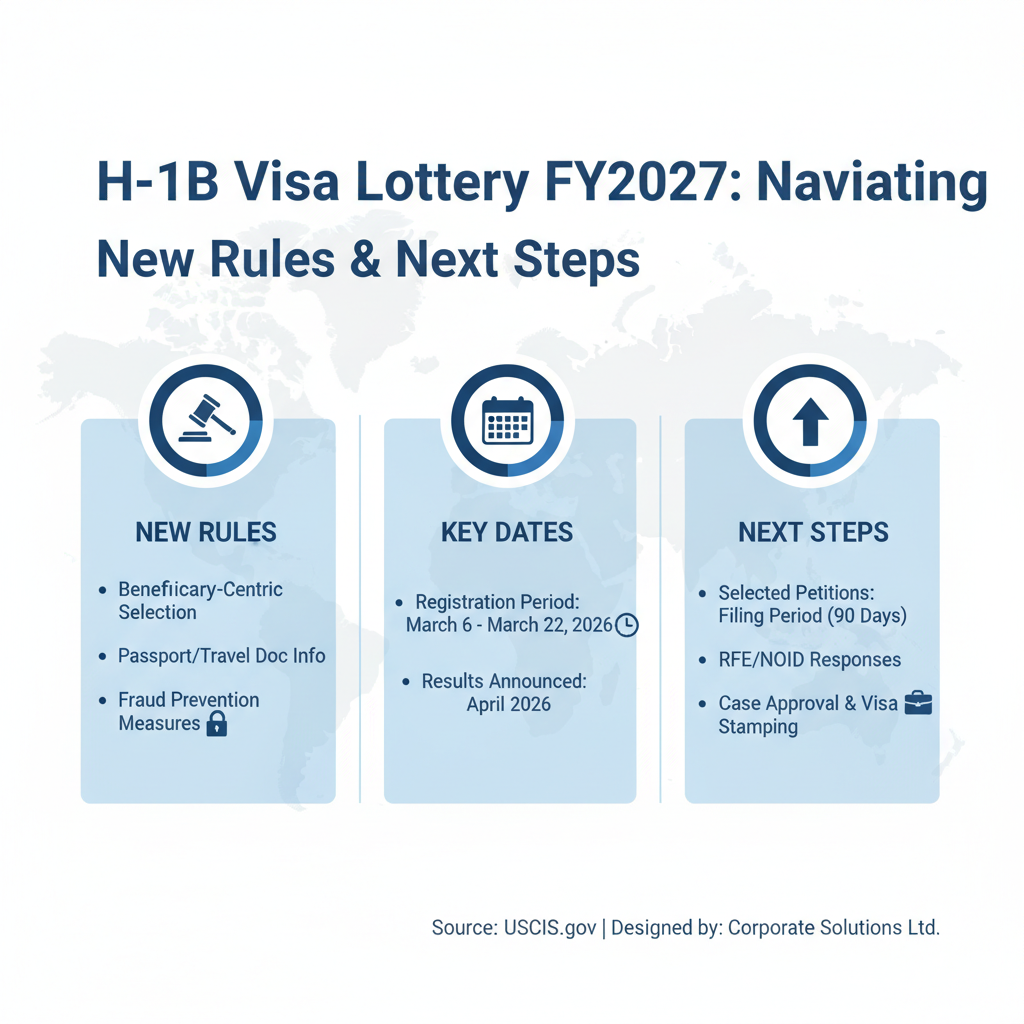
The information and insights presented in this comprehensive guide are informed by ongoing developments in immigration law, particularly those reported by legal news outlets regarding the H-1B visa lottery process. For a broader overview of current trends, you can refer to the following source:
H-1B Visa Lottery Changes for FY2027 (Legal News)
What This News Means for Immigrants in Orlando and Across Florida
The H-1B visa program is a lifeline for many skilled foreign workers and the U.S. companies that rely on their expertise. As we navigate the post-FY2027 lottery period, understanding the implications of the new rules is paramount for anyone involved or planning to be involved in this competitive process. For immigrants in Orlando, across Florida, and throughout the nation, these changes directly impact career aspirations, business strategies, and family unity.
Why this news is showing up now
The "news" surrounding the H-1B visa lottery for FY2027 is not about a sudden, brand-new announcement today, September 23, 2026. Instead, it reflects the ongoing analysis, impact assessment, and lessons learned from the significant regulatory updates that governed the FY2027 lottery cycle. These changes, primarily the implementation of a beneficiary-centric selection process, were finalized and put into effect by U.S. Citizenship and Immigration Services (USCIS) to combat fraud and enhance the integrity of the H-1B cap lottery. While the FY2027 lottery registration and selection phases have concluded (typically occurring in March of the preceding fiscal year, so March 2026 for FY2027), the implications of these new rules are still very much a topic of discussion. Many beneficiaries are currently awaiting or have received approvals for their H-1B petitions, preparing for their October 1, 2026, start dates, or unfortunately dealing with denials. This ongoing reality makes the changes highly relevant as we evaluate the outcomes of the FY2027 cycle and look ahead to future lotteries.
How it can affect Florida residents
Florida, particularly Central Florida and cities like Orlando, is a hub for innovation, tourism, healthcare, and technology. Industries ranging from theme parks and hospitality to advanced manufacturing, aerospace, and IT heavily rely on a skilled workforce, often including foreign talent. The H-1B visa program is crucial for these sectors to attract and retain top professionals. For Florida residents:
- Employers: Businesses in Orlando and the I-4 corridor, especially those in tech, engineering, and healthcare, must meticulously adhere to the new beneficiary-centric registration rules. Failure to do so can result in disqualification, loss of valuable talent, and potential legal repercussions.
- Prospective Beneficiaries: Individuals living in or aspiring to work in Florida, particularly those with advanced degrees in STEM fields, need to understand that the playing field has changed. While the new rules aim for fairness by preventing multiple entries for one person, the overall competition for the limited H-1B visas remains intense.
- Educational Institutions: Graduates from Florida universities like the University of Central Florida (UCF), University of Florida (UF), and Florida International University (FIU) who are on Optional Practical Training (OPT) or STEM OPT often seek H-1B sponsorship. These changes directly impact their post-graduation career paths within the state.
- Economic Impact: A more transparent and fair H-1B lottery system can stabilize the workforce for Florida businesses, fostering economic growth and innovation. Conversely, any perceived hurdles could affect the state's ability to attract global talent.
Understanding these shifts is not just about compliance; it's about strategizing for success in a highly competitive environment. Imigrar is deeply rooted in the Orlando community, and our team is uniquely positioned to assist both employers and individuals navigate these complex federal regulations with a local understanding.
Need Help Navigating H-1B Changes? Our Orlando immigration team is ready to assist. Call +1 786-791-3106 for a free consultation, or message us online. Se Habla Español.
What H-1B Visa Lottery Changes for FY2027 Is (and Why It Matters)
The H-1B visa program allows U.S. employers to temporarily employ foreign workers in specialty occupations. A "specialty occupation" generally requires a bachelor's degree or higher in a specific field. Due to high demand and an annual statutory cap, USCIS conducts a lottery to select eligible registrations when the number of registrations exceeds available visas.
A plain-English definition
Imagine a highly sought-after job that many people want, but there are only a limited number of positions available each year. That's essentially the H-1B visa. The "lottery" is the system USCIS uses to fairly pick who gets a chance to apply for one of these visas when too many people register. For FY2027, the big change was how they conducted this lottery: instead of selecting based on each *registration* (which allowed multiple employers to register the same person, potentially inflating their chances), USCIS now selects based on each *person* (the beneficiary). This means if five different companies registered you, your name only goes into the lottery once. This aims to make the process fairer and reduce fraudulent or speculative registrations.
Key terms you need to know
- H-1B Visa: A nonimmigrant visa that allows U.S. employers to temporarily employ foreign workers in specialty occupations.
- Specialty Occupation: An occupation that requires theoretical and practical application of a body of highly specialized knowledge, and a bachelor's degree or higher in the specific specialty (or its equivalent) as a minimum for entry into the occupation in the U.S.
- Annual Cap: The statutory limit on the number of H-1B visas issued each fiscal year. Currently, it's 65,000 for the regular cap and an additional 20,000 for the U.S. Master's Cap (for those with a U.S. master's degree or higher).
- Cap-Subject: Refers to H-1B petitions that are subject to the annual statutory cap. Certain employers (like universities, non-profit research organizations, government research organizations) are cap-exempt.
- Beneficiary: The foreign national who is seeking the H-1B visa.
- Petitioner: The U.S. employer who files the H-1B petition on behalf of the beneficiary.
- H-1B Registration Period: A designated period, typically in March, during which employers submit electronic registrations for prospective H-1B beneficiaries for the upcoming fiscal year's lottery.
- Beneficiary-Centric Selection: The new lottery process (implemented for FY2025 and continuing for FY2027) where selections are made based on each unique beneficiary listed in a registration. If a beneficiary has multiple registrations submitted on their behalf by different employers, they are entered into the lottery only once. This significantly reduces the chances of fraud or multiple entries by a single individual.
- Form I-129: The Petition for a Nonimmigrant Worker, which is the primary form filed by an employer to request H-1B classification for a beneficiary once selected in the lottery.
- Labor Condition Application (LCA) (Form ETA-9035): A form filed with the U.S. Department of Labor (DOL) by the employer, attesting that they will pay the H-1B worker at least the prevailing wage for the occupation in the area of employment and provide working conditions that will not adversely affect other workers. This must be certified before filing Form I-129.
- Premium Processing: An optional service offered by USCIS that guarantees processing of certain petitions (like H-1B) within 15 calendar days for an additional fee.
- Request for Evidence (RFE): A notice from USCIS requesting additional documentation or information to support an H-1B petition.
These terms are foundational to understanding the H-1B process, especially with the recent beneficiary-centric changes. The shift aims to ensure that every eligible individual has an equal and fair chance in the lottery, regardless of how many employers are willing to sponsor them.
Current Immigration Law: The Foundation
The H-1B visa program operates under the authority of the Immigration and Nationality Act (INA), specifically Section 101(a)(15)(H)(i)(b) and Section 214(g). These statutes establish the framework for nonimmigrant specialty occupation workers, including the annual numerical limitations (the cap) and exemptions. Regulatory provisions found in 8 CFR Part 214 further detail the requirements for H-1B petitions, including eligibility criteria, filing procedures, and employer attestations.
Federal requirements
To qualify for an H-1B visa, both the employer and the beneficiary must meet specific federal requirements:
- Specialty Occupation: The job offered must meet the definition of a specialty occupation, meaning it requires a bachelor's degree or higher in a specific field.
- Beneficiary Qualifications: The beneficiary must hold a bachelor's degree or its equivalent, or possess a license in a specialty occupation field, or have work experience equivalent to a bachelor's degree.
- Employer-Employee Relationship: A valid employer-employee relationship must exist between the petitioner and the beneficiary.
- Wage Requirements: The employer must pay the H-1B worker at least the prevailing wage for the occupation in the area of employment or the actual wage paid to other employees with similar experience and qualifications, whichever is higher. This is attested to in the Labor Condition Application (LCA).
- H-1B Cap: Unless cap-exempt, the petition must be filed during a period when H-1B visas are available under the annual cap, usually after selection in the lottery.
- Fraud Prevention: USCIS has increased its focus on fraud detection, especially in light of past lottery abuses. The new beneficiary-centric selection method for FY2027 is a direct response to this, aiming to prevent individuals from gaining an unfair advantage through multiple employer registrations.
Florida-specific considerations
While H-1B law is federal, its application has practical considerations in Florida. The Orlando USCIS Field Office, though not directly involved in H-1B petition processing (which is handled by service centers), plays a role in related matters such as interviews for Adjustment of Status or other immigration benefits for H-1B workers seeking permanent residency. For Central Florida residents, understanding the local economic landscape is crucial:
- Key Industries: Florida's growing tech, aerospace, healthcare, and engineering sectors often sponsor H-1B visas. Employers in these industries in Orlando, Tampa, and Miami are regular participants in the lottery.
- Prevailing Wage: The prevailing wage for a specialty occupation can vary significantly based on the specific location within Florida. An H-1B worker in Orlando might have a different prevailing wage than one in Tallahassee, impacting the employer's cost and compliance obligations.
- Local Talent Pool: Florida universities produce a significant number of graduates in STEM fields. Many international students graduating from these institutions seek H-1B sponsorship to remain and work in the state, contributing to its economy.
Important: All H-1B petitions begin with the employer filing the Labor Condition Application (LCA) Form ETA-9035 with the Department of Labor, followed by the electronic registration for the lottery, and then the filing of Form I-129, Petition for a Nonimmigrant Worker, with USCIS upon selection.
For official information and to download forms, always refer to the USCIS official website.
How to Navigate the H-1B Visa Lottery Changes for FY2027: A Complete Step-by-Step Guide
Successfully navigating the H-1B lottery process, especially with the beneficiary-centric changes, requires meticulous planning and adherence to strict timelines. This guide outlines the typical steps involved, reflecting the process for FY2027 and beyond.
1) Understand the New Rules & Eligibility
Before any action is taken, both the employer and the prospective beneficiary must have a clear understanding of the updated H-1B lottery rules, particularly the beneficiary-centric selection process. This means that each unique beneficiary can only be selected once, regardless of how many employers register on their behalf. Fraudulent or multiple registrations for the same beneficiary by related entities will lead to disqualification. Ensure the beneficiary meets the minimum educational or experience requirements for a specialty occupation.
-
Required Documents (for assessment):
- Beneficiary's educational credentials (degrees, transcripts, evaluations).
- Beneficiary's resume/CV detailing work experience.
- Employer's job description, outlining specialty occupation duties.
- Employer's Federal Employer Identification Number (FEIN).
2) Employer Registration for the Lottery (Beneficiary-Centric)
The first formal step for a cap-subject H-1B petition is the electronic registration process. This typically opens in March for the fiscal year beginning October 1. The employer (petitioner) must create a USCIS online account and submit a registration for each prospective H-1B beneficiary. Under the new rules, each beneficiary must have a unique passport number or travel document number. This ensures that even if multiple employers register the same beneficiary, that beneficiary only gets one entry into the lottery.
-
Key Information Required for Registration:
- Employer's legal name, FEIN, and mailing address.
- Employer's authorized signatory information.
- Beneficiary's full legal name, date of birth, country of birth, country of citizenship.
- Beneficiary's gender.
- Beneficiary's passport number or travel document number.
- Whether the beneficiary has a U.S. master's degree or higher (for the U.S. Master's Cap).
- The required registration fee (which increased for FY2025 and subsequent years).
Warning: Any false statements or fraudulent registrations will lead to severe consequences, including petition denial, revocation of approvals, and potential criminal penalties.
Confused by the H-1B Registration Process? Don't risk disqualification. Our experienced immigration attorneys in Orlando can guide your employer through every step. Call +1 786-791-3106 for expert assistance. Se Habla Español.
3) Lottery Selection & Notification
After the registration period closes, USCIS conducts the lottery. For FY2027, this process would have occurred in late March 2026. USCIS first selects enough registrations to meet the U.S. Master's Cap, and then selects from the remaining registrations (including unselected master's cap registrations) to meet the regular cap. USCIS notifies registrants (employers or their attorneys) of selections through their online accounts. Only selected beneficiaries can proceed to the next step.
-
Outcome Notifications:
- "Selected": The beneficiary is chosen, and the employer can file an H-1B petition.
- "Not Selected": The beneficiary was not chosen in this lottery round.
- "Denied": This status is rare at the registration stage but could occur if USCIS determines a registration was invalid or fraudulent.
- "Waitlisted": This status is not typically used, but sometimes USCIS conducts subsequent lotteries if initial selections don't result in enough filed petitions.
4) H-1B Petition Filing (Form I-129)
If a registration is selected, the employer has a specific window (typically April 1 to June 30 for the FY2027 cycle) to file the complete H-1B petition with USCIS. This involves preparing and submitting Form I-129, Petition for a Nonimmigrant Worker, along with extensive supporting documentation. Before filing Form I-129, the employer must first obtain a certified Labor Condition Application (LCA) Form ETA-9035 from the Department of Labor (DOL).
-
Required Documents for I-129 Petition:
- Certified LCA (Form ETA-9035).
- Form I-129 and H-1B Data Collection and Filing Fee Exemption Supplement.
- Employer's letter of support detailing the job offer, specialty occupation duties, and beneficiary qualifications.
- Beneficiary's educational documents (degrees, transcripts, evaluations).
- Beneficiary's resume/CV.
- Copies of beneficiary's passport, visa, I-94 record, and previous U.S. immigration documents (if applicable).
- Evidence of employer's ability to pay the prevailing wage.
- Organizational charts, company brochures, and other evidence of the employer's business operations.
- Form G-28, Notice of Entry of Appearance as Attorney (if represented by counsel).
- Appropriate filing fees (base fee, ACWIA fee, fraud prevention and detection fee, public law 114-113 fee if applicable).
5) Premium Processing (Optional)
Employers can opt for Premium Processing by filing Form I-907, Request for Premium Processing Service, along with an additional fee. This guarantees a decision (approval, denial, RFE, or Notice of Intent to Deny) within 15 calendar days. This can be crucial for beneficiaries needing to start work by October 1, especially if the petition is filed closer to the end of the filing window.
-
Required Document:
- Form I-907 and its associated fee.
6) Responding to Requests for Evidence (RFEs)
USCIS may issue an RFE if they require more information or clarification to make a decision on the petition. RFEs are common and can ask for evidence regarding the specialty occupation nature of the job, the beneficiary's qualifications, the employer-employee relationship, or the availability of work. Responding thoroughly and accurately within the given deadline is critical.
-
Required for RFE Response:
- All requested documents and information.
- A detailed cover letter explaining how the submitted evidence addresses each point of the RFE.
- Any additional supporting evidence that strengthens the case.
7) Petition Approval and Visa Stamping/Adjustment of Status
Upon approval, USCIS sends an I-797 Approval Notice. If the beneficiary is outside the U.S., they will need to schedule a visa interview at a U.S. embassy or consulate in their home country to obtain the H-1B visa stamp. If the beneficiary is already in the U.S. in a valid nonimmigrant status (e.g., F-1 OPT) and the petition requested a change of status, their status will automatically change to H-1B effective October 1, 2026. For those in Orlando or elsewhere in Florida, the start date for H-1B employment is typically October 1 of the fiscal year.
-
Documents for Visa Stamping (if applicable):
- Original Form I-797 Approval Notice.
- Valid passport.
- DS-160 confirmation page.
- Visa interview appointment confirmation.
- Employer's support letter.
- LCA.
- Educational documents, resume.
- Photos.
Practical Steps You Can Take Today
Even if the FY2027 lottery has passed, understanding these changes is crucial for current H-1B holders, those awaiting decisions, and future applicants. Here's what you can do:
- Review Your Eligibility (or Your Employee's): Ensure the beneficiary truly qualifies for a specialty occupation and possesses the required education or equivalent experience. This is the bedrock of any successful H-1B petition.
- Gather and Organize Documents: Proactive document preparation is key. Collect all educational transcripts, degrees, evaluations, resumes, passport copies, and any previous immigration documents. For employers, consolidate company information, job descriptions, and wage data.
- Consult with an Experienced Immigration Attorney: This is perhaps the most critical step. An attorney can assess your specific situation, confirm eligibility, advise on the best strategy, and ensure compliance with all new rules and deadlines. For Central Florida residents, our Orlando firm, Imigrar, offers personalized guidance.
- Understand Employer Responsibilities: If you are an employer, familiarize yourself with the ethical obligations and legal requirements, especially regarding the beneficiary-centric registration and wage attestations. Compliance can prevent costly delays or denials.
- Monitor USCIS Updates: USCIS frequently updates its policies, processing times, and forms. Regularly check the USCIS official website and subscribe to their alerts. You can also check USCIS Processing Times for current estimates.
- Plan for Future Cycles: If you were not selected in the FY2027 lottery, start planning for the FY2028 cycle now. This includes identifying potential employers, enhancing your qualifications, and understanding any further regulatory changes.
Timeline Expectations:
- LCA Processing: Typically 7-10 business days for DOL certification.
- H-1B Petition Processing (Regular): Can range from several months to over a year, depending on the service center workload.
- H-1B Petition Processing (Premium): Guaranteed 15 calendar days for a decision.
- Visa Interview Scheduling: Varies by embassy/consulate; check U.S. Department of State website for specific wait times.
Reminder: The H-1B process is highly time-sensitive. Missing deadlines can result in disqualification or significant delays.

How Imigrar Helps Immigrants in Orlando
At Imigrar, we understand that the H-1B visa process can be daunting, especially with the recent changes and the high stakes involved. Our dedicated team of immigration attorneys in Orlando is committed to "Keep Families Together" by providing expert legal counsel and unwavering support to both individuals and businesses navigating the complex H-1B landscape.
- Our Experience and Expertise: Our firm has extensive experience with H-1B petitions, from initial registration to RFE responses and visa interviews. We stay abreast of all USCIS updates and policy changes, including the nuances of the beneficiary-centric selection, to provide accurate and up-to-date advice. We have successfully assisted countless clients in Orlando, across Florida, and throughout the nation in securing their H-1B visas.
- Personalized Strategy: We don't believe in a one-size-fits-all approach. We carefully analyze each client's unique situation, whether you're a skilled professional seeking sponsorship or an employer looking to hire foreign talent, to develop a tailored strategy that maximizes your chances of success.
- Comprehensive Support: From preparing accurate lottery registrations and meticulously assembling Form I-129 petitions to crafting persuasive RFE responses and preparing for visa interviews, we guide you through every step. We ensure all required documents are in order and deadlines are met.
- Local Insight: As an Orlando-based firm, we have a deep understanding of the local job market, the needs of Central Florida businesses, and the specific considerations that may arise for clients interacting with local USCIS offices or Department
Related Topics
Need Legal Assistance?
Our experienced immigration attorneys are here to help with your case. Contact Imigrar today for a free consultation and let us guide you through the legal process with confidence.
📍 Orlando, Florida • Serving clients nationwide
📧 info@imigrar.com